




Abstract
Listening modes are often ignored in music perception research, especially when it comes to the supposedly attentive listening situation of a classical concert. The audience members’ various ways of listening, understood as the directedness of activity toward different dimensions of sound, is hypothesized to play a key role in the experience of live music. We assessed listening activity of participants (N = 786) attending a series of experimental live concerts. Exploratory factor analysis (EFA) revealed the following five listening modes: emotional-immersive, structural, sound-causal, diffuse, and single-focused. Furthermore, listening modes significantly predicted affective states (positive activation, negative activation, and valence) after the concert. Results show that, despite music educational paradigms, structural listening increases negative activation, whereas emotional-immersive and sound-causal listening increase valence and lead to relaxation in a classical music performance. The results are in line with former empirical and theoretical taxonomies of listening modes and provide a new contribution to the understanding of the role of listening modes for the perception and aesthetic experience of music in live concerts and beyond.
Keywords
If one asks attendees of Western classical concerts what they do during a concert, they often respond that they listen to the music. From the perspective of enactive music cognition, listening attentively is indeed described as a “doing,” whereby one engages actively and in an embodied way with the musical stimulus (Krueger, 2009; Leman, 2007; Reybrouck, 2005, 2021). Under the concept of “listening modes,” various modes of this activity are conceptualized, pertaining to different modes of directedness toward sound. Within the context of embodied cognition, for Varela et al. (1993) the concept of directedness of action is an integral part of intention. Intention, however, is not conscious per se, as people also behave spontaneously and impulsively (Varela et al., 1993). In this sense, listening modes can be conscious to different degrees and involve different amounts of attention, but they always indicate a directedness of perceptual action. 1
In the literature, several taxonomies and concepts distinguish and define listening modes (Adorno, 1968; Behne, 1997; Chion, 2012; Herbert, 2012; Rössel, 2011; Schaeffer, 1966; Stockfelt, 1993; Tuuri & Eerola, 2012 for an overview, see Weining, 2022). The core concept revolves around what listeners listen for in the music and what they focus on when engaging with music or sound in general. Listening modes distinguish, for example, whether one listens to the musical structure, or a person listens for the properties of the sound itself. In Schaeffer’s (1966) basic differentiation of listening modes, these two modes are called comprendre (understanding the structure) and entendre (hearing a sound).
In conceptualizations of musical emotions (Juslin, 2013; Scherer & Coutinho, 2013; Zentner et al., 2008) and functions of music (DeNora, 2000; North et al., 2004; Schäfer et al., 2013; Sloboda et al., 2001), listening modes have mostly been neglected, even though they might have a significant impact on the musical experience and musical emotions.
Especially in the inherently attentive setting of a Western classical concert (Heister, 1983; Tröndle, 2021a), the question of directedness of listening is particularly relevant as listening activity typically goes beyond inattentive background music listening. It might be more appropriate to describe listening in a concert as trending toward attentive “deep listening” (Krueger, 2009).
Usually, at least some attention is given when a person attends a concert and the music starts to play. From a historical perspective, Tröndle (2021a) emphasizes that in the conventional classical concert, the “strategy of drawing attention” (p. 18) continues to be pursued today, not least through the architecture of concert halls and the rules of conduct. However, the experience in a classical concert is highly individual and is influenced by the music itself as well as the concert “frame,” meaning the environmental properties that shape the listening situation (Wald-Fuhrmann et al., 2021). Wald-Fuhrmann et al. (2021) argue that the concert frame might also influence the listening modes and behavior. A recently published literature review (Weining, 2022) sharpens this argument, synthesizing various listening modes from the literature and grouping them into seven categories of listening modes that appear relevant for the listening situation of classical concerts (diffuse listening [undirected, diffuse attention], bodily listening, emotional listening, associative listening, reduced listening [listening for the sound properties itself], structural listening, causal listening [listening for the sound cause]). It is argued within the framework of the ecological theory of perception (Gibson, 2015), including the concept of affordances, that various factors influence the activation of specific listening modes and, ultimately, impact the aesthetic experience. Although affordances in the environment can suggest certain modes of directedness toward sound, it is always a directedness that emanates from the individual, that is, it is active, not passive, regardless of the level of consciousness. Following Stockfelt (1993) and Clarke’s (2005) argumentation, individual dispositions, the music itself (e.g., composition, repertoire, interpretation, performance quality), the listening situation, and cultural genre norms drive the activation of different modes. Listening modes shift between each other, meaning that several modes can be activated over the course of a listening period (Stockfelt, 1993). Even if Stockfelt claims that different people can have different repertoires of listening modes and follow different listening strategies, it is important to differentiate between an individual’s mode of directedness and listener types in the sense of Adorno’s (1968) typology of musical behavior. The first refers to modes of listening a person can incorporate (action), and the latter to listener types (person).
Most conceptualizations and taxonomies of listening modes are based on theoretical approaches, or even assumptions. Only a few empirical studies of listening modes exist (e.g., Behne, 1997; Lehmann, 1994; Rauhe et al., 1975). Data are often not collected in real-life listening situations (such as actual live performances) and the analyses tend to ignore potential effects of the listening modes on the musical experience. The only empirical study investigating “modes of cultural consumption” in audiences of live music performances was conducted by Rössel (2011), which aimed to investigate relations between the mode of listening and the audience members’ cultural capital in the sense of Bourdieu’s (1968) theory of art perception. 2 The results showed that different listening modes occur in the audiences of opera and ballet performances and that cultural capital indeed explains different modes (especially structural listening). The listening modes found through conducting a principal component analysis of the audience responses to a set of items by Behne (1990, 1997) are Feelings, Analysis, Escape, Superficial, Bodily, and Concentration. It is important to note that, due to the stage action, opera and ballet have different visual and narrative components than classical concerts, which must be taken into account when interpreting the resulting modes of consumption in comparison to purely instrumental performances. Testing these results through replication in another live classical music context will help to evaluate the empirical stability of these modes and move toward reliability. As there is not yet any research on listening modes’ effect on the experience of music, extending the analysis in this regard is overdue. Further analysis will expand understanding of music perception and experience in live contexts and other supposedly attentive listening situations to include the neglected aspect of the directedness of listening. Also, this contribution is intended to suggest greater consideration of listening modes in the conceptualization of musical experience and musical emotions in the future.
Several studies so far have investigated what influences the audience experience in live classical concerts in regard to how concertgoers describe their experience and in regard to concrete aspects, such as the attendance motivation or the social experience (Chen & Cabrera, 2023; Dobson, 2010; Kolb, 2000; Pitts, 2005; Pitts et al., 2013; Swarbrick & Vuoskoski, 2023; Thompson, 2006). Nevertheless, the way of listening, in the sense of individual auditory directedness, is given little consideration in research on live music perception. One of the few examples is a study by Swarbrick et al. (2021), who demonstrate that the level of attention predicts social connection, being moved, and feeling of presence in virtual reality (VR) concerts. However, only the level of attention is considered, but not different listening modes (e.g., structural, emotional, causal). The lack of research on ways of listening in Western classical concerts exists despite the fact that this kind of performance plays a central role for the field of classical music as a setting of intense aesthetic experience and as a relevant sociocultural and often state-funded event in Western culture. 3 In a literature review on research on classical concerts (Wald-Fuhrmann et al., 2021), it becomes clear that, although aspects of joint music listening and the effects of priming and visual aspects (such as program notes and venue) on the musical experience have been sporadically investigated, there is a lack of comprehensive and systematic research on what factors influence the experience of classical concerts and live music in general, especially in naturalistic settings. The effect of the directedness of the listening activity on the concert experience, examined in this study, adds a new and important aspect to the field of concert research.
Subsequently, the present study aims to empirically investigate, in an ecologically valid concert setting, which listening modes are activated in classical concert audiences and how these modes are related to the concert experience. 4 Two research questions are formulated:
RQ1. Which listening modes can be identified in classical concert audiences based on the self-reported listening activities of concertgoers?
RQ2. How are the concertgoers’ listening modes (based on RQ1) related to the subjectively rated affective state and overall enjoyment of the concert?
Method
Experiment and procedure
We assessed data within the context of a large-scale experimental study aiming to investigate the experience of Western classical concert visitors. 5 A concert series of 11 concerts called “Classical Concert in Experiment” was held in the spring of 2022 in Berlin, Germany. Two concerts took place at Pierre Boulez Saal and nine at Radialsystem, both of which are venues that regularly present classical music.
Concert visitors decided in advance if they would like to take part in the study or visit the concerts as regular audience members, without being involved in the data assessment. The tickets were purchasable via the venues’ websites. The concert series was advertised online via social media, in the venues’ programs, on posters around Berlin, via traditional media (radio, newspapers), and through the newsletters of the involved research institutions.
Participants arrived at the venue 1 hour prior to the concert. After showing their tickets at the entrance to the venue, assistants led participants to seats in a hall where the survey took part before and after the concert (in Pierre Boulez Saal, this was the concert hall itself). The assistants led the participants through the process. Once seated, they received a personalized token (pseudonymized identifier for the data set). After written consent was given, participants could start the entrance questionnaire on a tablet by logging in with their token. The entrance questionnaire took about 15 minutes (German or English). Once finished, participants could leave the survey hall and enter the concert hall to take their seats. After the concert, participants returned to the survey room to fill in the exit questionnaires, which took about 20 minutes. The research carried out in this project adhered to the principles outlined in the Declaration of Helsinki and complied with applicable regulations in Germany. The Ethics Council of the Max Planck Society granted approval for the procedure under the reference number 2702_12.
Participants
Over the course of the 11 concerts, a total of 802 participants started the questionnaires, of which 776 completed pre-and post-assessment. On average, participants were 43.8 years old (SD = 17.5). Of the participants, 54.4% identified as female, 40.9% as male, and 0.4% as another gender identity and 4.4% preferred not to say. For 77.9% of the sample, German was the first language, followed by English at 4.5%; the remaining 17.6% were distributed among other languages; 77.1% lived in Berlin, 5.4% lived in the area around Berlin, and 14.6% lived somewhere else (6.1% abroad). At 80%, most of the participants had a university degree, which is typical for Western classical concert audiences in Germany. Rated on a Likert scale from 1–5, on average the audiences liked the concerts overall (M = 4.27, SD = 0.68).
Materials
All concerts within the concert series were performed by one of two string quintets. One was composed of internationally well-known musicians (eight concerts), and the other quintet featured lesser-known emerging professional musicians. The pieces performed were as follows:
Ludwig van Beethoven, String Quintet op. 104 in C minor, Allegro con Brio.
Brett Dean, Epitaphs.
Johannes Brahms, String Quintet op. 111 in G major.
Among the concert series, concert formats included conventional concerts and variations in terms of moderated interviews with the musicians on the pieces between the pieces, lighting, program order, sound amplification, and live video footage. The concerts lasted between 65 and 75 minutes. Other research articles on this experiment will examine the effects of the variations on the audience experience.
Questionnaire
Listening modes
To assess the directedness of the listening activity, a standardized questionnaire was used in the survey immediately after the concert. It was developed by Behne (1990, 1997) to investigate “listening styles” and applied by Rössel (2011) to assess “modes of consumption” of music among opera and ballet audiences. To date, it is the most comprehensive questionnaire to investigate listening modes. Participants were asked to rate 28 statements regarding the frequency of listening in a particular way, for example: “While listening to the music in the concert . . . ”, “. . . I paid attention to the style of the composer,” or “ . . . I immersed myself in the sound.” The items were rated on a 5-point Likert scale from never to almost always. 6 We adopted 24 items from Rössel (2011) of which three were adjusted to account for the difference between opera and concert settings (Table 1).
Item Adjustments.
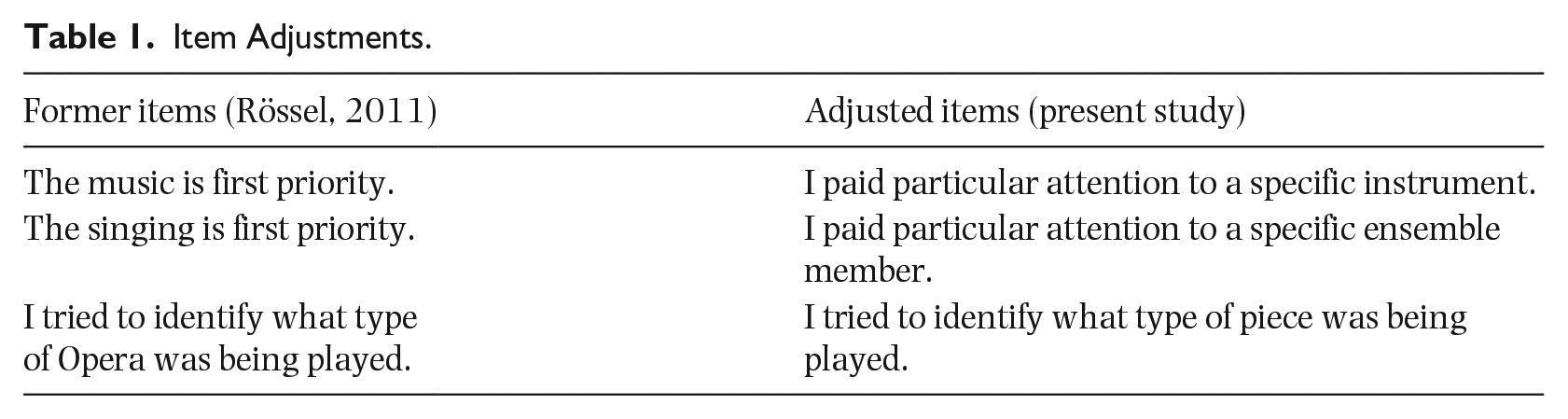
Furthermore, we added four more items (Table 2) to extend the variety of listening activities in the questionnaire, aiming to capture as many listening activities as possible. In a recent literature review (Weining, 2022), causal listening (listening for the cause of the sound) was identified as a relevant category of listening modes in concerts, as was reduced listening (listening for the sound itself). Both aspects were added to the questionnaire through two items each (for all 28 items, see Appendix 1).
New Items.
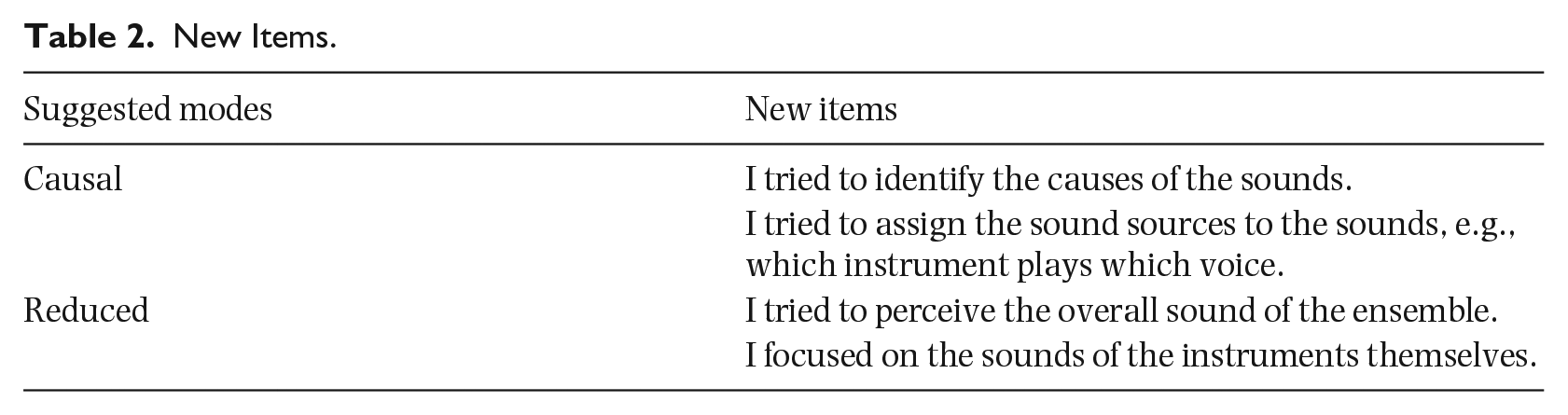
Affective state, enjoyment, and individual characteristics
To assess the experience of the audience members, affective state was measured with the PANAVA-KS questionnaire (Schallberger, 2005). The three subscales—positive activation (PA), negative activation (NA), and valence (VA)—were rated before and after the concert as the first question of the questionnaires. Participants were asked to rate affective states on a scale from −3 to 3 for pairs of opposites (e.g., happy vs. unhappy, peaceful vs. angry, tired vs. wide awake). Each subscale represents the level of activation, ranging between poles of negative and positive affective states. In this sense, high positive activation means enthusiasm and motivation, whereas low positive activation refers to negative states with low activation (bored, tired). Conversely, high negative activation refers to feelings of stress and nervousness, whereas low negative activation pertains to a state of calmness and relaxation.
Besides multiple standardized items on the experience and background of the participants, which are not considered in the present analysis, we asked for age and frequency of listening to classical music (5-point Likert scale from never to daily). The overall enjoyment of the experienced concert was surveyed through a 5-point Likert scale rating from very bad to very good for the statement: “I found the concert overall . . . ”.
Analysis
Statistical analysis was performed using IBM SPSS Statistics 29.0 (IBM Corporation, 2022).
Exploratory factor analysis (RQ1)
To assess relevance of the items on the listening activity within a classical music performance, means and standard deviations per item were computed. A total of 786 complete participant responses were included in the analysis.
Furthermore, a maximum-likelihood exploratory factor analysis (EFA) was computed to identify underlying structures of the items on listening activities, aiming to find listening modes in the audience (RQ1). A varimax rotation with Kaiser normalization was performed. Bartlett’s Test of Sphericity and the Kaiser–Meyer–Olkin test (KMO) were performed to test the suitability of a factor analysis on the data set. Due to low communalities (<0.3) for four items in the first round of the EFA, a second EFA was computed, excluding the respective items. After a third EFA (three more items excluded due to communalities < 0.3), all communalities were > 0.3 and 21 items remained. 7 The resulting factors are interpreted as listening modes.
Multiple linear regressions (RQ2)
To assess the relation between listening modes and the individual concert experience, multiple linear regression analysis was performed (RQ2). Post-concert ratings of the PANAVA subscales (PA, NA, VA) assessing affective state were predicted by the listening modes (factors of the EFA) in three separate models controlling for the respective pre-ratings of the PANAVA subscales. Furthermore, listening frequency to classical music, age, and overall enjoyment of the concert were added as covariates based on theoretical considerations. To further analyze the relation between listening modes and the experience, we also predicted overall enjoyment of the concert by the factors, also controlling for age and listening frequency to classical music.
Results
Descriptive statistics
Table 3 presents the mean and standard deviations of the listening activity items across all participants (N = 786). This shows that all listening activities occurred at least occasionally throughout the concert, even if not necessarily among all participants.
Mean and Standard Deviation (SD) per Item.
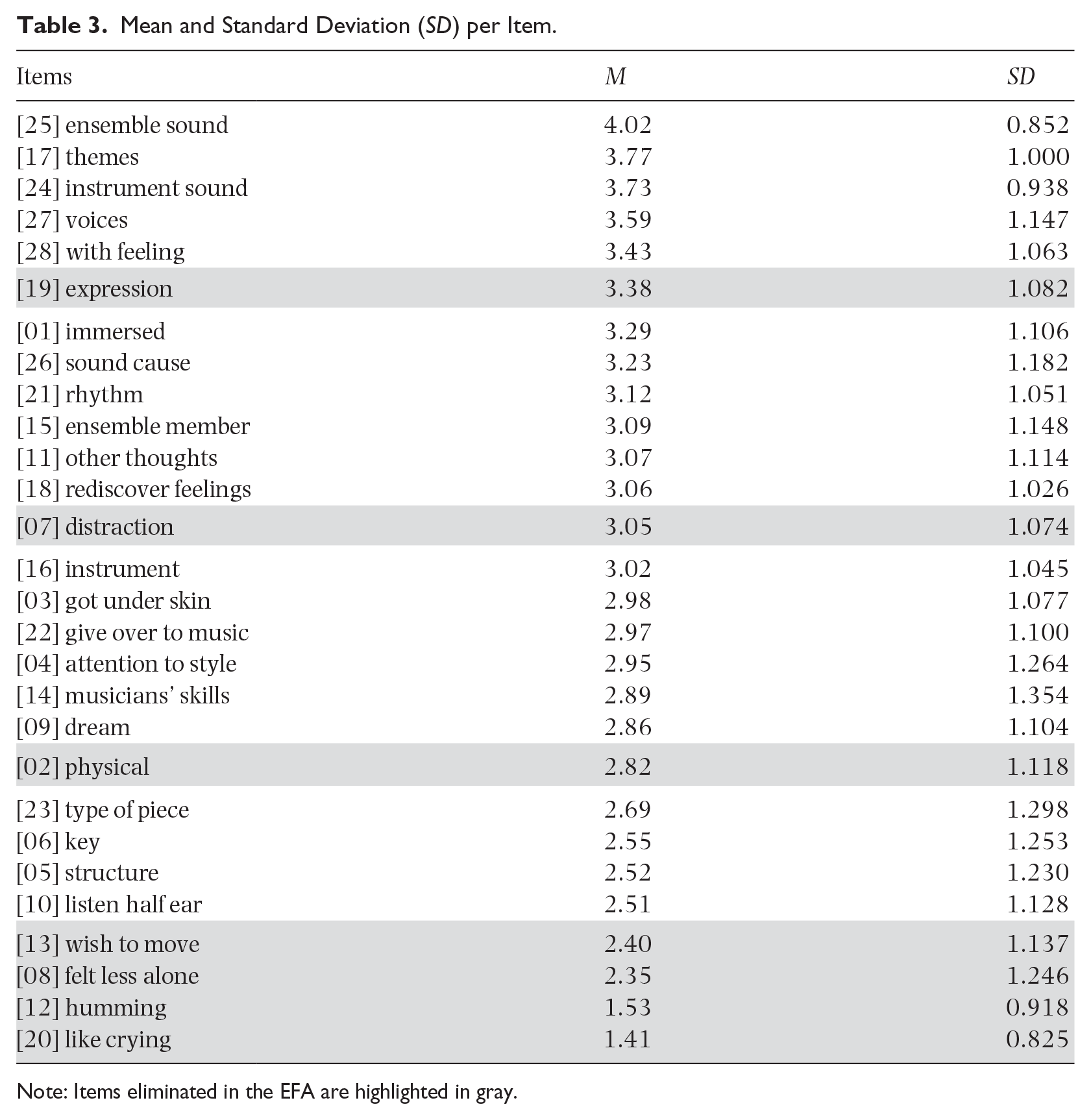
Note: Items eliminated in the EFA are highlighted in gray.
Factor analysis of items on listening activity (RQ1)
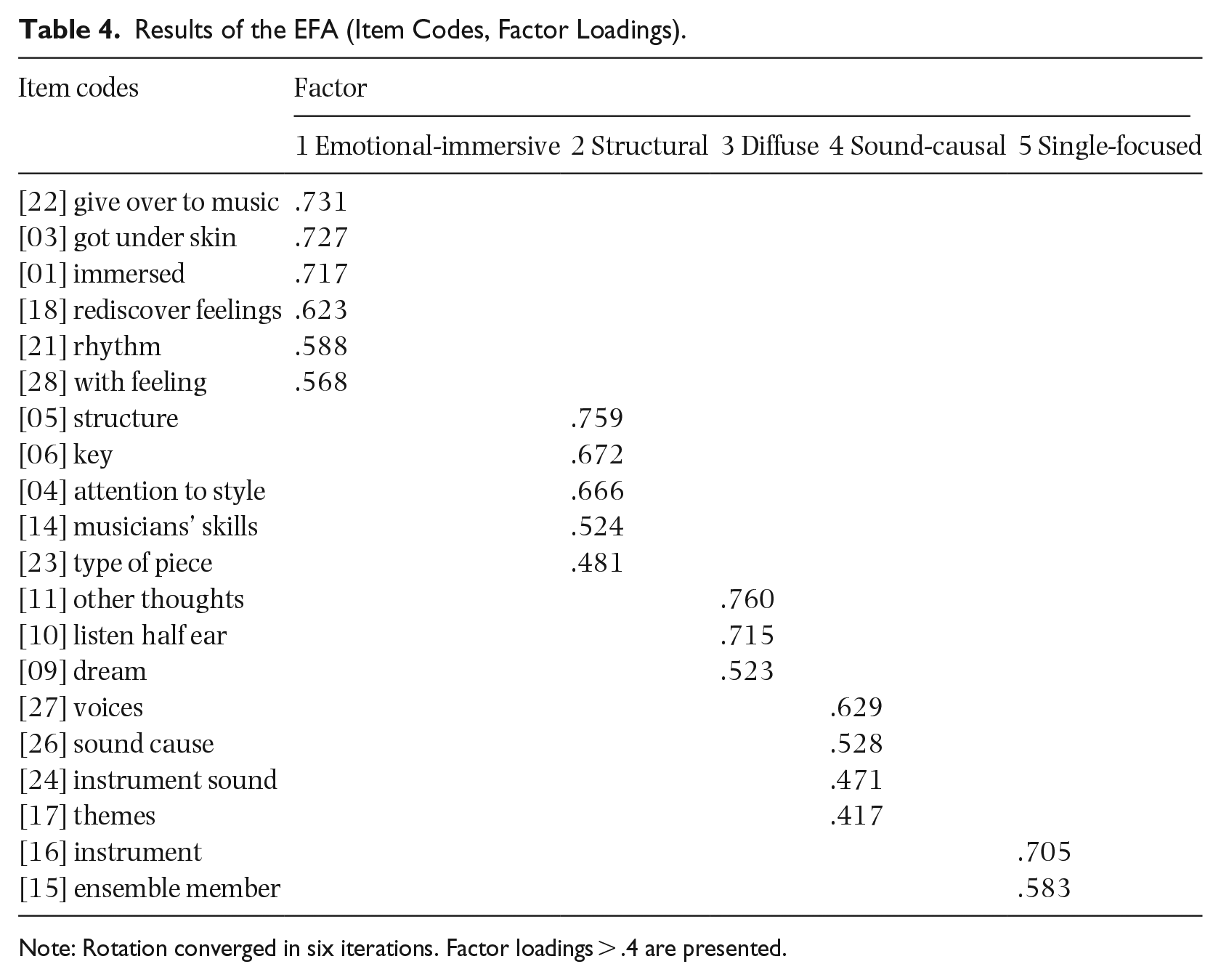
Results are reported for the final EFA, which included 21 items (Table 4). Suitability of data for a factor analysis was confirmed by KMO (0.885) and Bartlett’s Test (χ2[210] = 5558.494; p < .001). Based on the eigenvalue (1.030) with an explained variance of 59.7%, a solution of five factors was revealed: F1 = 27.6%; F2 = 11.9%; F3 = 10%; F4 = 5.3%; F5 = 4.9%. Based on the loading items, we use labels similar to Weining (2022) and call the listening modes: emotional-immersive (F1), structural (F2), diffuse (F3), sound-causal (F4), and single-focused (F5).
Results of the EFA (Item Codes, Factor Loadings).
Note: Rotation converged in six iterations. Factor loadings > .4 are presented.
Regression analysis (RQ2)
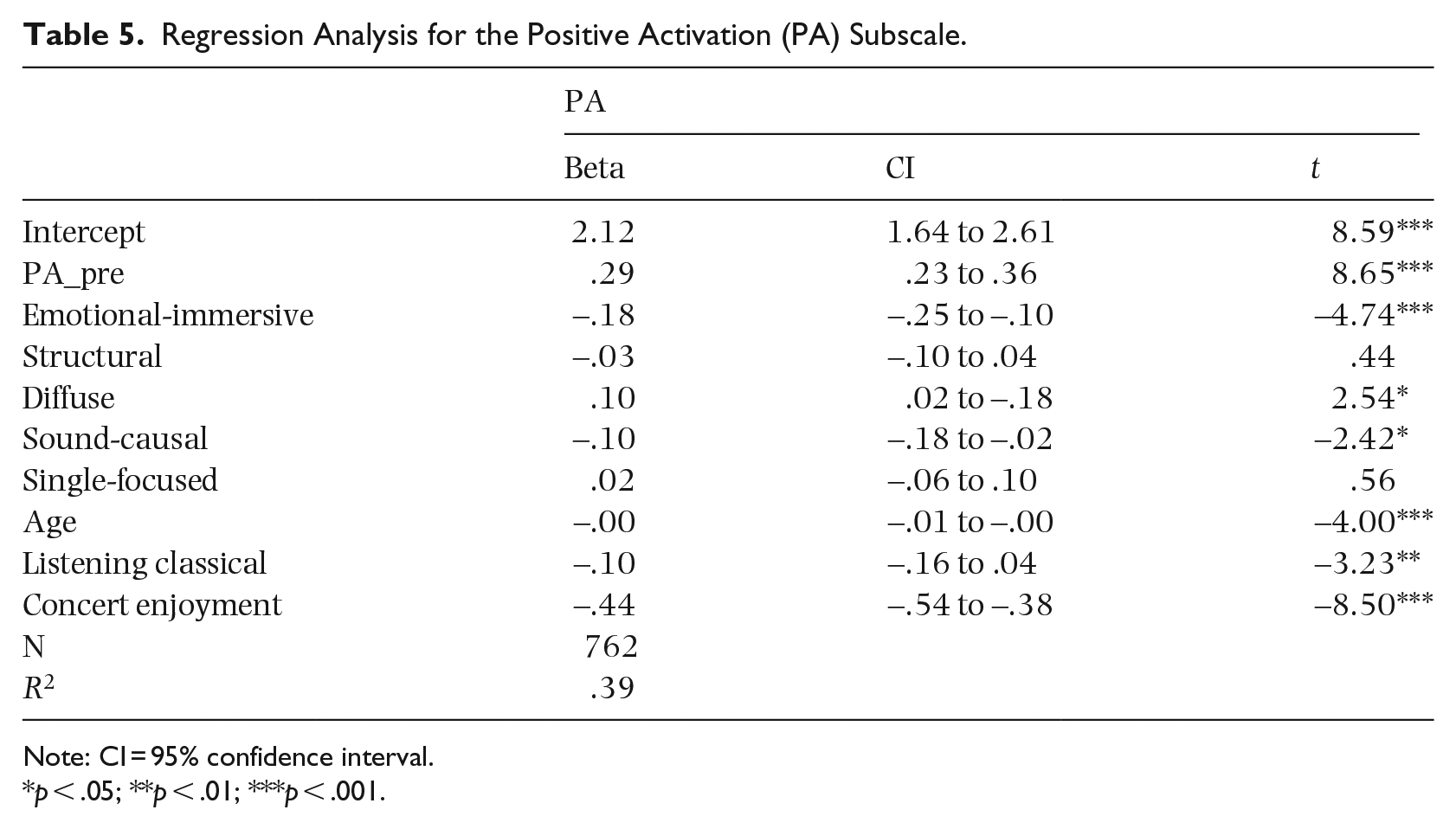
The overall regression model to explain PA is significant, F(9, 752) = 54.24, p < .001. F1 (emotional-immersive) and F4 (sound-causal) negatively explain PA. F3 (diffuse) explains PA positively (Table 5).
Regression Analysis for the Positive Activation (PA) Subscale.
Note: CI = 95% confidence interval.
p < .05; **p < .01; ***p < .001.
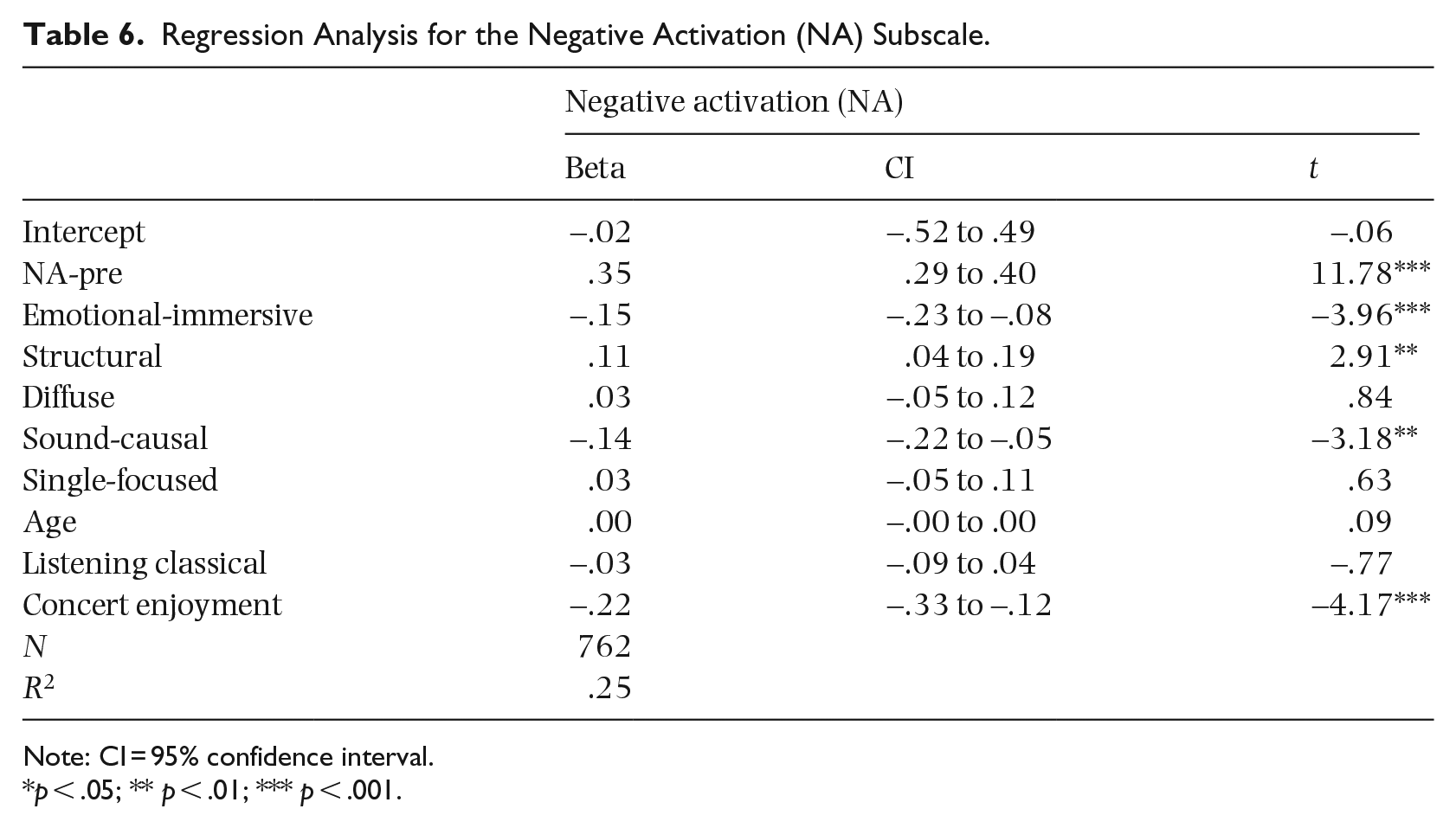
For NA, the overall model is significant, too, at F(9, 752) = 27.79, p < .001. Again, F1 (emotional-immersive) and F4 (sound-causal) negatively explain NA. F2 (structural) positively explains NA (Table 6).
Regression Analysis for the Negative Activation (NA) Subscale.
Note: CI = 95% confidence interval.
p < .05; ** p < .01; *** p < .001.
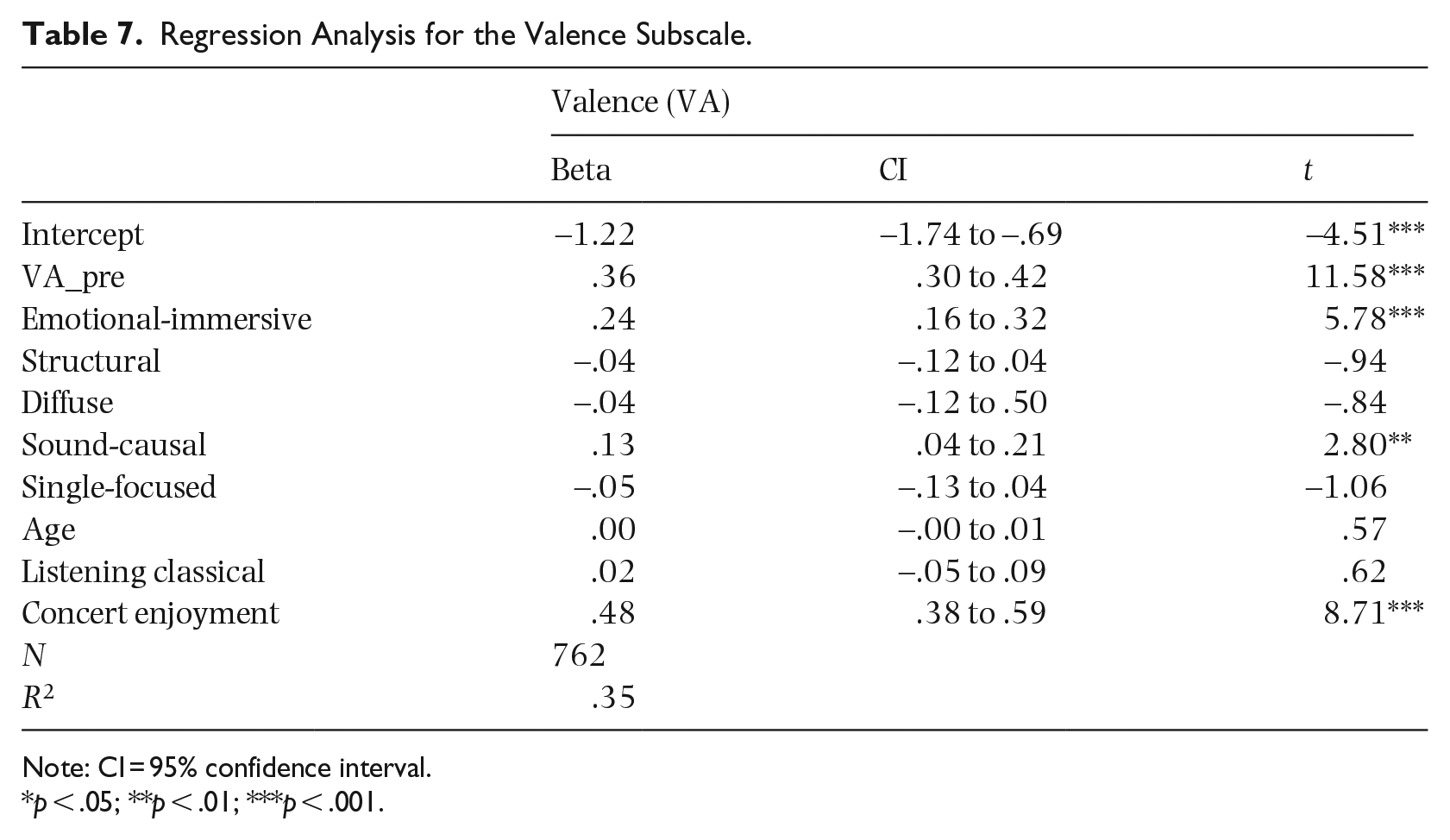
Regression analysis indicated that the overall regression model to explain VA is significant, at F(9, 752) = 45.15, p < .001. F1 (emotional-immersive) and F4 (sound-causal) explain VA positively (Table 7).
Regression Analysis for the Valence Subscale.
Note: CI = 95% confidence interval.
p < .05; **p < .01; ***p < .001.
The regression model to explain the overall enjoyment of the concert by the factors is significant, at F(7, 754) = 34.30, p < .001. F1 (emotional-immersive) and F4 (sound-causal) positively explain liking the concert. F3 (diffuse) negatively explains liking the concert (Table 8).
Regression Analysis for the Item on Overall Concert Enjoyment.
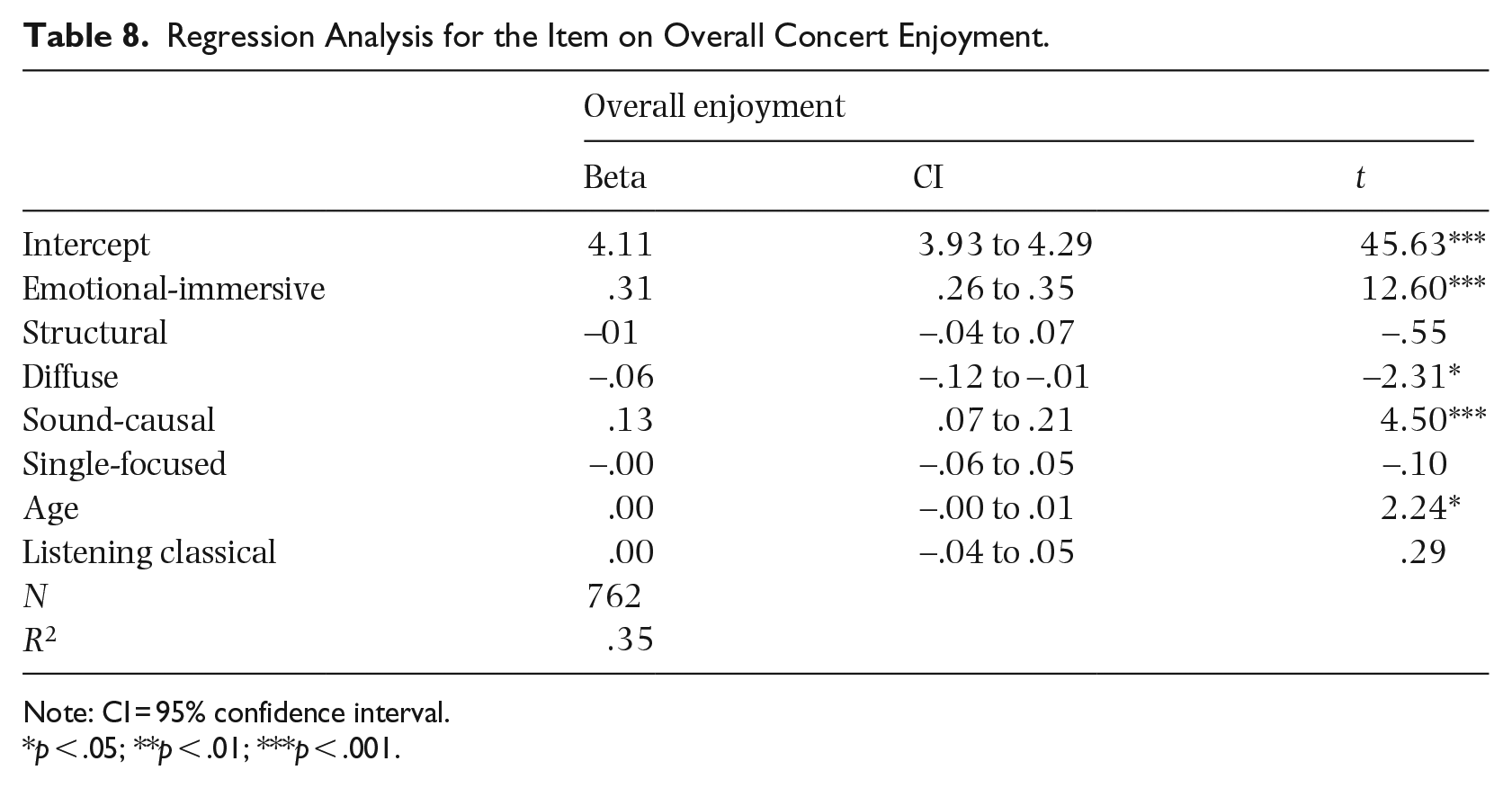
Note: CI = 95% confidence interval.
p < .05; **p < .01; ***p < .001.
Discussion
A factor analysis of the questionnaire responses of classical concert audiences on the directedness of their listening activity suggests five distinct listening modes from our data: emotional-immersive, structural, diffuse, sound-causal, and single-focused. They are understood as different listening modes that alternate and shift between each other over the course of a concert (Clarke, 2005; Stockfelt, 1993). Furthermore, regression analysis shows that listening modes are related to change of affective state from before to after the concert and thus are related to the concert experience. The results of the regression analysis mean that a higher or lower frequency of listening in a certain mode results in the presented effects of affective states.
Listening modes in the audience
Factor 1 represents emotional-immersive listening. The loading items refer to a directedness toward emotions in the music and immersive listening, such as rediscovering feelings in the music, listening with feeling, immersing oneself in the sound, and giving oneself over to the music. Previous literature often describes this mode as “emotional” or “empathetic” listening (e.g., Behne, 1997; Huron, 2002; Santaella, 2017; Schramm, 2005; Tuuri & Eerola, 2012). The occurrence of emotional and immersive listening activity in one factor could indicate that immersion in the music might be a precondition for empathetic listening, or vice versa. Of course, this is not the only way of listening that involves being emotionally touched by the music. Rather, a specific focus on the emotions in the music is present. According to the BRECVEMA framework (Juslin, 2013), many mechanisms induce emotional reactions to music. In the case of emotional-immersive listening, the listener directs their attention to emotional aspects in the music in their listening activity, supposedly listening for expressed emotions in order to feel them (Evans & Schubert, 2008). Overall, and again in regard to Clarke (2005) and Stockfelt’s (1993) influencing factors and Weining’s (2022) model, emotional reactions to music likely influence the listening modes and listening modes influence the emotional reactions over the course of the listening period. In that sense, the relations between listening modes and emotions fluctuate bidirectionally. As the participants answered the questionnaire after the concert, memory processes may also moderate the questionnaire responses regarding these fluctuations.
Factor 2 (structural) refers to a listening activity directed to the formal aspects of the music, such as structure, key, or style of the composer, but also the skills of the musician in the sense of a critical and analytic listening. In addition to “structural” (Lehmann, 1994; Rauhe et al., 1975; Rösing, 1984), this mode is referred to as “comprendre” (Schaeffer, 1966), “intellectual” (Santaella, 2017; Yingling, 1962), and “semantic” (Chion, 2012; Tuuri & Eerola, 2012). For Adorno (1968), this listening mode would represent the only adequate way of listening to (Western art) music, supposedly activated only in musical experts.
Factor 3 includes items (having other thoughts; listen with half ear; daydream during listening) that point to a rather less directed, dreamy listening mode, which means that the directedness is diffuse. One aspect of this mode is a lower level of attentive directedness, described as “diffuse” or “dispersed” in the literature on listening modes (Behne, 1997; Rauhe et al., 1975; Rösing, 1984; Schramm, 2005). Although a basic attentiveness can be assumed when listening in concerts, it is obvious that a listener cannot have a specific and focused directedness over the entire course of the event because attention likely fluctuates. This mode is also accompanied by the aspect of occurring other thoughts and daydreaming to the music. Several concepts, mostly related to “everyday music listening” (Herbert, 2012, 2013), are connected to this aspect, such as “mind wandering” (Vroegh, 2019) and increased “mental imagery” (Küssner et al., 2022; Taruffi & Küssner, 2019). Vroegh (2019) empirically investigated different states of absorption in music listening and differentiated between “concentration,” “mind wandering,” “zoning-in,” and “tuning-in,” all of which refer to different dimensions of consciousness. The diffuse listening mode most corresponds most obviously with “mind wandering,” which is characterized by the lowest level of attentional focus.
Factor 4 (sound-causal) refers to directed listening activity toward the sound as such and its cause (sound of specific instruments, sound cause, assigning voices to instruments) and the overall sound (following themes, melodies, and rhythms). Regarding the focus on the sole sound, this mode is mentioned in the literature as “reduced” listening (Chion, 2012; Schaeffer, 1966; Tuuri & Eerola, 2012) as well as “enchanted” (Stoichita & de Mori, 2017) and “object sound” (Petitmengin et al., 2009). In addition, listening for the cause of the sound is referred to as “causal” (Tuuri & Eerola, 2012) and “indexical” (Stoichita & de Mori, 2017). The fact that these two different modes from the literature are found to be one mode in the present factor analysis shows that these modes have overlapping features. This can be explained by the commonality of the two modes in terms of their directedness toward the sound detached from the musical meaning.
Factor 5 (single-focused) includes items that point to a listening activity directed toward a single specific aspect of the musical performance, a specific instrument, or a specific ensemble member. We argue that this mode also has a visual component, as it is reasonable to assume that the focus on one specific actor or their instrument on the stage is also led by the gaze. Audience members who know the cello player personally or are fans of theirs, or even play the cello themselves, might especially focus on the cello player and the instrument, with both visual and auditory terms. 8 In that regard, Swarbrick and Vuoskoski (2023) found that personal relations with the musicians affect the emotional experience of live concerts. The perceptual action of a single-focused mode could be similar when it comes to the sound; for instance, if an instrument clearly audibly takes over the lead voice, audience members’ auditory and visual directedness might turn toward the corresponding person or instrument. Even if these are assumptions that cannot be verified using the available data, studies suggest that there is likely a relationship between watching and listening during attendance at concerts (Kawase & Obata, 2016; Küssner et al., 2020; Platz & Kopiez, 2012; Urbaniak & Mitchell, 2024).
The occurrence of the five modes in earlier literature on listening mode taxonomies supports the reliability of our analysis. Rössel’s (2011) analysis of opera and ballet audiences, with most of the same items, especially supports the reliability, as his taxonomy includes six modes of which five correspond to four of the modes identified in this study through the loading items: (a) emotional-immersive, (b) structural, (c) diffuse, and (d) single-focused directly correspond to (a) “Feelings,” (b) “Analysis,” (c) “Superficial”/“Escape,” and (d) “Concentration”, respectively.
The main items referring to bodily listening (wish to move to the music, desire to hum along) were eliminated in our study due to low communalities and relatively low mean ratings across visitors (M ⩽ 2.4). This result makes sense because in ballet and opera, aspects of the music that are much more physical are represented via the stage action (dancing, acting, singing), as compared with a chamber music performance. In addition, in a Western classical concert audience, a desire to move or hum along might be restricted through the conventions of not moving and being silent (Small, 1998; Tröndle, 2021a). We suggest that this mode is likely to be more frequently found in popular music contexts, where dancing and singing along is encouraged and culturally expected.
The effects of listening modes on experience
Emotional-immersive listening and sound-causal listening negatively explain positive and negative activation. In other words, these two listening modes are related to an overall lower activation level, for both negative and positive states. More specifically, this means that these modes are related to a decrease of anger and nervousness (+NA), and motivation and energy (+PA) but to an increase of calmness and relaxation (−NA), and tiredness and listlessness (−PA). Also, both modes are positively related to valence, which refers to the concept of pleasantness, regardless of the activation level (for more information on the PANAVA scales, see Schallberger, 2005). Thus, listening more frequently in these modes correlates with happiness and satisfaction after the concert. These and the following results are controlled for by the overall concert enjoyment, meaning the presented effects of the listening modes on the affective state are stable, regardless of how much someone likes the concert. It can be interpreted from these results that more listening in emotional-immersive and sound-causal ways reduces the listeners’ activation and leads to a rather relaxed affective state after the concert, while being overall satisfied and happy. In that sense, these two modes seem to be key to a pleasurable experience in concerts, in a way that brings relaxation and satisfaction. This interpretation is supported by the result that emotional-immersive and sound-causal listening both positively predict overall enjoyment of the concert.
Listening structurally, on the contrary, is related to affective states of stress, anger, and nervousness, and to less relaxation. Although this seems counterintuitive at first, it is reasonable as this listening mode bears higher potentials for getting into negative energy, such as when one is disappointed or annoyed by the pieces, the musical performance, the interpretation, or the musicians’ skills. One could even claim that structural listening is like a task to do, thus bringing not relaxation but stress. We hypothesize that experts and musicians in particular listen structurally, as they are trained to do so and thus might be focused more on the quality of the performance and therefore potentially listen more critically and less emotionally. Although this is an assumption not backed up by data analysis in this study, this relates to Rössel’s (2011) findings, that cultural capital and individual involvement in musical practice is related to the listening mode “Analysis”, which corresponds to structural listening. Also, this finding feeds the critique of the primacy of structural listening and structural approaches in music education and musicology in general (Dell’Antonio, 2004; Subotnik & Narmour, 1988). Future research should systematically investigate who listens in which listening modes (e.g., regarding the musical expertise) to better understand the relation between individual dispositions and listening modes.
In line with the above described results is the finding that diffuse listening is related to positive activation, meaning higher levels of motivation and enthusiasm and an energetic affective state. Although undirected, unconscious, and associative ways of listening are strongly connected to everyday listening practices, the occurrence of diffuse listening in concert audiences and its positive relation to positive affective states shows that this mode should not be neglected in any kind of listening situation. Herbert (2011) identified a diffuse listening mode, naming it “trancing,” and found that “a significant affordance of music is its capacity to effect shifts of consciousness that support an individual’s sense of daily psychological balance” (p. 306). The positive relation of diffuse listening with positive activation in our results supports this claim. In other words, less attentive modes of directedness with their “shifts of consciousness” (Herbert, 2011) are related to increasing motivation after the concert, because the concert was used for a phase of resting and relaxing, bringing “psychological balance” (Herbert, 2011). However, besides the positive effect on positive activation, the analysis also reveals that diffuse listening is negatively related to the overall evaluation of the concert. This shows that musical inattention and diffuse directedness, similar to everyday background music listening, can have a positive effect on mood but at the same time making one evaluate the overall listening experience worse. This allows interesting conclusions to be drawn regarding the motivation of different groups of music listeners at concerts. Tröndle et al. (2023) find that especially concertgoers with less enthusiasm for the played music more often listen less attentively in the concert and rate the concert experience as worse. Thus, their experience of positive activation represents the added value of a shared live musical and presumably relaxing experience, although they are not enthusiasts or lovers of the played music. A recent model on functional episodes of music listening supports these results (Eerola et al., 2024). There, the authors conceptualize diffuse listening to be related with the functions of relaxation, distraction, and also motivational functions of music listening.
Limitations
The present study investigated the individual directedness of listening activity and its effect on the experience within the context of classical concert audiences. The audience surveyed was the typical audience of the respective venues. Although audiences of conventional classical concerts are typically older than in our sample (Reuband, 2018), the sample size and the realistic composition of the sample in terms of education allowed a classical concert audience to be generalized. Generalizability is supported by the strong correspondence between our results and Rössel’s (2011) results for opera and ballet audiences. To allow for this comparison, we used the same items as Rössel, which was well suited for the endeavor of this study. However, some of the items are not optimally formulated for the investigation of listening modes, as those items do not clearly depict the difference between listening activity and musical experience (distraction, got under skin, physical, felt less alone, rhythm). Of these five items, only two were included in the factor analysis, which minimizes the possible negative influence on the results. The development of a new questionnaire that more accurately captures the directedness of listening activity is an important task for future research. The questionnaire responses were collected after the concerts, so as not to interrupt the concert experience. Possible fluctuations in the listening modes in response to certain moments in the concert could therefore not be captured. Some assumptions made regarding the quality of the listening modes found in the data cannot be backed up by the data but are interpretations related to previous literature. Addressing this, the results of this study and future studies on listening modes need to be validated through qualitative research, giving the audience members a voice regarding their own listening behavior.
Implications for research and practice
Overall, the results of this study show that classical concert audience members listen in manifold ways and that their directedness of listening has an impact on their experience. To date, this aspect of music perception, the directedness of the listening activity, has been almost entirely neglected in systematic and experimental empirical research; as such, we suggest further investigation of listening modes in other listening situations, such as everyday listening and other live music situations, as different genres might afford different listening modes (Stockfelt, 1993). Willekens and Daenekindt (2022), for example, show genre differences with regard to concert attendance motivation. Referring to that, the relation of listening modes and visitor motivations to attend concerts should be analyzed to understand if and how the motive of visiting a concert influences the way of listening.
Another promising endeavor that will add an important piece to the puzzle of understanding musical emotions in general is further investigation of the relation between listening modes and emotional reactions. In relation to models of musical emotions such as the BRECVEMA framework (Juslin, 2013; Juslin & Västfjäll, 2008), listening modes might play a role in terms of the underlying mechanisms of emotion induction. For example, investigations could reveal that emotional listening is related to the “contagion” mechanism of emotion induction. In their recently developed episode model, Eerola et al. (2024) aim to connect the different approaches to understand musical emotions by considering both listening modes and functions of music.
Last but not least, the results imply that a focus on the structural and formal aspects of music is related to stress and anger, whereas the directedness toward emotion and the sound itself enhance positive activation and valence. These results might be of interest to the fields of music education and audience development, especially when thinking about didactic materials and strategies to get people involved with classical music.
Regarding enactive and embodied approaches to the musical experience, the results underline the relevance of the directedness of the listening activity in the sense of an active engagement with musical sound (Krueger, 2009). To increase understanding of this aspect of music perception, further research is suggested, including the questions of when and how directedness shifts and to what extent individual dispositions and the music itself influence the listening modes. Although the first needs to be studied in more detail through qualitative interviews with music listeners or experience sampling methodology, the latter can be studied through large-scale surveys, testing the relation between habitual listening modes activated for various musical pieces and sociodemographics, personality traits, and music education.
Footnotes
Appendix
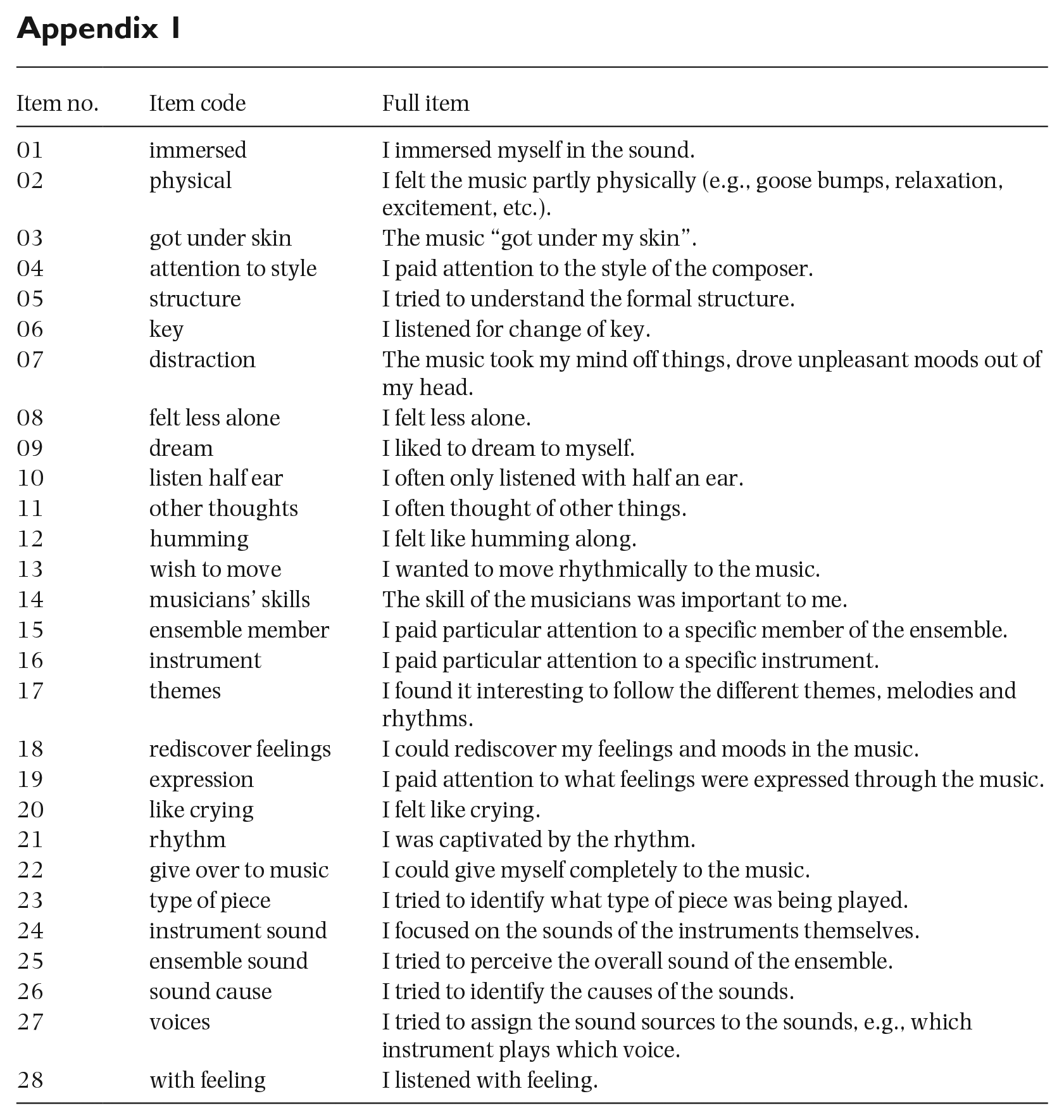
| Item no. | Item code | Full item |
|---|---|---|
| 01 | immersed | I immersed myself in the sound. |
| 02 | physical | I felt the music partly physically (e.g., goose bumps, relaxation, excitement, etc.). |
| 03 | got under skin | The music “got under my skin”. |
| 04 | attention to style | I paid attention to the style of the composer. |
| 05 | structure | I tried to understand the formal structure. |
| 06 | key | I listened for change of key. |
| 07 | distraction | The music took my mind off things, drove unpleasant moods out of my head. |
| 08 | felt less alone | I felt less alone. |
| 09 | dream | I liked to dream to myself. |
| 10 | listen half ear | I often only listened with half an ear. |
| 11 | other thoughts | I often thought of other things. |
| 12 | humming | I felt like humming along. |
| 13 | wish to move | I wanted to move rhythmically to the music. |
| 14 | musicians’ skills | The skill of the musicians was important to me. |
| 15 | ensemble member | I paid particular attention to a specific member of the ensemble. |
| 16 | instrument | I paid particular attention to a specific instrument. |
| 17 | themes | I found it interesting to follow the different themes, melodies and rhythms. |
| 18 | rediscover feelings | I could rediscover my feelings and moods in the music. |
| 19 | expression | I paid attention to what feelings were expressed through the music. |
| 20 | like crying | I felt like crying. |
| 21 | rhythm | I was captivated by the rhythm. |
| 22 | give over to music | I could give myself completely to the music. |
| 23 | type of piece | I tried to identify what type of piece was being played. |
| 24 | instrument sound | I focused on the sounds of the instruments themselves. |
| 25 | ensemble sound | I tried to perceive the overall sound of the ensemble. |
| 26 | sound cause | I tried to identify the causes of the sounds. |
| 27 | voices | I tried to assign the sound sources to the sounds, e.g., which instrument plays which voice. |
| 28 | with feeling | I listened with feeling. |
Declaration of conflicting interests
The author(s) declared no potential conflicts of interest with respect to the research, authorship, and/or publication of this article.
Funding
The author(s) disclosed receipt of the following financial support for the research, authorship, and/or publication of this article: This study was conducted within the Experimental Concert Research project, which is substantially funded by VolkswagenStiftung. The concert series was supported by the Aventis Foundation.
