




Abstract
Musicians have normalized performance anxiety (PA) to be part of their musical career. Perfectionism has been proposed as a possible personality risk factor for PA. Although perfectionistic concerns have been consistently positively correlated to PA, results have been inconsistent for perfectionistic standards. This inconsistency is potentially attributable to the fact that past studies did not differentiate the pursuit of high standards and the pursuit of perfectionistic standards. In this study, we aimed to compare the levels of PA of students who pursue high standards (excellence) from those who pursue perfection with the model of excellencism and perfectionism. As a supplementary analysis, we have also investigated if different standards predicted different positive and negative affect levels. A total of 94 music students completed questionnaires on perfectionism, PA, and positive and negative affect. They were recruited through their music conservatory (N = 69) and recruitment ads on Facebook (N = 25). Results of multiple linear regression demonstrated that only perfectionistic standards were positively and significantly associated with cognitive state anxiety, overall score of PA, and negative affect. Overall, aiming for excellence rather than perfection seemed to help mitigate levels of PA and the negative affect felt by musicians.
Performance anxiety (PA) is one of the most common distressful psychological experiences in musicians (Barbar et al., 2014; Burin & Osorio, 2017; Kenny et al., 2014). A recent systematic review indicated that between 15% and 60% of musicians and singers report having experienced PA, with approximately one-third of them suffering from severe problems due to their anxiety (Fernholz et al., 2019). The high prevalence and deleterious effects of PA on the well-being of music students seem to generalize across the professional and amateur levels (Kobori et al., 2011). Even school-age students report suffering from PA (Patston & Osborne, 2016) starting as early as their first performance (Boucher & Ryan, 2011). With many musicians severely affected by PA, researchers are continually trying to understand the factors that might influence and alleviate its manifestation. In this study, our goal was to investigate the differential associations of perfectionism and excellencism with PA of students in music.
Performance anxiety
PA is both physically and mentally demanding (Papageorgi & Kopiez, 2018) and it can be felt before, during, and after a performance (Papageorgi et al., 2007). When experiencing PA, musicians can experience three main types of responses: somatic anxiety, cognitive anxiety, and lack of self-confidence (Martens et al., 1990). Somatic state anxiety refers to physiological responses to anxiety, which include bodily reactions such as muscular tension, agitations, tremors, increased heart rate, sweating, and shortness of breath (Studer et al., 2014; Wesner et al., 1990; Wolfe, 1989) as well as an immobile “fight-or-flight” physiological activation (Friedman & Silver, 2007). Cognitive state anxiety includes the thoughts and beliefs toward one’s performance, such as being hypercritical about one’s performance and failing to perceive that one is performing adequately (Wallace & Alden, 1997). The third and last component refers to a lack of confidence often experienced when people are anxious about their performance. This lack of confidence can be seen as an indirect manifestation of PA (it is not anxiety per se), but it nonetheless adds to the understanding of the thoughts and feelings of people while they experience PA (Martinent et al., 2010).
The amount of anxiety is hypothesized to depend on the gap between the importance of the goals pursued by the person and their perceived expectations or likelihood of reaching that target (Martens et al., 1990). As a result, it appears defendable to expect that musicians with the highest standards could be more afraid of not reaching their goals, more likely to doubt their competence, and more at risk of suffering from PA. Perfectionism involves the pursuit of extremely high standards and has been widely related to PA in domains like sports (e.g., Sankaran, 2018), school (e.g., Burcaş & Creţu, 2021), work (e.g., Harari et al., 2018), and music (e.g., Patston & Osborne, 2016). In the domain of music, classical musicians have been frequently studied because they experience higher levels of PA than musicians in the jazz and popular genres (Nusseck et al., 2015; Papageorgi et al., 2013; Perdomo-Guevara, 2014). As stated by Papageorgi (2021), classical performers will often try to emulate the great masters and achieve technical perfection. Those standards can also bring stress and performance-related health problems to music performers (Leech-Wilkinson, 2018). The venue is often a recital hall, where the public is quietly and attentively listening to the performance of the musicians. When compared with other genres (i.e., jazz, contemporary), the space for freedom in the interpretation and the tolerance of mistakes are largely nonexistent. By default, due to the exacting nature of the task, classical musicians will often aim to produce perfect performances and may suffer from the many deleterious consequences associated with perfectionism (Patston & Loughlan, 2014; Sternbach, 1995, 2008).
Perfectionism
Perfectionism is a multidimensional personality construct defined as the setting of unattainable standards and goals, frequently accompanied by a propensity to judge one’s action harshly (Frost et al., 1990; Hewitt & Flett, 1991). Traditionally, most characteristics of perfectionism have been regrouped under two higher-order dimensions: perfectionistic concerns and perfectionistic standards/strivings (Stoeber, 2017). Perfectionistic concerns are a dimension characterized by recurrent doubts about one’s behavior (Frost et al., 1990), excessive worrying about making mistakes (Hill et al., 2004), a perceived disparity between one’s standards and performance (Slaney et al., 2001), and a perceived need to attain high standards and expectations prescribed by people around one (Hewitt & Flett, 1991). Perfectionistic strivings is a dimension that refers to the tendency of having excessively high standards for oneself, striving to attain perfection, and evaluating oneself based on these standards (Frost et al., 1990; Hewitt & Flett, 1991; Hill et al., 2004; Slaney et al., 2001). Overall, this bi-dimensional framework has organized the perfectionism literature over the last two decades.
Perfectionism has steadily increased among young people for the past 30 years (Curran & Hill, 2019). Concurrently, the excessive and recurrent pressure to perform has recently reached the fourth position among the top risk factors of psychological maladjustment in adolescents (Luthar et al., 2020). Although the link between these two phenomena remains unclear, many studies have studied the relationship between perfectionism and PA in children and adolescents (e.g., Patston & Osborne, 2016), students (e.g., Diaz, 2018), professional musicians (e.g., Kenny et al., 2004), and mixed samples of musical students and professionals (e.g., Dobos et al., 2019). Overall, these studies have shown consistent associations between perfectionistic concerns (e.g., doubts about action and concerns over mistakes) and PA.
The associations between perfectionistic standards and PA have been inconsistent, revealing nonsignificant (Butković et al., 2022; Dobos et al., 2019), positive (Kobori et al., 2011), and negative associations with PA (Sarıkaya & Kurtaslan, 2018). These findings are similar to a recent meta-analysis on test anxiety, which reported a positive, small, and inconsistent association between perfectionistic standards and anxiety experienced before, during, and after tests and evaluations at school (Burcaş & Creţu, 2021). One possible explanation for these inconsistent findings is the varying definitions used to measure “perfectionistic standards.” For example, both PA (Sarıkaya & Kurtaslan, 2018) and test anxiety (e.g., Abdollahi et al., 2018) have been negatively associated with perfectionistic standards when they were measured as high standards with the high standards factor from the Almost Perfect Scale-Revised (APS-R; Slaney et al., 2001). Both PA (e.g., Butković et al., 2022) and test anxiety (e.g., Hejazi & Khalili, 2015) were not significantly associated with the personal standards subscale of Frost’s Multidimensional Perfectionism Scale (FPMS; Frost et al., 1990). In contrast, both PA (Kobori et al., 2011) and test anxiety (e.g., Kavanagh et al., 2016) showed a positive association with the perfectionistic standards dimension measured with the Multidimensional Perfectionism Scale (MPS; Hewitt & Flett, 1991). It appears, then, that different ways of measuring the dimension of perfectionistic standards/strivings produce different results when it comes to predicting and understanding PA.
The Model of Excellencism and Perfectionism (MEP)
Gaudreau (2019) introduced a new concept (i.e., excellencism) to formally differentiate the pursuit of high standards and the pursuit of perfection. The MEP (Gaudreau, 2019) and its respective questionnaire, the Scale of Perfectionism and Excellencism (SCOPE; Gaudreau et al., 2022), characterize excellencism as the pursuit of high yet attainable standards, and the tendency to work toward them in a determined, engaged, and flexible manner. Those who pursue excellence are aiming at competence, accomplishment, productivity, mastery, and very good results. Although it is true that those standards can also be pursued by perfectionists, perfectionism goes beyond excellencism and consists of an exaggeration or an elevation of the standards and efforts put into place. In other words, pursuing excellence does not require the pursuit of perfection, but pursuing perfection inevitably entails the pursuit of excellence (Gaudreau, 2019). As such, perfectionists tend to aim at unreasonable, idealized, and excessively high standards, and they relentlessly pursue them (Gaudreau, 2019). As they work toward their goals, excellence strivers will savor the satisfaction of reaching excellence, whereas perfection strivers will keep working toward their exceedingly high goals of perfection even if they reach excellence.
The MEP has already received empirical support. In a previous study on the MEP, university students aiming at perfection were more likely to experience fear of failure in both sports and school (Gaudreau et al., 2021). They also experienced increased difficulty in balancing sports and school. By contrast, students aiming for excellence were more likely to experience feelings of goal attainment in both sports and school. Gaudreau et al. (2022) tested the conceptual, functional, and developmental distinctiveness of excellencism and perfectionism. Confirmatory factor analyses provided evidence of the distinctiveness of excellencism and perfectionism in a model that displayed a better fit than a unifactorial model. Among university students, perfection strivers aimed more frequently at perfect goals than those who aimed at excellence. Although excellence strivers aimed at “A+” grades less often, they were more likely to be “straight A” students and to experience higher improvements in their grades over time than perfection strivers. Furthermore, after separating high standards (i.e., excellence) from perfectionistic standards, having perfectionistic standards no longer predicted better grades. Contrary to the results of previous studies (Damian et al., 2017; Endleman et al., 2021), perfectionistic standards appear to be a risk factor rather than a factor that contributes to the success of students. Only standards of excellence predicted better grades.
This study
In this study, our goal was to observe the different associations of PA with having high standards (i.e., excellencism defined by the MEP) and having perfectionistic standards (i.e., perfectionism defined by the MEP) in a sample of music students. Based on the MEP, we expected that perfectionism (but not excellencism) should be linked to higher levels of PA. In other words, we hypothesized that perfection strivers should experience higher levels of PA compared with excellence strivers. Past studies with musicians have rarely investigated the specific associations of perfectionism with the cognitive and somatic aspects of PA (e.g., Dobos et al., 2019; McNeil et al., 2022; Patston & Osborne, 2016). Therefore, we refrained from formulating differentiated hypotheses, but we explored whether the associations of excellencism and perfectionism would generalize across all facets of PA.
We gathered complementary evidence to assess the different positive and negative emotions typically experienced by musicians during their musical performances. A previous meta-analysis showed that the associations between levels of perfectionism and depressive symptoms were reciprocal (Smith et al., 2021). In contrast, another recent study observed through experimental induction that perfectionistic concerns predicted higher levels of negative affect, but negative affect did not predict higher levels of perfectionistic concerns, suggesting a unidirectional relationship (Hummel et al., 2023). Therefore, we hypothesized that perfection strivers should experience higher levels of negative affect compared with excellence strivers. In contrast, we expected that excellence strivers should experience higher levels of positive affect compared with nonexcellence/nonperfection strivers.
Method
Participants
We recruited 94 French-speaking Canadian students in music, of which 69 were from music conservatories in the province of Quebec and 25 were recruited through advertisements on Facebook. Participants provided written informed consent and agreed to have their data collected, analyzed, and used for publication. The data collected from these participants on the dependent variables (PA and positive and negative affect) were used in a previous study (Vachon Laflamme et al., 2021). However, participants’ data on the independent variables (measures of the MEP) were not used in the previous study. Therefore, this study is the first to explore the distinct associations between standards of perfection and excellence among musical PA. Participants identified as female (N = 61) or male (N = 33) and most of them were teenagers and young adults, with a mean age of 19.05 years (SD = 4) and a range of 14 to 40 years. On average, they had been students for 4.73 years (SD = 3.68) at their respective music schools. Two multivariate outliers were removed from our sample, bringing our final sample to 92 (Mahalanobis, χ2 > 24.32, df = 7, p < .001).
Procedure
Music conservatories of the province of Quebec agreed to partner with us on this project. They invited students of 14 years old and older to participate in this study. Consistent with the regulations of the province of Quebec, students could provide consent for participating without advising their parents, though the conservatories informed the parents about the study. The ethics board committee (Comité d’éthique de la recherche de l’Université du Québec à Trois-Rivières) approved this study. We used the online platform Survey Monkey to build the consent form and the questionnaire. The secured link to the survey was distributed by email to the conservatory, which was responsible for sending it to their students. For compensation, a draw was organized to give 20 gift cards of $25 to participants who filled out the entire questionnaire. We also recruited participants using Facebook advertisements aimed at music students. The participants had to be French-speaking music students to be admitted to the questionnaire. Participants remained anonymous, and the average completion time was 25 min.
Measures
Perfectionism and excellencism
Based on the MEP (Gaudreau, 2019), the SCOPE (Gaudreau et al., 2022) was developed to draw a conceptual distinction between the pursuit of high standards (i.e., excellence) and the pursuit of perfection. The SCOPE is composed of 22 items, 11 items measuring excellencism, followed by 11 items measuring perfectionism. For this study, we used the shorter 10-item version (Gaudreau et al., 2022). Using a rating scale ranging from 1 (“not at all”) to 7 (“totally”), participants were asked to indicate the extent to which each item represents the goals they are generally pursuing in their lives. Five items measured the aiming and striving toward standards of excellence (e.g., “be a competent person”) and five items measured the aiming and striving toward standards of perfection (e.g., “be a perfect person”). A previous study has reported good reliability of the 10-item version of the scale for both excellencism (α = .84) and perfectionism (α = .94; Cheek & Goebel, 2020). Internal consistency in our sample was high for both excellencism (ω = .891) and perfectionism (ω = .941).
Performance anxiety
We measured PA with the French version of the Competitive State Anxiety Inventory-2 Revised (Cox et al., 2003) which was validated by Martinent et al. (2010). We adapted the instructions of the questionnaire to measure PA in the global context of music studies. The participants were asked, “In general, regarding your musical studies. . .to what extent do you agree with the following 16 items?” These items measure the intensity of symptoms felt within three dimensions: five items measuring cognitive state anxiety (ω = .826), six items measuring somatic state anxiety (ω = .825), and five items measuring self-confidence (ω = .896). All items were rated on a scale ranging from 1 (“not at all”) to 4 (“totally”). The scores for self-confidence were then reversed to have all our hypotheses oriented in the same direction. Like previous studies (e.g., Lundqvist & Hassmén, 2005), we summed the scores of the three subscales to create a total score of PA.
Positive affect and negative affect
Positive and negative affect were measured with the original 20-item French version (Gaudreau et al., 2006) of the Positive and Negative Affect Scale (PANAS; Watson et al., 1988). Each adjective of the scale (e.g., interested) was rated on a scale from 1 (“not at all”) to 5 (“totally”). Participants were asked to evaluate how each adjective accurately described how they typically feel during musical performances. The PANAS has 20 items divided equally into positive affect and negative affect. Consistent with past studies, our sample had good reliability for both subscales: positive (ω = .857) and negative affects (ω = .868).
Plan of analyses
We used the free statistic software JAMOVI to estimate the reliability of the scores (McDonald’s omega). For the descriptive statistics and the multiple linear regressions, we used the free demo version of Mplus 8.10. We started by looking at the associations of excellencism and perfectionism with the total score of PA because it provides important information about the sum of all anxiety-related symptoms. Then, we performed additional multiple regressions on each of the three subscales of anxiety, positive affect, and negative affect.
Our plan of analysis followed the steps delineated in a tutorial that shows how to test the hypotheses of the MEP (Gaudreau et al., 2024). We looked for outliers and reported descriptive statistics such as the means, standard deviations, and Pearson’s correlations between each variable. We tested our hypotheses using multiple linear regressions, with excellencism and perfectionism as predictors of our dependent variables. We then used the formula of the multiple regression to calculate and graph the predicted values of (a) those who do not pursue excellence nor perfectionism (−1SD of excellencism, −1SD of perfectionism), (b) those who pursue excellence (+1SD of excellencism, −1SD of perfectionism), and (c) those who pursue perfection (+1SD of excellencism, +1SD of perfectionism). It is important to note that participants are not divided into groups and that all inferences are based on the results of the multiple linear regression. A positive beta for excellencism implies that excellence strivers have higher anxiety than nonexcellence/nonperfection strivers. A positive beta for perfectionism implies that perfection strivers have higher anxiety than excellence strivers. Standardized effect sizes (approximations of Cohen’s d) were calculated by dividing the difference between two predicted values by the SD of the dependent variable (e.g., anxiety). This information is needed to properly estimate how much anxiety differs across nonexcellence/nonperfection, excellence, and perfection strivers. Our Mplus syntax and output are available at: https://osf.io/qxvfd/?view_only=304d5c8b142748779c10fb5f75cd6987
The statistical power to detect our expected effect size (β = .20) was extremely low (power = 50%). Therefore, we relied on a less conservative alpha level (.10 rather than .05) to test the null hypothesis. Although less frequent, this analytical approach was deemed necessary to avoid type I errors (false negative effects). Using a .10 alpha level is the equivalent of using a one-tailed test at the level of .05. This decision, although less conservative than usual, is acceptable considering our directional hypothesis for the positive association between perfectionism and anxiety. Most importantly, our approach relies on reporting the exact p-value and a more comprehensive interpretation of the results using both the null hypothesis significance testing (p < .10) and a close examination of standardized effect size that includes their 95% confidence intervals.
Results
Preliminary analyses and descriptive statistics
Participants recruited directly from the conservatory (N = 69) and the recruitments on Facebook (N = 25) did not significantly differ on excellencism, t(90) = 0.231, p = .818, perfectionism, t(90) = −1.27, p = .209, cognitive state anxiety, t(90) = 1.26, p = .212, somatic state anxiety, t(90) = 1.55, p = .125, or negative affect t(90) = 1.60, p = .114. However, our conservatory group had higher levels of lack of self-confidence, t(90) = 1.68, p = .097, and lower levels of positive affect t(90) = −3.59, p = .001 than the sample recruited through Facebook. The effect sizes of the differences were moderate (d = 0.393) and high (d = −0.841), respectively. Due to the small sample sizes, and the absence of differences in the independent variables, the two recruitment groups were combined for the main analyses. However, the differences in self-confidence and positive affect are important to consider when looking at the associations of those variables with excellencism and perfectionism.
Descriptive statistics are presented in Table 1. Consistent with past MEP studies, the mean score of excellencism was higher than the mean score of perfectionism. As expected, excellencism and perfectionism were positively and significantly correlated. Correlations of excellencism and perfectionism with anxiety and affectivity should be cautiously interpreted because the hypotheses of the MEP are multivariate and should be tested within the confines of a multivariable analysis (Gaudreau et al., 2024).
Descriptive statistics and bivariate correlations.
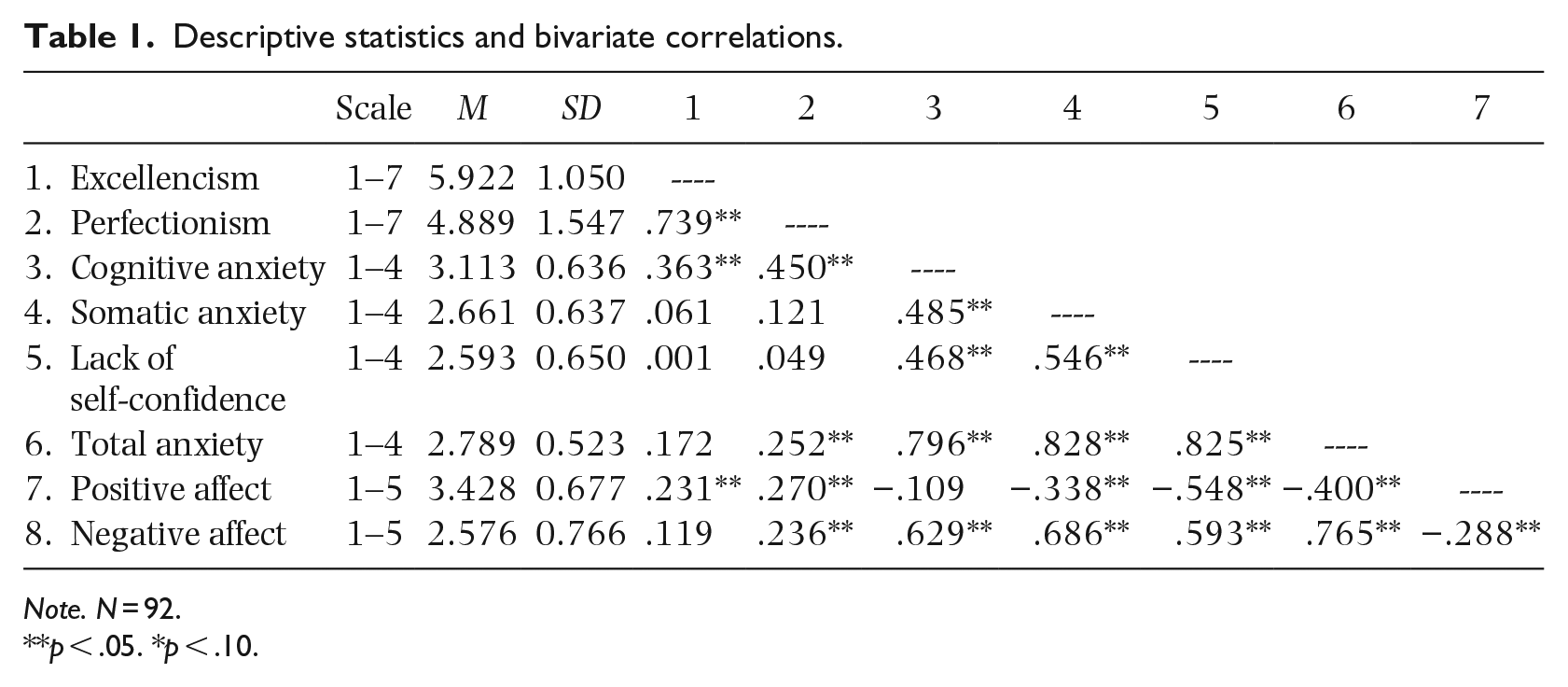
Note. N = 92.
p < .05. *p < .10.
Main analyses
The results of the multiple regressions are presented in Table 2. Results for the total score of anxiety showed that perfectionism was positively and substantially associated with PA (p = .074). As shown in Figure 1 (Panel a), predicted values indicated that perfection strivers experienced higher PA compared with excellence strivers (d = 0.550) and nonexcellence/nonperfection strivers (d = 0.488). The size of the difference between perfection and excellence strivers was medium. Excellence strivers and nonexcellence/nonperfection strivers did not significantly differ (d = −0.062).
Results of the multiple regressions.
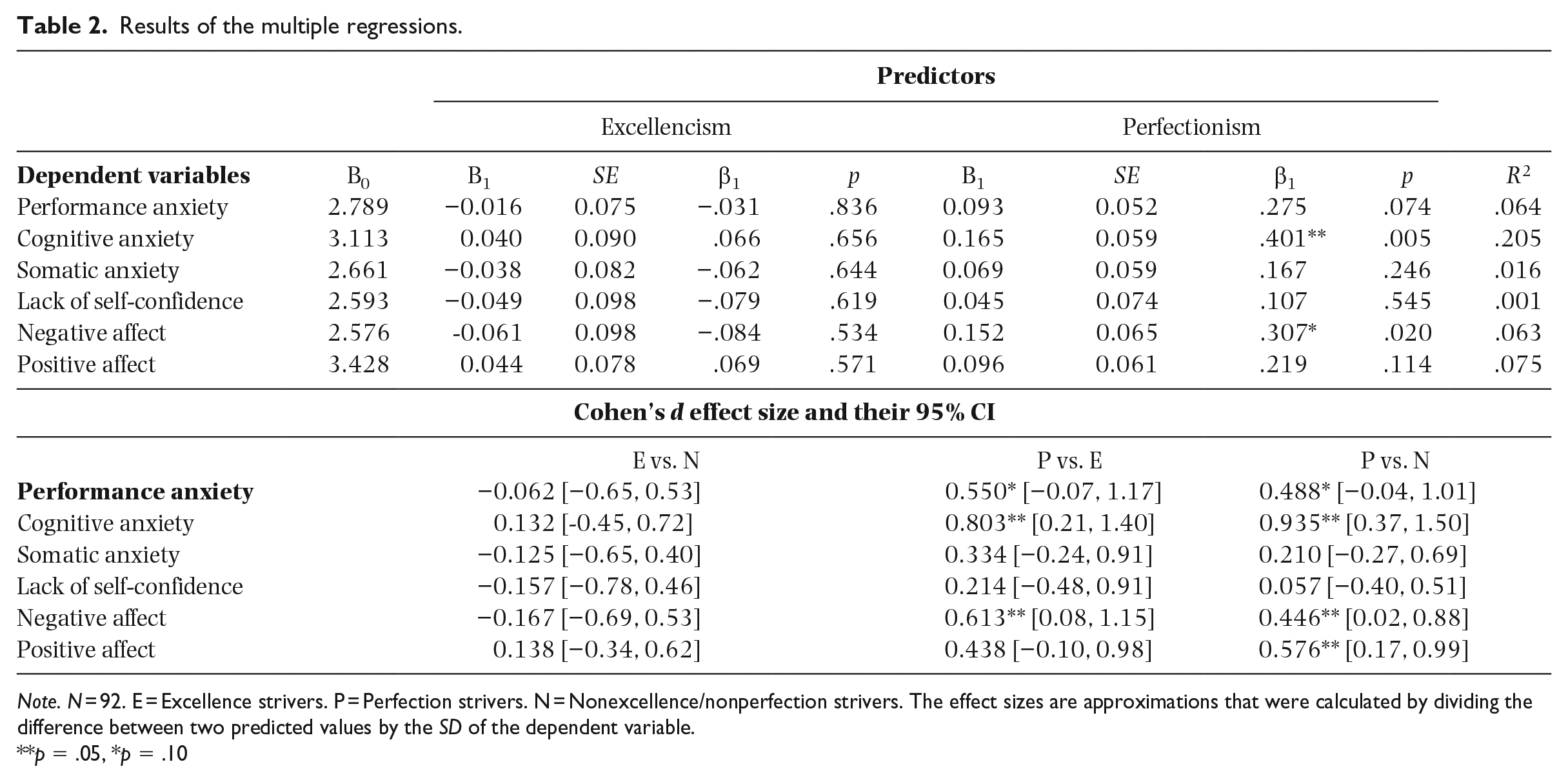
Note. N = 92. E = Excellence strivers. P = Perfection strivers. N = Nonexcellence/nonperfection strivers. The effect sizes are approximations that were calculated by dividing the difference between two predicted values by the SD of the dependent variable.
p = .05, *p = .10
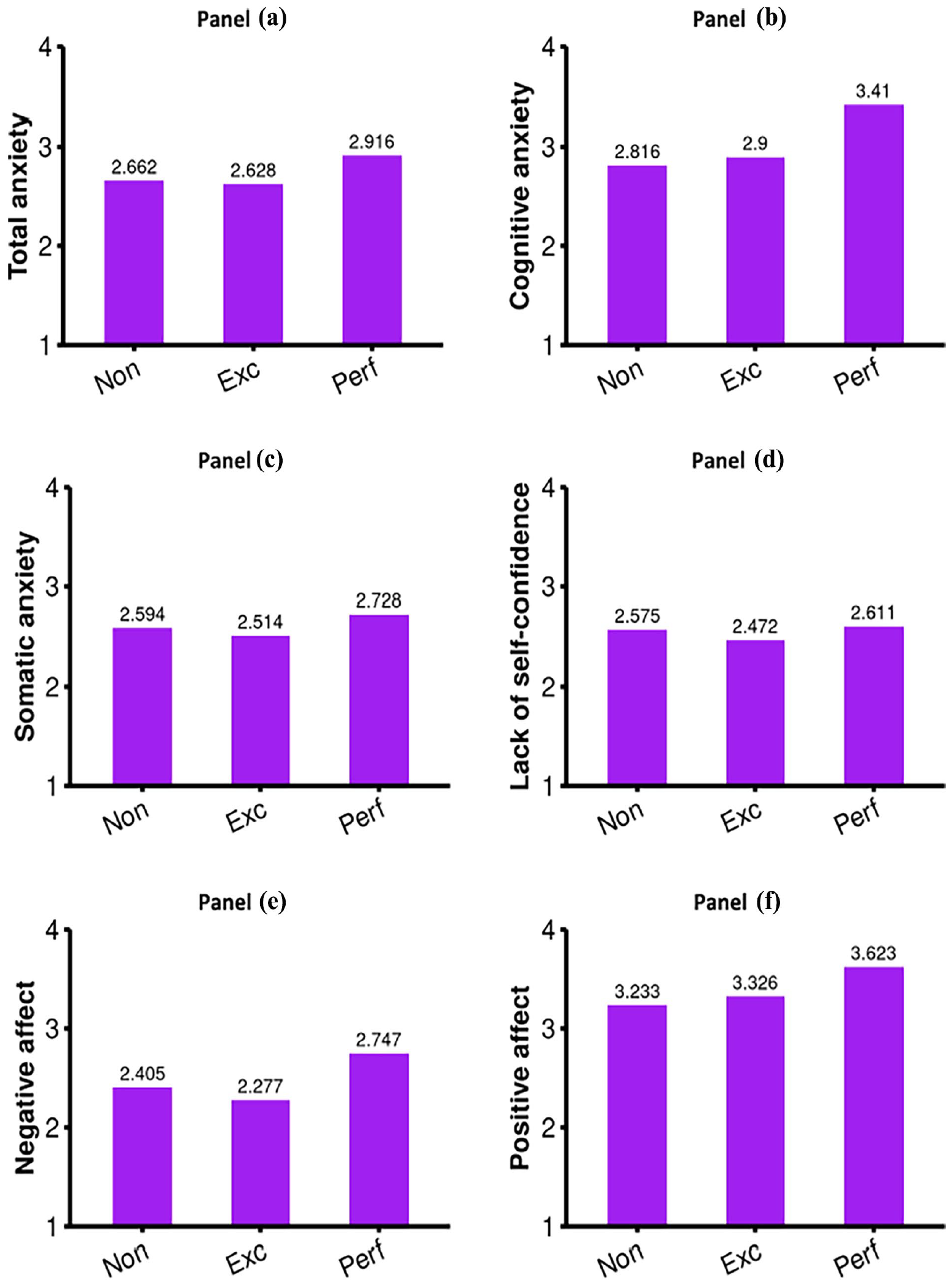
Predicted Values From the Multiple Regressions.
Results of the three multiple regressions on the subscales of anxiety showed that perfectionism was a significant positive predictor of cognitive anxiety (p = .005). However, perfectionism did not significantly predict somatic anxiety (p = .246) and lack of self-confidence (p = .545). As shown in Figure 1 (Panel b), predicted values indicated that perfection strivers experienced higher cognitive anxiety compared with excellence strivers (d = 0.803) and nonexcellence/nonperfection strivers (d = 0.935). The size of the difference between perfection and excellence strivers was large. Excellence strivers and nonexcellence/nonperfection strivers did not significantly differ (d = 0.132). Results of the nonsignificant association with somatic anxiety and lack of self-confidence are shown in Table 2.
Results of the two multiple regressions on the subscales of affectivity showed that perfectionism was a significant positive predictor of negative affect (p = .020). As shown in Figure 1 (Panel c), levels of negative affect were higher in perfection strivers compared with both excellence strivers (d = 0.613) and nonexcellence/nonperfection strivers (d = 0.446). The size of the difference between perfection and excellence strivers was medium to large. Although perfectionism did not significantly predict positive affectivity (p = .114), the valence of the effect was unexpectedly positive and stronger than expected.
Discussion
Perfectionism is common among musicians and it has been suggested that many of them experience elevated PA (e.g., Jeong & Ryan, 2022). Perfectionism is a multidimensional construct and the associations between perfectionistic standards and anxiety in musicians have been inconsistent across studies (e.g., Dobos et al., 2019; Kobori et al., 2011; Sarikaya & Kurtaslan, 2018). In this study, we aimed to address this inconsistency by revisiting these associations within the confines of a newly developed conceptual framework: the MEP (Gaudreau, 2019). Our results revealed the distinct associations that high standards (i.e., excellencism) and perfectionistic standards had with PA, as well as positive and negative affect in a sample of music students. Overall, several of our findings supported the need to more clearly define perfectionistic standards by differentiating them from the pursuit of excellence.
Key findings
Past studies with musicians have often combined high standards and perfectionistic standards into their measures of perfectionism. The MEP conceptualizes these standards as different constructs likely to be differentially associated with psychological outcomes. In this study, we found evidence for the idea that perfectionism (rather than excellencism) is associated with higher levels of PA among musicians. More precisely, the results of our multiple regression showed that perfectionism (but not excellencism) was positively associated with the total number of PA symptoms experienced by the musicians. Interpreted together, these findings indicate that perfection strivers experience more PA symptoms compared with excellence strivers. The size of this difference was consequential (d = 0.550). Based on another measure of effect size (Cohen’s U3; Magnusson, 2022), we can conclude that 70.9% of perfection strivers exhibited higher anxiety levels compared with the average anxiety level observed among excellence strivers.
Performance anxiety is a multidimensional construct. However, studies with musicians have generally focused on the total number of PA symptoms irrespective of their cognitive and somatic origins (e.g., Dobos et al., 2019; McNeil et al., 2022; Patston & Osborne, 2016). A recent study by Butkovic et al. (2022) suggested that perfectionistic standards might be more closely linked to cognitive anxiety than somatic anxiety. However, a recent meta-analysis focusing on test anxiety in the school domain instead showed a stronger association between perfectionistic standards and somatic anxiety (Burcaş & Creţu, 2021). To further our understanding of multidimensional anxiety, we tried to determine if the differential associations of excellencism and perfectionism generalized to all facets of anxiety or if they were contained to some specific facets of the construct. Our findings showed that the association between perfectionism and performance anxiety was limited to cognitive symptoms of anxiety and did not generalize to somatic anxiety or lack of self-confidence. The difference between excellence and perfection strivers was large (d = 0.803), meaning that 78.9% of perfection strivers exhibited higher cognitive anxiety compared with the average anxiety level observed among excellence strivers. More attention will be needed to further elucidate why perfectionistic standards are mostly associated with cognitive anxiety.
Part of this explanation is offered by the MEP. Past MEP studies have found strong positive associations between perfectionistic standards and perfectionistic concerns (e.g., Gaudreau et al., 2021). The MEP asserts that the concerns over mistakes and frequent doubting of perfection strivers are signature expressions that tie their perfectionistic standards with symptoms of psychological maladjustment (e.g., Gaudreau et al., 2023). The signature expressions are more prevalent in perfection strivers and differentiate them from excellence strivers. Perfectionistic concerns involve achievement-related concerns (e.g., doubts, fears, worries) that are common to people with elevated cognitive anxiety and perfectionistic standards. As such, it is not surprising to observe a stronger association between perfectionistic standards and cognitive anxiety. Future research will need to examine the role of different signature expressions in the associations of perfectionistic standards with the different facets of music anxiety.
Coping and emotion regulation have been proposed as mechanisms involved in music anxiety (e.g., Miranda, 2019). Musicians engaged in high-level performances, such as those who participated in this study, have likely developed coping strategies to handle their physiological activation and bodily reactions during their performances. This could explain why perfection strivers reported somatic anxiety that failed to be significantly stronger than excellence strivers. Future research should examine the specific ways through which perfection strivers differ in their capacities to reinterpret and regulate negative emotions such as somatic anxiety. In a similar vein, perfection and excellence strivers did not differ in their amount of lack of self-confidence. Such a finding is consistent with studies on creative performance in which perfection strivers – despite their lower creative achievement – have manifested a similar amount of creative self-efficacy (Goulet-Pelletier et al., 2022). If replicated in the context of music, such results could indicate that perfection strivers tend to overestimate their self-confidence to protect themselves against the negative emotions arising from the likelihood of failing during important performance situations like concerts, competitions, and auditions. These interpretations are theoretically defendable but in need of future empirical exploration.
Performance anxiety is often accompanied by many other negative affective states such as anger, guilt, shame, fear, and hostility. Past studies generally found that perfectionistic concerns – rather than perfectionistic standards – were associated with negative affectivity (e.g., Hummel et al., 2023; Prud’homme et al., 2017). Of particular interest, our results illustrate that a clearer separation between high and perfectionistic standards is useful to unpack the association between perfectionism and negative affectivity. Consistent with our results for anxiety, perfectionism but not excellencism was significantly associated with higher negative affect. Perfection strivers reported significantly higher negative affectivity compared with excellence strivers, and the size of this effect was medium to large (d = 0.613). Said differently, 73% of perfection strivers exhibited higher negative affectivity compared with the average level of negative affectivity observed among excellence strivers. Overall, perfection strivers appear to be more prone to experience a range of negative affective experiences compared with excellence strivers.
Interpretational nuances and implications
This study was conducted with a small sample of musicians. For the size of our sample, the average correlational effect size observed in psychological science (Bosco et al., 2015) failed to reach the traditional threshold of statistical significance (p < .05). In that context, it appears important to draw attention to one unexpected finding. Contrary to our expectations, perfectionism was positively associated with positive affectivity. The association was not statistically significant (p = .114) but the effect size suggests that perfection strivers may experience more positive affectivity than excellence strivers (d = 0.438) and nonexcellence strivers (d = 0.576). This effect would have been statistically significant with a larger sample of musicians. However, interpretations are limited since our sample recruited through Facebook (N = 25) had significantly higher positive affectivity (d = 0.841) than our initial Conservatory sample (N = 69). Taking into account the results for negative affect, our findings indicate that perfection strivers could experience a form of emotional ambivalence characterized by bouts of positive and negative emotions. This would suggest that excellence strivers may be more emotionally stable than perfection strivers. This would be aligned with previous meta-analyses reporting associations between trait neuroticism (e.g., emotional instability) and perfectionism (e.g., Stricker et al., 2019), which could explain why perfectionists tend to feel higher positive and negative emotional states. Such findings would also fit with the hypothesis of differential susceptibility (Belsky et al., 2007) wherein perfection strivers are presumed to be more likely to react to both positive and negative triggers in their environment (e.g., Gaudreau et al., 2022). Prudence is warranted considering that our results for positive affect did not reach statistical significance.
Despite the small sample of musicians, our study was nonetheless a needed step to offer novel insights about the differences between the excellencism and perfectionism of musicians. Past MEP studies mostly focused on undergraduate students (e.g., Gaudreau et al., 2021; Goulet-Pelletier et al., 2022). The musicians in this sample displayed a mean score of excellencism (M = 5.92, SD 1.05) comparable with those observed with university students (means ranging from 5.66 to 6.09 and standard deviations ranging from 0.93 to 1.22). Interestingly, the mean score of perfectionism was higher in musicians (M = 4.89, SD 1.55) compared with previous studies with students (means ranging from 3.86 to 4.57 and standard deviations ranging from 0.93 to 1.85). Higher scores on perfectionism could partly be due to the extremely competitive environment of classical music, but also the reputation and common requirements that classical performances entail. This musical genre requires pristine performances in which musicians follow the instructions of music sheets with the utmost precision (Papageorgi, 2021). These findings, if replicated with a larger sample of musicians, could suggest that perfectionism is more prevalent in classical musicians compared with nonmusicians (Perdomo-Guevara, 2014).
Finally, it is important to report that our correlation between excellencism and perfectionism was higher (r = .739) than those reported in previous studies (rs from .35 to .51; Gaudreau et al., 2022; Goulet-Pelletier et al., 2022). On the one hand, a moderate to strong correlation is theoretically expected because perfectionism and excellencism both involve the pursuit of high standards. In their pursuit of perfection, the perfection strivers also pursue the high standards involved in excellencism. High standards are part of both perfectionism and excellencism, but perfectionistic standards are unique to perfectionism. According to this view, even if they were to attain high standards, the perfection strivers would be unsatisfied, and they would keep on striving toward perfection. On the contrary, at least two factors could explain the higher correlation observed in this study. One possible explanation lies in the higher mean score of perfectionism. The correlation between excellencism and perfectionism may increase as the mean score of perfectionism increases and resembles the mean score of excellencism. Whether this pattern of co-occurrence is specific to musicians will deserve further empirical scrutiny. Alternatively, an explanation might be that our sample was younger than the university students who participated in previous MEP studies. Whether the differentiation between excellencism and perfectionism increases with cognitive maturation from adolescence to adulthood is another plausible explanation in need of further exploration. Overall, future research will be needed to examine whether the co-occurrence of excellencism and perfectionism varies across different populations (e.g., athletes, musicians, students) and different age groups (e.g., children, adolescents, adults).
Limitations and future directions
This study recruited a smaller sample than we originally planned. Our goal was to recruit 300 students from the Conservatories of Music of Quebec. However, only 69 participated, partly due to the relatively small participant pool. We recruited an additional 25 participants using Facebook ads, for a total of 94. Overall, our sample may have produced false negative effects (e.g., association of perfectionism with somatic anxiety). Future research will be needed to replicate our findings with sufficiently powered samples while examining if our results replicate across musicians of different age and gender groups (Patston & Osborne, 2016). Replicating our findings with a sufficiently large number of male and female musicians of various ages would be a welcomed addition to estimating the socio-demographic invariance of excellencism and perfectionism at both the descriptive and structural levels (i.e., invariance testing in multiple groups factor analysis). Such analyses require large samples (e.g., Baranger et al., 2023; Leitgöb et al., 2023) and were therefore beyond the scope of this study. Overall, the effects reported in our study offer seed points to estimate the needed sample size for future studies (i.e., power analysis) as well as informative priors to be included in Bayesian regression analysis (e.g., Depaoli, 2021). Rather than starting our next study anew, the Bayesian framework could be useful to mix informative priors (based on the current study) with the data from a new sample of musicians. As such, the results of this study were a needed first step for a cumulative science on excellencism, perfectionism, and performance anxiety.
This study relied on a cross-sectional design in which participants completed only one survey. Future research should try to examine how perfection and excellence strivers differentially react across different performance scenarios. Using daily diaries would allow researchers to monitor the daily ups and downs in musical performances to determine how subtle variations influence the anxiety and affective states of musicians. Still, this study offers valuable information about the need to differentiate high standards and perfectionistic standards to better understand the performance anxiety of musicians.
Another route to explore in future studies is to observe the different associations of excellencism and perfectionism with objective musical performances. On the one hand, the higher levels of cognitive state anxiety in perfection strivers could affect their musicality and how relaxed and in control they look while performing. On the other hand, since the perfection strivers have elevated standards, they may practice more than the excellence strivers. Nonetheless, there is a higher emotional cost for perfectionists in the pursuit of their standards compared with excellence strivers (e.g., Gaudreau et al., 2022, 2024). For recreational musicians (where objective musical performances might be less important than for professionals) experiencing lower cognitive anxiety and negative affect might be sufficient to persuade perfection strivers about the benefits of transforming their perfectionism into excellencism. Professional musicians may hold the belief that perfectionism is required to maintain their performance and survive in the highly competitive world of music. Evidence that excellence strivers outperform perfection strivers – like the performance advantages observed in academic (Gaudreau et al., 2022) and creative (Goulet-Pelletier et al., 2022) achievements – would be useful to convince some perfectionistic strivers of the benefits of reshaping their perfectionism into excellencism. Research looking at the learning and performance outcomes associated with excellencism and perfectionism is therefore warranted.
Finally, excellencism and nonexcellencism/nonperfection strivers did not differ significantly on any dependent variables observed in this study. It is possible that including more adaptive variables in this study other than positive affect (e.g., flexibility, flow, motivation) would have provided a better distinction between the two, or additional insights on the similarities that they might share.
Conclusion
Overall, our findings have implications for the learning and teaching of music. Anxiety can be detrimental to learning and performance (e.g., von der Embse et al., 2018). In the school domain, anxiety has also been associated with dropout intentions and increased psychological distress (e.g., Putwain et al., 2021). In that context, our results suggest that perfection strivers may be at a greater risk of experiencing emotional difficulties related to their lives as musicians. Teachers and parents should be on the lookout for early signs of exhaustion, frustration, and performance anxiety that could turn into psychological distress and derail one’s love for music. Music anxiety can be influenced by the broader social context of music (e.g., Perdomo-Guevara, 2014). As such, informing teachers and parents about the distinction between excellencism and perfectionism is a first step to instilling a culture of musical excellence rather than perfection. Perfectionistic cultures have been studied in the sports domain (e.g., Grugan et al., 2021) and could equally be at play in music and performance arts. For now, our results indicate that there is a line not to cross for musicians and teachers between the pursuit of high standards and the relentless pursuit of perfection. Optimal learning requires both practicing and sufficient time to recover (Macnamara et al., 2014). Perfection strivers are harder on and more critical of themselves. They are less likely to be self-compassionate (Gaudreau et al., 2022) and to savor the progress they make during the learning process (Gaudreau et al., 2024). Overall, our study opened the door to future MEP studies that will try to understand the pathways through which excellence strivers and perfection strivers end up having a different psychological experience while participating in their musical activities.
Footnotes
Authors’ note
The authors used a dataset from a previous study (Vachon Laflamme et al., 2021), but they made observations on independent variables that were not previously used. Therefore, all statistical analyses are unique to this manuscript.
Data availability
Data from this study are available upon request.
Declaration of conflicting interests
The author(s) declared no potential conflicts of interest with respect to the research, authorship, and/or publication of this article.
Funding
The author(s) received no financial support for the research, authorship, and/or publication of this article.
Ethical approval and informed consent
Both studies have been approved by a research ethics board, and all participants provided informed consent.
