




Abstract
Practice may be the single most important activity that musicians can use to improve their performance. Yet practice requires significant effort and can sometimes feel difficult or unenjoyable. For this reason, substantial motivational resources are required to sustain consistent, high-quality practice over long periods. In this study, we used self-determination theory to study the kinds of motivation that predict practice behavior and the potential influence that teachers might have on their students’ behaviors. A total of 213 university music students in the United Kingdom and Canada completed measures of practice time, practice quality, motivation, and their teacher’s teaching style. Hypothesized relationships between these variables were examined using structural equation modeling. Results supported the process model in which teacher autonomy supported predicted autonomous motivation, which in turn predicted practice time and practice quality. Teacher control predicted controlled motivation, but controlled motivation was not predictive of practice time or practice quality. Indirect effects suggested that motivation fully mediates the link between teaching style and practice behavior. The findings add clarity to research aiming to understand the kinds of social environments that lead students to develop forms of motivation that enable them to practice in a way that is enjoyable and productive.
One of the core tasks that any developing musician must do is to practice. To be effective, research suggests practice needs to be high in both quantity (i.e., the accumulation of many hours of regular practice) and quality (i.e., effortful, focused, strategic activity with the goal of improving performance; Lehmann et al., 2018; Miksza, 2022). Yet sustaining this kind of practice is difficult; it requires considerable motivation which itself can vary in quantity and quality (Ryan & Deci, 2017). Fostering high-quality motivation to sustain high-quality practice is therefore an area of interest for music students, their parents, teachers, and music institutions (Comeau et al., 2019; McPherson et al., 2017; Miksza, 2022).
In this study, we examined these issues in university music students by studying how practice time and practice quality might be associated with different types of motivation. We also studied the degree to which these types of motivation are influenced by teachers. In the following sections, we introduce the study by briefly reviewing the importance of practice and how it can be operationalized in terms of quantity and quality. We then invoke self-determination theory (Ryan & Deci, 2017) as a framework to explain how motivation itself can vary in both quantity and quality and how that motivation can be fostered by the social environment (specifically, in this case, music teachers).
Practice
On the surface, it would seem that much of the research on practice has focused on practice time: How much practice is undertaken by music students, and how that relates to their performance. Among the more prominent areas of research is the deliberate practice approach, which contends that the attainment of expert performance in any domain can be attributed to the accumulation of many hours of practice sustained over long periods of time (Ericsson, 2020). In their study of violinists, for example, Ericsson et al. (1993) found that the variance in levels of expertise attained could be attributed to the accumulation of many thousands of hours over many years. 1
However, more recent work has shown that practice time alone may not be sufficient to explain variations in performance. For example, some meta-analytic studies of practice time and performance are relatively circumspect about the size of the relationship between the two variables, contending that practice time actually accounts for only a relatively small amount of variance in performance (e.g., Hambrick et al., 2020; Macnamara et al., 2014). In addition to practice time, another necessary dimension—practice quality—may be identified. Even in their early work on deliberate practice, Ericsson et al. (1993) explained that effective practice is effortful, involves high levels of cognitive engagement, and is designed specifically to improve performance. Indeed, when revising the meta-analytic research to include only studies that operationalized practice in this way, Platz et al. (2014) found a much larger relationship with performance.
Alongside the deliberate practice work, practice quality has been the subject of several strands of research on developing musicians. Sloboda et al. (1996) studied the practice diaries of children and adolescents and distinguished between ‘formal’ (effortful, deliberate, and strategic) and ‘informal’ (playful, unplanned, and unstructured) practice, finding a positive correlation between the practice time, formal practice (but not informal practice), and performance as measured in standardized examinations. Among children in Australia, McPherson and McCormick (2006) similarly operationalized formal and informal practice, finding that examination performance was predicted by formal practice (positively) and informal practice (negatively). In university music students, Bonneville-Roussy and Bouffard (2015) found that formal practice accounted for far more variance in performance examination results than practice time alone (in fact, after controlling for the relationship between formal practice and practice time, practice time had a negative influence). Another line of research has used the framework of self-regulated learning, which describes the extent to which learners proactively and cyclically set goals, select and deploy strategies, and monitor effectiveness to improve their learning and performance (McPherson, 2022; McPherson et al., 2017). Research using this framework has investigated the variability in how students adopt these self-regulated learning strategies during their practice, the degree to which these strategies can be taught, and their relationship with performance (e.g., Hatfield et al., 2017; McPherson et al., 2019; Miksza, 2015; Nielsen, 2008; Osborne et al., 2021).
It is therefore clear that both practice time (the amount of practice) and practice quality (the degree to which practice is deliberate, formal, and self-regulated) are necessary dimensions for practice to be effective. These are important considerations for developing musicians—especially those who are focused on improving their performance at a high level, often in preparation for a music performance career. Indeed, in summarizing research on music practice, Miksza (2022) pointed out that practice quality is important not just because it improves performance, but because time is relatively limited, and if musicians spend large amounts of time on practice activities that are ineffective or inefficient, the subsequent plateaus in their performance ability can have significant consequences. Sustaining large amounts of practice time and practice quality is difficult, so in the following sections, we turn our attention to the kinds of motivation that might be needed to support it.
Motivation
Sustaining large amounts of practice—especially quality practice—requires substantial motivational resources. To operationalize motivation in the present study, we adopted self-determination theory (SDT; Ryan & Deci, 2017) as a framework. SDT is a useful theory for these issues. Musicians are generally motivated for practice not for intrinsic reasons, but by the instrumental value that practice has in improving performance. SDT explains how such extrinsically motivated activities are still able to be supported and sustained by high-quality motivation. Additionally, SDT contends that motivation can vary in both quantity and quality and that the quality of motivation bears a strong relationship to the quality of behavior that it instigates and sustains. Thus, it is a relevant theory for studying both the amount and quality of practice. SDT also theorizes the social contextual conditions under which high-quality motivation is fostered, thus permitting ways to study how teachers might influence students’ motivation to practice. In the following sections, we first describe the relevant tenets of SDT, then briefly review applications of SDT to music practice, including the conditions under which high-quality motivation can be fostered by teachers.
Self-Determination Theory. Self-determination theory is a broad theory of human motivation, development, and wellness (Ryan & Deci, 2017). SDT’s theoretical origins lie in understanding how external events (e.g., rewards, punishments, threats, supports) can either support or undermine motivation. SDT’s development established a range of mini-theories that explain various aspects of motivation, such as the kinds of experiences that are associated with high-quality motivation and wellness (basic psychological needs theory) and the kinds of goal pursuits that best align with psychological flourishing (goal contents theory; for a review of the full range of SDT mini theories and their application to educational settings, see Vansteenkiste et al., 2018).
The main mini-theory of relevance to the present study—organismic integration theory—proposes a continuum on which different types of motivation are positioned (see Figure 1). At one end of the continuum is intrinsic motivation, where behavior is initiated and sustained for its own enjoyment. Intrinsic motivation is described as fully autonomous, meaning that it is undertaken with the wholehearted, volitional involvement of the self. Towards the end of the continuum, motivation is classified in the broad category of extrinsic motivation, which describes any kind of motivation other than doing an activity or behavior for its own sake, moving through four categories gradually involving less of the self in behavior. Integrated regulation represents behavior that is fully self-endorsed and in line with the individual’s own values, and as such can be practically indistinguishable from intrinsic motivation. Identified regulation is behavior that might not be inherently enjoyable but is undertaken because of a belief in its importance, or usefulness, especially to other self-endorsed goals. Introjected regulation is where the source of motivation has shifted from the self to ego contingencies such as pride, shame, and guilt. Finally, external regulation is perceived as coming from completely external forces, with no involvement of the self. These forces include parental or teacher pressure, arbitrary deadlines, threats of evaluation or punishment, and even tangible rewards that are arbitrarily associated with the behavior. The qualitatively distinct categories that fall on the continuum are broadly categorized as autonomous motivation (including intrinsic motivation, integrated regulation, and identified regulation), and controlled motivation (introjected regulation and external regulation). Figure 1 depicts the ordered categories of intrinsic motivation, four types of extrinsic motivation, and amotivation (an absence of motivation or the absence of a relationship between motivation and behavior), described in terms of a continuum from autonomous motivation to controlled motivation.
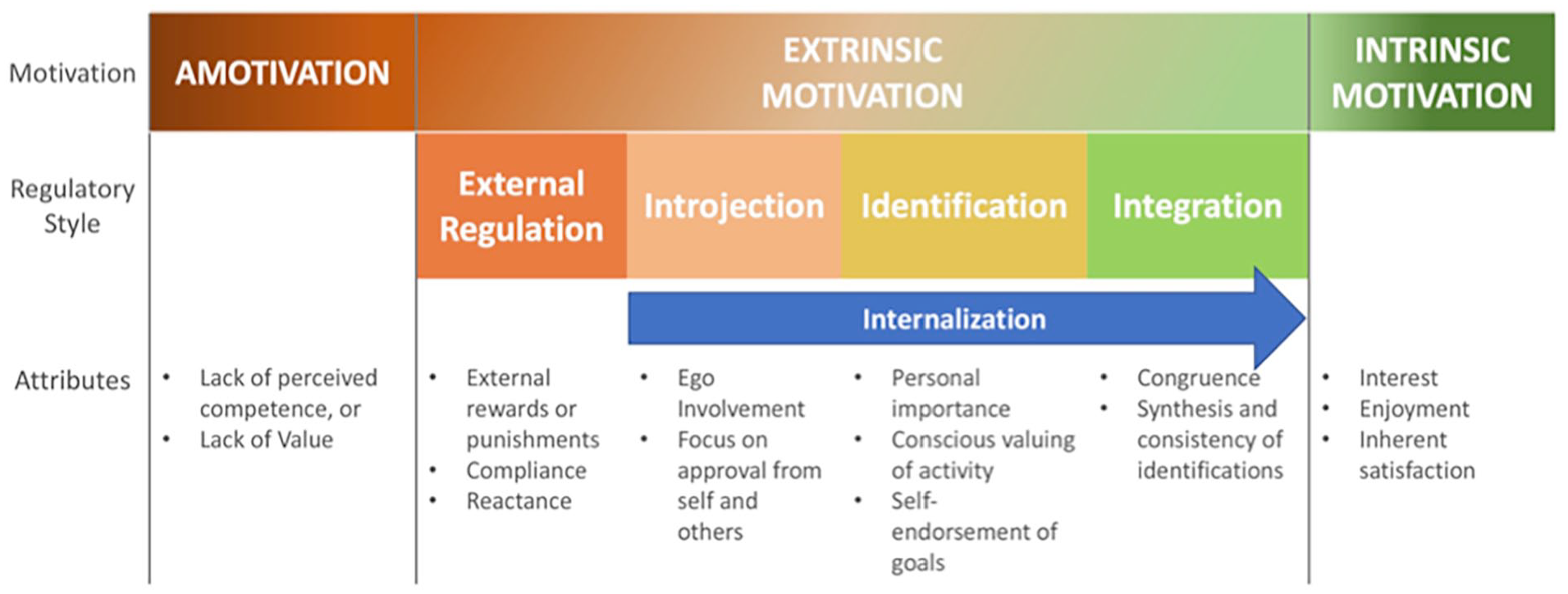
Self-Determination Theory Taxonomy of Motivation.
Self-determination theory and music practice
SDT has been used to understand motivation in a range of domains, including work environments, schools, universities, sports teams, and health care (Deci & Ryan, 2000; Ryan, 2023; Ryan & Deci, 2017). The findings overwhelmingly point to the benefits of relatively internal (autonomous) motivation for general well-being, as well as key outcomes of interest. For example, when students in schools exhibit autonomous motivation, they are more likely to enjoy school, experience greater well-being, engage in self-regulated learning behaviors, and achieve more, and are less likely to engage in cheating behavior, demonstrate oppositional defiance, and disengage from their learning (for a review, see Vansteenkiste et al., 2018). It is not surprising, then, that SDT has been applied to the music domain to understand musicians’ and music students’ motivation and behavior in a range of ways (for reviews, see Evans, 2015, 2023; Evans & Ryan, 2022).
SDT posits several types of motivation that may explain how musicians are able to undertake large amounts of high-quality music practice although it is generally an effortful activity and is not inherently enjoyable (Evans & Ryan, 2022; Miksza, 2022). It is conceivable that a music student might engage in music practice just for the fun of it, from intrinsic regulation (Evans, 2023). But, more likely, they have other reasons, and the primary reason for engaging in the behavior and the salient regulatory processes surrounding the behavior are probably those associated with some form of extrinsic motivation (Evans & Ryan, 2022; Miksza, 2022). Some forms of extrinsic motivation are relatively autonomous (see Figure 1). A music student might be motivated by integrated regulation, for example, if they see that their identity as a vocationally oriented, lifelong, committed musician is a full expression of who they are, and thus their music practice is harmoniously aligned with their sense of self (Evans & Ryan, 2022; Miksza, 2022). They might be motivated by identified regulation insofar as they do not experience music practice as particularly enjoyable but understand that it is necessary for their long-term goals of improving music performance. In both cases, music practice is regulated by autonomous motivation, and the reason for doing it is well understood and endorsed.
However, other forms of extrinsic motivation are relatively controlled (Evans, 2023, see Figure 1). A musician could be motivated by introjection, spending time on practice purely because they would feel guilty if they did not (Evans & Ryan, 2022; Miksza, 2022). Or their motivation could be completely external, their practice motivated only because a parent paid them to carry out each practice session, because of the pressure of an upcoming examination, or because of some threat by their teacher. These forms of controlled regulation are unlikely to result in a productive or enjoyable experience of music practice.
Several studies have examined self-determined motivation and its associations with music and practice-related behavior. Evans and Bonneville-Roussy (2016), for example, found that university music students’ relative autonomy (an aggregate measure representing the position of motivation on the continuum) predicted the frequency of practice and the proportion of practice sessions they reported as being highly productive. Renwick (2008) found that, in children and young people studying music, autonomous motivation was related to self-regulated learning in music practice. A study of conservatoire-level music practice (Valenzuela et al., 2018) found that autonomous motivation (especially intrinsic motivation) was positively related to practice quality in relation to the experience of flow experienced during music practice.
However, some mixed findings illustrate the need to understand more fully the unique contribution of particular types of motivation to different practice outcomes. For example, Evans and Liu (2019) studied high school orchestra students. Although they focused on psychological needs rather than motivation, their findings suggested that both satisfaction and frustration with the needs were positively related to the amount of practice undertaken by the students. This suggests that, as predicted by SDT, even controlling social conditions and extrinsic motivation energizes behavior but perhaps not in productive or enjoyable ways (Ryan & Deci, 2017). Similarly, in university music students, high amounts of practice time might seem to indicate high levels of motivation, but if that motivation is not of high quality, it may have negative effects on the quality of the practice being undertaken. Further research is required to understand this in the context of music practice and to illustrate the nuanced relationships between different types of motivation and their outcomes.
The influence of teachers on motivation for practice. In music education, the music teacher is often the main source of guidance for musicians (Gaunt, 2010). At the conservatoire level, music students typically have regular one-to-one lessons with their music teachers for one or one-and-a-half hours each week. It seems feasible that the music teacher may be an influential figure in motivation and in learning how to practice. Indeed, in other educational settings (such as school classrooms and sporting teams), SDT research has established that the teacher is an influential figure in the development of students’ motivation (Patall et al., 2018; Vansteenkiste et al., 2018).
Studies using SDT have shown that motivation results from interactions with the social environment. In educational settings, many studies have shown that what a teacher says and does can be described as an overall motivating style. An autonomy-supportive style of teaching in school classrooms is important in the formation of students’ autonomous motivation (Aelterman et al., 2019; Cheon et al., 2020; Vansteenkiste et al., 2018). Autonomy-supportive teachers acknowledge their students’ emotions and thoughts and provide adequate structure and feedback, a meaningful rationale for tasks, and opportunities for decision-making (Aelterman et al., 2019; Cheon et al., 2020; Reeve & Jang, 2006; Soenens et al., 2012). By contrast, a psychologically controlling motivating style is one in which teachers enforce their own aims when working with students, without giving them choices, rationale, or structure, and often without being receptive to them (Aelterman et al., 2019; Vansteenkiste et al., 2018). A psychologically controlling teaching style also fosters controlled intentionality and controlled motivation, as students are required to behave the way the teacher wants.
Studies of teacher autonomy support and psychological control in music contexts have produced similar findings. Bonneville-Roussy et al. (2020) found that music teachers and students mostly agree about what constitutes autonomy-supportive and controlling behaviors in music lessons. For example, autonomy-supportive music tutors provide choices within their music lessons and repertoires, and provide thorough explanations as to why some exercises and techniques are needed, whereas psychologically controlling teachers tend to impose their ideas on students. They also found that autonomy support from music teachers was linked to greater levels of well-being in students. Bonneville-Roussy et al. (2013) have shown that perceived autonomy support from music teachers was linked to a more harmonious kind of passion, to future career intentions in music, and higher objective persistence rates in higher education music students. Miksza et al. (2021) found a direct negative link between teachers’ perceived psychological control and students’ autonomous motivation for studying music. Collectively, these studies suggest that teacher autonomy support is linked with more autonomous types of motivational regulation, while teacher psychological control seems to promote controlled motivation in musicians. To date, it is unknown whether the impact of teacher autonomy support and teacher psychological control on motivation also has an impact on the quantity or quality of music practice.
The present study
In the present study, we aimed to understand the quality of motivation required to sustain music practice—specifically, music practice that is high in quality—as well as the degree to which that motivation can be influenced by the music teacher. The study responds to three gaps in the literature noted throughout this introduction: (1) a lack of understanding as to how music teachers’ autonomy support and psychological control influence the different types of motivation regulation; (2) how motivation regulation affects practice time and practice quality; and (3) the impact of teachers on practice time and practice quality, and the degree to which this is mediated by student motivation.
We were guided by two research questions: (1) what kinds of motivation are associated with practice time and practice quality? And (2) to what extent can teachers support the development of these kinds of motivation? Based on self-determination theory and associated work in music and other educational settings, we hypothesized a process model in which teacher autonomy support leads to more autonomous forms of motivation, and teacher psychological control leads to controlled forms of motivation; and in turn, autonomous and controlled motivation have differential effects on practice time and practice quality. This model also allows us to investigate the degree to which motivation mediates this relationship and, specifically, whether teacher autonomy support and psychological control influence their students’ practice time and practice quality primarily via motivation.
Method
Participants and procedure
Participants were 213 vocal and instrumental music students recruited between January 2017 and January 2018 from five conservatoires and university-based music schools, three in the United Kingdom and two in Canada. The authors had no affiliation with these institutions. The participants were aged between 18 and 50 years (M = 21.60, SD = 3.92) and had played their instrument or sung for an average of 11.05 years (SD = 4.41). In response to the question “what is your gender?” 46% selected “male” and 54% selected “female.” Participants studied voice (26%) and the following instruments: winds (23%), piano (17%), brass (12%), strings (12%), guitar, percussion, harp, organ, and oud (< 5% each). They reported being in their first (21%), second (25%), third (21%), or fourth (6%) year of undergraduate study, or were postgraduate students (9%).
Ethical approval was granted by the University of Roehampton’s Research Ethics Board; reference number EDU16/12. Each participant answered a web-based or paper-based questionnaire. The questionnaires took approximately 10 to 15 min to complete. Permission to visit each music school or conservatoire in the United Kingdom in person was granted in advance via email. The Canadian sample was recruited through a web link sent directly to the Canadian institutions that then forwarded the link to students.
Measures
Descriptive statistics, including, means, standard deviations, minimum and maximum values, and skewness are presented in Table 1. For the confirmatory factor analyses (CFAs) reported in this section, we used the criteria described under Analytic Strategy to evaluate model fit.
Zero-Order Correlations and Descriptive Statistics of the Variables Included in the Present Study.
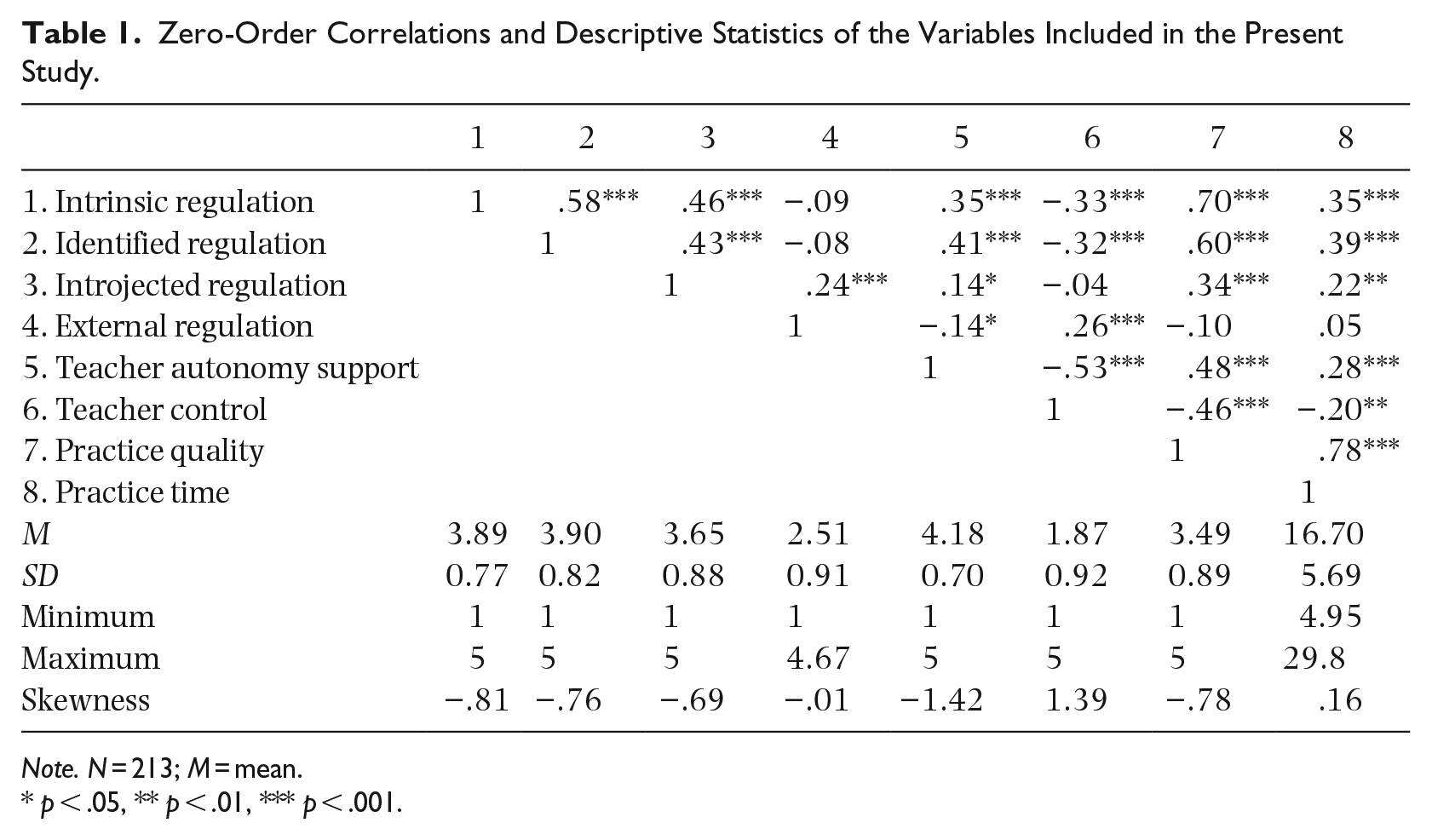
Note. N = 213; M = mean.
p < .05, ** p < .01, *** p < .001.
Motivation regulation
The motivation regulation scale was adapted from Ryan and Connell’s (1989) set of items measuring four types of SDT-based motivation regulation in academic settings: intrinsic (two items), identified (two items), introjected (three items), and external (three items). Items were measured using a Likert-type scale ranging from 1 (strongly disagree) to 5 (strongly agree). The fourth type was amotivation but, for the sake of parsimony, we did not include it in the following analyses since it is rare in advanced music students. Similar adaptations of this scale are often used to measure motivation in educational settings, for example with university students (Gillet et al., 2017; Litalien et al., 2017; Sheldon et al., 2017) and music students in particular (Bonneville-Roussy et al., 2017; Evans & Bonneville-Roussy, 2016). CFA results confirmed the factor structure of the scale and its five subscales, with adequate model fit, χ2(63) = 83.75, p = .04; comparative fit index (CFI) = .97; Tucker–Lewis index (TLI) = .96; root mean square error of approximation (RMSEA) = .04 [.01, .06]; and standardized root mean square residual [SRMR] = .05. The correlations between motivation subscales resembled the motivation simplex pattern predicted by SDT, with strong correlations between adjacent forms of motivation, and decreasing correlations with further subscales (Ryan & Deci, 2017; Sheldon et al., 2017).
Teacher autonomy support and teacher psychological control
The scale measuring teacher autonomy support and psychological control was adapted from the Teacher As Social Context questionnaire (TASC; Belmont et al., 1992). Eleven items were selected to represent two constructs: perceived autonomy-supportive attitudes and behavior (8 items, e.g. “my music teacher provides me with choices and options”) and perceived psychological control (3 items, “my music teacher never lets me do things my own way”). Items were measured on a Likert-type scale ranging from 1 (strongly disagree) to 5 (strongly agree). Results of CFA confirmed the two-factor solution, with adequate model fit, χ2(43) = 70.80, p = .005; CFI = .97; TLI = .96; RMSEA = .06 [.03, .08], SRMR = .04.
Practice quality
The survey included four items measuring practice quality. These were taken from the survey developed by Bonneville-Roussy and Bouffard (2015) to explore a range of constructs broadly indicative of the cognitive engagement and regulation common to deliberate practice and self-regulated learning. The four items concerned goal direction (“I practice with the specific aim to improve”), focused attention (“when I practice, I try to stay focused”), planning (“I plan my practice time”), and distraction avoidance (“when I practice, I stay away from any form of distraction (phone, email. . .).” Collectively, these facets represent a practice that is high in quality (Miksza, 2022) and share conceptual territory with various representations of the quality of practice as deliberate (e.g., Ericsson, 2020; Miksza, 2022), formal (e.g,. Bonneville-Roussy & Bouffard, 2015; Sloboda et al., 1996) and self-regulated (e.g., McPherson, 2022; McPherson et al., 2017). They were measured on a Likert-type scale ranging from 1 (strongly disagree) to 5 (strongly agree). Bonneville-Roussy and Bouffard (2015) found validity support for these items with similar participants (university music students) such that practice quality was associated with both motivation and performance.
Practice time
The survey included two further items concerning mental practice and practice on the instrument. In line with a number of similar studies in music, participants were asked to report their practice time (Bonneville-Roussy & Bouffard, 2015; Evans & Bonneville-Roussy, 2016; McPherson et al., 2019): number of hours per day, and number of days per week.
The results of CFA of the practice measure with practice quality (four items) and practice time (two items) confirmed the validity of a two-factor solution for these items, with adequate model fit, χ2(5) = 5.65, p = .34; CFI = 1.00; TLI = .99; RMSEA = .03 [.00, .10], SRMR = .03.
Analytic strategy
We used structural equation modeling (SEM) and mediation analysis to address the aims of this study. We calculated the chi-square statistic and used the following indications of model fit to evaluate all CFA and SEM models: CFI and TLI, with values > .90 deemed adequate, and > .95 excellent; SRMR, with values < .10 considered adequate; and RMSEA with values < .08 and upper confidence interval < .10 considered adequate (Marsh et al., 2004). Missing values were accounted for in the SEM analyses using Full Information Maximum Likelihood.
To examine the indirect effects of teachers’ autonomy support and psychological control on practice behavior, we used mediation analysis. Bias-corrected bootstrap confidence intervals (BC Bootstrap C.I.; N = 100 samples) were used to compute these indirect effects (MacKinnon, 2008). Mediation links were tested via the calculation of the indirect effects of predictors on the outcomes as mediated by the mediators. All of the analyses were performed using Mplus version 8.7 (Muthén & Muthén, 2017) with the Maximum Likelihood estimator.
In the hypothesized model, autonomy support and psychological control predicted the four types of motivation, which in turn predicted practice time and practice quality. The outcome variables (practice time and practice quality) were modeled as latent variables, with practice time indicated by two items and practice quality indicated by four items. The predictor (exogenous) variables in the model were modeled as observed variables using mean scale scores, as a fully latent model given the sample size would not have had sufficient power. Direct effects of autonomy support and psychological control on practice time and practice quality were also added to the model, to compare their direct and indirect effects (MacKinnon, 2008). Finally, covariances between the different types of motivation regulation and between autonomy support and psychological control were estimated freely.
Results
Descriptive statistics and zero-order correlations of the constructs are presented in Table 1.
Structural equation modeling
The hypothesized model did not fit the data well, as it did not fit the evaluation criteria presented in Analytic Strategy: χ2(34) = 74.65, p = < .001; CFI = .93; TLI = .86; RMSEA = .08 [.05, .10]; SRMR = .05. Inspection of the model modification indices indicated that adding covariances between some items indicating practice time and practice quality would improve the model further without affecting the structure of the model that comprised the core hypotheses for the present study.
The modified model did fit the data well, χ2(30) = 47.82, p = .02; CFI = .97; TLI = .93; RMSEA = .05 [.02, .08]; SRMR = .04. The model is presented in Figure 2, and the unstandardized and standardized parameter estimates are shown in Tables 2 and 3. In general, the hypothesized process model (i.e., teachers’ motivating style significantly predicting motivation, and motivation predicting practice) was supported. Autonomy support predicted both intrinsic and identified types of motivation regulation. Psychological control was positively related to external regulation and negatively linked to intrinsic motivation. In turn, intrinsic and identified types of regulation were positively linked to practice quality, but only identified regulation was linked to practice time. Contrary to the hypotheses, the more controlled forms of motivation regulation were not linked to either practice time or practice quality, and teacher autonomy support had a positive effect, rather than the hypothesized negative effect on introjected regulation. There were no significant direct effects of teacher autonomy support and teacher psychological control on practice time and practice quality.
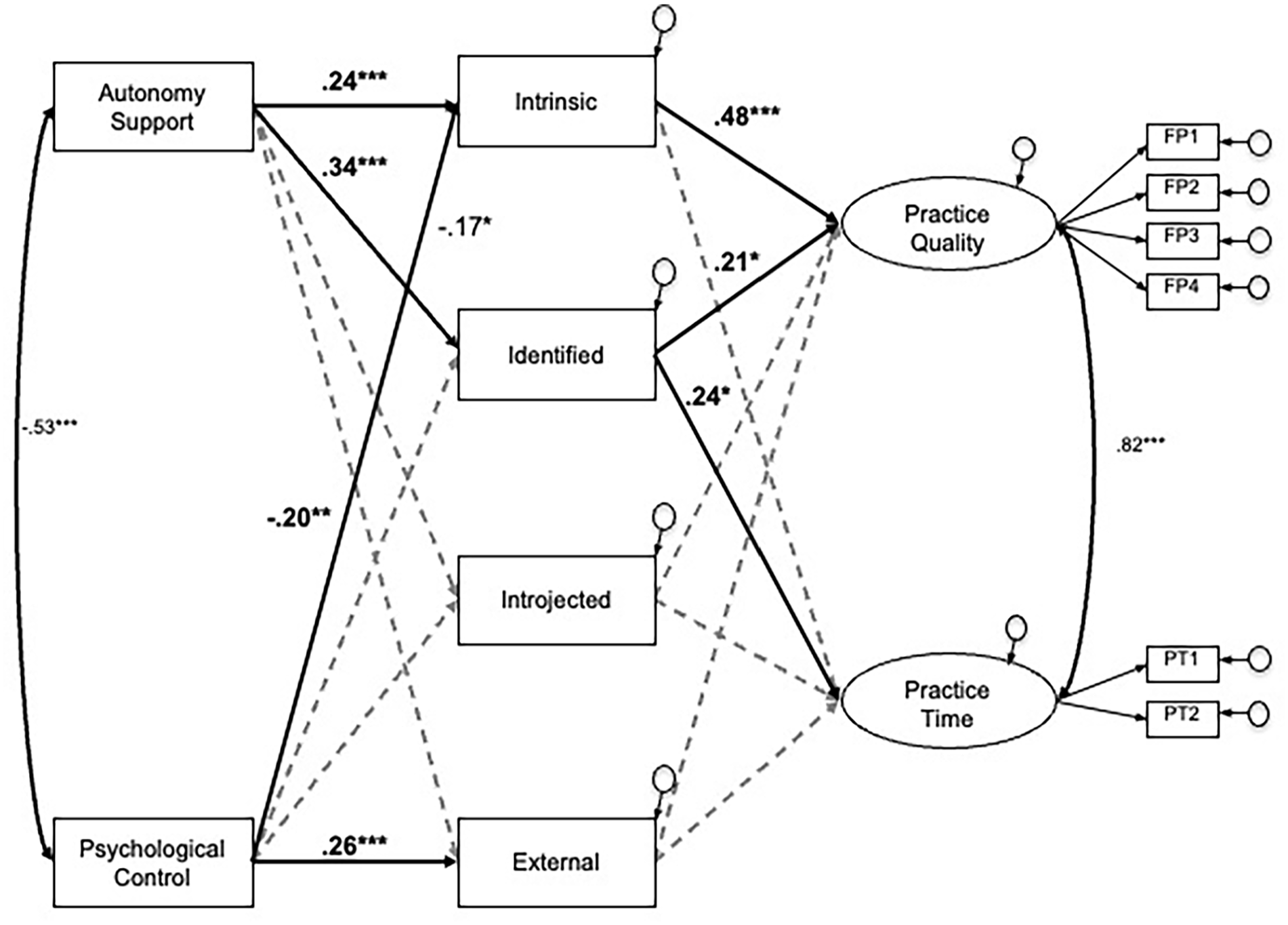
Structural Equation Model.
Parameter Estimates of the Final Structural Equation Model.
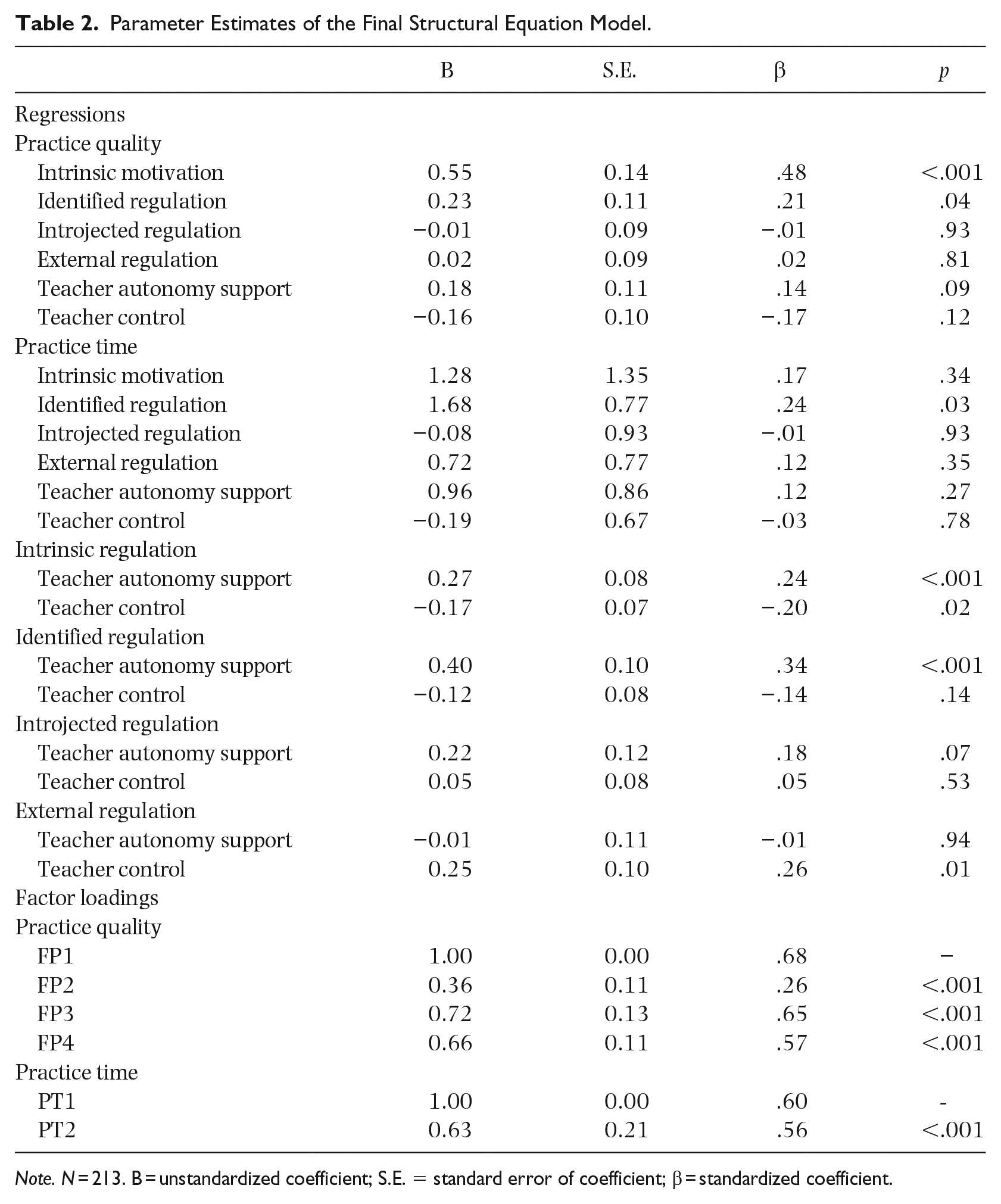
Note. N = 213. B = unstandardized coefficient; S.E. = standard error of coefficient; β = standardized coefficient.
Covariances and Residual Variances of the Variables Included in the Model.
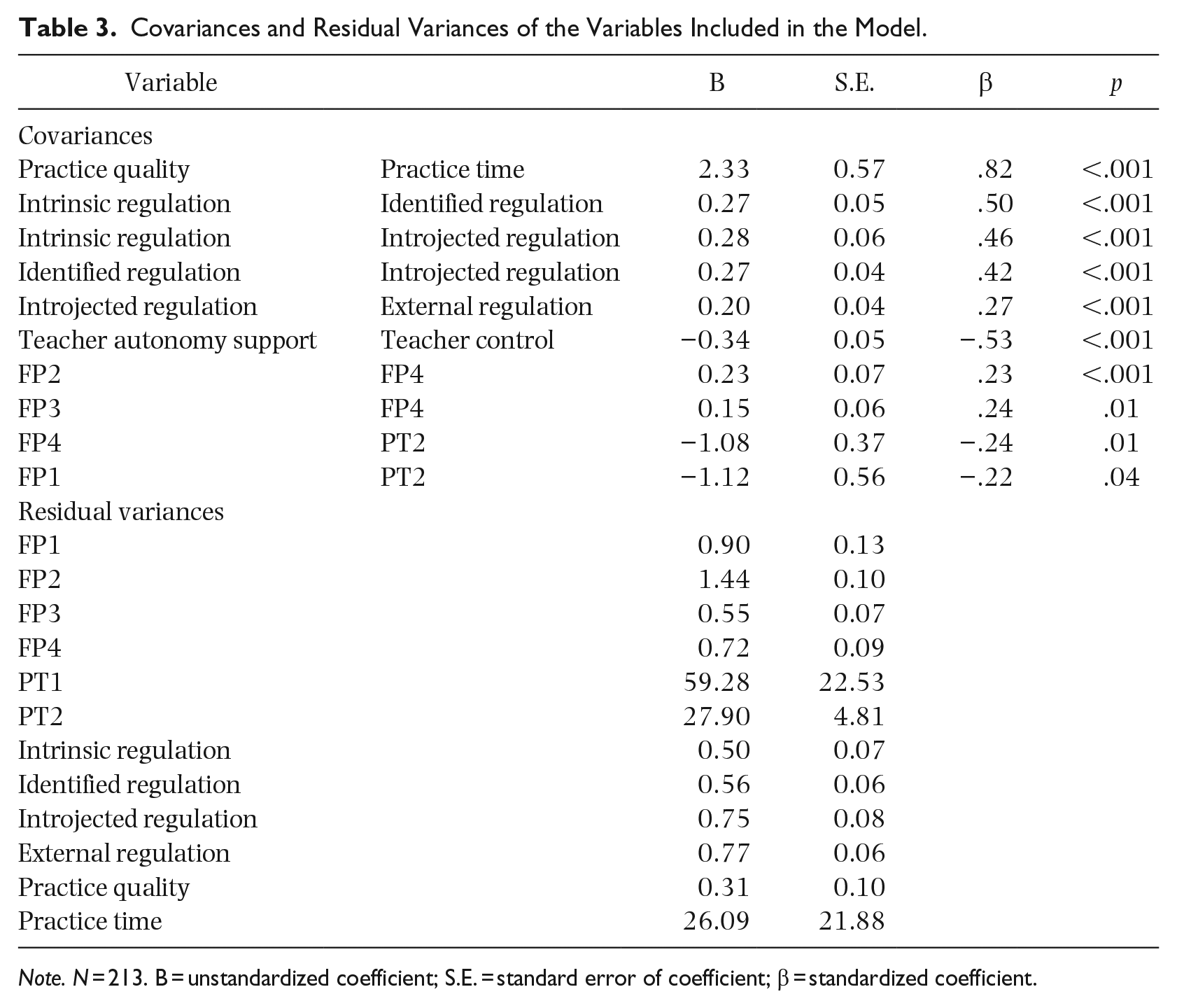
Note. N = 213. B = unstandardized coefficient; S.E. = standard error of coefficient; β = standardized coefficient.
The final model explained 60% of the variance in practice quality and 20% of the variance in practice time. Autonomy support and control explained 15% of the variance in intrinsic motivation, 18% of identified regulation, 2% of introjected and 7% of external regulation.
Mediation analyses
We predicted that perceived autonomy support and psychological control would be linked to practice time and practice quality only indirectly through the different types of motivation regulation. This hypothesis was partially supported. Teacher autonomy support predicted practice quality indirectly through intrinsic motivation, .15 (95% BC bootstrap confidence interval [CI] = [.04, .29], z = 2.48, p = .01). Teacher autonomy support predicted practice time also indirectly through identified regulation, .67 (95% BC bootstrap C.I. = [.25; 1.60], z = 2.07, p = .04). There were no significant indirect pathways between teacher psychological control and practice time or practice quality.
Discussion
Although the findings of the research have clearly established that high-quality motivation is needed to sustain large amounts of practice, the specific kinds of motivation that predict both practice time and practice quality have not been identified. Furthermore, autonomy support from teachers is known to foster high-quality motivation in musicians, but little is known as to the potentially deleterious effects of teacher psychological control. In the present study, we therefore aimed to understand how various types of motivation predict practice time and practice quality in university music students, and to understand the role of teacher autonomy support and psychological control in shaping students’ motivation for practice. In relation to Research Question 1, we found that practice time and practice quality were both associated with identified regulation, and that practice quality was associated with intrinsic motivation. No relationships (positive or negative) were observed with introjected or external regulation. In relation to Research Question 2, we found that teachers’ motivating styles were associated with motivation: autonomy support was associated with intrinsic and identified regulation, while psychological control was associated with external regulation and (negatively) with intrinsic motivation. No significant associations were found, however, between introjected regulation or external regulation and practice time or practice quality. Overall, the proposed model explained a substantial amount of the variance in practice quality (60%), mainly driven by autonomous motivation and autonomy support, and a non-negligible amount of the variance in practice time (20%), mainly driven by identified regulation. The sections below provide more detailed answers to the two research questions.
Students’ motivation is related to practice quality and quantity (RQ1)
Our results also reveal that only autonomous motivation was related to measurable practice behavior. It is particularly important to study both practice time and practice quality, as only the combination of both leads to the highest musical performance outcomes (Bonneville-Roussy & Bouffard, 2015; Ericsson, 2020; Miksza, 2022; Platz et al., 2014). The present results confirm the benefits of autonomous motivation for music students. On the one hand, participants who scored higher for autonomous motivation tended to report significantly higher levels of practice quality and more practice time. On the other hand, more controlled forms of motivation such as introjected and external regulation were not significantly associated with practice behaviors. SDT postulates that controlled types of motivation are likely to influence the amount of a particular behavior carried out by individuals, even if poor engagement or the poor quality of that behavior has detrimental effects on the individual’s sense of self. We had therefore hypothesized that introjected and external regulation would be positively associated with practice time. While we found no such associations we did, however, observe in the zero-order correlations that introjected regulation was positively correlated with both practice time and practice quality. Further research is warranted in this area, especially given that introjected regulation is the type of regulation most likely to be associated with higher social desirability bias when self-reporting practice time (Ryan & Deci, 2017).
Unlike Hatfield et al. (2017), we found a very high correlation between practice quality and practice time (r = .78). The difference between the two sets of results may be attributable to our investigation of a different population. Our results suggest that, at advanced levels, music students who practice more also tend to practice better.
The roles of autonomy-supportive and psychologically controlling teaching styles in students’ motivation (RQ2)
Autonomy support from the principal instrumental teacher was related to higher levels of autonomous motivation (intrinsic and identified) and higher levels of perceived psychological control from teachers were related to higher levels of controlled motivation (specifically, external regulation). Autonomy-supportive teachers allow students to feel a sense of choice in what they are doing, provide meaningful feedback in a supportive and non-contingent manner, and communicate that their interest is in the student’s engagement with and enjoyment of their lessons. In so doing, they promote the integration of motivation for music into students’ sense of self (Evans, 2015; Evans & Ryan, 2022; Ryan & Deci, 2017). In this case, autonomous motivation was associated with practice time and practice quality. These findings contribute to a growing body of evidence for the outcomes of autonomy-supportive teaching in music, along with short- and long-term persistence (e.g., practicing a particular piece; Renwick & McPherson, 2002), retention rates in a college music program (Bonneville-Roussy et al., 2013), and well-being (Bonneville-Roussy et al., 2020). They also echo well-established findings in school settings (Vansteenkiste et al., 2018).
Interestingly, and contrary to our expectations, introjected motivation was related neither to autonomy support, psychological control, nor practice. Introjected regulation involves internalizing a motive such as avoiding negative feelings. One such feeling is guilt, and musicians sometimes carry out large amounts of practice to avoid feeling guilty. Paradoxically, this can have the effect of exacerbating rather than relieving their sense of guilt. Although participants in the present study did experience introjected motivation, this form of regulation may have come from other sources than the music teacher. In SDT research more generally, introjected regulation often demonstrates unreliable or non-significant correlations with behavior, as it is itself an unstable form of motivation, and as an ego-involved form of motivation, it is most subject to response bias in survey research (Ryan & Deci, 2017). Thus, the finding in relation to introjected regulation warrants further research.
Psychologically controlling teaching was associated with external regulation, a form of motivation that is perceived to emanate from forces completely external to the self, such as pressure to perform or other people’s expectations. Psychologically controlling teaching in other educational domains is associated with controlled motivation in students, and maladaptive outcomes such as lower self-regulated learning strategies and dropout (Aelterman et al., 2019; Soenens et al., 2012). Miksza et al. (2021) found that psychologically controlling teaching reduced students’ autonomous motivation (as it did in the present study) but was not associated with controlled motivation for studying music. Bonneville-Roussy et al. (2013) found that psychologically controlling teaching was clearly associated with objectively measured academic persistence (negatively) and dropout in university music programs. Although the findings are somewhat mixed, it is clear that psychologically controlling teaching damages motivation by promoting controlled motivation, or by reducing autonomous motivation.
Interestingly, psychologically controlling teaching did not predict practice time or practice quality, either directly or via student motivation. This may mean that while autonomy support can encourage more and better practice via more autonomous motivation, psychologically controlling teaching may not necessarily harm it. Nonetheless, future research that addresses some of the present study’s limitations may uncover such a relationship, and we note the damaging effects of psychologically controlling teaching may also manifest in other ways (Soenens et al., 2012), even if they do not directly or indirectly affect practice behavior.
Mediation between teacher’s motivating style, motivation, and practice
An important objective of this study was to examine how a teacher’s motivating style affects students’ motivation and behavioral outcomes by asking if teaching styles have a direct impact on students’ practice, or whether their association with students’ practice behavior operates mainly via their effects on student motivation. The mediation analysis supported the latter conclusion in relation to autonomy support such that autonomous motivation fully mediated the links between teacher autonomy-supportive behaviors and student practice in one-to-one teaching settings. This result indicates that autonomy support from music teachers has a positive impact on their students’ motivation for music practice, and consequently, their students tend to undertake more practice and do so with higher levels of meaningful engagement.
Limitations
Three limitations are worth mentioning in addition to those already discussed. First, this study was cross-sectional; no causality can be inferred from the findings. Future research should use longitudinal or observational designs to gain a greater understanding of how autonomy support and psychological control are linked over time and how they manifest themselves in music education settings. Second, we relied on participants’ reports of their own teachers’ motivating styles, which may have been biased (although Bonneville-Roussy et al., 2020, have found that music teachers and their students tend to agree on their appraisals of autonomy-supportive and psychologically controlling behavior). In general, self-report measures do not control for participants’ bias and potentially less biased methods should be used in future research in this field, such as observation. Similarly, further psychometric work on the measurement of practice quality and practice time may be useful in the future as, in the present study, we modified the factor structure of the latent practice time and practice quality constructs, and practice quality was limited to only four items. For this reason, it may not be possible to generalize our results from the sample to the population at large, and they should therefore be interpreted with caution. The use of standardized reporting instruments with validity and reliability established across a range of populations may increase the generalizability of future work, enable the findings of different studies to be compared more effectively and facilitate meta-analyses. Third, this study was limited to advanced music students. Although elementary and secondary school students have been shown tend to experience the links between teachers’ behavior and motivation in similar ways (Jang et al., 2016; Soenens et al., 2012; Vansteenkiste et al., 2018), these links have yet to be examined in younger music students. It would therefore be well worth studying how autonomy support and psychological control affect music students of various ages and levels of experience.
Directions for future research
In terms of theory, we focused on organismic integration theory and how it is facilitated by teachers. This relatively narrow focus permitted us to make specific findings in relation to the research question, but SDT provides theoretical opportunities to expand beyond this focus. For example, we did not operationalize basic psychological needs in the present study. Yet music practice can be a highly satisfying (or frustrating) experience. We also focused on teachers, but other social supports, such as peers, parents, and other members of the learning community, can also influence motivation to practice. These are fruitful areas for future research, and SDT provides the theoretical and methodological tools that future research may use to investigate them (Evans, 2023; Evans & Ryan, 2022). We would also recommend that other aspects of music students’ learning, practice, and performance should be investigated more fully, together with how they are motivated, and the motivational milieu in which they occur. In the present study, we examined teachers’ overall motivating style (autonomy-supportive vs. controlling), but not the content of what they actually teach, although this could be relevant; for example, some teachers may teach effective practice strategies explicitly, for students to use between lessons (see McPherson et al., 2019; Osborne et al., 2021). Further work involving different populations may also clarify whether this is more or less important depending on the stage of learning (e.g., beginners could require more support for learning specific practice strategies, while more experienced musicians could be more resilient when faced with demanding teachers). Time can affect learners in many ways, but we considered it only in relation to the length of a practice session. Since motivation is malleable, it would make more sense to consider it from moment to moment during a single lesson, over the course of a semester, or in terms of the length of time remaining before an upcoming, high-stakes event such as a performance or examination, depending on the aims of the research. SDT provides the theoretical and methodological tools available to advance research in these areas (Evans, 2023; Evans & Ryan, 2022).
Conclusion
In this study, taking an SDT perspective, we investigated the direct and indirect links between the autonomy-supportive and psychologically controlling teaching styles of music teachers, students’ intrinsic, identified, introjected, and external forms of motivation, and their links with music practice behavior. Our first research question concerned the kinds of motivation that are associated with practice time and practice quality. We found that autonomous motivation is indeed associated with practice time and practice quality: intrinsic and identified types of regulation energized student motivation for practice and enabled them to engage more fully in high-quality practice. However, we were not able to draw any conclusions as to the effects of controlled motivation on practice.
Our second research question concerned the extent to which teachers can support their students’ motivation. We found that the way teachers teach does indeed impact student motivation to practice. Students who perceived their teachers as high in autonomy support were more autonomously motivated, while students who perceived their teachers as high in psychological control had higher controlled motivation. Mediation effects suggest that teachers can support their students to practice for longer and more effectively because of their ability to influence their students’ motivation.
Generally, the findings highlight the more positive aspects of support and motivation. While we found limited effects of controlled motivation, further research in this area is warranted as, in other educational settings, psychologically controlling teaching has damaging and lasting negative effects on student motivation, well-being, and educational outcomes.
Footnotes
Funding
The author(s) disclosed receipt of the following financial support for the research, authorship, and/or publication of this article: This project was funded by the Reg and Molly Buck Award from the Society for Education and Music Psychology Research to the first author.

Data availability statement
The data that support the findings of this study are available from the corresponding author upon reasonable request.