




Abstract
Extracurricular and out-of-school engagement with music is often associated with positive effects for musical goals while also holding potential for developmental and empowerment processes. The COVID-19 pandemic has highlighted the importance and the potential of digital technologies for facilitating musical engagement. The emergence of digitally transformed musicking has added complexity to the already multifaceted and complex field of research on non-formal musical engagement. Thus, the aims of this text-mining-supported scoping review are (1) to map and describe the underlying research topics in the field of children’s and adolescents’ musical engagement, (2) to explore potential for empowerment processes, and (3) to identify the extent to which digital aspects emerge. Based on N = 624 articles, a topic-modeling procedure yielded k = 10 topics covering cognitive, emotional and attitudinal, youth cultural and digital aspects. Among these, one predominantly digital topic comprised studies on the production and consumption of music. Implications for the potential for empowerment can be drawn from studies that focus on youth cultural aspects, such as hip-hop culture and digital aspects. Limitations and implications for further research are discussed, including how to transfer these findings and how new technologies can further enhance music-making and creation.
Activities beyond formal education, such as extracurricular and out-of-school activities, are considered to exert a number of favorable effects on the development of children and adolescents (Fredricks & Eccles, 2006; Larson, 2000; Simpkins et al., 2010). This is especially true for cultural activities in general and musical activities in particular (Born & Devine, 2015, 2016). Engagement in music, that is, composing, conducting, listening, producing, distributing, and performing music, is often considered to be associated with positive effects for both specific musical goals, such as instrumental skills or practice strategies, and developmental goals, such as an increase in self-efficacy, well-being, or creativity (Colson, 2012; Degé et al., 2014; Hetland, 2000; Kokotsaki & Hallam, 2007; Mellor, 2013; Miranda & Claes, 2009). This became particularly evident during the COVID-19 pandemic (Jones et al., 2020) where the reception and production of music played a prominent role among the psychological coping strategies of children (Gupta, 2020; Howlin & Hansen, 2022; Kiernan et al., 2021).
Empowerment can be defined as “a process, a mechanism by which people, organizations, and communities gain mastery over their affairs” (Rappaport, 1987, p. 122). Empowerment processes thus refer to the ability and opportunity to make self-determined choices that contribute to self-selected goals and to acquire competencies that allow one to experience the surrounding environment as shapable by one’s own actions. Opportunities for empowerment are of particular importance in times of rapid developments like the digital transformation of society, which can be defined as the “evolving integration of digital technologies into social, economic, and cultural processes and structures” (Pawluczuk, 2022, p. 6). Especially in such times of great changes, “[an] empowered individual is less likely to feel hopeless or helpless; less likely to feel victimized” as well as “actively working to fulfill their perceived potential by using their existing knowledge, positive attitudes and interpersonal skills” (Travis, 2013, p. 144).
The integration of digital technologies and cultural activities has enabled new opportunities for empowerment, particularly in the field of music, as it transformed the way music is listened to, created, produced, taught, and distributed (Hugill, 2012; Minors et al., 2017; Waddell & Williamon, 2019). This was beneficial during the COVID-19 pandemic, where digital technologies were increasingly used to facilitate engagement in musical activities, providing otherwise difficult-to-access mental health support and valuable ways of maintaining social connections (Joseph & Lennox, 2021; Levstek et al., 2021; Marques & Giolo, 2020; Onderdijk et al., 2021; Ziv & Hollander-Shabtai, 2022).
While formal music education and its effects on formal educational objectives have been a frequent subject of research in recent years, also yielding a few research syntheses (Calderón-Garrido et al., 2019; Jaschke et al., 2013; Pendergast, 2020), this is not the case for settings beyond formal education, despite their potential for self-determination and self-regulation (Colley et al., 2003). This may be due to the fact that the field is very broad and is constantly and rapidly becoming even more multifaceted as a result of ongoing digital transformation. Moreover, data collection in settings beyond formal education is more challenging and diverse than in school settings (Cogo-Moreira & Lamont, 2018; Simpkins et al., 2004). Thus, the areas being explicitly addressed in the field of research beyond formal music education and the role the empowerment of children and adolescents play, especially in the context of the digital transformation of society remain to be established.
To accomplish this task, this article reports the results of a text-mining-supported scoping review. This method offers the possibility to thoroughly explore even very heterogeneous and extensive research fields (Christ et al., 2021). Building on a topic model based on text from titles and abstracts, this review examines the field of research on children’s and adolescents’ engagement with music beyond formal education, focusing on musical or developmental goals, by (1) mapping and describing the underlying research topics, (2) exploring their potential for empowerment processes, and (3) identifying the extent to which digital aspects emerge.
The engagement with music beyond formal settings and its potential for empowerment processes
Defining the potential for empowerment processes with regard to the informality of musical engagement
Not all settings for musical engagement of children and adolescents are equal. The different characteristics of these settings determine the impact of the activities on an individual (Hargreaves et al., 2012). Curriculum-based music lessons with clearly defined learning objectives and assessment of skills or competencies may trigger different learning and motivational processes than voluntary extracurricular activities or making music at home with the family or in youth centers with friends (Green, 2008; Griffin, 2011; Marsh & Young, 2006; Tobias, 2012). Thus, many definitions of the formality of learning contexts involve the setting as an important aspect (Colley et al., 2003; Eraut, 2000; Malcolm et al., 2003; H. H. Ng, 2020). However, from an empowerment perspective, it may be more beneficial to focus on the learning processes themselves rather than on superficial characteristics of the setting. In this regard, Eraut (2000) distinguishes between formal and non-formal learning processes, the latter including informal learning processes. In the context of music education, formal learning is described by Hargreaves et al.’s (2003, p. 158) “globe” model as curriculum-based compulsory music education at school. In contrast to formal learning activities, any activities with learning processes that are informal or elective (Hargreaves et al., 2003) can thus be considered as non-formal (Mok, 2011). This includes extracurricular activities such as choirs, instrumental lessons, or bands, as well as self-directed activities at home or elsewhere. This approach allows for the consideration of learning activities as non-formal, even when they occur in school settings but have a non-formal nature.
Digital transformation in the field of musical activities
Digitalization has led to major transformations in individual and collective musicking. Children and adolescents are provided with unprecedented access to music as well as opportunities for individual compilation of playlists using Spotify or similar streaming services (D. T. K. Ng et al., 2022; Roberts & Foehr, 2008; Sinclair & Tinson, 2017; Yan, 2021). New fields of active engagement range from interactive participation in music-related networks (Cremata & Powell, 2017), to digital tools for individual or collaborative asynchronous music production such as Bandlab or Soundtrap (Brader & Luke, 2013; Gower & McDowall, 2012), and digital tools which enable synchronous collaborative music-making, digital group lessons, or online jamming like Jamulus or Multiplayerpiano (Hanrahan et al., 2019; Rofe et al., 2017). Moreover, it is possible to collectively watch a concert live stream via Zoom or Twitch while communicating in a chat or engage in Spotify group sessions (Cremata & Powell, 2017; Moritzen, 2022; Vincent, 2023). Furthermore, sharing platforms such as YouTube or SoundCloud have profoundly transformed the career opportunity paths of young musicians for better or worse (International Federation of the Phonographic Industry, 2018).
As a particular facet of digital transformation, the rise of social media has fundamentally transformed the musical activities of children and young people. Particularly prominent among children and youth is the TikTok app, which is centered around the sharing of short videos, often used for easily accessible musical activities (Montag et al., 2021; Vizcaíno-Verdú & Aguaded, 2022). In principle, such platforms embody considerable potential: They may facilitate being part of a large community, provide opportunities for self-expression, and open up opportunities for communication and participation, especially among marginalized youth (Evans, 2022; Kennedy, 2020). In practice, however, the embeddedness of social media in the context of platform economy, attention management and—in many states—governmental control often results in conflicts between education and empowerment, on one hand, and maximization of online time and data privacy concerns on the other (Baruh et al., 2017; Neyaz et al., 2020; Page et al., 2018; Zuo & Wang, 2019).
Non-formal musical engagement and empowerment of children and adolescents
While numerous benefits of music have been found and synthesized in therapeutic contexts (Geretsegger et al., 2022; Hernandez-Ruiz, 2021; Ishak et al., 2021; Maratos et al., 2008; Mayer-Benarous et al., 2021), also referencing empowerment (Gold et al., 2005; Hirsch & Meckes, 2000; Rolvsjord, 2004), this review aims to explore the potential for empowerment beyond this clinical research field. Thus, we decided to exclude studies focusing on clinical aspects or special needs (e.g., Johnson & LaGasse, 2021), despite these often being of high quality and value for research on empowerment in clinical populations. Moreover, we shed particular light on adolescents, as young people are in need of empowerment during this particularly emotionally challenging phase of their lives (Halle, 2003), where multiple socialization processes take place in different systems, such as school, peers, out-of-school settings, or the family (Bronfenbrenner, 1986; Stanton-Salazar, 2011).
It can be argued that children and adolescents may be empowered in the context of musical activities, but only if they actually engage in such activities (Holcombe, 1995). At the same time, it is challenging to reach all children and adolescents with appropriate opportunities (Smolarczyk et al., 2022). There are many factors negatively influencing participation, including beliefs, financial resources, and a lack of opportunities at school (Costa-Giomi & Chappell, 2007; Guest & McRee, 2009; Kröner, 2013; Pendergast, 2020; Pendergast & Robinson, 2020; Quinn, 1999). Thus, the factors of socioeconomic and ethnic disparities in the field of music education require greater attention (Griffin, 2011; Jorgensen, 2007).
Review questions
The field of music beyond formal education is a particularly broad one that has recently become increasingly multifaceted, especially as a result of the digital transformation of society. A vast scope of publications can be located in this research field, also accounting for digital aspects and empowerment processes. However, these publications are not easily identified with a classical Boolean search. Apart from a few studies beyond clinical research that explicitly refer to both music and empowerment processes (e.g., Albert, 2017; Travis, 2013; Travis et al., 2021), many studies only implicitly link to empowerment, using related constructs like self-efficacy or agency. Thus, to obtain a comprehensive overview of the various topics found in this area of research, the extent to which implicit aspects of empowerment and digital transformation might come into play and where gaps might be located, a very broad search is required, leading to a large amount of false alarms to minimize the amount of omissions. This is where text-mining and topic-modeling methods come into play, as explained below, to efficiently answer the following research questions:
Method
A text-mining-supported scoping review
Scoping reviews can be used to summarize and analyze key issues in research areas, providing a sound starting point for further investigation, education, practice, and policy (Arksey & O’Malley, 2005; Peterson et al., 2017). The scope of these reviews is broad; they may cover studies addressing a wide-ranging research question, including qualitative and quantitative studies (Tricco et al., 2016). However, given the large research field of engagement of children and adolescents with music, any thorough literature search would yield a very large number of publications. This makes it almost impossible to map and categorize them using traditional qualitative methods.
Text mining is a collection of different methods that can be used to analyze unstructured text data, resulting in a variety of variables and measured values (O’Mara-Eves et al., 2015; Silge & Robinson, 2017). Thus, rather than significantly restricting the search string and therefore included publications to make the publication volume more manageable by sacrificing comprehensiveness, text-mining and big data methods allow for large amounts of text to be analyzed, as only a fraction of the time required with traditional methods is needed for each paper (Wu et al., 2014). As has been done in this work, it is possible to automatically and systematically clean and prepare titles, abstracts, and keywords of articles for the identification of underlying topics within corpora. This procedure is explained in more detail below.
Search procedure
We conducted our search in the Scopus database (Elsevier, 2021). The search string consisted of three dimensions labeled “children/adolescents,” “music,” and “non-formal character.” The terms included in these dimensions were combined by the Boolean operator AND, each comprising several search terms (Table 1). Thus, we retrieved publications which featured at least one term of each dimension.
Search String With “or” Linking Between the Search Terms and “and” Linking Between the Dimensions.
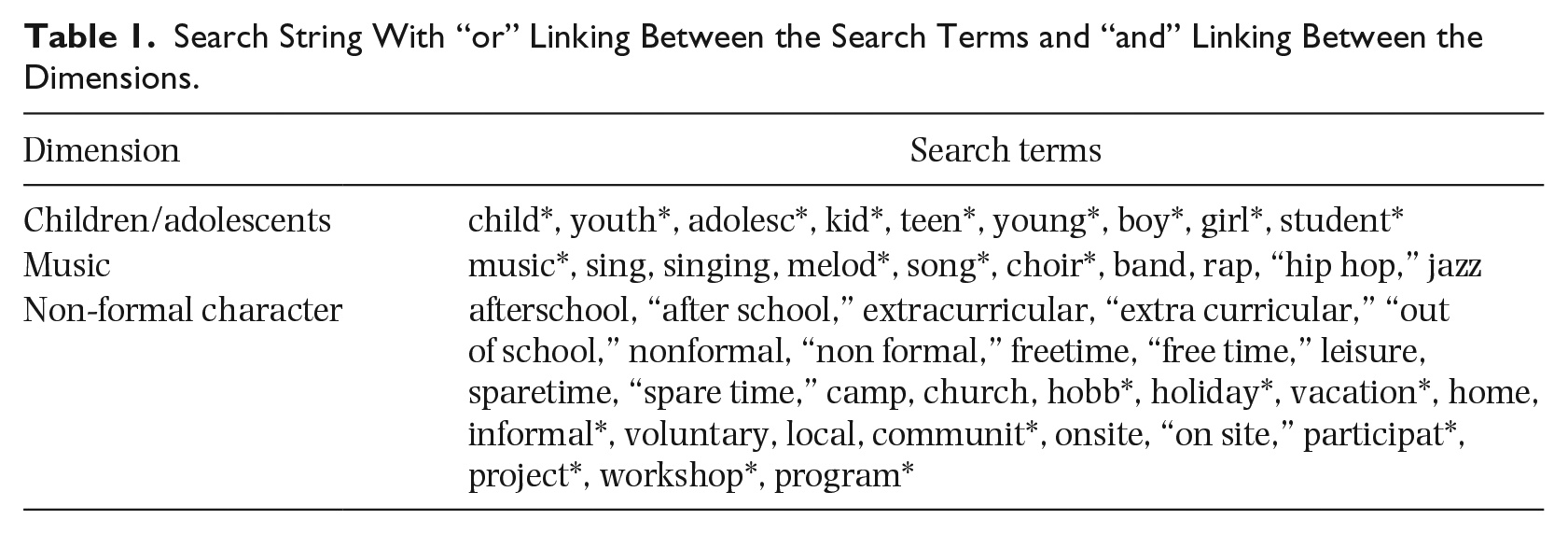
The search was restricted to the areas “Social Sciences,” “Arts and Humanities,” and “Psychology,” as well as to the last 10 years (2012–2021) and to the document type “Article.” The temporal restriction yielded publications of the last decade, thus covering the era of digital transformation in the way children and adolescents deal with music. To assure a minimum level of quality, the search has been restricted to articles, thus excluding conference papers and book chapters which do not necessarily undergo rigorous peer review process. This procedure resulted in n = 4,678 articles on January 19, 2022.
Screening the corpus
The manual screening of titles and abstracts was based on the following inclusion criteria: (1) empirical study, either quantitative, qualitative, or with mixed methods; (2) with children or adolescents as participants that either go to primary or secondary school or are in those respective age groups; (3) no health-related or special needs selective samples researched from a therapeutic point of view; (4) engagement with music; (5) with non-formal character; and (6) involving musical or developmental goals. Thus, if the purpose and characteristics of the activities indicated non-formal musical engagement as described above, the study was included in the review. This means that studies on purely formal research topics did not fulfill the inclusion criteria of this review. The screening of titles and abstracts of all n = 4,678 search results yielded n = 624 included articles.
Text-mining analyses
Cleaning and stemming
After exporting the search results, the resulting CSV file containing titles, abstracts, and keywords was prepared for the subsequent text-mining analyses with cleaning steps. This included removing so-called stop words which are irrelevant to the content of texts, such as the most common linking words “the,” “a,” or “is.” This list was based on the stop words of the R package “tidytext” (Silge & Robinson, 2017) and extended by Christ et al. (2021). All supplementary material such as the data used and R-scripts is available at https://osf.io/ynjxg/.
Moreover, all words were reduced to their stems (Silge & Robinson, 2017) to ensure that words with different forms but the same word stem were counted as the same words in the analyses. This applied to words with different spelling (substitution; for example, “hip hop” and “hip-hop”) or British or American English endings (e.g., “analyse” and “analyze” both ending up as “analys” after stemming) or different words with the same word stem (e.g., “musicking” and “musician” became “music”). This step was important to avoid attributing words with different word affixes to different underlying topics.
Word substitutions and identification of additional stop words
At its core, text mining quantifies words and word combinations. Due to the nature of natural language, combinations of two or more words often carry different meanings than their single constituting words. This may lead to fuzziness in the algorithmic analyses of text corpora via topic modeling (Silge & Robinson, 2017). To prevent this, we combined specific frequent word combinations into one word by deleting the spaces. Examples of such substitutions are “social” and “media,” merged into “socialmedia” or “out,” “of,” and “school” merged into “outofschool.” Additional stop words and substitutions were identified by examining the most frequent and most indicative words, bigrams, and trigrams (see tf and tf-idf, Aizawa, 2003). In addition, all words that were not included in the list of words indicating inclusion or exclusion and did not occur more than 5 times were deleted. This did not result in any substantial loss of information, nor affected the results of topic modeling, as that is based on words frequently occurring together. The entire cleaning and substitution process was applied to all abstracts, titles, keywords, and journal titles and led to a substantial reduction of text to be analyzed. The resulting processed data set subsequently comprised only relevant words that could be used for topic modeling.
Topic modeling
Determining underlying topics of large corpora with topic modeling requires a so-called document-term matrix consisting of rows containing all articles and all words as columns. The cells of this matrix contain the word frequency of each respective word in each article (Rajman & Besançon, 1998; Silge & Robinson, 2017). The most widely used clustering algorithm for topic modeling (latent Dirichlet allocation, LDA, Blei, 2012; Crain et al., 2012) identifies the k underlying thematic topics of this matrix by clustering words and word combinations occurring frequently together and documents which contain those frequent words and word combinations. The most important words per topic are denoted as β and the important articles per topic with as γ. The relevancy of a word for each topic is represented by its word-topic probability β, the relevancy of a document for each topic by its document-topic probability γ. The higher the probabilities, the more relevant the words and documents are for the respective topic. As opposed to traditional k-means clustering, LDA is a fuzzy clustering algorithm which does not assign documents to a single particular topic, but rather provides a probability for each article of belonging to each of the individual topics (Blei, 2012). Thus, it is possible that documents or words may belong to several topics with a high weight, if they contain words that are relevant for several topics. Nonetheless, the highest document-topic probability γ may be utilized to determine the main topic of each article. The actual content of each topic is determined by analyzing and interpreting the lists of words with high β-values and documents with high γ-values.
As proposed by the seminal work on topic modeling by Griffiths and Steyvers (2004), Gibbs-sampling was utilized to identify which amount of topics k may best represent the underlying topics in the corpus. For each k indicating a good representation of the underlying topics of the corpus, two of the authors determined the content of the topics on the basis of the topic-indicative words (i.e., words with high β-values) and documents (i.e., articles with the highest γ-values). By doing this, the number of topics k that resulted in the best separability and interpretability of the topics was determined by the authors and kept for the analysis of the corpus.
Finally, the relation of each document to each other document based on the document-topic-probabilities was determined and visualized via t-SNE-clustering algorithm (t-distributed stochastic neighbor embedding [SNE]). By this a nonlinear method of complexity reduction and visualization for high-dimensional data, each article is assigned a location in a two-dimensional map. With this algorithm, similar articles are mapped close to each other, while dissimilar articles are mapped far apart (van der Maaten & Hinton, 2008). Based on the graphical representation resulting from t-SNE-clustering, the topics were inductively grouped into thematic sections and numbered accordingly.
Presentation of exemplary studies
To provide a comprehensive overview of the topics identified, we report studies that are prototypical to each topic, as determined by the probability of the studies belonging to the topic. As individual studies can have high scores even for multiple topics, the reported studies per topic are not necessarily strictly those with the very highest scores. Rather, the studies were selected both on the basis of (1) their likelihood of belonging to a particular topic and (2) their content of valuable insights for our research questions. In addition, the 10 most important wordstems per topic as well as the confidence intervals of the topics, number of assigned articles, and document-topic-probabilities are displayed in Figure 1. Words derived from these stems are set in italics in the description of the topics throughout the results section (see Supplementary Material for more detail).
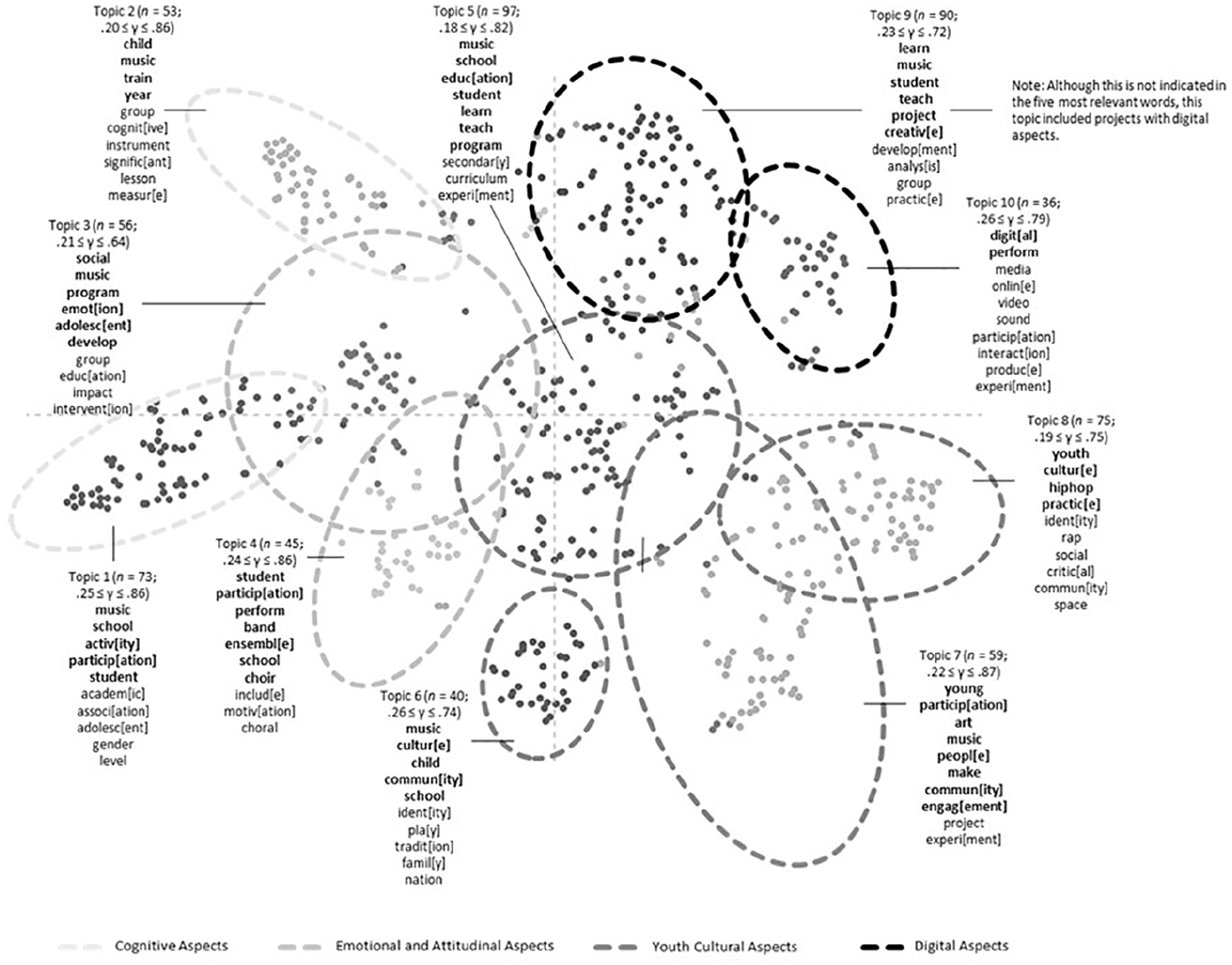
Visualization of t-SNE-Clustering for all Included Articles With Ellipses Displaying the 95% Confidence Intervals of the Topics, Number of Assigned Articles.
Results
Determination of the number of topics
A Gibbs sampling based on the whole corpus of words was carried out to retrieve potential optimal numbers of topics k, with 2 ⩽ k ⩽ 25. The parameters suggested by Cao et al. (2009) with a local minimum and by Deveaud et al. (2014) with a local maximum indicated a good fit for k = 8 and k = 10 topics (see Supplementary Material for the Gibbs-sampling figure). The examination of the content of the topics revealed that k = 10 topics was the most comprehensive number of topics and more accessible to interpretation, as a purely digital topic emerged that had not formed in the case of k = 8 topics. Therefore, the topic model with k = 10 topics was used for the following analyses. Each of the topics contained between n = 36 and n = 97 articles.
Description of the topics and evidence from prototypical studies
Topic overview
The topic-modeling process yielded k = 10 topics that differed in their most relevant words, each highlighting different areas and aspects of engagement with music of children and adolescents with non-formal character and focusing on musical or developmental goals (Figure 1). The first striking finding was the emergent multidimensionality of non-formal musical activities and the diversity of the areas involved. The t-SNE clustering revealed that the topics could be inductively split into four groups. Those groups were related to musical engagement with a focus on (1) cognitive aspects, (2) emotional and attitudinal aspects, (3) youth cultural aspects, and (4) digital aspects (Figure 1).
Topics on musical engagement with a focus on cognitive aspects
Topic 1 “music, school, activ[ity], particip[ation], student” featured studies which focused on determinants of participation as well as on academic self-concept and academic achievement. With regard to predictors of enrolment in music classes, studies reported lower levels for boys, children with low socioeconomic background, ethnic minorities, and older adolescents. According to several studies, typically around one fourth to one third of children and adolescents in the United States were enrolled in music classes in total (Alegrado & Winsler, 2020; Elpus & Abril, 2019; Kinney, 2019; Shaw, 2021; Šulentić Begić et al., 2021). Regarding academic self-concept, there is longitudinal evidence that participation in school-based music activities fosters the academic self-concept of children (Degé & Schwarzer, 2018). Moreover, with regard to academic achievement, engagement in music was reported to promote general school academic achievement (Guhn et al., 2020). Considering academic achievement in the area of music, informal musical engagement was highlighted to be particularly beneficial (Guo et al., 2022).
Topic 2 “child, music, train, year, group” included studies that highlighted the importance of an early start to musical engagement. Many studies focused on musical engagement of children of primary school age. Some provide evidence for significant effects of various features of musical training programs with children regarding the development of musical abilities or cognitive functioning, including working memory (Frischen et al., 2021; MacCutcheon et al., 2019; Roden et al., 2014, 2012). For example, incorporating bodily movement and gestures into musical training was claimed to be useful for fostering musical abilities (Kohn & Eitan, 2016; Liao & Davidson, 2016a, 2016b).
Topics on musical engagement with a focus on emotional and attitudinal aspects
Topic 3 “social, music, program, emot[ion], adolesc[ent]” contained studies on the use of music for emotional regulation of adolescents. The studies focused on how to use music in several programs and interventions to achieve goals that belong to the area of personal development. While preference for some youth cultural music styles may be associated with risks of externalizing behavior like drug use (Franken et al., 2017), music may also be intuitively used by adolescents for emotion regulation (Saarikallio et al., 2017). Beyond this correlational evidence, there are studies reporting the development of musical interventions aiming at the improvement of participants’ emotional awareness and regulation skills (Dingle et al., 2016) as well as interventions fostering positive social and emotional behaviors (Mogro-Wilson & Tredinnick, 2020). With particular focus on social well-being, Papinczak et al. (2015) reported that music listening was related to well-being. With regard to group interventions, musical interventions were even found to contribute to reducing bullying (Epelde-Larrañaga et al., 2020).
Topic 4 “student, particip[ation], perform[ance], band, ensembl[e]” highlighted experiences in typical school-based non-formal musical activities. This topic covered studies of extracurricular activities like participation in bands, choirs, ensembles, and orchestras (Dagaz, 2012; Freer, 2016; Hendricks, 2014; Lowe, 2018). The studies highlighted the key role of self-efficacy, especially in the context of competitive group performance festivals. Such competitive environments are perceived as an opportunity for positive musical experiences and are associated with an increase of musical self-efficacy (Albert, 2017; Hendricks, 2014; Pope & Mick, 2015). To unfold their full potential and to foster further musical engagement, these competitions should include a fair and transparent performance assessment (Bergee & Rossin, 2019; Pope & Mick, 2015). Besides competitive environments, there are also studies in which the potential of cooperative group environments for motivation and enjoyment is highlighted, especially as they enable strong social connections which promote long-term engagement (Dagaz, 2012; Lowe, 2018).
Topics on musical engagement with youth cultural aspects
Topic 5 “music, school, educ[ation], student, learn” addressed the ongoing transformation of music education with regard to the importance of popular culture. The studies assigned to this topic highlighted the necessity and the potential of the integration of informal learning strategies in formal music settings, especially for fostering the engagement of disadvantaged students (Hallam et al., 2017; Ho, 2015; H. H. Ng, 2020). For example, informal strategies like playing by ear or peer-teaching were found to be particularly beneficial for engaging at-risk students in formal settings (Costes-Onishi, 2016). In general, it is claimed that the integration of youth cultural music-making in different school or community programs may be beneficial for the (re)engagement of disadvantaged or marginalized students, for example, in urban areas (Cleaver & Riddle, 2014; Dosman, 2017; Osborne et al., 2016). In this context, Law and Ho (2015) particularly emphasized the importance of the integration of popular music.
Topic 6 “music, cultur[e], child, commun[ity], school” contained studies focusing on youth’s multicultural associations with music-making. Some studies explored the contributions of participation in musical play to the well-being of bicultural children (Marsh, 2017). With regard to the use of music in multicultural communities, the studies reported that children and adolescents made use of music to form a connection with their cultural traditions, which supports their construction of self-identity (Good et al., 2021; Nethsinghe, 2013). Beyond individual cultural identity, music was also used to preserve shared cultural values. For example, Ichumbaki and Lubao (2020) explored the potential of music to increase people’s awareness of the value of heritage sites in Africa. In such preservation of cultural assets, the role of family needs to be considered (Ćalić & Đurđanović, 2020).
Topic 7 “ young, particip[ation], art, music, peopl[e]” indicated the importance of music activities as a form of art for groups of young people that are in particular need of empowerment processes. The papers assigned to this topic covered studies of children and adolescents in particular life situations such as refugees, living in foster homes, or otherwise “at risk.” They focus on the potential of these children’s and adolescents’ participation in musical activities for the development of skills, confidence, and resilience as well as feelings of social connectedness (Humphrey, 2019; Kenny, 2018; Rimmer, 2012; Salmon & Rickaby, 2014). The importance of music in temporary accommodation settings for the definition and negotiation of sometimes multiple cultural and musical identities was highlighted as well as the underlying sense of community and the opportunity to express one’s culture and make own decisions in the sense of agency through music-making (Kenny, 2018; Rimmer, 2012).
Topic 8 “ youth, cultur[e], hiphop, practic[e], ident[ity]” centered around the youth cultural social practice of hip-hop. The studies assigned to this topic focused on the potential of community-based hip-hop and rap cultures for developmental goals (Angelucci, 2021; Eisenberg, 2012; Haaken et al., 2012). With mostly ethnographic approaches and focusing on urban and African youth cultures, the authors highlighted the potential of community hip-hop production for empowerment processes such as identity building, cultural emancipation, political participation, or practice of multiliteracy (Lázaro & Silva, 2016; Rapoo, 2013; Williams, 2016). Youth centers might be particularly suitable social spaces for such processes, as they are open and autonomy-driven (Bramwell & Butterworth, 2020).
Topics on musical engagement with digital aspects
Topic 9 “learn, music, student, teach, project” was the first digitally infused topic and included studies on creative projects in instrumental learning and collaborative music composing. The studies assigned to this topic examined the adaption of popular musicians’ informal learning practices in instrumental lessons, like playing by ear, reporting greater enjoyment during instrumental lessons or greater confidence in instrumental playing (Green, 2012; Varvarigou, 2014). Many studies featured technological aspects, for example, when reporting that learning traditional musical instruments was more attractive to students when additionally using technology (Julia et al., 2019) or claiming online distance-learning as a fruitful complement to face-to-face teaching (Brändström et al., 2012). Furthermore, the potential of technology-assisted cooperative work for creative projects was highlighted (Palazón-Herrera, 2021). Moreover, the use of technology such as a tablet-based app for group collaborative composition successfully included primary school students with different musical backgrounds (Hart & Williams, 2021).
Topic 10 “digit[al], perform, media, onlin[e], video” had a digital focus and featured studies on the digital consumption and production of music, the devices used, the preferred platforms, and the music styles involved. The studies covered several aspects of digital music-making and consuming: With regard to digital aspects of musical performance, there were studies which examined best-practice for musicking in online orchestras for musicians in remote communities (Prior et al., 2017; Rofe et al., 2017). Moreover, there were studies that reported how video tutorials could help with using editing programs (Palazón-Herrera, 2018) as well as the use of game-based learning materials for musical learning, especially informal learning (Wang, 2023).
Furthermore, studies investigated the combination of music production and computer programming (Magerko et al., 2016) and the potential of digitalization to create new music genres (Supiarza & Sarbeni, 2021). Focusing on digital and social media, there were studies on the preference for media usage for listening to music (Barrios-Rubio, 2021; Zilka, 2018). Other studies examined the use of social media including YouTube, which hovers between digital music consumption and the potential of social media for merging consumption and producing into prosumption (Fedele et al., 2021; Pérez-Escoda & Contreras-Pulido, 2018) or investigated the relationship between prosuming music engagement in social media and musical skills, literacy, or identity development of young people (Schoon, 2014; Vizcaíno-Verdú et al., 2021). For example, through digital hip-hop music production, young people had the opportunity to unfold their creativity and build up resilience (Schoon, 2014).
Discussion
Summary of findings
In this scoping review, a large number of studies judged relevant to children’s and adolescents’ engagement with music beyond formal education have been retrieved and further analyzed using topic modeling. Text-mining proved to be a suitable approach, yielding 10 distinct topics that provide an insightful overarching view of the research area. Four groups of topics on musical engagement emerged, which focused on cognitive aspects, emotional and attitudinal aspects, youth cultural aspects, or digital aspects. The topics included multifaceted findings as well as numerous explicit or implicit references to the potential of musical engagement for empowerment processes, especially those regarding youth cultural aspects and digital aspects.
Underlying potential for empowerment processes of musical engagement, blind spots, and implications for further research
As our focus was on non-formal activities, we excluded studies focusing on purely formal music education. Nevertheless, outcomes typically allocated to formal learning were involved in studies on non-formal musical engagement, too. Especially in Topic 1 and Topic 2, several studies focused on the acquisition of specific competencies and academic achievement in non-formal contexts. Nevertheless, they clustered with studies on determinants of the enrolment of young people in extracurricular school-based musical activities. Such findings about the determinants of participation are especially valuable for future examinations of empowerment processes, since, as outlined above, participation is a prerequisite for empowerment processes to take place at all. Considering the potential of connecting learning activities across various settings, lessons learned from research on self-determined and empowering non-formal activities in school settings can also be usefully applied to places of learning outside the traditional school environment. Studies such as the present one could facilitate collaborative research efforts to promote musical engagement among children and adolescents across different settings.
Illustrating the results of topic modeling with prototypical studies revealed a number of implicit references to empowerment. These were, for example, studies focusing on music and well-being (Topic 3) and self-efficacy (Topic 4) indicating how such activities need to be designed to promote children’s and adolescents’ development.
In particular, empowerment processes played a major role in the topics focusing on youth cultural aspects (Topic 5, Topic 6, Topic 7, and Topic 8). This involved the explicit engagement of at-risk students, and the possibility of motivating them particularly through informal content and learning strategies. It became evident that to reach as many young people as possible, researchers are exploring how to infuse settings that are rather formal with non-formal characteristics. In this context, the potential of musical engagement for forming one’s own identity, feeling socially connected, and experiencing agency was repeatedly highlighted. These themes were of particular prominence in the context of hip-hop (Topic 8). This may be due to the fact that hip-hop is a preferred music genre in adolescents from lower socioeconomic backgrounds (Cian et al., 2022), for whom empowerment programs and opportunities are more frequently developed and provided. As preferences for music styles may vary, it needs to be further investigated how evidence from the musical domain of hip-hop may be transferred to other music styles.
Additional empowerment potential of digital aspects and implications for further research
The topics focusing on digital aspects (Topic 9 and Topic 10) indicated a wide-ranging potential for digital empowerment processes, as there was a strong focus on creative and self-determined engagement with music in youth’s personal cultural environments. In terms of the receptive use of music, digitalization in the form of social media and large-scale platforms played a major role. Moreover, possibilities regarding collaborative online music-making, reducing the dependence on the place of residence and transport, such as in rural areas, emerged. There was also great potential for digital empowerment processes in the area of composing and producing music, and for attracting new target groups by lowering barriers to entry. Furthermore, novel approaches emerged in the field of creative digital fabrication and making (Smolarczyk & Kröner, 2023), combining music with tinkering and programming. This could be a potential new field of music, suitable for opening up musical activities to new target groups. There could be large potential in integrating and using digital technologies in music contexts to strengthen the feeling that the activities have a benefit for oneself or the community, enabling processes of digital and musical empowerment (Mäkinen, 2006; Tissenbaum et al., 2019).
For the future, it will be exciting to see how technologies will further intertwine music, design, and programming (Magerko et al., 2016). At the same time, (music) education will be faced with the question of how to address digital (and) musical engagement. This also raises the question of how curricula can better address the valuable experiences that children and young people have in non-formal settings. It became apparent that empowerment processes are primarily found in social places where young people spend their leisure time and everyday life, such as youth centers (Bramwell & Butterworth, 2020). At the same time, however, critical issues like privacy and security concerns as well as the risk of disenfranchisement have not yet emerged as individual topics. As the potential for empowerment that comes with digital platforms may not be separated from their economic and political context, this is also an important path for future research on empowerment (Baruh et al., 2017; Neyaz et al., 2020; Page et al., 2018).
Limitations
While topic modeling is a well-suited method of exploring nonobvious patterns in large samples, studies assigned to a topic may vary in their topic probability. However, even given a substantial topic probability, individual studies may differ in how prototypical they are for a topic, while some studies may not be prototypical for any of the emerged topics as they are related to multiple different topics.
We manually screened the studies resulting from our database search to obtain a comprehensive overview of all studies and applied text-mining methods only in the analyses. This has the advantage that implicit aspects such as non-formal characteristics, which are not prominent in the studies and cannot be clearly defined, are not overlooked. However, manual screening is not possible with broader research subjects with larger amounts of search results. This is where predictive modeling via text-mining can help determine the corpus of relevant studies (Christ et al., 2023).
Furthermore, given our purpose of shedding light on the everyday and voluntary musical activities of children and adolescents from a view of educational psychology, we did not include studies that were primarily medical and therapeutic in nature. Follow-up studies, applying a modified version of the methods utilized here, could now bring the two fields together to see whether different topics emerge and where potential synergies and contrasts can be identified. Nonetheless, in this review, particular attention was paid to children and adolescents otherwise at risk, for example, due to their social or ethnic background. It has been shown that many successful efforts are already being made to support these groups through non-formal musical activities.
Conclusion
Research on children’s and adolescents’ non-formal musical activities covers a lot of ground. Many of the studies identified in this comprehensive analysis of the research landscape show the great potential of musical engagement for empowerment processes, particularly with regard to youth cultural or digital aspects.
While the potential of classical and nondigital musical activities is already widely acknowledged, there is a need for further research in the context of empowerment processes and digital transformation in the field of music: Which design possibilities do digital technologies offer to promote musical activities and contribute to self-determined music-making? Where are the limits of digital transformation in relation to the use of new technologies in music education? Thus, it is worthwhile to continue the research on empowering opportunities for the non-formal musical engagement of children and adolescents to accumulate evidence and enable a sustainable transfer into practice.
Footnotes
Author contributions
Conceptualization: L.B., A.C., S.K, K.S.; Data curation: K.S.; Formal Analysis: L.B., A.C., K.S. ; Funding Acquisition: S.K.; Investigation: L.B., K.S.; Methodology: L.B., A.C., S.K., K.S.; Project Administration: S.K.; Visualization: A.C., K.S.; Writing—Original Draft: L.B., K.S.; Writing— Review & Editing: L.B., A.C., S.K., K.S. in alphabetical order.
Funding
The authors disclosed receipt of the following financial support for the research, authorship, and/or publication of this article: This research was supported by a grant from the Federal Ministry of Education and Research (01JKD1711, subproject 2) to Stephan Kröner.
