




Abstract
Research in the area of Positive Psychology typically investigates positive psychological interventions and their impact on the lives of participants, positive psychology as an approach to enhance the lives of participants, or investigations of particular populations in search of evidence of flourishing. This paper presents a research process of embodied, creative engagement to facilitate the exploration of research phenomena within community contexts. Entitled Spiralling Engagement Experiences of Creativity (SEEC), the process adapts concepts from Poetic Inquiry as the basis for exploring a phenomenon and extending participants’ engagement with that phenomenon through the facilitation of creative activities. This pilot study focused on the phenomenon of flourishing, using preliminary participant conversations to generate poetry/lyrics that tell individual, personal stories. Participants repeatedly engaged with their own positive personal stories to create an artwork that they could use to remind themselves of ways to interpret their lives. The benefit of this research process is that it prioritises participants making sense of their own lives in creative ways while exploring a phenomenon of interest. The SEEC process has the potential for use in varied contexts where the intersection of a deliberate research and arts-making framework would be helpful for exploring a phenomenon of inquiry.
Research on flourishing suggests that engagement with, and reflection on flourishing themes, is an appropriate strategy to facilitate flourishing (Turner et al., 2022). Flourishing themes (or “pillars”) as proposed by Seligman in 2011 all arguably need to be present for an individual to “flourish.” In the years since the PERMA flourishing model was introduced to the field (Seligman, 2011), it has invariably been used as a frame for analysis (see Ballantyne & Zhukov, 2017; Kovich et al., 2023), and as a frame for enhancing well-being in various institutions including schools (see Reachout Schools, n.d.) and workplaces (Kenny, 2018).
In research exploring the intersection of human flourishing and music-making, the engagement of participants in music-making is typically seen as evidence of flourishing, which occurs as a result of music-making. Participatory music and arts-making are frequently examined in terms of the impact on well-being (e.g. Silverman et al., 2016), and, increasingly, through the lens of positive psychology (e.g. Ballantyne & Zhukov, 2017; Creech et al., 2023; Lamont et al., 2018). The intersection between human flourishing and artistic engagement, particularly musical engagement, has been well documented over the past 15 years (Baker & Ballantyne, 2013; Ballantyne et al., 2014; Dingle et al., 2013; Packer & Ballantyne, 2011; Tay et al., 2018), and it is well established that engaging in active music-making is associated with human flourishing. We know, for example, that people demonstrably “flourish” during and following “passive” artistic engagements, such as attending art galleries and attending music concerts, and further that “active” artistic engagements, such as singing in choirs, participating in drama workshops and creating visual art hold even greater power in facilitating flourishing. Tay et al. (2018) identified four key modes of engagement to this effect: immersion, embeddedness, socialisation, and reflectiveness. They argued that these mechanisms are particularly significant in artistic and humanities processes. In their theoretical model, the mechanisms of engagement lead to flourishing. “Engagement” is one of the five pillars of well-being proposed by Seligman (2011).
However, the process of moving towards “engagement” needs further explanation and exploration (Walmsley, 2021) as it is unlikely that it is a simple transactional equation in which playing music results in individuals feeling “engaged” (see Bailey, 2009). Rather than retrospectively examining the impact of an experience, the research process could possibly liberate participants by helping them learn about themselves and how and when they flourish. Accordingly, rather than measuring flourishing (and engagement), we argue for research that uses the flourishing model to facilitate arts-making and to hopefully cast a light on how artistic and research processes can intersect as people move through arts-making. This article explores the ways in which a process of deliberately guiding participants toward songwriting on the topic of “flourishing” might inform a deliberate research and arts-making framework and reveal the intersection of flourishing and arts creation to participants and the research community.
Context
The University of Queensland funded this research as part of a broader arts-led research project entitled Creative Arts and Human Flourishing. As implied by the project’s title, flourishing within creative arts was the central idea of the investigation. The pilot study presented in this paper investigated flourishing from the perspective of music and sound creation for augmented reality environments. The research was based at Inala Wangarra Incorporated, an Australian Indigenous community organization located on the traditional land of the Yuggerabul people. Working with Inala Wangarra and experienced First Nations musicians, researchers ran a series of creative workshops where young people unpacked Seligman’s (2011) concept of PERMA to create music that would feature in an augmented reality mobile app experience entitled City Symphony (see Klein, 2022). City Symphony, a mass public placemaking artwork crafted by Textile Audio and QMF presents perspectives on Brisbane City crafted by over 850 community members and artists. It seeks to represent how the community feels about Brisbane City’s past, present, and future. Leaders from the Inala Wangarra community talked with researchers about how Indigenous youth were systemically excluded from Brisbane City. Placing the voices of these youth within a high-profile AR mobile art experience was seen as a strategic placemaking intervention into this exclusion. Focusing on how Inala Wangarra youth flourish was an essential factor in this intervention as it provided a deliberate counter-narrative to the negative depictions of the Inala community presented in the Australian media, such as the Struggle Street documentary series (SBS Television, 2017). Inala youth believed these media representations negatively impacted their ability to access employment and education opportunities available to other Brisbane residents. Youth voices were strategically placed outside Queensland’s State Parliament so that politicians and other visitors using the City Symphony app hear the literal voices and reflections of Inala youth, affirming their community and life experiences. State politicians are the people most able to strategically impact the lives of Inala youth, so this location placement seeks to engender an empathetic perspective for those who can enact meaningful change. While these outcomes are not certain, inclusion in the City Symphony app still amplifies music and lyrics of Indigenous youth flourishing—stories that are not often told or heard in the media or society generally. As discussed in Bishop and Willis’ (2014) poetic inquiry into young people’s meanings of “hope,” positive stories and hope are clearly related to improved mental health and quality of life.
Method
The method chosen was underpinned by pragmatic constructivism, in that the project aimed to develop a transferable process for research-informed creativity and flourishing within community contexts. Ethical approval for the project was granted by the University of Queensland. Within our pilot study, outputs included public presentations of the artworks works themselves (including art creation and curation) and scholarly presentations of the process beyond the sphere of the participants and their community.
Participant engagement and ethical project foundations
Central to the design of this project is the desire to empower people who are making artworks to reflect on flourishing and what it means in their own lives as an impetus for and strategy toward the process of artistic creation itself. Within this design, the researcher provides a structure (in this case, teaching participants how to engage in poetic inquiry) to facilitate flourishing as a theme within artmaking. Researchers remain active as listeners to acknowledge the participants’ self-actualisation through their creative endeavours. The researcher is an affirmative presence providing guidance where required or simply bearing witness where it is not. Oliver (2001, p. 7) notes that bearing witness is a form of relationality essential for ameliorating the trauma of “othered subjectivity” associated with marginalised communities. Witnessing is therefore an important concept where artmaking is associated with social-transformation goals.
Working with young people from an Australian Indigenous community required that we establish protocols for ensuring the well-being of participants in line with the AIATSIS Code of Ethics for Aboriginal and Torres Strait Islander Research (Australian Institute of Aboriginal and Torres Strait Islander Studies [AIATSIS] 2022). In line with these protocols, researchers considered participant well-being as best supported by community members, with researchers committing to employ artistic leaders with existing relationships to the Inala community to mentor young people throughout the project. Three First Nations artistic leaders worked with the participants. The leaders had diverse backgrounds as a singer-songwriter, R&B singer, and hip-hop producer, respectively, meaning that young people could draw upon various kinds of musical experience as well as cultural knowledge in creating their songs. In addition, researchers employed youth workers from the Inala Wangarra youth centre who had pre-existing relationships with many participants to provide additional support where required.
Participants were recruited by gatekeepers within the youth centre based on perceived interest and benefit. Participation in the workshops was not dependent on participation in the research, although all participants also decided to contribute to the research. Parents/guardians supplied consent for underage participants where required with support from Inala Wangarra, and in total five participants completed the workshops. Six workshops were held, each with a three-hour duration across 10 weeks of engagement. Nine months of consultation and planning preceded execution of the workshops to establish ethical protocols and community support.
Poetic inquiry and facilitating flourishing
Within research-led art creation, research outcomes may be constituted by the artworks produced, by collaborative curation or aggregation of these artworks, via reflective scholarly writing, reflective scholarly artmaking, or other combinations of public dissemination and reflection.
Poetic inquiry is an analysis method established to bridge the gaps between artistic research and traditional qualitative research methods. Saldaña (2011) describes it as enabling the “transformation of qualitative data or the expression of qualitative experience through poetic structures” (p. 13). Simply put, it involves a process of systematically distilling the essence of an idea expressed by participants to more fully illuminate the idea itself to “render an essentialised account of the participants’ perceptions” (Saldana, 2011, p. 14). The research data are presented as poems that emerge through this systematic rendering.
Within poetic inquiry, researchers create poems to express ideas on behalf of participants, often combining participants’ and author’s words to convey shared experiences or meaning (e.g. Galvin & Prendergast, 2016; Prendergast, 2006). A beautiful example of this in the area of music education is the work by Wiggins (2011) who used found poetry to explore what musicians felt it was to be a musician. Within this work, Wiggins constructs imagined conversations that then became a poem, combining the words of 40 accomplished musicians, pruning their words to create a combined work of poetry.
In poetic inquiry, to illuminate the core issues being investigated, participants enter a dialogue, and this dialogue is turned into transcripts which are then transformed into poetry, or participants craft written texts which are then transformed into poetry. The creation and presentation of poetry as research requires “poetical thinking” (Freeman, 2017) on behalf of both the poet and the audience/researcher—“the minute we . . . step out of the experience into an explanatory or reflective discourse on the experience, we have stepped away from that which is gained from poetical thinking” (Freeman, 2017, p. 73). Thus, most texts on poetic inquiry recommend that the poetry itself stands alone without commentary on the themes within.
Often the final poems are crafted not by the participants but by researchers, distancing participants from their words. In addition, we noted that Wiggins (2011) felt that the “found poetry” approach presented difficulties for her as a researcher: I considered reworking some of the sections or consolidating some to create a more artistic poem—but I found myself unable to do so because I could hear the speakers’ voices so clearly in my mind as I read each section. They were different people and, as a researcher, I needed to honor their differences [emphasis not in original] (p. 6).
In our work, we wanted to honour the different stories of our participants, but more than that, we wanted to teach the participants how to engage in poetic inquiry as a process to understand their own flourishing better and to facilitate extended engagement with personal themes of their own flourishing. This is the key innovation of this work.
One of the experiential benefits of artmaking is that it offers modes of embodiment and understanding that move beyond the linguistic experience. Therefore, when designing our initial trial of the approach (documented in this article), we considered a two-step process to enhance embodied understanding of the flourishing phenomena. Step 1 was determining how poetic inquiry could focus participants’ understandings of their own flourishing, with participants creating poetic texts themselves. Step 2 was to combine completed poems with other artmaking experiences to reinforce their understanding of flourishing via different embodiment modes. Within our study, we utilised poetic inquiry as the basis for creating song lyrics. Participants then workshopped lyrics into song melodies, rehearsed their songs, and made music recordings over 6 weeks. This structure enabled participants to establish what flourishing meant to them, firstly as speech and then as written text. They subsequently revisited this understanding over a sustained period until they produced an output that conveyed their perspective on their flourishing fashioned via the extended refinement of a song that constituted multiple modes of embodied experience (individual and group singing, playing, listening, dancing, audio recording, and audio editing).
As it has been established that immersion, embeddedness, socialization, and reflectiveness lead to human flourishing outcomes (Tay et al., 2018), we wondered how embedding the flourishing outcomes (the phenomenon) into the process of engagement through art creation (in our instance music) might be combined with poetic inquiry to shed light on a phenomenon and provide numerous opportunities for participants to revisit that phenomenon from different perspectives to form a more holistic understanding (see Figure 1). Within our study, that phenomenon was flourishing and the extended experiential exploration of this phenomenon is described as Spiralling Engagement Experiences of Creativity (SEEC) research. SEEC is participatory research that actualizes creative experiences through reflective creativity, allowing participants to revisit, creatively, the way that a phenomenon exists in their lives. In our SEEC pilot study, the mechanism of “reflection” on flourishing leads to multiple modes of engagement, which then reinforces and creates new opportunities for flourishing through The Arts. SEEC is presented as a process for other researchers to consider and presents data from our pilot study to illustrate its application.
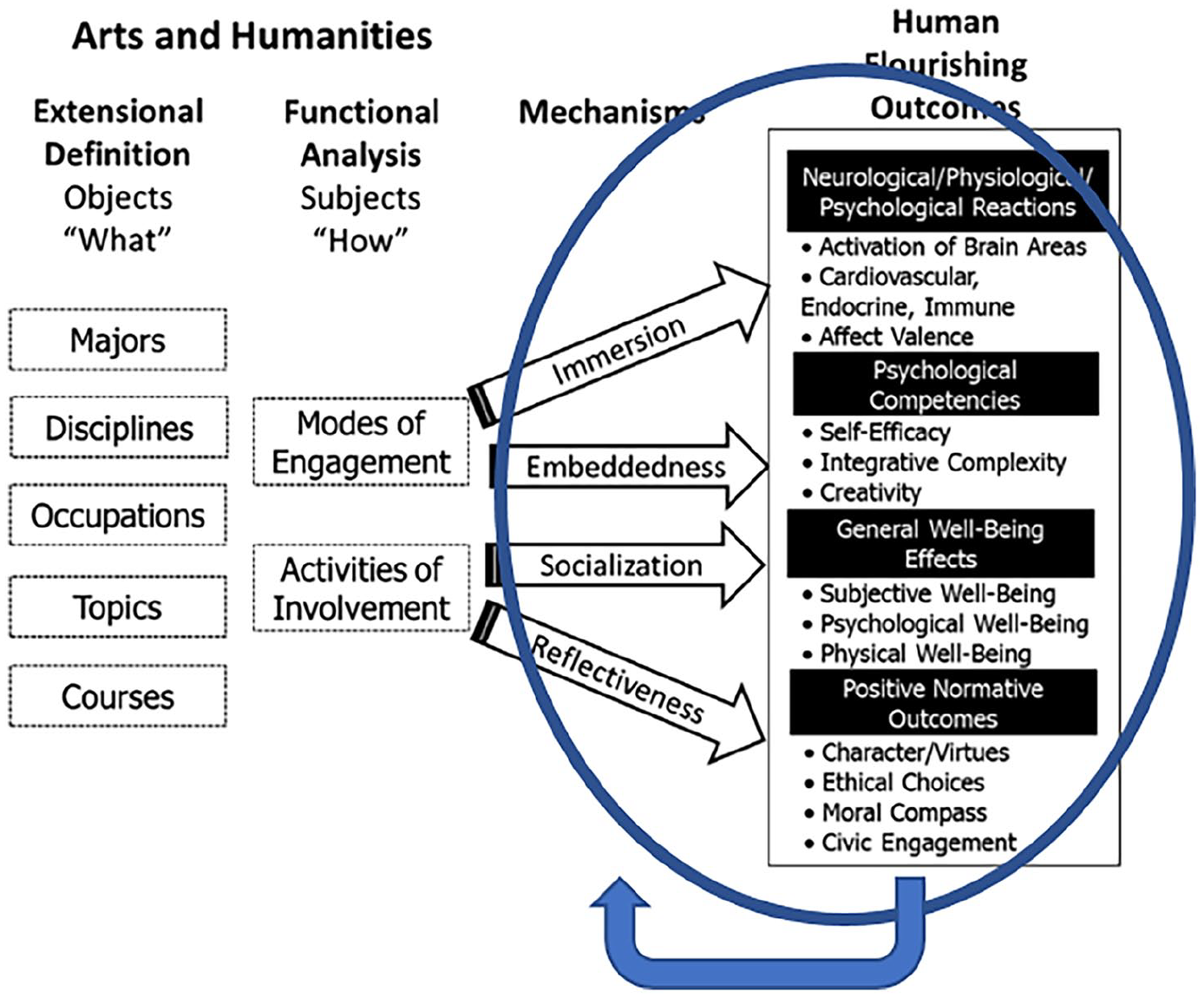
Facilitating Human Flourishing Outcomes Through Engagement with Poetic Inquiry.
Poetic inquiry as knowledge creation
Horvath and Carpenter (2020) argue that there is increasing recognition that alternative approaches to knowledge production “can lead to much greater societal benefits” (p. 1). Accordingly, this project takes an exploratory approach, using arts-based methodologies to explore what flourishing means and sounds like to young musicians.
Poetic inquiry can take the form of three fundamental approaches: poetic transcription, research poems and evaluation of existing, relevant pieces of poetry (Bishop & Willis, 2014). The approach that most aligns with ours is that of poetic transcription. However, a key point of departure from the strategies in most texts is that we were the facilitators of the poetic transcriptions generated by the participants in response to our stimulus (the PERMA framework). This approach is similar to Lafreniere and Cox (2013), who employed a team of social science/philosophers, graduate students and undergraduate students enrolled in courses on ethics or poetry to create poetry from interview transcripts. In their case, the words/experiences used as the basis of the poetry were created by other, initial research participants. In our study, however, the transcripts were generated through interviews with the young participants, who then were taught how to use transcribed poetry approaches to elicit their own poems/lyrics. The purpose for the participants was to distill their own ideas around “flourishing.”
During these workshops, participants were deliberately guided through questions that enabled them to reflect on Seligman’s (2011) PERMA themes of flourishing in their lives (see Figure 2). These reflections were transcribed, and participants were carefully instructed in the Poetic Inquiry approach to form lyrics for a song they would later put to music. Therefore, the lyrics for the music they created (with guidance from community musicians and researchers) were derived through utilising the Poetic Inquiry approach (Prendergast, 2006; Wiggins, 2011).
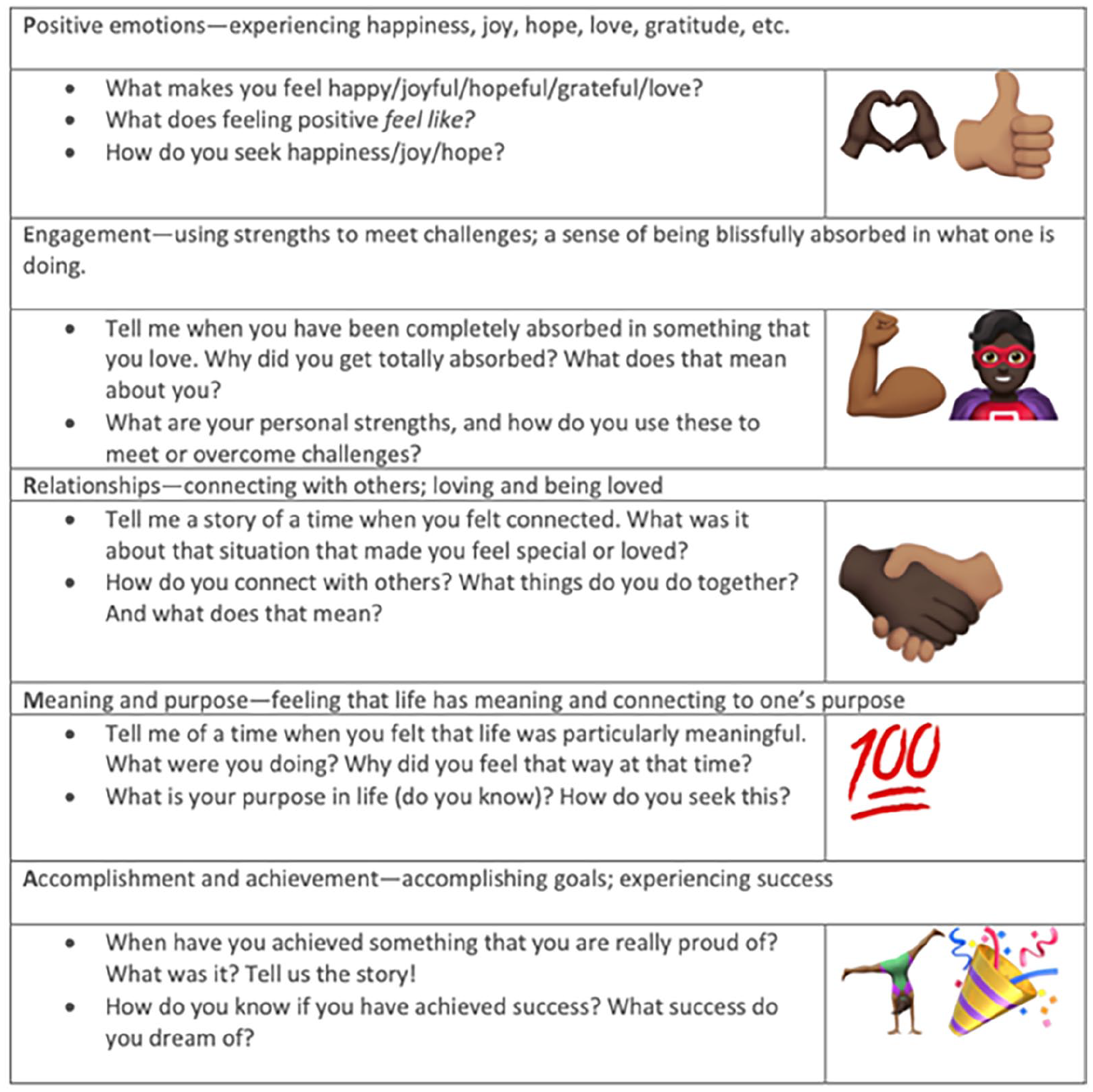
Poetic Inquiry PERMA Framework Participant Discussion Prompt Worksheet.
Poetic inquiry as a research process
Prior work in this area (as described by Wiggins, 2011) inspired the process for this project, with the departure being that the impetus for our work with a reflection on personal flourishing, and the participants were aware right from the beginning that their transcripts would be the basis for their songwriting. Following Wiggins, we initially intended to create a poetic constructed or imagined conversation between all participants as the basis for a collaborative work, where the lyrics emerged from the discussions with participants but collated by us, the researchers. Thus, the project design initially looked like this:
Interview participants asking them to describe their ideas about “flourishing”
Pull references to each of the pillars from the data—separating into P, E, R, M, and A. Anonymize participant contributions.
Weave some of the comments into an imagined conversation that never occurred, lifting quotes from the data and juxtaposing them with quotes that might have been there if the conversation had happened.
Present a copy of the constructed conversation to all participants whose words appear and any others who happen to be at the workshop.
Ask them to decide whether the conversation seems plausible.
Spend the rest of the workshops creating musical representations of the collaborative lyrics.
However, because the participants indicated in the first session that they would like to each make individual pieces of music, we were required to rapidly adapt the process. This methodological decision, which privileged participants’ ownership of the lyrics, was intentionally made because although we could, as external researchers, create poetry from their transcripts, the purpose was to empower the participants by enabling them to create their own lyrics and to preference their own specific stories in their arts creations.
Music making as knowledge creation
After creating lyrics, participants worked one-on-one and in small groups with facilitators to craft melodies for their lyrics and additional music elements like beats, chord progressions and secondary instrumental parts. This process extended over four workshops. Workshop facilitators had different musical specialisations—singing, playing the guitar, playing the piano, rapping, making beats, arranging samples, and general music production. Participants began their music creation process with whichever facilitator they preferred, with some facilitators talking through ideas, listening to music, or jamming based on the participant’s preferred entry point. Participants formed strong friendship bonds and often supported one another through the music creation process, listening, experimenting, and giving feedback in a fluid, collaborative way.
Each workshop had a similar structure, with the whole group coming together, acknowledging Country, talking about how they were feeling that day, and their hopes for the workshop. The workshop would progress based on those discussions and the needs established in conversation. A wrap-up session finished each workshop with participants assessing how they felt after the creative process, sharing their music and listening to feedback from the group.
The first two music-based workshops were oriented around songwriting and composition—with participants and facilitators working out key elements like melodies and hooks and fleshing out a song structure. Participants would perform the songs, tweak music and lyrical elements, and perform again until the song settled into its final form. The latter two workshops were oriented around recording the songs, with each participant getting individual time with facilitators to capture their track. Facilitators played instruments and made beats to accompany the vocals. Participants, facilitators and supporting youth workers sang harmony parts for the recordings. The recording process included moments of listening, reflecting, and completing additional takes based on how the participants felt about their recordings. Two of the participants felt especially vulnerable during their recording process. The facilitators, experienced with running songwriting workshops in youth settings, took time to work out how they could be made more comfortable and adapted the physical room to accommodate, in one instance, making the environment feel more private by turning out the lights and in another instance by clearing observers from the room entirely. Notably, the two participants who felt vulnerable while recording described feeling empowered by being supported to complete the recording, with both noting that singing for a recording was something they previously thought they could not do. Both participants had written lyrics about growing strong through their experiences, and this seemed to be reinforced via their music creation process.
After the formal research process had concluded, a research team member completed polished studio recordings for each participant in the style of a commercially released single. A follow-up series of four workshops was then held, where the researcher, supported by youth workers from the organisation, re-worked the songs, mixing with each participant until the final musical artefact felt complete and in line with their taste. Digital audio workstation files, mix stems, and a mastered stereo recording were then given to participants to use however they saw fit. These music files were also incorporated into the City Symphony app with the participant’s permission and after placement consultation.
The SEEC process in action
The SEEC process (Figure 3) comprises five stages: the phenomenon-focussed interview; the creation of the transcript; teaching the technique of poetic inquiry and text creation; the create-refine-reflect cycle; and the artistic output.
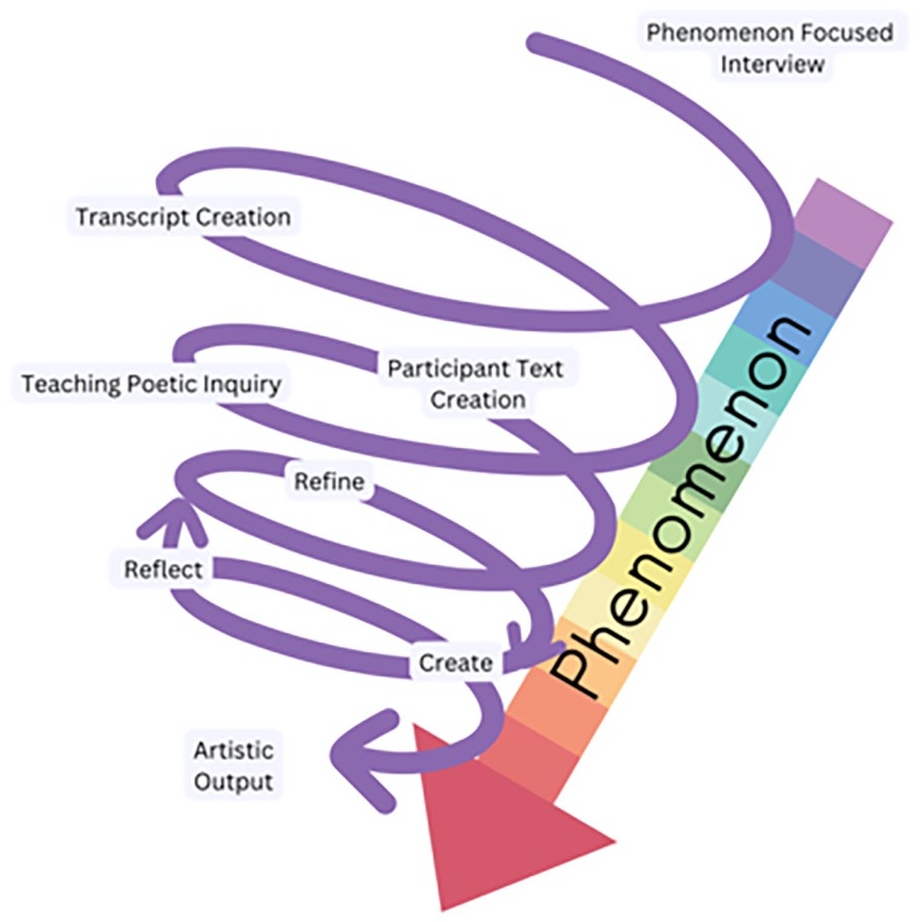
The Spiralling Engagement Experiences of Creativity (SEEC) Process.
Two aspects of the process would be specific to each implementation instance: the phenomenon under consideration (in this instance, the notion of flourishing as described by Seligman, 2011) and the artistic output (in this instance, a song, but it could equally be a poem or another kind of artwork). Naturally, the process’s context varies, but this is the case in any research endeavour. These stages are briefly outlined in Table 1, and the implementation in the context of this study (conducted over six 3-hour long sessions over 10 weeks), is described.
The SEEC Process in Practice.
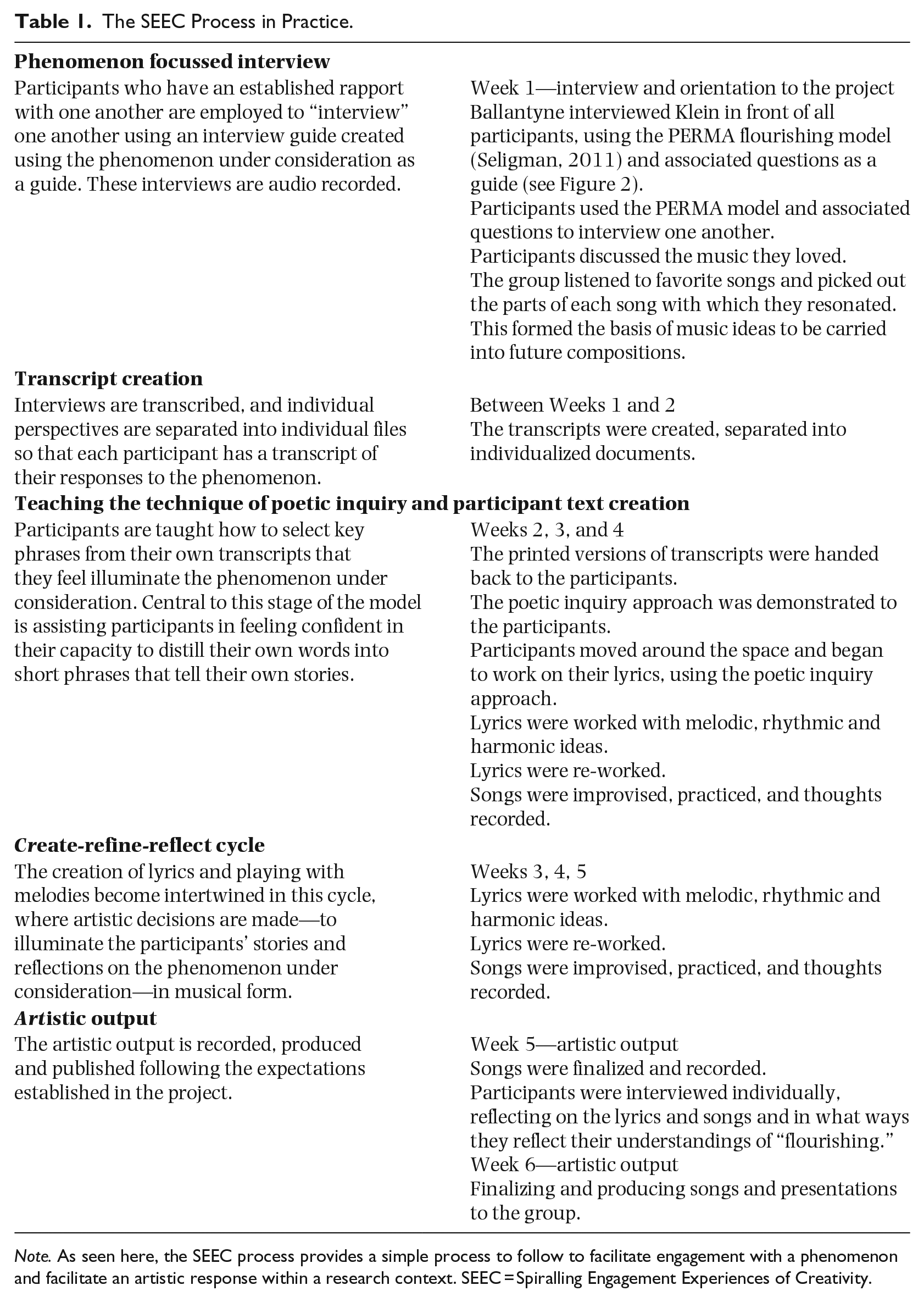
Note. As seen here, the SEEC process provides a simple process to follow to facilitate engagement with a phenomenon and facilitate an artistic response within a research context. SEEC = Spiralling Engagement Experiences of Creativity.
Findings
Art, music and poetry are at their most powerful when they speak directly to the audience without the need for interpretation or context. This research process has resulted in a number of carefully crafted artworks.
The temptation (for us, as researchers) to comment on how these poems align with the phenomenon under question is strong. And yet, in the spirit of Poetic Inquiry, we let readers draw their own conclusions. In this way, we respond to the call issued by Galvin and Prendergast (2016) to address the tendency in qualitative research to attend to the risk of “appropriate[ing], over-shadow[ing] or even silenc[ing]” participants’ voices (p. xi). The words in the poems result from a deep and embedded creative cycle, and they, therefore, stand on their own, requiring engagement from the reader. As Freeman (2017) writes: “researchers using poetical thinking strategies believe that providing provocative, artistic expressions of their encounters with their topic of inquiry or data provides a significant contribution to human research. It does this by creating a collaborative, performative space where researchers, participants, and audiences can make sense of lived life together” (Freeman, 2017, p. 83).
In the spirit of artistic practice as research and following the research method of Poetic Inquiry, the artistic outputs are considered the investigation’s “findings.” We acknowledge the debate described by Lafrenière and Cox (2013) regarding whether artistic works created to represent research need criteria to establish the quality and effectiveness of them as findings and hold particularly to the criteria relating to the end product, specifically the performative criteria in their framework (emotions/feelings; understanding; response; change). As researchers, we have selected these three artworks because we assessed that they had an effect on us, as audience, when represented as findings. Accordingly, in the spirit of conversation, we suggest readers of this paper absorb these lyrics and ask themselves the questions suggested by Lafrenière and Cox (2013) to determine for themselves whether these artworks have an effect. Do these artworks-as-research-as-findings reveal new knowledge in relation to these participants’ experiences of flourishing as expressed by their artworks?
Emotions/feelings. Does the arts-based work generate emotions and/or feelings? Are these instructive about the experience being conveyed?
Understanding. Does the artistic work help the reader/audience notice, understand and appraise the issues at stake? Is the arts-based work useful in presenting an alternative perspective? Does it inform?
Response. Is the arts-based work accessible to its targeted audience (e.g. language used)? Does it generate internal dialogue or prompt interpersonal discussion so that it furthers engagement and response?
Change. Does the artwork move the audience to change in salient ways (e.g. broaden or focus their opinion about a situation, shift their understanding of an experience, contribute to meaningful change in policy, regulations, etc.)? (Lafrenière & Cox, 2013, p. 331)
These artworks are owned by their creators, not constructed by researchers trying to interpret others’ experiences of flourishing. The lyrics are therefore presented as they were created by participants (pseudonyms used) without commentary:
Trying to get out of my comfort zone
Doing a lot of things ‘cause I’m not that old
Studying cause I’m not drinkin’ beer
All the while mind is clear.
It helps my mind wonder
Cause I’ve got my older brother
He knows some of my weaknesses
Gave it to him, now he know my fear
Now he knows I ain’t having beer
We on the same length but I got my own strength
Cause I’m not dying
I’m surviving and I’ll make it out alive
I won’t fall any deeper
I’m not a creeper.
Watch me fly
Watch me fly
Watch me fly
Like a phoenix I will rise
I will rise I will rise I will fly higher than you thought I could I will watch you from the top As you fall lower Lower than the roots in the soil I will bloom like the flowers in the Dreamtime. Using powers that you hid from me Since I was young Watch me fly Watch me fly Watch me fly Like a phoenix I will rise I will rise I will rise I have so many thoughts, ideas and emotions but just can’t seem to get them out I’ve gone through so much yet still see the good in life I’ve gone through so much yet I’m still here It’s like I’ve just been in some type of game. Just being played If only life was like the flowers I sketch in my book. Life would be a beautiful flower My brain is just a labyrinth, everyone getting in my headspace My family tell me I’m never going anywhere, won’t make a name for myself I’m here to rise up above them looking down and prove them all wrong!
Watch me fly
Watch me fly
Watch me fly
Like a phoenix I will rise
I will rise
There’s a place in my heart with
crystal clear waters
Sunny skies, butterflies,
Waterfalls and rockslides
Jumping from the top
We had no fear.
Now,
Don’t be scared
Stay fearless
So don’t shy away
Be confident
There’s a song in my soul that needs to be sung.
Reach for the sky no matter how young.
Be strong and you’ll make it, so
Don’t be scared
Stay fearless
So don’t shy away
Be confident
Stay connected to that place
Your Country your safe space
Bright grasslands
Red dirt roads
Smooth white sand
Coral reef,
The smell of rain
Floating in the water
Tall trees, two homes, two worlds
Country and coastal
Don’t be scared
Stay fearless
So don’t shy away
Be confident
It’ll get hard, you’ll change and grow
but you’ll make it through
Don’t be scared
Stay fearless
You’ll be fine stay strong
So don’t be scared
Stay fearless
Discussion and conclusions
Our research investigated whether and how flourishing might inform a deliberate research and arts-making framework and reveal the intersection of flourishing and arts creation to participants and the research community. We found that teaching poetic inquiry to illuminate individual participants’ views on a phenomenon emerged in this pilot as a powerful qualitative tool. The SEEC process could easily be adapted to other artistic endeavours and provide a strategy to facilitate future artworks arising from various phenomena. We believe that sharing this research approach enables consideration of a new way to enmesh research processes and creative outputs whilst enhancing participants’ lives. This approach privileges the production of creative outputs and research that draw from and illuminate participants’ perceptions and experiences.
In this work, the PERMA flourishing framework provided participants with a way to explore positive aspects of their experience, which they were not experienced at articulating. This enabled individual, authentic stories to emerge. Two participants utilised poetic inquiry as the impetus for their work but turned final lyrics into love songs which diverged from the thematic focus of flourishing. For reasons of brevity, we have presented above only the lyrics where participants retained focus on the phenomenon of enquiry for the duration of the workshops. While the love songs do not feature in this article, they are featured as public artistic outputs of the project. As researchers, our priority was to foreground the creative engagement of participants, and we were happy for participants to change focus if that served their interests better.
Poetic inquiry enabled young people’s voices to be actualised, whilst demystifying the process of lyric creation. We also found that the process has the potential to move participants quickly to the part of artistic creation where they are making choices and being creative. It removed the “writer’s block” that can sometimes exist at the beginning of a creative process.
In this project, expertise as a musician was not crucial to creating authentic and creatively sophisticated works. In our estimation, the works fully encapsulate the “quality” argument put forth by Lafrenière and Cox (2013, p. 321) that “an example of a relevant quality of a research poem . . . would be the vividness with which the poem conjures an image, sound or feeling.” In our pilot, all participants were novice musicians capable of expressing musical ideas after the lyrics were formulated, moving easily between the creative systems of commercial record production (performing, songwriting, engineering, and producing) with assistance from project facilitators (see Thompson, 2019).
We found that an extended engagement over many weeks was required to establish trust and grow confidence. This is consistent with the AIATSIS Code of Ethics expectations, which foregrounds building relationships based on trust as a foundational ethical principle (AIATSIS, 2022, p. 14). In our pilot, fewer than 6 weeks would have proved difficult and resulted in less meaningful engagement and collaboration experiences and arguably less refined artworks. Although we used poetic inquiry as a tool, in terms of embodying their ideas around flourishing, the music itself was the catalyst for engagement and the central motivator for ongoing engagement. Indeed, a musical output was viewed as the main impetus for an extended engagement. It is highly likely that the project would not have succeeded if we were merely asking the participants to engage in poetic inquiry.
In conclusion, this article revealed how a process of deliberately guiding participants toward songwriting on the topic of “flourishing” might inform a deliberate research and arts-making framework and reveal the intersection of flourishing and arts creation to participants and the research community. The SEEC process has the potential for use in a variety of contexts. With the phenomenon remaining as “flourishing,” this has already been implemented in professional development contexts with musicians and music teachers to assist them in coming to a better understanding of the ways in which they flourish in their careers. We also see the potential for this process to be trialled in professional development/research where participants might like to explore other topics or ideas (phenomena) in more depth. We imagine future songwriting research processes that facilitate songwriting to understand people’s response to the climate crisis or to better understand memories of childhood. Such topics are almost endless but probably should be designed to enhance participants’ understanding of their own responses to such topics. The creation of songs, created by participants and honed over a period of time in response to a research topic, has the capacity to reveal much both to the participants and the research community in a way that more traditional approaches to research may not.
Footnotes
Funding
The author(s) disclosed receipt of the following financial support for the research, authorship, and/or publication of this article: We would like to gratefully acknowledge the musicians, social workers, participants and our Faculty at the University of Queensland for believing in, contributing towards, and supporting this project.
