




Abstract
This study aimed to shed light on the role of music in maladaptive daydreaming (MD), a psychological condition characterized by excessive, immersive daydreaming that interferes with well-being and functioning. Forty-one individuals with probable MD participated in asynchronous in-depth email interviews. A thematic analysis yielded three themes describing the role of music in MD. Two homogeneous themes pertained to outlier experiences: Music necessary and Music not desired. The third theme, Music enhances the MD experience, encompassed most of the data retrieved in this study and was further divided into five subthemes: Music avoided in “low energy” daydreaming scenes, Music as white noise, Music enhances MD creativity, Music as an MD trigger compromises the sense of agency; and Music as a powerful immerser that sets MD’s emotional “soundtrack.” This study adds to the sparse knowledge of complex visual narratives and identifies the essential role of music in inducing and formatting MD. The results led to the conclusion that music might be instrumental in MD by distancing the person from the external reality, triggering complex visual storylines, deepening the altered state of consciousness, and intensifying the vividness of the daydreamed plot by invoking an emotional response. Furthermore, hypothesis-driven controlled research was recommended.
Keywords
I always use music to daydream. I am able to daydream without it, but I won’t get euphoric, so I use it to feel very happy. It also makes me disconnect more efficiently. The first time I had a vivid daydream, I was 9 . . . Grandma gave me a CD player as a birthday gift. I closed the door . . . I was completely alone. I put the only CD I had: the soundtrack of my favorite TV cartoon, and I listened to it very loudly. Suddenly my heart was beating fast . . . it felt like the music had awakened something powerful inside me that I couldn’t explain . . . I made strange moves with my hands and legs as if I was dancing . . . Then I felt a bit dizzy, and my bedroom was gone. Suddenly, I was at a beautiful park on a sunny day, and my teacher and classmates started interacting with me. That daydream was so enjoyable and cool that I felt bad when it ended. A feeling of being incomplete and miserable. It happened when the music ended. When it ended, I was back in my bedroom, unhappy. So I put the same song to play again, and suddenly my daydream was there: the same park, same people, like a story waiting to be continued. (Mindy)
Visual mental imagery appears to be a common phenomenon during music listening, often leading to evoked emotion (Juslin et al., 2008). Bonny (2002) argued that music, by its ambiguity and complexity, produces altered states of consciousness (ASC). The Guided Imagery and Music (GIM) she developed is a method of psychotherapy that uses music and imagery to access and explore memories, emotions, and beliefs in an ASC. GIM allows access to the inner world of imagery, feeling, and early life experiences.
Visual mental imagery and emotional processes during music listening are closely intertwined. In particular, the emotional tone of the music is linked to the amount and vividness of these mental experiences (Martarelli et al., 2016; Taruffi & Küssner, 2019). Furthermore, happy music can lead to more vivid and positive daydreams, whereas sad music elicits less vivid and more negative daydreams (Martarelli et al., 2016). The evocative power of music was also observed by Herbert (2013), who has contended that listening to music can effectively dissociate from self or surroundings. She argued that a common dissociative function of music is the intentional escaping of preoccupations or unwanted thoughts.
Herbert (2012) argued that music is an effective agent of absorption because it offers several attentional loci of absorptive attention, such as the acoustic attributes of music, including resonance, timbre, rhythm, pitch, and so forth. Headphones may trigger an absorption into the stereophonic spatial features of the music, such as the surround effect or sound played from different points in the virtual space. Music can elicit memories and personal associations, which trigger imaginative involvement; physical activation and synchronization with the music are also potentially absorptive; and emotional activation by music can deepen immersion in the experience (Wells & Stevens, 1984). All these captivating foci of attention are musical features that may support the induction of a powerful immersion akin to a hypnotic trance.
The idea that music can be an effective method of dissociating from self or surroundings has been shown previously by Aldridge and Fachner (2006). Their data suggest that music’s dissociative function is to escape preoccupations or unwanted thoughts. This idea was supported by Saarikallio and Erkkilä (2007), who reported that adolescents frequently use music as a means of diversion from undesirable moods or life events due to its mood regulation effect and as a tool for self-determination of individual mood states. Exploring the intricate relationship between visual mental imagery, emotional processes, and music provides a nuanced understanding of how music engages the human psyche. Building upon these connections, this study explores a distinct yet interconnected psychological phenomenon: maladaptive daydreaming (MD). In the subsequent section, we delve into the construct of MD through a review of pertinent literature.
In this qualitative study, I aim to explore the role of music in MD, a distinct clinical phenomenon characterized by an addictive-compulsive engagement in vivid imaginative experiences involving intricate scenarios, often accompanied by stereotypical movements while listening to emotionally evocative music. These behavioral patterns become maladaptive due to the resulting distress and disruption of daily functioning (Schimmenti et al., 2019; Schupak & Rosenthal, 2009; Somer, 2002). The immersive capacity of daydreaming offers substantial gratification. Still, it can escalate into a time-consuming and deleterious behavior that impairs crucial obligations, akin to other forms of behavioral addiction (Bigelsen et al., 2016; Pietkiewicz et al., 2018). A recent conceptualization of MD by Soffer-Dudek and Somer (2022) characterized MD as a disorder of dissociative absorption. Dissociative absorption is a psychological phenomenon in which an individual becomes deeply engrossed and immersed in a sensory or cognitive experience to the point of obliviousness to one’s surroundings and reduced self-awareness. This absorption can be so profound that the person may feel disconnected from their body and sense of identity. It is often associated with activities like daydreaming, intense focus on a book or movie, or even during meditative or spiritual practices (Soffer-Dudek et al., 2015).
Despite the scarcity of scientific investigation regarding this emerging construct in psychiatry, many individuals across online platforms have enthusiastically adopted the term, expressing excitement upon discovering a vast community of fellow strugglers engaging in this mental activity. Various online forums devoted to MD boast substantial memberships, such as the “Reddit” MD community, which currently comprises over 100,500 members (from www.reddit.com/r/MaladaptiveDreaming, retrieved on July 30th, 2023). Furthermore, a Google search for the term “maladaptive daydreaming” yielded 1,310,000 results in the “all results” search category and 440,000 results in the verbatim search category (retrieved on December 6, 2023).
Since the publication of the seminal paper on MD (Somer, 2002), I have received thousands of email messages from people coping with MD, requesting and providing information about MD—a communication process described by Bershtling and Somer (2018). The opening quote in this article is one among the myriad emails gathered. It describes the role music plays in this highly absorptive form of daydreaming. Many of the email messages received indicated that music is crucial in triggering and maintaining the fantasy and evoking its accompanying feelings. The original 14-item Maladaptive Daydreaming Scale (MDS; Somer, Lehrfeld, et al., 2016) had not contained any items on the role of music in MD. Following consistent guidance from members of the MD community, we revised the original MDS and proposed a set of diagnostic criteria for developing a valid nosology. The new and validated 16-item MDS (MDS-16, Somer, Soffer-Dudek, et al., 2017) contains two music-related items: “Some people notice that certain music can trigger their daydreaming. To what extent does music activate your daydreaming?” (Item 1) and “Some people find it hard to maintain their daydreaming when not listening to music. To what extent is your daydreaming dependent on continued listening to music?” (Item 16).
The suggested diagnostic criteria for MD (Somer, Soffer-Dudek, et al., 2017) are contingent upon persistent and recurring fantasy engagement for at least 6 months, characterized by vivid and imaginative experiences denoted by a profound sense of absorption and immersion, encompassing visual, auditory, or affective dimensions. The suggested diagnostic criteria also require at least one additional feature, such as daydreaming triggered, sustained, or intensified by music exposure or stereotypical movements (e.g., pacing, rocking, hand movements). Furthermore, individuals experiencing MD typically yearn to daydream when prevented, along with repeated unsuccessful attempts to control or reduce their daydreaming episodes. These symptoms often lead to clinically significant distress or impairment in important domains of functioning, including social and occupational areas. Notably, the diagnostic criteria for MD necessitate ruling out alternative explanations such as substance use or other underlying conditions.
In addition to stereotypical movements like pacing, rocking, and mouthing (Bigelsen & Schupak, 2011; Somer, 2002), intentional exposure to specific music tracks often characterizes MD (Somer, Somer, & Jopp, 2016). While immersive daydreaming can be the gratifying creation of intricate storylines (Somer, 2002), it can become maladaptive when consuming too much waking time. Immersive daydreaming becomes problematic when it interferes with functioning in social, academic, or occupational arenas or causes clinically significant distress (Pietkiewicz et al., 2013; Schimmenti et al., 2019; Schupak & Rosenthal, 2009).
There are similar characteristics of MD to those of other behavioral addictions, including an intense craving to engage in the behavior, annoyance whenever it is not feasible, and unsuccessful attempts to control, reduce, or stop it with no success (Pietkiewicz et al., 2018; Soffer-Dudek et al., 2020). Often used initially to cope with distress (Somer, 2002), MD is frequently linked to elevated comorbid psychopathology (Somer, Soffer-Dudek, & Ross, 2017) and subsequent negative emotions (Soffer-Dudek & Somer, 2018; Wen et al., 2022).
Daydreaming is often confused with mind-wandering (MW), although the two constructs differ. MW is a regular, transient mental activity that occurs when a person’s attention drifts away from the current task or external environment toward unrelated mental content (Smallwood & Schooler, 2015). It involves internal thoughts, memories, fantasies, or unrelated topics and may serve such cognitive functions as problem-solving and planning (Fox et al., 2015). During this state, the brain often exhibits a pattern of activity called the default mode network (DMN). The DMN is a network of brain regions active when the mind is at rest and not focused on the external environment. These regions include the medial prefrontal cortex, posterior cingulate cortex, and regions of the parietal lobe (Raichle, 2015).
Conversely, mindful attention is associated with reduced DMN activity compared with MW, which is often independent of the practitioner’s attention focus (i.e., internal vs. external; Scheibner et al., 2017). Immersive daydreaming is an absorptive form of mindful attention to generate vivid imaginary storylines. When immersive daydreaming is excessive and interferes with daily functioning and responsibilities, it becomes maladaptive. During immersive and maladaptive daydreaming, the mind is not wandering off-task but instead focused on creating fanciful scenarios that can become time-consuming. These daydreams can interfere with concentrating, meeting real-life responsibilities, and maintaining relationships (Somer, 2002; Somer, Somer, & Jopp, 2016).
Research shows music can consistently affect mental imagery (Dahl et al., 2022). Thought content in spontaneously evoked MW seems to be associated with the perceived emotional tone of played music (Deil et al., 2022). For example, heroic-sounding music produced more positive, exciting, constructive, and motivating thoughts, whereas sad-sounding music evoked more calm or demotivating thoughts (Koelsch et al., 2019). Furthermore, recent evidence shows that music can also affect the vividness, sentiment, and content of directed imagination (Herff et al., 2021). However, little is known about the role of intentionally listener-chosen music in shaping the desired fantasy experience in MD. This inquiry aims to learn from individuals who daydream immersively and excessively about the functions of music in MD and its meaning.
The use of music in MD is widely discussed in Internet communities. For example, Reddit’s 106,000-strong MD community (https://www.reddit.com/r/MaladaptiveDreaming/, retrieved December 6, 2023) often chats about the role of music in their fantasies. To gain a more nuanced understanding of these under-researched phenomena, I launched a systematic exploratory research study. I conducted in-depth interviews with individuals exhibiting heightened symptoms of MD with the primary objective of collecting extensive information related to the study’s research question: What is music’s lived experience and function during MD?
Method
Design
I approached the data from an inductive thematic analysis perspective that included compiling the interview responses, anonymizing them, and following coding stages. Thematic analysis is an iterative process that allows for capturing and representing participants’ voices and experiences authentically, giving them a central role in shaping the study’s outcomes and the ensuing development of theory (Braun & Clarke, 2006).
Materials
The interview guide
The study’s overarching research question was as follows: What is music’s lived experience and function during MD? The research interview followed a pre-prepared interview guide that was designed to generate rich data on the main research question. The research guide occasionally diverged from it to explore spontaneously shared information or seek clarification. It included the following grand tour questions: Describe the experience of listening to music during MD; how different is it from listening to music without MD? How does music affect your MD? What is the role of music in your MD? Can you attempt to do MD without music? What is the experience like?
“Email interviewing” is a novel research method that offers unique potential for qualitative researchers (Hawkins, 2018). In synchronous interviews, the interviewer and interviewee are online simultaneously, and questions are posed sequentially in real time. In asynchronous interviews, respondents receive questions by email, which they reply to at their convenience (Gibson et al., 2017). Asynchronous email interviews can occur over various intervals, offering flexibility and a greater opportunity to ponder the answers (Golding, 2014). Amri et al. (2021) discussed the merit of asynchronous email interviews for health research. They mentioned the opportunity to think carefully through the wording of each response, the optimization of anonymity, and the relief from time pressure as significant advantages. My preference for this form of data collection was also guided by its easy accommodation to busy schedules or time zone differences. Another advantage of this methodology related to participant capacity: Email interviews contribute to participant-centered research by empowering participants to articulate their thoughts and experiences in their own words and at their own pace. Furthermore, asynchronous email interviews generate a written record of the participant’s responses, facilitating comprehensive data collection that allows reviewing the interviews multiple times, ensuring accurate interpretation and analysis of the data.
The 16-item Maladaptive Daydreaming Scale (MDS-16; Somer, Lehrfeld, et al., 2016; Somer, Soffer-Dudek, et al., 2017) is a self-report questionnaire designed to assess the presence and severity of maladaptive daydreaming tendencies in individuals. The MDS-16 is a self-report Likert-scale questionnaire designed to evaluate the characteristics and symptoms of MD with scores ranging from 0% to 100%, indicating the frequency of the respondent’s experiences. For scoring purposes, each item is assigned a numerical value corresponding to the chosen response. The respondent’s MDS-16 score is the obtained mean. Items inquire about triggers to daydreaming, physical movements, and music that accompany daydreaming, how daydreaming feels, how interruptions or being denied the chance to daydream feel, and the impact of daydreaming on daily life.
Participants
As Patton (2002) argued, qualitative research should use purposeful sampling to select cases with the most relevant information on a particular topic. A recruitment effort was initiated to enlist participants from a list of volunteers who self-identified as coping with MD, were proficient in English, and were aged 18 years or above. These volunteers had previously indicated their willingness to participate in MD research. Two hundred individuals fitting these criteria received an explanation of the study’s aims and procedure and an invitation to participate. Fifty-two respondents were interested in the research topic and signed an informed consent form. Out of the initial cohort, 41 participants achieved a mean MDS-16 score equal to or higher than 40, the established cutoff mean score denoting probable MD, as indicated by Soffer-Dudek (2021). These 41 individuals were invited to participate in an asynchronous email interview study.
The participants were located in various regions across the globe, representing the following five continents: Asia (13), North America (11), Europe (8), South America (6), and Africa (3). Eleven respondents were male, whereas the remaining were female. Their mean age was 31.3 years (SD = 10.3), ranging from 18 to 62. Most respondents (31) indicated being single, whereas three were divorced, one was a widow, and six were married or in a committed relationship.
Regarding educational background, nine participants had completed high school, some college education, or a diploma; 17 had obtained a Bachelor’s degree or were pursuing graduate studies; 10 had achieved a Master’s degree, and five had completed their doctoral-level education. Their employment status was as follows: 22 individuals were employed, one was retired, and the remainder were unemployed. The mean MDS-16 score of the sample was 61.4 (SD = 12.4), with scores ranging from 40 to 99. Consequently, the typical participant in this culturally diverse sample was an unmarried, well-educated female in her 30s, exhibiting an MD score well above the clinical cutoff score of 40. Notably, the sample showed a 46% unemployment rate and less than 15% were married or in a relationship, potentially demonstrating the functional and social challenges facing persons with MD.
Procedure
I offered no compensation to respondents, so participation in this study was voluntary. I requested that participants try to respond within 48 hr to my emailed questions. Participants were encouraged to provide rich responses with illustrative examples and no word limit. I sent a reminder if no response was received within 72 hr. Except for four individuals who did not respond to specific follow-up questions, there were no dropouts among this highly motivated sample, and all other questions were fully answered.
The study was approved by the Ethics Committee of the University of Haifa Faculty of Social Welfare and Health Studies (Approval # 407/22). Following the ethics guidelines, the data underwent anonymization after collection and before the commencement of data analysis.
Data analysis
My research assistant, a graduate student, and I read and re-read the email responses to identify potential themes. In the second round of analysis, we reviewed these initial codes separately. We focused on retaining the initial codes’ range while producing subthemes. In analyzing the data, we were informed by the research question: What is music’s lived experience and function during MD? In the third analysis stage, we identified quotes congruent with the identified themes. Next, we defined the themes and subthemes after reviewing them. The quoted respondents were identified with pseudonyms.
Results and discussion
My analysis revealed three themes describing the role of music in MD. Two homogeneous themes pertained to outlier experiences: Music necessary and Music not desired. The third theme, Music enhances the MD experience, encompassed most of the data retrieved in this study, and featured in the responses of 36 participants. The theme was further divided into five subthemes, as shown in Figure 1. In this section of the article, I will integrate the results with commentary and previous literature.
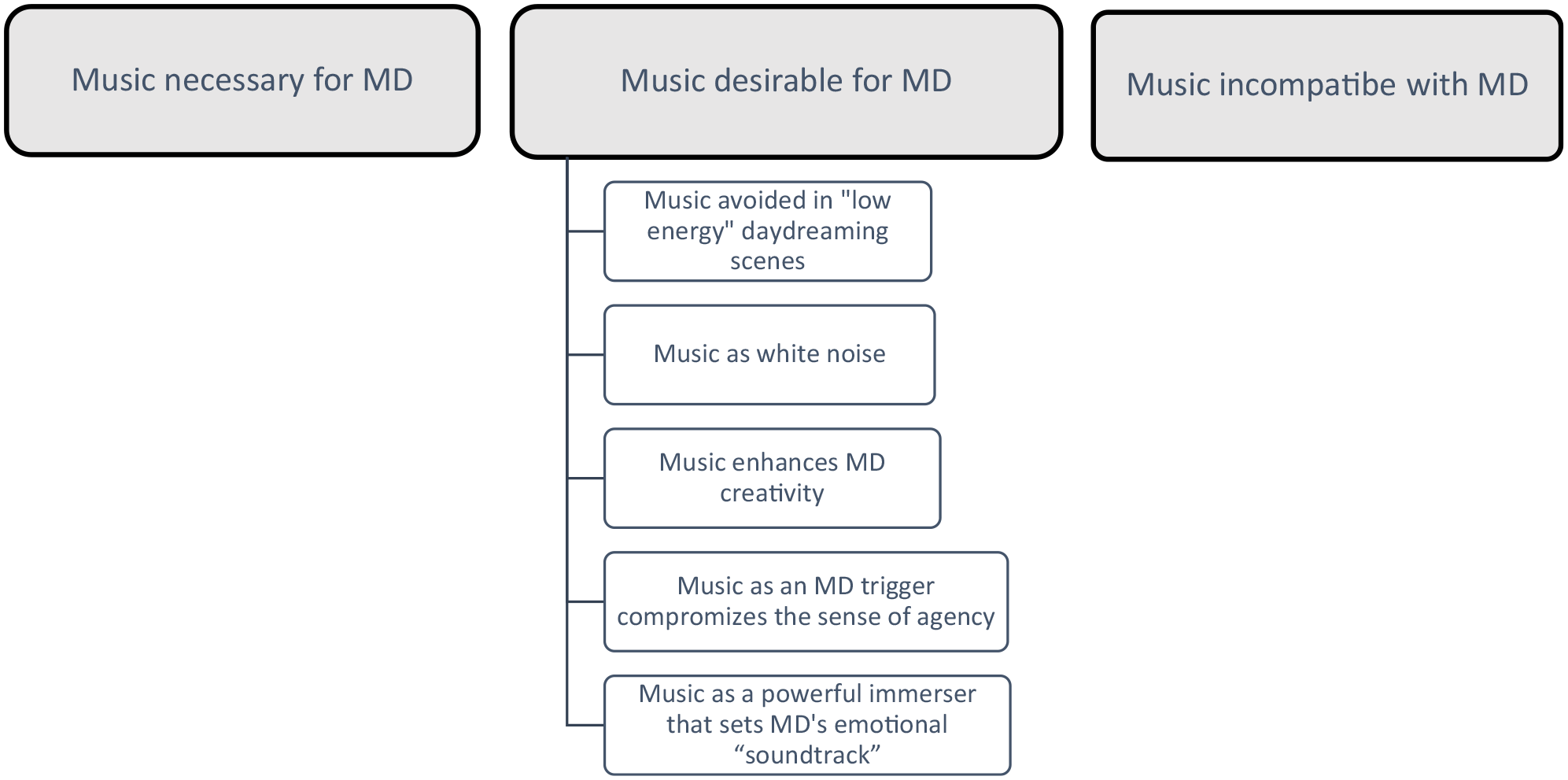
The Role of Music for Individuals with Maladaptive Daydreaming.
Most of the data collected in this study suggest that listening to music during MD is an advantageous option because it enhances the fantasy experience.
Music is desirable for MD
I identified seven variations of the role music plays in MD. In the first two subthemes, the power of music is implied by how it is avoided or selectively employed.
Music is avoided in “low energy” daydreaming scenes
The accounts of a few interlocutors indirectly addressed the impact of music on MD by indicating instances when music is to be avoided or controlled. For example, Emma said, “The daydreams I experience without music reflect my inner desires and medium to long-term goals. These are the daydreams that depict me enjoying a successful career in science, a loving girlfriend or wife, and happy children.” She prefers that fantasies about her most precious aspirations be treasured in an unadulterated fashion and without the impact music typically has on his daydreams: Danielle illustrates how the powerful impact of music is applied with discretion. The role of music depends on the MD. If it’s about me taking an exam, there’s no music. I can MD with no music because there are real-life situations that I would not listen to music, for example when I am someone famous who answers a question in an interview in a very intelligent way, when I teach English at a college in London or when I take an exam and prove a theorem in the blackboard, and I’m doing very well. Though most of the time, my MDs are situations with a lot of people and music.
Danielle differentiates between customary music-laced daydreaming scenes and storylines in which she exerts a concentrated intellectual effort and cannot be influenced by the evocative nature of music. The two examples imply that music has a potent stimulating effect on the MD experience. Music is purposefully shunned when exquisite concentration is required in the imagined scene. One possible explanation for the negative impact of music on concentration is offered by Taruffi (2021). She showed that music-evoked emotions predicted thought valence. MW triggered by music may, therefore, interfere with generating the desired fantasy storyline in MD.
As shown in the next section, in some cases, aural stimulation seemed to function as an isolating barrier, effectively shielding some immersed daydreamers from external reality.
Music as white noise
For some individuals with MD, music does not enhance MD directly. For them, sound is a vehicle for isolation from external distractions. As Carol puts it: “I guess it’s having one of my senses completely occupied that allows me to slip even deeper.” She relates to music as an ear plug rather than an earphone. The following example depicts music as a white noise that enables kinesthesia, a prototypical MD behavior. It facilitates the absorption process: “Music makes it easier to isolate the exterior distractions. It helps with the immersion. If I listen to music on any occasion, I immediately feel a big urge to pace around” (Nora).
The following quote accentuates this particular role of music as white noise. He explicitly indicates that the content and nature of the played music are of no consequence because it is used merely as an induction into the daydreaming state: I do like to listen to any youtube video without watching the video at a minimal volume. I guess it helps me put myself in a state where I feel comfortable moving into my dream world with my eyes open . . . I would simply put on a video or a music podcast at minimal volume and start dreaming. (Dan)
Recently, Schmidt et al. (2020) used the multimodal Ganzfeld (MMGF) technique to induce altered states of consciousness and found a decreased thalamo-cortical coupling, thought to contribute to the emergence of ASC crucially (Vollenweider & Geyer, 2001) and an increase in the centrality of the default mode network (Horn et al., 2014), often associated with MW (Mittner et al., 2016). In MMGF, participants undergo homogeneous visual and auditory stimulation to produce perceptual deprivation through an unstructured sensory environment. A few minutes of MMGF exposure typically induces an absorptive state characterized by inward-directed thoughts and reduced vigilance, which is sometimes described as feeling like an eyes-open, elongated transition state between wakefulness and sleep (Schmidt & Prein, 2019).
Therefore, it is conceivable that one of the functions of music and the stereotypical movements associated with MD (Robinson et al., 2016) is to mask external stimulation by creating an unstructured sensory environment conducive to ASC. Future brain imaging research should shed further light on this question.
Still, a considerable portion of my sample reported that music made an essential, meaningful contribution to their MD experience. The following subthemes capture the unique contribution of melodies to the quality of fantasy in this sample.
Music enhances MD creativity
Unlike the distracted state of mind during MW, immersive and maladaptive daydreaming emerges from an engaged and creative mindset focused on developing internal scenarios, sharing similarities with the creative process involved in filmmaking. It involves scripting, casting, directing, designing sets, props, wardrobes, and filming, deciding on angles, lighting, and points of view. My analysis suggests that music can catalyze creativity in MD. Ellen states squarely: “Music really adds to the overall experience. I feel more creative when I am listening to music. It makes the daydream more exciting and adds emotion to the moment.”
Karen explains that she chooses music to inspire her scripting. She knows the specific effects particular tunes can have on her creativity and the ensuing scripts she will be able to construct: The music boosts my creativity. I use specific songs to inspire me. I can create a daydream centered on depression or sadness if I listen to sad music. If I listen to music like metal, punk, or grunge, then conflict, anger, and rebellion scenes will be my daydreams’ themes.
These qualitative data align with previous evidence that listening to music can stimulate different brain areas, including those involved in creativity and problem-solving (Fink et al., 2009; Koelsch, 2014). The following quote shows that listening to music can inspire daydreaming plots that focus on other art forms: While listening to music, my daydreams are often about the music itself or other artistic activities . . . music appears to provoke thoughts of me painting, drawing, and playing music. These daydreams are more difficult to discontinue once they have begun. (Emma)
While music can be desirable because it leads to more creative fantasies, my respondents report that it can actuate this mental activity, sometimes automatically.
Music as an MD trigger compromises the sense of agency
The data also suggest that music can instigate an immediate immersion in fantasy for some people with MD. “The music triggers the daydream. If there’s music on, I’ll be daydreaming.” says Roy; “It works as a ‘bang’ in my mind. As soon as I can hear music, I feel good AND (sic) I am in one of my Worlds” (Bethany); “Music may be more a trigger than I thought. For example, if I hear military music, I have two characters for that background music, they will come up for daydreaming” (Lora).
An experience of automatism often characterizes the triggering effect of music. The following are typical descriptions: “I can keep myself from daydreaming so long as I maintain concentration, but in the presence of music, that becomes difficult. Daydreaming with music ‘forces’ the daydream to conform to the song” (Aria); If I hear a song I like very much, I can’t help falling into a beautiful romantic daydream . . . I can imagine never ending stories . . . and feel as if they were real. Music is my number one daydream trigger or induction. (Patricia)
Not only is the induction of MD involuntary, but in the presence of music, the sense of agency associated with its interruption is also compromised: . . . when I listen to it (music), I tend to fall into daydreaming. It’s harder to come out of daydreaming if I’m listening to music. I can continue for hours. Therefore, I usually avoid listening to music a lot unless I have lots of free time. (Beatrice)
Visual imagery plays a crucial role in music-evoked emotions, but the mechanisms are unclear (Taruffi & Küssner, 2019; Vuoskoski & Eerola, 2015). Still, the existing empirical studies identified two content categories of music-evoked visual mental imagery. Taruffi et al. (2017) showed that sad music focuses attention inward and generates spontaneous thoughts related to the self and emotional aspects of life. In contrast, happy music evokes more external focus and mental images of dancing.
While the literature shows that sad music can stimulate off-task MW, our data suggest that, in some cases, music can also trigger intentional, pleasurable, and intricate imaginary plots associated with MD. The data presented in this study points to a possible causal relationship between music and the induction of immersive and maladaptive daydreaming. Still, the precise neurocognitive process involved is yet to be explored.
Identification of the direction in which imagery content affects psychological well-being will be crucial. For example, could mood, such as depression, influence the choice of music and the valence of the invoked daydreaming plot? Or does awareness of negative images influence the choice of music? The possible complex relationship between mood, music, and mental images will be discussed in the subtheme titled “Bidirectional influence.”
Music as powerful immerser that sets MD’s emotional “soundtrack.”
Almost all my interlocutors identified music as pivotal in altering their consciousness by creating a formidable, emotionally laced fantasy experience: Music was the main reason why my MD got boosted to a whole new level since I associate mood and feelings with music. They help me express myself better in MD, sometimes lyrics help too, but it’s more or less about the tune that matters. It’s like even if you aren’t sad, but you listen to sad music, you start to feel it. If I’m having an extremely emotional day, music helps me to vent it out properly via MD with high intensity. According to music, my mood fluctuates so does the story in MD. It generally is progressive, i.e., it’ll start with extremely sad or angry music. After I’m done expressing myself, the music selection will move towards more romantic or devotional, and it will set the matching scene. Music is like a mood controller, It’s the tool that helps me tame the angry bull that my mood is. (Quincy)
This typical account portrays music as possessing the power to deepen the daydream by infusing it with cathartic affect. This participant describes a linear causative process in which the person chooses the soundtrack most instrumental in creating a cathartic and emotionally releasing fantasy. I would describe the sequential progression as follows: When experiencing intense feelings, people with MD may turn to play intense music, which facilitates a cathartic daydream and brings relief. This relief can then prompt them to switch to heartening music, triggering a positive daydream.
Aria described music’s deterministic character in starting the daydream and setting its scene: Music typically guides the topic, tone, and pace of the daydream. For example, intense music may induce a daydream that is about two characters having a brawl, i.e., graphic violence as opposed to cartoon or slapstick violence, and pacing that matches the song. For example, characters may hit each other to the beats of the song. Typically, music will significantly increase my ability to daydream and may cause me to daydream even when I am trying to maintain focus.
Many others used the metaphor of “soundtrack” to best describe music’s role as similar to that in the film industry: Music is kind of like the cinematic soundtrack to my daydreams. It can often change the tone or mood of what I am daydreaming in the moment. For example, I may daydream about running or fighting when I listen to upbeat music or epic movie soundtracks. Other times, if I’m listening to something more lowkey, the mood of my daydream may change to something more emotional. (Ellen)
The responders in this study were well aware of how music soundtracks in films create emotions in viewers. Music activates the same brain regions involved in processing emotions, such as the amygdala and the prefrontal cortex. Alluri et al. (2017) found that when participants listened to music congruent with a film clip’s emotional content, their brains showed increased activity in regions associated with emotional processing. Indeed, filmmakers use music to heighten the emotional impact of a particular scene. For example, Baltes and Avramova (2018) showed that when viewers were exposed to emotional movie scenes accompanied by music, they reported experiencing stronger emotional reactions than when the same scenes were presented without music. My respondents have apparently noticed the evocative nature of music and its powerful impact on the instigation of immersive daydreams and discovered music’s influence on MD plots and their emotive intensity.
Finally, I identified two outlier response patterns in the answers of four individuals. While in quantitative research, outliers complicate data analysis, in qualitative research, participants with unique stories are informative because they provide evidence that instances exist that are not in line with a particular theorem.
The two anomalous themes represent participants for whom music is either not desired at all because it is incompatible with MD or music as a condition necessary for MD to occur. Let me first present these two polar relationships with music.
Music incompatible with MD
All but David talked about the various functions music fulfilled in their daydreaming. He put it squarely by saying, “I don’t like music. Unlike other daydreamers, I prefer quiet to music. Music with lyrics in special distracts me.” As with all other participants in this study, this self-identified maladaptive daydreamer had a mean score above the cutoff, indicating probable MD, suggesting that music is incompatible with daydreaming for some individuals with MD. In contrast, there were a few participants for whom MD was impossible without music.
There could be several reasons why music could be undesirable for some individuals: First, music might disrupt their daydreaming process or interfere with the narrative flow. It might distract or hinder their ability to fully immerse themselves in their daydreams. Second, personal preference: Music tastes and preferences vary widely among individuals, and some may simply find that music does not align with the type of daydreams they prefer or enjoy. Third, emotional triggers: Certain types of music might evoke emotional responses that are incompatible with the daydreaming experience or cause discomfort, leading some individuals to avoid music during daydreaming.
Music as necessary for MD
Without music or movement, it is very irritating. It’s like having an itch that you cannot scratch. I imagine it’s like being a child knowing that your friends are outside having so much fun, but you are trapped inside of the house being forced to sit in time out. (Tricia)
This individual has obviously tried to daydream without music and found the experience exasperating, particularly in comparison to the familiar pleasure associated with music-laced fantasy. Following are two additional statements suggesting the essentiality of music to MD to some individuals: “I have to have music going on in my head. I cannot daydream very well without it” (Emanuel); “I can even say that I can’t daydream without music” (William). In contrast to these polarized outlier relationships with music, the data in this study indicate that music plays a range of desirable roles in enhancing fantasy immersion. So, the central theme emerging from this inquiry depicts music as a critical element in a satisfying MD experience.
There are two potential reasons that some participants feel that music is a necessary condition for their daydreaming: First, music might serve as a soothing way of coping, helping some individuals escape from stress, anxiety, or negative emotions by allowing music to act as a form of emotional regulation, offering a safe and comforting environment. Second, altered state of consciousness: The combination of music and daydreaming might create an altered state of consciousness, intensifying the immersive experience, and distancing the person from external reality.
Future research should investigate the underlying factors and individual differences contributing to the divergent experiences of “Music as necessary” and “Music not desired” in MD to understand their potential implications better and inform targeted interventions.
A pictorial insight into music’s impact on MD
The artwork presented in Figure 2 1 was shared by a member of one of the online MD communities. It portrays a young woman sitting at a desk, listening to music while attempting to focus on her work. However, the enjoyable bright music generates a functional paralysis represented by a black hand dripping viscous dark matter that covers the protagonist in monochrome tones. The music, in contrast, and the forming daydream are depicted in bright colors and become the center of attention. This piece titled “When the Escape Became the Prison” illustrates the triggering effect of music that sets off the colorful fantasy. The picture also demonstrates the protagonist’s compromised sense of agency. Despite her efforts, the young woman’s sense of self-governance is compromised as she is prevented from attending to her real-world tasks.
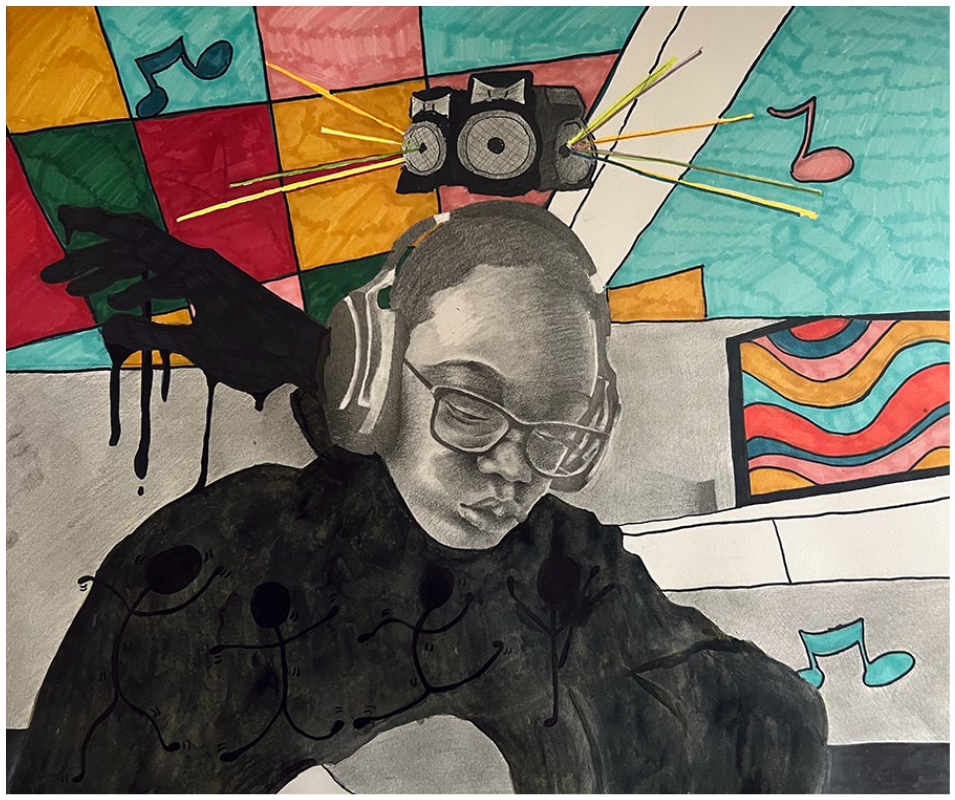
Music in MD by Kristine Clyde.
Limitations and future research
Several limitations should be considered when evaluating the outcome of this study.
Transferability
Transferability is a term commonly associated with qualitative studies, emphasizing the applicability of findings to similar contexts rather than making broad population-level claims, as in quantitative research utilizing random sampling and statistical analysis. In this qualitative study, valuable and in-depth insights into specific contexts and phenomena were gained. The findings, while not intended for broad generalization, significantly enhance our understanding of the complexities and nuances within the studied group or setting, illuminating potential underlying mechanisms. Despite the absence of data on the prevalence of music playing during MD, the present findings provide novel inductive insights into potential roles music might play. These insights can inform hypothesis development for future deductive studies.
Retrospective report bias
To avoid memory bias and to enhance ecological validity, future studies should employ prospective designs that include standardized musical stimulations and in vivo experience sampling (Mölsä et al., 2022).
Clinical implications
Given that music serves as both a triggering stimulus and a sustaining factor for individuals affected by this condition, further exploration is necessary to determine whether enhancing control of exposure to music could be beneficial in mitigating the levels of MD. Considering MD as a potential behavioral addiction calls for examining relevant interventions to control the stimuli associated with triggering the addictive behavior. For example, Stimulus Control Therapy (Bootzin & Epstein, 2000) is a behavioral therapy approach that addresses various addictions, including addictive behaviors. Its underlying premise is that environmental cues or stimuli play a significant role in initiating and perpetuating addictive behaviors. Therefore, future research should investigate how manipulating music stimuli affects MD and whether incorporating techniques like Stimulus Control Therapy could be effective in managing this condition.
Conclusion
In-depth interviews with individuals experiencing elevated levels of MD indicated that listening to specific music is critical in enabling, shaping, and modifying their pathological fantasy experiences. This study adds to the sparse knowledge of MD and identifies the essential role of music in inducing and formatting MD. The participants’ accounts in this study suggest that music might be instrumental in facilitating the process of dissociative absorption. Our data show that music plays a fourfold role in MD: it helps in distancing from the external reality, triggering complex visual storylines, deepening the absorption, and intensifying the vividness of the daydreamed plot by invoking an emotional response. Furthermore, hypothesis-driven controlled research should shed further light on these mechanisms.
