




Abstract
In tone languages where pitch is used to distinguish word meanings, questions arise about how tonal pitch is preserved in singing. While most studies focus on tone-melody matching by examining pitch changes between tones/notes, the pitch change of tones realized within individual notes is less investigated. This article explores how singers realized tones when singing in Chaozhou, a Southern Chinese language with a complex tonal system. It used a Chaozhou song containing 10 tonal patterns to collect data from 34 Chaozhou singers. Results show that tones are realized to varying degrees when sung, and pitch range, pitch level, and neighboring pitch of tones appear to be influential factors. Vocal training affected the realization of falling tones /53/ and /42/ by reducing the pitch fall and also affected rising tone /23/ with a larger pitch change being found for non-professional singers than for professionals. However, the singers’ experience of singing in Chaozhou did not greatly affect the tone realization. An effect of the metrical structure was only found for tones /53/ and /42/. In addition, tone sandhi affects tones /53/ and /21/. The analysis also hints at the potential effect of melodic intervals on the pitch change of tones when sung.
In tone languages, tone is the use of pitch to distinguish lexical meanings of words (Yip, 2002). Given the shared property of pitch in speech and music, the relationship between tones and songs in tone languages has fascinated many researchers. So far, the majority of the studies emphasize pitch transitions between sequential tones and sequential notes in song lyrics and melody (Ho, 2006; Kirby & Ladd, 2016; Li, 2021; List, 1961; Mendenhall, 1975; Richards, 1972; Sollis, 2010; Yung, 1983; Zhang & Cross, 2021). However, for some tone languages that are rich in tonal patterns such as rising, falling, or falling-rising pitch, the question arises of how the phonetic make-up of tones might have evident effects in singing.
This study aims to address the question by examining how singers realize the phonetic patterns of tones within individual notes when they sing in Chaozhou, a Southern Chinese tone language, and to analyze the effects of (1) vocal training, (2) experience of singing in the language, (3) metrical structure of songs, (4) melodic interval formed by the notes sung on two adjacent tones, and (5) tone sandhi. Rather than using the same carrier phrase as in previous perceptual experiments (Schellenberg & Gick, 2018; Wong & Diehl, 2002), it employed a song that contains 10 tonal patterns in the Chaozhou language to collect data from 34 local singers through an observational study. The following sections explain the tones, analysis factors, study methodology, and results.
Chaozhou lexical tones
Chaozhou (潮州话, or Chao-Shan, 潮汕话, also known as “Teochew”) is a Southern Chinese tone language mainly spoken by the Chaozhou people in Eastern Guangdong province in China and by the Chaozhou ethnic in many other countries in Southeast Asia, such as Thailand, Malaysia, Singapore, Cambodia, and Vietnam, as well as in other parts of the world.
Chaozhou has a complex tonal system, with tones varying slightly across the Chaozhou cultural region in China. This study focuses on the variety of Chaozhou City, which comprises eight citation tones and a wealth of tone sandhi. Table 1 uses Chao’s five-letter notation (Chao, 1930), where five numbers represent pitch levels, with “5” being the highest and “1” the lowest. The combined two- or three-figures, such as /55/, /35/, /53/, or /213/, indicate the contours of tones, such as level, rising, or falling, or dipping. These figures will represent tone values throughout the article.
Chaozhou Lexical Tones and Their Traditional Chinese Names, Modern Labels, Values of Citation Forms, Sandhi Forms and Examples of How Tone Impacts Lexical Meaning Using the Syllable “si” in the Variety of Chaozhou City.
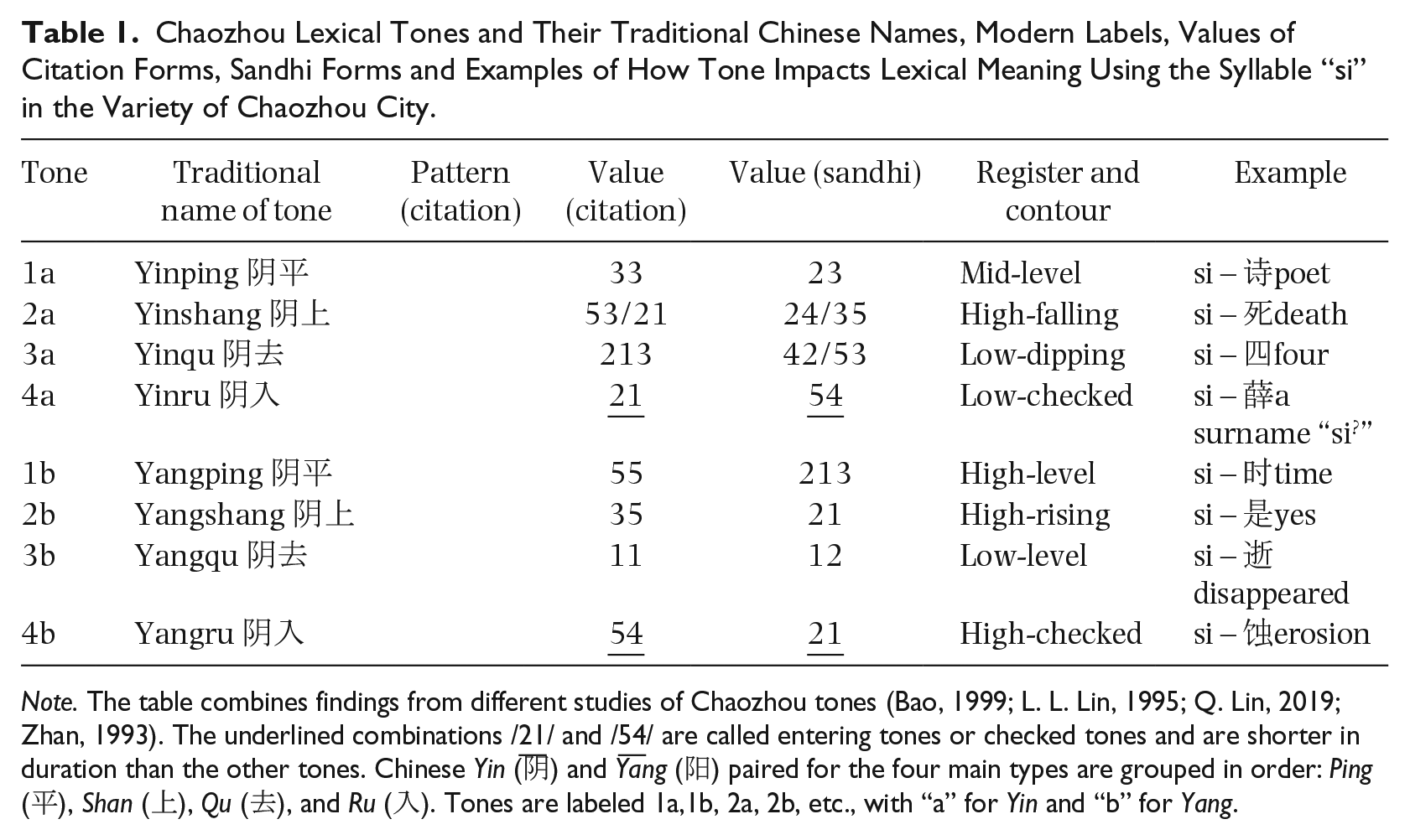
Note. The table combines findings from different studies of Chaozhou tones (Bao, 1999; L. L. Lin, 1995; Q. Lin, 2019; Zhan, 1993). The underlined combinations /
The term “citation tone” in Chaozhou commonly refers to tones spoken in isolation (see Bao, 1999: 79; Q. Lin, 2019), while “tone sandhi” refers to the alteration of tones that occurs in connected speech (Chen, 2000, p. 19). In the context of connected speech, syllables in final positions of phrases keep the value of its citation tone, but others in non-final positions undergo sandhi and change their values. Overall, the Chaozhou tonal system is complex enough to provide a rich source of information about singing in tone languages that might not be evident in a simpler system.
Factors to be analyzed
Building on previous findings of consistent realization of falling tones /53/ and /42/ in singing (Zhang & Cross, in press), the first aim of this study is to determine whether all tonal patterns in Chaozhou are realized within individual notes in natural singing and to identify the degree to which tones are realized differently. Studies have briefly mentioned that level tones and contour tones may be differentiated when sung in Tai Phake (Morey, 2010) and Cantonese (Schellenberg & Gick, 2018), though thorough empirical examination is lacking. For instance, are both contour and level tones at high-, mid-, and low-pitch levels realized differently when they are sung? Would contour tones that span a wider pitch range, which refers to the frequency change between the onset and the offset of pitch, exhibit a larger pitch variation than other tones when they are sung? Given the wealth of tonal patterns in Chaozhou, this study aims to establish a better understanding of these issues.
Two further factors concern singers’ vocal training and their experience of singing in the Chaozhou language. The term vocal training refers mainly to Western bel canto style and Chinese folk singing, which are mainstream vocal techniques taught in conservatories in China. The experience of singing in Chaozhou means the frequency with which singers sing in the language, given the fact that Chaozhou is a dialect and the overwhelming majority of songs in China are sung in Mandarin the official Chinese language. Relevant previous studies were mostly based on materials provided by non-professional singers (Schellenberg & Gick, 2018) or collected from singers who are experienced in singing in their languages (Morey, 2010; Pian Chao, 2000; Pooley, 2020; Stock, 1999; Yung, 1983). So far, little research has compared non-professional singers with professionals and examined how the singing experience in a particular language affects tone realization.
These issues are also complicated by the effects of two musical factors — metrical structure and melodic interval — on singers’ realization of tones. The aspect of metrical structure explored in this study is metrical position, that is, the location of alternating strong and weak beats in a regularly recurring meter, and beat duration, that is, how much of a given measure a beat takes up. In most music, the first beat of each measure is accented while other beats are less so. This metrical accent is considered when setting texts to tune in stress-time languages, such as English (Dell & Halle, 2009; Hayes & Kaun, 1996; Ladd, 2008, pp. 56–58; Palmer & Kelly, 1992; Proto, 2015; Rodríguez-Vázquez, 2010) and in pitch-accent languages, such as Japanese (Cho, 2017; Hayes & Swiger, 2008), in which stressed syllables are usually matched by a metrically strong beat. In a tone language in which lexical pitch, rather than syllabic stress or accent, is used to contrast word meanings, it raises a question of whether the metrical structure would lead to differences in the realization of tones during the performance of a song. The other musical factor considered here is the melodic interval. As tones are sung in a melodic context, it is assumed that the size and position of an interval over which a tone is sung may affect the realization of the tone. The effects of these musical factors are issues that are as yet unexplored.
As discussed above, the Chaozhou language is characterized by tone sandhi, which means that in some circumstances certain tones may be expressed in citation form or sandhi form. In this study, four tones, /35/, /53/, /213/, and /21/ can be expressed in both forms, allowing the effect of tone sandhi on the performance of individual tones as they are sung to be explored. This issue of sandhi effect in songs does not appear to have been investigated (so far as I am aware), and the case of Chaozhou song should provide significant new information.
Test material: the Chaozhou song “Oŋ a oŋ”
The song “Oŋ a oŋ” (拥啊拥, “I am tucking you in, my little baby”) was composed by Chaozhou songwriter Zheng Haodan (郑皓丹). The text is based on a well-known traditional nursery rhyme that was originally recited without a tune. Unlike most Chaozhou folk songs, which typically follow a traditional narrative structure and use a 2/4- or 4/4-time signature, Zheng’s composition employs a 3/4-time signature to give a contemporary feel to the music.
I modified the metrical structure of Zheng’s to enable a comparison between two metrical positions with different beat durations (strong and long beat vs. weak and short beat) while preserving the musicality of the song (see Figure 1). I set a tempo of 118 bpm to allow a comfortable pace for singers to be able to depict the syllable tones when they sang and used a different key for each gender: E for male singers and C for female singers. To avoid confusion between some syllables that could be pronounced with different tones, vowels, or consonants, I read out the song lyric and recorded it for the participants’ reference.
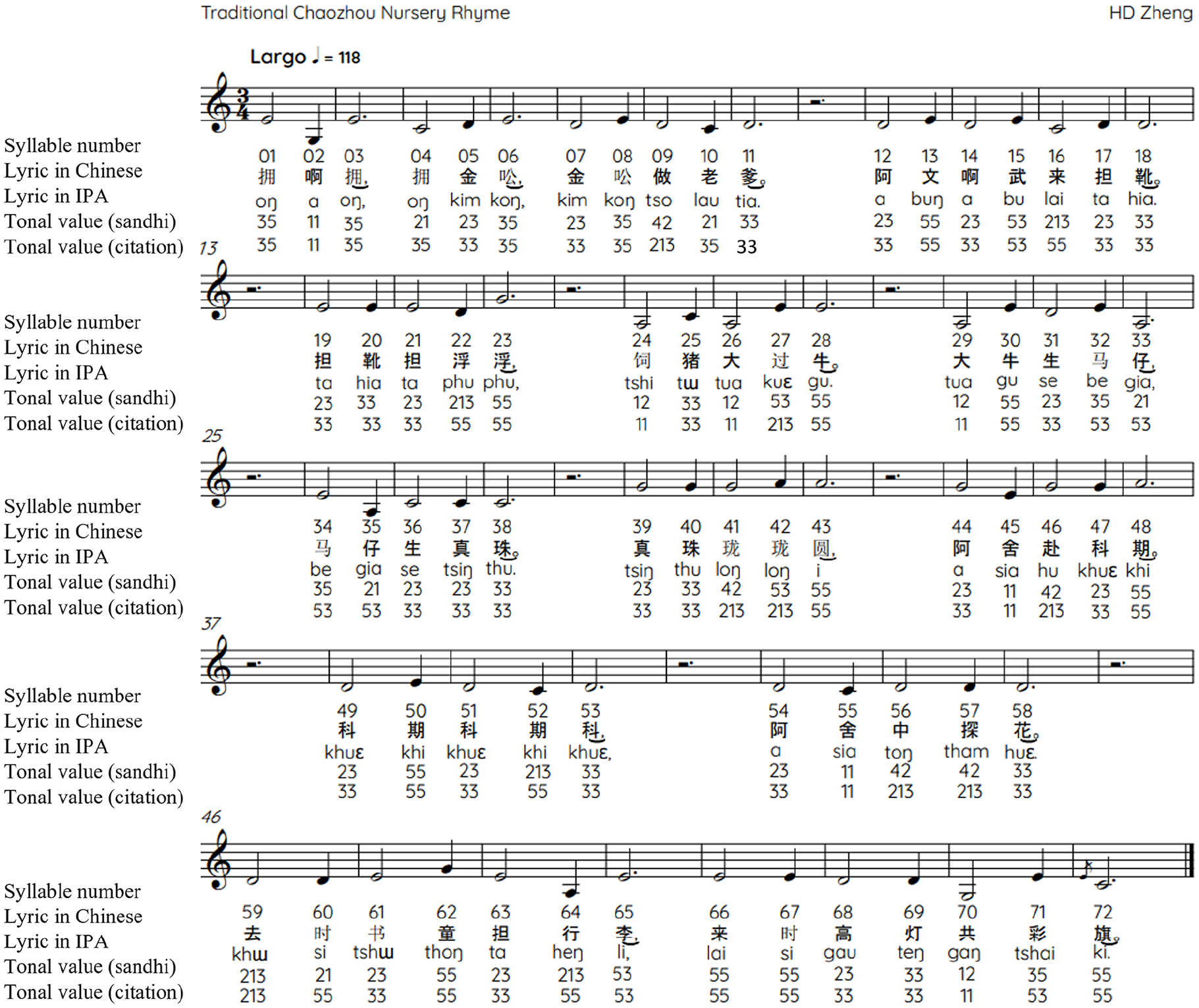
The Modified Score of the Song “Oŋ a oŋ.”
The song text produces 10 tones in the context with sandhi, including level tones /11/, /33/, and /55/, and contour tones /35/, /53/, /42/, /213/, /23/, /21/, and /12/, but the song does not include the two Chaozhou checked tones /
The Syllables With Tone in Citation Form and Sandhi Form.
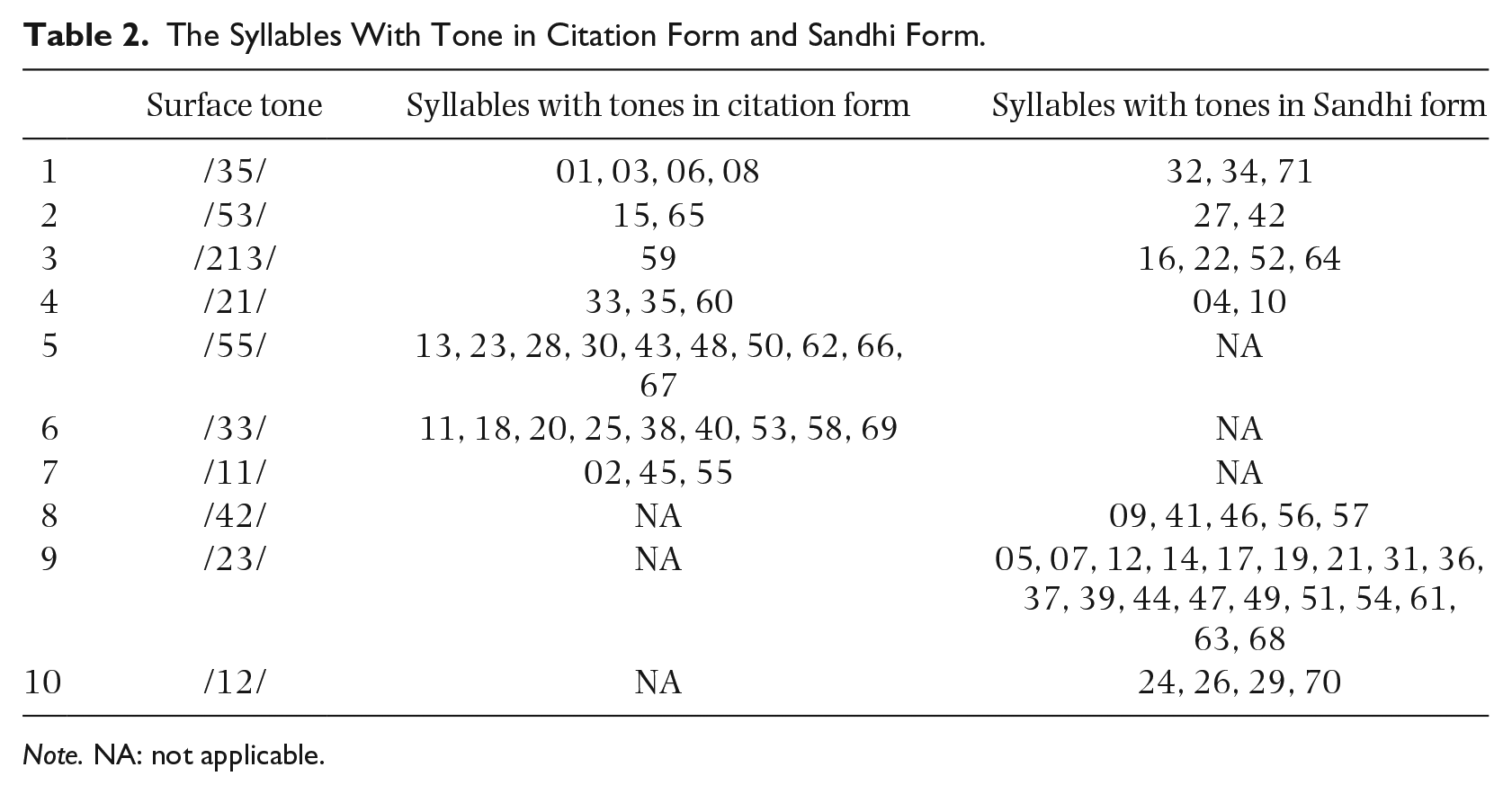
Note. NA: not applicable.
Method
Participants
Thirty-four Chaozhou singers (22 females, 12 males, mean age = 38.12, SD = 8.11) were divided into professional and non-professional groups. A professional singer should (1) have received more than 5 years of vocal training, (2) be still practising or performing, and (3) self-identify as a professional singer. Otherwise, they were identified as a non-professional. There were 19 professional singers with long-term vocal training in Western bel canto and Chinese folk singing (13 females, 6 males, mean years of vocal training = 9.53, SD = 4.53) and 15 non-professionals with little or no vocal training (9 females, 6 males, mean years of vocal training = 0.67, SD = 1.29). The participants also reported at four levels how often they sang in the Chaozhou language: “often,” “sometimes,” “seldom,” and “never.”
Procedure
All participants received the manuscript of the song “Oŋ a oŋ” written in numbered musical notation with the lyrics in Chinese. They were instructed to learn the song by listening to the demo of the song melody played on a grand piano and the recording of the read-out song lyrics. They learned the song with no time limit and were told to record their singing on their smartphone’s high-quality recorders when they felt sufficiently confident and comfortable to do so. Participants also responded to a questionnaire on an online survey platform about their musical training and experience and their linguistic background.
Measurements
After collecting the 34 recordings, I segmented the 71 syllables in each recording in Praat (Boersma, 2001). For each syllable, I identified the tone-bearing unit (TBU) where a tone is phonologically associated (Matthews, 2014) and determined the boundaries of TBU assisted with waveforms. The beginning of each syllable was measured from where a harmonic waveform started, excluding the initial 10–30 ms in case of irregular pitch contours at consonant edges, while the endpoint of the syllable was taken as being where the harmonic waveform ended. I normalized the duration of syllables to reduce the potential noise created due to the participants’ singing style and extracted the F0 (fundamental frequency) values at 10 equal-time points automatically by using ProsodyPro (Xu, 2013). To calculate how much variation occurred within a note, I looked at the data point that reflected the change by ΔF0 = fmax – fmin, where the fmax was the maximum value of the 10 time points from f1 to f10 and the fmin the minimum. When the fmax occurred before the fmin, the direction of pitch change was counted as falling and was marked with a minus sign ‘–’; in the opposite case, the direction of pitch change was counted as rising. The values of the data points were recorded in Hertz and converted to semitones using the formula: semitones = 12 * log2 (fmax/fmin). The 71 syllables from the song sung by 34 participants produced a total of 2414 data points.
Results
Pitch change of tones
To depict the pitch change of tones, I grouped the sung syllables with the same tone and measured the mean pitch change in semitones across singers at each time point. Figure 2 shows that the pitch change varies from one tone to the next when the song is sung. Notably, high-rising tone /35/ and high-falling tone /53/ were the most distinguishable contour tones of all, while low-dipping tone /213/ was sung similarly to tones /23/, /12/, and /11/. Overall, most of the contour tones exhibited a larger pitch variation than level tones. In addition, contour tones that span a wider pitch range, such as /35/, /53/, and /42/, exhibited a greater pitch change than other contour tones, like /23/ and /21/.
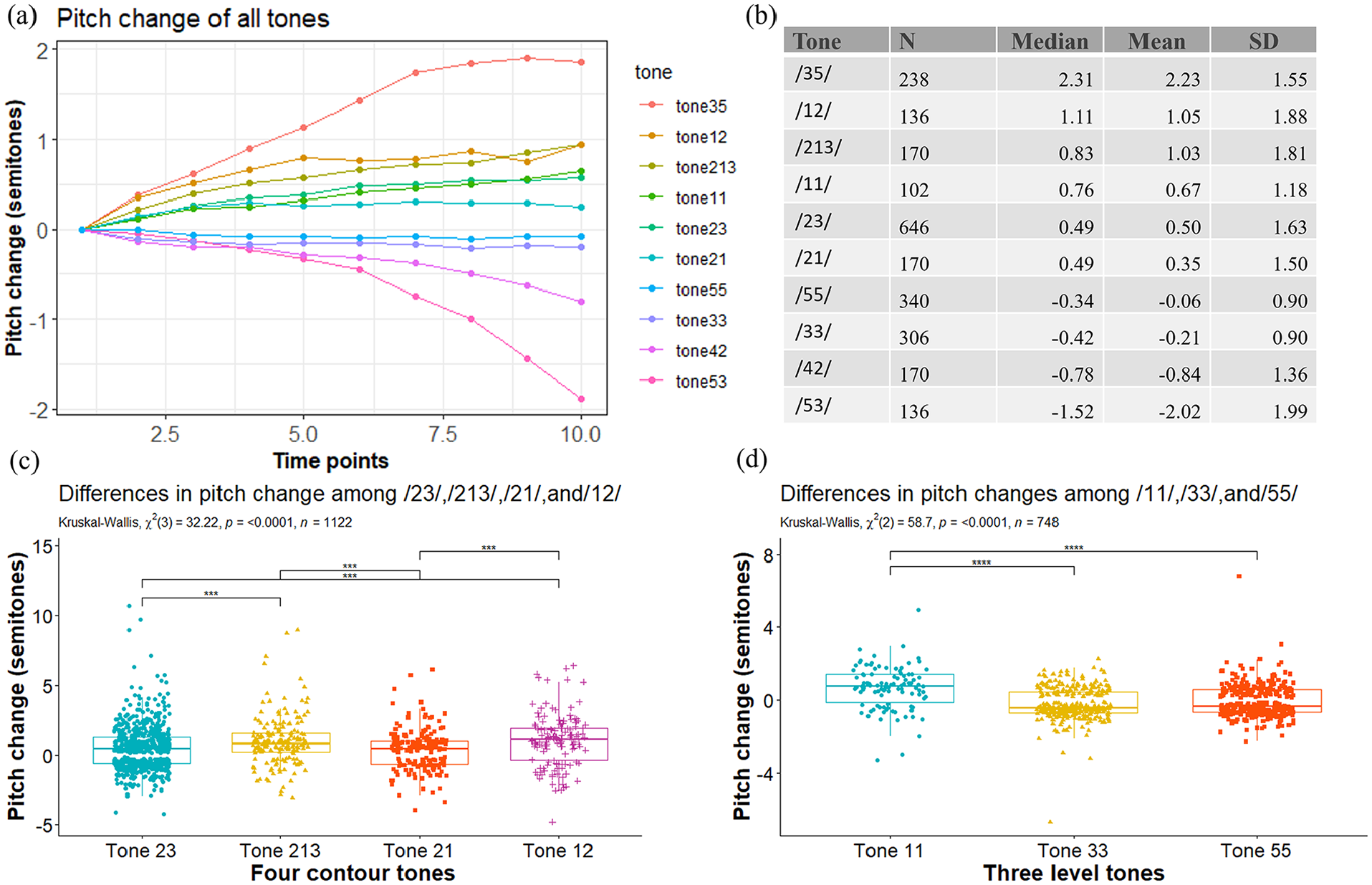
(a) Indicates the Mean Pitch Changes Measured in Semitones at 10 Time Points for Each Tone Across 34 Singers, with the First Time Point Normalized as Zero. The Legend on the Right Follows the Order of the Pitch Changes of Tones in the Plot. (b) Summarizes the Mean, Median, and Standard Deviation of Pitch Changes for the Tones. (c) and (d) Present the Results of Kruskal–Wallis Tests, Followed by Wilcoxon Pairwise Comparisons, for Four Contour Tones (/23/, /213/, /21/, and /12/) and Three Level Tones (/11/, /33/, and /55/), respectively (All p values were Bonferroni-adjusted).
The pitch of four contour tones /23/, /213/, /21/, and /12/ all slightly went up. Figure 2(c) found significant differences between /213/, /23/, and /21/ (p < .001), but no significant differences between /213/ and /12/ (p = .49). In contrast, the direction of three level tones varied. Unlike the upward pitch change of low-level tone /11/, mid-level tones /33/, and high-level /55/ tended to go down. Figure 2(d) shows that /11/ exhibited a larger pitch change than /33/ and /55/. Significant differences were found between tone /11/ and other level tones (p < .001); however, there was no significant difference between /33/ and /55/.
Vocal training
The median pitch change in Figure 3 shows that there tended to be a larger pitch variation of contour tones when non-professional singers sang the syllables. Wilcoxon rank sum tests found statistically significant differences between professional and non-professional singers when they sang high-falling tone /53/ (p = .012), mid-falling tone /42/ (p < .001), and mid-rising tone /23/ (p < .01) with results indicating that singers with vocal training exhibited less pitch change in these tones. However, no significant difference was found for other tones.
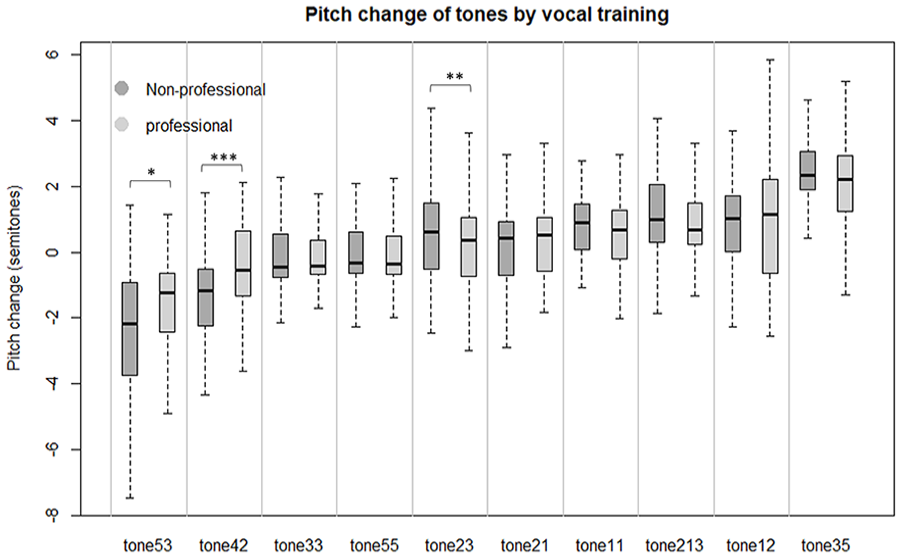
Median Pitch Changes for 10 Tones and the Differences Between Non-Professional and Professional Singer Groups.
Experience of singing in Chaozhou
I sorted the participants into four groups according to their reports about how often they sang in Chaozhou: “Often,” “Sometimes,” “Seldom,” or “Never.” The Kruskal–Wallis test revealed significant differences between groups for tones /42/ (p < .001) and /55/ (p < .01). Dunn’s test was employed to conduct multiple pairwise comparisons, with all p values being Bonferroni adjusted. For tone /42/, significant differences were found between the group “Seldom” and others (p < .01), but no significant differences were observed for “Often” and “Never,” likely due to the limited sample size in the group of “Never” (only three singers). For tone /55/, significant differences were found between the group “Often” and the other two groups, “Seldom” (p < .01) and “Never” (p < .01). However, Figure 4 suggests that this result may be due to different directions of pitch change for tone /55/.
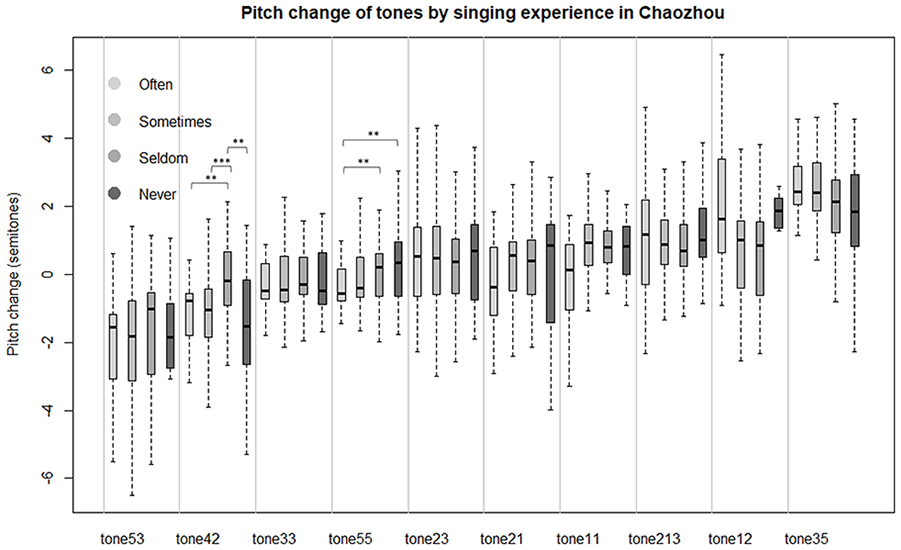
Median Pitch Changes of 10 Tones Across 4 Frequency Scales of Singing in Chaozhou: “Often,” “Sometimes,” “Seldom,” and “Never.”
Metrical position and beat duration
In the song “Oŋ a oŋ,” syllables on a strong beat are sustained longer and syllables on a weak beat are shorter, yielding combined conditions of “strong & long” and “weak & short” (Figure 5). I grouped syllables with the same tone based on these combined conditions. Eight tones, /35/, /53/, /42/, /23/, /21/, /213/, /33/, and /55/, met these two conditions and were included in the dataset. Results of Wilcoxon rank sum tests indicate significant differences between the two conditions for tone /53/ (p < .01) and tone /42/ (p < .05), with larger pitch changes observed in the “weak & short” condition.
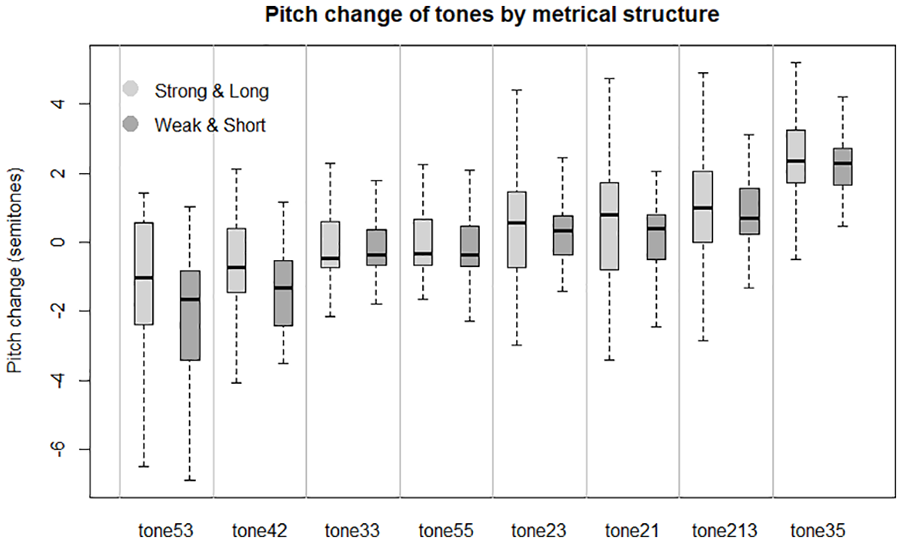
Median Pitch Changes of Eight Tones under “Strong & Long” and “Weak & Short” Conditions.
Melodic interval
The potential influence of the melodic context on the realization of tone in singing melodies was explored by investigating the effect of the melodic interval within which a target tone was sung. As shown in the example in Figure 6, the target tone may either be a preceding or a succeeding note of the interval, expressed in the two conditions, “preceding” and “succeeding”. The effect of the size of the interval in which the target tone was sung under these two conditions was assessed. Nine tones, /35/, /53/, /55/, /42/, /23/, /33/, /213/, /12/, and /21/ were included in the sample.
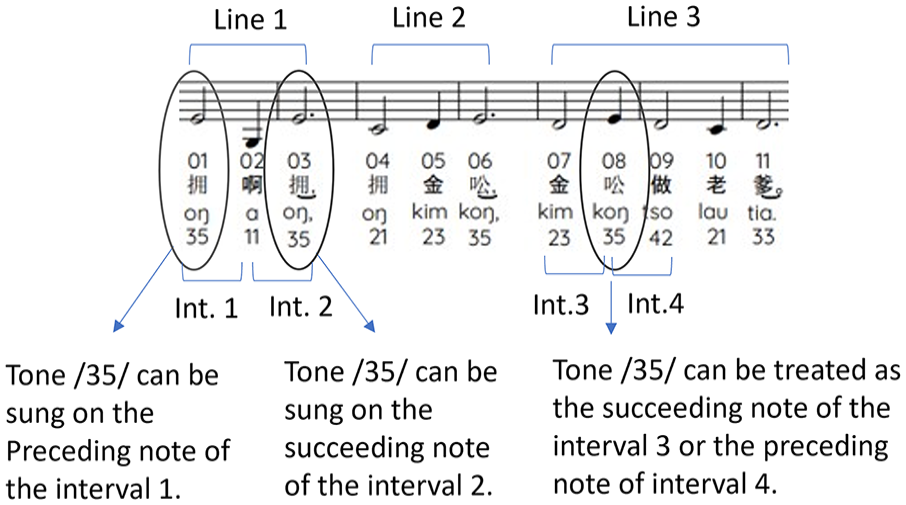
The Condition of Being a Preceding Note or a Succeeding Note of the Interval. In the Example, the Complete Musical Phrase Contains Three Minor Phrases. Syllables with Target Tone /35/ are Marked with an Oval in the (Minor) Phrase 1 and 3.
Interval size was found to influence the pitch change of most of the tones when they were sung as a “preceding note” and “succeeding note”. However, it appears that the interval sizes only affected the pitch change of tone /42/ (p < .01) and tone /23/ (p < .001) when those tones were sung on a preceding note of the interval (Figure 7). In addition, the pitch level of tone may interact with the interval position, as shown by the significant difference between interval sizes for tone /12/ when it was sung on the succeeding note of the interval.
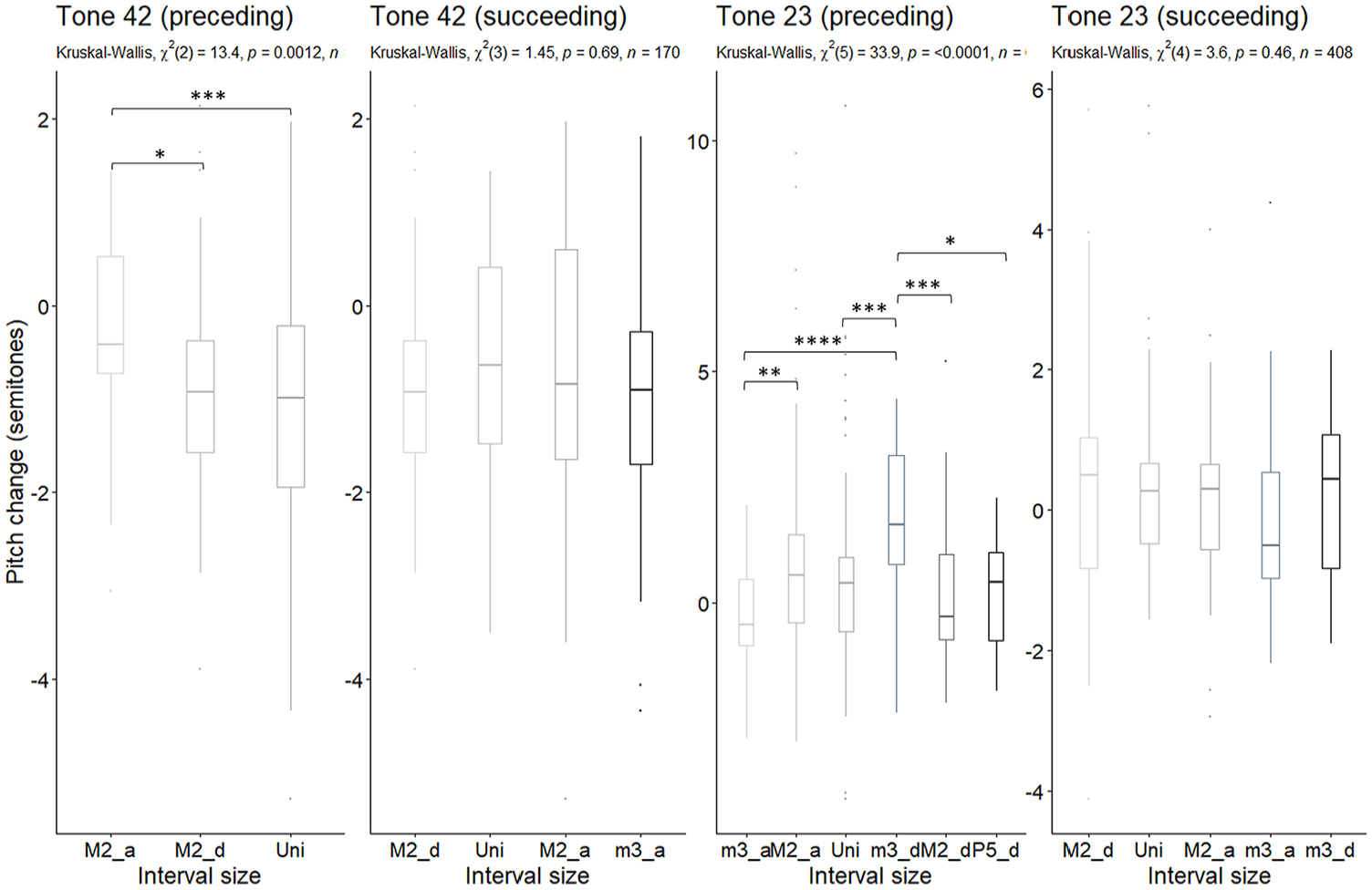
Significant Differences Found Between Interval Sizes When Tones /42/ and /23/ Sung on a Preceding Note.
Tone sandhi
The question of whether or not tones that can be expressed in citation and sandhi form are realized differently or in the same way was explored. The sample contains tones /35/, /53/, /213/, and /21/ that can be expressed in both forms.
Wilcoxon rank sum tests revealed significant differences between the two forms for tones /53/ (p < .001) and /21/ (p < .0001), while tones /35/ and /213/ were performed similarly. Figure 8 shows that the median pitch change in the citation form of tone /53/ differed considerably from the median pitch change in the sandhi form, with four semitones in the citation form and nearly two semitones in the sandhi form. For tone /21/, although there were similar pitch variations of almost one semitone in both forms, the pitch of tone /21/ in the citation form went down while the tone in the sandhi form went up, an interesting and seemingly anomalous result that will be discussed below.
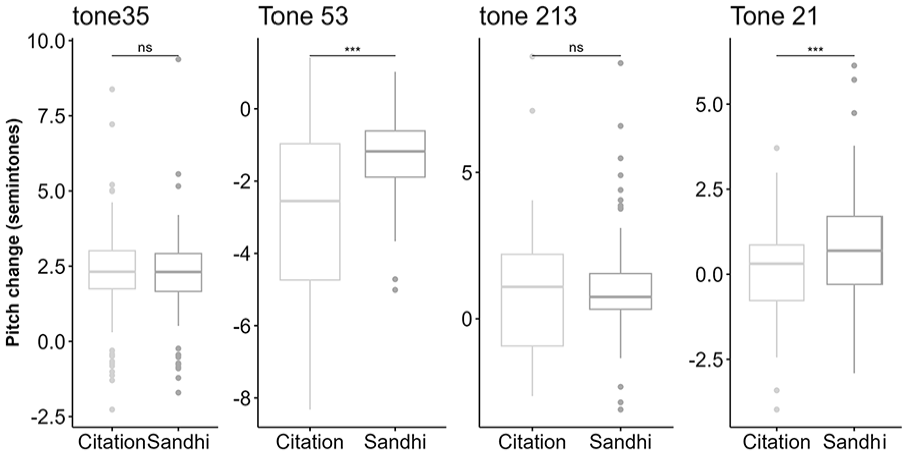
Differences Between Citation Form and Sandhi Form for Tones /35/, /53/, /213/, and /21/.
Discussion
The varying degrees of pitch change of tones within individual notes
Seven contour tones /35/, /53/, /42/, /213/, /23/, /21/, and /12/, and three level tones /11/, /33/, and /55/ were included in this study. One of the main results suggests that Chaozhou singers were sensitive to high-pitched contour tones /35/ and /53/. The initial assumption was that the pitch range of tones, which refers to the frequency change between the onset and the offset of pitch, may be a factor contributing to some contour tones exhibiting a larger pitch change than others. This assumption was supported by the results in relation to tones /35/, /53/, /42/, and /213/. However, the larger pitch change of low-rising tone /12/ than tones /42/ and /213/ hints that the pitch range is not the only influential factor. Another factor may be the pitch level of the tones. The analysis of tone categorization in a previous corpus study (Zhang & Cross, 2021) shows that tones in Chaozhou songs were classified by pitch levels, where /5/ and /1/ were two tone-extremes that characterized the tones as high-pitched or low-pitched, and /3/ the neutral that characterized the mid-pitched tones. The larger pitch variations of tones /35/ and /53/ and of tone /12/ suggest that tones being high-pitched or low-pitched may afford a flexible space for singers to express the tonal contours.
When level tones were sung, they seem to be greatly affected by the pitches next to them in terms of pitch direction. The pitch of tone /11/ tended to rise while the pitches of tones /33/ and /55/ fell. While results show that low-level tone /11/ exhibited a significantly larger pitch change than the mid-level /33/ and the high-level /55/, the median pitch change of tones /33/ and /55/ suggest that they are relatively stabler than tone /11/. This finding continues to support the assumption on the influence of tonal levels, which will be further looked at when we discuss the effect of melodic intervals later.
It should be noted that low-dipping tone /213/ and low-rising tone /12/ performed similarly on the basis of the current data. Tone /213/ was supposed to be a falling-rising tone; however, the curve contour of the tone was not depicted by the extracted F0 values at 10 continuous time points. A previous analysis in Q. Lin’s (2019) study shows that sandhi tone /213/ and sandhi tone /12/ were identical in the speech of Chaozhou (pp. 66–69). In the present sample, five out of the six syllables with tone /213/ featured the sandhi form, which may explain the similarity between pitch changes in tones /213/ and /12/. There may also have been information lost in the data analysis process that would have signaled a difference between these syllables.
Influence of vocal training
In general, there are two types of vocal styles taught in most Chinese conservatories: Western bel canto and Chinese folk singing that adopts techniques of voice and breath from the Western bel canto yet manages to maintain the Chinese folk and opera traditions. Results show that non-professional singers who had little or no vocal training realized falling tones /53/ and /42/ and rising tone /23/ with a significantly larger pitch change than that of professional singers when they sang. This finding may correspond to the older Chaozhou singers’ view that younger generations, who have received intensive vocal training in conservatories, would be likely to focus more on vocal technique than on the phonetic features of contour tones when they sing. Tones /53/ and /42/ are often perceived as a Chinese-style glissando that glides from one fixed pitch but ends loosely at any pitch when it is notated on scores. Thus, vocal training may contribute to a reduction of flexibility in articulating such falls and, moreover, to a flattening of tones.
Effect of experience of singing in Chaozhou
It was assumed that the more experience of singing in the Chaozhou language the singers had, the more sensitivity to tonal patterns they would possess; however, significant differences between groups were only found in relation to tones /42/ and /55/. With regard to the performance of tones /55/, the difference between groups was mainly reflected in the direction of pitch change. Singers with more experience of singing in the language tended to realize the tone with a falling pitch change, while singers with less experience were more likely to sing it with a slightly rising pitch change. There may exist a phrase-final effect, as most of the syllables with tone /55/ were sung in a phrase-final position, where a relatively flexible space was available for a freer and variable musical expression.
Effect of metrical structure
It was predicted that contour tones sung on a musically strong and long beat would exhibit a larger pitch change than those on a weak and short beat, due to the accented pitch and lengthened note. However, the result shows that significant differences between the two situations of “Strong & Long” and “Weak & Short” occurred only in relation to falling tones /53/ and /42/. More surprisingly, the median pitch change of the tones sung on the strong and long beat was significantly smaller than that of the tones sung on the weak and short beat. This result implies that, first, metrical position and beat duration did not necessarily affect the pitch change of tone; and second, for the tones that were realized significantly differently under the two conditions, being sung on a strong and long beat did not necessarily lead to a larger pitch variation. The reason may be that in Chinese music that is monophonic, the center of attention is the melodic line rather than the rhythmic accent. However, the design of the observational study did not manipulate the metrical position and beat duration separately so as to eliminate the possibility of a confound. Also, it is not clear whether lengthening the duration of note would contribute to a flattening or a steepening of tonal contour. To better understand this issue, further study is necessary.
The possible effect of melodic interval
The effect of the melodic interval in which a target tone was sung was assessed. The location of the target tone introduces two situations: a tone could either occur as a preceding note of the interval. It was found that interval size may influence the pitch change of tones /53/, /55/, /42/, /23/, /12/, and /213/ when these syllable tones were sung. Furthermore, the results hint that there may be an effect of tones being sung on a preceding note or a succeeding note of the interval. Also, it appears that the effect may depend on whether they are rising or falling tones. However, the current samples of different interval sizes were unequal, and intervals were not paired. A follow-up experiment within which these variables are controlled more explicitly should afford a better understanding of these issues.
Effect of tone sandhi
Tones /35/, /53/, /213/, and /21/ can be expressed in citation form and sandhi form. Results show significant differences between the two forms in relation to falling tones /53/ and /21/. However, no significant difference between the two forms for rising tone /35/ and dipping tone /213/ appeared. The significant differences may be related to the position of the syllable in a phrase. In the Chaozhou language, the tone of the syllable in the final position keeps the value of its citation tone but others in the non-final position undergo sandhi. Results suggest that falling citation tones that were in the final position of a phrase tended to exhibit a larger falling contour. However, the pitch change of sandhi tones that are in the non-final position may be more affected by the pitches of tones that precede or follow them. For example, less falling pitch change is observed in relation to the sandhi form of surface tone /53/; in the case of tone /21/, the pitch went up under the influence of the high pitches of its neighboring tones. Although no significant difference was found between citation /213/ and sandhi /213/, the median pitch changes of the two forms suggested citation tones in the final position tended to be freer in expressivity, while sandhi tones were relatively less flexible.
Conclusion
The current observational study used a Chaozhou song “Oŋ a oŋ” to investigate the phonetic effect of tones when singers sing in the Chaozhou language. The findings indicate that:
Tones are realized to varying degrees when they are sung. Pitch range of tones, pitch level of tones, and neighboring pitch of tones appear to be three factors that are related to the varying degrees of pitch change.
Vocal training affected the realization of some of the tones—in particular, /53/, /42/, and /23/—when they were sung.
The degree of experience of singing in Chaozhou did not greatly affect the realization of tone. It appears that the performance of tones in singing is more likely to be affected by habituation to tones in everyday language use.
There is an effect of metrical structure on the realization of tones /53/ and /42/ when they are sung. However, being in a strong and long beat does not necessarily contribute to a larger pitch change.
There are potential effects of melodic intervals on the realization of tones, which warrant further exploration.
A tone-sandhi effect on the performance of individual notes was detected in relation to tones /53/ and /21/.
Overall, the observational study shows that the realization of tones in singing may be governed by several complex factors that may include the phonetic patterns of the tone identified by its contour and pitch level, singers’ vocal training, singers’ everyday language use, the context with sandhi, and its melodic context. Chaozhou serves as a rich test case for understanding how individual notes are sung to individual tones in tone languages. Despite the findings presented in this article, much more remains to be explored.
Footnotes
Acknowledgements
This study was supervised by Prof. Ian Cross at the Center for Music and Science of the Faculty of Music at the University of Cambridge. Without his dedicated involvement in every step of the process, this paper would have never been accomplished. The author would also like to show gratitude to Prof. Bob Ladd and Prof. Sarah Hawkins. Their knowledge of linguistics and phonetics helped her exceed her limits and gave her great insights into the topic of study. She is grateful to Nicky Swett for editing the draft of the manuscript. She also wants to thank Huang Haihua (黄海花), the head of the Department of Arts in Chaozhou Education Bureau for her assistance in recruiting the participants and thank all the Chaozhou singers who have made an incredible contribution to the observational study!
Funding
The author received no financial support for the research, authorship, and/or publication of this article.
Author’s note
This article won the Aubrey Hickman Award 2022, given by The Society for Education, Music and Psychology Research (SEMPRE).
