



Abstract
Despite recent reviews of the effects of arts therapies and music therapy on people with intellectual disabilities (IDs), significant knowledge gaps remain in this field, notably concerning informal music activities and the role that young participants play in music interventions. A scoping review was conducted in January 2021 to explore music interventions implemented in youth with ID and their effects. In total, 74 studies were retained, including 12 reviews and 62 empirical studies. We apply a bibliometric analysis to identify the evolution of publications and research trends in the field. We then attempt to answer the question: “What is the state of knowledge on music education for youth with ID?”. To do so, we describe the music interventions examined in the research to date and the main measured effects. Overall, the findings show that music interventions in youth with ID facilitate overall development in terms of a range of functional skills, that technology-assisted music training has excellent educational promise, and that learner voice merits greater attention in the music research. Nevertheless, studies have largely neglected to consider self-determination and creativity, qualities that are likely to foster youth engagement, and in the longer term, promote social participation.
Significant musical experiences and the benefits of such experiences should be available to all, including youth with intellectual disabilities (IDs). Pioneering works in this area include inclusive social research initiatives such as the Resonaari Special Music Center (Ruokonen et al., 2012) and the Prism Project (Hourigan, 2016), as well as various inclusive ensemble music activities developed under the umbrella of SoundOUT (McHale, 2016). To this, we may add recent reviews of arts therapies (Mino-Roy et al., 2021), music therapy (Spiro et al., 2018), and music participation in relation to social connectedness in youth with ID (Murphy & McFerran, 2017). Still, the knowledge in this area remains incomplete, particularly with respect to the role of the youth who participate in research studies. Do they listen passively, listen actively, or participate actively? To what extent is their creativity engaged? Do they have any say in the measurement tools that are used and the main effects that are measured? To respond to these questions, a scoping review was conducted in January 2021 to examine music interventions implemented in youth with ID and their measured effects.
Rationale
Individuals with disabilities may face diverse physical, cognitive, social, and accessibility-related barriers that exclude them from informal and participatory music-making experiences (Rathgeber, 2017). Moreover, on top of accessibility issues, youth with ID who get the chance to participate in music-making activities are unlikely to have opportunities to have input into the activities, and even less so in studies in the field. Indeed, a recent systemic literature review (Després & Dubé, 2020) found that not a single author considered learner voice in studies of music and youth with ID.
Intellectual disabilities
ID can be defined as a “condition characterized by significant limitations in both intellectual functioning and adaptive behavior that originates before the age of 22” (American Association on Intellectual and Developmental Disabilities, 2021). Down syndrome “is the most common genetic cause of intellectual disability, affecting approximately 1 in every 700 children” (Boston Children’s Hospital, 2021).
Learner voice
Learner voice refers to learners’ active involvement in decisions about their learning, while taking their preferences and interests into account (Rudd et al., 2006). According to Rudd et al.’s (2006) model, learner voice ranges across a full spectrum of engagement, from non-participatory passive learning (inform) to self-responsibility for learning (empower). Learner voice approaches have received scant attention in the research to date on music education. Thus, in a recent systematic literature review (Després & Dubé, 2020), only seven articles published since 2005 have specifically addressed learner voice in relation to music education. Similarly, although the literature has highlighted the importance of learner voice, which is considered to be a vector for self-determination in everyday life (Huus et al., 2021), inclusive education (Gordon, 2010), and various domains, such as physical education (Gilbert, 2019), have neglected in the research on music interventions in youth with ID. A literature review by Murphy and McFerran (2017) on music participation in young people with ID revealed significant gaps between the outdated “expert” methods used in many recent empirical studies and the prevailing discourse among defenders of the rights of individuals with ID. More precisely, the authors note that, despite the growing use of participants’ voice in the literature, there remains a need for greater collaboration, especially to make decisions about research agendas, planning, and evaluation (Murphy & McFerran, 2017).
Active and passive roles
At the same time, while certain benefits are associated with music listening activities, making music has been demonstrated even more beneficial. In reality, both playing and reading music call on perceptual, cognitive, and motor skills (Brochard et al., 2004). However, the available literature reviews on music and individuals with ID provide little or no empirical evidence on the participants’ role, even though it is liable to significantly impact the results.
Creativity
Meanwhile, creativity is considered essential for learning in the 21st century according to the Frameworks for 21st-century learning (P21, 2019). Indeed, creativity is widely believed to be the most important skill in this day and age (Robinson, 2011). Creativity has been well demonstrated as a vector for health and well-being, community development, and personal achievement (Cameron et al., 2013; May, 2007; Tamannaeifar & Motaghedifard, 2014). But creativity has become much more than that: it is now considered a basic competency and an essential component of the education framework (Lin, 2011). Nevertheless, individuals with disabilities are underrepresented in creativity studies. This means that their contributions to both subcultures and larger cultures remain invisible and underappreciated (Jones, 2022). Furthermore, even though creativity is an essential component of musical activities (Schiavio & Benedek, 2020), it is rarely explicitly examined in studies on music and ID. The first available studies in this area address behavioral issues and the potential of music to inhibit what were considered inappropriate behaviors (Allen & Bryant, 1985; Deutsch & Parks, 1978; Simpson, 1976; Soraci et al., 1982). This utilitarian perspective on music was gradually replaced by a recognition that music interventions contribute positively to overall development in learners with ID (Brown & Jellison, 2012; Gemma et al., 2020) as well as their social and academic inclusion (Salvador, 2015). More recently, advancing beyond the utilitarian perspective, Wong (2015, 2021, 2022) conducted several studies on musical creativity in students with ID. Her recent study (2021) in Hong Kong examines how the curriculum requires teachers to develop music skills, creativity, and imagination in all their students and to achieve the same learning targets for all, regardless of ID status. In the province of Québec (Canada), the Camp musical extra-ordinaire (Després et al., 2022; Després & Grenier, 2021) is an inclusive adapted music program based on principles of informal music learning (Green, 2002, 2009). The results of Després et al.’s (2022) study demonstrated that informal learning approaches to music via a synchronous distance learning environment are effective in fostering learner voice and creative expression in children with intellectual and/or physical disabilities. Apart from Wong and Després et al., few researchers have examined creativity in youth with ID. Yet, despite this gap in the music literature, both individuals with ID and typical learners benefit from expressing their creativity. Hence, concrete actions are needed to provide the conditions that mobilize creativity in all youth (Jeanne et al., 2019).
Approaches
The theories underlying music therapy and music education are relatively well defined. In practice, however, the lines are somewhat blurred, and the two disciplines tend to overlap. Both disciplines generally involve playing and appreciating music. We provide separate definitions of music therapy and music education but propose that the two disciplines are closely aligned.
Music therapy
Music therapy consists of interventions delivered by qualified music therapists to improve the psychological and/or psychological health and well-being of clients or participants (MacDonald, 2013; Mawby, 2018; Peters et al., 2021). Music therapists hold an undergraduate or graduate degree in the field and are accredited by a music therapy association (Salvador & Pasiali, 2017). Because the interventions focus on the particular needs of clients (MacDonald, 2013), the therapeutic relationship between therapist and client is central to the intervention.
Music education
Music education is delivered by a qualified teacher with a university degree in music education (Salvador & Pasiali, 2017). The main goals of music education are to develop musical skills, knowledge, and abilities, and notably instrumental techniques (MacDonald, 2013; Peters et al., 2021). However, music educators frequently report that they are poorly prepared to teach children with special needs or to use adapted teaching practices (Salvador & Pasiali, 2017). Other music educators feel that they must sometimes act as therapists with certain children (Peters et al., 2021). In sum, although music therapists and music educators pursue different goals in theory, in practice, the activities they deliver and the benefits that result tend to overlap. In some cases, the border between the fields of music therapy and music education becomes porous. That said, in our analysis, we accounted for the journals’ specialties, the academic backgrounds of the authors, the vocabularies used, and the main distinctions between the two disciplines to better classify the reviewed studies.
Contingent and non-contingent music
Interventions sometimes use contingent and non-contingent music conditions to reinforce or inhibit certain behaviors. Because this type of intervention is not usually used in music therapy or music education, we classified this approach as a separate category.
Research questions
In sum, many questions remain unanswered in the music research with respect to the role of youth with ID. The overall objective of this scoping review was therefore to report the state of the knowledge on music interventions in youth with ID. To do so, we formulated three research questions concerning the literature on the participants’ role in music interventions:
We also formulated a set of research questions concerning the methods used and the main empirical results:
These questions were applied to identify the predominant types of music interventions that are presented in the research and the main effects observed in youth with ID.
Method
The research team, with the help of a librarian, determined the following key words for the document database search: (“Down Syndrome” OR “Trisomy 21” OR “Learning disabilit*” OR “Intellectual disabilit*” OR “Special needs” OR “Mental retardation” OR “Learning difficult*” OR “Developmental disabilit*” OR “Special education”) And (Musi*) And (Child* OR Adolescent* OR Youth OR Teen* OR Kid*)
In January and February 2021, the following databases were searched: RILM, Music Index, Eric, Education Source, Academic Search Premier, Web of Science, PsycNet, Francis, and Érudit. Depending on the database, the searches were effected by subject, field, title, abstract, and key words.
The following article selection criteria were used: the article had to (1) be peer-reviewed, (2) be written in French, English, or Spanish, (3) assess the effects of a music intervention, and (4) examine a population aged from 6 to 21 years who presented with ID. If there was overlapping of age or diagnostic groups, we included only articles in which at least half (50%) the participants met Criteria (3) and (4). We excluded articles in which the demographic data were insufficient to determine the exact proportion of participants aged 6–21 years with ID.
The search results were then input into Covidence, 1 a systematic review software. Two research assistants screened all the article titles and abstracts to obtain inter-rater agreement. In case of conflict or ambiguity, the principal researcher made the final decision. The research team then read and analyzed the included articles. Study data were extracted according to our research questions. Figure 1 presents the flowchart of the study selection process.

Flowchart.
Results
Description of the corpus
In all, 74 studies were retained, including 12 reviews and 62 empirical studies. The reviews comprised six systematic reviews, five narrative reviews, and one critical interpretative synthesis.
Reviews
All the reviews were published between 2007 and 2020. Figure 2 shows the evolution of the key words across the reviews from 2007 to 2020. First, we observe a certain polarization between the fields of music education and music therapy, the two main intervention approaches in the music research. Next, the reviews most often address populations of youth with trisomy 21 (also called Down syndrome). Finally, the most frequent research themes in the older reviews (“effective practices” and “qualitative research”) (in blue) were dropped as the years went on in favor of themes relating to language and socioemotional development.

Bibliometric data for the reviews.
Of the 12 included reviews, five do not describe the document search method used and four focus on a specific national perspective in the United States: the Individuals with Disabilities Education Act (IDEA). Moreover, only three studies differentiate between the music intervention types in the results presentation while accounting for the participants’ role in the analysis. Only four reviews account for the participants’ characteristics in the analysis. The only review that differentiates between music intervention types and population characteristics simply provides a description of the musical abilities of each population and the effects of each intervention but does not cross-analyze the data.
Empirical studies
The 62 included empirical studies were published between 1959 and 2020, over a period of 61 years. Of these studies, 35 adopted a quantitative design, 19 a qualitative design, and eight a mixed-methods design. Table 1 presents the main characteristics of the empirical studies.
Characteristics of the Empirical Studies.

Creativity was labeled as “solicited” when the intervention as a whole invited the participant to be creative, e.g., through improvisation or composition. Creativity was labeled as “partial” when the intervention proposed a combination of creative and non-creative activities. Figure 3 presents the temporal evolution of key words in the included empirical studies. We observe that the “assessment” theme gradually gives way to the themes “emotional response,” “attention,” and “communication” (in green). Furthermore, the key word “mental retardation,” which was in widespread use in the 1990s, was replaced by “intellectual disabilities” around 2015. In addition, the empirical studies most often examine populations of individuals with Down syndrome, Rett syndrome, cerebral palsy, and/or autism spectrum disorder.

Bibliometric data for the empirical studies.
Of the included empirical studies, 16 present multi-element music interventions that include various activities such as improvisation, songs, rhythmic movement, and instrumental play. Ten of these studies examine music therapy and six examine educational music activities. The music therapy interventions were offered to groups and individuals, while the multi-element music education activities were practiced in groups. Three further studies that do not provide a detailed description of the interventions were classified as not applicable (N/A).
Fifteen studies implemented listening activities, and six others used contingent and non-contingent music. In the latter case, music is used to motivate the participants to complete a task or adopt a desired behavior. In contingent condition, music is played when the appropriate behavior (i.e., a behavior desired by the researcher) is adopted or a task is completed. The music stops when the behavior ceases, according to a reward and punishment system. In non-contingent condition, the music is played continuously regardless of participants’ behavior. The aim in both cases is to determine the effect of music on performance and behavior. In addition, seven studies used music interventions involving information and communication technology (ICT), whereas the remainder used different types of single interventions, including learning an instrument (n = 6), singing (n = 4), and musical theater (n = 4). The studies presented group (n = 27) and individual (n = 33) activities to youth in various age groups. The most represented age group was elementary school age: 29 studies addressed children aged 5–12 years, 10 addressed high school students (aged 13 and over), and 13 addressed students in two school levels.
Answers to questions
The aim of this scoping study was to better understand the different types of music interventions implemented in youth with ID, the measurement tools used, and the effects that were measured.
Role, creativity, and voice
Figure 4 shows that the children were generally active participants in the interventions, although in 19 studies they played a more passive role. The most passive participation is found in the interventions that used listening or contingent and non-contingent music. In contrast, the children participated more actively in activities that featured songs, instrument playing, and musical theater.

Participants’ role, creativity, and voice.
In terms of creativity, we note that few researchers implemented interventions that tapped into participants’ creativity. Only eight studies gave the participants opportunities to fully express their creativity, while eight others accorded some place to creativity, albeit limited. Finally, participants’ voice was largely neglected across the studies, with the exception of four: three of which were case studies with one participant only. We classified studies as non-applicable (N/A) if participants’ role, engagement of creativity, and accounting for learner voice were either not specified by the authors or the information provided was unclear.
Measured variables
The reviewed studies measured a diverse range of variables, as shown in Figure 5. The most commonly assessed variables were music skills and social skills, whereas only a few studies measured play experience, emotions, and attention.
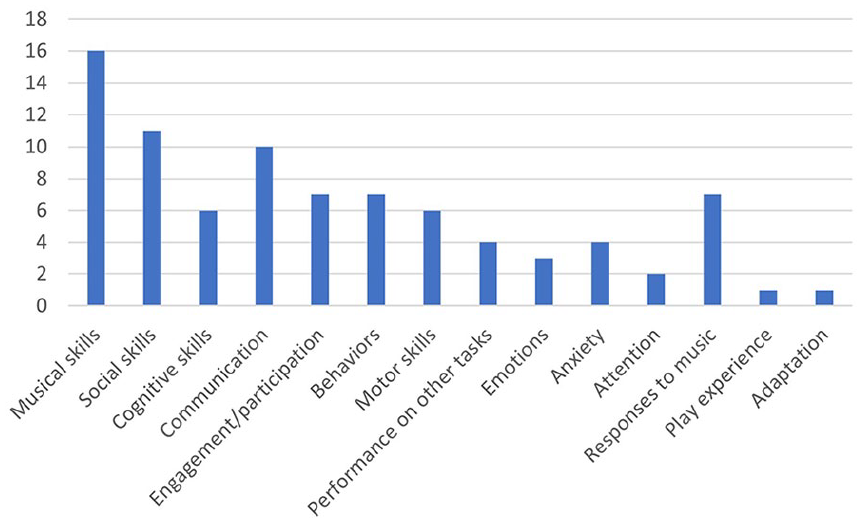
Measured variables.
Measurement tools
The measurement tools varied widely across the studies, as shown in Table 2. Many studies used in-house tools or standardized tests that are not found in any other studies. Aside from this significant disparity, many of the studies used videotapes and semi-directed interviews to gather data. Overall, the studies most frequently used a multi-tool approach that combined methods such as observation, videotaping, logbooks, and semi-directed interviews.
Measurement tools.

Main outcomes
Figure 6 presents the main contributions of the included studies in terms of the results obtained on the measured variables. The variables anxiety reduction, attention, communication, play experience, and performance on other tasks consistently showed positive or significant results. However, only a small number of studies measured these variables. Music skills and social skills, which were measured in many studies, obtained positive or significant results in 86% and 90% of cases, respectively, with 85% for the variable engagement or participation. The results are lower for the variables emotions, behaviors, and motor skills.
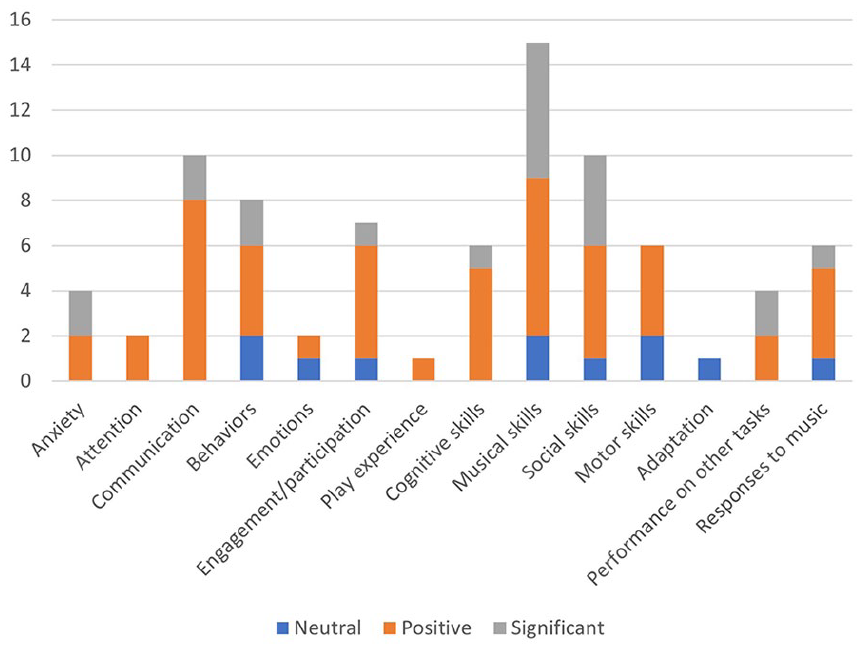
Main outcomes.
Figure 7 presents the results according to the type of music intervention that was implemented. In cases where several variables were measured, we classified studies with at least one significant result as obtaining significant results. We considered an insignificant improvement as a positive result.

Results according to intervention type.
All the interventions that incorporated songs or musical theater achieved positive results. The multi-activity interventions, which mainly involved improvisation, songs, movement, rhythm, and instrument playing, produced more significant results compared to other interventions. In contrast, learning an instrument led to the least significant results.
Discussion
The objective of this scoping review was to report the state of the knowledge on musical interventions in youth with IDs. More precisely, we wanted to gain a deeper understanding of the participants’ role in music interventions and in the research field, notably in terms of consideration of their voice, role (active participation, active listening, or passive listening), and creativity. Finally, we wanted to look at the measured variables and the measurement tools used in the empirical studies, the measured variables that were associated with the main results, and the most promising approaches and interventions.
The earlier studies were conducted at a time when the knowledge of ID was much less advanced than today: the prevailing model stressed integration rather than inclusion (Rousseau, 2015). Hence, the potential of individuals with ID appeared to be either unknown or underestimated. This could explain why the interventions focused more narrowly on changing behaviors through environmental interventions rather than broader stimulations of skills and creativity. Despite this, and although the music interventions largely involved passive listening (contingent or non-contingent), those studies generally obtained positive results. More recently, as shown in Figure 7, music interventions have shown greater potential to foster overall development in youth with ID, and in all the domains (Brown & Jellison, 2012; Gemma et al., 2020; Jellison & Draper, 2015), including a range of functional skills (Hooper et al., 2008). Moreover, interventions that combine technology and music have demonstrated strong educational potential (Theodorou & Drigas, 2017).
Interpretation
First, we wanted to examine participants’ voice: was it solicited, heard, or considered in the music interventions and study designs? The results show that only four studies solicited learner voice, either in a decisional (n = 2) or consultative (n = 2) capacity. Note that all four studies were published in the 2000s, and only two of them involved the participants in decisions about the study (Bell, 2008, 2014). Moreover, both studies were conducted by the same researcher as individual case studies focusing on interventions involving music skills: learning how to play the guitar and developing improvisation, composition, performance, and recording skills. This relative absence of young learner voice concurs with the results of Murphy and McFerran (2017), who found that whereas some studies considered participants’ voice in a consultative sense, by assessing their appreciation, emotions, and social skills, few of these studies involved the participants in decisions about running the activities or the study. More generally, Després and Dubé (2020) reached a similar conclusion in a systematic review of studies of music education in typically developing populations.
We also examined the role of young participants: to what extent were the participants active, receptive, or passive in the music interventions? Here, the results were more mixed. Less than half the studies involved active participation in the interventions (n = 36). The studies in which the children actively participated tended to measure social skills, engagement and participation, and music skills. We also observed that 74% of the group interventions solicited participation, versus 45% for individual interventions. In these two intervention approaches, receptive listening was rarely used (3% for individual and 15% for group interventions). Moreover, more individual interventions involved passive participation compared to group interventions (39% vs 22%, respectively). Interestingly, most of the studies that solicited active participation (80%) were conducted after the 2000s. This trend could indicate the growing weight of the evidence-based research that suggests that active music-making has superior benefits to those of purely listening-based interventions.
We also looked at the engagement of children’s creativity in the interventions. All the studies that considered this aspect were published from 2000 to 2020 (n = 8). However, during that same period, 58% of the studies completely disregarded this aspect. Furthermore, we noted that most of the studies that allowed children to express their creativity were individual intervention studies, whereas the majority of the group intervention studies neglected to do so. This raises the question as to why participants’ creativity was not addressed in group interventions, given that certain approaches, and notably informal music learning approaches (Green, 2009), have been demonstrated effective in this sense. Moreover, it has been demonstrated that informal music learning in groups can benefit learner engagement and motivation (O’Neill, 2014). Finally, the main study variables that are associated with participants’ creativity are engagement and musical skills. As Wong (2022) concludes, opportunities to play and explore and to develop feelings of engagement are two conditions that foster creative expression.
The duration and frequency of music interventions is relatively heterogeneous across the studies: the programs range from 5 to 96 sessions, with an average duration of 20 sessions. The most frequent number of sessions oscillates around 10, a relatively small number in the literature on ID, knowing that these children require extra time to consolidate their learning (Normand-Guérette, 2012; Westling et al., 2015). Thus, a small number of sessions may not provide the optimal conditions for the participants to get used to the settings or the interventions. Overall, the inconsistent frequency and length of the music interventions could result in fluctuating outcomes.
We also observed certain trends in the types of interventions associated with the publication years for the articles. For example, contingent and non-contingent music were more commonly used in the 1970s and 1980s but had become sparser by the 2010s. In contrast, interventions that focused on instrument learning by participants with ID first appeared in the 1990s and remain prevalent today. One explanation for this is that more researchers are exploring the benefits of active music-making (Brochard et al., 2004; Peretz, 2018). In addition, knowledge advances in ID and music education could have spurred the use of better practices in adapted and individualized music education for individuals with ID. In this sense, multimodal interventions, and especially those that combine singing, improvisation, movement, and rhythm, appear to be particularly effective in children with ID. Indeed, the dynamic variety of the activities gives the children opportunities to consolidate their learning through simultaneous activities (e.g., singing combined with improvised dancing) and in different learning contexts, thereby contributing to full development of their potential. This approach is supported in the literature, which reports that multimodal learning situations foster cognitive development (Côté et al., 2016). Furthermore, studies have shown that music interventions can reduce anxiety in children, and that even a contingent music atmosphere can improve task performance and reduce stereotypical and inappropriate behaviors (Spiro et al., 2018). Today, music education is recognized as a factor for inclusion in students with ID. For example, in a review, Salvador (2015) proposes intervention approaches that promote their inclusion in music classes.
Implications
The results of this review indicate that the active involvement of participants with ID in music studies remains relatively limited. In fact, although a majority of the reviewed studies included active participation in the music interventions, learner voice and creativity remain rarely solicited or engaged, even in the most recent studies.
These findings call for future studies to address participants’ voice by actively involving them in decisions concerning the music interventions and study designs. The scant attention that is paid to learner voice raises the risk of non-alignment between the interventions and study design and the participants’ own needs and interests. This failure to listen to youth with ID sends them the message that they are not experts in their own lives (Murphy & McFerran, 2017, p. 310). Therefore, learners should be more involved in decisions about the music interventions and study designs. This would require adopting inclusive decision-making processes that foster self-determination and allow everyone to be heard and everyone’s voice to count (Julien-Gauthier et al., 2009). This approach could promote participant engagement in music activities and studies. In the longer term, it could promote social participation and self-determination, two significant factors for the quality of life in adulthood (Lachapelle et al., 2005; Wehmeyer, 2020; Wehmeyer & Palmer, 2003). In this sense, many studies have helped children develop communication skills as well as social interaction skills and self-confidence (e.g., Blasco Magraner & Valero, 2016; Hooper et al., 2008) by encouraging and training them to express and share their views.
It would also be essential to conduct studies that make better use of children’s creativity. Although music education is one of the most favorable contexts for fully engaging learner creativity (Green, 2009), its potential has been under-exploited in the research on ID. Music studies in youth with ID should provide them with opportunities for personal expression through adapted improvisation and composition activities that tap into their creative capacities. When individuals can act as authors of their own art, so that, it represents their own awareness, language, and unique creativity, they may transform not only themselves, as artists, but also the environment in which they evolve (Fernandes Viana & Rahme, 2021). This approach would require music educators to rethink their expectations. They may have to accept unanticipated products that depart from their own aesthetic preferences as creative expressions. That said, music educators must always act as guides and creators of circumstances through a shared artistic experience in which everyone learns from each other, according to their own possibilities and limitations (Fernandes Viana & Rahme, 2021). In sum, studies in music and ID should explore the potential of collaborative and emancipatory approaches (Boucher, 2003) that allow youth to express themselves and to co-construct their creativity with others.
Limitations
Our results must be considered in light of certain limitations. First, in terms of the methods, we did not conduct manual searches, nor did we search the reference lists of the included articles. Moreover, the choice of key words could have led to some bias, as only a single syndrome (Down syndrome) was considered. Future studies should either include more extensive causes of ID or else avoid including syndromes altogether. That said, we believe that including Down syndrome in our key words had only a limited impact on our results, because all the studies that explicitly focused on Down syndrome (Bell, 2014; Gemma et al., 2020) also included broader terms such as “intellectual disabilities” OR “special needs.” Furthermore, in hindsight, we realize that our choice of databases may have limited our research results, and including other relevant databases such as Scopus and PubMed could have offered a broader perspective on the state of the knowledge on music interventions in youth with ID. In addition, we did not consider methodological quality or the strength of the findings in our analysis. Accordingly, the relative weight of each article was not calculated in terms of methodological quality, sample size, or obtained results. Finally, we did not distinguish between “Music Education” and “Music Therapy” studies in our analysis. Although this was our initial intent, we realized in the process that several studies did not unambiguously belong to either the field of “Music Education” or Music Therapy.” We also realized that, in the studies where the musical intervention was described, some “Music Education” and Music Therapy” studies were based on musical interventions that were, in fact, quite similar. We decided to avoid this classification, given that the distinction between “Music Education” and “Music Therapy” and their practical implementation was often blurred.
Avenues for future research
Only a small number (n = 6) of the reviewed studies used follow-up measures to assess the effects of the interventions after the end of the experiment. To properly assess the benefits of music programs and interventions for youth with ID, future studies should include follow-up measures. In light of best educational practices for individuals with ID (Normand-Guérette, 2012; Westling et al., 2015), more studies of long-term interventions are needed, in terms of both number of sessions and frequency. We note also that few studies were conducted in ecological environments such as school or family settings. Furthermore, it would be useful to document the impacts of active and creative music education approaches that foster learner voice in youth with ID, which in turn would promote self-determination and social participation skills.
Supplemental Material
sj-docx-1-pom-10.1177_03057356231203697 – Supplemental material for Music and young people with intellectual disability: A scoping review
Supplemental material, sj-docx-1-pom-10.1177_03057356231203697 for Music and young people with intellectual disability: A scoping review by Jean-Philippe Després, Francine Julien-Gauthier, Flavie Bédard-Bruyère and Marie-Claude Mathieu in Psychology of Music
Supplemental Material
sj-docx-2-pom-10.1177_03057356231203697 – Supplemental material for Music and young people with intellectual disability: A scoping review
Supplemental material, sj-docx-2-pom-10.1177_03057356231203697 for Music and young people with intellectual disability: A scoping review by Jean-Philippe Després, Francine Julien-Gauthier, Flavie Bédard-Bruyère and Marie-Claude Mathieu in Psychology of Music
Footnotes
Funding
The author(s) disclosed receipt of the following financial support for the research, authorship, and/or publication of this article: This research was supported by the Social Sciences and Humanities Research Council of Canada (SSHRC).

Supplemental material
Supplemental material for this article is available online.
Notes
References
Supplementary Material
Please find the following supplemental material available below.
For Open Access articles published under a Creative Commons License, all supplemental material carries the same license as the article it is associated with.
For non-Open Access articles published, all supplemental material carries a non-exclusive license, and permission requests for re-use of supplemental material or any part of supplemental material shall be sent directly to the copyright owner as specified in the copyright notice associated with the article.
