




Abstract
Music appreciation is a complex process that involves responses to surface-level structure, personal associations, and source sensitivity. Source sensitivity is an understanding of the context in which a musical artifact was created. This article joins a growing body of literature in which program notes are manipulated to highlight the importance of source sensitivity, shifting the focus onto cultural context. Two hundred eighty-four participants formed six groups in a 2×3 between-subjects design. Western and non-Western participants (ethnicity condition) listened to an original percussion composition accompanied by a short text providing a Western, Indian, or blended cultural context (cultural context condition). They then evaluated the music across a range of measures. Exploratory factor analysis revealed two factors of appreciation: Hedonic and Eudaimonic. Results revealed significant ethnicity–cultural context interactions for both. In the Indian context, Western participants exhibited high appreciation, whereas non-Western listeners exhibited low appreciation. Among non-Westerners, appreciation was highest in the blended context. Our results demonstrate an association between cultural source information and music appreciation. We propose that Western participants experience a proteophilic response to Indian music due to their secure status as members of a dominant social group. Non-Western participants, however, require a neutralizing Western context to similarly appreciate Indian music content.
Psychological and neurological investigations into the appreciation of music have, until recently, focused primarily on pleasure and reward. Research has begun to explore the differences and connections between the immediate sensory pleasure known as “hedonia,” and the kind of long-term enrichment associated with “eudaimonia” (Stark et al., 2018). Recognizing that music appreciation is a uniquely complex cognitive process, Thompson et al. (2023) have proposed a framework in which appreciation of surface-level musical structure, personal identity/memory, and source sensitivity all contribute to the listening experience. Source sensitivity refers to a listener’s understanding of the context in which a musical artifact was created, and its role in music perception has been analyzed in many recent studies.
Source sensitivity in Western art music appreciation
In the Western art music context, program notes are often the primary source of contextual information. Simply providing a program note—either dramatic or purely descriptive—has been shown to increase the level of attention paid to a performance (Margulis et al., 2015). Furthermore, listeners’ perception, preferences, and evaluation of music can be altered by explicitly manipulating a program note (Anglada-Tort & Müllensiefen, 2017; Fischinger et al., 2020). For example, explicitly emotional programs can intensify the emotions invoked by music (Vuoskoski & Eerola, 2015), whereas information regarding a composer’s expressive intent has the power to alter music’s perceived expressive content (Margulis et al., 2017). The effects of context provided by program notes depend upon such factors as a listener’s level of musical experience and knowledge, with some evidence that more experienced listeners pay less conscious attention to the contextual information provided, relying instead on their own direct impressions of the music (Bennett & Ginsborg, 2018).
Information about the creators themselves can also alter the listener’s experience. The perceived quality of a performance is raised when a performer is described as “world-renowned” (Kroger & Margulis, 2017), whereas younger listeners have been shown more likely to enjoy a piece of music attributed to Mozart rather than a more obscure contemporary figure (Fischinger et al., 2020). Furthermore, the belief that a piece has been composed by a human, rather than a computer, results in increased brain activity associated with empathy (Steinbeis & Koelsch, 2009) and increased enjoyment of the music (Shank et al., 2023).
This research shows that source sensitivity of the kind that is provided by a program note does influence the music listening experience. Furthermore, we see that the listener’s own background can mediate these effects. However, with these studies focusing exclusively on intracultural musical settings, the role of source sensitivity in intercultural musical settings—which are increasingly prevalent in the present day—remains under-explored.
Source sensitivity and intercultural music appreciation
For centuries Western composers have turned to foreign cultures for aesthetic influence, a subpractice within the wider field of musical borrowing (Burkholder, 1994). Entire volumes have been devoted to studying how composers as early as the 16th century sought to evoke “exotic” cultures (Locke, 2009, 2015) and to examining the cultural and political factors that drive the continuation of this phenomenon in the modern age (Born & Hesmondhalgh, 2000; Taylor, 2007). Speculations regarding the socio-political factors motivating composers to borrow from specific cultural sources tend to overshadow analyses of subsequent aesthetic outcomes (Chilvers, 2021). Yet these outcomes are abundant and diverse, as intercultural musical borrowing is not the exclusive domain of classical composers. The widespread influence of Indian music on British and American rock musicians in the 1960s and 1970s provides perhaps the most pertinent example outside the art music realm (Ireland & Gemie, 2019). Notably, both Indian and Western cultures possess distinct classical music traditions shown to elicit strong emotional responses (Valla et al., 2017), and many modern influential Western art music composers have turned to Indian music as a source of creative influence (Pelinski, 1972; Welch, 1999). This history of exchange between the two musical cultures makes Indian music a suitable non-Western category for studies of intercultural music engagement.
The experience of music is dependent on the cultural background of both the listener and the musical artifact itself. It has been shown that listeners are capable of perceiving distinct emotional categories within music from unfamiliar foreign sources (Balkwill & Thompson, 1999). There is also evidence that listeners are more likely to engage with an imagined extramusical narrative in a piece of music from a familiar cultural tradition and that this, in turn, leads to greater enjoyment (Anglada-Tort & Müllensiefen, 2017; Margulis et al., 2019). Furthermore, listeners struggle to remember music from an unfamiliar culture, as they rely on encultured schematic understandings of music when processing novel stimuli (Demorest et al., 2016; Demorest & Morrison, 2015). Critics have argued, however, that such cross-cultural studies oversimplify the insider/outsider relationships people forge with musical traditions (Morrison et al., 2019).
Although ethical issues surrounding cultural appropriation in the artistic sphere have also been widely discussed (Root, 1996; Young, 2008, 2021), relatively little research has investigated how such intercultural references affect individual listeners. A 2016 study examined how a period of “engaged listening” to either traditional versions or Western stylizations of Korean folk songs affected American students’ familiarity with, and preference for those original songs (Kang & Yoo, 2016). Although both conditions increased familiarity, only those exposed to the traditional versions showed increased preference levels. This would suggest that notionally “authentic” musical experiences are more effective when introducing listeners to foreign traditions. Similar results were produced by a 2019 study involving pop arrangements of traditional Chinese music (Tan & Conti, 2019). There is also evidence that listening to the music of another culture can evoke affiliation toward people from that culture, particularly when the listener exhibits high trait empathy (Vuoskoski et al., 2017).
Researchers are yet to explicitly examine whether music appreciation is influenced by interculturality: the creative incorporation of content borrowed from different musical cultures. Given the history of Western musicians engaging creatively with Indian music, in both the popular and classical realms, a study comparing and combining these two musical cultures will be pertinent to a broad range of musical discussions. Although many questions remain as to how and why a modern Western audience (which is diverse in itself) might appreciate music from Western and non-Western cultures differently, even less is known about what happens when those two distinct musical cultures are blended.
The present study
The present study aimed to investigate the effects of cultural context on music appreciation. Specifically, we asked: how do descriptions of a musical stimulus’ cultural origins affect listener engagement, enjoyment, and evaluation of various expressive qualities? To investigate this overarching research question, we invited Western and non-Western participants to listen to a complete recording of a single new music composition. This solo percussion piece was composed by a Western conservatory-trained composer who incorporated a range of rhythmic patterns used in the Hindustani (North Indian) classical tradition (Lavignac et al., 1913). Devoid of pitch content, which plays a primary role in both Western and Hindustani music, the composition was purposely designed to be culturally ambiguous.
Accompanying the recording was a short paragraph of text (a program note) specifying that the music had been composed in either a Western context, an Indian context, or a blend of the two (i.e., by a Western composer exploring Indian influences, as was indeed the case). Knowing that authenticity matters, we were particularly interested to see how listeners perceive music that enacts the process of intercultural borrowing exemplified by our music stimulus, and explicitly acknowledged by the third version of our program note. As a conceptual blend of the two monocultural conditions, we expected any effects caused by foreignness in the Indian context to be weakened under this blended condition. Although ours is the first study to explore the effects of blending musical cultures in this way, our prediction follows findings that Western stylizations make non-Western music more accessible to children (Demorest & Schultz, 2004).
We anticipated that the cultural frame in each program note would affect listeners’ (a) music appreciation, (b) recall performance, and (c) implicit racial attitudes toward Indian people. We sought to observe interactions between a disparate range of evaluation measures, recognizing that entertainment can often be fulfilling without necessitating enjoyment (Oliver & Raney, 2011). We examined multiple measures of appreciation with the aim to extract underlying factors related to what we would ultimately term “Hedonic Appreciation” and “Eudaimonic Appreciation.” “Eudaimonic entertainment experiences” involving challenging stimuli can be moving, thought-provoking, and ultimately rewarding experiences (Powell et al., 2023; Wirth et al., 2012), whereas hedonic experiences lead directly to pleasure and enjoyment. Engaging with foreign music can indeed be challenging. We thus hoped to shed light on how cultural source information affects the perception of music that is novel and, potentially, unpleasant.
Acknowledging the cultural diversity of Australian society and our experimental participants, we aimed to determine whether the above effects would interact with a listener’s ethnicity or existing racial biases. The relationship between attitudes toward foreign cultures and how one engages with music produced by those cultures remains unclear. The terms “proteophobia” and “proteophelia” stem from the word “protean” (meaning versatile/multifaceted) and have been used by social scientists to define contrasting responses to Otherness (Bauman, 1993). Proteophobia entails apprehension, whereas proteophilia arouses curiosity. The lack of clarity surrounding such responses in the context of intercultural music appreciation is something we hope to address. Researchers have proposed that engaging with the music of another culture can reduce biases against people from that culture (Li et al., 2023; Vuoskoski et al., 2017). Although we did not specify the ethnicity of the performer or composer of the music stimuli, we sought to determine whether cultural knowledge about the style of music would produce a similar impact on cultural attitudes. We also investigate trends in how participants qualified the ratings they provided.
Method
Participants
Two hundred eighty-four undergraduate student participants were recruited via Macquarie University’s School of Psychological Science online recruitment portal (Sona System). Students participated voluntarily by selecting our study from a pool of advertised experiments. The advertisement explained that the study aimed to better understand the relationship between modern music composition and cultural identity. The entire experiment was conducted online within a single Qualtrics survey. Participants were required to be over 18 years of age and on a computer with headphones/earphones. On completion, they received credit toward their undergraduate psychology course. Among these 284 participants, 25 identified as Indian or South Asian (e.g., Sinhalese/Sri Lankan) and were not included in the final analysis. This was done to ensure that our chosen non-Western culture, Indian, was foreign to all participants. Data of five participants were removed because they completed less than 80% of the study. The remaining 254 participants were aged 18–56 years (M = 21.77, SD = 6.66) including 153 females, 98 males, and 3 who identified as nonbinary. Participants who identified themselves as Australian, New Zealander, North American, South American, or European were classified as Western. Participants who identified themselves as Asian (excluding Indian or South Asian) and Middle Eastern were classified as non-Western.
Although everyone has a unique lived experience, we divided our participants into the broad categories of Western and non-Western based on how each individual construes their own ethnicity. Our decision to use these broad categories was based on the fact that Australia is often described as primarily a “Western” nation, given it shares political, social, and economic characteristics with other Western nations such as the United States, Canada, and European nations. Australia’s political and legal frameworks are also aligned with Western traditions, and those who identify as “non-Western” are often perceived as outsiders to the mainstream of Australian society. Importantly, both groups in this comparison contain several diverse populations (e.g., the “Western” group is constituted by Anglo-Celtic people, Europeans, American ex-patriots, Jewish Australians, and other groups). Music is known to play a significant role in identity formation (Lidskog, 2016), and broad comparison between Western and non-Western people is a useful starting point to develop hypotheses about the role of culture in music experience that can then be applied to more specific cultural comparisons.
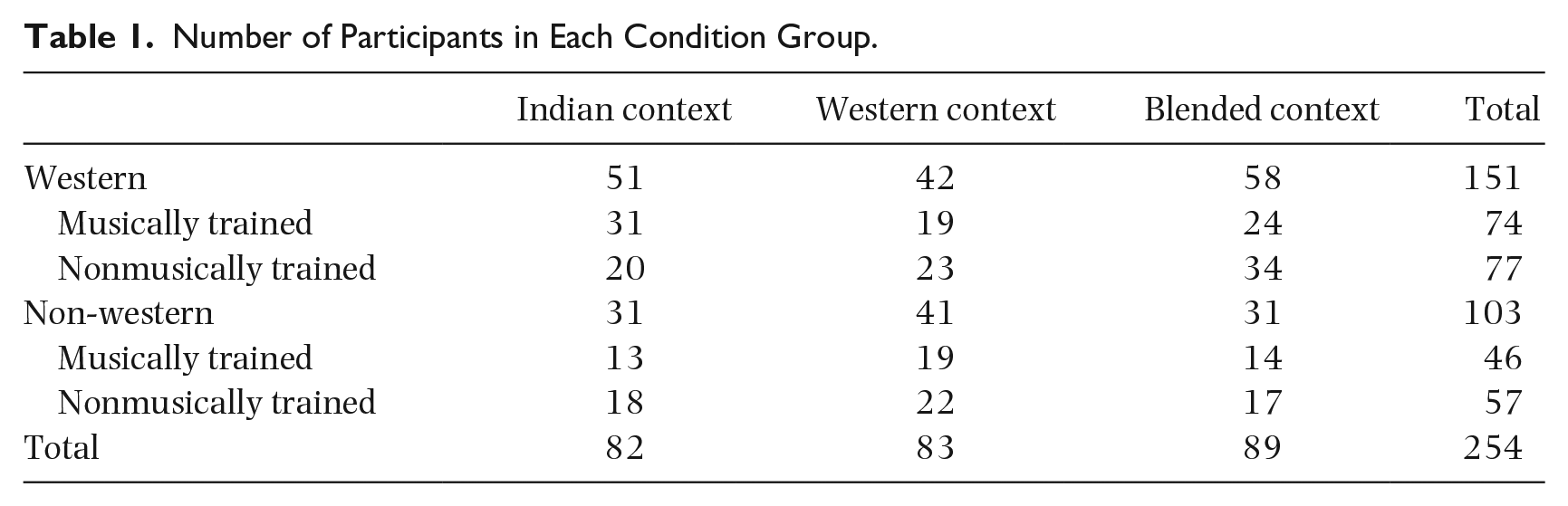
Table 1 summarizes the numbers of Western and non-Western participants in the three cultural context conditions. Of all participants, 47.2% reported that they played an instrument or sang. Pearson Chi-square tests showed that there was no relationship between musical training experience and cultural context conditions, λ2(2) = 2.16, p = .34, nor ethnicity, λ2(2) = .46, p = .50.
Number of Participants in Each Condition Group.
Materials
Audio stimulus
The stimulus was a 3 min 48 s recording of an original solo percussion piece composed by author AC. Instruments of definite pitch were avoided by the composer, as Hindustani music tends to be characterized by microtonal pitch inflections and tunings, thus the absence or presence of these features might impede on its cultural ambiguity (Rao & Rao, 2014). Performance required three concert toms, three rototoms and a small gong. A constantly changing mix of meters was created, using different combinations of simple (crotchet, aka quarter note) and compound (dotted crotchet) beats, with a constant underlying pulse (quaver, aka eighth note = 280). These combinations were derived from the 120 talas tabulated in Encyclopédie de la musique et dictionnaire du Conservatoire (Lavignac et al., 1913, pp. 301–304)—a source from which the 20th-century French composer Olivier Messiaen derived his own innovative rhythmic approach (Messiaen, 1956, p. 14).
A concert tom/rototom ostinato built upon these mixed meters provides the foundation of the composition. This ostinato is interrupted by irregular interjections of solo rototom producing prolonged pitch bends—an effect that intentionally evokes Indian hand drumming technique, where pressure applied to the drum skin alters the sounding pitch. These interjections are gradually replaced by singular strikes of the small gong, followed by short pauses, which are again irregular and have been designed to prevent predictability. As the ostinato stabilizes with less frequent metric changes, new complexity is added via rhythmic diminution and more expansive gestures utilizing the full range of the six drums, until the piece concludes abruptly with a final strike of the gong. The result is a piece of music that could, to the nonexpert listener, feasibly fit into either a modern Western or Hindustani musical context.
Accompanying text in program notes
Three alternative texts accompanied the stimulus to provide three different cultural contexts (the blended version accurately describing the compositional context):
Western version: “This piece for solo percussion was composed by a musician trained in the Western classical tradition. The composer has drawn on a range of metric structures, both regular and irregular, and sought to exploit the various alternative means of subdividing these. As the rhythmic density of each section increases over time, patterns emerge yet direct repetition is consciously avoided.”
Indian version: “This piece for solo percussion was composed by a musician trained in the Indian classical tradition. The composer has drawn on a range of Hindustani tala patterns and demonstrates some of the complex rhythmic patterns found in Indian drumming. These patterns are grouped according to the number of matras (beats) and develop over time to create multiple waves of rhythmic density.”
Blended version: “This piece for solo percussion was composed by a musician trained in the Western classical tradition who has incorporated elements of the Indian classical tradition. The composer has drawn on a range of Hindustani tala patterns and sought to blend these with conventional western beat structures. As the rhythmic density of each section increases over time, patterns emerge yet no single tala is repeated.”
The first sentence of each text was designed to emphasize the musical culture(s) from which the stimulus had emerged as a result of the composer’s training. We did not specify the composer’s ethnicity, as our focus is on source sensitivity regarding musical cultures rather than individual identity. The second and third sentences elaborated on stylistic elements, representative of program notes one would realistically expect to encounter in a Western art music context. The vocabulary used in each description was adjusted to match the musical cultures relevant to that condition.
Measures
Music appreciation
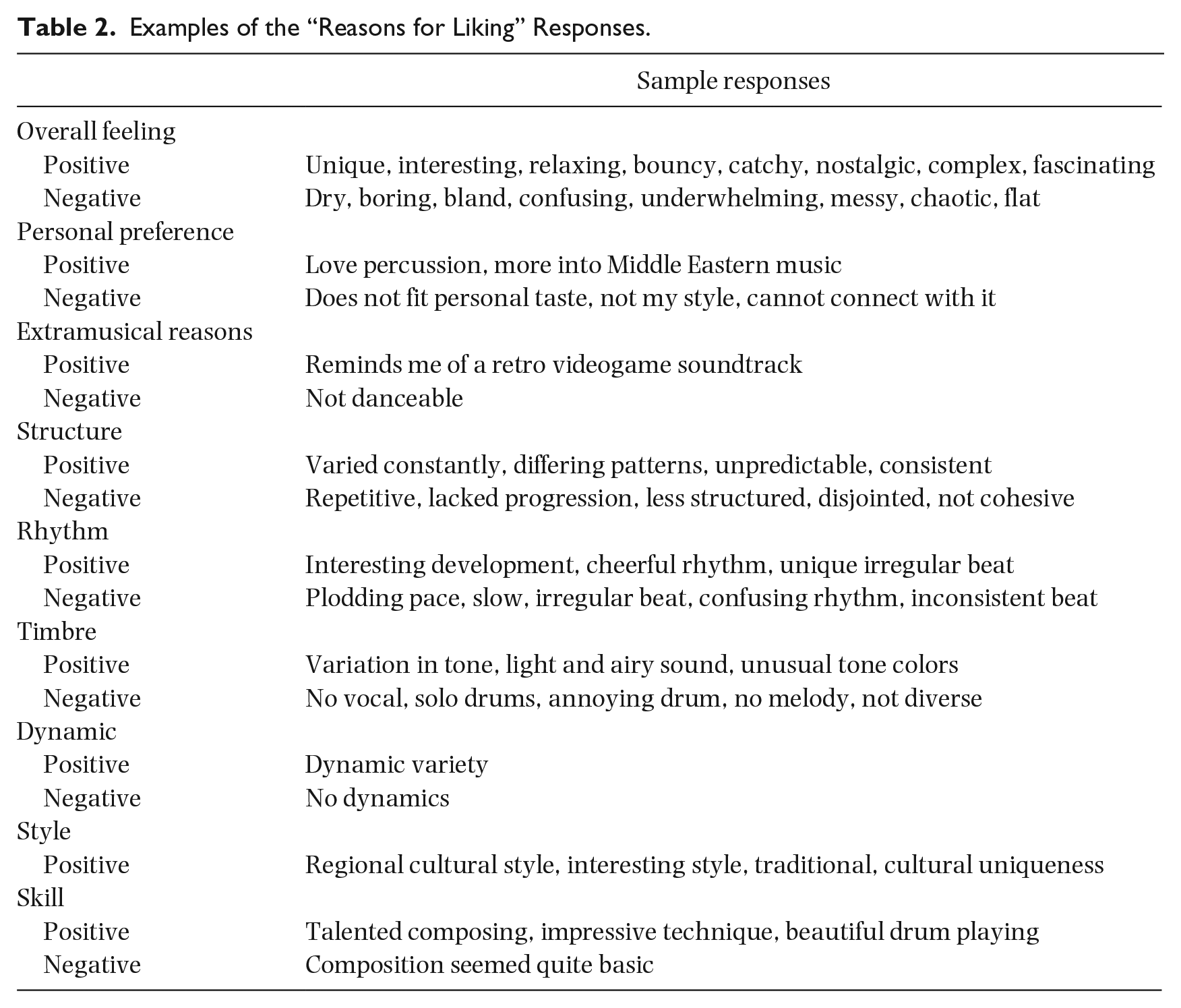
Participants were asked “How engaged were you in listening attentively to the music?” and “To what extent did you like the music you just heard?” with a response scale ranging from 1 (Not at all) to 7 (Very much). They were also given the opportunity to describe their reasons for that liking rating. Responses providing informative justifications for liking ratings were evaluated and coded separately by the first and second authors. After discussion, nine categories were agreed upon and used for subsequent analyses: overall feeling, personal preference, extramusical reason, structure, rhythm, timbre, dynamic, style, and skill. Each category has two dimensions—positive and negative. No answer fell into Style [negative], resulting in 17 categories. Responses often included multiple categories. A total of 375 reasons were identified. Table 2 presents example responses for each category.
Examples of the “Reasons for Liking” Responses.
Participants were then asked to evaluate the music by responding to the following nine semantic differentials with a scale range from 1 to 7: (1) primitive–sophisticated; (2) simple–complex; (3) disjointed–coherent; (4) boring–interesting; (5) unpleasant–pleasant; (6) monotonous–rich in contrast; (7) superficial–profound; (8) unimaginative–imaginative; and (9) unexpected–predictable (reverse-scored in analyses). To reduce the number of dimensions, an exploratory factor analysis with the principal axis factoring method and oblique promax rotation was conducted for the above semantic phrases as well as engagement and preference ratings. 1 We included both the engagement/liking evaluations and the semantic differential evaluations in our exploratory factor analysis to investigate the multifaceted nature of music appreciation. This is consistent with the music appreciation model proposed by Thompson et al. (2023), in which the outcomes of appreciation include enjoyment, emotional states, structural understanding, and aesthetic evaluations (p. 262). Including all 11 measures in our factor analysis would thus provide a more comprehensive picture of music appreciation than a consideration of aesthetic judgments alone.
The Kaiser–Meyer–Olkin measure of factor adequacy was .87, and Bartlett’s test of sphericity was significant, λ2(55) = 1,210.91, p < .001, suggesting that these items were suitable for factor analysis. The parallel analysis revealed two factors. A factor loadings cutoff rule suggested by Costello and Osborne (2005) was applied to only keep items that: (1) load onto the primary factor above .55 and (2) do not load above .32 on multiple factors. Table 3 summarizes the factor loading matrix for the 11 evaluation items. Six measures (i.e., unpleasant–pleasant, disjointed–coherent, preference, unimaginative–imaginative, monotonous–rich in contrast, simple–complex) met the satisfactory factor loadings cutoff. Cronbach’s alpha of the six measures was .81, indicating a high degree of internal consistency reliability among the items.
Oblique Factor Loadings Based on a Principal Axis Factoring for 11 Evaluation Items (N = 254).
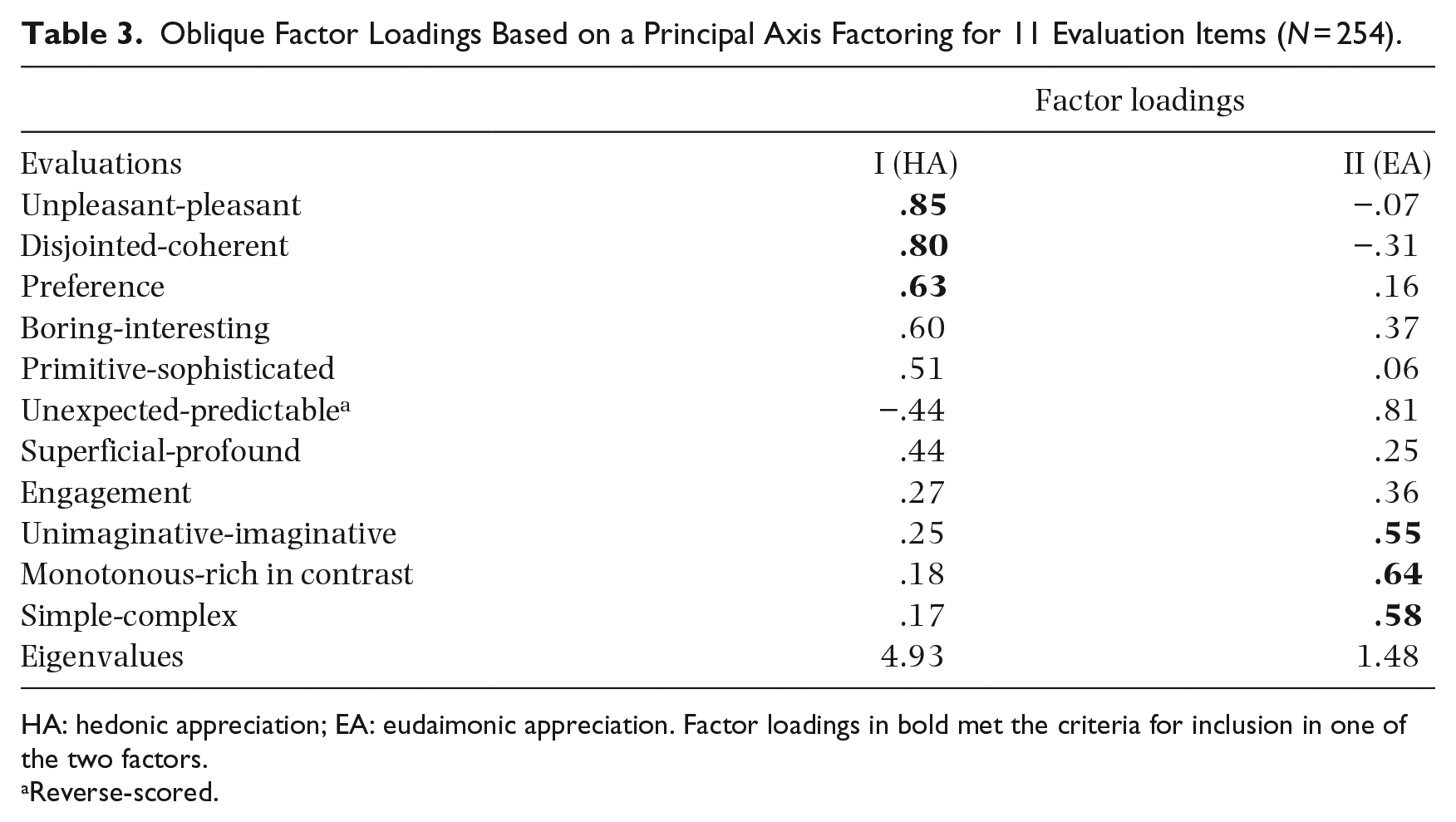
HA: hedonic appreciation; EA: eudaimonic appreciation. Factor loadings in bold met the criteria for inclusion in one of the two factors.
Reverse-scored.
Based on the characteristics of the measures in each factor, Factor I was named Hedonic Appreciation (HA; 3 items, α = .75) and Factor II was named Eudaimonic Appreciation (EA; 3 items, α = .78). The first label was chosen because pleasantness and likability clearly align with hedonism, understood as pleasure and enjoyment (Wirth et al., 2012), while music critics and analysts have long considered coherence to be an aesthetic virtue contributing to pleasurable listening (Levinson, 2006). In contrast, we arrived at “Eudaimonic” because the descriptors “rich in contrast,” “complex,” and “imaginative” align with previously identified eudaimonic motivations for media consumption (Oliver & Raney, 2011). For each participant, two-factor scores were calculated based on the regression method to determine a score for EA and a score for HA. Each factor score can be considered as normalized data that have a range between −1 and +1. A factor score of zero represents the sample’s mean appreciation for EA or HA, a negative score represents relatively less appreciation than the group mean, and a positive score represents relatively more appreciation than the group mean. These factor scores were used in the main analyses to test hypotheses specific to music appreciation.
Recall performance
Participants were presented with six pairs of 4–7 s audio clips and asked to identify the clip that was taken from the original stimulus. Each pair contained one clip extracted from the stimulus and one unheard clip (foil). The foils were separately recorded transformations of the original extract. Transformations included altering tempo, retuning drums, replacing the gong with a cymbal, and inverting rhythmic figures. A pilot study was conducted to identify which of the foils were reliably discernible from the original clips.
Implicit Association Test
Participants completed a Qualtrics-based implicit association test (IAT) (Carpenter et al., 2019) in which they sorted and combined Western/Indian faces and positive/negative words. The IAT measures implicit bias for Western and Indian ethnicities and the result is a single D-score for each participant: a positive D-score indicating association in the form of (Western + positive; Indian + negative), a negative D-score indicating the opposite bias (Western + negative; Indian + positive), and a D-score of zero indicating no bias. The missing data for participants who did not complete the test or whose reaction time was too fast or too slow were imputed by the single regression imputation method—using the “linear trend at point” method in SPSS. This method was selected as it has been shown to be the most effective single imputation method for handling missing data (Eekhout et al., 2014).
Procedure
After providing informed consent, participants were randomly assigned to one of three cultural context conditions: Western, Indian, or blended. They were then asked to provide their age, gender, ethnicity, and whether they play an instrument and/or sing. If their response to the latter was “yes,” further questions about their training and current musical activity were asked. The Western/Indian/blended program note was then displayed, and participants clicked the play button to hear the stimulus. After playing to the end, participants could click to proceed. Responses were then collected for Music Appreciation and Memory, and the experiment concluded with the IAT.
Data analysis
SPSS 26 (IBM Corp, 2019) was used to analyze the data. We used a between-subject design. The independent variable was the experimental condition: reading the Western, Indian, or blended text. The dependent variables were HA, EA, recall performance, and IAT D-score.
Results
Table 4 displays the means and standard deviations of EA, HA factor scores, recall performance, and IAT D-scores under the Indian, Western, and blended conditions. For each dependent variable under each condition, the table includes the descriptive data for the whole group, Western participants only, and non-Western participants only. The similarity in standard deviations of the non-Western and Western confirms that our Western group was no more homogenous than our non-Western group.
Means and Standard Deviations (in Brackets) for EA and HA Factor Scores, Memory Recall Performance, and IAT D-Scores.
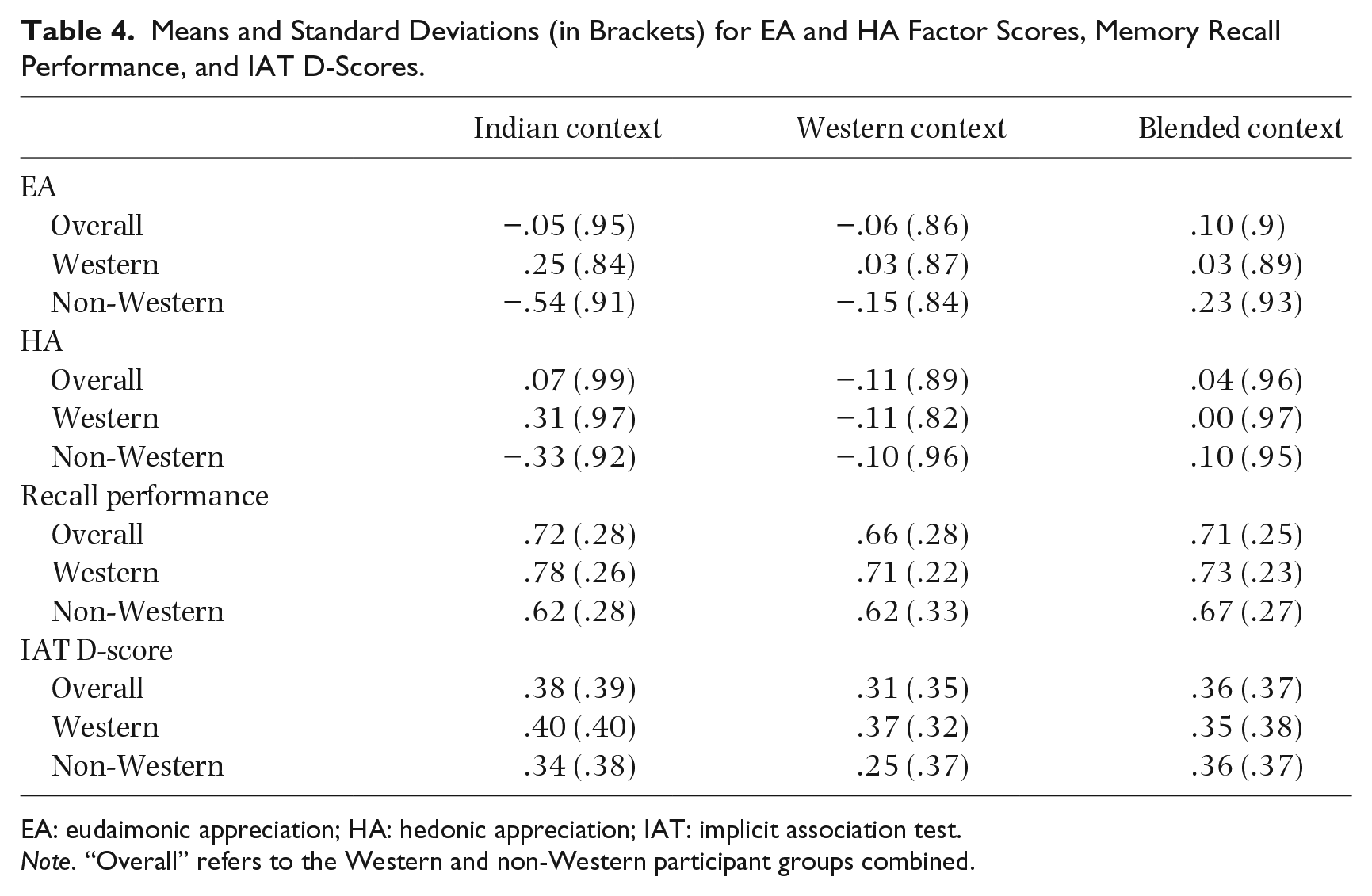
EA: eudaimonic appreciation; HA: hedonic appreciation; IAT: implicit association test.
Note. “Overall” refers to the Western and non-Western participant groups combined.
After an initial analysis comparing all three cultural conditions, the data were analyzed in two stages for each dependent variable: (1) comparing the monocultural Indian and Western conditions and (2) comparing the blended condition to the mean of the combined Indian and Western conditions. This second stage allowed us to test our hypothesis that the blended condition would produce results comparable to the mean of the two monocultural conditions.
Comparisons between the three cultural context conditions
Music Appreciation
Table 5 presents descriptive statistics for the six evaluation scale items that were used to calculate factor scores for EA and HA (see also Table 1 for more information). Group mean factor scores used in the following analyses are presented in Table 4 and visualized in Figure 1 for all four conditions (as discussed, factor scores are normalized data that have a range between −1 and +1, with zero representing the sample’s mean). A negative score indicates a relatively low EA or HA compared with the overall sample of participants, whereas a positive score indicates a relatively high EA or HA.
Means and Standard Deviations (in Brackets) for Ratings of Six Evaluation Scale Items Used to Calculate EA and HA Factor Scores.
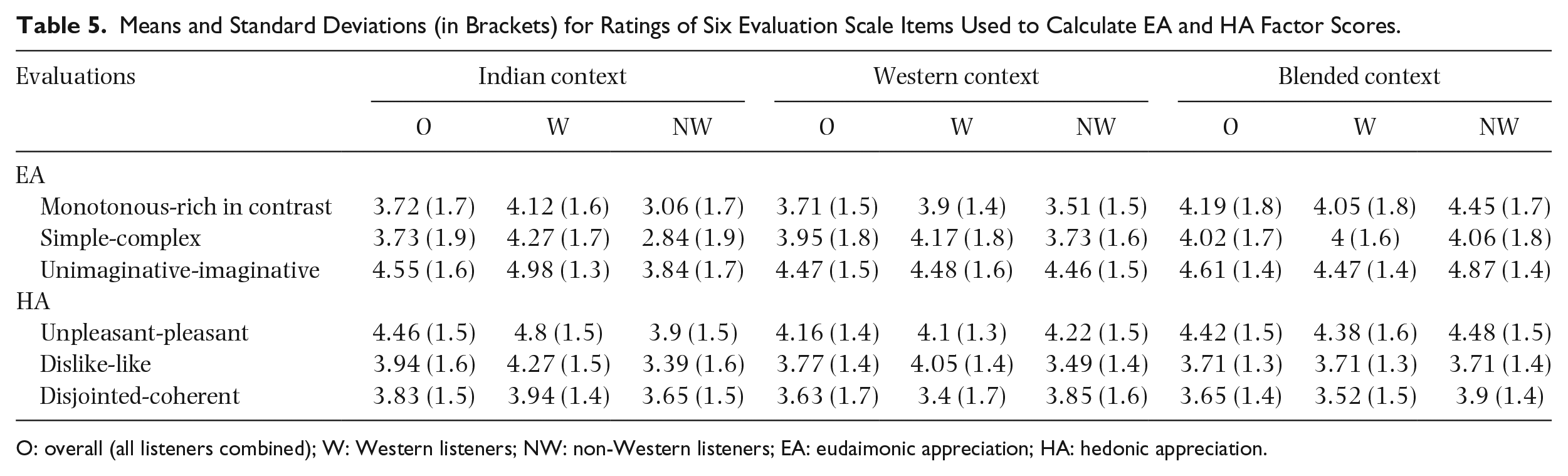
O: overall (all listeners combined); W: Western listeners; NW: non-Western listeners; EA: eudaimonic appreciation; HA: hedonic appreciation.
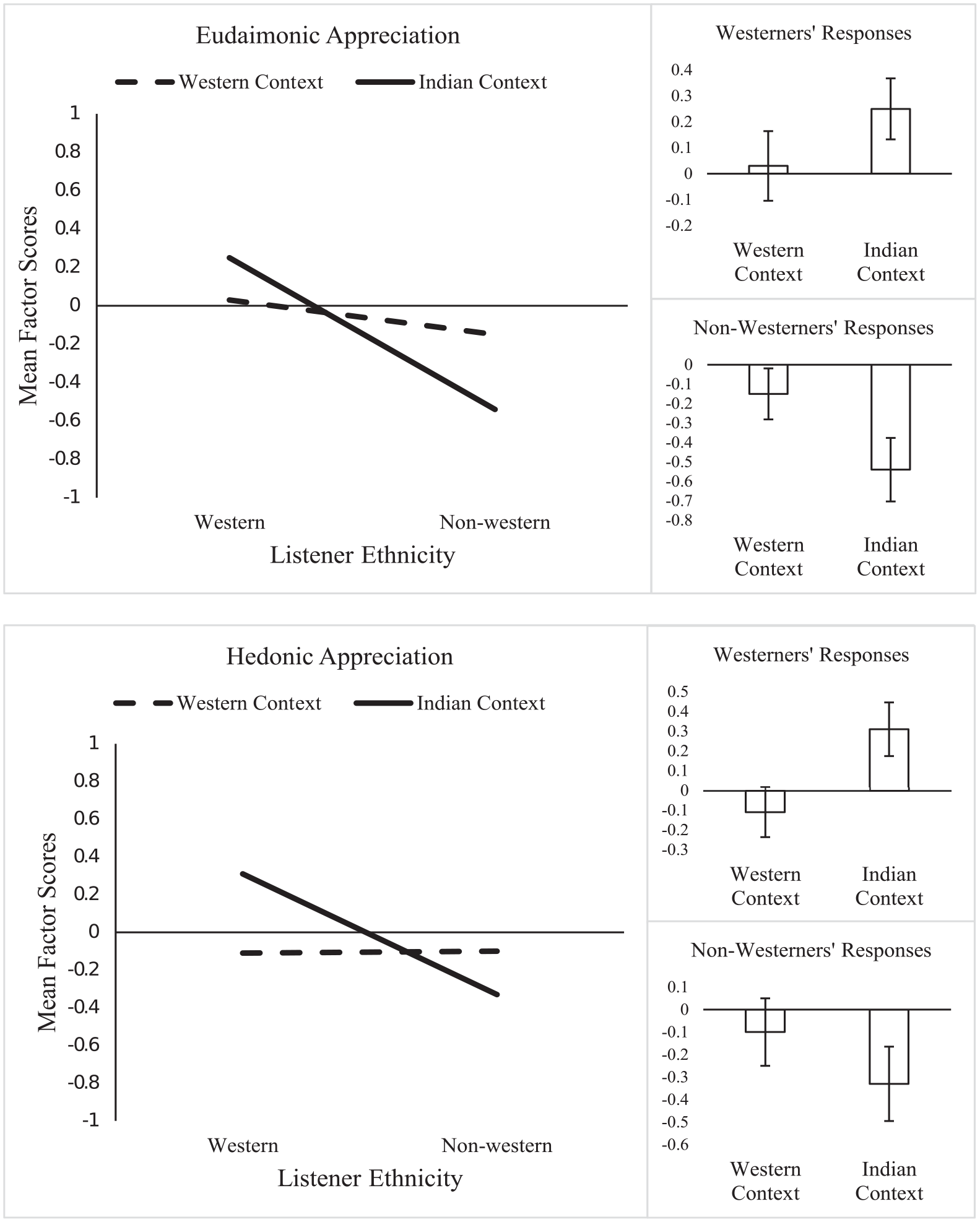
Eudaimonic and Hedonic Appreciation Scores as a Function of Cultural Context and Listener Ethnicity.
A 2 (Western, non-Western participants) × 3 (Indian, Western, and blended conditions) between-subjects Analysis of Variance (ANOVA) was performed to analyze the effect of cultural context and listener ethnicity on music appreciation. Across the three conditions, there was no statistical difference in EA, F(2, 251) = .87, p = .42, nor HA, F(2, 251) = .84, p = .43. However, there were significant condition × ethnicity interactions on both EA, F(2, 248) = 6.35, p = .002, and HA, F(2, 248) = 3.67, p = .027.
We then conducted two separate 2 (Western and non-Western participants) × 2 (Indian and Western condition) between-subject ANOVAs to compare the two monocultural context conditions. With EA as the dependent variable, there was no significant main effect of cultural context, F(1, 161) = .37, p = .54, Ƞ p 2 = .002. However, the main effect of listener ethnicity was significant, F(1, 161) = 12.84, p < .001, Ƞ p 2 = .074, indicating that EA was significantly higher in Western listeners (M = .15, SD = .86) than in non-Western listeners (M = −.32, SD = .89) when responses to both cultural context conditions are combined. Importantly, the interaction effect was significant, F(1, 161) = 4.99, p = .027, Ƞ p 2 = .03. Post hoc analyses were conducted using a Bonferroni adjusted alpha of α = .0125 (.05/4 comparisons). As can be seen in the top panel of Figure 1, Western listeners had significantly higher EA (M = .25, SD = .84) than non-Western listeners (M = −.54, SD = .91) when listening to the music with an Indian cultural context, t(80) = 4.01, p < .001, 95% CI = [.4, 1.19]. The remaining pairwise comparisons were not significant.
With HA as the dependent variable, the main effect of cultural context was not significant, F(1, 161) = .49, p = .49, Ƞ p 2 = .003. However, there was again a main effect of listener ethnicity, F(1, 161) = 4.75, p = .03, Ƞ p 2 = .029, indicating that Western listeners reported higher HA (M = .12, SD = .93) than non-Western listeners (M = −.20, SD = .94) when responses to both cultural context conditions were combined. The interaction effect was also significant, F(1, 161) = 5.02, p = .026, Ƞ p 2 = .03. Post hoc analyses were conducted using a Bonferroni adjusted alpha of α = .0125 (.05/4 comparisons). Similar to the EA results, HA was significantly higher in Western listeners (M = .31, SD = .97) than in non-Western listeners (M = −.33, SD = .92) when listening to the music with an Indian cultural context, t(80) = 2.98, p = .003, 95% CI = [.23, 1.06]. The remaining pairwise comparisons were not significant.
The left panels of Figure 1 display the interaction effect between experimental conditions and ethnicity on EA and HA. To tease apart the distinction between the two ethnic groups, bar charts in the right panels are presented to display the means (±standard error of the mean) of Western and non-Western participants’ responses for EA and HA. Figure 1 shows that Western and non-Western participants have a reversed tendency of appreciation under Indian and Western cultural context conditions: Western participants reported a positive appreciation of the music thought to be a product of Indian musical culture, whereas non-Western participants reported a negative appreciation of the music under those same conditions.
“Reasons for liking” responses
Table 6 categorizes the different reasons participants used to qualify their liking ratings, as well as the frequency of these reasons. Chi-square tests of independence showed a statistical correlation between listener ethnicity and the valence (positive/negative) of responses, χ2(1) = 10.27, p = .001. In other words, there was a relationship between ethnicity and whether participants qualified their liking ratings in positive or negative terms. The correlation was not significant in the Western cultural context condition, χ2(1) = 2.17, p = .14, but significant under the Indian cultural context condition, χ2(1) = 8.87, p = .003. Western participants assigned significantly more positive reasons (39.06%) toward the music in the Indian condition than non-Western participants (10.94%). No correlation was revealed between the cultural context condition and reason positivity/negativity, χ2(1) = .70, p = .4.
Frequencies and Percentage (in Brackets) of the “Reasons for Liking” Responses for Music Presented With Western or Indian Cultural Context.
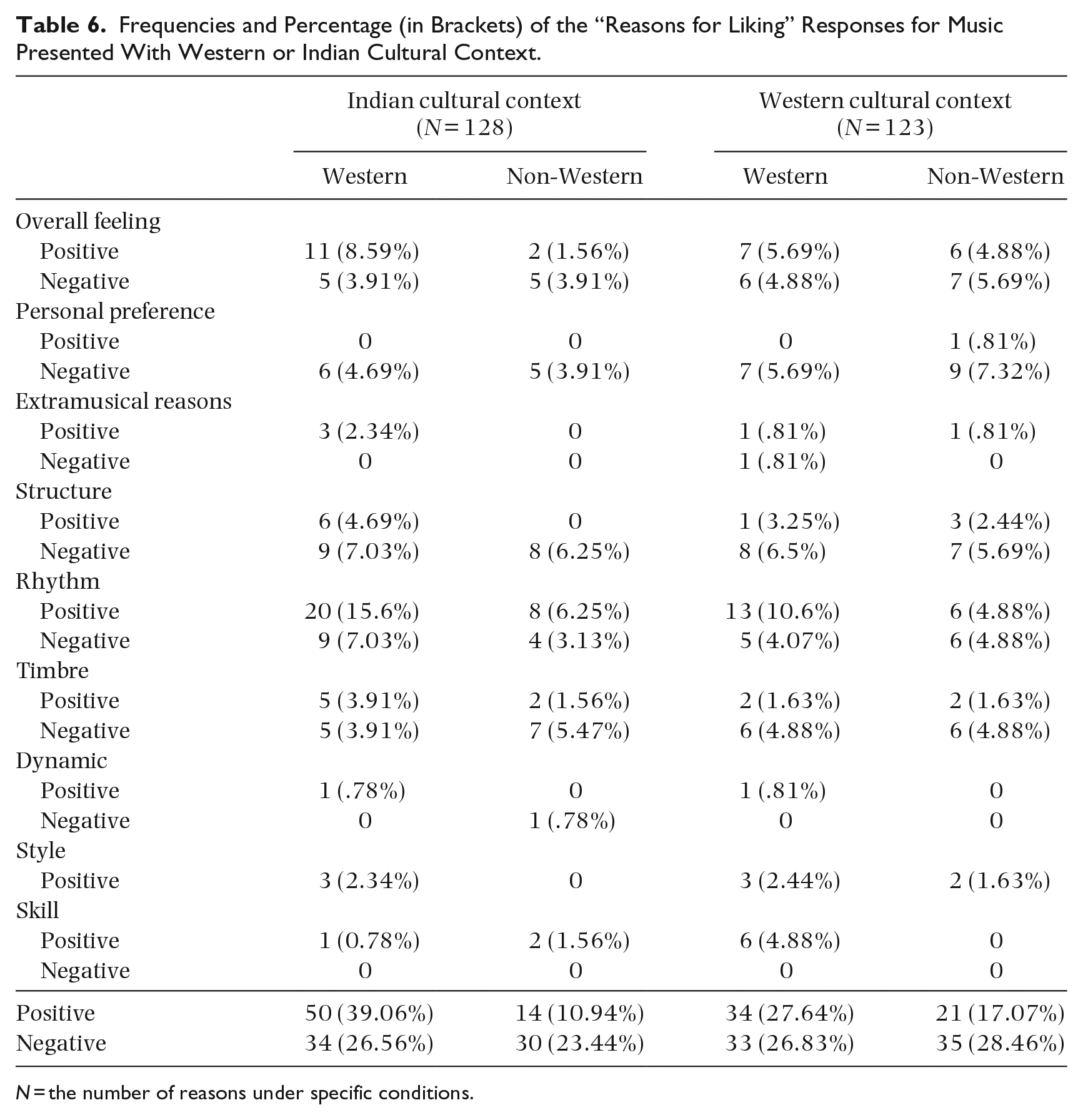
N = the number of reasons under specific conditions.
Recall performance
The Main effect analyses showed that recall performance did not differ across Western and Indian cultural context conditions, F(1, 161) = .75, p = .39, Ƞ p 2 = .005. However, there was a significant main effect of listener ethnicity, F(1, 161) = 8.40, p = .004, Ƞ p 2 = .05. Westerners had higher accuracy on the recall test (M = .75, SD = .25) than non-Westerners (M = .62, SD = .31). There was no significant interaction between the effects of cultural context and listener ethnicity on recall performance, F(1, 161) = .73, p = .39, Ƞ p 2 = .005.
Implicit bias for Western and Indian ethnicities
A two-way ANOVA revealed that the main effect of cultural context was not significant, F(1, 161) = 1.07, p = .30, Ƞ p 2 = .007. The main effect of listener ethnicity was also not significant, F(1, 161) = 2.22, p = .14, Ƞ p 2 = .014. The interaction between cultural context and listener ethnicity was also not significant, F(1, 161) = .27, p = .60, Ƞ p 2 = .002. Therefore, implicit bias for Western and Indian ethnicities was not significantly different between Western and non-Western listeners, and this did not vary as a function of whether these listener groups were presented music with Western or Indian cultural context.
The effect of a blend of Western and Indian cultural context on music appreciation, memory recall, and implicit bias
One-sample t-tests were performed to estimate whether there is a difference between the blended condition and the mean of the combined Indian and Western conditions for each dependent variable. The results are shown in Table 7. The only statistical difference was observed for non-Western participants’ EA scores, t(30) = 3.44, p = .002, Cohen’s D = .62 (medium effect). Non-Western participants reported significantly higher ratings of EA under the blended condition (M = .23, SD = .93) than the mean of the Indian and Western conditions (M = −.35).
Results of One-Sample t-Tests Comparing EA, HA, Recall Performance, IAT D-Score Between Blended Conditions and the Mean of Indian/Western Conditions.
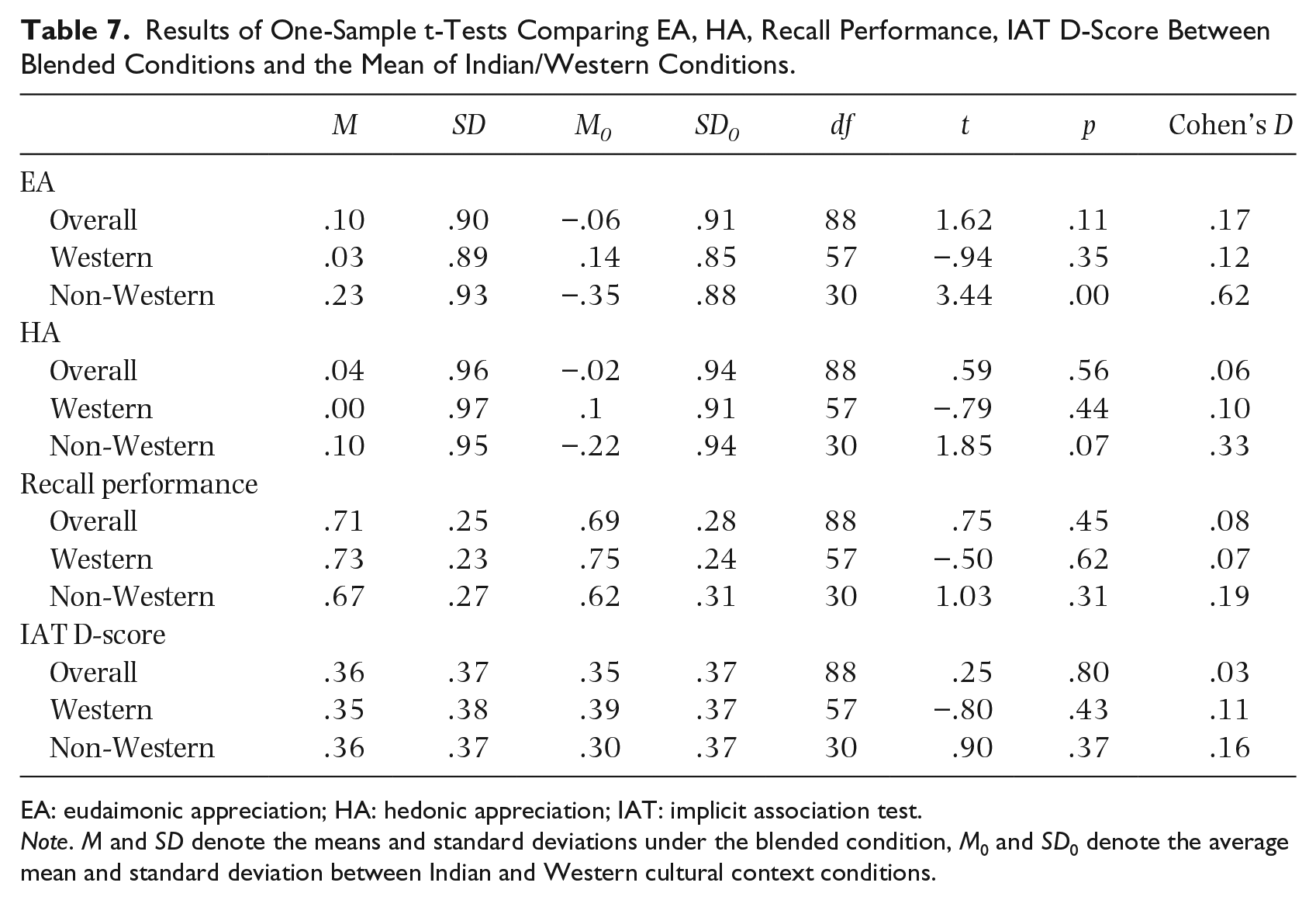
EA: eudaimonic appreciation; HA: hedonic appreciation; IAT: implicit association test.
Note. M and SD denote the means and standard deviations under the blended condition, M0 and SD0 denote the average mean and standard deviation between Indian and Western cultural context conditions.
Table 8 summarizes the frequencies of each “reason for liking” category under the blended condition and the mean of the Indian and Western conditions. Results of chi-square tests of independence suggested that there was no relationship between the cultural context provided with the music and the valence (positive/negative) of reasons, χ2(1) = .23, p = .63. This was also the case for the relationship between listener ethnicity and valence of reasons, χ2(1) = .74, p = .39.
Frequencies and Percentage (in Brackets) of the “Reasons for Liking” Responses for the Blended Condition and Mean of Indian/Western Conditions.
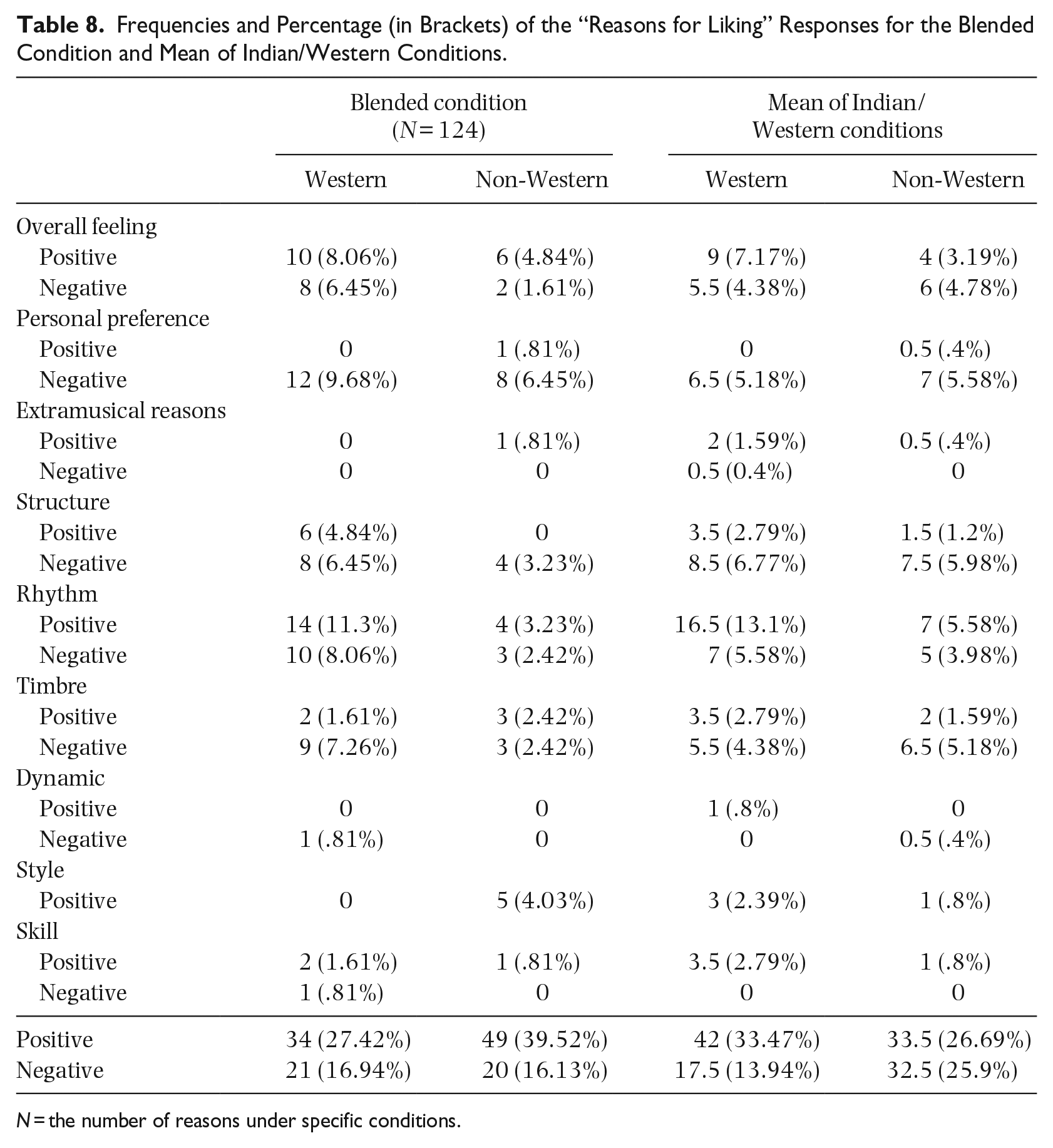
N = the number of reasons under specific conditions.
Discussion
The results of the present study confirm our prediction that source information regarding the cultural context of a piece of music affects listeners’ evaluation of that music. Although memory recall was higher among Western participants overall, this was not affected by the music’s cultural context. Similarly, implicit racial bias seems not to have been influenced by the musical experience presented. Regarding appreciation, two distinct factors emerged from the various evaluation measures taken, and we have labeled these HA and EA. A high HA score means that the music was found to be coherent, pleasant, and enjoyable. A high EA score suggests that the music was considered rich in contrast, complex, and imaginative. The concept of eudaimonia has been featured in recent discussions of media appreciation (Eden, 2020; Oliver & Bartsch, 2016), and is used here to denote a form of appreciation that arises when the listener’s expectations are challenged rather than met. In the past, studies have connected eudaimonia to more “meaningful” experiences, as well as individuals with “more contemplative and reflective tendencies” (Oliver & Raney, 2011). The challenging nature of our music stimulus might explain why the effects were clearer on the EA dimension.
Considering Western-identifying participants alone, cultural source knowledge had only a small effect on how the music was evaluated. For non-Western listeners, however, source sensitivity did make a significant difference—particularly regarding eudaimonic appreciation, which was highest for music framed as a blend of Western and Indian cultures and lowest when the music was framed as Indian. The Indian cultural context condition produced the highest appreciation scores from Western participants, thus providing the greatest distinction between our two ethnic listener groups.
Comparing ethnic groups under monocultural conditions
Our results demonstrate a significant difference between Western and non-Western participants in their evaluations of music framed as Indian. Specifically, Western participants had higher levels of appreciation—both hedonic and eudaimonic—than their non-Western peers. Their liking ratings were also accompanied by more positive explanations. “Indian classical” and “Western classical” are both distinct and definable (albeit broad) traditions, and it is worth restating that all participants with South Asian subcontinental ethnicity were excluded from our analysis. Therefore, when our stimulus was presented as “composed by a musician trained in the Indian classical tradition,” it became a product of a foreign musical culture to all participants. We therefore attribute the observed trend to the differences between our two ethnic groups’ perspectives on Indian musical culture.
In Music, Difference and the Residue of Race, Jo Haynes (2012) analyses ‘“positive’ dimensions of racialisation that constitute favourable aesthetic judgements of ethnic groups and music” (p. 3). In doing so, she invokes a term coined by sociologist Zygmunt Bauman: proteophilia. Proteophilia refers to individuals’ attraction toward, and willingness to engage with, the “Other.” This positive response hinges on the understanding that this “Other” is not a threat to the current order of a social space. This sense of security, according to Bauman (1993, p. 123), appeases modern society’s wider obsession with the imposition of order and structure. Drawing on interviews with WOMAD (World of Music, Arts and Dance) festival participants, Haynes (2012) presents such intercultural events as the manifestation of proteophilia (p. 77). Bauman (1993) also emphasizes that the episodic nature of such “mismeetings”—unemotional and inconsequential as they are—and their confinement to the realm of aesthetic space ensure no meaningful change within the social space (pp. 157, 180).
As members of the dominant social group within the Western cultural setting in which our experiment was conducted, Western-identifying participants were best placed to engage with Indian music as a nonthreatening object of curiosity. In contrast, non-Western participants do not enjoy the security of belonging to the dominant group, nor do they “control the processes of social spacing” (Bauman, 1993, p. 165). According to ethnocentrism theory, nondominant cultural groups tend to be more accepting of the dominant cultural group than of other “outsider” cultural groups (Berry et al., 2011, pp. 348–349). For non-Western participants in the present scenario, Indian culture is neither reflective of their personal ethnic identity nor of the culture in which they live. In Bauman’s terms, Indian culture is therefore ambiguous: an unfamiliar stranger evoking an ambivalent response (Bauman, 1990; Bauman & Tester, 2001, p. 80). The result of this encounter with strangeness is proteophobia: an “unwillingness of engagement” (Bauman, 1993, pp. 149, 164). Thus, irrelevant to a non-Westerner’s quest to make sense of their own cultural identity, the cultural artifact framed as Indian is apparently stripped of its hedonic and eudaimonic value.
Interpreting the blended effect
At the beginning of this study, we predicted that the blended condition would produce hybrid results. We have therefore compared these results to the means of our Indian and Western condition data, following evidence that music enacting a similar cultural blend is perceived as neither Western nor non-Western (Demorest & Schultz, 2004; Kang & Yoo, 2016). Contrary to our prediction, an unexpected effect has emerged. When our stimulus was framed as a blend of Western and Indian content, non-Western participants had significantly higher levels of eudaimonic appreciation. No such increase emerged among Western listeners in the blended condition, suggesting that the mere accuracy of the program note was not the determining factor. Where the monocultural Indian condition evoked non-Western participants’ proteophobia, it is apparent that this intercultural integration—of Indian musical content within a Western musical context—has neutralized the threat posed by the Indian “Other” toward the non-Westerner’s sense of social order. The blended condition thus facilitated a more secure engagement with the musical “Other,” which has apparently led to a proteophilic response.
Cultural blending is one aspect of acculturation, a process whereby one is forced to contemplate their own sense of cultural identity and belonging (Berry et al., 2011). For non-Western participants in our Western cultural setting, the blended condition may have also resonated on a meaningful personal level resulting in this significant increase in eudaimonic appreciation. Understanding one’s true self, or “daimon,” is central to the concept of eudaimonia (Reybrouck & Eerola, 2022). Our data suggest that, to a certain type of listener, an intercultural music composition may be more than just the sum—or mean—of its parts. It might provide both a safe pathway for engagement with foreign cultures and an impetus for meaningful self-reflection.
Limitations and concluding remarks
We acknowledge that conducting online studies has its challenges and, although reasonable attempts were made to ensure the integrity of participant responses, it is impossible to guarantee that all participants engaged attentively. Future studies will benefit from a more realistic experimental setting, where we would expect the observed trends to strengthen rather than diminish. Likewise, we recognize that the use of a single piece of music limits the generalizability of conclusions we draw from this experiment. Future studies might explore whether the cultural context has a similar effect on the appreciation of music that is more accessible and familiar.
We note that the multifaceted structure of our program notes, in which a musical cultural context was named and then reinforced by an idiomatic overview of the piece, raises questions about the role of such descriptive language. It is impossible to say whether the mere evocation of a musical culture would yield similar results. Future studies may seek to isolate the effect of a simplified cultural variable. Furthermore, given that we avoided specifying the cultural identity of our stimulus’ creator, future experiments may be able to determine whether references to musical cultures evoke stereotypical associations pertaining to an artist’s personal identity. In an age of increased mobility, such stereotypes—for example, that Indian people alone possess expertise in Indian music—are increasingly unreliable. The context of intercultural music provides a rich ground for further exploration of these issues.
This study sheds new light on two aspects of music appreciation. First, that evaluations of complex musical stimuli can be conceptualized in two dimensions: hedonic and eudaimonic. Second, that cultural context specifically contributes to the role of source sensitivity in music appreciation. Our findings suggest that musicians can manipulate how their music is appreciated by altering its contextual frame, emphasizing details likely to resonate with an audience. Furthermore, we have shown that the subsequent effects of sensitivity to cultural context are dependent on a listener’s own cultural identity, and that certain conditions are required to obtain positive outcomes from intercultural music engagement.
