




Abstract
Based upon a sample of 232 German elementary school students aged 9–12 years, the present longitudinal study aimed to examine the relations between achievement, self-concepts, and intrinsic values in music, mathematics, and verbal domains within the generalized internal/external frame of reference model (GI/E model). Results showed significantly positive achievement-self-concept/intrinsic value relations within domains and some significant achievement-self-concept/intrinsic value relations across domains: Mathematics achievement negatively predicted verbal self-concept, verbal intrinsic value, and music intrinsic value, whereas verbal achievement positively predicted music self-concept and music intrinsic value but negatively predicted mathematics intrinsic value. Music achievement, in turn, positively predicted verbal intrinsic value. All three self-concepts mediated the achievement-intrinsic value relations within domains. Furthermore, verbal self-concept proved to mediate the relation of mathematics achievement to verbal intrinsic value, whereas music self-concept also proved to mediate the relation of verbal achievement to music intrinsic value.
A great interest in self-concept research has been dedicated to the internal/external frame of reference model (I/E model, Marsh, 1986). This model posits that the relations between academic achievement and academic self-concepts (i.e., self-perceptions of academic abilities) are significantly influenced by social and dimensional comparisons because students use two frames of reference when evaluating their achievement: On the one hand, students use an external frame of reference for social comparisons, where they contrast their achievement to that of other classmates within domains. These comparisons result in positive effects of achievement on self-concepts within a domain. On the other hand, students also use an internal frame of reference for dimensional comparisons, where they contrast their achievement across domains. These comparisons can result in either negative (contrast) or positive (assimilation) effects of achievement in one domain on self-concepts in other domains. Contrast effects occur when the achievement-self-concept relations are compensatory. For instance, if students’ music achievement is high (low), their music self-concept may increase (decrease), while their mathematics or verbal self-concept may decrease (increase). In contrast, assimilation effects appear when students evaluate their achievement across domains in a very similar way because these domains share some similar contents. For instance, it is reasonable to assume that students who perform well in physics are also good at chemistry and may develop higher self-concepts in those two domains (Jansen et al., 2015). A paradoxical consequence of the interplay between social and dimensional comparisons in the I/E model is that self-concepts across domains (e.g., music and academic domains) are not or only weakly correlated with each other, whereas achievement across those domains is positively interrelated (e.g., Marsh, Lüdtke, et al., 2015; Möller et al., 2014, 2020). This paradoxical finding has also been found for domains other than academic domains (e.g., Arens & Preckel, 2018; Jansen et al., 2015) or predictors and outcomes other than academic achievement and academic self-concepts (e.g., Dörendahl et al., 2021; van der Westhuizen et al., 2022). While the original I/E model focuses on achievement as predictor of self-concepts in mathematics and verbal domains, the extension of the I/E model to other domains or other predictors and outcomes is also called the generalized I/E model in the literature (GI/E model; Möller et al., 2015). Thus, the GI/E model suggests that students generally contrast their characteristics within and across domains to each other (Möller & Marsh, 2013). For instance, some studies have considered students’ achievement as predictor and several motivational-affective characteristics as outcomes in the GI/E model, such as students’ perceptions of effort (Lohbeck, 2019), intrinsic motivation (Marsh, Lüdtke, et al., 2015), interest (Schurtz et al., 2014), anxiety (van der Westhuizen et al., 2022), enjoyment (Goetz et al., 2008), or achievement goals (Dörendahl et al., 2021). However, none of those studies have yet integrated the music domain into the GI/E model. Although the relations between music and academic domains have been investigated in numerous studies (dos Santos-Luiz et al., 2016; Sala & Gobet, 2017; see also Guhn et al., 2020 for a review), no study has so far explored the possible impact of social and dimensional comparisons on the formation of students’ music self-concept within the GI/E model framework. As a consequence, it is still unclear whether social and dimensional comparisons across music and academic domains also influence the formation of students’ music self-concept or other desirable outcomes, such as students’ music intrinsic value (i.e., the extent of enjoyment that students perceive from performing a task; Eccles & Wigfield, 2020). For this reason, this study aimed to advance previous literature by (1) extending the GI/E model to the music domain in addition to mathematics and verbal domains, (2) integrating both self-concepts and intrinsic values as outcomes of achievement into the GI/E model, (3) testing the possible mediating effects of self-concepts on the relations between achievement and intrinsic values, and finally (4) using a rather young sample of elementary school children, who have largely been neglected in the literature relative to secondary school students. This study is thus the first to explore the possible underlying influencing processes (i.e., social and dimensional comparison processes) of the formation of elementary school children’s self-concepts and intrinsic values across music and academic domains within the GI/E model framework. Given that students’ music self-concept and music intrinsic value are two essential factors that positively influence students’ music achievement or other desirable outcomes (see West, 2013 for a review), knowledge about the underlying processes of the formation of students’ music self-concept and music intrinsic value can help teachers create more specific intervention programs in music education aiming at enhancing students’ music self-concept or music intrinsic value and keeping students from making negative (contrast) dimensional comparisons, which are more likely to result in lower self-concepts (Möller et al., 2020; Wigfield et al., 2020; for an overview).
Marsh/Shavelson self-concept model
A theoretical rationale for proposing contrast and assimilation effects in the GI/E model is the revised Marsh/Shavelson’s self-concept model (Marsh, 1990; Marsh et al., 1988). According to the original self-concept model by Shavelson et al. (1976), self-concept represents a multidimensional, hierarchically structured construct, which encompasses all individual’s self-evaluations of abilities and characteristics in different domains. At the top of the hierarchy is the general self-concept, also known as self-esteem, which includes all individual’s global self-evaluations. This global self-concept is subdivided into an academic and a non-academic self-concept part at the next level. While the academic self-concept part subsumes all self-evaluations of abilities in academic domains (e.g., history, mathematics, or biology), the non-academic self-concept part relates to all self-evaluations of social, emotional, and physical aspects, such as social relationships, emotions, and physical abilities. However, since mathematics and verbal self-concepts were non-significantly correlated with each other, Marsh et al. (1988) revised this model later by summarizing two higher order factors of a general mathematics self-concept and a general verbal self-concept. This model assumes that academic self-concepts can be ordered along a verbal-mathematical continuum, depending on the similarity of the domains. While mathematics self-concept is expected to be located on the first endpoint, verbal self-concept is expected to be located on the last endpoint of this continuum. Academic self-concepts in more similar domains (e.g., mathematics, physics) should be placed next to each other, whereas academic self-concepts in more dissimilar domains (e.g., mathematics, English) should be placed more far from each other on this continuum (Guo et al., 2017; Jansen et al., 2015; Marsh, Lüdtke, et al., 2015). Despite some exceptions (e.g., Helm et al., 2016; Marsh, Lüdtke, et al., 2015; Niepel et al., 2014; Xu et al., 2013), several studies have provided support for those positive (assimilation) effects (e.g., Jansen et al., 2015; Marsh, Lüdtke, et al., 2015).
Dimensional Comparison Theory (DCT)
Although dimensional comparisons were firstly explained in the I/E model (Marsh, 1986), they have become more prominent in dimensional comparison theory (DCT; Möller & Marsh, 2013). DCT suggests that students can make two kinds of dimensional comparisons when evaluating their achievement: (1) If students contrast their achievement in very dissimilar domains to each other (e.g., music, sports), achievement in one domain shows negative (contrast) effects on self-concepts in other domains. (2) If students contrast their achievement in very similar domains (e.g., biology, physics, chemistry) to each other, achievement in one domain has positive (assimilation) effects on self-concepts in other domains. Support for these assumptions has been found in various domains (e.g., Guo et al., 2017; Helm et al., 2016; Jansen et al., 2015; Möller et al., 2015). However, results of the available studies are rather mixed (Jansen et al., 2015; Marsh, Abduljabbar, et al., 2015; Niepel et al., 2014; Xu et al., 2013) and almost no study has yet investigated students’ perceived (dis)similarity of both academic and non-academic domains simultaneously. An exception is a study by Haag and Goetz (2012), in which students perceived mathematics, German, and music as very dissimilar but mathematics and physics or German and English as very similar. However, the GI/E model was not tested in this study and no study has so far explored whether social and dimensional comparisons also exist between music, mathematics, and verbal domains.
Evidence for the GI/E model in elementary schools
A few studies have already provided support for the generalizability of the GI/E model in elementary schools (e.g., Arens & Preckel, 2018; Lohbeck, 2019; Schneider & Sparfeldt, 2020). For instance, Arens and Preckel (2018) extended the GI/E model to the non-academic physical domain, in addition to mathematics and German domains, with achievement as a predictor of self-concepts and intrinsic values in 514 elementary school children from Grade 3. Results revealed significantly positive effects of achievement on self-concepts and intrinsic values across domains, reflecting social comparisons. However, evidence for significantly negative (contrast) effects of achievement on self-concepts and intrinsic values, reflecting dimensional comparisons, was only found across academic domains but not across both academic domains and the physical domain. Similarly, using a sample of 858 elementary school children from Grades 2 to 4, Schneider and Sparfeldt (2020) tested the GI/E model with competence and affect self-concepts (as they were also operationalized in this study) as outcomes of achievement in mathematics and German domains. In all three grades, they found moderate to high effects of achievement on self-concepts, supporting social comparisons but only some significant effects of achievement on self-concepts across domains, i.e., significantly negative effects from (1) mathematics achievement to German affect self-concept in Grade 2; (2) from German achievement to mathematics competence self-concept in Grade 4; and (c) from German achievement to mathematics affect self-concept in Grades 3 and 4. In contrast, drawing on a sample of 200 fourth graders, Lohbeck (2019) examined the GI/E model with both competence and affect self-concepts (as also operationalized in this study) as well as self-perceptions of effort as outcomes of achievement in mathematics and German domains. Results significantly positive effects of achievement on self-concepts and significantly positive effects of self-concepts on self-perceptions of effort within domains, supporting social comparisons. However, there was no support for significantly negative effects of achievement on academic self-concepts or significantly negative effects of self-concepts on self-perceptions of effort across domains, indicating dimensional comparisons. Both academic self-concepts even showed significantly positive effects on self-perceptions of effort in corresponding domains. Furthermore, there were non-significant achievement effects on self-perceptions of effort, except for German achievement which was slightly positively related to self-perceptions of German effort. This research indicates that dimensional comparisons are less frequently used by elementary school students than social comparisons.
Research on music education and music psychology
A plethora of studies have highlighted the cognitive and educational benefits of music education for many executive functions that are closely related to academic skills (Dumont et al., 2017; Frischen et al., 2021; Guhn et al., 2020; Jaschke et al., 2018; see also Hogenes et al. (2014) for a review on the impact of music on children’s functioning). For instance, numerous studies have shown that music training significantly influenced students’ reading and linguistic skills (e.g., Carioti et al., 2019; Hogenes et al., 2016; Moreno et al., 2009; Slater et al., 2014; Tierney & Kraus, 2013), phonological awareness (Gordon et al., 2015; Linnavalli et al., 2018; Moritz et al., 2013; Ozernov-Palchik et al., 2018; Vaiouli & Grimmet, 2020), word matching, letter sounding, and word reading (Corrigall & Trainor, 2011; Degé & Schwarzer, 2011; Peynircioglu et al., 2002), or verbal memory (Roden et al., 2012). More specifically, Carioti et al. (2019) investigated 128 students aged 10 and 14 years at the beginning of Grade 6 and 1 year later, at the beginning of Grade 7. Of these, 72 students attended a music curriculum (30 with previous music experience and 42 without), while 56 students belonged to a standard curriculum (44 with prior music experience and 12 without). Results showed that students attending the music curriculum systematically outperformed students of the control group in tests of general cognitive abilities, visuospatial skills, and accuracy in reading and memory tests. Similarly, Jaschke et al. (2018) examined 147 primary school children who were randomized into the following four groups: two music intervention groups, one active visual arts group, and a no arts control group. Children in the visual arts group also performed significantly better on visuospatial memory tasks as compared with the three other conditions.
In contrast, studies testing the effects of musical training on children’s logical–mathematical skills have been rather inconclusive, showing either no (Elpus, 2013; Holmes & Hallam, 2017) or positive effects on mathematics skills (Rauscher & Hinton, 2011), such as counting (Hallam, 2010), operations and algebra (Barroso et al., 2019; Guhn et al., 2020), or proportions and ratios (Vaughn, 2000). For instance, Mehr et al. (2013) tested the effects from music lessons to mathematics skills in 5-year-old children and found no support for significant differences in mathematics tests between children attending either a music program or a visual arts group. In contrast, Holochwost et al. (2017) reported in a study with 265 school-aged children from Grades 1 to 8 that students attending a music education program scored significantly higher on all standardized achievement tests (i.e., reading, mathematics, language arts) and had better grades in English language arts and mathematics than students in the control group. Furthermore, there is also evidence that music education significantly affects students’ second language learning (Busse et al., 2021; see also Zeromskaite, 2014 for a review), emotional well-being (Jones et al., 2020), emotion regulation (e.g., Campbell et al., 2007; Sakka & Juslin, 2018; Seifried, 2006), and identity formation (Cabedo-Mas & Díaz-Gómez, 2013; Seifried, 2006; see also Ilari, 2020 for an overview of longitudinal research on music education and child development). For instance, using a sample of 9- to 11-year-old children, Degé and Schwarzer (2018) showed that children attending an extended musical curriculum exhibited a significantly higher academic self-concept after a year of participation than children not attending the curriculum. A more positive music self-concept has, in turn, been found to be closely related to higher levels of self-esteem (Scalas et al., 2017) and intrinsic motivation for musical activities (West, 2013). This research highlights the great relevance of music education for several academic outcomes. However, it must also be noted that the effects of music training on cognitive and academic skills are mostly small in previous research (see the comprehensive meta-analyses by Cooper, 2020; Gordon et al., 2015; Sala & Gobet, 2017, 2020) and most of the available studies testing the effects of music training have focused on executive functions but not on (academic) achievement.
Mediating effects of self-concepts
In addition to students’ self-concepts, the present study considered students’ intrinsic values as outcomes of achievement in the GI/E model. Intrinsic values were mostly described in expectancy-value theory (EVT; Eccles et al., 1983), which has recently been retitled situated expectancy-value theory (SEVT; see Eccles & Wigfield, 2020). Both EVT and SEVT suggest that individuals’ performance, behavior, and choices of activities are significantly determined by (1) their expectancies of success (or self-concepts) and (2) subjective valuing of tasks or activities. For instance, if students show a more positive music self-concept and perceive a high value of music tasks, they are more likely to perform well (low) in music. Evidence supporting the strong links between expectancies of success (or self-concepts), intrinsic values, and achievement has been found for multiple (academic) domains (e.g., Arens & Preckel, 2018; Gaspard et al., 2018; Guo et al., 2017; Helm et al., 2020). Furthermore, both EVT and SEVT propose that expectancies of success (or self-concepts) also mediate the relations between several psychological, situational or contextual factors and achievement-related outcomes. Support for significant mediating effects of self-concept on the relations between students’ academic achievement and intrinsic values or other desirable outcomes has been reported in different domains (e.g., Dörendahl et al., 2020; Lohbeck, 2019; Schurtz et al., 2014; Trautwein et al., 2006). For instance, in the study by Lohbeck (2019), both academic self-concepts in mathematics and verbal domains mediated the effects from achievement to self-perceptions of effort in corresponding domains. Similarly, Dörendahl et al. (2020) tested a GI/E mediation model with self-concept as a mediator of the relations between achievement and achievement goals in mathematics and verbal domains. All initially significant direct paths from achievement to achievement goals became non-significant within domains when integrating self-concept as a mediator into the GI/E model, indicating full mediation. These full mediation effects were also found across domains, with only one exception. This study aimed to add to this research by exploring whether students’ self-concepts also mediate the relations between achievement and intrinsic values within and across music and academic domains.
Objectives and hypotheses
This study is unique in examining the relations between achievement, self-concepts, and intrinsic values in music, mathematics, and verbal domains within the GI/E model framework. Until now, no studies have yet investigated the possible impact of social and dimensional comparisons on the formation of students’ self-concepts and intrinsic values in these three domains in the GI/E model. For this reason, the present study attempted to fill this research gap by testing the following two research questions: (1) Are the relations posited by the GI/E model replicable in a sample of elementary school children when incorporating music, mathematics, and verbal domains into the GI/E model simultaneously? (2) Do elementary school students’ self-concepts mediate the relations between achievement and intrinsic values within and across domains? In line with the theoretical and empirical framework reviewed, all of the (G)I/E model’s predictions were expected to hold, that is, (1) positive effects of achievement on self-concept and intrinsic value within domains, (2) negative (contrast) or positive (assimilation) effects of achievement on self-concepts and intrinsic values across domains, and (3) higher correlations between achievement than self-concepts or intrinsic values across domains. Furthermore, (4), as stated by (S)EVT (Eccles & Wigfield, 2020) and some previous research (e.g., Dörendahl et al., 2020; Lohbeck, 2019; Schurtz et al., 2014; Trautwein et al., 2006), self-concepts were also assumed to mediate the relations between achievement and intrinsic values in the GI/E model.
Method
Sample
The present study is a longitudinal study with two measurement points. The sample of the first measurement point (T1) consisted of 232 elementary school students (boys: n = 108; girls: n = 120, four students did not report their sex), while the sample of the second measurement point (T2) included n = 209 students (boys: n = 95; girls: n = 110, four students did not report their sex). Students attended 13 classes from Grade 4 in seven elementary schools. The number of students per class varied between 10 and 29. Students’ ages ranged from 9 to 12 years in the total sample (M = 9.76, SD = 0.68).
Procedures
The first data collection (T1) took place around early/mid-April 2017, and the second data collection was performed around early/mid-July 2017. All schools were randomly selected and located in the North of Germany, Lower Saxony. The selection of the schools was based on a list of all schools in the city and district of the first author. First, the first author contacted the school principals of the available schools through phone or email. Second, when the school principals agreed to participate, they asked the teachers at “their” school to accept the data collection in their class. Third, the school principals informed the first author of the number of participating classes and the date for the data collection. All school principals, teachers, students, and students’ parents were informed about the purpose of the study and gave written consent to take part in the study. Participation was voluntary and anonymous. Data collection was administered in class by trained university students who confirmed data confidentiality and read all items aloud in class to facilitate children’s responding. All children were able to complete the questionnaire within one lesson (45 min) at school. The training of the university students was conducted by the first author during several lectures and seminars at university, in which the first author explained both the procedure and implementation of the survey in the schools. Furthermore, the first author provided a small booklet in which all information about the procedure and implementation was documented in detail. One lecture of 90 min was sufficient for this training. All procedures were in line with the ethical principles and human subjects’ standards, and the institutional review board from the institution of the authorship also approved the study.
Measures
Self-concepts
Students’ self-concepts in the three domains were measured with two questionnaires at the second measurement point, that is, the short German version of the Self-Description Questionnaire I-GS (SDQ I-GS; Arens et al., 2013) and the short version of the Music Self-Perception Inventory (MUSPI; Morin et al., 2016, 2017). The MUSPI consists of 84 items, with a 12-item Overall Music Ability subscale and six 12-item domain-specific subscales (i.e., Singing, Instrument Playing, Reading Music, Listening, Composing, Moving to Music). For both academic self-concepts, three positively worded items were used (i.e., “I am good at mathematics/German,” “I learn things quickly in mathematics/German,” and “Work in mathematics/German is easy for me”). Analogously, for music self-concept, three items of the global music self-concept scale from the short version of the MUSPI (Morin et al., 2016, 2017) were applied (i.e., “I am good at doing most music-related activities,” “I am confident in my ability to do most music-related activities,” and “Doing most music-related activities is easy for me”). All responses were made on a 5-point scale ranging from 1 (false) to 5 (true).
Intrinsic values
Students’ intrinsic values in the three domains were also measured with the SDQ I-G (Arens et al., 2013) at the second measurement point. As the MUSPI does not include any items for intrinsic values, all three intrinsic values were assessed with three items derived from the SDQ I-GS (i.e., “I like mathematics/German/music,” “I am interested in mathematics/German/music,” and “I look forward to mathematics/German/music”). All items were evaluated on a 5-point response scale ranging from 1 (false) to 5 (true).
Achievement
Apart from the questionnaires, children’s self-reported grades of the last school report were also recorded at the first measurement point. For easier interpretation of the correlation analysis, all three grades were reverse-coded because grades usually differ from 1 (very good) to 6 (insufficient) in the German educational system; thus, higher values reflect higher achievement in the correlation and regression analysis.
Data analysis
Data analysis was performed with confirmatory factor analysis (CFA) and structural equation modeling (SEM) using the maximum likelihood estimator with robust standard errors (MLR) in Mplus 8.6 (Muthén & Muthén, 1998−2017). To replicate the pattern of relations in the GI/E model including music, mathematics, and verbal domains (RQ1), multiple SEM models were tested in which students’ self-concepts and intrinsic values of the second measurement point were considered as latent variables and students’ grades of the first measurement point were considered as manifest achievement indicators. To explore the possible mediating effects of self-concepts (RQ2), a GI/E mediation model was tested by using the “model indirect”-option in Mplus. In this model, both self-concepts and intrinsic values were regressed on achievement, and intrinsic values were also regressed on self-concepts in all three domains. To account for shared method variance associated with the wording of the items, correlated uniqueness between parallel-worded items was permitted (Byrne, 2012). Due to the hierarchical nature of the data, the “type = complex”-option in Mplus was used, and all variables were standardized within each class. To evaluate the fit of the models, the chi-square test statistic, the comparative fit index (CFI), the Tucker-Lewis-index (TLI), and the root mean square error of approximation (RMSEA) with its confidence interval were considered. An adequate model fit was assumed if the RMSEA was < 0.08 and both the CFA and TLI were > 0.95 (Hu & Bentler, 1999). Changes of the fit between the models were analyzed with the criteria by Cheung and Rensvold (2002); that is, the CFI should not decrease by more than .01 and the RMSEA should not increase by more than .015. Missing data were handled with the Full Information Maximum Likelihood (FIML) approach. The number of missing values ranged from 0% to 2% on the item level. The intraclass correlations (ICCs) of all variables were additionally tested to determine whether the variance in the variables was located on the classroom level.
Results
Factor analysis
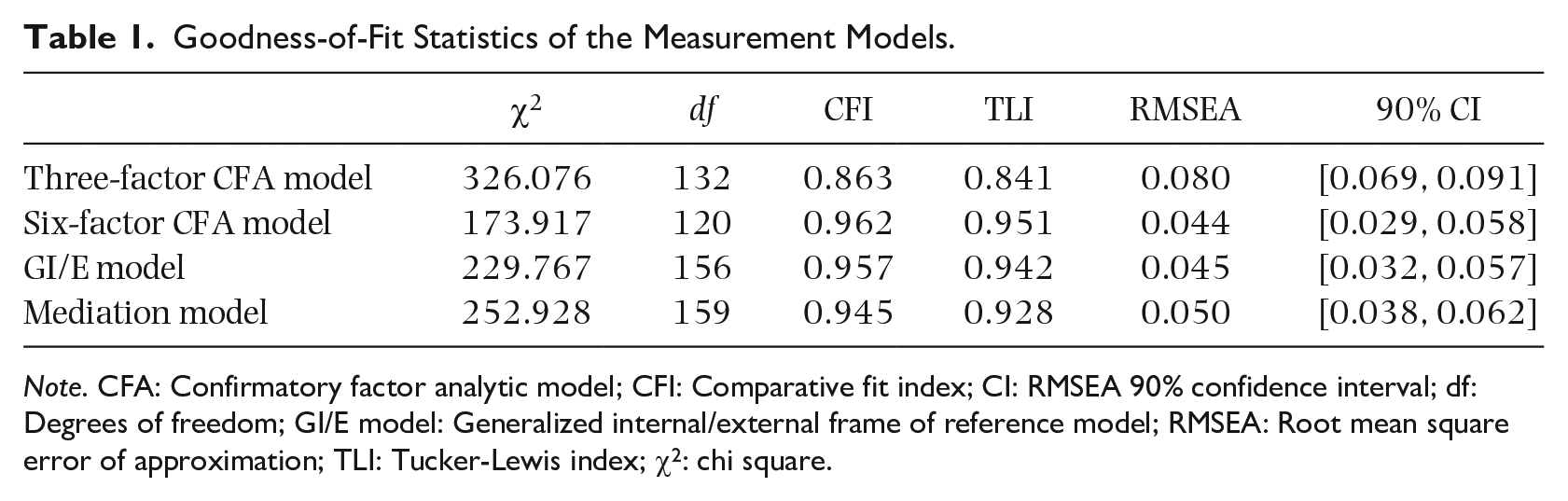
Results of CFA provided strong support for a clear differentiation between the six self-concept and intrinsic value factors. Table 1 presents the standardized results of the CFA models under investigation.
Goodness-of-Fit Statistics of the Measurement Models.
Note. CFA: Confirmatory factor analytic model; CFI: Comparative fit index; CI: RMSEA 90% confidence interval; df: Degrees of freedom; GI/E model: Generalized internal/external frame of reference model; RMSEA: Root mean square error of approximation; TLI: Tucker-Lewis index; χ2: chi square.
The 3-factor model with three latent factors showed a significantly worse fit to the data than the 6-factor model differentiating between six latent self-concept and intrinsic value factors (Δχ2[12] = 152.159, ΔCFI = −0.099, ΔTLI = −0.110, ΔRMSEA = +0.036). All six latent factors of the 6-factor model were well defined by adequate factor loadings (.59 ⩽ β ⩽ .88). For this reason, the 6-factor model was used for further analyses.
Descriptive statistics and correlations
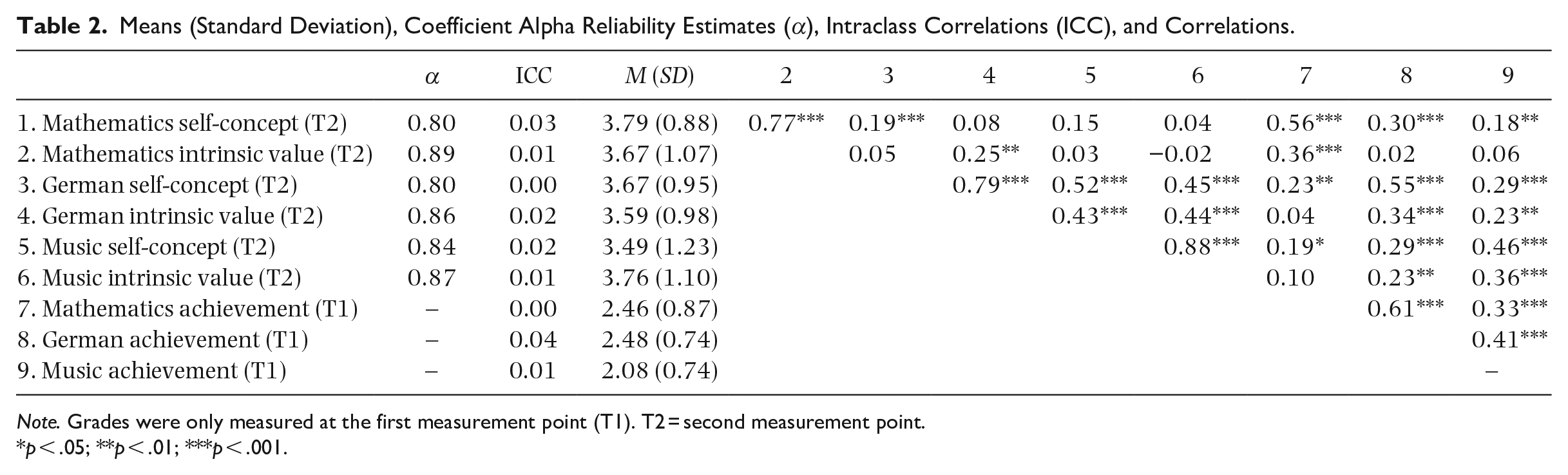
Descriptive statistics, Cronbach’s alpha estimates, ICCs, and correlations of all standardized variables are provided in Table 2.
Means (Standard Deviation), Coefficient Alpha Reliability Estimates (α), Intraclass Correlations (ICC), and Correlations.
Note. Grades were only measured at the first measurement point (T1). T2 = second measurement point.
p < .05; **p < .01; ***p < .001.
All six scales showed good reliability estimates, ranging from .80 to .89. The ICCs of the variables were low, ranging from .00 to .04. On a response scale from 1 (lowest value) to 3 (highest value), children’s self-concepts and intrinsic values were generally high, ranging from 3.49 (music self-concept) to 3.79 (mathematics self-concept). In contrast, children’s self-reported grades were rather satisfactory, ranging from 2.08 (music grade) to 2.48 (German grade) because the best grade is 1 (very good) and the worst grade is 6 (insufficient) in the German educational system.
All three latent self-concept factors were significantly positively related to the three latent intrinsic value factors and three grades within domains. Similarly, all three intrinsic value factors showed significantly positive correlations with the three grades within domains but at a lower level than the three self-concept factors. The correlations between the six self-concept and intrinsic value factors (−.02 ⩽ r ⩽ .25) were generally lower than those between the three grades across domains (.33 ⩽ r ⩽ .61), as also expected in Hypothesis 3. Only the correlation between German and music grades (r = .41) was numerically lower than that between German and music self-concepts or music intrinsic values (.43 ⩽ r ⩽ .52).
Research question 1
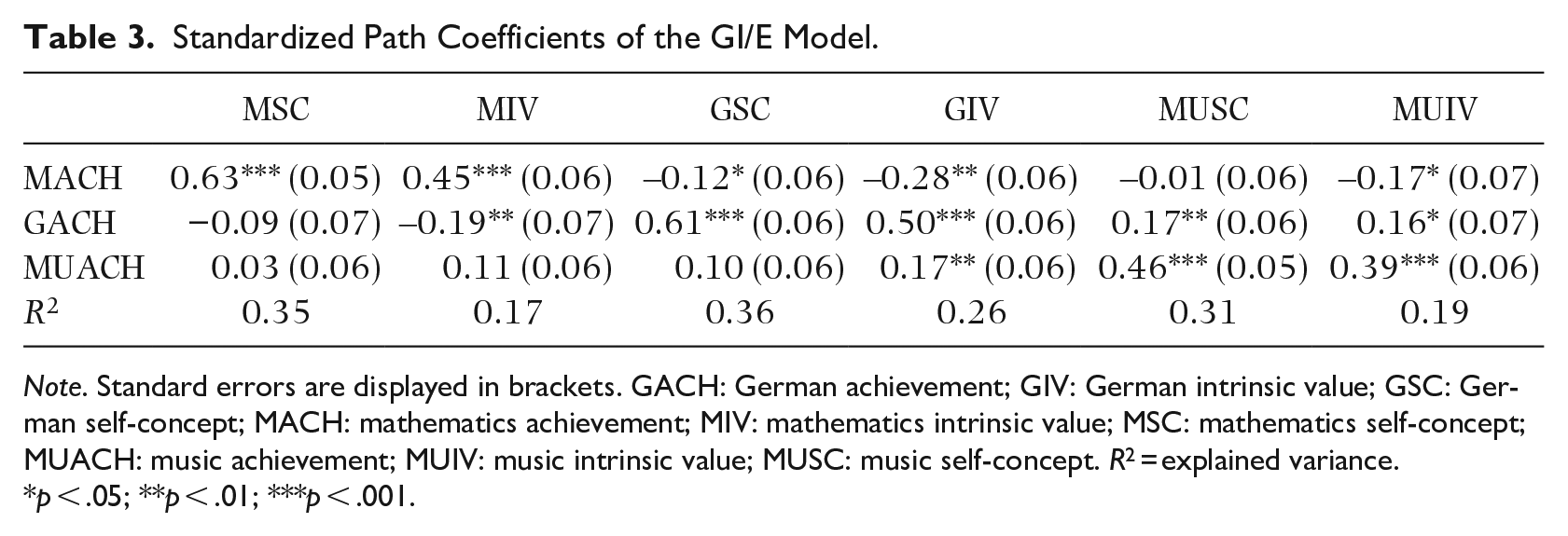
When exploring the first research question asking whether the pattern of relations posited by the GI/E model would be replicable in a sample of elementary school children when integrating music, mathematics, and verbal domains into the GI/E model simultaneously, not all of the GI/E model’s predictions held. Table 3 presents the results of the GI/E model tested in this study.
Standardized Path Coefficients of the GI/E Model.
Note. Standard errors are displayed in brackets. GACH: German achievement; GIV: German intrinsic value; GSC: German self-concept; MACH: mathematics achievement; MIV: mathematics intrinsic value; MSC: mathematics self-concept; MUACH: music achievement; MUIV: music intrinsic value; MUSC: music self-concept. R2 = explained variance.
p < .05; **p < .01; ***p < .001.
In support of Hypothesis 1, all three achievement measures significantly positively predicted self-concepts and intrinsic values within domains. In contrast, there was only less support for Hypothesis 2 stating significant effects of achievement on self-concepts and intrinsic values across domains: Mathematics achievement negatively predicted German self-concept, German intrinsic value, and music intrinsic value, while German achievement only negatively predicted mathematics intrinsic value but positively predicted music self-concept and music intrinsic value. Furthermore, music achievement also showed a significantly positive effect on German intrinsic value but non-significantly positive effects on both academic self-concepts and mathematics intrinsic value. Finally, all three achievement measures were significantly positively and higher correlated with each other than the six self-concept and intrinsic value factors. The amount of explained variance ranged from .17 to .36 (see Table 3). The fit of this model was sufficient (see Table 1). Figure 1 depicts the significant results of the GI/E model under investigation.
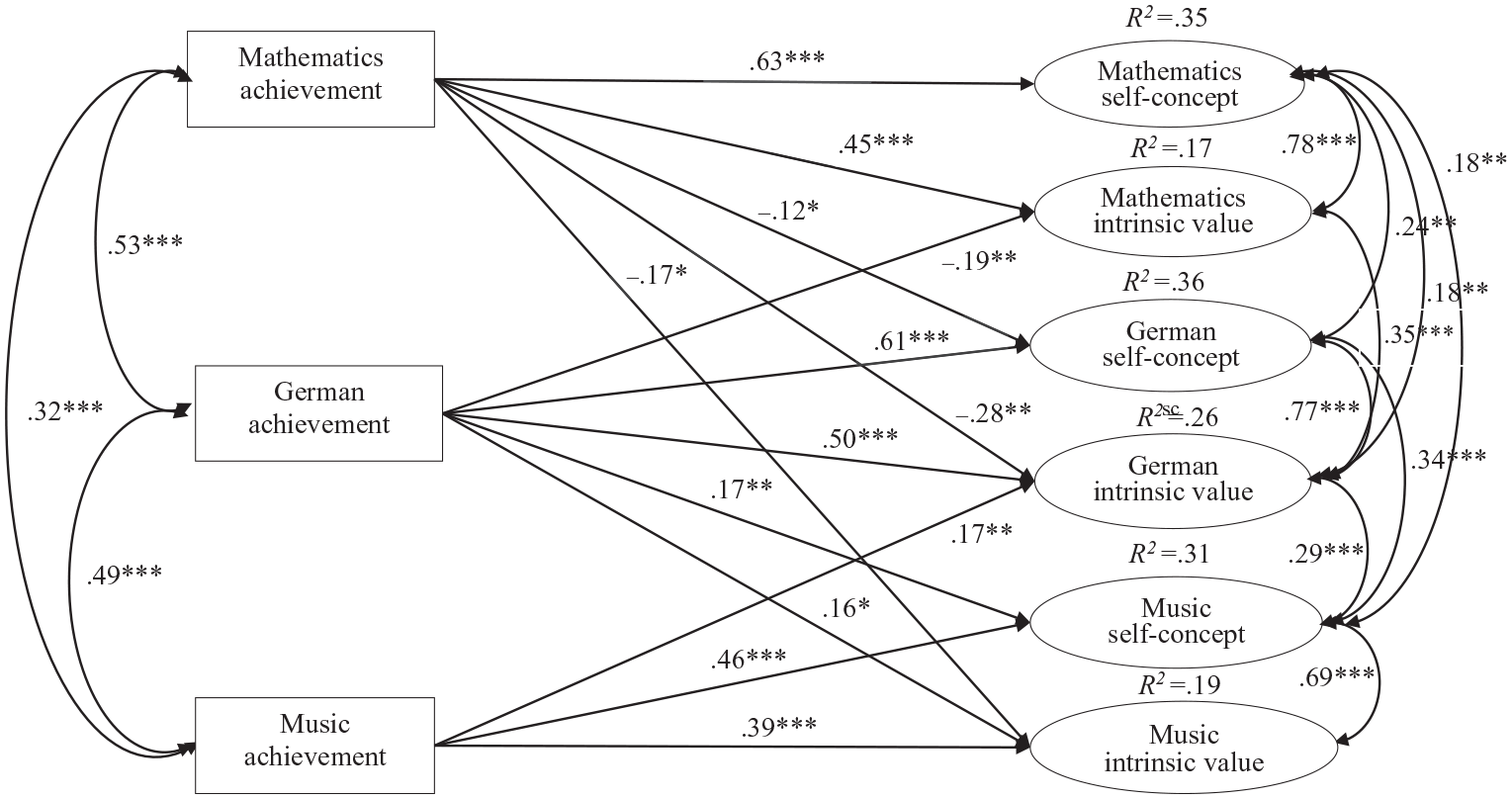
Significant Results of the GI/E Model Under Investigation.
Research question 2
The second research question asked whether students’ self-concepts would mediate the relations between achievement and intrinsic values in the three domains. Results of this analysis are reported in Table 4.
Standardized Path Coefficients of the Mediation GI/E Model.
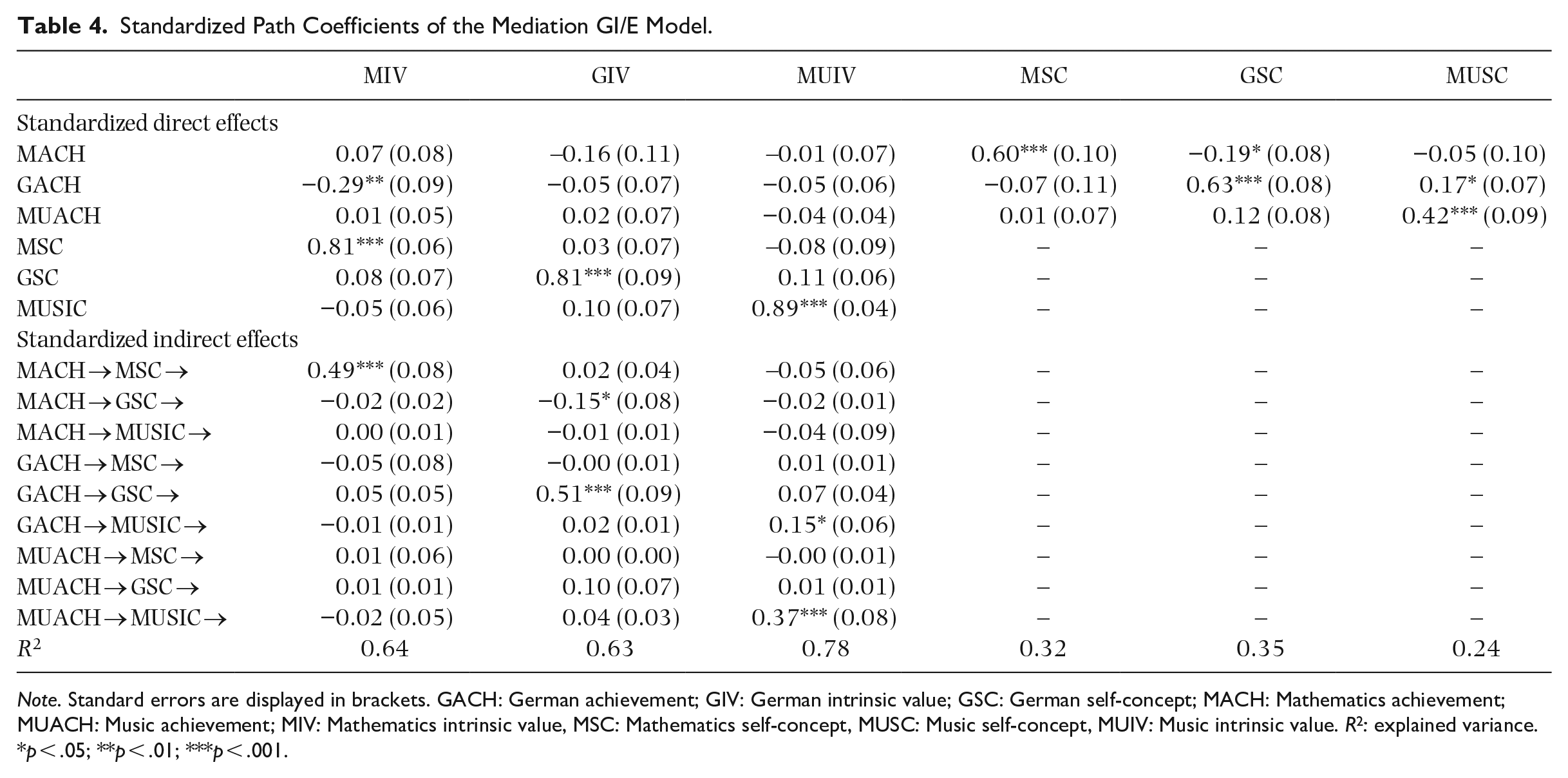
Note. Standard errors are displayed in brackets. GACH: German achievement; GIV: German intrinsic value; GSC: German self-concept; MACH: Mathematics achievement; MUACH: Music achievement; MIV: Mathematics intrinsic value, MSC: Mathematics self-concept, MUSC: Music self-concept, MUIV: Music intrinsic value. R2: explained variance.
p < .05; **p < .01; ***p < .001.
All three achievement measures were significantly positively related to self-concepts within domains. In contrast, mathematics achievement significantly negatively predicted German self-concept, whereas German achievement significantly positively predicted music self-concept but significantly negatively predicted mathematics intrinsic value. All three self-concepts, in turn, showed significantly positive effects on intrinsic values within domains. Furthermore, as expected in Hypothesis 4, all indirect relations were substantial within domains and there were some significant mediating effects of self-concepts across domains: German self-concept also proved to significantly negatively mediate the relation between mathematics achievement and German intrinsic value, while music self-concept also proved to significantly positively mediate the relation between German achievement and music intrinsic value. The amount of explained variance of the six self-concept and intrinsic value factors ranged from .24 to .78 (see Table 4). The fit of this model was acceptable (see Table 1).
Discussion
This study went beyond previous literature by extending the GI/E model to the music domain in addition to mathematics and verbal domains. To date, no study has already integrated the music domain into the GI/E model. Furthermore, by considering not only self-concepts but also intrinsic values as outcomes of achievement and exploring the possible mediating effects of self-concepts, this study is the first to provide evidence for the underlying processes of the formation of self-concepts and intrinsic values and the significance of self-concept as a mediator in the GI/E model. Finally, by using a rather neglected sample of elementary school children, this study also took a developmental psychological perspective and attempted to reveal what kind of comparisons were most frequently used by elementary school children in music, mathematics, and verbal domains.
The first research question asked whether the pattern of relations posited by the I/E model can be replicated when integrating all three domains into the GI/E model. In support of Hypothesis 1 and most other previous studies (see Möller et al., 2020; Wigfield et al., 2020 for an overview), elementary school children’s self-concepts were mostly determined by social comparisons, as evidenced by the significantly positive effects of achievement on self-concepts and intrinsic values within domains (Hypothesis 1). In contrast, Hypothesis 2 stating dimensional comparisons was only partially supported because not all effects of achievement on self-concepts and intrinsic values were substantial across domains (Hypothesis 2). The non-significant cross-domain relations do not seem to be unusual, as earlier studies have also shown that dimensional comparisons were less frequently used by elementary school students than social comparisons (e.g., Lohbeck & Möller, 2017; Möller et al., 2020; Weidinger et al., 2019). This result may result from younger children’s lower cognitive abilities (Harter, 2012) and indicates that elementary school children are not yet good at coordinating opposing concepts into their self-concepts across domains. However, the significantly negative effect of mathematics achievement on music intrinsic value in this study also suggests that elementary school children contrast mathematics and music domains to each other and perceive these domains as quite dissimilar, leading to lower (higher) music intrinsic value when their mathematics achievement is high (low). Thus, both social and dimensional comparisons can be functional or dysfunctional for the formation of elementary school students’ music self-concept and music intrinsic value. In contrast, the two significantly positive (assimilation) effects of German achievement on music self-concept and music intrinsic value propose that elementary school students perceive music and verbal domains as quite similar, leading to more or less positive music self-concept and music intrinsic value. A possible reason for these positive assimilation effects may be that both verbal and music domains require good reading and writing skills, whereas the mathematics domain demands more complex skills (e.g., multiplication, division, geometry). These results also align with other previous findings highlighting that music training significantly influences numerous executive functions related to verbal skills, such as reading and linguistic skills (e.g., Carioti et al., 2019; Hogenes et al., 2016; Moreno et al., 2009; Slater et al., 2014; Tierney & Kraus, 2013), phonological awareness (Gordon et al., 2015; Linnavalli et al., 2018; Moritz et al., 2013; Ozernov-Palchik et al., 2018; Vaiouli & Grimmet, 2020), word matching, letter sounding, and word reading (Degé & Schwarzer, 2011; Peynircioglu et al., 2002), or verbal memory (Roden et al., 2012). Furthermore, music requires good auditory skills, which have also been found to significantly mediate students’ reading ability (Schellenberg & Weiss, 2013). Finally, as expected in Hypothesis 3, results revealed significantly positive and higher correlations between achievement across domains than between self-concepts or intrinsic values across domains. This paradoxical finding can be attributed to the interplay between social and dimensional comparison processes and has also been reported in other previous studies supporting the generalizability of the GI/E model (e.g., Arens & Preckel, 2018; Gaspard et al., 2018; Trautwein et al., 2012).
When exploring the second research question asking whether the relations between achievement and intrinsic values would be mediated through self-concepts, results yielded significantly positive mediating effects of all three self-concepts on the relations between achievement and intrinsic values within domains. Intriguingly, there were also two significant mediating effects of German and music self-concepts across domains: While German self-concept also proved to mediate the relation between mathematics achievement and German intrinsic value, music self-concept also proved to mediate the relation between German achievement and music intrinsic value. These results are also consistent with Hypothesis 4 and previous research (e.g., Dörendahl et al., 2020; Lohbeck, 2019; Schurtz et al., 2014; Trautwein et al., 2006) stating that students’ self-concepts play a crucial role in predicting their intrinsic values or other desirable outcomes within and across domains.
Implications
Results of this study provide several important implications for teachers or intervention researchers aiming at enhancing children’s music self-concept and music intrinsic value at school. On the one hand, if children are performing well in German, they show a more positive music self-concept and higher music intrinsic value, which may be caused by lower mathematics achievement. On the other hand, if children are performing low in German, they demonstrate a more negative music self-concept and lower music intrinsic value, which may result from higher mathematics achievement. An important implication of this research is that teachers should be aware of those negative (contrast) dimensional comparisons and try to avoid those rather dysfunctional comparisons to improve students’ music self-concept and music intrinsic value. Some effective strategies to support more functional comparisons in students may be, for instance, highlighting students’ individual progress and success, providing individually challenging tasks, setting achievable, realistic learning goals, which the students can determine themselves, emphasizing that competences can be improved through effort and are the result of effort, offering individual feedback on students’ performance, using individual reference norms, and creating a pleasant and constructive learning climate in class by interpreting mistakes as learning opportunities and not as signs of a lack of skills (see Craven et al., 2003 for an overview of self-concept enhancement research). Moreover, given the cross-domain effects from both academic domains to the music domain, teachers could promote children’s music self-concept and music intrinsic value by implementing, for instance, music-themed activities in mathematics and German lessons and transforming traditional education through entertainment (An et al., 2018). Some research has already shown that music education increases students’ capacity to remember information (Crowther et al., 2016) and to learn more effectively because music stimulates the brain (Pretorius, 2017) and helps students to associate what they have felt and heard in songs or melodies (Haddad & Heong, 2020). Furthermore, mathematics lessons integrated with music have been found to improve students’ motivation to learn mathematics (An & Capraro, 2011; An et al., 2014). Finally, teaching grammar through singing may also be a very effective strategy for supporting language learning processes of elementary school children, as younger children may still have problems with grammar instruction due to their shorter attention spans, and singing does not require complex resources (Busse et al., 2021).
Limitations
This study has several limitations: The first limitation of this study concerns the measurement of the variables because only two measurement points were taken into consideration and the time interval between these two measurement points was very short (i.e., 3 months). Second, only students’ self-reported music grade at school was measured, although it is reasonable that students’ music performance outside of school also differs from their music performance at school because all students must learn music at school, irrespective of whether they like music or whether they have already acquired music skills in extracurricular activities, such as playing an instrument, singing in a choir, or dancing in a music club. Third, no data on children’s musical experience or demographics (e.g., whether they live in a single-income household or whether they have learning disabilities) were available. Further studies must therefore show whether the pattern of relations reported in this study would also be confounded by these or other variables (e.g., prior academic achievement, sex, and/or socioeconomic status; Guhn et al., 2020; Haddad & Heong, 2020). For instance, music education has been found to be more effective for students from a musically talented family (Wilson et al., 2012) or with better musical instrument accessibility at home (Young et al., 2014). Finally, this study focused on intrinsic values, although the EVT framework (Conley, 2012; Trautwein et al., 2012) suggests four different value factors (i.e., intrinsic value, attainment value, utility value, cost). Further research is therefore recommended to explore whether social and dimensional comparisons also influence these factors or whether the relations of these factors to achievement or other desirable outcomes are also mediated through students’ self-concepts.
Conclusion
Despite the limitations mentioned, this study adds to previous literature on the GI/E model by showing the following (novel) findings: (1) Social comparisons are strongly supported for both self-concepts and intrinsic values in music, mathematics, and verbal domains; (2) dimensional comparisons are mainly supported between academic domains but less supported across music and academic domains; (3) self-concepts mediate the relations between achievement and intrinsic values within domains; (4) verbal self-concept also mediates the relations between mathematics achievement and verbal intrinsic value, although (5) music self-concept also mediates the relations between verbal achievement and music intrinsic value. These findings highlight the great significance of social and dimensional comparisons for the formation of elementary school children’s self-concepts and intrinsic values as well as the significant mediating role of self-concepts in predicting children’s intrinsic values, even across music and academic domains.
Footnotes
Declaration of conflicting interests
The author(s) declared no potential conflicts of interest with respect to the research, authorship, and/or publication of this article.
Funding
The author(s) received no financial support for the research, authorship, and/or publication of this article.
