




Abstract
There are a multitude of influences on adolescents’ decisions to enroll in elective instrumental music ensembles. While some music teachers might rely on external rewards such as end-of-year trips to encourage retention from year to year, middle school students’ sociocultural and psychological characteristics may best account for their intentions to continue in band or orchestra. I examined needs satisfaction variables from Self-Determination Theory and task values from Expectancy Value Theory alongside environmental factors such as parent and peer influence as well as socioeconomic status (SES) as predictors of adolescent instrumental students’ elective intentions (N = 42). Data were analyzed using structural equation modeling. Parents tended to exert a large amount of influence over the extent to which participants’ needs were satisfied and a small amount of influence over the task values of their children. Concurrently, peers and SES played small but important roles in the development of elective intentions. Moreover, when parents and teachers were supportive of students’ autonomy, competence, and relatedness, instrumental music learning tasks were valued. Task values, in turn, strongly predicted middle school instrumental students’ intentions to persist and enroll in future instrumental music courses.
Since the early 20th century, music educators and advocates have been unified by Karl Gehrkens’ vision of “Music for every child, every child for music” (Heidingsfelder, 2014, p. 47). Federal legislators have also signaled support for music education through the Improving America’s Schools Act of 1994 (U.S.C. S.1513, 1994), the National Standards for Arts Education, and the No Child Left Behind Act (U.S.C. 6319, 2008). Furthermore, a guiding policy of the National Association for Music Education stated, “Music study should be a required part of education for every student each year through grade eight, and every student in grades 9–12 should have the opportunity to elect music study each year” (Where We Stand, 1997, para. 8). As a result of the slogans, policies, and position statements made in support of music as an essential part of K–12 education, music education has been made available in 94% of U.S. public elementary schools and 91% of U.S. public secondary schools (Parsad et al., 2012). Yet, when students move from elementary school to middle school music typically becomes an elective area of study. Any number of logistical, economic, and sociocultural factors may both limit students’ access to music education and impact their intentions to enroll in secondary music ensemble classes.
Researchers have noted a precipitous decline in music participation throughout the middle grades. Kinney (2019) reported enrollment rates for band in a midwestern metropolitan area dropped from 25% of students in sixth grade to 17% in eighth grade and 9% in 10th grade. In orchestra settings, the enrollment rates dropped from 7% in sixth grade to 4% in eighth and 10th grades. Using a national sample of music and non-music students, Elpus and Abril (2011) reported that 21% of high school seniors self-reported participation in band, orchestra, or choir, which is in contrast to Stewart’s (1991) transcript analysis which indicated that 36% of high school seniors participated in instrumental classes. According to a National Center for Education Statistics report, 26% of high school juniors and seniors participated in band, orchestra, or choir during the 1986–1987 school year (National Center for Education Statistics [NCES] & Snyder, 1993). This collection of findings reflects a flat to declining trend of enrollments in high school music since the 1980s. Diminished participation during the middle grades likely contributed to this trend.
Problem statement
Children are inherently musical, and through their elementary years most students are provided opportunities—vis-a-vis general music instruction, extra-curricular choirs, and beginner instrumental music programs—to develop their musical knowledge, skills, and sensibilities. As they move into the middle school years adolescents typically are presented with an increasing range of choices specific to in-school and out-of-school activities. Some researchers point to high competency levels in music and achievement in other subjects as indicators of elective participation (Corenblum & Marshall, 1998; Hartley & Porter, 2009; Kinney, 2009; Klinedinst, 1991). Others attribute retention to structural factors such as the influence of peers and parents and student interests (Stewart, 2005; Warnock, 2009). Concurrently, practitioners have suggested that extrinsic factors (e.g., performance opportunities, field trips, group accolades, fundraising events, and social gatherings) might explain students’ elective intentions for instrumental ensemble participation (Darling, 2014; Dolan, 2018; Sandene, 1994).
Analyses of music student retention typically lack a clear conceptual framework through which participation can be assessed in a comprehensive manner, thereby ignoring the influence of motivation on student interest in music ensemble participation throughout the middle grades (McPherson & Hendricks, 2010). Therein lies the general problem; researchers and practitioners do not tend to acquire a broad perspective on student motivation that is inclusive of environmental, social, and psychological antecedents. Music student rationales for continued participation might be better explained by the circumstances through which adolescents employ motivation to choose and persist in instrumental electives.
Needs satisfaction
The first motivational construct considered was Deci and Ryan’s (2000) basic psychological needs, which operates as a core facet of Self-Determination Theory. Generally, Self-Determination Theory outlines the impacts of psychological needs satisfaction and needs frustration on wellness and optimal functioning over the course of human life. Within academic contexts, the three basic psychological needs are autonomy (i.e., a student’s perceived agency over their own lived experience), competence (i.e., a student’s perception of their knowledge and skills regarding an assigned or chosen task), and relatedness (i.e., a student’s sense of connectedness with peers and teachers), the “satisfaction of which fosters psychological wellness, and the frustration of which conduces to ill-being” (Evans, 2015; Ryan & Deci, 2019, p. 20).
Research on psychological needs satisfaction in music education contexts has been largely limited to secondary school (i.e., 9th through 12th grade in America, Year 10 through Year 13 in the United Kingdom) and undergraduate populations. However, a few studies present the impacts of needs satisfaction on adolescent instrumental students (Evans et al., 2012; Frey, 2018; Kingsford-Smith & Evans, 2019; Lowe, 2011; Schatt, 2018). The most outlined effect for adolescents was the impact of needs satisfaction on the quality and frequency of instrumental practice. Parents also tended to influence the motivation of instrumental music students as they either thwarted or supported the psychological needs of middle school students’ near-critical elective decision-making moments. In addition, needs satisfaction played an important role in the development of task values for music study, holding effects on subsequent elective intentions, or as Freer and Evans (2018) stated, “a sense of value for music as a subject and the activities in the classroom will be advanced to the extent that the students’ psychological needs are developed” (p. 892).
Task values
Eccles’ (1983) Expectancy Value Theory included task values as an important determinant for academic motivation. Applied to education, task values are the multifaceted perceptions of value derived from an academic task. Task values are formulated in reference to the tidal shifts of competing interests and goals within a student’s developing self. The theoretical framework includes attainment value (i.e., the importance of a task as it relates to both the students’ identity and perceived competence within the academic domain), interest value (i.e., the self-aligned interest or enjoyment that a student perceives while engaging in the task), utility value (i.e., the importance of a task as it relates to the students’ academic and career goals), and perceived cost (i.e., the student’s perception of the detrimental facets of a task).
Overall, the reviewed studies represented the phenomenon of students’ task values in decline throughout the middle grades. Task values tend to directly impact students’ enrollment decisions after middle school—such that students that have higher task values for math than music are less likely to expend energy on musical academic tasks (Frey, 2018; McPherson et al., 2015; McPherson & O’Neill, 2010). This effect is invariant across gender differences for American and international populations. In addition, parents seem to play a mediating role in the development of task value for multiple school subjects, in that the parental beliefs, attitudes, and supports impact the extent to which students value an academic subject or activity (Simpkins et al., 2012). Peers also play an important role, although this effect has not been studied to the same extent as in the parent–child relationship (Chen et al., 2017).
Connecting psychological needs and task value
Students who value music to a lesser extent are less likely to enroll in future music classes (Martin, 2007; McPherson & O’Neill, 2010). In addition, the way students value music is related to whether that student’s needs are satisfied (Freer & Evans, 2018). As students come to view band or orchestra as interesting, enjoyable, important, and useful despite the costs—and as their social circumstances (e.g., teachers, peers, parents, socioeconomic status [SES]) reinforce those perceptions through variability in needs satisfaction—student motivation to continue studying and making music can be reignited or frustrated, resulting in continued enrollment over time or attrition from music studies. Exacerbating the issue, many music teachers adopt behavioristic or competitive approaches to motivating students, which may produce changes in students’ behavior in the near term, but also undermine students’ inherent interest in making or learning about music over their educational careers (Coppola, 2021).
One key determinant of the practicality of an analytical model on this topic is the extent to which variance in elective choice is explained by the model. The most substantive models of academic motivation for middle school music students are inclusive of both needs satisfaction and task value (Yoo, 2021). Such models tend to include important environmental variables, such as quality of instruction, or antecedent variables, such as SES and parent influence (Evans & Liu, 2019; Freer & Evans, 2018; Frey, 2018).
Freer and Evans’ model of elective intentions
According to Freer and Evans (2018), students were more likely to intend to enroll in future music classes when they valued music learning to a greater extent. In addition, students were more likely to value music if their psychological needs were satisfied. Prior music learning experience is commonly thought to influence enrollment intentions above and beyond immediate appraisals of task value and psychological needs satisfaction. Freer and Evans’ proposed model illustrated their hypotheses that instrumental experience, needs satisfaction, and task value each predicted elective intentions—theorized partially in response to McPherson and O’Neill’s (2010) finding that over eight countries, including the United States, task values and instrumental experience were significant predictors of elective intentions. In Freer and Evans’ (2018) model, instrumental experience was measured using a self-report item which asked students to indicate how many years they have had formal instrumental music instruction, including school music instruction and private lesson study. However, instrumental experience had little influence on intentions to enroll, eclipsed by the effects of needs satisfaction and subject task value (Figure 1).
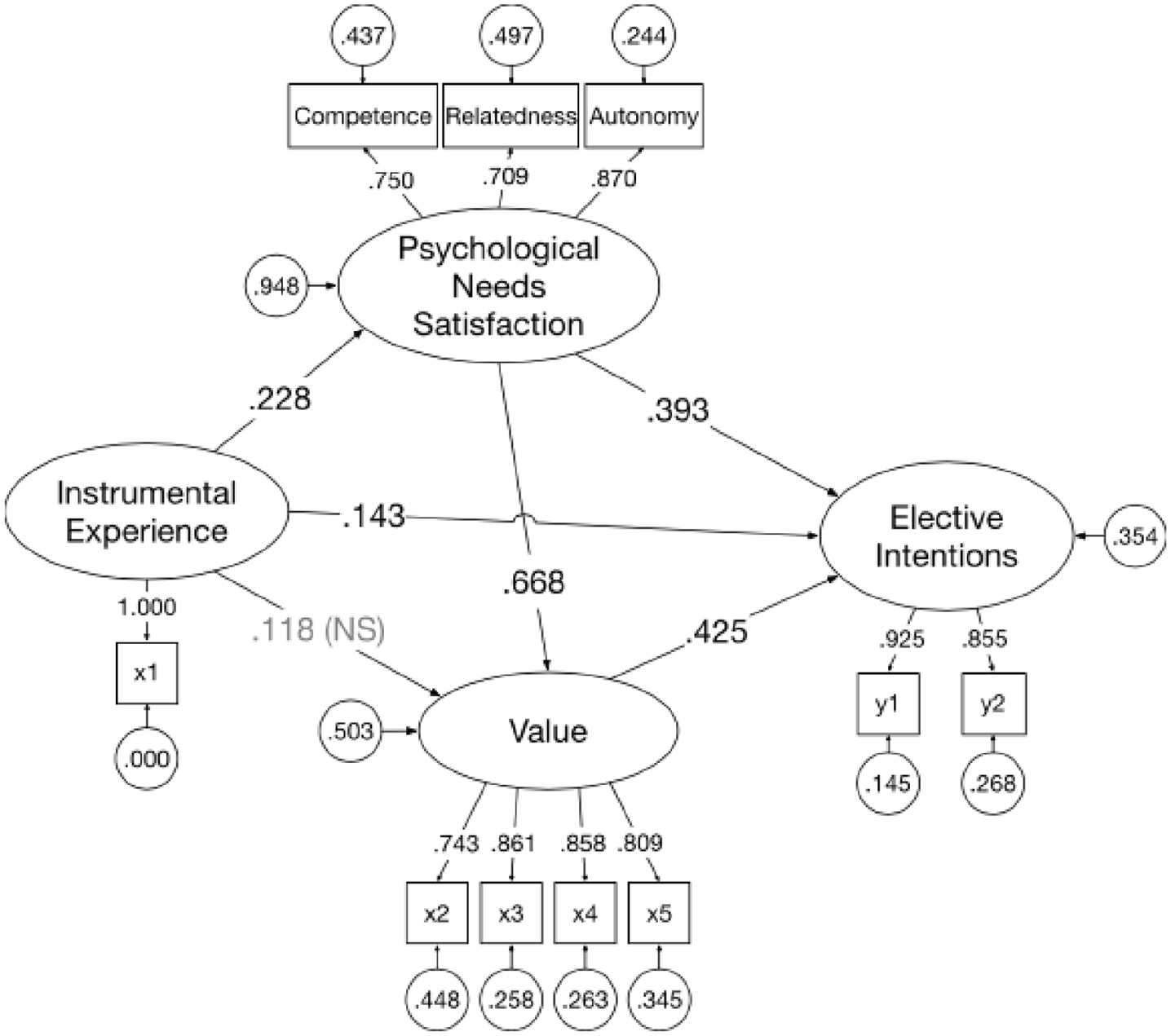
Freer and Evans’ (2018) Model of Elective Intentions.
Purpose and research questions
The purpose of this study was to determine whether middle school music students’ elective intentions were associated with their SES, parent and peer influence, needs satisfaction, and task values. More specifically, I replicated and extended Freer and Evans’ (2018) study Psychological Needs Satisfaction and Value in Students’ Intentions to Study Music in High School with a representative sample of American middle school music students in seventh and eighth grade instrumental music ensembles. This study addresses the following research questions:
To what extent is needs satisfaction or task values predicted by environmental variables, including parent and peer influence, as well as SES?
To what degree does the satisfaction of autonomy, competence, or relatedness contribute to differences in task values and continued participation in band or orchestra?
To what extent do task values predict continued participation in band or orchestra?
Method
I utilized a purposive sampling method to recruit seventh- and eighth-grade band or orchestra students (N = 42) who were representative of the middle school student population in a large state-funded school district in central North Carolina. There are several limitations to purposive sampling, including a higher likelihood of sampling bias which may potentially lead to non-representative samples. The population of interest was recruited from multiple schools within a district serving diverse populations of students in terms of SES, as well as race/ethnicity to contend with potential bias. Approval was granted from an institutional review board (IRB) and parental consent was acquired before a 52-item survey was distributed to potential participants. Participants then provided assent in the first section of the survey. Data were collected on students’ demographics, including race/ethnicity, grade level, and class type (i.e., whether the student was participating in a band or orchestra class), as well as other variables of interest.
Socioeconomic status
Data collection for SES presents unique challenges, including the potential for missing data or low reliability of adolescent self-reports due to the sensitive and personal nature of SES. Because adolescent students, particularly those in low-income households with non-traditional family structures, may not be completely aware of various factors related to SES, researchers have recommended multifaceted approaches of measurement. Such approaches often include an estimation of three types of capital: financial (e.g., the income or occupation of parents), human (e.g., parents’ educational attainment), and social (e.g., family structure) (Coleman, 1988; Ensminger et al., 2000). Freer and Evans (2019) only utilized the financial capital component, whereas Alegrado and Winsler (2020) used free and reduced lunch, another indicator of financial capital, as a proxy for SES. I adapted the more comprehensive approach of Ensminger et al. (2000) to assess SES in my study while omitting the family structure and welfare items out of a concern for item reliability and survey mortality.
Participants were asked whether their parents or guardians were not working, working part-time, or working full-time. Participants were also asked to report their free/reduced lunch status, as well as their parents’ or guardians’ highest level of education (i.e., less than high school, high school graduate, or General Education Development Certificate (GED)/college graduate or above). Data on each type of capital were averaged, rather than summed, into a composite index, resulting in a single SES score for each student to accommodate missing data. All items included the possible response “Don’t know” if students were not aware of the most appropriate answer for their situation.
Parent influence
Models of parental involvement in adolescent music learning have been deployed with a primary focus on the factors which contribute to the musical environment in the home (Brand, 1985; Zdzinski, 2013). Zdzinski adapted the Parental Involvement Home Environment scale for music settings, resulting in 99 items that represented seven dimensions of parental involvement for music students. Items for the musical structure subscale of the Parental Involvement Home Environment for Music (α = .80) reference the extent to which parents directly interact with a students’ practice (e.g., “My parents listen to me practice”) and provide supports for students’ practice (e.g., “My parents provide me a place to practice at home”).
Peer influence
I used Chen et al.’s (2017) Social Support for Exercise Scale (SSES) to assess peer influence for physical activity (α = .80). Items referred to the behaviors and attitudes which peers would demonstrate to the participant regarding physical activity. These items were modified to represent the domain of band or orchestra learning (e.g., “My peers give me encouragement to stick with learning my instrument,” and “My peers discuss band/orchestra with me”).
Needs satisfaction
In Freer and Evans’ (2018) study, needs satisfaction was measured using the Balanced Measure of Psychological Needs (Sheldon & Hilpert, 2012). However, the authors used the Basic Psychological Needs Satisfaction and Frustration scale in a subsequent study (Chen et al., 2015; Freer & Evans, 2019). The authors utilized 12 items of the Basic Psychological Needs Satisfaction and Frustration scale in reference to students’ perceptions of autonomy (α = .67; “I feel a sense of choice and freedom in the things I undertake”), relatedness (α = .79; “I feel close and connected to people who are important to me”), and competence (α = .80; “I feel confident that I can do things well”) satisfaction in their music classrooms.
Task values
Few researchers measure all components of task value within one study as many elect to focus on interest and attainment values (Freer & Evans, 2018; Martin, 2007; Wigfield et al., 1997). Several researchers have measured utility in addition to attainment and interest with adolescents in music contexts (Durik et al., 2006; Eccles et al., 2005; Ivaldi & O’Neill, 2009; Simpkins et al., 2012). Additionally, Phillips and Weiss (2016) measured interest and attainment value, as well as perceived cost in sport, music, and reading domains. Task value measures from each of these studies were considered in terms of reliability and item wording in the construction of an item pool. Items regarding perceived cost were adapted from Phillips and Weiss (2016) (e.g., “There are unpleasant things associated with playing a musical instrument,” α = .92). Eccles et al. (2005) also measured perceived cost (e.g., “In general, how hard is band/orchestra for you?” α = .92). Due to the satisfactory reliability of each of these measures, I drew on both studies to create a cost subscale of four items. I measured interest (e.g., “In general, I find working on band/orchestra assignments very boring/very interesting,” α = .76), attainment value (e.g., “How important is it to you to get good grades in band/orchestra?” α = .70), and utility value (e.g., “For me, being good at playing a musical instrument is unimportant/important,” α = .75) using items adapted from Eccles et al. (2005) and Simpkins et al. (2012).
Elective intentions
Because of the difficulty in gaining access to official course enrollment data, researchers often ask students to project their future enrollment at critical points in time. Such decisions are framed as elective intentions. Elective intentions, then, function as a proxy for actual course enrollments. I considered using verifiable elective choices in the model, such as enrollment documents disclosed by the district. However, I instead focused on students’ intentions to enroll in electives as course selections can be influenced by the requirements of the school and the district (Barnes et al., 2005). I used Shen’s (2010) items which asked students to report on their expectations (e.g., “I expect to enroll in band or orchestra next year), intentions (e.g., “I intend to enroll in band or orchestra next year”), and projected effort (e.g., “I will try to enroll in band or orchestra next year”).
Data analysis
I first compared distributions of SES and race/ethnicity to what might be expected at the district level using Chi-square tests. I then used measurement and structural models derived from structural equation modeling (SEM) methods to address the research questions (Kline, 2011). SEM utilizes maximum likelihood estimation, a statistical method which determines values for model parameters. Specifically, maximum likelihood estimation maximizes the likelihood that the observed data will fit a theoretical model over other potential data distributions (Enders & Bandalos, 2001). I constructed models and conducted SEM analyses using RStudio, an environment and programming language that is used for statistical computing (RStudio Team, 2020). Specifically, I used the Lavaan package in R, a free open-source statistical package for latent variable modeling and path analysis (Rosseel, 2012).
Results
I utilized measurement and structural models to address the research questions. Before fitting data to the models, I confirmed that all variables and subscales met the assumption of normality. I then established that there were no issues with multicollinearity using correlation and variance inflation factor indices. The internal consistency of each subscale was also assessed, with subscales producing satisfactory to excellent reliability. Autonomy proved to be the one exception (α = .67). Full information maximum likelihood (FIML) estimation was utilized with each model to impute a minimal amount of missing data; goodness of fit thresholds were met and nonsignificant predictive paths in the model were pruned.
The sample (N = 42) included a fairly equivalent representation of gender with 23 participants identifying as female (55%), 17 identifying as male (40%), and two missing responses (5%). The sample was skewed toward younger participants with 28 seventh-graders (66%), 12 eighth-graders (29%), and two missing responses (5%). In addition, the sample was evenly split across band (n = 22) and orchestra students (n = 20). Independent-samples t-tests were utilized to establish group equivalence in relation to elective intentions across gender and class type. These differences were nonsignificant, which supported the notion that elective intentions were comparable for males and females, as well as band and orchestra students. There was, however, a significant difference between seventh- and eighth-graders’ intentions for enrollment (seventh M = 14.29, SD = 4.77; eighth M = 9.50, SD = 4.81; p = .009; d = 1.0). This finding indicated that seventh-graders were conceiving of enrollment intentions in a significantly more positive manner than eighth-graders.
Paths were pruned if they exceeded an alpha level of .10. First, the path between SES and task values (p = .61) was pruned, followed by paths for peer influence and SES scores to needs satisfaction (p = .50 and .44, respectively). The path between peer influence and intentions (p = .15) was then pruned. At this stage, all predictive paths were significant. However, the model was saturated making it necessary to prune additional paths. I decided to remove duplicitous antecedent factors in the model that held a predictive relationship with both elective intentions and needs satisfaction and/or task values. This decision allowed for the number of estimated parameters to be reduced while retaining important predictors in the model.
The fit statistics for the final model were acceptable, χ2(5) = 6.03, p = .303, comparative fit index (CFI) = .981, root mean square error of approximation (RMSEA) = .070. When the alpha level for power analysis was set to .20, the model had a statistical power estimate of .30 with an alpha/beta ratio of .28. With a more stringent alpha level of .10, the power estimate was .17. Concurrently, the model still explained 27% of variance in needs satisfaction, 49% of variance in task values, and 44% of variance in elective intentions. See an overview of model fit and usefulness estimates for both the present study and Freer and Evans’ (2018) study in Table 1 and the final model, including effect sizes for each relationship, in Figure 2.
Fit and Usefulness Estimates for the FIML and Freer & Evans’ (2018) Models.
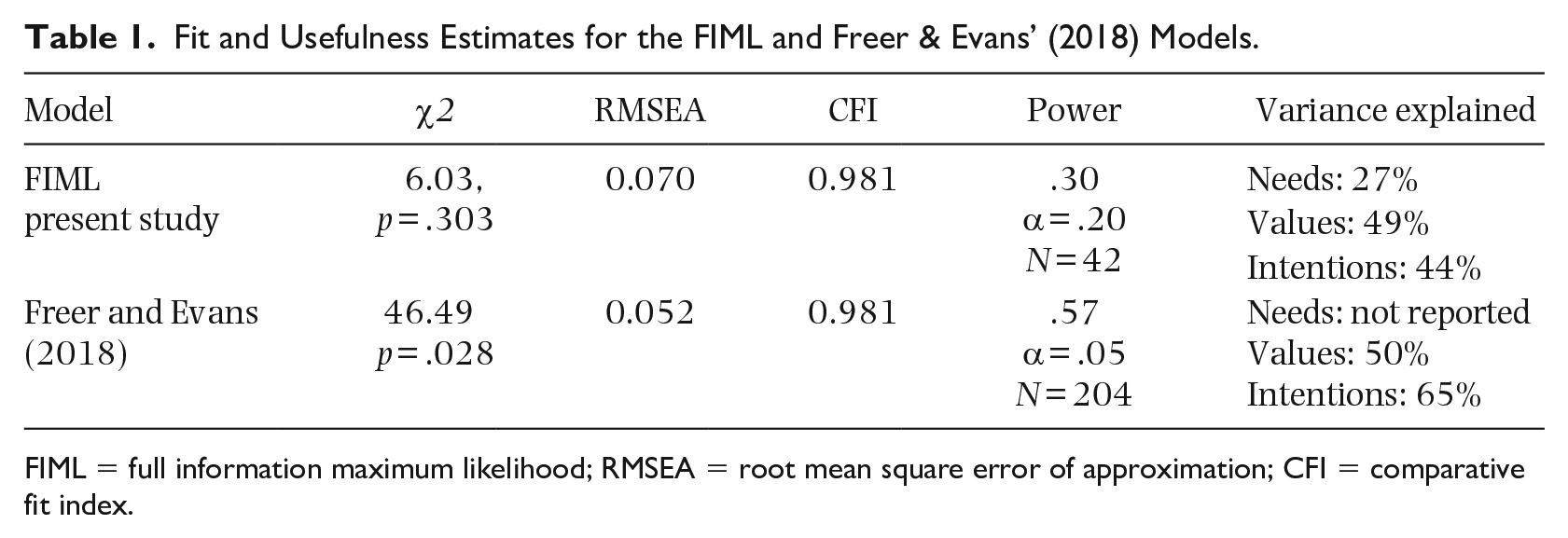
FIML = full information maximum likelihood; RMSEA = root mean square error of approximation; CFI = comparative fit index.
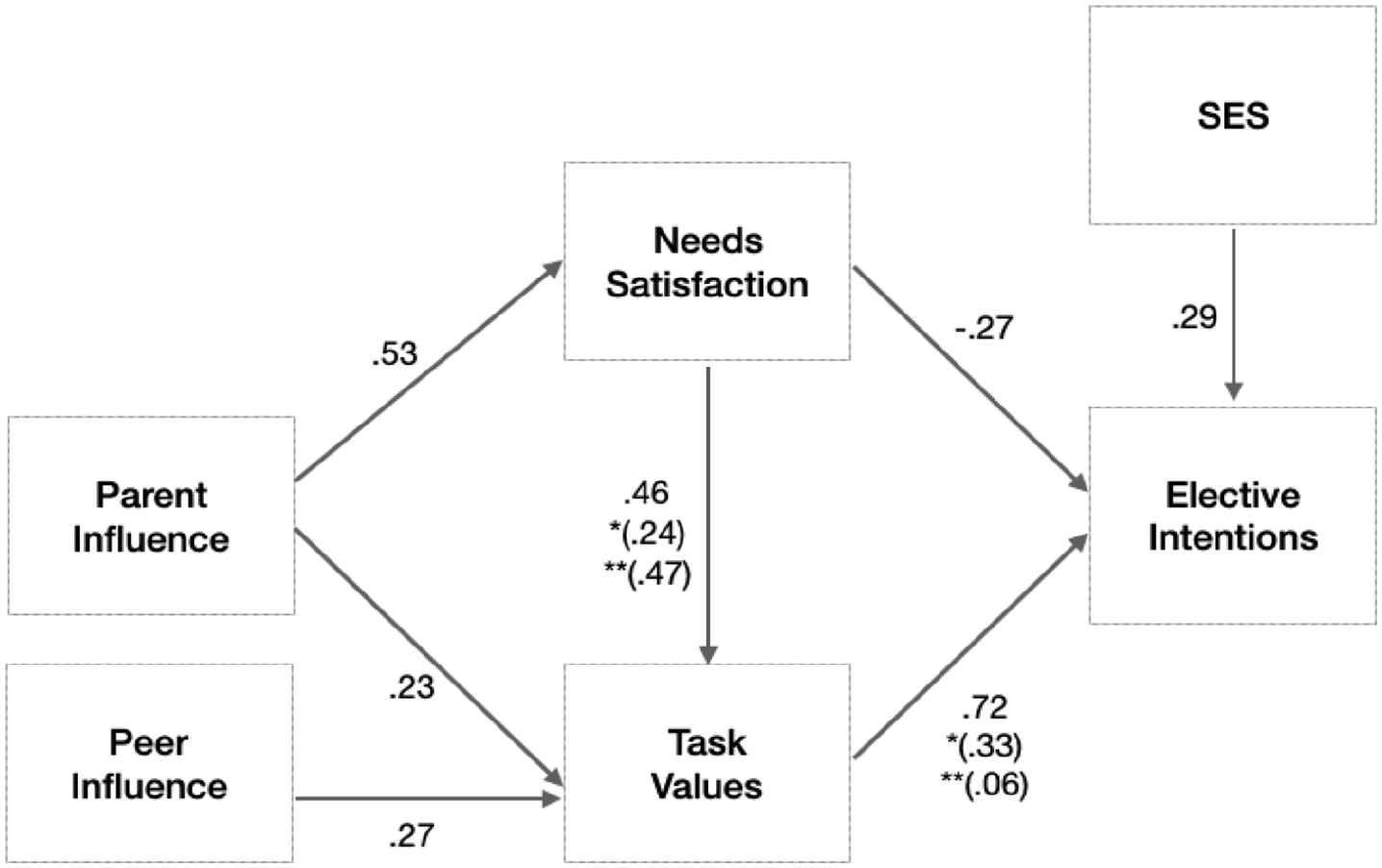
Final Model.
Interpreting indirect effects
There were two mediational relationships in the final model. Mediational relationships are denoted by the presence of a significant direct effect between an endogenous variable (e.g., parent influence) to two other variables that also have a significant relationship (e.g., needs satisfaction and task values). Indirect and total effects were indicative that needs satisfaction partially mediates the relationship between parent influence and task values (indirect effect β = .24; total effect β = .47) such that participants with higher levels of parent influence and needs satisfaction reported higher task values than participants with higher levels of parent influence and lower needs satisfaction scores. As the total effect exceeds the value of the indirect effect, the relationship is interpreted as a partial mediation. The presence of this relationship signifies a combined effect inclusive of parent influence and needs satisfaction to boost task values, which are demonstrably important as a predictor of elective intentions.
In addition, a moderate, positive indirect effect was estimated from needs satisfaction to elective intentions, as mediated by task values (indirect effect β = .33; total effect β = .06). The small total effect size was likely due to the moderate inverse relationship between needs satisfaction and elective intentions (β = –.27). This result indicates that participants who reported high needs satisfaction scores, but low task values scores, were less likely to enroll in instrumental music, while participants who had both high needs satisfaction and high task values scores were highly likely to enroll in instrumental music.
Discussion
Freer and Evans (2018) attempted to understand how certain factors contributed to adolescent music students’ intention to continue in instrumental music. They concluded that
despite instrumental experience (i.e., ability) influencing students’ intentions to choose music, it is how students’ psychological needs are supported in their music classroom that provides a superior explanation for their value of music as a subject and in turn, their intention to pursue music learning further. (Freer & Evans, 2018, p. 890)
This phenomenon is fitting with Expectancy Value Theory, as Eccles (2011) attributed the development of task values to an individual’s interpretation of experience, individual reaction, and memories regarding a domain, expectations of success, and the extent to which an individual’s cultural background matched that of others in the explored domain. Furthermore, Eccles (2011) linked achievement-related beliefs to both external (e.g., SES) and internal (e.g., task values and parent influence) forces.
In comparison with Freer and Evans’ (2018) model, there are several unique facets of the present study model. First, there is a connection from SES to elective intentions despite the inclusion of other variables such as peer and parent influence, which suggests that higher levels of SES are associated with a higher likelihood of continued enrollment in band or orchestra regardless of social agent influences. As Elpus and Abril (2019) reported, this phenomenon may be attributable to a perceived need to focus on non-elective classes such as math. Students coming from lower SES backgrounds may decide to discontinue band/orchestra participation in response to increasing costs of instrumental music participation over time.
Second, the effects of parent and peer influence in the model might provide a frame of reference for the interpretation of the other model effects. For instance, the large positive effect from parent influence to needs satisfaction substantiates other published works that indicate that parents play a key role in the development of needs satisfaction (Buff, 2019; Duineveld et al., 2017; Picone, 2012; Renwick & McPherson, 2002; Schatt, 2013) and task values (Eccles, 1983; Eccles et al., 2004; Gniewosz et al., 2014; Stuart, 2003) in music learning domains. Furthermore, this relationship signifies potential connections between the engagement directed at adolescents from parents and the adolescent’s ability to function in music class with a sense of autonomy, relatedness, and competence.
Finally, a more complex predictive model of task values was presented in the present study while a similar amount of variance was explained, whereas task values were explained univariately in Freer and Evans’ model. While model simplicity is often desirable, complexity is beneficial in this case as any factor which influences task values might provide key support for the continued participation of an adolescent instrumental music student. Future multivariate analysis is required to model the nuances involved in the development of motivation for instrumental music enrollment. However, it is important to note that Freer and Evans’ SEM, as well as the SEM in the present study, was underpowered and thus not generalizable to a larger population.
Implications for music teachers
Instrumental music teachers, and music teacher educators alike, should acknowledge and learn about the influence of needs satisfaction not only on task values and in turn on elective intentions, but on student wellness and other areas of academic motivation. In essence, teacher actions that satisfy psychological needs are the key lever for student growth toward self-regulated learning and autonomous, intrinsic motivation. Conversely, teacher actions which thwart basic psychological needs tend to externalize student motivation and disrupt student growth. Teachers might adopt an organismic perspective to contend with this responsibility—acknowledging that students “are active organisms, with tendencies toward growing, mastering challenges, and integrating new experiences” (Deci & Ryan, 2017, para. 4). Furthermore, music teachers should continue to provide “ongoing social nutriments and supports” to bolster the needs satisfaction of their students over time (Deci & Ryan). Practically, music teachers should consider places in the curriculum where needs satisfaction can be frequently and meaningfully highlighted for students. In response to the relationship between parent support and the needs satisfaction construct, music teachers might define psychological needs for parents while providing practical suggestions for how they might develop needs satisfaction in the home.
While task values are less malleable than psychological needs, they tend to increase within needs-satisfaction-supportive instruction alongside the validation and curiosity provided by parents and peers. One solution for increasing task values is to utilize the influence of parents, peers, and needs satisfaction, and in turn increase the likelihood of continued enrollment. Music teachers might specifically define task values for students and parents while providing practical suggestions for how parents can empower students to learn more about their own task values. A teacher or parent might ask a child what their favorite music is, in and out of band or orchestra class to allow reflection on interest. Regarding usefulness, parents or teachers might ask a child what they want to do with music in the future. Addressing cost, a child might be asked whether their instrumental music class is stressful, whether they feel that they are missing other experiences, or whether they feel that the tasks they complete require too much effort. Allow the child to reflect on these costs and work with them to create an action plan for overcoming costs to mitigate attrition risk.
Socioeconomic status
Instrumental music teachers can create a safe and equitable environment by acknowledging the role of SES in elective intentionality. As students with lower SES backgrounds are less likely to continue enrollment in band or orchestra, music teachers might seek to proactively root out expectations that are not equitable for all student populations in terms of both ethnicity and SES. For instance, the requirement of frequent after school rehearsals that obligate families to arrange transportation around demanding work schedules and tight budgets may induce the influence of financial cost. Concurrently, a lack of school instruments for students who cannot afford to purchase or rent their own might prevent students from optimal instrumental participation, thus increasing effort-related costs and frustrate each psychological need. In addition, individual music performance assessment policies that do not consider the difficulties students might have procuring quality instruments, reeds, space, or time to practice outside of class tend to invalidate student growth. Unfair or high-stakes assessments might also frustrate psychological needs while increasing cost for participation.
Suggestions for future research
The present study was primarily limited by a small sample size. A future study with a larger sample may involve research questions that were not within the scope of this study. For instance, discussion on best practices to support needs satisfaction is sparse in music education literature. Bonneville-Roussy et al. (2020) investigated potential facets of autonomy satisfying teacher-behaviors. Those results suggested that teachers’ consideration of (a) choice, (b) structure, (c) rationale, and (d) perspective taking (i.e., whether a teacher validates a student’s anxieties) were the most influential for autonomy satisfaction. Other facets of the needs satisfaction construct may also be considered, including the inverse construct of needs frustration, the experience of beneficence in the classroom, and how each considered factor might impact a student’s larger experience of subjective wellbeing (Martela & Ryan, 2015). In addition, the order of the effects may matter as a collection of general education research studies suggests that students’ needs are satisfied in stages—moving from relatedness, to competence, and finally to autonomy (Radel et al., 2012). Finally, as parent support was a major determinant of needs satisfaction in the present study, more avenues of parent support for instrumental music students should be explored empirically.
Task values have also been modeled differently in other studies. For instance, cost has been excluded from task values as a distinct construct at times (Chiang et al., 2011; Eccles & Wigfield, 1995; Kosovich et al., 2015). Researchers might also elect to model interest as a standalone predictor of elective intentions or other measures of academic motivation. A staged model may also be of use for task values as interest might precede the development of utility and attainment values.
While the SES measure was reliable and was a significant predictor of elective intentions, it is now important to validate the presented SES subscale within other populations. Due to the difficulty of measuring SES, a valid and reliable self-report scale would be useful as an explanatory variable in many quantitative research strands. Music education research regarding most childhood, adolescent, and early adult experiences could be contextualized by an informal but accurate measure of SES using self-report measurement. It is also important to collect data on which parent or guardian participants are conceiving of when they respond to items. Open-ended responses should be presented to participants regarding family structure to contend with this.
Conclusion
Middle school students’ elective intentions—the courses in which they choose to enroll— are informed by a constellation of personal and environmental factors. When middle school students evaluate the importance, usefulness, enjoyment, and cost of the electives in which they participate, they are formulating task value beliefs. Concurrently, higher levels of task values are associated with continued engagement in a task despite the costs. Continued task engagement, however, may require that students’ psychological needs for autonomy, competence, and relatedness be satisfied. On the other hand, the frustration of autonomy, competence, or relatedness needs in academic settings is associated with lower levels of task value, which is often predictive of a middle school student’s decision to cease engaging in an academic activity. Music teachers and parents of instrumental music students should attempt to understand these effects from the perspective of the child, such that task values are validated with no adverse consequences, and the needs of autonomy, competence, and relatedness are consistently supported through curricular and instructional decisions.
