



Abstract
Practicing slowly is an intuitive and prevalent learning strategy among instrumental musicians. Nevertheless, little is known about the psychological mechanisms of slow practice, or how rehearsing slow movements may support the performance of fast-tempo playing. This study investigated the prevalence and possible functions of slow practice strategies. A total of 256 adult instrumental musicians provided self-report ratings about slow practice and tempo-management strategy use, musical background information, and the Musical Self-regulated Learning Questionnaire in an online survey. Results indicate that practicing slowly is an extremely common technique among classical (99.45%) and non-classical (89.12%) musicians of varying expertise, supporting both technical and expressive goals, with technical more frequently reported. Principal components analysis identified three types of slow practice as serving expressive, technical, or preparatory functions. Expressive Slow Practice and Technical Slow Practice were positively associated with self-regulated learning, but not expertise across both music genre groups. Preparatory Slow Practice was positively associated with self-regulated learning and expertise in classical musicians, while in non-classical musicians, it had no association with self-regulation and a negative association with expertise. These findings provide groundwork for further research exploring causal effects of slow practice and tempo-management strategies on learning and development of self-regulated learning in various music genre cultures.
From an early stage in their musical education, aspiring musicians learn a simple approach to tackling difficult material: practicing slowly. Learning to play music is learning to craft an art form in real time; thus, manipulating tempo may provide a useful strategy for musicians in building both motor skills (Donald, 1997; Henley, 2001) and intellectual understanding of the music (Chaffin et al., 2003). Slowness in music practice may take the form of slow movement exercises, particularly for developing tone control in woodwind, brass, or string instruments (Galamian, 1962; Schorr-Lesnick et al., 1985; Waddell, 2002), but in the current study, we investigate a specific form of slow practice common to all instruments: practicing musical material slower than its intended performance tempo.
While slow music-practice is a commonly known practice technique, little is understood about the functions of slow practice from a psychological perspective. Slow practice is likely used by both novice (Austin & Berg, 2006) and experienced (Chaffin et al., 2003) musicians, but the different roles that slow practice might play in various stages of learning are unknown. Furthermore, general belief that slow practice is the optimal starting point for learning unfamiliar material may not be supported by empirical data (Donald, 1997). Another pertinent question is how rehearsing slowly may support the learning of fast movements which fundamentally differ in motor organization and sound quality compared to their slowed-down versions (Goebl & Palmer, 2008; Winold et al., 1994). This study aims to address this gap in the literature by investigating how and why instrumental musicians use slow practice and tempo management to achieve their musical goals, and the possible cognitive functions that slow practice may play in learning.
Slow practice in music research
Practicing slowly is often valued as a sophisticated rehearsal approach. One example of this is the extremely slow practice of virtuoso pianist Sergei Rachmaninov. His student Abram Chasins described this practice as lowering the tempo so drastically as to render the music unrecognizable, and attributed this strategy to Rachmaninov’s dedication to precision and perfection (Chasins, 1961). In music research, little is known about the many possible ways musicians use slow practice, although some studies have touched upon the topic. Slow practice with gradual tempo increase has been reported as a frequent teaching strategy (Barry & McArthur, 1994) and is commonly used among undergraduate instrumentalists (Smith, 2005). Similarly, slow tempo in music practice has been reported as often used among 11- to 12-year-old music learners (Austin & Berg, 2006) and music education undergraduates (Byo & Cassidy, 2008).
Slow practice has further been considered an indication of systematic or structured practice. For example, Barry (1992) included slow practice as a key component of their structured practice intervention, which also involved musical analysis and mental practice. They found that, in children learning brass and woodwind instruments, structured practice better improved accuracy and musicality compared to free practice. Slow practice may have played an important role in this improvement. Similarly indicating a link between slow practice and structured practice, questionnaire studies have found that rating items relating to slow practice loaded highly onto a factor representing systematic practice strategies (Hallam et al., 2017, 2020). Thus, slow music learning strategies are likely indicative of practice that is planned and organized.
Considering a deeper look at possible functions of slow practice, research on expert musicians has provided some preliminary ideas. Nielsen (2001) found evidence of slow practice in two experienced organ players, showing that one player used slow practice to improve accuracy, while another combined accuracy with rapidity goals by incorporating fast hand movements into a slow tempo. Furthermore, Chaffin et al. (2003) found that an expert concert pianist used slow practice in an initial run-through of a new piece to tackle technical difficulties, establish structural knowledge, and evaluate performance markings. These findings show that slow practice may be employed by expert players and might involve high-level musical goals as well as basic motor control outcomes.
Tempo-management strategies
Slow practice may be particularly useful for learning technically difficult fast passages, which place a high information load on working memory resources. An alternative strategy for dealing with such sections is chunking, in which the learner divides the music into manageable sections (e.g., Prichard, 2017). In this way, a fast tempo may be maintained within chunks, while pauses allow time to prepare for the next section. Another strategy for dealing with fast passages is practicing note patterns in varying rhythms (e.g., Hallam, 1995), which may help the performer by allowing individual note changes to be rehearsed at different speeds. These three strategies provide different ways to insert extra time into musical material during practice, and thus can be considered tempo-management strategies. Little is known about how common or effective these techniques are in comparison to slow practice.
Another aspect of tempo management during practice is the organization of different tempi. Utilizing only slow practice is unlikely to improve fast performance (Pierce, 2006); therefore, slow practice is probably often used in conjunction with faster speeds. Jørgensen (2004) described two main strategies of tempo organization relating to slow practice: starting slowly with a gradual tempo increase and alternating between fast and slow tempi. Although gradually increasing tempo may seem intuitive, Donald (1997) found evidence that alternating tempi resulted in more efficient learning of piano scales. As tempo changes may affect a musician’s motor system organization (Dahl et al., 2011; Goebl & Palmer, 2008; Winold et al., 1994), the alternating tempo strategy may benefit learning by preparing the motor system for the final tempo early in the learning process (Donald, 1997). However, Henley (2001) was unable to replicate this finding in high-school aged woodwind and brass students; thus, generalizable effects of tempo organization remain to be explored.
A further possible tempo organization technique is playing at different tempi in a random order, which may benefit motor learning (Caramiaux et al., 2018) through a process known as contextual interference (Shea & Morgan, 1979). The contextual interference effect describes an improvement to motor skill learning when practicing tasks in a mixed-up order, rather than perfecting one task before moving on to the next (Farrow & Buszard, 2017). However, the degree to which this technique benefits learning may depend on the characteristics of the tasks and the individual learner (Magill & Hall, 1990). Initial support for benefits of contextual interference in music learning has been shown, although further research is required in order to generalize such effects (Carter & Grahn, 2016; Stambaugh, 2011). Thus, investigating the prevalence of these three tempo organization strategies will inform further empirical testing of their efficacy in a musical context.
Cognitive functions of slow practice
The cognitive functions of slow practice are not well understood. A likely possibility is that slow practice makes difficult tasks more accessible by reducing cognitive load during learning. In this context, reducing cognitive load can be seen as a simplification in learning, affecting perceived object difficulty and attentional demands. For example, the reduction of speed can benefit training of bimanual coordination (Magill, 2011, p. 417), and music perception research has shown that high cognitive load diverts attention from a musical task, leading to underestimations of time durations (Brown & Boltz, 2002; Wöllner & Hammerschmidt, 2021). Learning to play a new piece of music requires large amounts of information to be quickly processed in working memory (Roden et al., 2014), and slow practice is one method of reducing this working memory load while still taking in all of the musical information. Slow, holistic processing of musical material might also help to stimulate germane schema-building processes important to learning (de Jong, 2010).
From a perceptual-motor skills perspective, slow practice may be useful during the early associative phase of skill acquisition, in which feedback is particularly important (Rosenbaum, 2010). For example, slow movement may allow continuous processing of feedback where fast movement does not (Hay & Bard, 1984), thus providing a necessary learning step before motor control becomes automatized. This view would imply that once musical material has been established in long-term memory (i.e., automatic motor control), slow practice is no longer required. Therefore, we might assume that slow practice is associated with the early stages of learning musical material and with beginners more than expert players (cf. Gentile, 2000). Conversely, for sound-sustaining instruments, slow practice may be more difficult for less experienced players (Maxfield, 2018) and might be avoided in the early learning stages. Advanced wind, brass, or string instrumentalists might also use slow practice as a way of working on tone production (Galamian, 1962; Schorr-Lesnick et al., 1985; Waddell, 2002). For furthering understandings of the cognitive functions of slow practice, it would be useful to know what goals musicians have when they practice slowly and what specific musical features they aim to improve through slow practice.
Slow practice may also be understood as a self-regulatory practice behavior. Self-regulated learning is defined as the active management of one’s own learning, involving planning, goal-setting, strategy selection, and self-assessment; and is considered an important ingredient of successful music practice (McPherson & Renwick, 2011). Advanced music students tend to exhibit highly self-regulated practice (Nielsen, 2001), and instruction in self-regulation may increase performance achievement (Miksza, 2015). Slow practice appears to exemplify a self-regulated behavior, as the purposeful selection and maintenance of an optimal practice tempo would require forethought, planning, and self-assessment, which are key ingredients of self-regulation. Thus, use of slow practice may require the ability to self-regulate. In addition, establishing slow practice as a regular part of a practice routine might help to improve a learner’s self-regulatory capabilities. Investigating the relationship between slow practice behaviors and self-regulated learning as a psychometric trait (Ritchie & Williamon, 2013) provides a starting point for further understanding the possible self-regulatory functions of slow practice.
The current study
The current study aimed to broadly investigate the prevalence and possible cognitive functions of slow instrumental music practice, with the goal of informing psychological understandings of music learning. Furthermore, although the contexts and environments of music practice, as well as the perceived value of different skills, have been found to differ across musical genres (Creech et al., 2008; Gruber et al., 2004), the majority of previous research addressing the psychology of music practice has focused on Western classical music only (Jørgensen & Hallam, 2011). Therefore, we further aimed to explore how use and functions of slow instrumental music-practice may depend on the musical performance genre of the musician. Exploring possible genre-related differences in practicing has direct pedagogical value for higher music education where there is a need to understand music education approaches beyond the context of classical music (Welch et al., 2008). To this end, we employed a quantitative, self-report questionnaire study, sampling musicians from a wide range of experiences and backgrounds (e.g., professionals, amateurs, music students).
The research questions were as follows:
RQ1. How prevalent, among instrumental musicians, is the use of slow practice in general, as well as specific techniques of practicing slowly and managing tempo?
RQ2. Why do instrumental musicians use slow practice?
RQ3. When, in the musical learning trajectory, is slow practice used by instrumental musicians?
RQ1 was addressed through analyzing reported frequency of use of certain practice techniques, while RQ2 was addressed via reported goals during slow practice and exploring relationships of slow practice with self-regulated learning. Finally, RQ3 was addressed by exploring associations of slow practice with musical expertise.
Methods
Respondents
In total, 362 responses were collected from an online questionnaire administered through the SoSci platform and advertised online. Data were screened for completeness, uniqueness, quality (i.e., sufficient variation in ratings), and logical consistency; 102 respondents were excluded due to incompleteness of data. A further three participants who reported ages under 18 were excluded, and a final respondent was excluded for lack of variation and logical consistency in their ratings. Therefore, 256 respondents (132 female, 122 male, 2 other) were retained for analysis, all of whom played a musical instrument (M years of lessons = 10.18, SD = 7.41). No incentives were offered for filling out the questionnaire.
Respondents were aged between 18 and 77 years (M = 43.49, SD = 16.44) and were of 43 different nationalities; 113 were self-identified amateur musicians, 73 professional performers, 32 music teachers, 27 music students, and 11 “other professional musicians.” Reported genres of music played included classical (182), pop/rock/blues (30), folk (27), and jazz (17). To analyze the effects of musical performance genre, respondents were categorized into two groups: classical (n = 182) and non-classical (n = 74). Instruments played included bowed strings (140), woodwind (37), keyboard (31), plucked strings (33), brass (9), percussion (5), and accordion (1).
Materials and procedure
The questionnaire collected ratings on 7-point scales in response to questions about practice behaviors and goals. This included rating the frequency of a particular behavior from almost never to almost always, or the amount of time usually spent on a particular practice strategy from almost none to almost all. Respondents also rated how confident they felt (not confident at all to very confident) at sight reading, playing from memory, and improvising. Respondents were asked, “Do you use slow practice?” with a yes/no response option, and filled out the Musical Self-regulated Learning Questionnaire (Ritchie & Williamon, 2013). Information about musical background and demographics was also collected. Further data not analyzed in the current article included questions about mental practice and experienced flow during slow practice, as well as free-written answers and comments. The study was approved by the Ethics Committee of the Faculty of Humanities, University of Hamburg, and participants gave their informed consent before taking part.
Data analysis
Analyses were carried out in RStudio software, Version 1.3.1093. All variables were screened for extreme univariate outliers such that values outside the limits of three times the interquartile range above or below the second and fourth quartiles were excluded (Tukey, 1977). First, prevalence and goals of slow practice were assessed via analyses of variance (ANOVAs) of rating items, with factors Genre (classical or non-classical musician), and Technique or Goal (i.e., the different rating items). We report Greenhouse–Geisser corrected degrees of freedom, where Mauchly’s test of sphericity was statistically significant, and Bonferroni corrected post hoc tests to follow up significant main effects. In addition, we ran single-sample t tests on rating items of slow practice goals and techniques to establish whether they were rated significantly higher or lower than the midpoint of the rating scale. To reduce the variable set for further regression analyses, we carried out a principal components analysis (PCA), which is a method of uncovering latent variables within a dataset, emerging from a statistical analysis of the data, rather than pre-established theoretical ideas (Tabachnik & Fidell, 1983). We ran a PCA with Oblimin rotation on ratings of practice behaviors (both slow practice and general practice) and confidence in different musical skills. We then derived PCA scores using the regression method, in which participants’ original ratings were weighted based on component loadings, and standardized to have a mean of zero and standard deviation of one (Tabachnik & Fidell, 1983). This resulted in a score for each participant for each principal component. PCA components 1, 3, and 6 appeared to describe types of slow practice because they had high loadings for items related to slow practice goals and techniques, while the remaining components had high loadings for items relating to practice more generally (Table 2). Therefore, we utilized the derived PCA scores of these three components (Expressive, Preparatory, and Technical Slow Practice) to be used as dependent variables in forced entry linear regression models exploring relationships of slow practice components with expertise and self-regulated learning.
Results
Prevalence and methods of slow practice
Out of the total sample (N = 256), 96.48% of respondents reported using slow practice (99.45% of the classical group and 89.12% of the non-classical group). Further analyses focused on slow practice goals and strategies; therefore, the nine (one classical, eight non-classical) respondents who reported not using slow practice were excluded (new sample, n = 247).
To address RQ1, we analyzed differences between ratings of how frequently the following techniques were used: practicing under tempo, breaking the music into chunks, and practicing in different rhythms (rated from almost never to almost always). Results showed a main effect of Genre, F(1, 244) = 10.16, p < .01,
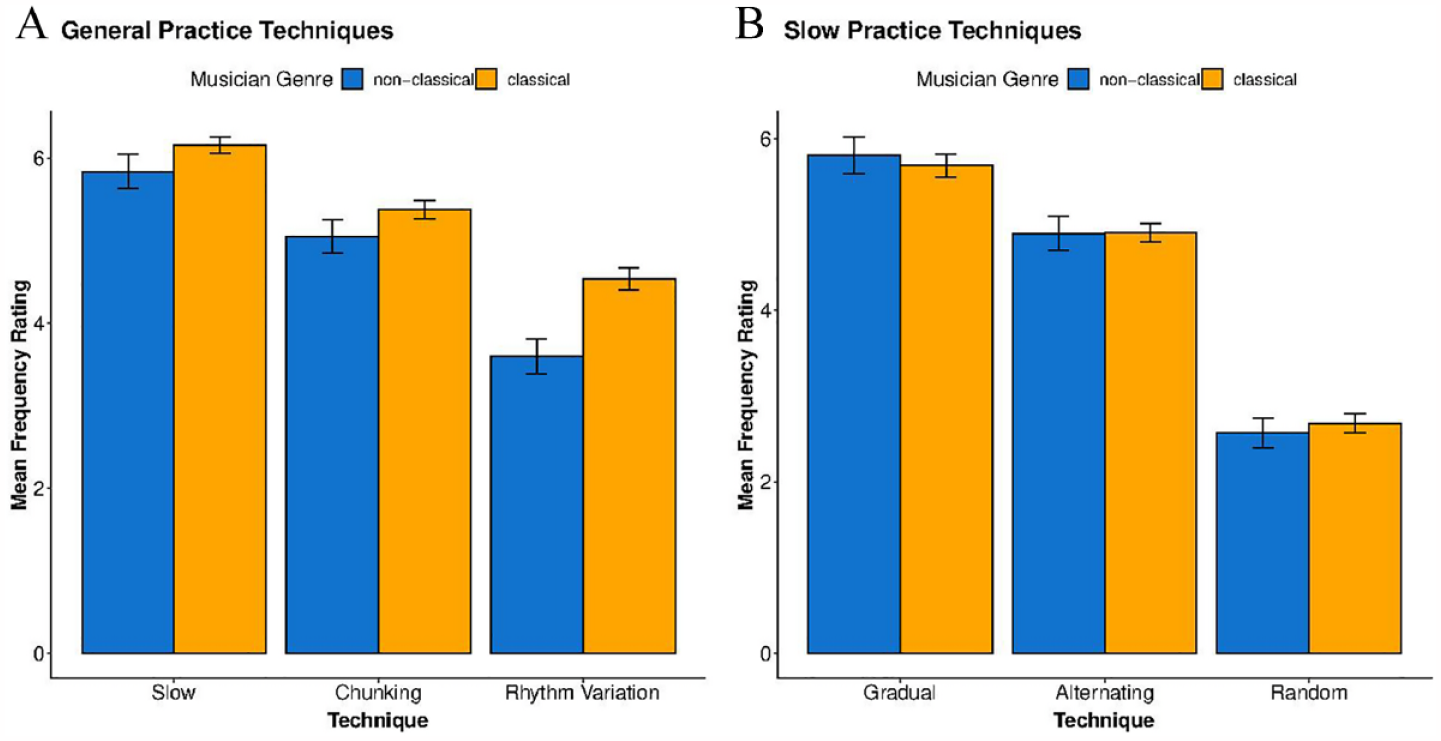
Frequency of Practice Techniques.
Also addressing RQ1, we compared frequency ratings of the different tempo organization strategies: gradually increasing tempo, alternating between slow and fast tempi, and playing at randomly ordered tempi (rated from almost never to almost always). There was a main effect of Genre, F(1, 245) = 6.19, p < .05,
Goals of slow practice
Addressing RQ2, we investigated whether respondents more commonly reported adopting technical or expressive goals during slow practice. Therefore, we compared ratings of how frequently performers’ reported goals during slow practice were “to work on expression” or “to work on technique” (rated from almost never to almost always). Results showed a main effect of Goal, F(1, 243) = 132.31, p < .001,
To examine slow practice goals in more detail, we analyzed ratings of more specific goals (intonation, rhythm, articulation, dynamics, structure, and memory), each rated from almost never (adopted) to almost always (adopted); 38 participants whose instrument did not enable intonation control (e.g., piano, percussion) were excluded, in order to be able to include intonation work as a goal. Results showed a significant main effect of Goal, F(4.33, 895.86) = 66.06, p < .001,
Single-sample t tests for each item showed that intonation, rhythm, articulation, and structure were rated significantly higher than the midpoint of the scale for both genre groups (frequently used). For both groups, dynamics and memory were not rated significantly higher than the midpoint, while memory was rated significantly lower for the classical group (infrequently used; see Table 1).
Ratings of Slow Practice Goals.
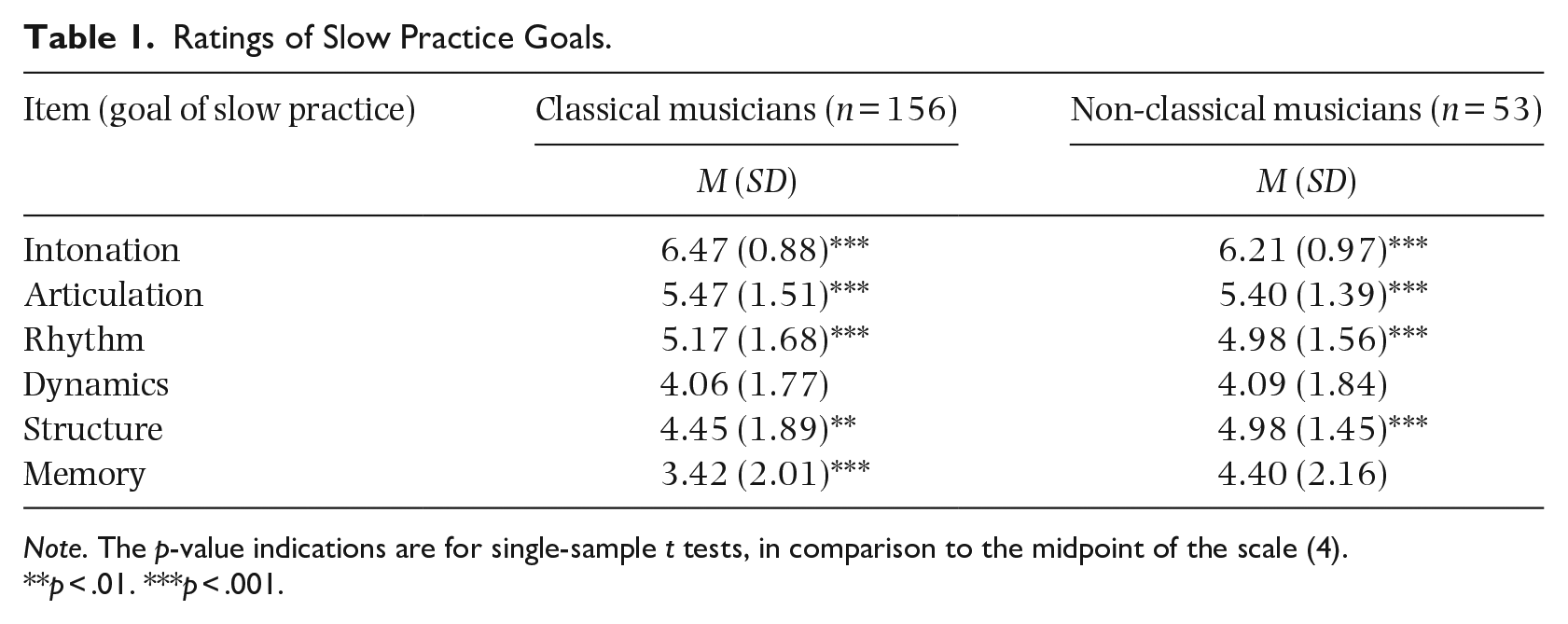
Note. The p-value indications are for single-sample t tests, in comparison to the midpoint of the scale (4).
p < .01. ***p < .001.
Dimensions of slow practice
We conducted a PCA on the ratings data in order to reduce the number of variables and to explore the underlying structure of the data. The Pearson correlation matrix of all 29 variables was first inspected, and one variable was excluded from the analysis, due to having no correlations >.30. A further four variables were later dropped due to cross-loadings with a difference between components of <.10, and a further three due to component loadings <.55. On the final dataset of 21 variables, the Kaiser–Meyer–Olkin measure of sampling adequacy was 0.72 (higher than the acceptable level of 0.5), indicating that the data were suitable for PCA, and Bartlett’s test of sphericity was significant, χ2(210) = 1,570.89, p < .001, indicating adequately high correlations between items for PCA (Field et al., 2012). Seven components were retained based on Eigenvalues > 1 and scree plot inspection. Table 2 shows the PCA weightings.
PCA Rotated Component Matrix.
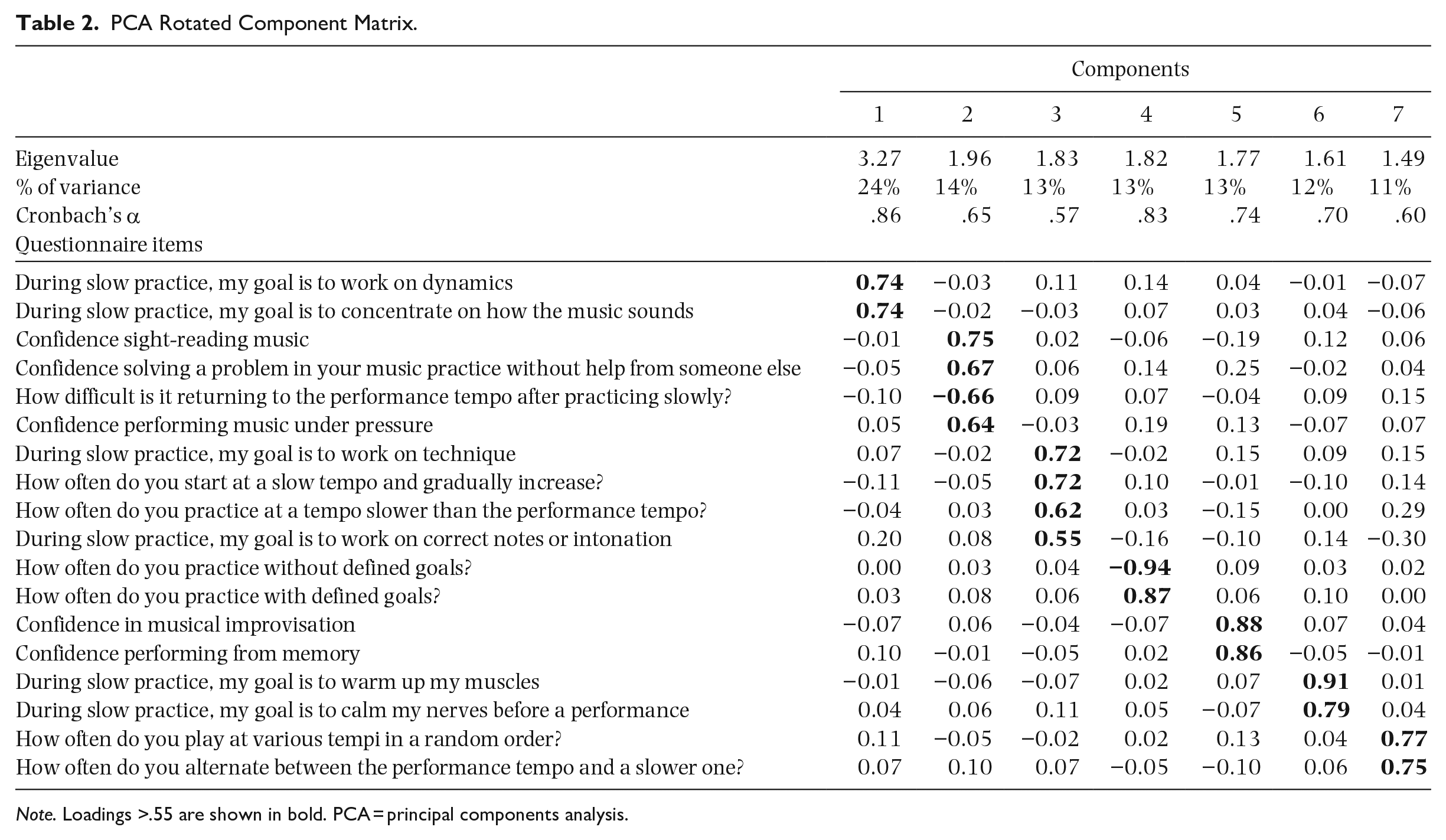
Note. Loadings >.55 are shown in bold. PCA = principal components analysis.
Component 1: Expressive slow practice
Component 1 is related to the adoption of slow practice goals concerned with cultivating musical expression, with high loadings for working on expression, concentrating on the emotions in the music, understanding or expressing musical structure, working on dynamics, and concentrating on how the music sounds during slow practice.
Component 2: Performance confidence
Component 2 is related to confidence in several performance- and practice-related skills, with high loadings for confidence in sight reading, problem solving during practice, and performing under pressure. It also received a high negative loading for difficulty returning to tempo.
Component 3: Technical slow practice
Component 3 is related to technical goals, with high loadings for working on technique and working on correct notes/intonation, during slow practice as well as frequency of simple slow practice techniques of practicing at a slow tempo, and gradually increasing the slow tempo.
Component 4: Deliberate practice
Component 4 is related to deliberate practice, with a high loading for practicing with defined goals and a high negative loading for practicing without defined goals.
Component 5: Memory confidence
Component 5 is related to confidence in performance skills requiring playing from memory or without a score, with high loadings for confidence in musical improvisation and playing from memory.
Component 6: Preparatory slow practice
Component 6 is related to use of slow practice to prepare for performance or for further practice, with high loadings for using slow practice to warm up the muscles and to calm the nerves before a performance.
Component 7: Tempo variation practice
Component 7 is related to using tempo variation as a practice technique, with high loadings for playing at different tempi in a random order and alternating between performance tempo and slow tempo.
Associations of slow practice with expertise, self-regulated learning and genre
We ran three linear regressions for each PCA component relating to slow practice: Expressive Slow Practice, Technical Slow Practice, and Preparatory Slow Practice. Independent variables were years of musical training (Expertise), Musical Self-regulated Learning (MSRL), and Genre (classical/non-classical), with interaction terms for Genre with Expertise and Genre with MSRL. The years of training variable has been found to be highly correlated with musical sophistication and musical identity (Zhang & Schubert, 2019), and thus should provide a reasonable measure of musical expertise. However, for unusual cases or self-taught musicians, this may not be the case. Therefore, the years of training variable was screened for consistency with other responses and 21 respondents were excluded on the basis that years of training could not accurately gauge their true expertise. For example, professional classical musicians with <10 years of training were excluded, in accordance with expertise theory (Ericsson et al., 1993), as well as participants who reported 0 years of training, who were assumed to be self-taught. A final participant was excluded as an outlier on this variable; thus, the final sample size for the regression analysis was n = 255.
Expressive slow practice
There was a significant positive association of Expressive Slow Practice and MSRL, no association with expertise, and no significant interactions (Table 3). The overall model was statistically significant, F(5, 219) = 9.98, p < .001, R2 = .19, adjusted R2 = .17, and explained 19% of overall variance in Expressive Slow Practice.
Linear Regression Results.
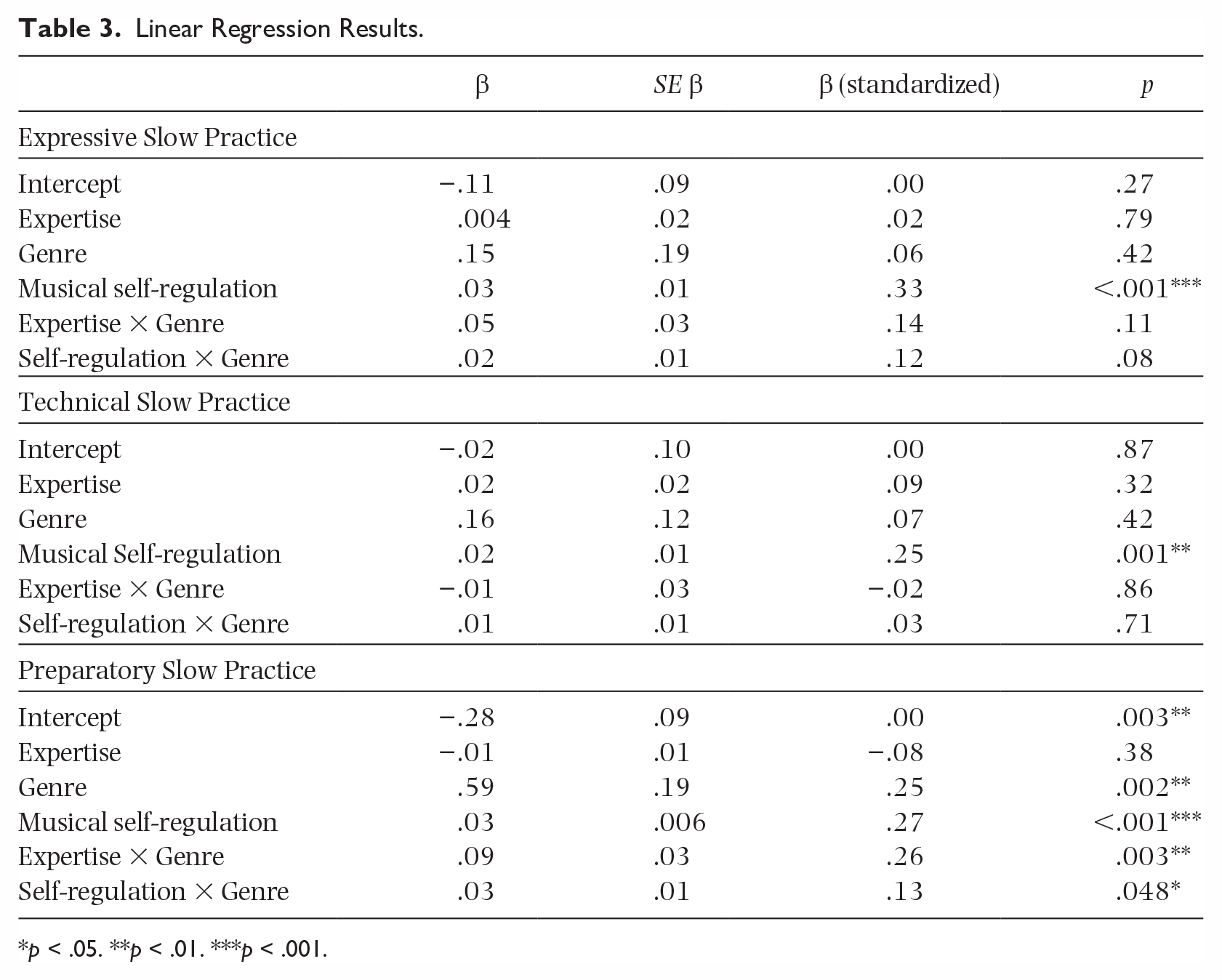
p < .05. **p < .01. ***p < .001.
Technical slow practice
There was a significant positive association of Technical Slow Practice and Musical Self-regulation, no association with Expertise, and no significant interactions (Table 3). The overall model was statistically significant, F(5, 219) = 4.44, p < .001, R2 = .09, adjusted R2 = .07, and explained 9% of overall variance in Technical Slow Practice.
Preparatory slow practice
There was a significant positive association of Preparatory Slow Practice and Musical Self-regulation, but no association with Expertise, and significant interactions of Genre with both Expertise and Musical Self-regulation (Table 3). In addition, there was a significant association with Genre, such that being a classical musician, compared to non-classical, was associated with an increase in Preparatory Slow Practice use. The overall model was statistically significant, F(5, 219) = 10.88, p < .001, R2 = .20, adjusted R2 = .18, and explained 20% of overall variance in Preparatory Slow Practice.
Interactions were followed up with simple slopes analyses. For classical musicians, there was a significant positive association between Musical Self-regulation and Preparatory Slow Practice, t = 5.53, p < .01, slope estimate = 0.04, SE = 0.01, but for non-classical, the relationship was not significant, t = 1.18, p = .24, slope estimate = 0.01, SE = 0.01 (Figure 2, Panel A). This suggests that while classical musicians who report more Preparatory Slow Practice are likely to report higher self-regulated practice, no such relationship exists in the non-classical group.
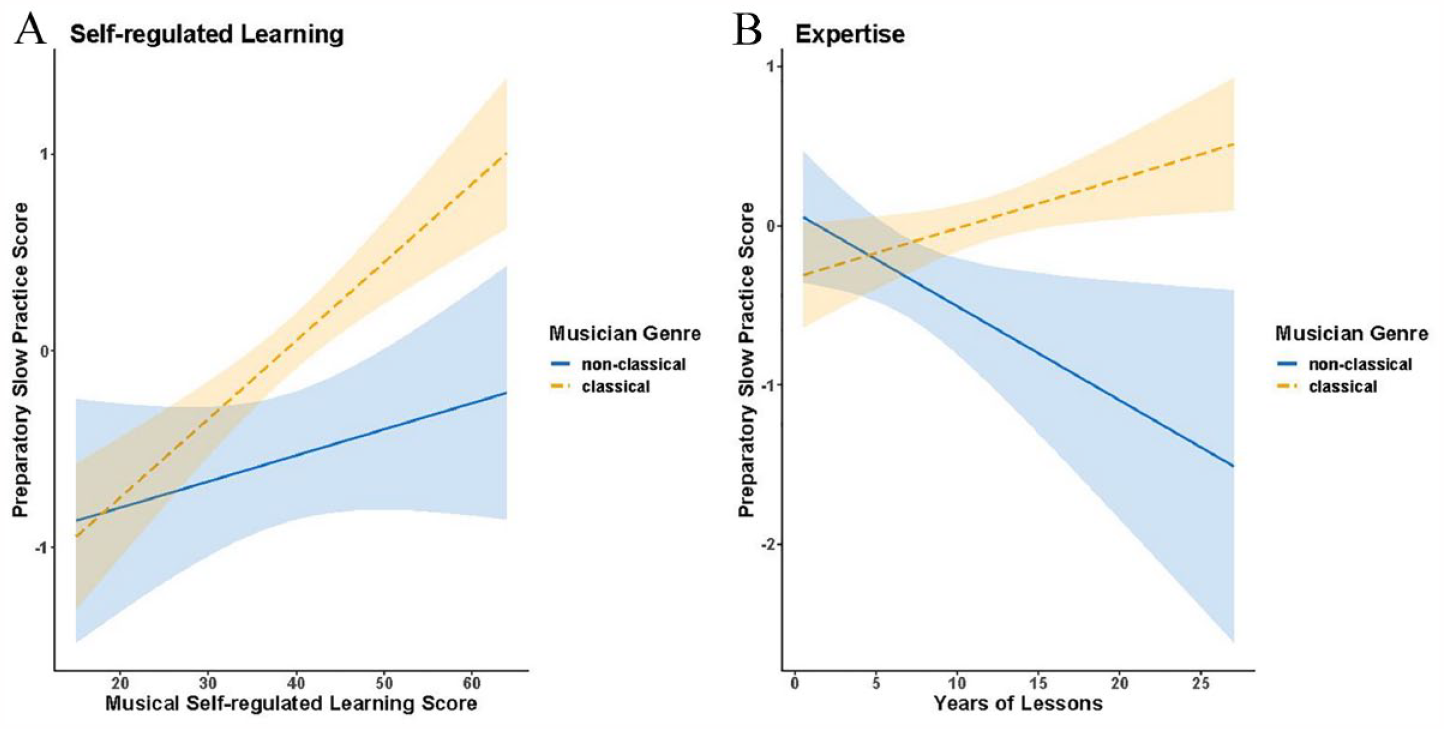
Interaction Effects of Musician Genre, Self-regulated Learning, Expertise, and Preparatory Slow Practice.
For classical musicians, there was also a significant positive association of Preparatory Slow Practice with Expertise, t = 2.68, p = .01, slope estimate = 0.03, SE = 0.01, while for non-classical musicians, this association was negative, t = –2.19, p = .03, slope estimate = –0.06, SE = 0.03 (Figure 2, Panel B). This suggests that Preparatory Slow Practice is reported more often by more experienced players in classical musicians, but less often by more experienced players in non-classical musicians.
Discussion
The results of this study indicate that slow music practice is a highly prevalent strategy, with 99.45% of classical musicians and 89.12% of non-classical musicians reportedly using slow practice. We further found that both technical and expressive goals during slow practice were frequently reported, with technical goals reported significantly more often than expressive, and we identified three possible types of slow practice, based on a PCA: technical, expressive, and preparatory. All three types of slow practice were positively associated with self-regulated learning, but not with expertise, while musical performance genre modulated these relationships for Preparatory Slow Practice.
Across both genre groups, slow practice was rated as significantly more frequently used compared to chunking and rhythm variation, although all three strategies were reported as more common than uncommon. This is in line with previous findings that slow practice is frequently used among learners and advocated by teachers (Austin & Berg, 2006; Barry & McArthur, 1994; Byo & Cassidy, 2008; Smith, 2005). Regarding methods of tempo organization, the current findings indicate that across both classical and non-classical musicians, gradually increasing tempo was reportedly the most often-used technique, followed by alternating between two tempi and then practicing at random tempi. This is an interesting finding in the context of motor learning theories, which may suggest gradually increasing tempo to be the least efficient strategy of the three (Caramiaux et al., 2018; Donald, 1997). Thus, prevalent use of gradual tempo increase may not be informed by objective knowledge of the most efficient method. However, there is a lack of empirical evidence for learning benefits of alternating or random tempi in an applied musical context; therefore, further research on this topic would be useful to discern if musicians’ practice habits reflect the most effective learning strategies.
Regarding possible functions of slow practice, we found that for both genre groups, technical goals were reported as significantly more common than expressive goals, although both were used frequently. Similarly, in comparing specific goals of slow practice, we found that intonation (a technique goal) was reported as the most prevalent goal of slow practice, across both expertise groups. Descriptively, technical goals of articulation and rhythm were also rated as more frequently used than higher level goals of working on dynamics, structure, and memorization. Overall, these results indicate that slow practice is reportedly used most often to achieve technical, low-level musical goals. This function of slow practice is consistent with the idea of slow practice as important to the early associative phase of motor learning (Gentile, 2000; Rosenbaum, 2010), where slower tempo may allow reduction of cognitive load and detailed attention to feedback in order to improve motor control. In addition, while respondents reported using slow practice to achieve technical goals most often, expressive and higher level musical goals were also frequently reported during slow practice. This finding reflects qualitative descriptions of how advanced musicians may use slow practice to shape expressive ideas (Chaffin et al., 2003). Indeed, use of slow exercises and studies for both tone and expressive skills development was emphasized by flute pedagogue Marcel Moyse, of the French School of Flute Playing (Waddell, 2002), further suggesting that slow practice may support expressive-interpretative functions as well as motor learning.
Further exploring potential functions of slow practice, a PCA revealed three different components relating to slow practice: Expressive Slow Practice, Technical Slow Practice, and Preparatory Slow Practice. This finding provides a foundation for further experimental research attempting to characterize the different types or functions of slow practice that may exist and may encourage music educators to teach diverse ways of using slow practice.
Utilizing multiple regression analyses, we found that all three slow practice components were positively associated with MSRL when performers’ musical genre was disregarded. This indicates that musicians who reported more frequently adopting these slow practice strategies tended to report more self-regulation in their music practice, which is consistent with the idea that slow practice strategies may either support or require self-regulation abilities. As self-regulated learning has been associated with musical expertise and performance improvement (Miksza, 2015; Nielsen, 2001), the current results might further suggest that the types of slow practice identified may indicate good quality practice. Establishing causal relationships between slow practice, self-regulation, and learning quality would require further experimental research. For example, would adopting slow practice strategies improve self-regulation, and would those with low self-regulation find slow practice more difficult to employ?
For Preparatory Slow Practice, different patterns of association emerged between classical and non-classical musicians. In the classical group, those who reportedly used more Preparatory Slow Practice tended to have higher reported self-regulated learning and more musical training (positive associations with MSRL and expertise), while in the non-classical group, they tended to have less training (negative association with expertise) and no more or less reported self-regulated learning (no association with MSRL). This finding implies that the characterization of highly expert and highly self-regulated practice may differ between classical and non-classical musicians, suggesting that research on optimal practice strategies should consider the influence of different music genres. However, limitations of the current sample may have influenced these results. For example, the non-classical group encompassed several distinct musical genres, and there was an uneven distribution of types of instrument between groups. Therefore, replication of this study in another sample may yield different results.
No main significant relationships between slow practice components and expertise were found, although we might have expected slow practice behaviors to decrease with expertise if slow practice’s main function was during the associative learning phase (Rosenbaum, 2010). This is a finding which may not be surprising to musicians who follow certain advanced pedagogies that advocate the practice of slow exercises and studies (Fischer, 1997; Waddell, 2002). Indeed, it may be the case that experts still employ slow practice in the early phase of learning, an unfamiliar piece of music. Future research could investigate how slow practice is used across the course of learning a new piece.
Several limitations to this study should be considered. For example, the current study did not analyze reported practice behavior differences between musical instruments or gender as has been previously investigated (Hallam et al., 2017, 2020), and the influence of individual differences such as personality on practicing remains to be explored. Indeed, differences in instrument technique may affect the use of slow practice. For example, sustaining instruments such as woodwind, brass, and strings may experience more technical difficulty when practicing long phrases slowly (i.e., running out of breath/bow; Sulliman, 2017) compared to non-sustaining instruments, meaning that novice players may avoid slow practice, while experienced players may use it to develop stamina. Further investigation of the importance of slow practice to specific instrument techniques would be useful. Another possible consideration is differences in slow practice usage between professional and amateur musicians. For example, approaching music practice as an activity to be enjoyed rather than a job to be completed might result in different ways of practicing. Furthermore, the current sample consisted of mainly classical string players; thus, different samples may show different results. Finally, qualitative exploration of this topic may reveal more about musicians’ attitudes, opinions, and motivations when using slow practice.
In conclusion, this study provides a first step in investigating prevalence, techniques, and cognitive functions of slow music practice. Our findings that reported use of slow practice was highly prevalent across expertise levels and that diverse musical goals were frequently reported during slow practice challenge the notion that slow practice is only used in the early stages of learning. Furthermore, researchers and music educators might consider possible functions of slow practice as technical, expressive, and preparatory, as highlighted in our PCA results. This study also suggests that further research on causal links between specific types of slow practice and self-regulated learning would be worthwhile. Finally, the differences in reported usage of Preparatory Slow Practice reported here between classical and non-classical musicians indicate the importance of considering how optimal practice and expertise may be characterized differently between various musical genres.
Footnotes
Funding
The author(s) disclosed receipt of the following financial support for the research, authorship, and/or publication of this article: This work was supported by a Consolidator Grant to the second author from the European Research Council (Grant Number 725319) for the project “Slow Motion: Transformations of Musical Time in Perception and Performance (SloMo).”
