




Abstract
To identify and classify musical tastes, researchers have extensively relied on the use of music-genre labels. However, the validity and reliability of such a method remain unclear. In this study, we examined the extent to which 873 high school students felt able to assess their musical tastes based on music-genre labels. Participants were expressly asked to evaluate the usability of such labels. Results showed that a majority of respondents were uncomfortable with the use of music-genre labels, mainly because of music-genre labels’ complicatedness and internal heterogeneity. Sex and social milieu predicted the perception of the usability of music-genre labels only weakly. Overall, our findings suggest that the reliance on music-genre labels in research on musical tastes might be problematic. We recommend that complementary indicators of musical tastes be more widely employed in the future.
To date, the psychological and sociological examination of musical tastes and music consumption has mainly relied on rating scales of music-genre labels (Brisson & Bianchi, 2020; Ferrer et al., 2013). Specifically, genre-based analysis has been extensively used in two major research areas. In sociology, the vast literature dedicated to cultural eclecticism and “omnivorousness” has principally focused on musical tastes, the main indicator of which relates to music-genre labels (Savage, 2006; for a review, see Hazir & Warde, 2016). In psychology, the investigation of the potential links between musical tastes and personality has largely involved music-genre labels as well (e.g., Rentfrow & Gosling, 2003; for a review, see Schäfer & Mehlhorn, 2017).
Over the past few decades, some investigators have analytically (e.g., Beer, 2013; Greenberg et al., 2016; Rentfrow et al., 2011) and empirically (e.g., Brisson & Bianchi, 2020; Ferrer et al., 2013; Vlegels & Lievens, 2017) questioned the validity and reliability of genre-based analysis. Notably, Bourdieu (1984), Holt (1997), Atkinson (2011), and Brisson (2019) highlighted taste oppositions at a within-genre level between contemporary and older artists. Vlegels and Lievens (2017) conducted cluster analyses of their participants’ favorite artists. These authors observed that the obtained clusters crossed genre boundaries, with artists from a given genre falling into different clusters. Brisson and Bianchi (2020) found that slight modifications in the set of genres under examination sufficed to significantly alter the emerging structure of musical tastes, a structure that some psychologists considered reflective of fundamental music dimensions (e.g., Rentfrow & Gosling, 2003; Zweigenhaft, 2008). Gürgen (2016) reported that music-genre identification strongly varies as a function of the music styles to which the excerpts belong. Perhaps most importantly, the vagueness surrounding music-genre labels and the absence of guidelines regarding the nature and the number of labels to be examined have been identified as serious methodological flaws that impede between-study comparability and hinder the understanding of the distribution of musical tastes (Brisson, 2019; Rentfrow et al., 2012; Savage, 2006). Despite such criticism and the long-standing existence of alternative, standardized indicators of musical tastes (e.g., music excerpts; see Cattell & Saunders, 1954; Greenberg et al., 2015), most researchers have continued to rely exclusively on music-genre labels over the past few years (e.g., Bonneville-Roussy et al., 2013; Chung et al., 2019; Daenekindt & Roose, 2014; Lizardo & Skiles, 2016; Mellander et al., 2018; Rossman & Peterson, 2015; Thomas, 2017).
The aim of this exploratory study was to further assess the relevance of the use of music-genre labels in research on musical tastes. More specifically, we investigated participants’ perception of such a use. To our knowledge, this issue remains overlooked in the research literature. Because sociologists and psychologists have long shown that musical tastes and music consumption can be affected by sex and socioeconomic status (e.g., Atkinson, 2011; Bonneville-Roussy et al., 2017; Bourdieu, 1984; Colley, 2008), we also evaluated the extent to which those factors bear on the perception of the usability of music-genre labels. In order to neutralize potential effects of age and generation, we focused only on high school students.
Method
Recruitment
High school principals from three French mid-sized towns were emailed and provided with a brief description of our study. 1 Five of the contacted principals showed an interest in the project and allowed us to administrate the survey in their school. The main recruitment criteria were the availability of the classes and professors’ approval to administrate the survey during class time.
Study sample
In all, 873 high school students completed our survey (MAGE = 16.85, SDAGE = 0.85; 59% female), including 49.4% of 11th graders (54% female) and 50.6% of 12th graders (64% female).
Dependent variables
Participants were asked the following question: “In order to examine people’s musical tastes, investigators generally use music-genre labels (for instance, rock, electro, rap, classical, jazz). What do you think of the usability of such labels for examining your musical tastes?” Participants had to choose between two response modalities: (1) “Music-genre labels are convenient, they allow me to talk about my musical tastes in a satisfactory manner” and (2) “Music-genre labels are not convenient, they do not allow me to talk about my musical tastes in a satisfactory manner.” The participants who selected the latter proposition were then invited to select, among four response options, the one that best reflected their own opinion. These response options were: (1) “Music-genre labels are complicated categories, I know little about the existing genres and I do not really know how they are defined”; (2) “Music-genre labels are not very suitable because many songs and artists can be classified in several genres at the same time”; (3) “Music-genre labels are vague, it would be better to use sub-categories (e.g., ‘alt rock’ or ‘1970s rock’ instead of ‘rock’)”; and (4) “Music-genre labels are heterogeneous categories, it would be better to use artists’ names because one can both like and dislike a large number of artists within a given genre.” We note that these options were selected based on pretests involving 30 adolescents who were asked to answer the same question(s) openly (i.e., without predefined response options). The retained response options cover the array of pretesters’ responses.
Independent variables
Sex and social milieu were used as independent variables. We distinguished between three milieus based on the educational level of participants’ parent having the highest degree: no diploma or high school degree (low social milieu; 48.7%), graduate diploma (medium social milieu; 25.8%), and postgraduate diploma (high social milieu; 25.5%).
Data analyses
First, we computed the percentages of individuals having selected each of the two response options regarding the usability of music-genre labels. Second, we performed a binary logistic regression to assess the influence of sex and social milieu in that respect. Third, among the participants who indicated that music-genre labels did not allow them to talk about their musical tastes in a satisfactorily manner, we computed the percentages of individuals having selected each of the four response options regarding the main problems associated with music-genre labels. Fourth, we conducted logistic regressions to ascertain whether sex and social were predictive of the selection of each of these four options. To this end, we recoded each modality of the dependent variable as a dummy variable. A response selected was coded 1 and a response unselected was coded 0. Fifth, we performed multinomial logistic regressions to estimate the influence of the examined independent variables within a multivariate approach. Complete results pertaining to these analyses are reported in Supplementary Material.
Results
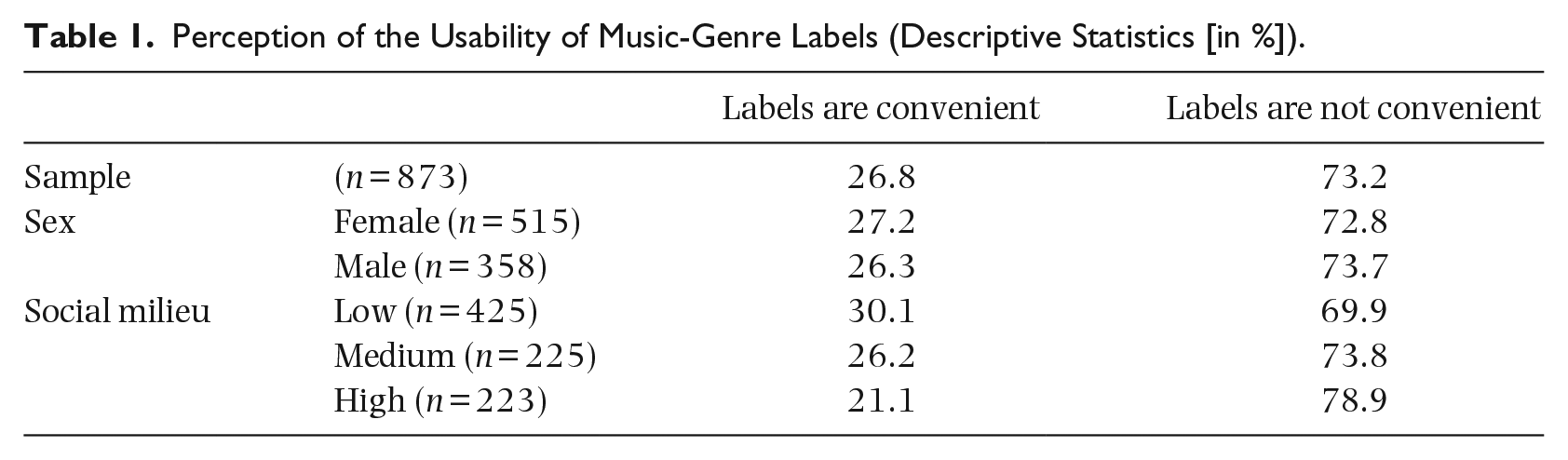
As shown in Table 1, 26.8% of the respondents indicated that the use of music-genre labels allowed them to report on their musical tastes in a satisfactory manner. Thus, a large majority of participants considered the usability of music-genre labels to be problematic.
Perception of the Usability of Music-Genre Labels (Descriptive Statistics [in %]).
A binary logistic regression (Table 2) indicated that social milieu influenced the perception of the usability of music-genre labels: the higher the milieu, the stronger the propensity to consider that music-genre labels are problematic categories. However, the difference between the students from the lowest milieu and those from the highest milieu was small, since the corresponding odds ratio fell in a 0.50–2 range (Ferguson, 2009). Sex had no influence here.
Perception of the Usability of Music-Genre Labels as a Function of Sex and Social Milieu.
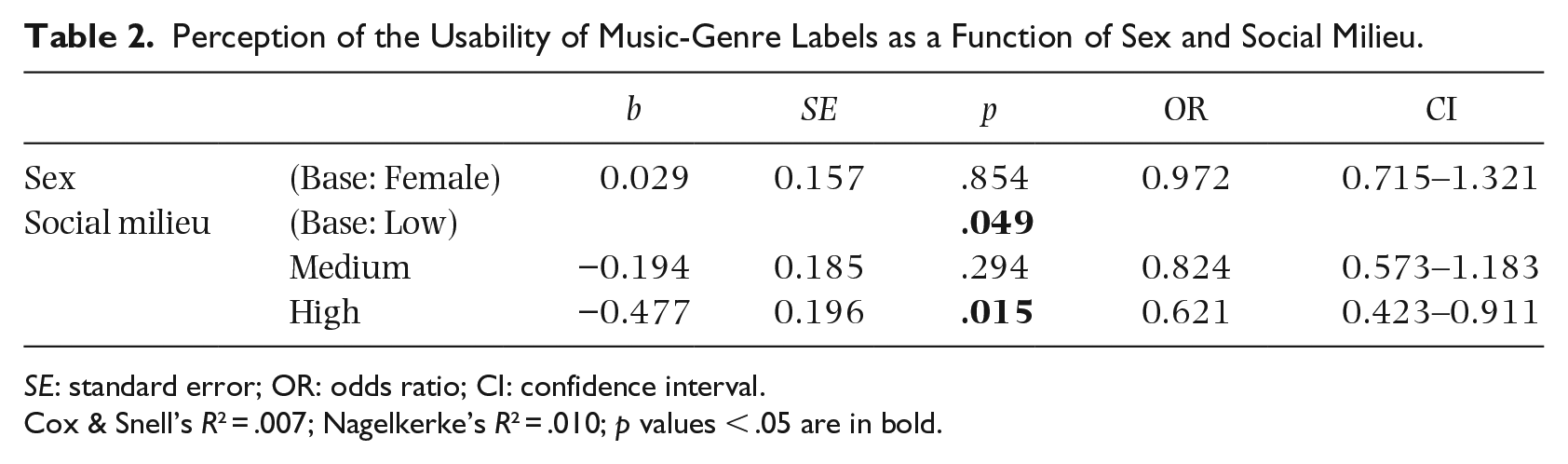
SE: standard error; OR: odds ratio; CI: confidence interval.
Cox & Snell’s R² = .007; Nagelkerke’s R² = .010; p values < .05 are in bold.
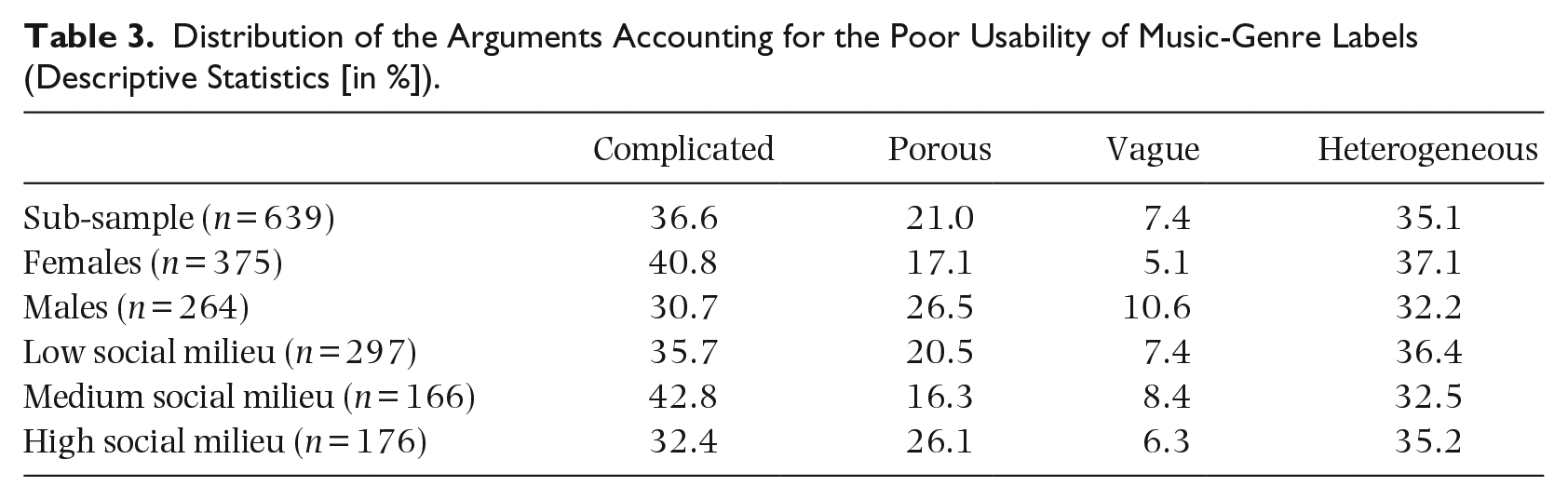
As shown in Table 3, the participants who reported that music-genre labels do not allow them to satisfactorily talk about their musical tastes considered those labels as too complicated (36.6%), too heterogeneous (35.1%), too porous (21%), or too vague (7.3%).
Distribution of the Arguments Accounting for the Poor Usability of Music-Genre Labels (Descriptive Statistics [in %]).
The selection of a given response option was quite independent of the social milieu. We found one statistically significant difference in that respect (see Table 4): students of high social milieu were more prone than students of medium social milieu to pick the option “porous.” However, the corresponding odds ratio was small. Unlike social milieu, sex consistently involved statistically significant differences. However, we found a unique moderate odds ratio: compared to females, males were more prone to select the option “vague.”
Associations Between Sex, Social Milieu, and Arguments Accounting for the Poor Usability of Music-Genre Labels.
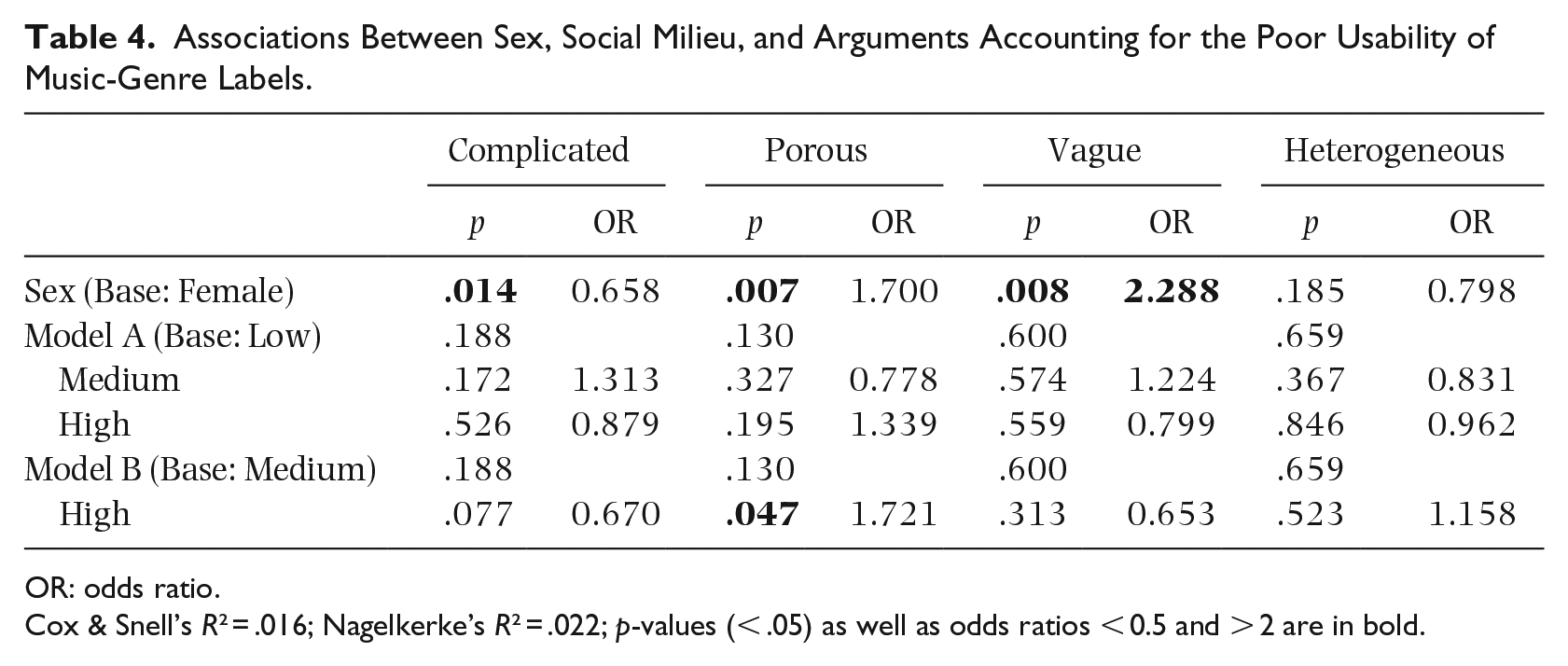
OR: odds ratio.
Cox & Snell’s R² = .016; Nagelkerke’s R² = .022; p-values (< .05) as well as odds ratios < 0.5 and > 2 are in bold.
Finally, results from multinomial logistic regression analyses dovetailed with our previous findings (see Supplementary Material). Because most p-values exceeded .05 and most odds ratios were above 0.5 and below 2, results revealed a rather limited influence of sex and social milieu on the nature of the main argument selected to account for the problems linked to music-genre labels. The conducted analyses revealed two moderate effects of sex. Compared to males, females were (1) more prone to select the option “complicated” than the option “vague” (OR = 2.80) and (2) less inclined to select the option “vague” than the option “heterogeneous” (OR = 0.40). Overall, social milieu had no influence here.
Discussion
In this exploratory study, we examined the extent to which high school students felt able to assess their musical tastes based on music-genre labels. Our results indicate that music-genre labels are difficult to maneuver for a majority of individuals. Indeed, most participants perceived these categories as complicated or too heterogeneous. Although we detected a few effects of sex and social milieu, these effects were small and can therefore be considered of minor importance. It is of note, however, that (1) social milieu affected the perception of the usability of music-genre labels to a larger extent than sex and (2) sex was a better predictor than social milieu of the main argument selected to account for the problems linked to such labels. Future research on the perception of the usability of music-genre labels may benefit from an assessment of musical knowledge and musical background (e.g., see Broomhead, 2001).
Our findings cast further doubt on the use of genre-based analysis the way it is currently performed. Music-genre labels may be particularly difficult to handle for individuals having the lowest and highest levels of cultural (here, musical) capital (Bourdieu, 1984), namely, casual listeners and music connoisseurs. On the one hand, casual listeners and people listening to a narrow set of music styles may be confused when asked to rate music genres that they do not know well. In addition, certain participants may like or dislike certain music genres without being able to identify these music genres based on mere labels. On the other hand, music connoisseurs may be disconcerted by the generality of the categories employed, which do not distinguish between periods (e.g., baroque vs romantic; old school rap vs contemporary rap), sub-genres (e.g., death metal vs doom metal; opera buffa vs opera seria), and other nuances (e.g., musical properties such as tempo or the use of auto-tune). All in all, this state of affairs may constitute a roadblock in the characterization of a consistent structure of musical tastes.
In view of the problems attached to the current use of music-genre labels, at both “objective” and “subjective” levels, we recommend that complementary musical-taste indicators, such as music excerpts, favorite songs, disliked artists, and music attributes, be employed in the future. In particular, the investigation of both favorite artists and songs would allow researchers to concomitantly examine a vast array of characteristics, such as period, degree of mainstreamness, artists’ age and gender, theme of song lyrics, and a multitude of musical properties (e.g., rhythm, tempo, types of instruments). It is encouraging to see that some investigators started implementing such methods fruitfully (e.g., Fricke et al., 2021; Greenberg et al., 2015, 2016; Rentfrow et al., 2012). These indicators likely present a higher ecological validity than music-genre labels and, advantageously, do not require participants to have specific musical knowledge.
Supplemental Material
sj-docx-1-pom-10.1177_03057356211046660 – Supplemental material for Perception of the usability of music-genre labels for the assessment of musical tastes
Supplemental material, sj-docx-1-pom-10.1177_03057356211046660 for Perception of the usability of music-genre labels for the assessment of musical tastes by Romain Brisson and Renzo Bianchi in Psychology of Music
Footnotes

References
Supplementary Material
Please find the following supplemental material available below.
For Open Access articles published under a Creative Commons License, all supplemental material carries the same license as the article it is associated with.
For non-Open Access articles published, all supplemental material carries a non-exclusive license, and permission requests for re-use of supplemental material or any part of supplemental material shall be sent directly to the copyright owner as specified in the copyright notice associated with the article.
