




Abstract
Music is appreciated for emotional reasons across cultures, but knowledge on the cross-cultural similarities and differences of music-evoked emotions is still sparse. The current study compared music-evoked emotions in Finland and in India, contextualizing them within the perceived psychological functionality of music in an individualistic versus collectivistic culture. Participants (N = 230) answered an online survey on music-evoked emotions and related personal meanings. A mixed-method approach using factor analysis and qualitative content analysis was used to identify the concepts for cross-cultural comparison. Results show that both cultures value music for positive emotional experiences, but the prevalence of more detailed emotional nuances and underlying meanings is distinctively different. The highest-scoring emotion factor for Finns was Power-Empowerment while for Indians it was Peaceful-Transcendence. For Finns, the personal relevance of music was distinctively related to self-enhancement, self-reflective insights, and self-expression, while for Indians the relevance was particularly related to using music as a mood management tool for reaching positive, relaxed, and motivated affective states. Both cultures found music important for experiencing social connection. The results partly reflect the individualistic-collectivistic dimensionality of cultures and emphasize the relevance of contextualizing music psychological knowledge of music-evoked emotions in individuals’ culturally bound meaning-making processes.
Background and aim
Everyday music listening is colored by emotions that vary in their shades from peacefulness to awe, excitement, and vigor (Juslin & Laukka, 2004; Zentner, Grandjean, & Scherer, 2008). Listeners do not only perceive these emotions in music but also indeed genuinely experience them (Lundqvist, Carlsson, Hilmersson, & Juslin, 2009; Schubert, 2013). Emotional experiences to music are rooted in the evolutionary and embodied meanings of sounds and vocalizations (Reybrouck & Eerola, 2017). They contain both aesthetic and utilitarian emotions, produced by a variety of production rules that range from embodied synchronization to cognitive appraisals (Scherer, 2004). Music psychology has been addressing a range of factors explaining the music-evoked emotions, including various musical parameters such as mode or tempo (Eerola, Friberg, & Bresin, 2013; Gabrielsson & Lindström, 2010; Juslin & Laukka, 2004), listener traits such as personality (e.g., Vuoskoski & Eerola, 2011), and contextual factors such as the listening location and related activities (Randall & Rickard, 2017; Randall, Rickard, & Vella-Brodrick, 2014). Music-evoked emotions are also intertwined with the psychological functions that music serves in people’s daily lives (Clayton, 2009; Maloney, 2017; Schäfer, Sedlmeier, Städtler, & Huron, 2013), with relaxation evoking different emotions than mental contemplation (Baltazar & Saarikallio, 2017; Saarikallio, Maksimainen, & Randall, 2018). Overall, research is only beginning to explore the interrelations of the complex set of different factors influencing musical emotions (Eerola & Vuoskoski, 2013).
Yet another factor influencing music-evoked emotions is cultural background. Ethnomusicology has elaborated on the embeddedness of musical behavior in a given culture, but cross-cultural comparisons are rare and research in music cognition and music psychology holds a Western premise (Saarikallio, 2011; Thompson & Balkwill, 2010). One of the approaches in cross-cultural research is to compare individualistic versus collectivistic cultures, a dimension that closely impacts everyday life, dividing people into valuing and approaching behaviors either from the personal relevance or in terms of the group integrity (Shiraev & Levy, 2010). This dimension has been addressed by some of the recent cross-cultural studies on music (Boer & Fischer, 2012; Juslin, Barradas, Ovsiannikow, Limmo, & Thompson, 2016; Saarikallio, 2011; Schäfer, Tipandjan, & Sedlmeier, 2012).
The existing cross-cultural work on music and emotion has mostly focused on emotion perception (e.g., Laukka, Eerola, Thingujam, Yamasaki, & Beller, 2013; for a review, see Thompson & Balkwill, 2010), not on the emotions induced. Recently, however, Juslin and his colleagues (2016) explored music-evoked emotions in six countries (Australia, Brazil, Kenya, Portugal, Sweden, and the United States). The results showed that the palette of most prevalent emotions was relatively similar across cultures: highly typical emotions in both individualistic and collectivistic cultures were pleasure-enjoyment, happiness-elation, calm-contentment, love-tenderness, and nostalgia-longing. However, some differences were also observed: sadness-melancholy and the emotion evocation mechanism musical expectancy were more prevalent for individualistic cultures (Australia, Sweden, the United States), while nostalgia-longing, spirituality-transcendence, happiness-elation, and the mechanism episodic memory were more frequent for collectivistic cultures (Brazil, Kenya, Portugal).
A few studies have also addressed the psychological functions of music across cultures. This work has been guided by the idea that music is a human universal, a behavior present in all societies (Blacking, 1974; Cross, 2001) and studies have often aimed at identifying elements that are shared across cultures. Among the pioneers was Merriam (1964) who listed 10 social and societal functions of music applicable across societies. More recently, Boer and Fischer (2012) conducted a qualitative study in which they identified seven functions that emerged as a cross-culturally common ground: Music in background, Memories through music, Diversion, Emotion in music, Catharsis, Music as reflection of self, and Social bonding. In another study among six countries (Germany, Kenya, Mexico, New Zealand, Philippines, and Turkey), Boer and her colleagues (2012) identified 10 functions that could be organized along two dimensions: first, music serves contemplation or affective functions, and second, music serves intrapersonal, social, and sociocultural functions. In line with that, based on a review of cross-cultural work in several disciplines, Saarikallio (2011) identified three psychological functions that consistently occur across studies and theories: (1) an emotional element (e.g., using music to express, experience, or regulate affect), (2) an introspective element (e.g., using music for reflection, mental work, personal growth, and spirituality), and (3) a social element (e.g., using music to strengthen social bonding, belonging, cohesion, and identity). At this broad level of only two or three dimensions, the categorizations are highly similar to categorizations based on merely Western samples (e.g., by Schäfer and colleagues, 2013: music functions to regulate arousal and mood, to achieve self-awareness, and as an expression of social relatedness).
While cross-cultural similarity is present at the level of basic functionality of music, cross-cultural differences have been observed at the level of subtle nuances in the prevalence and importance of these functions. Boer and Fischer (2012) reported that in individualistic cultures, music is particularly used for emotional and reminiscence functions, while for collectivist cultures, it is particularly used for diversion in social settings; feeling good, dancing, and entertainment with friends and family. Juslin and his colleagues (2016) reported relatively small differences in the functions overall, but noted that music as background was more common for collectivist cultures and use of music for relaxation, passing the time, obtaining company, influencing emotions, creating atmosphere, and having interest in the music were more common for individualistic cultures. Meanwhile, when comparing Germans (individualistic culture) and Indians (collectivistic culture), Schäfer and his colleagues (2012) observed that for the Indians, favorite music served background, emotion regulation, and self-regulation functions more than for the Germans. There were also differences in how the functions impacted music preferences (Schäfer et al., 2012). When zooming into the mood-regulatory functions, Saarikallio reported that Finnish adolescents (Individualistic culture) more than Kenyan adolescents (collectivistic culture) used music for background and discharging negative emotions using rock music, while Kenyans more than Finns used music for dancing and expression of positive emotions using jazz and hip hop (Saarikallio, 2008). As a whole, the body of these studies is still relatively scattered, so the picture on the nuanced differences remains somewhat ambiguous.
Overall, current research based on cross-cultural comparisons of musical experiences is sparse, particularly concerning the music-evoked emotions. The work conducted on the psychological functions serves as an important background for the current inquiry, because it provides knowledge about the personal meanings underlying the emotions and helps to contextualize them into the daily functionality of music in different cultures. However, individual studies have typically addressed only one aspect at a time, either the emotions or the functions. Another shortcoming is that the measurement instruments applied in the studies are typically of Western origin, which creates challenges for valid comparison when the very objects of study, music and emotion, are somewhat differently conceptualized in different cultures (Saarikallio, 2011; Thompson & Balkwill, 2010). Based on this, the current study took an exploratory approach on investigating both music-evoked emotions and the underlying psychological functions of music in two different cultures, in Finland (individualistic) and in India (collectivistic). The main aim of the study was to advance knowledge on the cross-cultural similarities and differences of the character of music-evoked emotions, and essentially situating and framing this knowledge within the meaning-making processes of personally relevant music experiences as part of the daily functionality of music listening.
Method
A mixed-method study was conducted in two countries, Finland and India. Data were collected through an online survey and experiences were approached through both rating scales and free descriptions. Data were analyzed through a combination of quantitative and qualitative approaches. The collected data will be publicly available on the Dataverse network at https://dvn.jyu.fi/
Participants
Participants consisted of a total sample of 230 individuals (156 Finns, M = 29.4 years, SD = 10, 109 females, and 74 Indians, M = 29.4 years, SD = 8.85, 39 females). Sample size was determined to fulfill requirements for a stable factor analysis solution. Based on prior research (Saarikallio et al., 2018), we expected the factor solution to have approximately six factors, the data thus having variables-to-factors ratio around 40:6 (the study contained 41 variables, see below). For this ratio, a sample size of 200 has been found to consistently yield convergent and admissible factor solutions regardless of the level of communality (MacCallum, Widaman, Zhang, & Hong, 1999). Participants were recruited through University mailing lists and social media, thus consisting mainly of University students. The sample in both countries was thus representative of young adults, relatively highly educated, and capable of responding in English language. Participants were informed about the study at the beginning of the survey. A chance to join in a draw for an Amazon voucher was used as an incentive.
Procedure and measures
Participants were asked to think about a piece of music that was meaningful and evoked emotions in their daily life. While this approach does not provide access to analyzing real-time experiences (Reybrouck, 2010) or mapping the fluctuating situational influences (Randall & Rickard, 2017) of listening, it allows participants to carefully reflect their experience from the perspective of personal meaning and to frame the experience within a retrospective insight about the role and function of music in one’s life and daily behavior.
Participants’ chosen music encompassed a wide range of musical styles from pop to rock to classical to dance to religious music to film scores. The spread of different styles was relatively similar in both countries, but Indians primarily reported the genres pop, rock, and Film music (which constitutes music generally of several genres such as pop, rock, jazz, folk, dance, classical, etc.), while Finns mostly reported pop, rock, alternative/indie, and classical genres. Specific to the Finnish sample was the genre metal/heavy.
Questions about the personal affective experience of the piece were then presented. The strength of discrete emotions evoked by the piece of music was assessed through 41 emotion terms (selected based on prior music and emotion research, including cross-cultural work, for example, Juslin et al., 2016; Juslin & Laukka, 2004; Zentner et al., 2008). Ratings were provided on a 7-point scale (not at all—extremely). To explore the functions of the music, participants were then asked to provide a free written description about the personal meaning of the chosen song.
Analyses
A mixed-method approach was taken to analyze the data. Descriptive statistics on the ratings on the individual emotions provided by Finns and Indians were first glanced for an overview of the most prevalent experiences in a given culture. Exploratory factor analysis (EFA) was then conducted on the emotion ratings for dimension reduction. To have the factor solution addressing emotions that the participants truly considered relevant for their experience, emotions with the lowest mean scores (20% percentile) were omitted from the analysis. These consisted of Boredom, Depression, Fear, Tiredness, Disgust, Anger, Stress, and Shame (same for both cultures). The remaining 33 emotions were retained, and Principal Components Analysis (PCA) indicated a five-factor solution. EFA was conducted using maximum likelihood for extraction and Varimax for rotation. Cross-cultural differences in the prevalence of emergent emotion factors were investigated through a within-subject analysis of variance (ANOVA) comparing the emotion factor scores, with culture as a between-subject factor.
A subset of 103 participants (59 Finns, 44 Indians) provided comments to the open-ended question about the meaning of the chosen song. These descriptions were subjected to a qualitative content analysis with an inductive approach. Each description was first given a short conceptual description (code) of the meaning/function that the music served (e.g., Music is a reflection of my view of the world and my personal life experiences or Music serves mood regulation in terms of motivating me to work). These initial codes were grouped under nine conceptual categories, each reflecting a specific function of music. Each description was allocated to one of the nine categories (two descriptions were left out since they only consisted of one word describing the name of the song or the genre of the song). Majority of descriptions was easy to allocate to one category, but some showed conceptual overlap with one or two other categories. Therefore, the nine original categories were further grouped into four meta-level factors, with categories demonstrating some conceptual overlap being grouped together. The frequencies of descriptions falling under each emergent category were calculated and their prevalence in Finnish and Indian samples compared. Frequencies were transferred to percentages of the total amount of responses in each sample to maintain comparability across samples. To provide knowledge on which actual music incurred the responses, the linkage of qualitative categories to genre choices was explored in Finnish and Indian samples.
Results
Emotion ratings
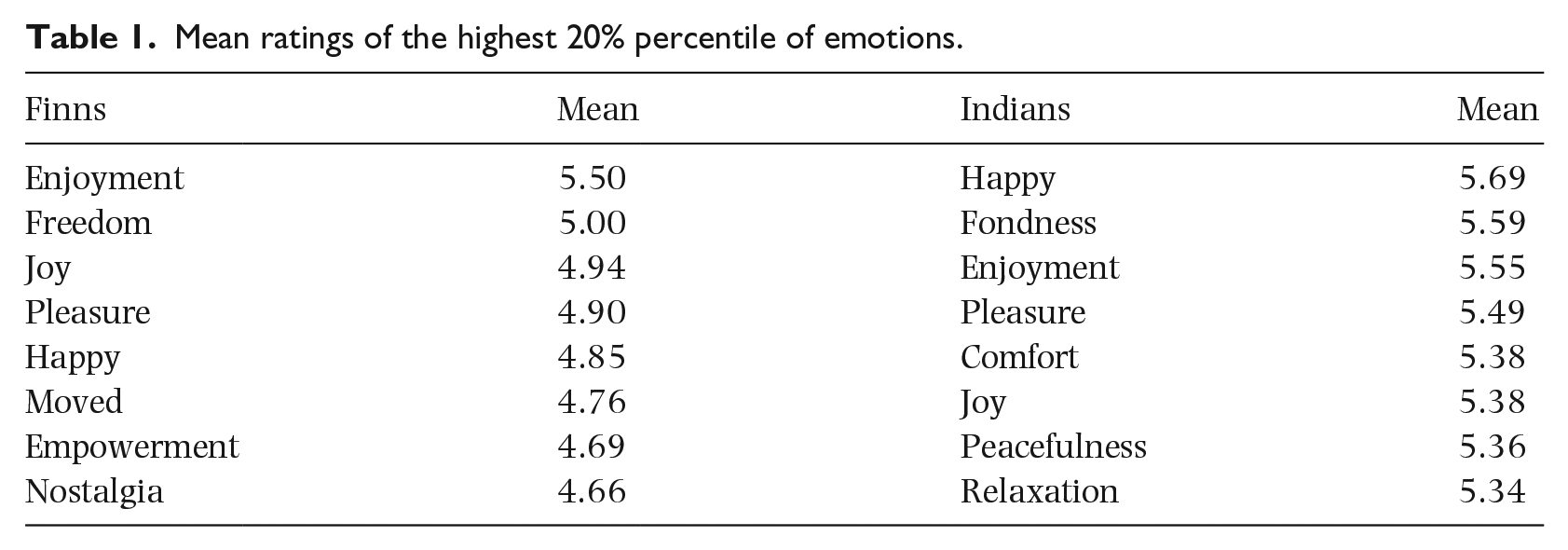
The most highly rated emotions (20% percentile) for Finns and Indians are reported in Table 1. For the Finns, these were Enjoyment, Freedom, Joy, Pleasure, Happy, Moved, Empowerment, and Nostalgia (in descending order). For Indians, these comprised of Happy, Fondness, Enjoyment, Pleasure, Comfort, Joy, Peacefulness, and Relaxation. Emotions prevalent for both thus included Happy, Joy, Enjoyment, and Pleasure, while differences were observed in Freedom, Empowerment, Moved, and Nostalgia being specifically prevalent for Finns and Fondness, Comfort, Peacefulness and Relaxation being specifically prevalent for Indians.
Mean ratings of the highest 20% percentile of emotions.
To further elaborate the comparative emphasis of different emotions in each culture, the mean differences between Finns and Indians were calculated for each emotion score, illustrated in Figure 1. Fondness, Spirituality, and Transcendence appeared particularly distinctive for Indians, in comparison to Sadness, Empowerment, and Fragility being distinctive for Finns.
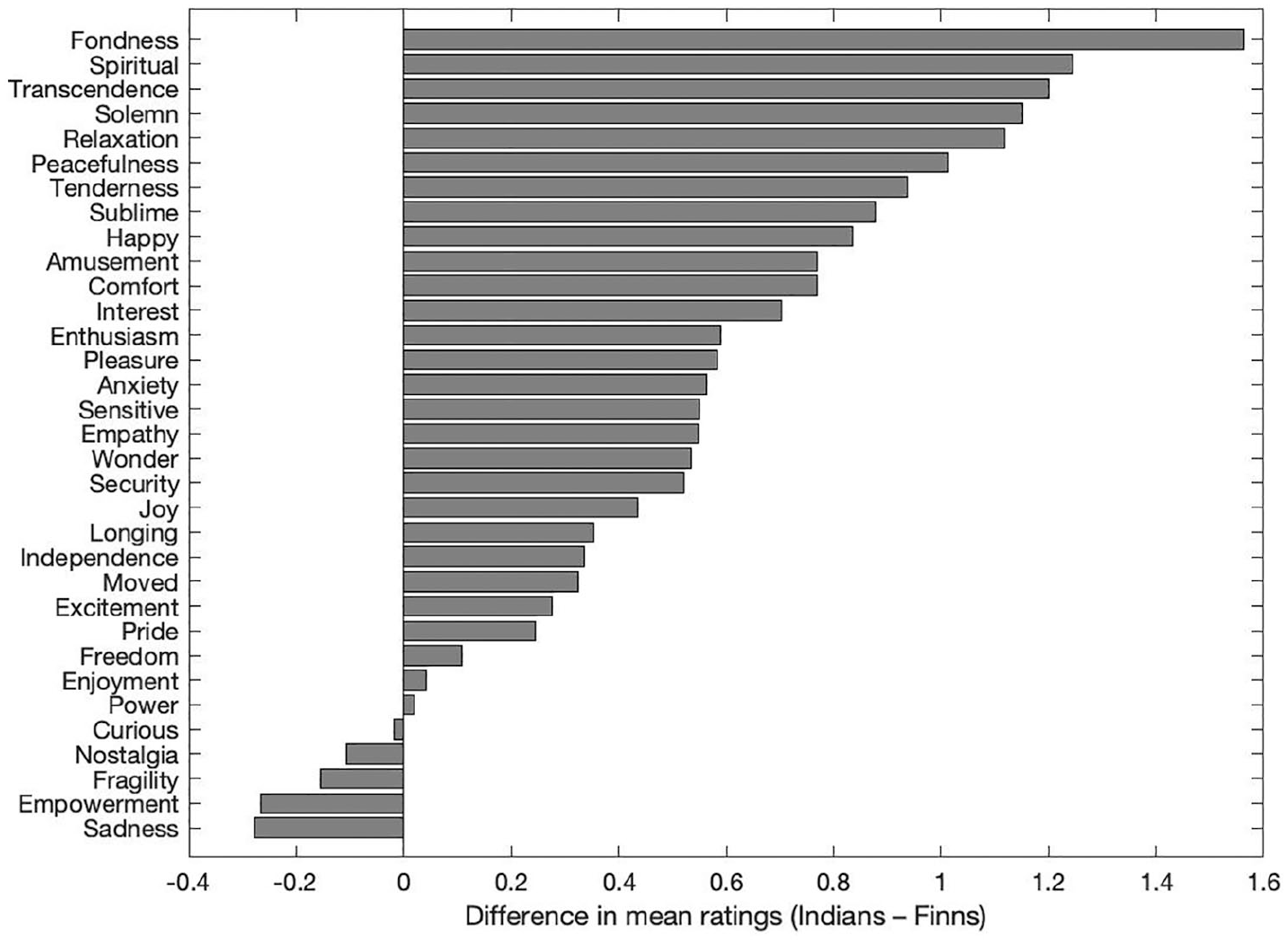
The difference of mean ratings between Indians and Finns.
PCA on the emotion ratings was used to determine the number of factors. To this end, we used Cattell’s (1966) scree test and Velicer’s Minimum Average Partial test (MAP; Velicer, Eaton, & Fava, 2000). Cattell’s scree test is a graphical method based on determining the point at which the eigenvalues of successive principal components level off to the right of the plot. Velicer’s MAP test is a numerical method that aims to determine the number of components that consists primarily of common variance in the data. To this end, it finds the number of components m for which the partial correlation matrix (i.e., correlation matrix from which the first m components have been partialed out) has minimal norm. Cattell’s and Velicer’s tests were chosen because they have been found to be among the most accurate graphical and numerical methods, respectively (Peres-Neto, Jackson, & Somers, 2005; Velicer et al., 2000).
Cattell’s scree test revealed a breakpoint after five components. Velicer’s et al. (2000) MAP also revealed five components. The first five principal components explained 59% of the variance. Factor loadings for an EFA for five factors with Varimax rotation are presented in Table 2. Emotions with high loadings (>.50) for their respective factor are shown in bold face.
Factor loadings and mean factor scores for Finns and Indians.
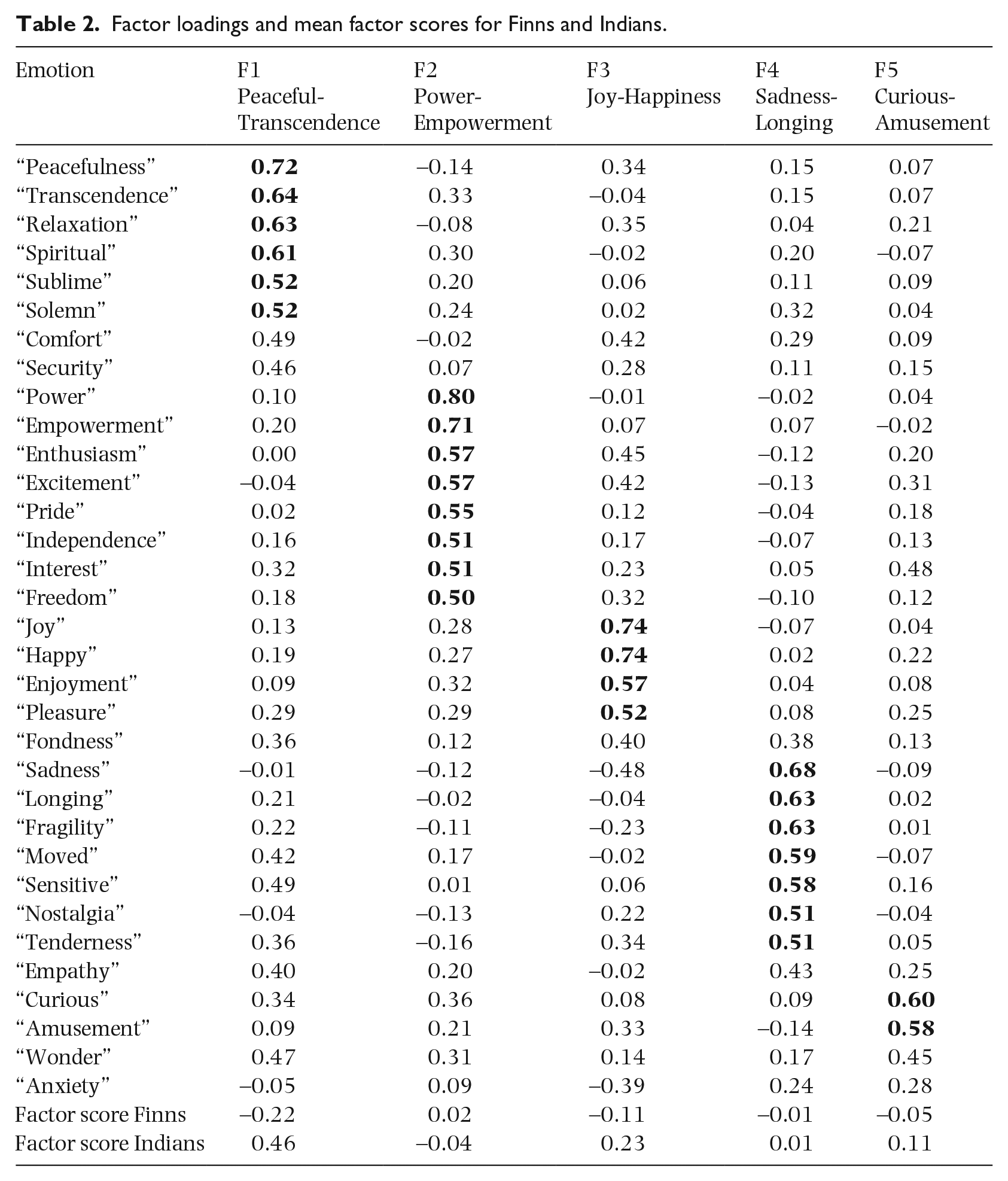
The first factor (F1) was labeled Peaceful-Transcendence. It received high positive loadings from peacefulness, transcendence, relaxation, spiritual, sublime, and solemn. The second factor (F2) was labeled Power-Empowerment. It received high positive loadings from power, empowerment, enthusiasm, excitement, pride, independence, interest, and freedom. The third factor (F3) was labeled Joy-Happiness. It received high positive loadings from joy, happy, enjoyment, pleasure, and fondness. The fourth factor (F4) was labeled Sadness-Longing, with high positive loadings from sadness, longing, fragility, moved, sensitive, nostalgia, and tenderness. The fifth factor (F5) was labeled Curious-Amusement, and it received high positive loadings from curious and amusement.
Mean factor scores for Finns and Indians are shown in Table 2, and illustrated in Figure 2. The repeated-measures ANOVA on the emotion factors with culture as a between-subject factor showed a significant interaction between emotion factors and culture, F(4, 225) = 3.47, p < .01. A significant within-subject difference between the emotion factors was observed for Indians, F(4) = 2.43, p < .05: Peaceful-Transcendence received the highest mean score and differed significantly from the lowest-rated emotion factors of Power-Empowerment (mean difference .50; p < .01) and Sadness-Longing (mean difference .45; p < .05). For the Finnish sample, Power-Empowerment received the highest mean score, but no significant differences were observed between the factors. A significant main effect of culture was observed, F(1) = 12.67, p < .001, with Indians generally providing higher ratings than Finns. In terms of particular emotion factors, Indians gave significantly higher values than Finns for Peaceful-Transcendence, t(228) = –4.50, p < .001, and Joy-Happiness, t(228) = –2.20, p < .05.
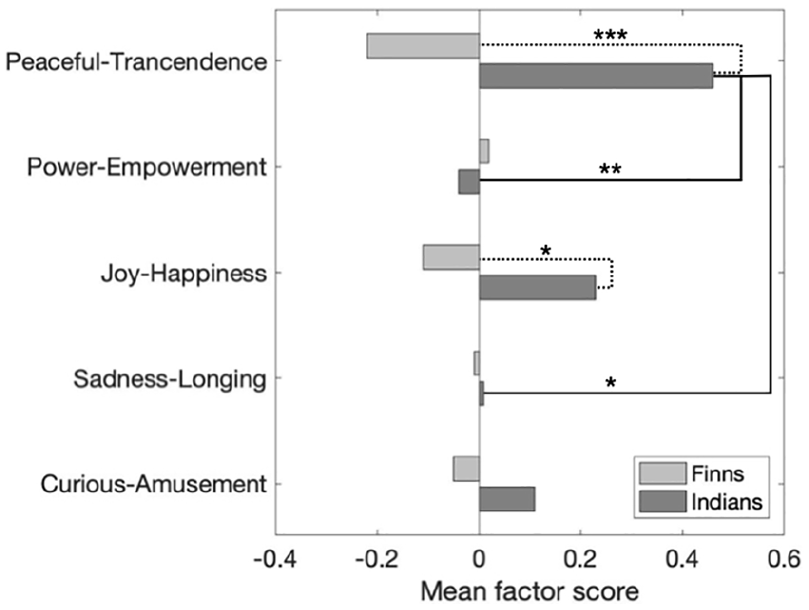
Illustration of the mean emotion factor scores in Finns and Indians. Significant differences between cultures are marked with a dashed line and significant differences between emotions with a solid line.
Functions of music
Qualitative analysis resulted in four meta-level factors of the personal meaning of the chosen song. These were labeled Mood management, Aesthetic enjoyment, Self-enhancement, and Memory connection. These meta-level factors were further comprised of nine subcategories and the emergent conceptual structure is presented in Figure 3 (with shortened labels for the subcategories). Each subcategory is described in more detail with participants’ quotes below.
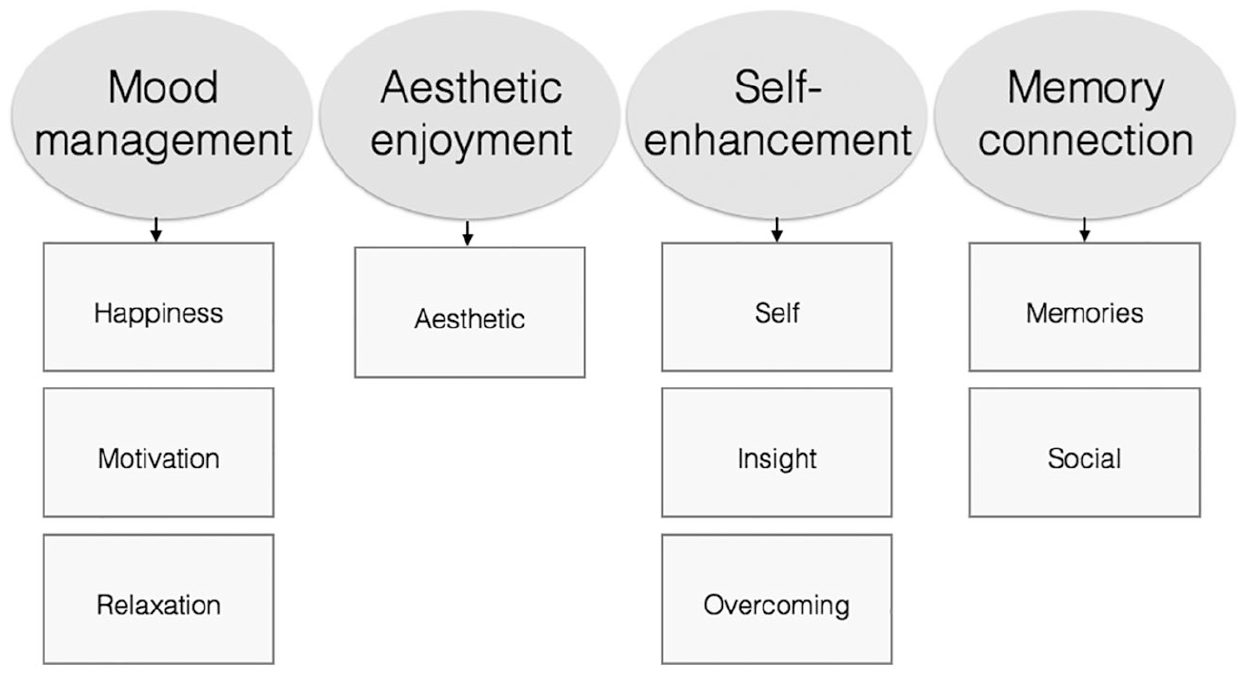
Emergent conceptualization of the functions of the music.
Mood management
The mood management meta-factor is representative of music being used for reaching desirable affective states. It consists of the following three subcategories: Happy transcendence (Happiness); Motivation, inspiration, and energy (Motivation); and Relaxation, comfort, and calming down (Relaxation).
Happy transcendence (Happiness) comprises of descriptions about music providing positive emotions of warmth, sensitivity, peacefulness, spirituality, lightness, calmness, pleasant happiness, and eternity. Participants felt that the music transferred them into a different world, activated dreaming, and had a spiritual connection. The quotes below are from Finnish (F) and Indian (I) participants: It has a very mysterious and spiritual feeling to it, and makes me feel very sensitive and light. (F) It makes me feel like I am in a different world, a different reality; I feel a part of a picture or music, a sense of belonging to a story. (I)
Motivation, inspiration, and energy (Motivation) is compounded of descriptions in which music boosted energy, encouraged positive thinking, provided inspiration, and motivated the listener for some activity. The descriptions below illustrate this category: Pump song I listen to before starting any long arduous task. (I) The song helps me to think positive and become inspired. (F) I prefer to work when there is some background music. So when I’m not in a mood of working I listen to this particular type of music and it kind of motivates me to work. (I)
Relaxation, comfort, and calming down (Relaxation) is reflective of music as a tool for peaceful, mood-improving relaxation and for soothing negative feelings. Music was described as being relaxing, or that it helped one to calm down and find comfort when feeling anxious, sad, or stressed.
It makes me feel calm and relaxed. (I) I use its calming effect to soothe my negative feelings, like stress, fear, anxiety. (F)
Aesthetic enjoyment
Aesthetic enjoyment (Aesthetic) emerged as a single factor with no subcategories. It refers to enjoying music for its musical qualities, such as for the beauty of the melodies and harmonies, for the catchy rhythm, or for the skillfulness of the composition.
It is just fantastic, brilliantly composed music. (F) I don’t have much of a personal relationship, other than that the song is extremely pretty and the melody and harmonies are awesome. (I) I find the singers’ voices as well as the instruments used in the song really pleasant, and the high notes especially make me want to sing along. (F) The song has a high tempo, and is upbeat and has a sort of attractiveness to it. (I)
Self-enhancement
The self-enhancement meta-factor represents music being used as an extension, expression, and reflective surface of self, serving the purpose of constructing and reconstructing positive self-image. Self-enhancement consists of three subcategories: Expression of self, values, and worldview (Self); Insight and appreciation of life (Insight); and Overcoming difficult experiences (Overcoming).
Expression of self, values, and worldview (Self) refers to music acting as a reflection of the listener’s personal thoughts and appreciations. Music served as a surface onto which personal values, dreams, and life goals could be projected on. It provided fortification, support, and a form of expression for the inner things that the listener found personally valuable. It helped to focus on personal strengths, find empowerment, and feel good about oneself.
It reflects my dreams, goals in life, thinking and to some extent ideology. (F) The lyrics capture my feelings I wish I could express to my girlfriend and puts it in a beautiful composition. (I) It represents my inner voice. It makes me dance. It shows me how much power there is in a human. And I have that power too. (F) It makes me feel good about myself, and helps me focus on my strengths. (F)
Insight and appreciation of life (Insight) refers to music providing awareness, understanding, and acceptance of one’s personal life experiences. Music was reflective of something that the listener had experienced in his or her life and it encouraged feelings of gratitude toward these experiences, including compassion toward oneself, and willingness to embrace life in all its beauty and fragility.
It reminds me the fragility and beauty of life. It makes me feel love for my life and compassion for people around me. It also brings up my childhood and home. It just sums everything and life’s meaningfulness shines through. (F) It makes me feel comforted, at home, and accepting of all that I am experiencing in life at this moment. (I) It reminds me that there is mercy in this world, in me and in other people, and that I don’t have to be more than I am. (F)
Overcoming difficult experiences (Overcoming) is reflective of music serving as a tool for working through difficult life experiences. People were describing things like a breakup, a divorce, difficulties in childhood, and depression, and describing that music reminded them of these times and how they managed to work through and get over their experiences.
Nostalgic, intimate, I feel like it contains bittersweet memories. It was present while I was going through depression and heartbreak, yet it reminds me of the (sorrowful) happiness that followed. It also represents me feeling comfortable with sadness. (F) Memories especially from my childhood, to overcame outer conflicts. (F) It is the music of my early teenage years, through my high school, through everything to this day. It has helped me to smile, it has helped me to cry, kinda to sort out my emotions. (F)
Memory connection
The memory connection meta-factor refers to music as a link to positive social relationships and memories. It consists of two subcategories: positive memories (Memories) and social connection (Social).
Positive memories (Memories) is representative of music being valued because it was providing positive memories of good times and experiences in the past. The content of the memories ranged from the music being part of a preferred video game or a dear hobby to the music being representative of one’s exchange year abroad or the song being played at the listener’s own wedding. Childhood family and home were pronounced in the Indian descriptions, while youth, friends, and the times of growing up appeared prevalent in Finnish descriptions.
It’s reminiscent of happy memories. (I) It has two different parts in my past: it was my favorite song of my all-time favorite movie and it was my walk-in song at my own wedding. (F) I relate to the object with my simple childhood and the place I grew up . . . it reminds me of how content I was with whatever I was offered with. (I) It reminds me of the feelings and thoughts I had when I was a teenager. (F)
Social connection (Social) is illustrative of instances in which music was felt important because it represented a particular social connection. Music could be a link to a specific family member, a spouse, or more generally to one’s family and roots.
It is connected to an interest I share with my daughter and is very important to her. It brings me joy through bringing joy to her. (F) Connect to my roots. (I) It’s a song that I heard first time in a children movie I was watching with my boyfriend. It became an inside joke between us and it wakes up emotions that I feel for my man. He always sings the song and then I feel both joy and irritation, because it’s very annoying that he sings it all the time. But also I think it’s funny and cute. (F)
Figure 4 displays the percentages of descriptions that fell under each conceptual category in Finnish and Indian samples. The Mood management subcategories were particularly prevalent for the Indians, while the Self-enhancement subcategories were prevalent for the Finns. Positive social memories were highly prevalent for both cultures. Aesthetic experiences were moderately typical for both.
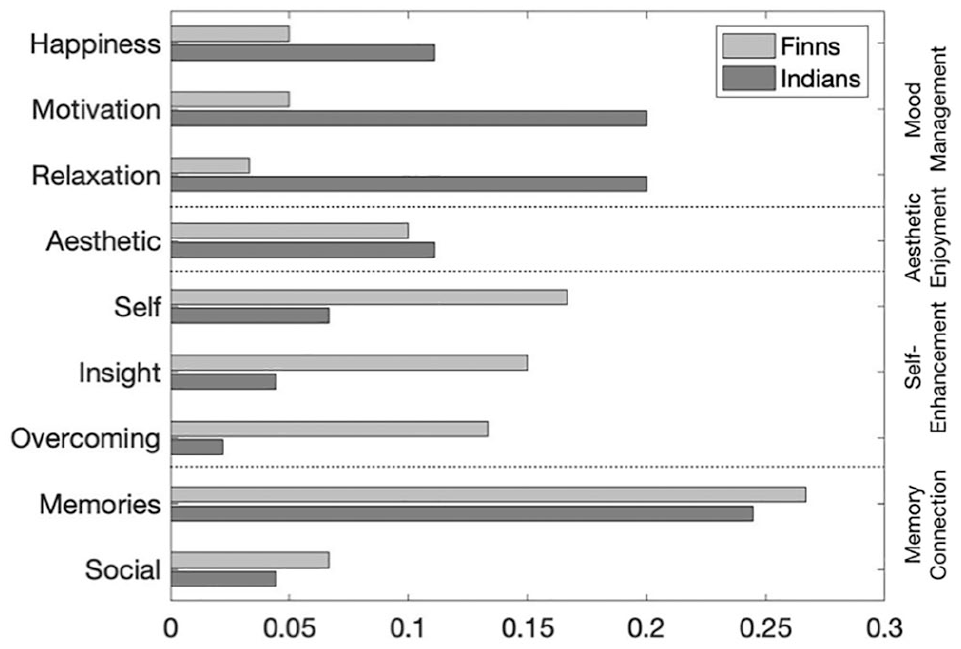
Percentages of the descriptions in each function category in Finns and in Indians.
Music genres that incurred the different function categories are presented in Appendix 1. The most typical genre for Mood management was musicals/film scores, followed by rap/hiphop; the most typical genre for Aesthetic enjoyment was pop, followed by classical and musicals/film scores; the most typical genre for Self-enhancement was alternative/indie, followed by rock, and the most popular genre for Memory connection was pop, followed by rock.
Discussion
The current study addressed the cross-cultural similarities and differences of music listening experiences from the perspective of music-evoked emotions and the related personal meanings and functions. Factor analysis and qualitative content analysis were used to create concepts for comparison and the emergent factors and qualitative categories were cross-culturally compared. On a broad level, the emotion terms grouped to factors relatively similarly to prior Western (Juslin & Laukka, 2004; Zentner et al., 2008) and cross-cultural (Juslin et al., 2016) studies. For instance, Peaceful-Transcendence is rather similar to Sublimity and Joy-Happiness is similar to Joyful activation of the GEMS scale (Zentner et al., 2008). High-arousal negative emotions were noticeably low-rated, and the only “negative” emotion factor ended-up being Sadness-Longing, which also contained some positive nuances such as sensitivity and tenderness. Power-empowerment emerged as a factor of its own with some flavors of excitement and independence. As for the qualitative categories on music’s functions, they also can be considered, on a broad level, to match with the emotional, social, and personal meanings observed in prior research (Boer et al., 2012; Saarikallio, 2011; Schäfer et al., 2013). Our findings thus support the idea that some degree of universality indeed is present in the emotional experiences and psychological functions of music. This is perhaps not so surprising, considering how ubiquitous the modern technology for music listening is across the world today. On a positive note, if some consistency can be reached at the conceptual level, it is possible to continue into the prevalence-based comparison between the cultures.
The results show that in both countries, music is appreciated by the positive emotions that it evokes. Yet, the emotional-functional compound underlying these positive experiences shows clear cultural differences. Emotions that were included in the highest-rated 20% percentile for Finns but not for Indians were Freedom, Empowerment, Moved, and Nostalgia. In line with that, Power-Empowerment and Sadness-Longing were the highest-scoring factors for the Finns, albeit not differing significantly from the other emotion factors. In their qualitative descriptions on the personal meanings, Finns were, in comparison to Indians, particularly articulate concerning the self-enhancement categories (expression of self, values, and worldview; insight and appreciation of life; overcoming difficult experiences), which were reflective of the use of music to find self-support and empowerment through better understanding, accepting, and valuing the personally lived experiences and choices made in one’s life. The findings resonate well with the proposition that in individualistic cultures, people appreciate behaviors particularly due to their personal relevance (Shiraev & Levy, 2010). In an individualistic context, self-enhancement is dependent on individualistic attributes (positive internal attributes of self), while in a collectivistic context, it relies on the collectivistic attributes (e.g., group conformity; Sedikides, Gaertner, & Toguchi, 2003). The self-enhancement meta-factor of the current study is reflective of using music to support individualistic attributes, such as validation of personal values and choices in life. Based on these results, it can be argued that Finns more than Indians appreciate even the relatively negative emotions experienced to music (Sadness-Nostalgia) in case these promote self-enhancement through the validation of personal choices and individual paths of life. The typical music genre for the self-enhancement function in Finns was alternative/indie, but pop, rock, and metal were used for this purpose, too.
In Indians, the distinctive features of the emotional-functional compound of music experiences were different. Emotions that were included in the highest-rated 20% percentile for Indians but not for Finns consisted of Fondness, Comfort, Peacefulness, and Relaxation. In line with that, the highest-scoring emotion factors were Peaceful-Transcendence and Joy-Happiness, for which the Indians scored significantly higher than Finns. In Indians, Peaceful-Transcendence also scored significantly higher than two of the lowest-scoring factors, Power-Empowerment and Sadness-Longing. The Peaceful-Transcendence factor holds some similarity to the concept of aesthetic emotions (Robinson, 2009; Scherer, 2008), so its prevalence in the Indian sample could indicate that Indians value music more for its aesthetic value than Finns. However, these experiences can just as well be interpreted as an end result of mood management toward positive affect. Indeed, in their qualitative descriptions on the personal meanings, Indians more pronouncedly than Finns provided accounts on the mood management categories (happy transcendence; motivation, inspiration, and energy; relaxation, comfort, and calming down), which were all reflective of active, goal-oriented use of music for the purpose of reaching a positive target mood. Using music to reach desirable moods resonates well with the notion of collectivistic cultures appreciating behaviors from a group perspective (Shiraev & Levy, 2010) and striving for group cohesion (Sedikides et al., 2003). It can be argued that Indians more than Finns value music for its capacity to induce positive, may we even say, socially desirable, mood states. The most prevalent music genre for such mood management function in Indians was film music, which encourages further research on the dialogue of movies and personal music listening in the Indian context.
Not all aspects of the experience were different between the cultures. The general positive emotions of Happy, Joy, Enjoyment, and Pleasure were included in the highest 20% percentile of emotion ratings in both cultures, generally confirming the cross-cultural prevalence of positive emotions in self-selected music engagement. In the qualitative descriptions, the meta-level factor of memory connection (positive memories, social connection) emerged as a highly important aspect for both Finns and Indians. The category of positive memories was the most frequent one in both samples. The importance of music as a link to our memories has been noted before (e.g., Sloboda, O’Neill, & Ivaldi, 2001), and our results identify this as a cross-culturally shared feature. Memories were often linked to close people, family, and friends, emphasizing the role of music as social bonding. We did not observe cross-cultural differences in the prevalence of these experiences, and this confirms previous research findings (Boer & Fischer, 2012; Schäfer et al., 2012), which have argued that the use of music for the social function is typical for both collectivistic and individualistic cultures. In the qualitative descriptions, however, it was noted that Indians were a bit more articulate on memories involving childhood family while Finns provided more descriptions on friends from teenage years. No cross-cultural differences were observed in the prevalence of aesthetic appreciation of music either. Both Finns and Indians provided a fair amount of accounts on music being enjoyed particularly because of its musical/aesthetic qualities. The contents of these descriptions were relatively similar across cultures, ranging from certain musical features like rhythm or melody to appreciating the brilliance of composition.
Certain limitations need to be acknowledged. The sample was restricted to young adults belonging to a relatively highly educated proportion of the population, capable of answering in English language. While this is a relatively common feature of research samples in psychology overall, it is nonetheless an important aspect to bear in mind when interpreting the results, particularly in terms of the cross-cultural comparison. It is possible that a highly educated Finn and a highly educated Indian, both competent in English language, are more similar to one another than individuals with very low educational background and no proficiency in English. Thus, the sample may show a bias toward higher cross-cultural similarity than what is the case for the overall population. On a positive note, in terms of the demographic characteristics, the two samples from the different countries were highly similar to each other, with similar biases in both countries. Another point of cautiousness is whether our results in the Finnish-Indian sample can be generalized to the overall comparison between individualistic and collectivistic cultures. For instance, when comparing three individualistic and three collectivistic cultures, Juslin and his colleagues (2016) observed differences not only between the culture types but also between the individual countries within the culture types. Finally, it must be noted that since the participants were asked to think about a song that they found personally relevant and emotion-evoking, the results are reflective of strong and meaningful experiences of music rather than mundane encounters. This is potentially further reinforced by the use of retrospective reports instead of experience sampling of real-time listening situations.
Overall, the current findings highlight the embeddedness of music-evoked emotions in the personal appreciations and meaning-making processes that are inherently culturally bound. Individuals from both cultures value music for the positive emotions it evokes, but Finns emphasize empowerment that is achieved through reflective self-enhancement, while Indians emphasize happy calmness that is achieved through mood regulation. Combination of qualitative and quantitative approaches was highly important in deriving this insight and the findings align with findings of the qualitative study of Boer and Fischer (2012), who reported that the emotional and reminiscence functions of music are emphasized in individualistic cultures while social diversion is emphasized in collectivistic cultures. Current findings further clarify why different studies may have reached differing results. For instance, if music as a tool for memorizing is discussed in terms of valued positive social memories, cross-cultural differences in the prevalence are likely to be minor, but if musical memories are discussed in terms of gaining personal insight from difficult autobiographical experiences, this is likely to be more typical for individualistic cultures. The findings of the current study can be used to guide this kind of hypotheses for future work. The findings also provide theoretical insight into the applied uses of music, such as how to conceptualize health-beneficial music engagement across cultures. Health itself is differently conceptualized across cultures and while Western tradition emphasizes biological and intrapsychic processes, social dynamics may play a bigger role in defining health and well-being in collectivistic cultures (Saarikallio, 2011). The significance of music reflects these broader culturally embedded appreciations and conceptualizations of what it means to be ill or to flourish and how music can be used to experience emotional well-being. This has implications on how we may recommend music to be used in educational and therapeutic settings or in support of daily well-being in different cultural contexts.
Footnotes
Appendix
Genre choices by the function categories in Finns and Indians.
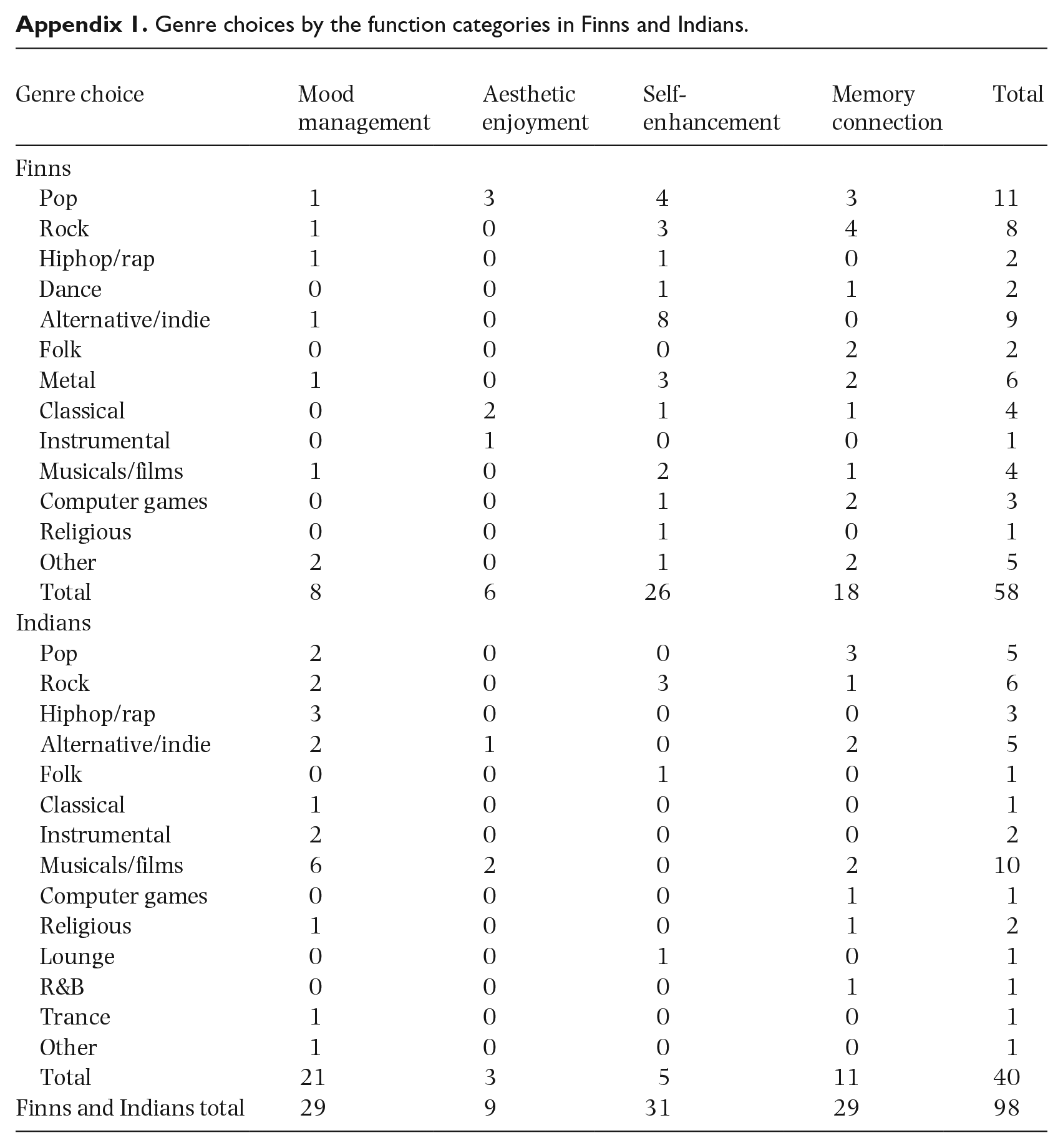
| Genre choice | Mood management | Aesthetic enjoyment | Self-enhancement | Memory connection | Total |
|---|---|---|---|---|---|
| Finns | |||||
| Pop | 1 | 3 | 4 | 3 | 11 |
| Rock | 1 | 0 | 3 | 4 | 8 |
| Hiphop/rap | 1 | 0 | 1 | 0 | 2 |
| Dance | 0 | 0 | 1 | 1 | 2 |
| Alternative/indie | 1 | 0 | 8 | 0 | 9 |
| Folk | 0 | 0 | 0 | 2 | 2 |
| Metal | 1 | 0 | 3 | 2 | 6 |
| Classical | 0 | 2 | 1 | 1 | 4 |
| Instrumental | 0 | 1 | 0 | 0 | 1 |
| Musicals/films | 1 | 0 | 2 | 1 | 4 |
| Computer games | 0 | 0 | 1 | 2 | 3 |
| Religious | 0 | 0 | 1 | 0 | 1 |
| Other | 2 | 0 | 1 | 2 | 5 |
| Total | 8 | 6 | 26 | 18 | 58 |
| Indians | |||||
| Pop | 2 | 0 | 0 | 3 | 5 |
| Rock | 2 | 0 | 3 | 1 | 6 |
| Hiphop/rap | 3 | 0 | 0 | 0 | 3 |
| Alternative/indie | 2 | 1 | 0 | 2 | 5 |
| Folk | 0 | 0 | 1 | 0 | 1 |
| Classical | 1 | 0 | 0 | 0 | 1 |
| Instrumental | 2 | 0 | 0 | 0 | 2 |
| Musicals/films | 6 | 2 | 0 | 2 | 10 |
| Computer games | 0 | 0 | 0 | 1 | 1 |
| Religious | 1 | 0 | 0 | 1 | 2 |
| Lounge | 0 | 0 | 1 | 0 | 1 |
| R&B | 0 | 0 | 0 | 1 | 1 |
| Trance | 1 | 0 | 0 | 0 | 1 |
| Other | 1 | 0 | 0 | 0 | 1 |
| Total | 21 | 3 | 5 | 11 | 40 |
| Finns and Indians total | 29 | 9 | 31 | 29 | 98 |
Funding
The author(s) disclosed receipt of the following financial support for the research, authorship, and/or publication of this article: The study was funded by the Academy of Finland, Project Number 316912.
