




Abstract
Music can be a particularly effective cue for bringing one back to the sights and sounds of events from across the lifespan. These music-evoked autobiographical memories (MEAMs) have typically been studied within laboratory experiments and clinical settings, often using experimenter-selected music to cue autobiographical memories. The present work took a more naturalistic approach, by studying the situational aspects, contents, and features of MEAMs within the course of participants’ everyday lives. Participants (N = 31) recorded details of their MEAMs and music listening habits in a diary for 7 days. MEAMs were experienced, on average, once per day and were cued by a wide variety of music, often during routine tasks such as traveling and housework. Everyday MEAMs were typically rated as highly vivid and involuntary and were often accompanied by positive or mixed emotions (e.g., happiness, nostalgia) and social themes. Some evidence of individual differences was found, with older participants rating their MEAMs as more vivid and accompanied by more positive emotions. The features reported within everyday MEAMs replicated several previous findings on MEAMs and autobiographical memory more generally, indicating that this naturalistic method was able to capture genuine MEAM experiences. Implications for future research on naturally occurring MEAMs are discussed.
Keywords
Listening to music can bring back vivid and emotional memories of lifetime periods and events. This capacity for cueing autobiographical memories may be facilitated both by the frequency with which many people listen to music (Greasley & Lamont, 2011; North et al., 2004; Sloboda et al., 2001), and by the tradition in many cultures of coupling music to significant lifetime events (e.g., weddings, funerals, initiations; Merriam, 1964). The often highly emotional nature of both music and events that are typically accompanied by music may enhance both encoding and subsequent retrieval processes (for an overview of the role of emotion in memory processes, see, for instance, Buchanan, 2007; Holland & Kensinger, 2010; Kensinger, 2009). In addition, autobiographical memory retrieval via musical cues may be facilitated by regular rehearsal, which can strengthen the link between the cue and associated memory, as favorite songs are typically listened to much more frequently over one’s lifetime than, for instance, a favorite film is watched or a favorite book is read (Janssen et al., 2007).
Most previous research on music-evoked autobiographical memories (MEAMs) has explored the features of MEAMs cued within a laboratory setting. Janata et al. (2007) conducted a seminal experiment in which they developed an autobiographical memory cueing paradigm using a large corpus of popular music (selected on the basis of chart popularity, to maximize familiarity). Overall, 30% of the presented songs evoked autobiographical memories in undergraduate participants, demonstrating the efficacy of this paradigm, which has also been successfully employed in subsequent neuroimaging work (Janata, 2009). In addition, Janata et al. (2007) provided detailed descriptive data on the reported MEAMs, which primarily evoked positive or mixed emotions such as happiness, youthfulness, and nostalgia; contained examples of both general and specific levels of autobiographical knowledge; and showed some similarities in terms of the memory content (e.g., 524 references to “school” and 393 references to “friends” within the memory descriptions). Belfi et al. (2016) extended this lab-based cueing approach by comparing MEAMs to autobiographical memories cued by famous faces. They found that MEAMs were more vivid 1 than autobiographical memories cued by famous faces, although famous faces cued significantly more memories than music.
A related body of experiments have explored the autobiographical salience of pieces of music as a function of their release date, with a particular focus on applying the concept of the “reminiscence bump” to musical memory. The reminiscence bump is a robust effect within autobiographical memory research in which older people disproportionately recall events from adolescence and early adulthood (ages 10–30 years) in comparison with other lifetime periods; these memories are also typically rated as more vivid and more important than other memories (Rubin et al., 1986, 1998). Research in the music domain has revealed that popular songs released when a participant was 10–30 years old are preferred, better recognized, and elicit heightened emotional responses compared to songs from other periods (Bartlett & Snelus, 1980; Krumhansl, 2017; Platz et al., 2015; Schulkind et al., 1999; Zimprich & Wolf, 2016). Some evidence also indicates that music from the reminiscence bump period may cue more MEAMs (Krumhansl, 2017; Rathbone et al., 2017), although experimenter-selected songs from the reminiscence bump period have failed to cue many autobiographical memories of specific events in two studies (Platz et al., 2015; Schulkind et al., 1999). In addition, increased recognition, preference, and emotional responses to music from their parents’ reminiscence bump period have been observed in undergraduate students—a phenomenon referred to as “cascading reminiscence bumps” (Krumhansl & Zupnick, 2013).
Finally, MEAMs have generated interest within clinical work, as some research has suggested that music can be an effective cue for autobiographical memories even in populations for which memory retrieval processes have become impaired due to disease or brain damage. For instance, music—in particular, self-selected music—has been shown to be a more effective cue for autobiographical memory recall than a silent control condition (El Haj, Postal, & Allain, 2012; Irish et al., 2006) and photographs of famous events (Baird et al., 2018) in people with Alzheimer’s disease. This facilitation effect of music may be related to the more involuntary nature of retrieval of MEAMs, as involuntary retrieval may be relatively spared in comparison with deliberate recall processes in Alzheimer’s disease (El Haj, Fasotti, & Allain, 2012). In addition, music has been shown to be a spared cue for autobiographical memories in case studies of patients with acquired brain injury (Baird & Samson, 2014).
To summarize, previous studies have revealed that music can elicit a diverse array of memories, which display some common features, such as a predominance of positive emotions and social themes (Janata et al., 2007), a greater prevalence of perceptual details than other autobiographical memories (Belfi et al., 2016), and some connection to the reminiscence bump period (Krumhansl, 2017; Platz et al., 2015; Rathbone et al., 2017; Schulkind et al., 1999). In addition, MEAMs may be more involuntarily retrieved than other memories, which may at least partially explain the relative preservation of MEAMs in clinical cases where other aspects of autobiographical recall are impaired (El Haj, Fasotti, & Allain, 2012; El Haj, Postal, & Allain, 2012). One limitation of previous work is the focus on using experimenter-selected music 2 to trigger MEAMs in a laboratory, which allows greater experimental control but is unlikely to capture the full range of MEAMs that may be experienced in everyday life. This study aimed to fill this gap in the literature by examining naturally occurring MEAMs in situ using a diary method. Although similar methodologies have been employed in research on everyday music listening (e.g., North et al., 2004; Sloboda et al., 2001), musical imagery (e.g., Bailes, 2007, 2006; Jakubowski et al., 2015), and other aspects of autobiographical memory (e.g., Berntsen & Hall, 2004; Schlagman & Kvavilashvili, 2008), the present work represents the first attempt to capture MEAMs in everyday life.
There are several reasons why there is potentially more scope for diversity in everyday MEAMs compared to previous laboratory studies. First, previous studies have typically used chart-topping pop music to maximize familiarity, whereas music listening habits in everyday life can comprise a much wider variety of musical styles. Chart-topping pop music may also be problematic in terms of the fact that a narrower range of emotions may be expressed and elicited by this music in comparison with other musical styles (Eerola, 2011), although one study has demonstrated that such music can still evoke MEAMs that cover a wide range of emotion space (Platz et al., 2015). Second, laboratory studies have often involved playing the same music to many participants, which may also limit the content of memories that are cued due to similar associations across participants (e.g., a particular song that was often played at school dances in the mid-1990s may cue memories of school dances for multiple participants who were in school during that time period). Third, research on autobiographical memory in everyday life implicates the role of multiple situational cues as an enhancer of memory retrieval success (Berntsen, 2009). Thus, music may have more potential to be a cue for autobiographical memories in everyday listening contexts, in which it may be coupled with other relevant cues (e.g., visual objects, activities, people) that enhance the discriminability of memory. In sum, one aim of the present work was to investigate features of everyday MEAMs (e.g., content, emotional responses, vividness, control, specificity) for comparison to previous findings on the features of laboratory-cued MEAMs. In addition, our study aimed to reveal new insights on the everyday prevalence and listening contexts in which MEAMs occur.
The primary goal of the present work was to develop a feasible methodology for capturing the everyday experience of MEAMs. Previous naturalistic studies of music listening in everyday life have employed both participant-led and experimenter-led (e.g., Experience Sampling Method) approaches. The present work took a participant-led approach, in which participants were asked to record all MEAMs as they occurred in a diary over the course of seven consecutive days. 3 No previous research has investigated the frequency of MEAMs in everyday life; however, it was estimated that MEAMs would typically only be experienced a few times per day (or less), based on previous research. For instance, North et al. (2004) found participants chose to listen to music for the purpose of bringing back memories 10% of the time. It is also assumed that MEAMs often occur involuntarily in everyday life, rather than music being deliberately chosen for the purpose of eliciting MEAMs; however, diary studies of involuntary autobiographical memories (triggered by any cue, including music) have also indicated that these types of memories typically occur only a few times per day (Berntsen, 2009). Therefore, we aimed to maximize the number of MEAMs captured by asking participants to record details of all MEAMs that they experienced. This allowed us to begin to explore the question of the everyday prevalence of MEAMs, which we also investigated as a function of music listening habits (measured in a listening log over the same 7-day period).
In this article, we present the first characterization of MEAMs in everyday life. In particular, we focus on the content and features of everyday MEAMs, situational factors surrounding their occurrence, and characteristics of music that cues MEAMs. This approach provides new insights on the role everyday music listening plays in the construction and maintenance of the life narrative.
Method
Design
A diary study of MEAMs was conducted over 7 days.
Participants
An opportunity sample of 31 participants took part, who were 18–72 years of age (M = 35.8, SD = 16.1; 14 males, 17 females). Participants were recruited via word-of-mouth and social media posts and received £30 compensation.
All participants were currently residing in the United Kingdom, 25 were born in the United Kingdom, and 28 spoke English as their first language. The Musical Training and Active Engagement subscales of the Goldsmiths Musical Sophistication Index (Gold-MSI; Müllensiefen et al., 2014) were administered to measure formal training in music (e.g., private lessons, instrumental practice) and engagement with music (e.g., concert attendance, buying and writing about music), respectively. Musical Training scores of the participants ranged from 7 to 48 (out of a possible range of 7–49), with seven participants attaining the lowest possible score of 7. The median score was 18, which corresponds to the 27th–28th percentile of the data norms from Müllensiefen et al. (2014). Scores on the Active Engagement subscale ranged from 19 to 51 (out of a possible range of 9–63), with a mean score of 33 (SD = 9), which corresponds to the 20th–21st percentile of Müllensiefen et al. (2014).
Materials
A paper diary was developed that consisted of two sections: (1) a music listening log and (2) a MEAM log. The music listening log recorded participants’ daily music listening frequency. On each afternoon of the study, participants rated how much music they had listened to since waking up (on a rating scale from “none” to ‘3+ hr’; see Appendix 1). Each evening, they used the same rating scale to record how much music they had listened to since the afternoon rating. Music listening could include both passive/background listening and active listening (in which the music was the main focus of attention), as well as the participant practicing/performing on an instrument. Participants were advised to fill in the listening log around 12 noon and 9 p.m. each day, but the exact timings were left to the participant to decide, based on their own daily schedules.
The MEAM log comprised a set of questions to be completed each time a MEAM was experienced. Each participant was provided with 24 MEAM report sheets, but advised that the exact number of MEAMs was likely to vary from person to person, and was asked to simply log all MEAMs they experienced, regardless of the total number. They were provided the experimenter’s contact information in case they needed to request more MEAM report sheets during the week; however, this was not necessary for any participant. Each MEAM report sheet comprised questions on the time and date of the MEAM; the title, artist, and section of music that cued a MEAM; whether the listening was active listening or background listening; the activity at the time of the memory; and familiarity and liking ratings for the music. Questions related to the memory itself included an open-response question asking participants to describe the memory in detail, the participant’s age during the remembered event, and 7-point rating scales for assessing the memory vividness and control (the degree to which the memory was spontaneously or deliberately recalled). Participants were also asked whether the memory was of a specific event, period of their life, or general memories (e.g., of a person/place), in correspondence with the categories used by Janata et al. (2007) to probe different levels of autobiographical knowledge (see Conway & Pleydell-Pearce, 2000). Finally, participants rated their emotional responses to the memory on 12 emotion categories from previous research on music and emotions (Juslin et al., 2015). The full list of diary questions is included in Appendix 1.
In addition, a questionnaire was administered that contained demographic questions as well as the Musical Training and Active Engagement subscales of the Gold-MSI (see further details in the “Participants” section).
Procedure
Participants selected a period of seven consecutive days in which to participate in the study at their own convenience. The study materials were distributed in person (n = 15) or by mail (n = 16). In both cases, participants were supplied with an information sheet, consent form, instruction sheet, questionnaire, and diary. Identical written instructions were provided regardless of the method by which they received the materials.
After reading the information sheet and completing the consent form, participants were asked to fill in the questionnaire before starting their diaries. Participants were instructed to commence the study at the beginning of the day, since music listening was to be logged over the course of a full day. In addition to logging music listening twice per day, participants were instructed to complete one MEAM report sheet as soon as possible after each MEAM they experienced.
Participants contacted the researcher once they had completed the 7-day data collection period, from which either a handover of materials was arranged or the materials were sent back in a prepaid envelope.
Analysis
Summaries and statistical analysis of the data were implemented in R. Contents of the written MEAM descriptions (open-response question) were coded using Linguistic Inquiry and Word Count (LIWC2015; Pennebaker et al., 2015). This software analyzes linguistic properties of text files, including word and sentence counts, classification of parts of speech, and categorization of words into themes (e.g., negative emotions, family) using large dictionaries of conceptually related words. LIWC has been successfully employed to reveal phenomenological properties of MEAMs in several previous studies (e.g., Janata et al., 2007; Zator & Katz, 2017).
Results
Frequency and situational aspects of everyday MEAMs
A total of 221 MEAM report sheets were completed. One report was excluded as it was not an autobiographical memory, but, rather, listening to a song reminded a participant of another song; this left 220 MEAMs for analysis. On average, participants reported seven MEAMs, although the number of MEAM reports varied greatly by participant (range = 1–16; SD = 4). The median response of participants in terms of how much music they had listened to per half day was “30 min to 1 hr.” The number of total MEAMs reported was positively associated with the total amount of music listening reported, although this correlation was only marginally significant, r(29) = .32, p = .084. The number of MEAMs reported by a participant was not significantly correlated with their Musical Training, r(29) = −.04, p = .825, or Active Engagement with music, r(29) = .09, p = .642, age, r(29) = .17, p = .367, or gender (Mmales = 7.7, Mfemales = 6.6): t(23) = −0.73, p = .471.
MEAMs were experienced throughout the course of the day, with the earliest MEAM reported at 12:00 a.m. (midnight) and the latest at 11:30 p.m. Of the 200 MEAMs for which participants recorded the time of the memory, 32% occurred between 12:00 a.m. and 12:00 p.m. and 68% occurred between 12:00 p.m. and 12:00 a.m. Most MEAMs were experienced during background music listening (58% out of 203 completed reports), which was defined here as experiences where attention was not directly focused on listening to music. In contrast, participants reported their attention was focused primarily on music (although they may have also been partaking in another activity, such as driving) in 41% of MEAM reports. 4 This result indicates that MEAMs can be effectively evoked even in situations where attention is not explicitly focused on music. The activities in which participants were engaged when a MEAM was experienced were grouped into themes and are displayed in Figure 1. Most MEAMs occurred while driving or traveling via other means (e.g., bus, train), and many MEAMs occurred during routine tasks or activities that are otherwise not highly cognitively demanding (e.g., housework, relaxing, getting ready, walking).
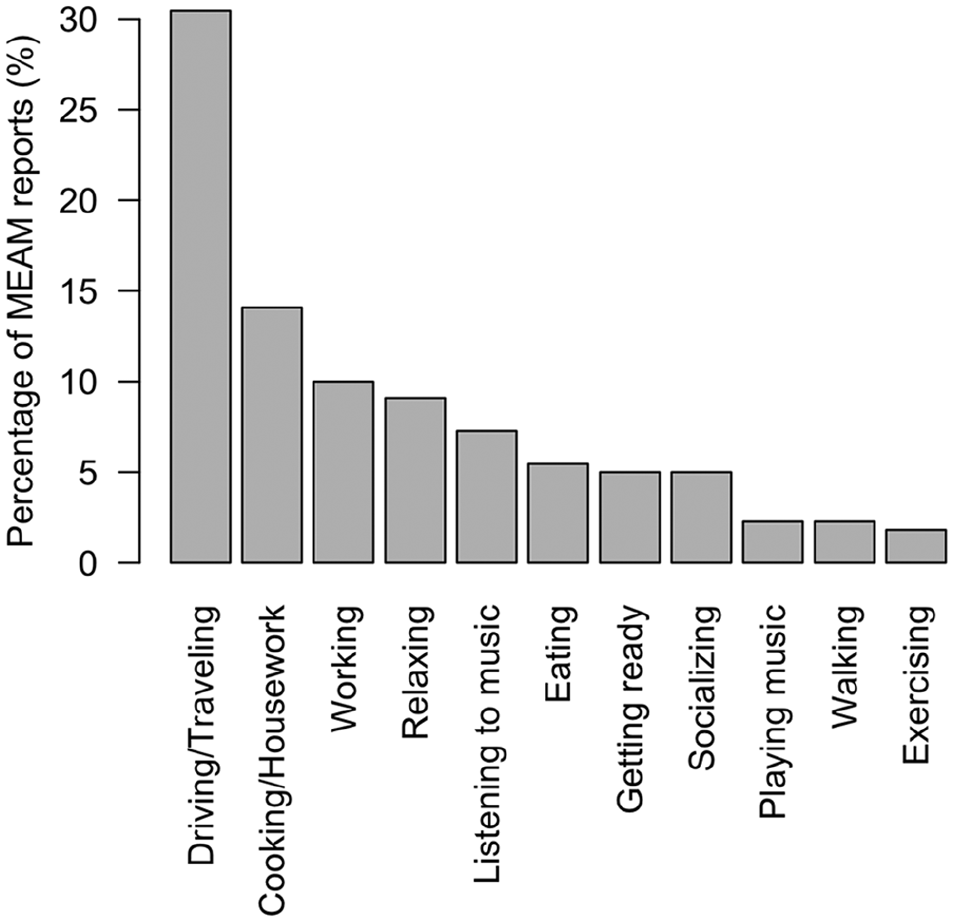
Activities during which a music-evoked autobiographical memory occurred.
We also examined how long it took participants to record the memory in the diary, as they were asked to record both the time of the MEAM and the time they filled in the report sheet. Overall, 24% of memories were recorded in the diaries within 20 min of being experienced, and the median time it took between having a memory and recording it in the diary was 75 min. This amount of delay is to be expected, given the fact that participants were completing the study while engaged in other everyday activities, in particular driving (see Figure 1). There were only three cases (1%) in which a memory was recorded in the diary the day after it was experienced.
Music that evokes MEAMs in everyday life
MEAMs were reported in response to a variety of different pieces and genres of music. Genre tags for the reported music were sourced via Last.fm. In total, 146 songs were reported that could be broadly categorized as “popular music,” which comprised a wide variety of sub-genres (e.g., pop, rock, indie, country, folk, reggae, hip-hop, rap, dance, electronic, house music). In addition, 49 pieces of classical music, 14 pieces from soundtracks/musicals, 4 children’s songs, 2 Christmas songs, 5 and 1 piece of jazz music were reported to have cued MEAMs.
The vast majority of pieces of music were reported by only one participant, suggesting that autobiographical memories can become coupled with a wide variety of music in a highly idiosyncratic way. However, the following six pieces of music were reported by two different participants: Baby Shark (children’s song), Everywhere (Fleetwood Mac), Freed from Desire (Gala), Morgenstimmung from Peer Gynt, Op. 23 (Edvard Grieg), Sweater Weather (The Neighbourhood), and This is Me from The Greatest Showman (Keala Settle). This overlap across participants may relate in part to cultural connotations of certain music; for instance, Everywhere triggered memories of dancing at weddings for both participants, and Freed from Desire evoked memories of a crowd singing along for both participants—at a football match and a club, respectively. Current popularity of a piece of music may also play a role (Baby Shark and This is Me were receiving a lot of media exposure at the time of the study). In addition, one participant reported two different memories in response to the same song, heard at different times (I Almost Do by Taylor Swift). Finally, one piece of music (Song for Athene by John Tavener) evoked the same memory—of Princess Diana’s funeral—in a married couple who participated in the study, although the couple completed their diaries separately without conferring.
Music that cued MEAMs was typically highly familiar (M = 5.86) and liked by the participant (M = 5.70), with 45% of familiarity ratings and 37% of liking ratings being given the highest possible score of 7. Mean ratings of familiarity, as computed for each participant, were significantly higher than the midpoint of the scale of 4, t(30) = 14.02, p < .001; the same was the case for liking ratings, t(30) = 15.36, p < .001.
Features of everyday MEAMs
Here, we give an overview of the responses of participants to the closed-ended questions probing the features of their MEAMs; the subsequent section will then describe the content of these memories, as provided in the written descriptions.
Participants classified their autobiographical memories as being of a specific event, life period, or general memories (e.g., of a person or place). They could select more than one option as relevant. Out of the 212 MEAMs for which this question was answered, 48% comprised memories of specific events, 32% comprised memories of life periods, and 30% comprised general memories of people or places. This indicates that several different levels of autobiographical knowledge were represented, and about half of the memories comprised details at the level of the most specific category included here (“specific event”).
Participants were also asked to provide an estimate of their age during the remembered event or period. In the following analysis, responses that encompassed a range of ages were recoded to a single, median age value (e.g., “14–16 years” was recoded to “15 years”), and 5% of the memories were excluded in which participants did not report an age or reported multiple ages that were not consecutive years. The mean age of the participant during the recalled event was 23.4 years. Similar to much previous memory research (e.g., Rubin & Wenzel, 1996), we found evidence for a recency effect, with 33% of the reported autobiographical memories having occurred within the past 2 years (see Figure 2). In addition, 77% of reports were of autobiographical memories from when participants were aged 10–30 years, indicating increased recall of events from the reminiscence bump period. However, many of our participants were young adults whose current age still fell within the reminiscence bump period. Therefore, we also examined the distribution of memories from participants aged 40 years or older (n = 8) and found that the majority (55%) were still from within the reminiscence bump period (see Figure 3). The youngest reported age during a remembered event was 4 years, which is in line with the period of “childhood amnesia” reported in the general autobiographical memory literature (Nelson & Fivush, 2004). In sum, the everyday MEAMs collected in this study conform to general patterns that have consistently been reported across the autobiographical memory literature.
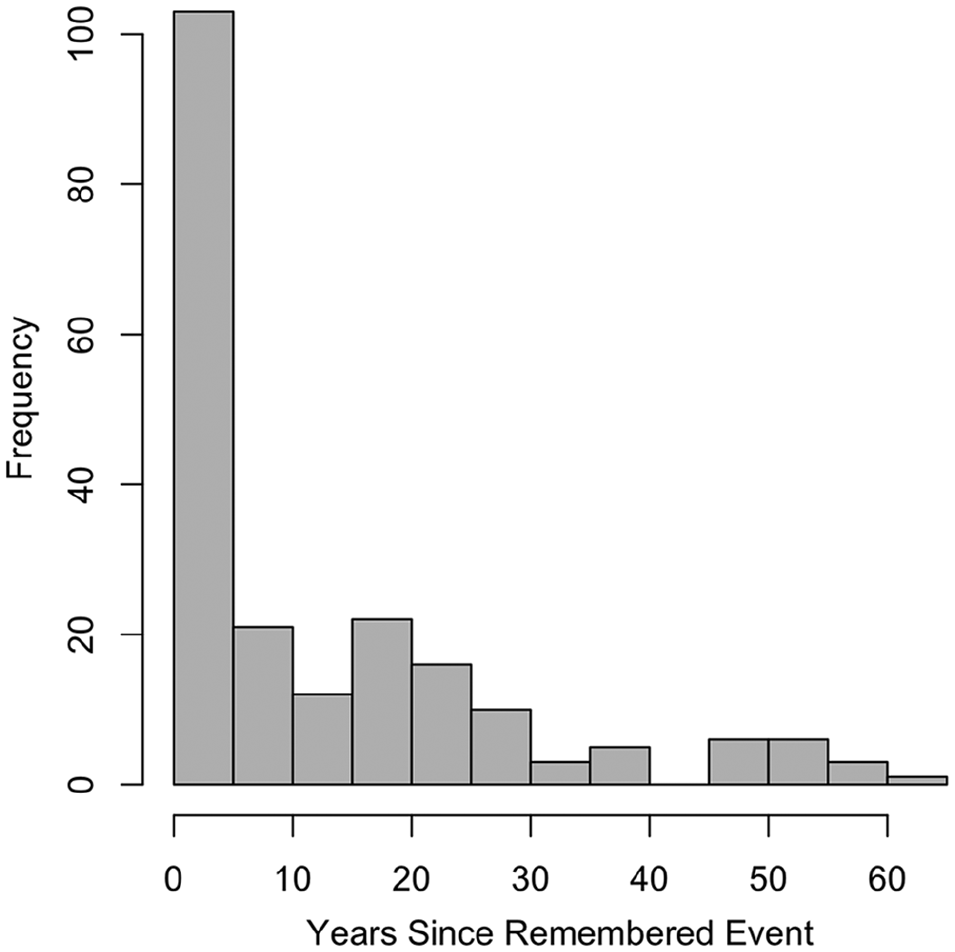
Recency of memories reported in the MEAM logs.
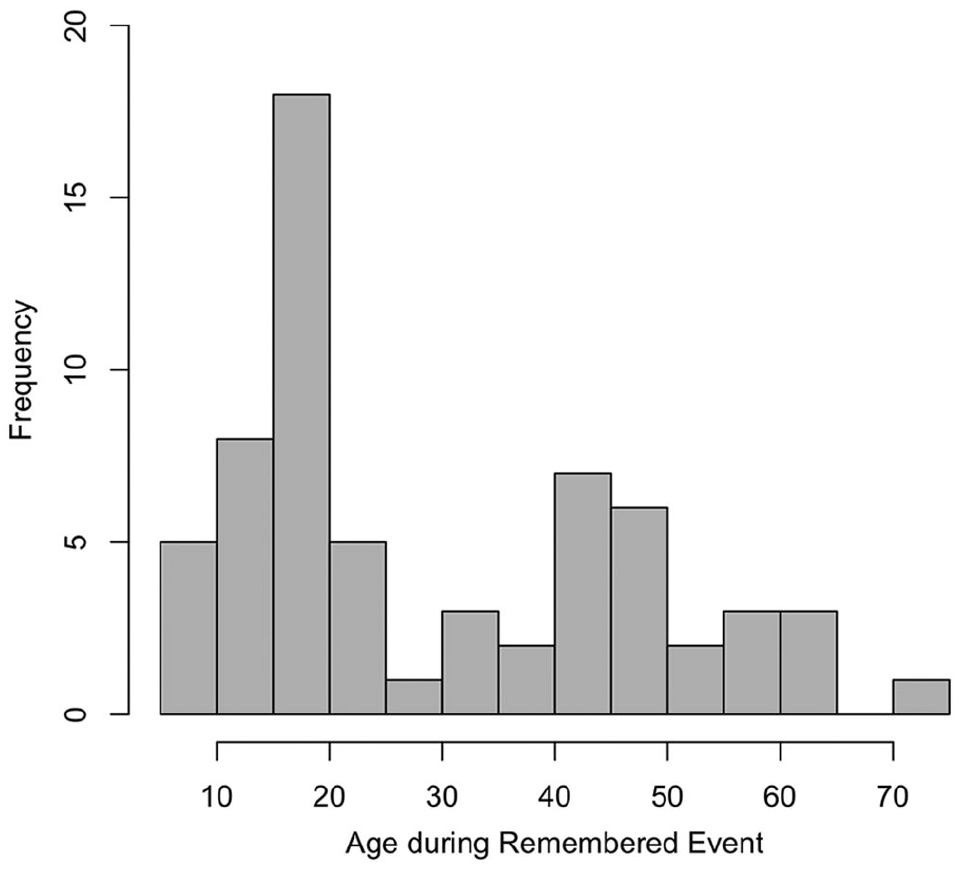
Age during remembered event for participants currently aged 40 years or older (n = 8).
MEAMs were typically rated highly in vividness (M = 5.22), with 27% of reports receiving the highest possible rating of 7. MEAMs were more often reported to be involuntarily than deliberately recalled (M = 2.77, on a scale from 1 = spontaneous recall to 7 = deliberate recall), with 65% of MEAMs falling on the involuntary end of the scale (scores of 1–3) and 20% falling on the deliberate recall portion (scores of 5–7). Mean ratings by participant on this measure of memory control were also significantly different than the midpoint of the scale of 4, t(30) = −4.64, p < .001.
Everyday MEAMs were characterized by a predominance of positive and mixed emotions, with the “happiness/elation,” “nostalgia/longing,” and “interested/captivated” emotion pairs receiving the highest mean ratings (see Figure 4). Despite the prevalence of certain emotions, it is worth noting that all 12 emotion categories were felt strongly during at least some MEAMs. Each of the 12 emotion categories received the highest possible rating of 7 on at least four occasions, and all 12 emotion categories are represented when the MEAMs are classified in terms of the highest emotion rating they received.
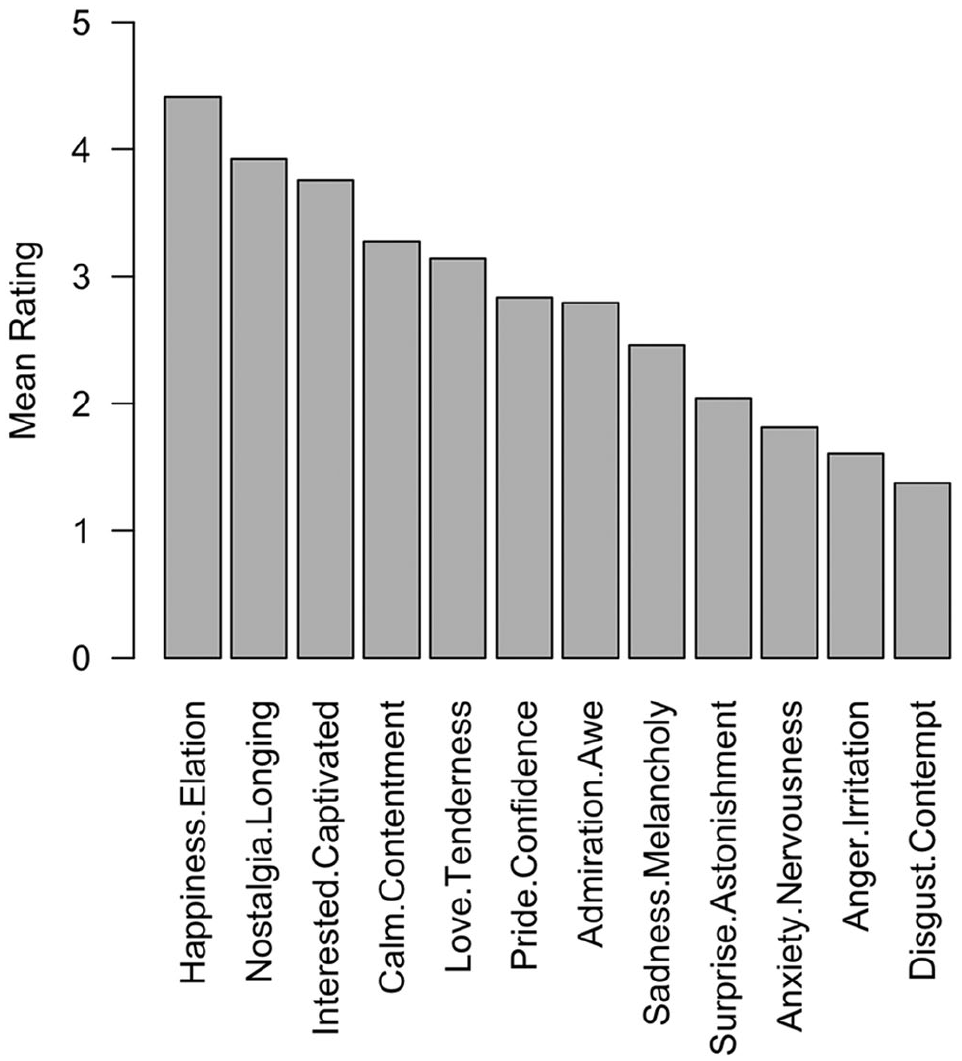
Mean ratings of felt emotions across all MEAMs.
Contents of everyday MEAMs
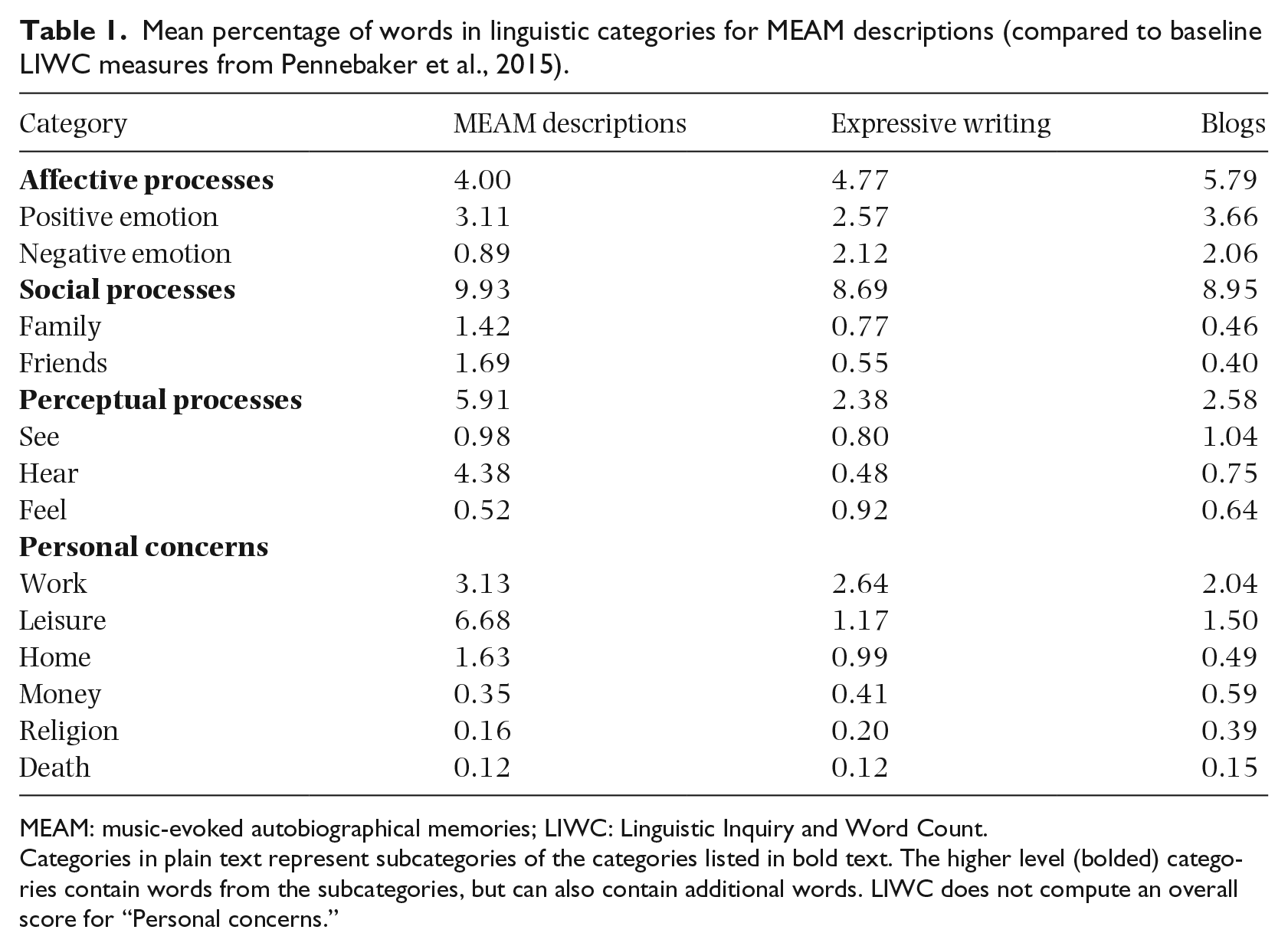
The LIWC2015 analysis revealed that, on average, participants’ written MEAM descriptions comprised 30.9 words (SD = 14.7; range = 3–100). On average, 89% of the words reported within a MEAM description were in the LIWC dictionary. For comparison to other previous studies on MEAMs, we focus here on the word classification related to the LIWC dictionaries comprising Psychological Processes, in particular affective, social, perceptual, and personal themes. A summary of the results is presented in Table 1; baseline measures derived by Pennebaker et al. (2015) from large corpora of expressive writing and blogs are provided as a point of comparison.
Mean percentage of words in linguistic categories for MEAM descriptions (compared to baseline LIWC measures from Pennebaker et al., 2015).
MEAM: music-evoked autobiographical memories; LIWC: Linguistic Inquiry and Word Count.
Categories in plain text represent subcategories of the categories listed in bold text. The higher level (bolded) categories contain words from the subcategories, but can also contain additional words. LIWC does not compute an overall score for “Personal concerns.”
This analysis reveals a relatively high proportion of positive emotion words (cf. “Expressive writing” baseline) and, perhaps more strikingly, a particularly low percentage of negative emotion words in comparison with the baseline measures. This aligns with the self-report emotion ratings described above (see Figure 4). On average, 10% of the words in MEAM descriptions comprised social process words, with more references to friends and family than the reference corpora. Perceptual process words could indicate the degree of reliving or imagery experienced. However, the “see” category is not often represented (around 1% of words from the MEAM descriptions fall into this category on average), despite the common assumption that MEAMs are accompanied by vivid visual imagery. MEAM descriptions were, however, characterized by a relatively high percentage of “hear” words. This appears to be predominantly due to remembrances of previous listening experiences (e.g., “I remember listening to this song when I was a teen. . .”), many references to the word “song,” and references to musical instruments and listening devices. Finally, MEAMs exhibited a high usage of “leisure” words. This is partially due to “music” being categorized as a leisure activity in LIWC, but there are also many references to other activities and places that fall under this category, including dancing, sporting events, clubs, restaurants, holidays, and TV/films.
Next, we examined the usages of individual words across all MEAMs. The most frequently used nouns and descriptive verbs (with counts listed in brackets) were as follows: song(s) [87], friend(s) [65], remember(ed) [63], music [60], memor(y/ies) [47], listen(ed/ing) [45], play(s/ed/ing) [44], time(s) [44], remind(s/ed) [35], school [30], piece(s) [27], danc(ed/ing) [24], hear(d/ing) [24], sing(ing) [21], perform(ance/ed/ers/ing) [19], year(s) [18], car [17], feel(ing/ings) [17], bed(room) [16], home [16], room [16], work(ed/ing) [16], walk(s/ing) [14], house(s) [13], like(d) [13], watch(ing) [13], daughter(s) [12], boyfriend [11], and together [10]. This aligns well with the LIWC categorization (Table 1), in that there are many references to the music itself, including memories of previous instances of listening to recorded music or attending a performance, and a predominance of social themes related to friends, school, and activities such as dancing and singing. There are also several common words that emerge in relation to the participant’s location during the event that was recalled (e.g., school, car, bedroom, home, work).
Individual differences in everyday MEAMs
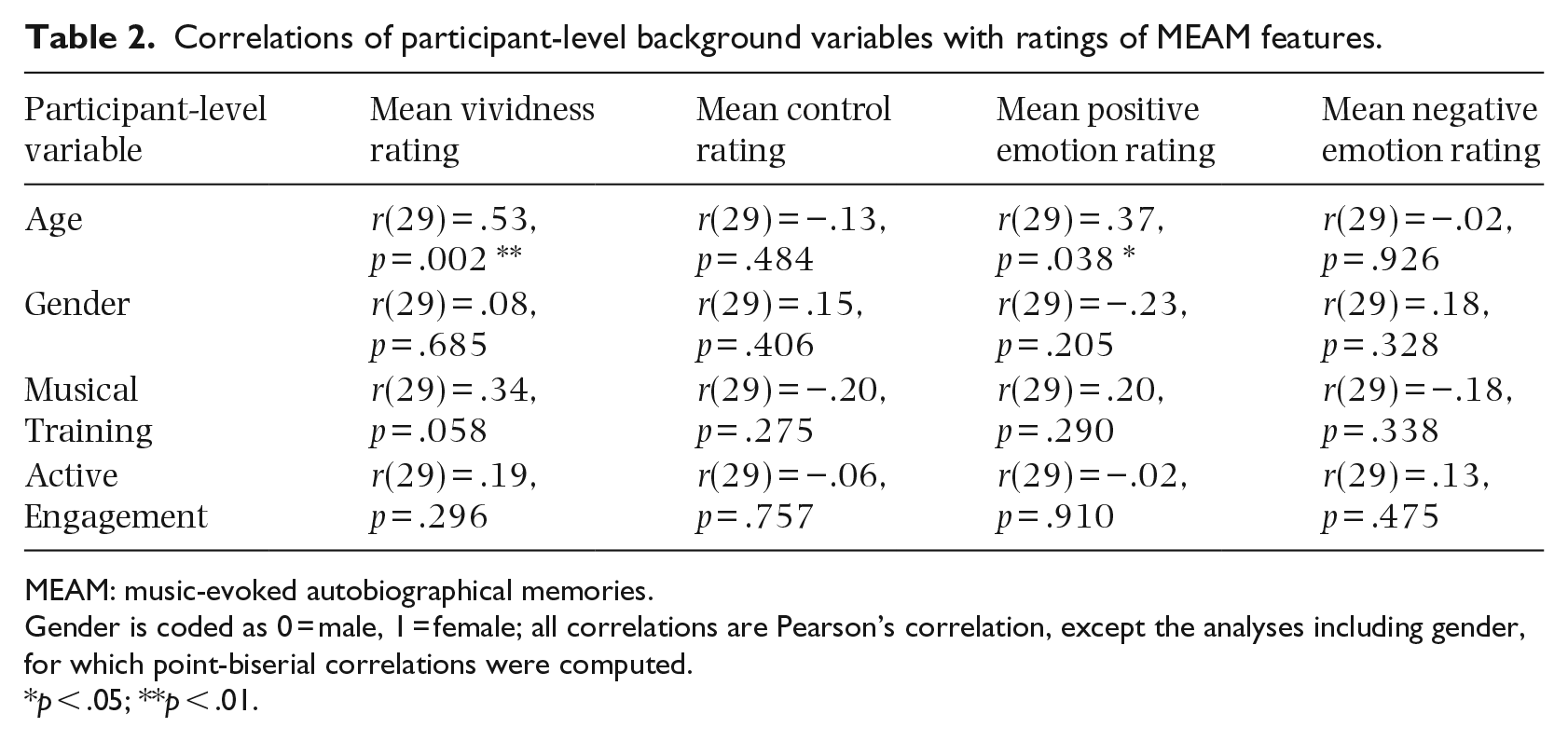
Finally, we explored the correlations between ratings of MEAM features and participant-level individual differences (age, gender, Gold-MSI Musical Training, Gold-MSI Active Engagement). This was an exploratory analysis, given that our study comprises a relatively small opportunity sample, but was intended to help inform future systematic research on individual differences in MEAMs.
Correlations were computed between the participant-level variables and the participants’ mean ratings of MEAM vividness and MEAM control, as well as the participant-wise mean of the summed Positive Emotions and Negative Emotions for each memory. Positive Emotions included “happiness/elation,” “calm/contentment,” “interested/captivated,” “pride/confidence,” “love/tenderness,” and “admiration/awe,” while Negative Emotions comprised “sadness/melancholy,” “anxiety/nervousness,” “anger/irritation,” and “disgust/contempt.” “Nostalgia/longing” and “surprise/astonishment” were excluded here due to their potentially mixed or unclear emotional valence. The results of this analysis indicate that older adults reported that their memories were more vivid and elicited more positive felt emotions than younger adults (see Table 2). There was also a non-significant tendency for participants with more musical training to report more vivid MEAMs.
Correlations of participant-level background variables with ratings of MEAM features.
MEAM: music-evoked autobiographical memories.
Gender is coded as 0 = male, 1 = female; all correlations are Pearson’s correlation, except the analyses including gender, for which point-biserial correlations were computed.
p < .05; **p < .01.
Discussion
In this article, we have introduced a new approach for capturing the everyday experience of autobiographical memories evoked by listening to music. This work builds on methods from previous studies, which have investigated music listening (e.g., North et al., 2004; Sloboda et al., 2001) and autobiographical memories (e.g., Berntsen & Hall, 2004; Schlagman & Kvavilashvili, 2008) separately in naturalistic settings. Specifically, we examined both the frequency and situational aspects of music listening and descriptions of the autobiographical memories elicited by this music to reveal the first empirical evidence on the features and content of MEAMs in everyday life.
Our results indicate that MEAMs typically occur around once per day, although with some degree of inter-individual variation. This suggests MEAMs are a fairly common everyday experience, albeit perhaps not common enough to be reliably captured using methods such as Experience Sampling of participants’ current experiences at random time intervals. In addition, our data suggest some (albeit only a marginally significant) relationship between MEAM frequency and amount of music listening, which may be useful as a selection criterion to maximize the number of MEAMs reported by participants in future research. The lack of a correlation between MEAM frequency and Musical Training suggests that MEAMs are a common experience regardless of formal instrumental practice and music lessons.
MEAMs typically occurred during routine or cognitively undemanding tasks, such as driving, traveling, housework, cooking, and relaxing. Similar activities have been reported in previous studies of the situations during which music listening most typically occurs (Juslin et al., 2008; Sloboda et al., 2001). In addition, these routine tasks bear similarity to the types of tasks that are often reported to accompany mind-wandering or daydreaming (Kane et al., 2007; Smallwood & Schooler, 2006), which is logical given that MEAMs may be conceptualized as one specific form of music-evoked mind-wandering or mental time travel.
Autobiographical memories were evoked in response to a wide range of music. Most memories occurred when listening to popular music genres or classical music. It is also notable that 14 MEAMs were evoked by soundtracks/musicals. It may be that music used in films, for instance, is particularly evocative of visual imagery, which in some cases can lead to autobiographical memories. Future research should explore the relationship between particular styles of music, visual imagery, and autobiographical memory. In addition, although MEAMs appear to be predominantly idiosyncratic experiences, there was a small degree of overlap in terms of certain songs being reported by multiple participants, with some of these songs evoking similar memories in different participants. This indicates that cultural associations can constrain the usages of music, and coupling music to similar situations can subsequently lead to similar memory experiences across different people. In future work, we aim to investigate commonalities in MEAMs evoked by the same song across multiple participants in a much larger sample, to further understand how both musical and cultural properties of a song can influence the types of memories it becomes associated with.
In regard to the features of memories evoked by music, we found that everyday MEAMs displayed the expected retrieval properties for autobiographical memories—a recency effect, a reminiscence bump, and childhood amnesia. This indicates that everyday MEAMs are representative of autobiographical memories in general and also serves as an indicator that our naturalistic, self-report method was able to capture valid autobiographical memory experiences. We also found that MEAMs comprised autobiographical knowledge at several levels of specificity. Approximately half of the memories in our study comprised details of a specific event, which is more than double that reported by Janata et al. (2007). This is likely due to methodological differences, as Janata and colleagues used experimenter-selected music to cue MEAMs, whereas our study examined MEAMs evoked via a participant’s natural music choices and listening setting, which may have increased familiarity in our study.
The emotions felt in response to MEAMs in our study also bear similarities to those reported by Janata et al. (2007). In both studies, happiness and nostalgia ranked among the top three emotions, while negative emotions were less commonly reported (with sadness as the top negative emotion in both). The LIWC analysis of the MEAM descriptions in our study also provided evidence in this regard, in particular by revealing a relatively low usage of negative emotion words in the MEAM descriptions in comparison with the reference corpora.
Janata et al. (2007) also used LIWC to categorize their MEAM reports and found a relatively high percentage of social and leisure words, similar to this study. Our list of the most frequently used words also bears many similarities to that reported by Janata et al. (2007, p. 854), including references to such words as “school,” “friends,” “dancing,” “car,” “music,” and “boyfriend.” Overall, the commonalties between our results and those of Janata et al. (2007) indicate that laboratory studies and diary studies can, in many regards, capture similar aspects of the MEAM experience. This suggests that laboratory studies are not substantially limited by the use of experimenter-selected music to cue MEAMs, although diary-based approaches may be able to collect more specific memories due to increased participant familiarity and control over the music that cues their MEAMs.
MEAMs were more often reported by our participants to be involuntarily than deliberately retrieved. This aligns with the work of El Haj, Fasotti, and Allain (2012), who found that MEAMs were retrieved faster, were more specific, and were accompanied by greater emotional impact than memories retrieved in silence, indicating that MEAMs exhibit many properties of involuntary memories. However, it should also be noted that 20% of MEAMs in our study were rated as being deliberately recalled, indicating that involuntary retrieval is not a definitive feature of MEAMs. Future work should explore the differences between features of involuntarily versus deliberately retrieved MEAMs. In addition, everyday MEAMs were typically rated as highly vivid. Despite these high self-report ratings, MEAM descriptions did not comprise a particularly high number of “see” words in the LIWC analysis, which could be a potential indicator of visual imagery; however, there were a relatively higher number of “hear” words used. In subsequent work, we aim to compare the vividness of everyday MEAMs to other everyday autobiographical memories; such work could also explore aspects of “reliving” in terms of imagery experiences in different modalities (visual, auditory, kinesthetic, etc.).
Finally, we found some preliminary evidence of individual differences in everyday MEAM features. In particular, older adults reported more positive emotions in response to their MEAMs, which replicates an age-related positivity effect that has been revealed in various previous autobiographical memory research (Reed et al., 2014; Schlagman et al., 2009), including research on MEAMs (Cuddy et al., 2017). Older adults also reported more vivid memories. This also replicates the findings of Cuddy et al. (2017) and could potentially relate to the increased recall of events from the reminiscence bump period in older adults, as these memories have been shown to be more vivid than other memories (Rubin et al., 1998). Features of MEAMs did not tend to vary in relation to self-reported musical training and engagement (with the exception of a marginally significant positive correlation between musical training and MEAM vividness), indicating that the MEAM experience is not strongly influenced by music-related behaviors.
In conclusion, we have presented here the first characterization of everyday autobiographical memories evoked by listening to music. MEAMs are a relatively common everyday experience which serve to transport us back to life events that are often highly vivid, positive, and social in nature. Despite the lack of experimental control over the research setting, several aspects of the results indicate that we were able to capture genuine MEAM experiences. The development of this methodology introduces new possibilities for further exploring the situational aspects of naturally occurring MEAMs and their role in maintaining one’s life narrative and evolving sense of self.
Footnotes
Appendix 1
Acknowledgements
The authors gratefully acknowledge the contributions of Matthias Lichtenfeld for assistance in data collection and Tuomas Eerola for feedback on an earlier version of this article.
Funding
The author(s) disclosed receipt of the following financial support for the research, authorship, and/or publication of this article: This research was funded by a Leverhulme Trust Early Career Fellowship (ECF-2018-209) awarded to the first author, and a Laidlaw Undergraduate Research and Leadership Scholarship awarded to the second author.
