




Abstract
This research explored both social context and personal characteristics in relation to being saddened by sad music when in a sad mood. Overall, 1686 respondents (aged 12–16 years; 44% female; 68% vocational training) answered questions about their background, social context (family climate, bullying issues), personal characteristics (depressive mood, self-esteem, social comparison style), and the degree to which they were saddened by listening to sad music. About 17% of the participants reported saddened mood as a consequence of listening to sad music when sad. Multivariate linear regression results revealed that female respondents and those who reported elevated levels of depressive mood and negative social comparison to peers were more likely to feel saddened. These young people further showed strained peer relations, as indicated by being bullied on social network sites and the Internet. Harsh family climate and low self-esteem correlated with the saddened mood-inducing effect of sad music, although they were not significant in multivariate analysis. This pattern of person and context relations with saddened mood was identical for girls and boys. Adolescents generally seek music that is mood-congruent; however, this research questioned whether adolescents with problems should dwell on music that reflects their unhappy state, as this may worsen their mood.
Music is an emotionally powerful medium. Humans are not only capable of detecting a wide range of emotions in music, they are also wired to be emotionally affected by music (e.g., Hevner, 1936; Gabrielsson, 2001). Both adolescents and adults use music to manage their arousal and mood levels (Saarikallio & Erkkilä, 2007; Schäfer, Sedlmeier, & Huron, 2013). Music experienced as happy is popular, but most adolescents also listen to music that is experienced as sad. Emotions expressed in music are strongly linked to emotions experienced by listeners (Schubert, 2013). For example, happy music often elicits happiness, but listening to sad music may trigger sad feelings (Schubert, 2016; Vuoskoski, Thompson, McIlwain, & Eerola, 2012). However, listening to sad music can also be beneficial, as it may help some listeners reflect on their selves, provide opportunities for reappraisal of negative events, and offer comfort (Ter Bogt, Vieno, Doornwaard, Pastore, & Van den Eijnden, 2017; Van den Tol & Edwards, 2013) while worsening the mood of other listeners (Garrido & Schubert, 2013, 2015a, 2015b; McFerran, Garrido, O’Grady, Grocke, & Sawyer, 2015; McFerran & Saarikallio, 2014). Emotional responses to music are the result of the interaction between music itself, person, and context (Juslin, Liljeström, Västfjäll, Barradas, & Silva, 2008). The current research aimed to identify the profile of adolescents who are most likely to be saddened by sad music by modeling both person characteristics and social context factors that may add to sad music’s negative effects.
Music, emotions, and mood
In the literature, emotions tend to be described as fast-induced affective experiences with a clear cause and great excitatory intensity that motivate individuals to reach a specific goal. Moods are affective experiences of longer duration and lower excitatory intensity, causally often more diffused and motivationally primarily restricted to maintain an agreeable mood or abandon a disagreeable one (Zillmann, 2003). Music can affect both emotions and mood, as it can elicit a range of distinct emotions in a relatively short time, resulting in a more enduring mood (Västfjäll, Juslin, & Hartig, 2012).
Humans recognize emotions in music. Hevner’s (1936) groundbreaking study on the “meaning” of music already indicated that musically trained and untrained respondents were able to gauge the affective value and expressiveness of music. Her study listed 66 adjectives, divided into eight homogeneous groups, reflecting a range of expressions in the work of classical composers, such as Debussy, Tchaikovsky, Mendelssohn, Paganini, and Wagner. More recently, in different studies conducted in several countries, it has been found that listeners easily and frequently discern happy, sad, and (non)-arousing qualities of music, such as, respectively, happiness, love, and tenderness in addition to sadness, anger and fear, calm and unrest, or more complex emotions (Juslin & Laukka, 2004; Juslin, 2013; Schubert, 2013).
It is furthermore undisputed that music touches humans emotionally, though debates continue on which types of emotions music generates, such as basic, simple, complex, vicarious, aesthetic, and the like; on how to categorize these emotions; and on the mechanism through which music listening produces emotions. At least three approaches aim to order and explain music-induced emotions (Eerola & Vuoskoski, 2011). First, dimensional models of emotion depict music-induced emotions as arranged in a two-dimensional space defined by the axes of valence (pleasant–unpleasant) and activation (arousing–non-arousing). Different types of music (e.g., happy, sad, scary, energizing and peaceful music) have been shown to elicit congruent feelings in listeners (Vieillard et al., 2008; Schubert, 2013). Second, studies focusing on basic emotions (e.g., fear, anger, happiness, sadness, disgust) have shown that musical excerpts induce such emotions (e.g., Gabrielsson, 2001; Juslin & Laukka, 2003). Taking this basic-emotions approach one step further, coding procedures beyond the processing of basic emotional stimuli allow for experiencing more complex emotions, such as relaxation, nostalgia, or even patriotism (Juslin, 2013). Third, fine-grained models of basic and aesthetic emotions differentiate between real-life emotions and those that may be specific to media use in general or music consumption in particular. In their Geneva Emotional Music Scale (GEMS), Zentner, Grandjean, and Scherer (2008) described nine broader categories covering 45 different aesthetic emotions. Aljanaki, Wiering, and Veltkamp (2016) tested this model with a large set of music excerpts and found that particularly tenderness, power, joyful activation, and calmness elicited aesthetic emotions. Notwithstanding the differences in these approaches to conceptualizing music-induced emotions, one thing is clear: sadness is easily recognized in music, and sadness is among the most important music-induced affects (Hunter, Schellenberg, & Griffith, 2011; Vuoskoski et al., 2012).
Why listen to sad music? Motives
In the European cultural tradition, hubris, suffering, sadness, and catharsis have been vital elements in poetics, literature, and the performing arts since ancient Greeks brought tragedy to the stage as theatrical genre in the 6th century BC, suggesting a universal appeal of the portrayal of negative emotions and their resolution. Today, a substantial number of listeners, up to 25%, report to enjoy listening to sad music or music that contains other complex and “darker” emotions, such as loss, longing, or nostalgia (Schubert, 2010). Eerola and Vuoskoski (2011) asked participants to listen to film music excerpts and rate them in terms of preference, musically expressed emotions, and beauty. Sadness of music correlated highly with beauty, r = .59, p < .001, implying that the appeal of sad music may, to a certain extent, lie in its aesthetic quality.
Particularly after a negative life event, people may be more motivated to listen to sad music to cognitively cope with a new situation, to re-experience and work through emotions, and to distance themselves from past experiences. Listening to sad music and decoding its lyrics is expected to give strength; help one cope; generate feelings of connectedness to others; and provide comfort. Music may function as an imaginary friend (Eerola, Peltola, & Vuoaskoski, 2015; Hanser et al., 2016; Ter Bogt et al., 2017; Van den Tol & Edwards, 2013).
In sum, attitudes towards sad music are not unequivocally negative. People listen to sad music, as it is aesthetically pleasing, and when confronted with difficulties or sad mood, it is expected to improve mood, help cope, and provide comfort.
Who listens to sad music?
There is rather limited research on gender in relation to liking sad music. Garrido and Schubert found no differences between males and females in their preferring sad music (2011), and, conversely, Chen, Zhou and Bryant (2007) did not find differences in preferring happy music either. In a recent large nationally representative study, Eerola et al. (2015) did not find substantial gender differences in attitudes towards sad music, except that females were more sensitive to sad music’s potential to evoke autobiographical sad memories. In his review of emotions expressed in music and felt by listeners, Schubert (2013) does not address the theme of gender and potential differences in music’s emotional effects. And in none of the quoted papers in the following paragraph is gender addressed either.
With regard to personal characteristics, individuals high on personality traits such as Absorption, Empathy, and Openness to Experience are more likely to appreciate sad music. People who are easily enveloped by music, those who are responsive to experiences of others, in real life or music, and those who are intuitively open to a range of aesthetic expressions may also enjoy sad music (Garrido & Schubert, 2011, 2013; Hunter et al., 2011; Thompson, Reece, & Di Benedetto, 2014; Taruffi & Koelsch, 2014; Vuoskoski et al., 2012).
Other important person-related factors refer to overlapping concepts, such as lack of emotional stability, depression, or sad mood. In his Mood Management Theory, Zillman (1988) proposed that people experiencing depressed moods are motivated to prefer and consume media that will distract them from their negative state and alleviate emotional discomfort. Indeed, with regard to music, Chen, Zhou, and Bryant (2007) found that listeners with sad mood sought joyful music. However, over time and with improved mood, the amount of time spent listening to this joyful music decreased, i.e., listeners were inclined to consume a wider range of music, including sadder music. Contrary, other studies have emphasized the fact that listeners experiencing negative psychological circumstances select music that reflects not only their target mood (enhancement), but also their present mood (sadness, stress) in order to vent negative emotions or get distracted from them (Saarikallio, 2010; Thompson, Reece, & Di Benedetto, 2014). Other studies have shown that listeners seek music that is congruent with their situation, mood, or personality; thus, persons who tend to engage in Rumination and lack Emotional Stability may be more likely to listen to sad music (Schubert, 2013; Thoma, Ryf, Mohiyeddini, Ehlert, & Nater, 2012). In difficult circumstances, it may be more “appropriate” to listen to sad rather than happy music (Taylor & Friedman, 2015). Furthermore, individuals who are sad detect sadness not only in sad music, but also in music that is not clearly happy or sad (Hunter et al., 2011). Thus, sad mood and adverse situations inducing sad mood are strong predictors of listening to sad music.
Positive and negative effects of listening to (sad) music
Listening to music for mood regulation is a strategy that is used widely by individuals across broad demographic categories defined by gender, age, and educational level, among others (Balthazar & Saarikallio, 2016; Saarikallio & Erkkilä, 2007; Ter Bogt, Mulder, Raaijmakers, & Gabhain, 2010). Review studies have shown that music listening helps reduce anxiety, fear, and pain (in medical contexts) and that music therapy can be effective in ameliorating depression and anxiety (Erkkilä et al., 2011). Generally, listening to self-selected music in everyday situations improves one’s mood (McFerran et al., 2015). Particularly when confronted with the loss of a loved one, when feeling lonely, or when experiencing the need to be accepted and understood by peers, music listening may be helpful (Van den Tol, 2016). The music itself, lyrics, and feeling of connectedness with artists and other fans promote positive affect and comfort (Saarikkallio & Erkkilä, 2007; Ter Bogt et al., 2017). Music can help adolescents cope even with longer lasting mood disturbances, such as depression (Miranda & Claes, 2009; Miranda, Gaudreau, & Morizot, 2010).
While it may seem obvious that happy music helps improve mood, listening to self-identified sad music can also be rewarding. Vuokoski et al. (2012) found that listening to sad music elicited complex and positive emotions, such as nostalgia, peacefulness, and wonder. In a similar vein, Kawakami et al. (2013) reported that listeners felt romantic and blithe emotions when listening to sad music. Taruffi and Koelsch (2014) reported that music elicited feelings of sadness blended with positive effects. Music that evoked sadness was pleasurable in the sense that it prompted listeners to empathize with music “as if it were another individual;” it led listeners to believe that their expressive abilities were on a par with the rich expressiveness of (sad) music itself. Last but not least, Taruffi and Koelsch corroborated an idea that is broadly shared in media and emotions research. Media use allows us to experience emotions without any real-world consequences (Goldstein, 2009). Listeners can wallow in music-evoked sadness as this emotion has no “real-life” implications.
Then again, sad music may also be problematic. Eerola et al. (2015) noted that sad music can intensify negative emotions beyond voluntary control or worsen mood. Music can irritate an individual and make him/her anxious or tired. About 10–17% of respondents moderately or strongly agreed with the items capturing these music induced feelings. None of the studies in this paragraph have explicitly focused on gender; only Carlson et al. (2015) noted that, though listening to (sad) music may help vent and release, this mood regulation listening strategy may be maladaptive, and, particularly in males, prolong a negative affective state.
Sad music’s (negative) effects are moderated by personality and social context
Music researchers state that there are no “pure” effects of music listening but that emotional responses to music are the result of the interaction between music itself, person, and context (Juslin, Liljeström, Västfjäll, Barradas, & Silva, 2008). Whereas the antecedents of, and motives for, listening to sad music and sad music’s effects have been investigated in many studies, only a limited number of studies have focused on the personal and context factors that add to being saddened by sad music. Garrido (2018) found that, among adults listening to self-selected “nostalgic” music, particularly those that tend to engage in Rumination, felt sadder after listening to this music. Sakka and Juslin (2018) noted that, compared with non-depressive peers, depressed listeners report lower happiness when listening to popular music that usually elicits happy memories of holidays and relaxation in their Swedish respondents.
With regards to adolescents and young adults, a small-scale qualitative study conducted with 40 Australians aged 13–20 years by McFerran and Saarikallio (2014) revealed that, among those struggling with mental health problems, listening to sad music could worsen mood and increase social isolation. These results were corroborated in another small scale quantitative study conducted with 111 Australian adolescents that uncovered a positive correlation between sad mood and feeling sadder after listening to music (McFerran et al., 2015). Garrido and Schubert (2015a) assessed 175 Australian university students after they had listened to a self-selected sad music excerpt. The participants who tend to engage in Rumination reported higher preference for sad music and mixed negative and positive emotional effects. In addition to sadness, they experienced peacefulness, connectedness, release of negative emotions, and nostalgia, but, overall, listening to sad music was said to increase depression. In a follow up study, it was concluded that both ruminating and non-ruminating Australian university students (N = 335) showed increased depression after listening to self-selected sad music. Since ruminators did not expect their mood to improve after listening to sad music and their mood in fact did not improve, the investigators concluded that listening to sad music is a maladaptive strategy for these particular listeners (Garrido & Schubert, 2015b).
The present study
Sad music is popular, particularly among people who are in unpleasant situations or have depressed mood. Sad music elicits sad feelings but also more positive emotions and evaluations that explain why people listen to it. However, for some, listening to sad music may be a maladaptive strategy, as it may worsen depressed or sad mood. This is particularly relevant for youth in adverse situations, for those who are depressed or with a tendency to ruminate. The present study aimed to extend the literature by focusing on adolescents who are generally heavy music users and who use music to manage mood, cope with adverse events, and form identity. Our study explores social context and personality factors affecting sadness. Though we focus on negative effects of sad music, we also investigate whether the same factors that drive being saddened by sad music may also be relevant for being comforted by listening to sad music. It must be noted that musical traditions vary widely and substantial cross-cultural differences exist in the perception of music and its emotional effects (cf. Balkwill & Thompson, 1999; Stevens 2012). The term “sad music” should therefore be used cautiously. In this study, sad music refers to music that is self-identified as sad by a young western audience, socialized in a cultural context where American, British, and Dutch popular music is dominant.
Through a large-scale study among Dutch adolescents (N = 1686), we tried to corroborate whether the link between depression and being saddened by listening to sad music, as found in Australian samples, shows cross-cultural consistency. Furthermore, the current literature has considered adverse situations, such as a loss of a loved one and social isolation, among others, as factors that prompt listening to sad music (Van den Tol, 2016), but these situations have not been specified or studied systematically in relation to being saddened by sad music. Adolescents facing strained relations with parents and peers may listen to sad music listening more, as they might identify with it; therefore, we included Family Climate and Being Bullied as potential predictors of getting sadder by listening to sad music.
We note that adolescents live in a highly digitalized world, that is, in addition to the real world, adolescents spent much time in a parallel, digital universe. An increasing body of evidence suggests that (heavy) social media use may affect mood and self-esteem negatively and foster negative social comparison (Feinstein, Hershenberg, Bhatia, Latack, Meuwly, & Davila, 2013; Verduyn, Ybarra, Résibois, Jonides, & Kross, 2017). Whether music can provide help and solace to adolescents with social media-use induced low self-esteem is open to discussion, and, as of yet, we do not know how listening to sad music may affect them. In this study, in addition to Depressive Mood, we tentatively explored the relation of Self-esteem and Negative Social Comparison (when using social network sites) with being saddened by sad music.
Based on our research question, What types of adolescents are saddened by sad music?, we hypothesized that both personality factors, such as Depressive Mood, low Self-Esteem, and Negative Social Comparison, and contextual factors, such as negative Family Climate and Being Bullied, will contribute to the extent to which listening to sad music worsens mood. However, sad music might also comfort adolescents; thus, in the second part of this research, we tentatively explored whether the same set of factors contributes to being comforted by sad music. In addition, during adolescence, substantial gender differences unfold in depression rates; hence, it is important to assess whether similar differences evolve in mood changes in reaction to sad music. As noted before, gender is not a dominant theme in the study of sad music and, for example, Carlson et al. (2015) posited the need for gender informed studies on music and mood; therefore, we tested gender effects and gender interactions with other predictors on mood. We thus explored gender-specific patterns in the relations between personality and context factors on the one hand, and being saddened or comforted by sad music on the other.
In sum, we aimed to explore the profile of adolescents who are most likely to be saddened by sad music by modeling both personal characteristics and social context factors that may add to sad music’s negative effects.
Method
Sample
The data came from the Digital Youth Project, a longitudinal Dutch study that started in 2015 and consists of annual measurements, including extensive measures on media use, personal background and personality characteristics. For the present study, the cross-sectional data from the 2016-measurement were used. Of the 1950 respondents aged 12–15 years, that participated in 2016, 1686 (87%) had valid answers on the music items and all covariates of interest. This sample (Mage = 13.33) was included in the current analyses (44% female, 52% middle or higher education level). The participants who were excluded due to missing responses were no different from included participants in terms of gender, χ2(1) = 1.13, p = .28, but there was a slight difference in terms of education, χ2(1) = 4.11, p = .04, with the participants in the vocational education track having more missing values compared to those in higher education.
Instruments
Negative family climate
Negative family climate was measured with a short five-item version of the original nine-item subscale measuring “Family Conflict” of the “Family relationships Index” (Moos & Moos, 1994). Items included, “How often do you criticize each other at home?”, “How often do you argue with others at home?” “How often do you call each other names at home?”, “How often does someone receive a slap at home?”, “How often is someone at home so angry that he/she throws with something?”. Five items were measured on 5-point Likert-scales, ranging from 1 (never) to 5 (very often); Cronbach’s α = .82.
Bullied by peers
Bullied by peers was measured by using the 12-item Peer Victimization Scale (Sumter, Valkenburg, Baumgartner, Peter, & Van der Hof, 2015). Respondents rated their online victimization experiences during the past 6 months using the internet, or more specifically, social network sites. Items included, “On the internet, another youngster has insulted me” and “On the internet, another youngster has made me embarrassed”. Items were measured on 6-point Likert-scales, ranging from 1 (never) to 6 (almost every day); Cronbach’s α = .91.
Depression
Depression was measured with five items from the Depressive Mood List (Kandel & Davies, 1982) regarding feeling of unhappiness, tiredness, hopelessness, sleeping problems, and nervousness. Items were measured on 5-point Likert-scales ranging from 1 (never) to 5 (always); Cronbach’s α = .76.
Negative social comparison
Negative social comparison regarded respondents’ tendency to compare themselves to peers negatively when using social media. Items included “He/she is having more friends than I do”, “He/she is more popular than I am”, “He/she gets more ‘likes’ than I do”. “He/she is doing more interesting things than I do”, and “He/she is looking better than I do”. There were five items each on a 5-point Likert-scale, ranging from 1 (never) to 5 (very often); Cronbach’s α = .89.
Self-esteem
Self-esteem reflects feelings of self-acceptance, self-respect, and positive self-evaluation. We used a short five-item version of the Rosenberg Self-Esteem Scale (Rosenberg, Schooler, & Schoenbach, 1989). Items included, “I take a positive attitude toward myself” and “I feel that I have a number of good qualities”. There were five items, each on a 5-point Likert-scale, ranging from 1 (not at all like me) to 5 (very much like me); Cronbach’s α = .81).
Sadder by listening to sad music and comforted by listening to sad music
The respondents were asked to indicate the extent to which they were saddened by sad music by responding to two statements: “When I am feeling down, sad music saddens me further” and “If I don’t feel well, then I should not listen to sad music, as it worsens my mood”. Two other items measured feelings of comfort when listening to sad music: “When I’m sad, sad music gives me comfort” and “When I’m down, listening to sad music makes me feel better”. Answering categories on 5-point Likert-scales ranged from 1 (not at all) to 5 (very much). A factor analysis (Principal axis factoring, Oblimin rotation) of the four items, two assessing being saddened and two assessing being comforted by sad music, resulted in a two-factor solution explaining 85.2% of variance. The two factors were clearly indicated by the two groups of items, with factor loading ranging from .82 to .85. Two sum scores were calculated.
Statistical analysis
First, we conducted descriptive statistics of the main study variables. Subsequently, for boys and girls separately, a series of correlations was conducted using Eid, Gollwitzer and Schmidt’s (2011) calculations via the Psychometrica online calculator (Lenhard & Lenhard, 2014). Last, we performed a set of linear regressions following a model comparison perspective (McElreath, 2016) to test for the possible contribution of personality and social context to being saddened or comforted by sad music. We started from the null model (no predictors) and subsequently introduced all the predictors. The best fitting model was selected using: (a) the Akaike Information Criterion (AIC), with the lowest AIC value indicating the best fitting model (i.e., best trade-off between goodness-of-fit and parsimony in terms of number of parameters; Akaike, 1973), and (b) the Akaike model weights (Wagenmakers & Farrell, 2004). As this research utilized a large database, significance levels were set to p < .01 to indicate a significant effect.
Preliminary analysis
A multi-collinearity analysis showed that the correlations among the predicting factors were weak to moderate, ranging from −0.42 to 0.52 (Table 2). Variance inflation factors (VIF) over 2.5 are considered indicators of multicollinearity (Craney & Surles, 2002). The VIF values in the present study ranged between 1.05 to 1.52; hence, they were below this benchmark.
Results
Most adolescent girls and boys were not saddened by sad music (72.7%; Table 1). Nevertheless, a significant number of adolescents in this study were affected negatively by listening to this type of music (17.0%), girls (24.9%) rather than boys (10.7%). On the other hand, most participants were not uplifted by listening to sad music (74.0%), although 20.9% of the girls and 9.9% of the boys indicated that sad music could enhance their mood and provided comfort.
Saddened and comforted by sad music listening, by gender (%).
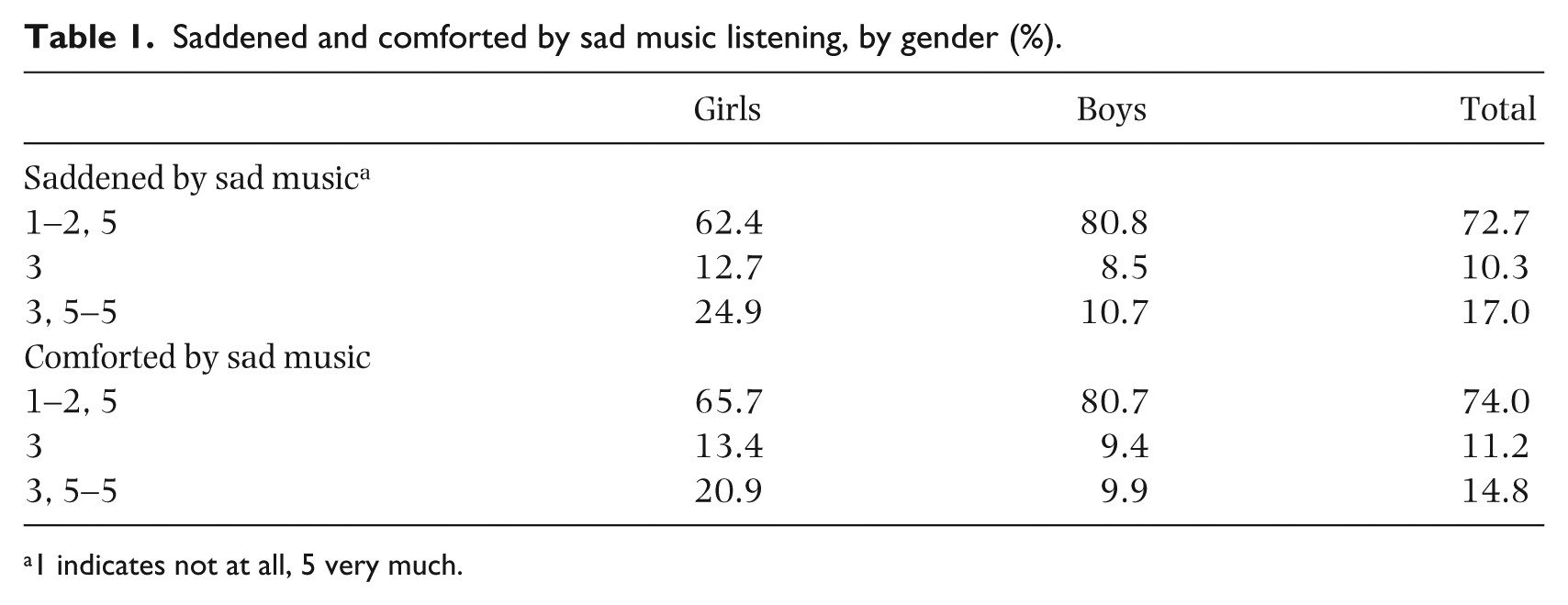
1 indicates not at all, 5 very much.
Correlations presented in Table 2 revealed that both being saddened and comforted by sad music are linked to negative family climate, being bullied, increased anxiety/depression, negative social comparison, and lower self-esteem. It is further noteworthy that a positive correlation, r = .26, was found between being saddened and being comforted by sad music (all ps < .01). This correlation was significantly higher in boys compared to girls (comparison of correlations test, p < .001; see Table 2). In addition, the negative correlation between self-esteem and being saddened by sad music was significantly stronger for girls than for boys (p < .001; see Table 2).
Pearson correlations between predictors and outcomes for total sample (N = 1686), boys (n = 946) and girls (n = 740).
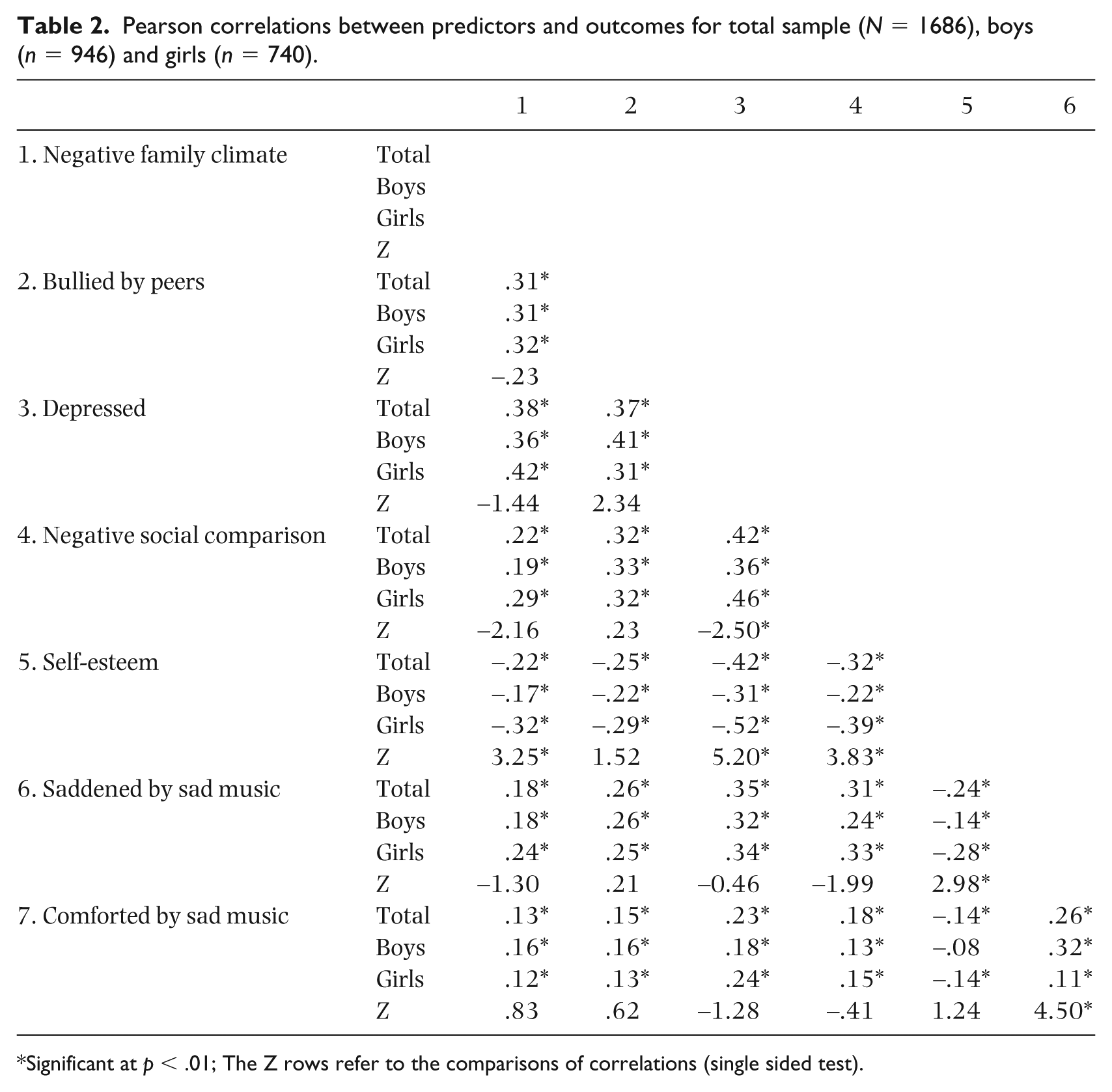
Significant at p < .01; The Z rows refer to the comparisons of correlations (single sided test).
To explore the possible contribution of personality and social context to being saddened or comforted by sad music, we tested and compared the following models: (a) the null model (M0); (b) the model with background characteristics (gender and education; M1); (c) the model with background characteristics and social context (negative family climate and bullied by peers; M2); (d) the model with background characteristics and personality variables (anxious/depressed, negative social comparison and self-esteem; M3); and (e) the model with background characteristics, social context, and personality variables (M4). As shown in Table 3, model (M4), which included background characteristics, social context, and personality variables, was the most plausible model for predicting getting depressed by sad music or comforted by sad music. M4 had the lowest AIC value, and, thus, the highest probability of being accurate compared with other models (AIC weight = 0.99 for being depressed by sad music; AIC weight = 0.97 for being comforted by sad music).
Model fit. a
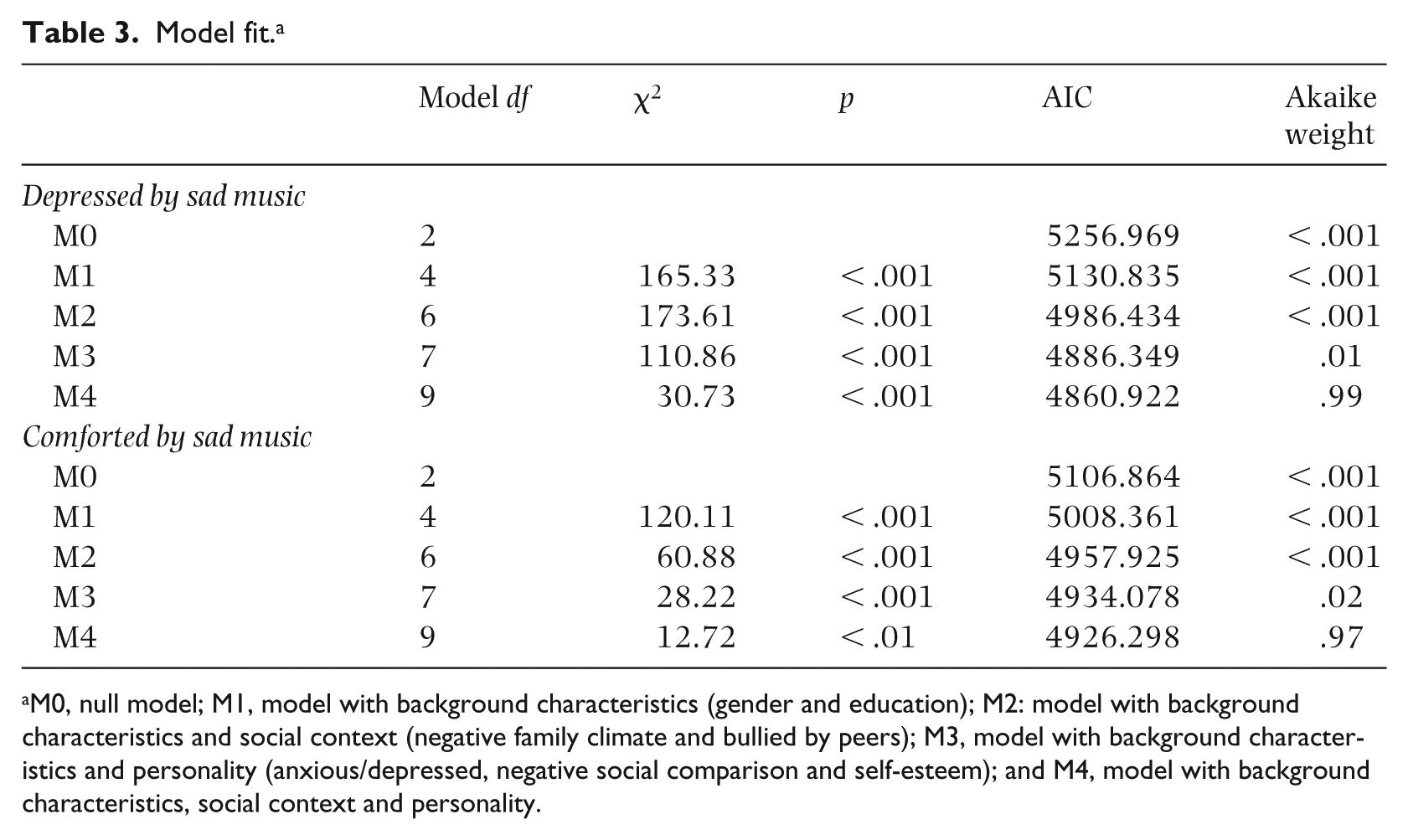
M0, null model; M1, model with background characteristics (gender and education); M2: model with background characteristics and social context (negative family climate and bullied by peers); M3, model with background characteristics and personality (anxious/depressed, negative social comparison and self-esteem); and M4, model with background characteristics, social context and personality.
The results of our regression analyses confirmed gender differences in being saddened by listening to sad music in that girls were found to be more likely to be saddened by a sad music (Table 4). Additionally, the results showed that being bullied, negative social comparison, and anxiety/depression enhanced the feelings of sadness. A somewhat similar pattern of results emerged for being comforted by sad music. Gender differences were again significant, with girls being more easily comforted by sad music. However, considering the person and context factors, only anxiousness/depression emerged as a strong predictor of being comforted by sad music.
Standardized coefficients for factors predicting Saddened by sad music and Comforted by sad music.
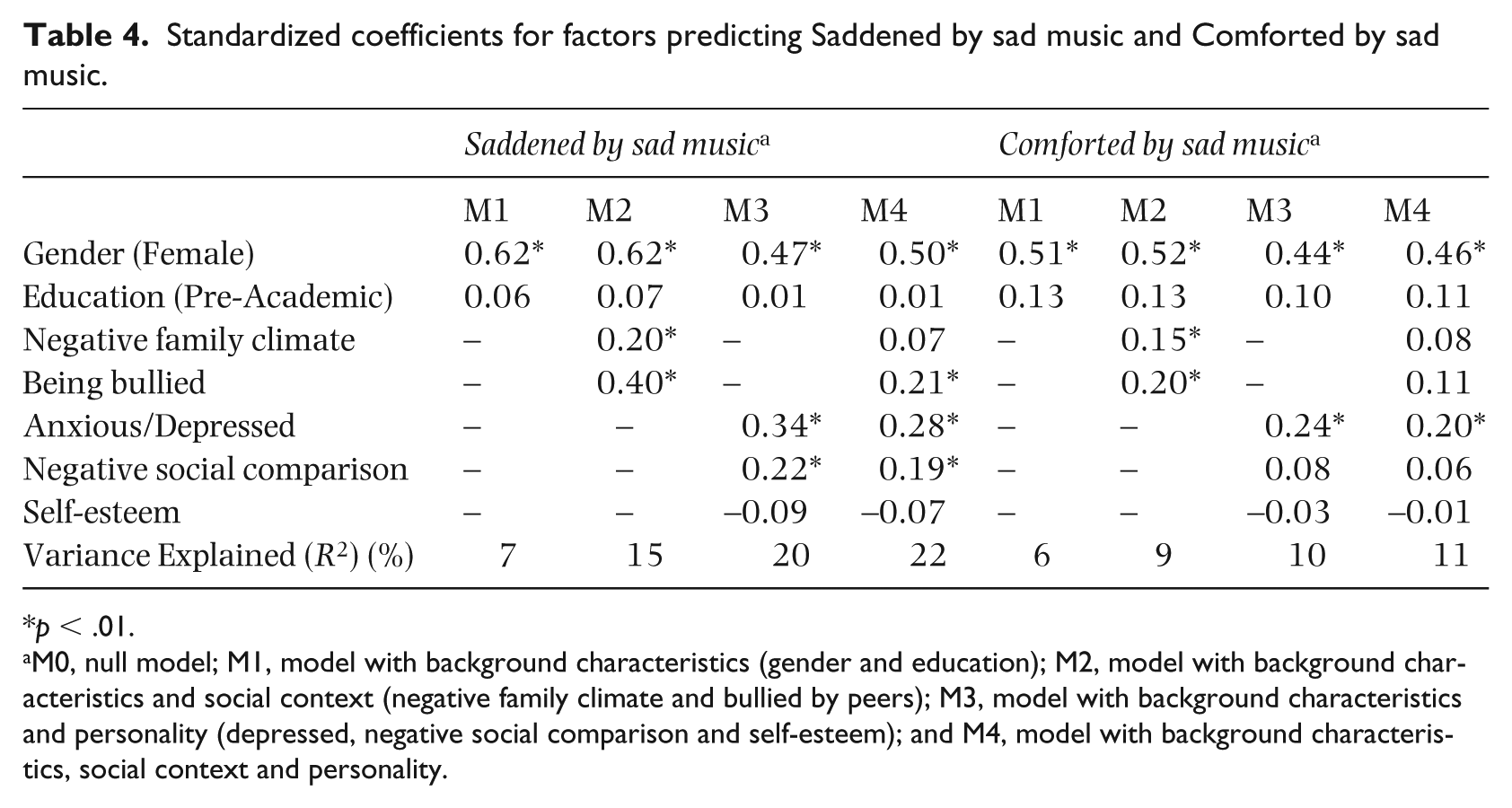
p < .01.
M0, null model; M1, model with background characteristics (gender and education); M2, model with background characteristics and social context (negative family climate and bullied by peers); M3, model with background characteristics and personality (depressed, negative social comparison and self-esteem); and M4, model with background characteristics, social context and personality.
No significant gender interactions with either background or personality characteristics were found in relation to both outcomes (not in Table 4), implying that the relations that were found do not differ by gender.
Discussion
We aimed to chart gender specific patterns in the relations between personality and context factors on the one hand and being saddened or comforted by sad music on the other hand. We found that listening to sad music may induce a range of emotions, both positive and negative.
About 17% of 1686 Dutch adolescents aged 12–16 years reported that sad music listening worsened their mood, when sad. We hypothesized that these young people more often lived in an adverse social context and had personality characteristics that not only enhanced detecting sadness in music, but also induced or strengthened their sad mood when listening to it. Our results showed that adolescents who reported elevated levels of depressive mood were most negatively affected by listening to sad music, corroborating earlier findings among Australian secondary school and university students (Garrido & Schubert, 2015a, 2015b; McFerran & Saarikallio, 2014; McFerran et al., 2015), adding to the existing evidence that self-selected and self-identified sad music’s negative effects on depressed young people may be universal.
In line with Juslin et al.’s (2008) notion that music effects depend on the features of music, person, and context, we explored a number of other person- and context-related variables. In our multivariate analysis, the personality factor of negative social comparison was, in addition to depressive mood, related to being saddened by sad music. Lack of self-esteem correlated with being saddened by sad music, but in our multivariate analyses, this factor was non-significant. Regarding context factors, strained relations with peers, as indicated by being bullied, also contributed to sad music’s distressing effects. Harsh family climate correlated with being saddened by sad music, but it did not uniquely contribute to explaining saddened effect in the multivariate analysis.
It must be further noted that sad music’s effects were not only negative. Depressed adolescents tended to benefit from listening to sad music when sad, as it comforted them. Thus, depressed adolescents may also benefit from listening to sad music. Depressive symptoms might be associated with higher levels of emotional sensitivity to music in general, making depressed adolescents more easily influenced by sad music, both positively and negatively. Indeed, this does not hold for adolescents who are being bullied or tend to negatively compare themselves to peers, i.e., for adolescents who have problems in the relational domain. While more often being saddened by sad music, we found no evidence of the uplifting effects of sad music on these adolescents.
In this study we particularly addressed gender differences in being saddened or comforted by sad music, when sad. Earlier studies reported no gender differences in preferences for or attitudes towards sad music (Eerola et al., 2015; Garrido & Schubert, 2011) but we found clear gender effects with regard to both outcomes. That is, girls were more often both negatively and positively affected by sad music compared to boys. While gender (female) was, thus, a highly salient characteristic related to being saddened or comforted by sad music, it did not moderate the relations of other predictors to these outcomes. As to explaining this difference: this may be difficult as there is a paucity of studies addressing this theme. Carlson et al. (2015) found that, compared with males, females are more inclined to consciously regulate emotions though music listening and adopt a strategy defined as Diversion: using music to distract from negative emotions. This could explain the surplus of comfort in females when listening to sad music, but leaves us at odds when trying to clarify sad music’s gendered saddening effects. On a more fundamental level, it has been suggested that gender differences exist in affect regulation, emotion processing and neural responses between males and females that may explain these differences, but speculating on different neurological patterning and its effects is beyond the scope of this article (McRae, Ochsner, Mauss, Gabrieli & Gross, 2008). Here we conclude that our results indicate the valence of gender informed designs when studying (sad) music’s effect.
Practical consequences
What are the practical consequences of our findings, and what can we advise young people who are saddened by sad music? For these young people, self-chosen and self-identified happy music that has been shown to enhance mood (Chen, Zhou & Bryant, 2007) may be a healthier choice than sad music. However, convincing these young people that happy music can be uplifting may not be that easy altogether. Studies have shown that sad music induces a range of emotions and evaluations that are not unequivocally negative (Kawakami et al., 2012), and our results accentuate that listening to sad music has positive effects as well. The ambivalent effect of sad music may be particularly salient in the group of adolescents already characterized by mood disorders. McFarren and Saarikkalio (2014) interviewed young people on their music choices, and found that some of them were hesitant to change the type of music to which they listened even after they realized that it exacerbated their bad mood, disconnected them from reality, and isolated them from peers. These adolescents stated that they sometimes sought to deepen their negative emotional state and prolong rumination. They reported feeling a certain pride in enduring the resulting emotional “pain.” Nevertheless, McFarren and Saarikkalio also noted that raising consciousness of the negative effects of music helped adolescents change their music listening patterns. Some of them learned to avoid saddening music themselves, for others, friends and family members became important. They helped them change their music preferences either by discouraging them from listening to music that worsened mood or by introducing new, more positive music.
Notably, the latter strategy may not be relevant for (depressed) young people in adverse social contexts. Hunter et al. (2011) noted that “Misery Loves Company,” and depressed adolescents indeed tend to have strained relations with parents and peers more often than their happier peers. In our research harsh family climate and exposure to bullying correlated with sadness that resulted from listening to sad music. It is ironic that adolescents who need to change their music listening behavior the most may actually live in social contexts that are least likely to facilitate this change, i.e., they may lack parents and peers helping them to change their music diet, away from saddening music.
We have furthermore noted that through the advances in, and massive use of, digitalized social media, social comparison may have entered a whole new level. Obviously, potential negative social comparison elicited by consuming and contributing to social network sites cannot be simply undone, as the media context in which young people grow up cannot simply change back to its non-digital predecessor. Increased (negative) social comparison is a fact of life. Our results show that adolescents who are insecure about themselves cannot buffer their negative feelings by listening to sad music that may reflect their state: in our models, negative social comparison indicated worsened mood, and we did not find any comforting effects of listening to sad music. Moreover, it is plausible that for young people who are already inclined to negative social comparison, listening to artists who are able to express their feelings through beautiful music and who are often admired as pop stars might even increase the perception of being inadequate in the social domain. Thus, this music might further amplify adolescents’ sad feelings. Again, for these young people, happy music may be a healthier choice. However, if the social comparison mechanism works as hypothesized, happy music performed by (beautiful, popular) artists may also foster negative social comparison. These assumptions have to be explored further.
In our study, we accentuated gender effects. Sad music may be depressing particularly for girls. All that was concluded on the media choices of adolescent in or with adverse contexts or personality traits, also applies to girls. A happier music choice, self-selected or recommended by peers and family members, may benefit them when sad music saddens.
Personalizing media choices in streaming music
The digital age may have negative effects in that it cultivates (negative) social comparison, but it has advantages as well. For example, it offers a wealth of music that has never before been readily available on such a large scale. A personal media player or phone with large storage capacity or connected to music streaming services on the Internet offers access to literally tens of millions of music tracks across a wide range of genres. New music players with recommendation systems promise to suggest music that nurtures wellbeing. Streaming services already provide recommendations based on what listeners actually listen to, and apps are being developed to help adolescents choose music based on their current mood (Hides et al., 2015). In order to develop a next generation of these recommendation systems, it would be valuable to personalize them so that they would not only list favorite types of music, but also contain a module that is sensitive to music’s effects on (self-reported) mood. A personalized music player can thus recommend music that fits preference, current mood, and mood enhancement. Such a personalized music player could help buffer sad music’s effects on stressed, ruminating, or socially disadvantaged young people.
Limitations and future research
Our study comprised a large sample of Dutch adolescents, but its setup was not particularly geared to studying music’s effects on mood. Research in this area would benefit from longitudinal research with a large number of micro-assessments in a real-life listening context, but this type of research is scarce. Furthermore, we controlled for background characteristic and considered gender as a predictor of saddened mood, but we did not measure other factors and person traits capable of buffering sad music’s saddening effects, such as Absorption and Empathy. An enriched operationalization would contain a wider range of individual, social, and context characteristics related positively or negatively to mood that is saddened by music listening. For example, listening alone may have different effects compared to group listening (Garrido, Eerola, & McFerran, 2017). We have noted that the concept of sad music has clear cultural connotations, i.e., in different cultures, musical tempo, scale, harmonic progression, timbre may have different emotional effects. Future research can benefit from operationalization in other cultural context than those that have been explored so far, i.e., western industrialized countries with music scenes heavily infused with American and British pop music or local varieties of these types of music.
Conclusion
Sad music is bittersweet, and it should be enjoyed as such. However, when bitterness prevails, it is advisable to search for other music with a sweeter taste. This is especially true for young people who are already depressed or are bullied and negatively compare themselves to others. It is up to themselves, and sometimes to their peers and family, to find music that is mood enhancing, energizing, and comforting.
Footnotes
Funding
The author(s) received no financial support for the research, authorship, and/or publication of this article.