




Abstract
Many peacebuilding approaches strongly focus on vertical or ‘top-down’ processes instigated by states and international actors. At the same time, theoretical critiques and new empirical research highlight the importance of horizontal or ‘bottom-up’ processes involving cooperation at grassroots levels for sustainable peacebuilding measures. These questions are particularly pertinent for this Special Issue which addresses sustainable peacebuilding and explores alternative approaches to dysfunctional ‘eco-environmental’ peacebuilding models, which, despite their promise in an age of climate crisis, rely heavily on international stakeholders and top-down approaches. In this article, we focus on general questions concerning the range of viable horizontal approaches, and their potential for mitigating conflicts, either in addition to or in replacement of vertical approaches. We focus particularly on the potential of deliberative practices for peacebuilding (i.e. horizontal exchanges involving open-minded, mutually respectful reason-giving that ideally allow deliberators to ‘put themselves in each other’s shoes’) and outline different ways that such exchanges can be institutionalised. On this basis, we discuss two very different cases (deliberative peacebuilding in Somaliland in the 1990s and ongoing deliberative initiatives in Ireland) where different forms of deliberative exchanges between conflicting parties, sometimes combined with vertical modes of peacebuilding, showed great promise. Taking these illustrative examples as a point of departure, we explore some of the relevant contextual variables, and discuss the appropriate forms of peacebuilding deliberation in different contexts. We conclude by developing a tentative map of the conditions and implications of different deliberative peacebuilding strategies in diverse political contexts.
Introduction
Building and sustaining peace is a multi-levelled task, just as the conflicts to be addressed have multiple determinants. In the contemporary age, those determinants may include global processes of climate change that impact on local resources, interstate competition over territory, influence and wealth, horizontal inequalities within the conflict region, and the contingent opportunities that incentivise armed groups. This article explores the horizontal aspects of peacebuilding at everyday grassroots level. This is particularly important in the intra-state conflicts between different groups that pose a constant challenge to peacemaking on the African continent and beyond. But grassroots peacebuilding is also important in conflicts with strong regional and global dimensions. This article explores horizontal models of peacebuilding, and the ways that they can be taken forward through deliberation. It criticises the tendency to prioritise vertical approaches, not because these are unnecessary, but because without a horizontal component they have unintended and often perverse effects. As such, the article deals with a foundational issue – the importance of everyday horizontal peacebuilding and the role of deliberation in this. It does so by exploring deliberative peacebuilding in two very different cases – Somaliland in the global South, and Northern Ireland, in the global North.
Our focus is on the everyday and largely intra-state manifestations of conflict that involve populations or ‘groups in conflict’. 1 Exactly the character of those groups in conflict and the nature and role of ‘ethnicity’ in their makeup has been much debated (Chandra, 2006; Ruane & Todd, 2004). They are often crystallised in closed, oppositional form in the context of Western colonial power. In parts of sub-Saharan Africa, this has affected their identification with the successor states imposed at the time of imperial withdrawal, and their attitudes to Western actors. But the point also has wider relevance, for colonisation and empire marked group formation and conflict throughout the world, even as the types of states in question and groups’ identification with them differs (Wimmer, 2013; for Kashmir, see Kanjwal, 2023; for Ukraine and Ireland, see Velychenko et al., 2022).
We are particularly concerned with peacebuilding in the strong sense, that not merely aims at the absence of violent conflict (‘negative peace’), but aims at ‘creat[ing] a structure of peace that is based on justice, equity, and cooperation’ (Gawerc, 2006: 439) This complex task is especially important where conflicts ‘tend to be internal (even if impacted by larger geopolitical realities), asymmetric, involve fragmented decision-making and are often directed by civilians’ (Gawerc, 2006: 438). In these cases, arguably, ‘traditional diplomacy’, ‘top-down’ or ‘trickle-down approaches’ that involve high-ranking officials negotiating in order to resolve or mitigate conflicts fail to reach the crucial actors and networks (e.g. Aall, 1996; Lederach, 1996; Lederach, 2022; see Gawerc, 2006, 440-1; MacGinty, 2021).
Of course, where the causes of conflict also involve transnational power resources and networks that span several states, traditional diplomatic negotiation is necessary. Climate action is one example, for many researchers agree that climate change constitutes a thread multiplier: climate change ‘has the potential to exacerbate a wide range of existing and often interacting conflict drivers such as resource scarcity and unmitigated migration’ (Koubi, 2019: 348). Dealing with major regional problems of water or food insecurity is likely to involve interstate negotiation and international investment. Equally, the conflict-generating legacies of a colonial past, from horizontal inequality between culturally defined groups to marginalisation of regions (Brown et al., 2012; Cederman et al., 2010; Horowitz, 2000; Stewart, 2016), require major infrastructural change on the part of states and international agencies. But without engagement with civil society and grassroots groups, such approaches may have unintended and perverse effects. First, by relying strongly on external donors and cooperation partners, they risk aggravating relations of dominance and dependency between the Global North and the Global South and reducing the sense of agency in conflict-torn regions. Second, they may fail to recognise or address the informal and experiential aspects of group division and conflict, from the different and often opposing forms of moral authority accepted by different groups to the informal dependence on group networks, to the perceived and real security threats for groups with a long history of conflict (e.g. Todd, 2024). Third, they may take ascribed notions of the end of conflict (often a period of 5 years without organised violence) rather than taking local markers of conflict and its end (MacGinty, 2021).
In what follows, we (1) develop the argument for horizontal approaches to peacebuilding by showing some of the problems with predominantly vertical approaches; we outline the range of horizontal approaches and argue that a deliberative method is promising. We outline the range of deliberative methods (for different forms of citizen assemblies see, for example, Bussu & Fleuß, 2023). On this basis, we (2) feature two very different cases of deliberative peacebuilding in Somaliland in the 1990s and ongoing deliberative initiatives in Ireland. These cases are chosen to illustrate different deliberative methods used in very different socio-political contexts which nonetheless have similarly promising results. Taking these illustrative examples as a point of departure, we (3) explore contextual factors that made these deliberative strategies appropriate. We conclude by developing a tentative map of the aspects and aims, contexts of applicability and appropriateness of three different strategies of deliberative peacebuilding.
Positive Peacebuilding: Taking Stock of Vertical and Horizontal Models
Vertical Peacebuilding Models
Diplomatic modes of peacemaking involve interstate or international negotiation and mediation between the parties to conflict. International mediation is often accompanied by international and interstate negotiation: for example, the internationally mediated Ohrid Agreement between the main parties in conflict in Macedonia was copperfastened by the Albanian government which would play a constructive role in conflict, in the understanding that it would in return receive EU candidature (on the role of EU conditionality in the Western Balkans, see Gjoni, 2019; Koneska et al., 2022). International negotiation may open the way to agreement that would not otherwise have been possible. For example, the Good Friday Agreement (1998) in Northern Ireland was driven forward and drafted by the British and Irish governments, supported by the US and EU. It opened the way to interparty negotiation and agreement because the British and Irish states were prepared to change their sovereign claims and procedures, thus opening enough options for the future to satisfy the conflicting parties in Northern Ireland (Coakley & Todd, 2020).
To international diplomatic mediation of interparty negotiations is often added internationally organised ‘liberal’ or ‘liberal-commercial’ peacebuilding – the creation of an economic ‘peace dividend’ that gives more of the population more of an interest in peace. Problems arise with this ‘liberal peace’ when international peacebuilders dominate over locals and impose technocratic and top-down approaches (Byrne et al., 2018; MacGinty, 2021). Peacebuilders may fail to understand the values, emotions and perceptions that inform conflict at the informal and everyday levels (Brewer 2018) or the actual security concerns of populations (MacGinty, 2021). Sometimes short-term liberal reforms put down in quick fix by international actors cover over rather than tackle underlying issues in conflict.
For example, trade diplomacy is a liberal-commercial ‘top-down’ strategy that is designed to create interdependencies between conflicting parties. At the heart of this liberal-commercial peacebuilding model is the premise that increasing trade and commercial bonds reduces the risks of war or conflict. Classically, it was used to promote economic cooperation and international trade between nation-states, and it remains dominated by economically globally dominant countries, with the risk that former colonisers are still powerful, potentially ‘neocolonial’ players in formally politically independent nation-states (e.g. Darwin, 2000). Furthermore, the liberal trade agenda ignores two crucial points. First, where contemporary conflicts are also inter-communal and asymmetric conflicts, often in economically underdeveloped states, then marketization and the opening of trade barely touches and does not benefit those involved in conflict. As Newman (2009: 39–41) summarises, ‘there is ample evidence that this marketization is unhelpful in volatile conflict-prone societies, which have been characterized by inequality and social grievances’ (see also Pugh, 2005: 23). Second, these approaches presuppose a ‘trickle-down effect’ which is likely to exist only where there is already a strong civil society and channels whereby economic and other reforms can benefit the grassroots.
In those cases where top-down approaches are reasonably successful – Northern Ireland is one of the most successful – this international dominance was less evident, and there was systematic involvement of the parties. The main diplomatic actors in the Northern Ireland peace and settlement processes were the neighbouring ‘kin’ states of the United Kingdom and the Republic of Ireland, with other international actors following their lead. The two states systematically involved Northern Ireland political parties and paramilitaries in discussion through the 1990s, and the final 1998 agreement was made between the parties and the states and ratified in referendum by the populations of Northern Ireland and the Republic of Ireland. And still, as we will argue, the lack of systematic grass roots engagement has left the groups in conflict relatively untouched, without ‘positive peace’ and with potential for conflict in the future.
The eco-environmental peacebuilding models discussed elsewhere in this volume exemplify these points. Eco-environmentalism peacebuilding is timely in light of the contemporary climate emergency and its damaging impact on vital resources of food, water and shelter. The nexus between conflict and environmental conditions, including climate variability is particularly prominent in the Global South. In sub-Saharan African countries, for example, scarcity of vital resources, aggravated by climate change, is one crucial factor that leads to inter-communal conflicts. This eco-environmental peacebuilding strategy aims at integrating ‘natural resource management and environmental protection in conflict resolution and recovery strategies’ to build sustainable positive peace (Bruch et al., 2019): Emerging in the late 1990s against the backdrop of increased debate around the links between environmental scarcity and conflict, environmental peacebuilding can be defined as the conflict-sensitive and sustainable management of renewable natural resources in conflict-affected or post-conflict states that supports sustainable and resilient peace. It focuses on the social, economic, and political conditions for peace and how they can be strengthened by environmental politics and management [..]. (Ide et al., 2023: 1087; Krampe et al., 2021)
Eco-environmental peacebuilding models nevertheless also share the problems of other vertical approaches: state-level environmental cooperation can marginalise local populations and frequently fails to address structural inequalities (Ide, 2015). Furthermore, Peluso and Watts (2001, 25; also see Ide, 2015) criticised unequal power relations with regard to ‘defining, controlling and managing nature’ while Swain (2016, 1316) points out that the intricacies involved in the management of scarce resources such as water can easily be utilised to legitimise the dominance of international agencies (also see Crawford, 2003), thus aggravating the asymmetrical relationship between the Global North and the Global South (also see Onditi in this vol.). At the very least, local and regional actors need to be integrated into this approach in an egalitarian way, not primarily to resolve technical issues but to help define problems and mutually acceptable ways to resolve them.
While connecting climate variability and its consequences with conflicts is a valid point of departure for peacebuilding initiatives, we must keep in mind that there are, as Scheffran et al. (2012) highlight, multifarious ‘pathways’ through which environmental challenges can impact conflicts/peacebuilding processes, as well as a broad range of other crucial factors which affect their impact on conflict and peace. Among these are cultural factors, not least the forms of oppositional group division. How far this ‘groupness’ is stably interrelated with state forms and environmental resources varies enormously and this has significant implications for how conflict resolution can proceed. As we argue below, colonial history, within which groupness was clarified and exploited, forms a link between conflicts in global South and global North.
In summary, vertical peacebuilding may allow the geopolitical context to be held secure and wider opportunities and incentives to be opened to the parties in the conflict region. In conflicts exacerbated by ‘bad neighbours’ and/or involving wider regional conflicts over scarce environmental resources, it is highly likely to prove necessary. But it is far from sufficient. At best, it works with a limited number of parties, and it does not touch the grassroots. It assumes a trickle-down effect from political elites to populace but does not provide the tools – institutional or cultural – to facilitate more permeable and open relations at the grass roots level, or adequately to anticipate the overtime impact of the elite agreement on the populations impacted by conflict.
Therefore, contemporary research must explore channels for grass roots impact and participation without which, we have suggested, the vertical models of peacebuilding are neither legitimate nor sustainable. Two further points follow that are relevant to this special issue, although we cannot explore them in depth in this article. First, that there is a complex relationship between environmental challenges and aggravated conflict and, second, that successes and failures of peacebuilding initiatives depend also on recognition of contextual factors, not least the legacies of colonisation as they have developed in particular forms of inter-group and group-state relations.
Alternatives: Horizontal Peacebuilding and Grassroots Deliberation
Horizontal peacebuilding models are themselves diverse, varying in the agents that they prioritise, from political parties through civil society organisations to grass roots communities and representative citizens, and in the forms of interaction that they propose. For example, John Brewer (2018) sees victims and victims’ groups as exemplary agents of peacebuilding and argues that peace processes from Sri Lanka to Northern Ireland have missed the opportunity to engage with victims as agents of compromise. Onditi et al. (this volume) take horizontal commercial interactions as important factors that help build positive peace in societies such as Somalia or Kenya that are deeply affected by intra-state, inter-ethnic conflicts. Others deal more generally with the ways closed and exclusivist group boundaries can be opened through interaction and contact on the micro-level. Lamont (2023), for example, argues that among the wide range of change agents, ordinary people’s small-scale attempts at contact and communication can soften group boundaries. There are also hybrid models which attempt to manipulate from the top the conditions and incentives that favour more permeable group interaction (e.g. centripetal constraints on party formation, funding models that favour cross-community institutions). Some approaches pre-define the problem to be resolved and create interactive contexts where it may be lessened (e.g. peace building practices which provide a ‘safe space’ for informal discussion between key party leaders). Others are more radical, allowing the people themselves to define the problems and the criteria of resolution and then attempt to ‘scale up and out’ to policymaking: for example, MacGinty (2021) discusses the everyday modes of peacebuilding where ordinary cooperation and routines of civility radically lessen the impact of conflict in immediate interrelations. But the mechanisms by which scaling up and out from small-scale horizontal interactions to wider peacebuilding takes place remain relatively unexplored, and the embeddedness of group division may hinder the process (Todd, 2024).
Deliberative practices can provide a key part of the process. Previous research showed that deliberation, given appropriate conditions, is particularly helpful when people’s identities, their fundamental belief systems and their assumptions about themselves and others are at stake (Morrell, 2010; Muradova, 2021; Schneiderhan et al., 2014). Surprisingly there is relatively little deliberation on the core issues at stake in ethno-national conflicts. Yet conceiving deliberative processes as an important part of peacebuilding in such conflicts allows for structured participation by the affected people.
‘Deliberation’ is by now an ‘essentially contested concept’ even among deliberative democracy scholars themselves (for a review on diverse viewpoints, see Bächtiger et al., 2010), and we will briefly outline how we use the term ‘deliberation’ and how we conceptualise the goals of deliberation for the purposes of this article.
A ‘classical’ reading of Habermas suggests that the goal of deliberation is reaching a rational consensus where only the ‘forceless force of the better argument’ Habermas (1990; 1998) counts. Scholars like Iris Marion Young (2002) criticised the potentially exclusionary standards for ‘rational consensus’. Against this backdrop, alternative accounts of deliberation have been developed where the goals of deliberation are not to arrive at unanimity or consensus between all participants but to foster what Habermas (1998) termed mutual understanding [Einverstaendnis], that is, reflectiveness about each other’s attitudes and their sources, for example, socialisation processes, education, exposure to more or less diverse environments (Fleuss 2021, 2023; Niemeyer & Dryzek, 2007).
Utilising deliberative practices in the broad sense of the term for peacebuilding was also suggested by John Braithwaite (2024) who argues that this approach prioritises wide community participation, puts ‘the problem, not the person, in the centre of restorative dialogue’, and emphasises the value of ‘working together to fix the problem, heal the harm together’ (275; 280). Furthermore, he highlights the value of inclusion and the plurality of voices that are supposed to be heard (e.g. of indigenous people, of women), and of mutual respect (275; 280). But, unlike Braithwaite, we build on the classic practices of deliberative democracy such as (potentially grassroots-driven) ‘deliberative forums’, ‘citizen assemblies’, etc. Especially in situations of intense division and inter-communal conflict, deliberative practices provide an important tool for bridging divides in societies that are characterised by deep and perennial political disagreements (e.g. Curato et al., 2017; Dryzek & Lo, 2015).
We focus particularly on the different forms of deliberation appropriate for different forms of group-centred conflicts. A considerable body of research (Abulof, 2015; Brewer, 2018; Brewer et al., 2018) has shown the deep moral and identity-related perspectives that people bring to their group identification and group conflict. It has also shown the dissonance between ascribed and assumed group identities and perspectives: perhaps particularly in places with colonial histories, groups in conflict are ascribed oppositional identities, belief systems, moral standards and modes of understanding while their assumed beliefs, values and identifications may be much more convergent (Todd, 2018). In such cases, rational argument and evidence is easily assimilated by group leaders within conflicting ideologies. But grassroots horizontal deliberation can in principle breach the ideological barrier by working with assumed (not ascribed) beliefs and values, and building shared meta-perspectives, which help understanding of the issues in conflict.
For the purposes of this article, the core aims of deliberative processes are promoting sustainable positive peace by bridging divides and helping people to see and understand opposing perspectives. Given the importance of accessing grassroots experience and definitions of the issues at stake, deliberative forums should be (co-) designed by people at the grassroots. Fairness and equality (or in some cases meaningful proportionality) in representation and voice is essential to avoid domination by any one group or party.
Illustrative Cases in the Global North and the Global South: Somaliland and Ireland
In this section, we illustrate the merits of ‘deliberative peacebuilding’ with the help of two cases that differ in terms of their political and economic structure, cultural factors such as the forms of group division, and their exposure to climate crisis. Northern Ireland, the Republic of Ireland, and Somaliland are post-colonial places but differ radically in the forms and embeddedness of British colonisation and the pathways taken after the end of the British empire.
Somaliland: Deliberation and Positive Peacemaking Without External Intervention
Somaliland was a British colony from 1920 to 1960 (see Millman, 2013). After several spontaneous (failed) insurrections, it ‘obtained its independence from Great Britain on June 26th, 1960, by the Royal Proclamation of Her Majesty Queen Elizabeth’. A few days later it merged with the neighbouring Italian ex-colony to form the Somali Republic: the whole territory later was known as Somalia. In 1969, Brigadier General Mohamed Siyad Barre established a ‘revolutionary council’ and made the entire territory ‘a military chiefdom governed by hand-picked military governers' (Somaliland Country Profile, 2021: 28). This regime exercised political oppression, social and economic repression, and increased socio-economic inequalities, and capital punishment, causing widespread disaffection and uprising. The SNM (Somaliland National Movement) waged a 10 year war and in 1991 it successfully defeated the military regime. Somaliland’s independence was declared in 1991. While it was in the first instance ‘immediately welcomed by 35 UN member states including permanent members of the Security Council’ (Farah & Lewis, 1997; Somaliland Country Profile, 2021: 349), it is up to the present not an internationally acknowledged nation state. Still it is widely seen as one of stable democratic regimes in East Africa (although since 2023 there has been violent conflict in the Eastern region of Sool which claims inclusion in Somalia; also see Mahmood, 2024).
That Somaliland has largely succeeded in maintaining a strong democracy is in part a legacy of the SNM war of independence. One crucial goal for the SNM was to avoid retaliation – which ‘has paved the way for Somaliland tribes and SNM leadership to hold a series of political reconciliations and peace building initiatives before reassertion of the sovereignty’ (Somaliland Country Profile, 2021: 30). Reconciliation was necessary since the (former) Somali regime was a crucial player in creating divides between different clans, that is, it essentially adopted a ‘divide and rule’ policy that affected especially the Isaaq clan, the Dir clan, and the Darood clan. The Isaaq clan was particularly opposed to the other two clans involved in the Somali regime and ‘the apparent defeat of the regime encouraged the Isaaq-led SNM to employ a clique of non-Isaaq fighters for inter-clan dialogues from early 1990 onwards’ (Nakagawa, 2016: 213-4; also see Interpeace, 2008; Kaplan, 2008; Walls, 2011).
Although the Somali National Movement was clearly much more powerful than any of the conflicting clans, it searched for a ‘consensual approach’: peace- (and nation-)building were here conducted based on grassroots-deliberation with conflicting tribes/clans. For the SNM this was, in the first instance, due to very pragmatic reasons: according to Interpeace (2008) and Farah and Lewis (1997), the SNM did not have an in-depth understanding of respective clans’ territories. Furthermore, the (comparatively) limited relief assistance by international donors was terminated since it ‘was largely looted by competing clan militias’ and NGOs were evacuated in 1992. While the SNM first fostered the Isaaq clan’s dominance, they nevertheless ‘feared Isaaq subjugation of the other hostile clans that were associated with the previous government’ (Farah & Lewis, 1997: 350).
Subsequently to smaller inter-clan peace talks, the SNM organised the ‘Brotherhood Conference of Clans’ and the ‘Brotherhood Conference of Northern Clans’ in the early 1990s. According to Nakagawa (2016: 213-4), ‘this external absence [of Western donors and the UN] enabled domestic factions to explore the socio-cultural tradition of deliberation in order to engage in the “legitimation problem”’ (highlights by the authors). The primary goal of these deliberative processes was to ‘reach[…] political consensus on ceasefire and governance in the post-Barre era’ (Nakagawa, 2016: 214). The peacebuilding process in Somaliland is an outstanding example of a ‘bottom-up initiative’: it ‘was first initiated at the local level by traditional political leaders, using conventional mechanisms of arbitration between […] clans’, and it involved elders leading grassroots-driven deliberation: Starting at the grassroots level, the elders’ peace endeavour progressed to district and regional levels. It reached its height as the Boorama conference, where a hundred and fifty delegates (known as Guurti) comprised of clan councillors representing all the groups in Somaliland managed to produce separate national and peace charters. And the elders moreover, for the first time in the post-independence period, extended their peace-making functions by acting as an institutional framework for the formation of executive interim government. (Farah & Lewis, 1997: 350)
Despite the lack of substantive financial support from international donors or the diaspora, ‘the locally driven Somaliland peace forums produced, with little external contribution, results in terms of preventing overblown clan wars in the region, and in successfully reconciling some warring clans […]’ (Farah & Lewis, 1997: 352). This not merely highlights the merits of bottom-up initiatives for deliberative peace talks, but also features the importance of respecting indigenous traditions – for example, providing so-called ‘elders’ who represent their respective community with a prominent role in these peace talks: ‘[w]ith a view to the structure and procedures of these deliberative processes that deal with peacebuilding, we can also see many similarities to deliberative forums in the West:[…] most peace forums are chaired by a selected committee which is assisted by a secretariat. […] Quite commonly, conference resolutions are legitimized by unanimous consensus of delegates of the reconciling parties’ (Farah & Lewis, 1997: 354). This also shows that the design of deliberative settings must be context-dependent, rather than limited to the communicative conventions of the Global North. In addition to granting ‘elders’ of different communities an outstanding role, grassroots activities also built on indigenous traditions. At the highest level of authority, the council of clan elders deliberates upon and arbitrates major conflicts between clans. […] At the local level, particularly at the buffer-zones between reconciling clans, joint security committees are established to solve minor disturbances and prevent opportunistic banditry. Such grassroots committees are locally known as Guddida turxambi, literally ‘the committee which uproots unwanted weeds from the field’. Here the act of weeding is employed as metaphor for the pernicious effect of violent act upon the mutually desired peace. (Farah & Lewis, 1997: 357-358)
Bradbury (2010: 131) states that ‘the efficacy of indigenous processes of conflict resolution’ is remarkable, and in ‘The Roots of Reconcilation’, Farah and Lewis (1993) highlight that ‘the resurgence of societal deliberation to meet and mediate the societal differences empowered the non-elite actors to intervene and mediate the radicalised political differences in a bottom-up manner’ – and to turn antagonism into agonism (also Nakagawa, 2016). In 1996, the then president decided not to allow for further ‘clan conferences’, but to hold a ‘National Conference’. This was a crucial indicator for the president’s aspiration ‘to push back societal forces into the “national” deliberative space' (Nakagawa, 2016: 226). This conference, however, ‘ended up with mixed results’; ‘[t]he government also created a special fund for the reconstruction of Burao, the socio-political base of the opposition. These measures ameliorated both […] inequalities/differences [between different groups]’ (Nakagawa, 2016: 226). President Egal’s death in 2002 had a liberalising and unifying effect on many ‘antagonised’ politicians – and this, in turn, led even more ‘radical’ thinkers to move from an antagonistic into an agonistic way of thinking (also see Nakagawa, 2016: 230-2).
Nevertheless, ‘the emergence of “modernity” has not weakened “tradition”, but revived and reinforced it'. In a situation where more than 70% of voters are assumed to be clan constituents …the most politically and economically viable way for candidates to secure the popular vote in the clan-based elections is to mobilise the affiliated clan constituencies and resources’ (Nakagawa, 2016: 238). This tends to consolidate tribe- or clan-based ‘groupness’ and allows senior people belonging to the respective clan to have a disproportionate impact on the outcome of democratic procedures – be it by explicitly nominating candidates for elections and/or indoctrinating young people and women who are likely to be particularly receptive to authority figures’ positions or ‘advice’ (e.g. Warsame, 2010). Conflicts between different societal groups or tribes have not been ameliorated by the electoral system where the Isaaq – the majority group – have increased their power (e.g. APD, 2006; Nakagawa, 2016).
While the dominant role of ‘clan elders’ may be criticised from a (deliberative-)democratic perspective, integrating people that hold the trust of their community to act as their representatives in deliberative processes can also have (pragmatic) merits: depending on the context, they might have authority to speak for their communities.
In sum, the Somaliland case shows that (a) deliberative processes can be extremely effective for peacebuilding processes if they start ‘bottom-up’, at the grassroots level. In addition (b) they are capable of mitigating entrenched conflicts over power between groups (in this case: different tribes/ethnic groups) by creating mutual understanding [Einverstaendnis] and allowing people to ‘see the other side’ or put themselves in their adversaries' shoes (see Muradova, 2021). Furthermore (c) building on indigenous traditions is of value, including the recognition of existing authority structures, although this also raises difficult moral-political issues beyond the scope of this article.
Against this backdrop, deliberative processes in Somaliland were, despite some reservations, successful in mitigating inter-tribal conflicts, and in establishing a stable democratic regime that is, according to major indices, characterised as ‘partially free’ (Freedom House, 2024) and receives comparatively high rates for the quality of its democracy (V-Dem, 2024).
Furthermore, by relying on indigenous traditions, deliberations in Somaliland were successful in that conflict between the clans retreated into the background for several decades. Significantly, the overall process went along without foreign aid or intervention. It shows that horizontal peacebuilding, without top-down intervention, can be a valuable strategy. It furthermore demonstrates the power of deliberative processes in peacebuilding in creating mutual understanding and even some convergence of preferences.
Ireland: Constitutional Deliberation?
The long Irish conflict was rooted in 16th-17th century British colonisation and developed in a tripartite (triangular) form, with multiply-defined groups-in-conflict (Protestant, ethnically Scottish and English in origin, originating in and/or enjoying the benefits of the colonial order vs Catholic, ethnically Irish or old English in origin, displaced and disadvantaged by the new colonial order), where the British state played the key role in stabilising the order with the aid of local Protestant administrators and police. Partition in 1920-2 focussed the conflict in Northern Ireland where it took the same triangular form at least to the 1980s, long after the end of the British empire and even when Northern Ireland had become an economic drain and political liability for the UK rather than an economy to exploit (Ruane & Todd, 1996). Partition also divided North and South of the island in their political, cultural and economic paths.
Multiple issues remained in conflict in the newly devolved Northern Ireland, primarily radical and increasing horizontal inequalities between Catholic and Protestant in political, economic and cultural fields, stabilised by the British state. Groupness in Northern Ireland expressed longer legacies of religious difference, national allegiance and colonial origin, and also expressed real differences in the sense of the good life, of what the state can and should do, and the basis of political obligation. At the same time, the different evolution of state and society in each part of the partitioned island made for differences even in the nominally identical Irish identity North and South, and increasing gaps in understanding and communication between the two areas (Todd, 2018). The violent conflict which began in Northern Ireland in 1968-9 was at once inter-communal, and asymmetric, with the British state a key military, economic and cultural actor, at once functioning to contain inter-group conflict and at least partially to constitute it, while the Irish state became an uneasy part of the solution.
The 1998 Good Friday Agreement was a top-down settlement, driven and drafted by the British and Irish states who changed their own practices accordingly, moderated abuses, opened borders, ameliorated cultural closure and largely remedied horizontal inequalities; successive drafts were amended in negotiations with the parties and the final agreement ratified in referendum by the populations (see Coakley & Todd, 2020). There was less amelioration of group division than had initially been anticipated. Many distanced themselves from the political blocs, but they were dispersed and politically weak, and strong group assertion by elected political leaders hid the increasing diversity of the society and the dissonances North and South. The settlement limped along (Guelke, 2022).
Brexit – the UK’s withdrawal from the EU – radically disturbed the situation, leading to a renewed mobilisation for Irish unity, renewed unionist resistance, increased political polarisation, and threats of renewed violence. While some hoped that a united Ireland could open new prospects of positive peace, it also threatened to reignite violent resistance by loyalists. Fears of the latter have dominated discussions of a united Ireland, so that proposed models tend to be uneasy compromises, designed to minimise unionist opposition even though the institutions they propose stand to reproduce group division within the proposed new united Ireland. While unionist opposition is real, it does not justify a focus only on the polarised blocs to the detriment of the wider populations. On most counts about half the population in Northern Ireland distances from the political blocs in significant ways, and there is an equally large constitutionally disengaged section of the population in the Republic of Ireland. If the disengaged are involved in discussion, alternative imaginative options that may gain greater support can be discussed, and convergent values that may draw bloc voters to them articulated. Deliberation is widely seen as a way forward (Garry, Pow et al., 2022; Suiter, 2021).
To the present, only a limited number of deliberative mini-publics about constitutional change have been held. Among them are two matching events, one in Northern Ireland and one in the Republic of Ireland, concerned primarily with institutional design (Garry et al., 2020; Garry, O’Leary et al., 2022). A representative sample of the population was asked to assess which of two designs for a possible future united Ireland would be better. One design involved continuing devolution for Northern Ireland, with continuation of most present arrangements for governance of the region, while the locus of sovereign government changed from London to Dublin. The other involved an integrated Ireland. Two findings were particularly important. First, despite the widespread fear that especially in Northern Ireland people would be unwilling or unable to deliberate on contentious constitutional issues, the participants showed their capacity to weigh arguments and discuss the relative merits of the two designs of a united Ireland, and this was so even when their preference was to stay in the United Kingdom. Second, deliberation led some participants to change their initial institutional preference. Some unionists came, after deliberation, to prefer an integrated united Ireland because it would give them more leverage and remove the political log-jams that characterise present politics in Northern Ireland. Some Southern nationalists preferred a devolved Northern Ireland, as a way of not antagonising unionists. This suggests the need for iterative deliberation, so that Southern nationalists can feed into their own understandings unionists’ changing preferences, and vice versa. The success of these initial mini-publics opens the way for further investigation of how the preferences of the public – for example, for or against power sharing in a future united Ireland – might change when they deliberate on different forms of power sharing. These sorts of mini-publics can help hone models of a future possible united Ireland which are likely to be maximally acceptable. Thus they can play an important part in peacebuilding.
These examples of deliberation are however also limited. Recent research (McEvoy & Todd, 2025) showed how many diverse clusters of people – particularly but not limited to women and young people – were turned off by technical political discussions of voting procedures and party power sharing. They were concerned about substantive issues – from economic to reproductive and gender rights to the ecological problems of rural areas. They were also concerned about process – respect, mutual understanding, taking one’s time to understand where values converge, and how others understand the world. They wanted to discuss these foundational issues ‘upstream’ in the process of constitutional deliberation, prior to and informing the phase of technical institutional design. To this end Todd and McEvoy convened a series of ‘deliberative cafés’, more concerned to access clusters of the population who were disengaged from constitutional politics, than to be representative. They showed how narrative deliberation allowed the diverse participants to move from individual experience to shared definition of collective problems, and to critically assess expert policy responses. They worked from participants’ collective definitions of problems and values to construct criteria by which participants could assess different constitutional options and suggest alternatives. Such deliberation leads to mutual understanding, and to a level of convergence not on policy or constitutional preferences but on the meta-criteria relevant to such preferences. In recent cafes, women from rural, cross-community and cross-border backgrounds defined shared and interconnected problems – including security, justice and domestic abuse, and environmental and health problems, not least the massive pollution of Lough Neagh, the largest lake on the island, with knock-on effects on health and wellbeing. The women were frustrated by the difficulty of accessing political influence, and they discussed how constitutional change would impact their ecological problems, and allow a more consensual form of policing. This form of deliberation widens the sphere of constitutional discussion and changes the language of constitutional debate to include substantive issues and values. It forges common meta-criteria of judgement so that, even while constitutional preferences differ, constructive discussion is possible and polarisation lessened (Todd & McEvoy, 2026 forthcoming).
The aim of this sort of horizontal deliberation – once it is widely replicated – is to allow a possible future united Ireland not only to be widely agreed, but also to be better able to cope with the important ecological, economic and social problems that increasingly concern ordinary citizens on the island. It is particularly appropriate upstream in the process when the aims and vision of a new society can be discussed. In contrast, the mini-publics organised by Garry et al. (2020, 2022, Garry & O’Leary, 2024) have so far dealt primarily with institutional design, although they could be adapted for other questions. Notably these different types of deliberation fulfil different purposes and are appropriate for different sorts of groups – the mini-publics have been designed to find maximum space for compromise between already-committed unionists and nationalists even while their constitutional preferences remain totally opposed. The participatory, grassroots modes of deliberation are designed to identify areas of meta-level convergence on values and interests, so as to increase mutual understanding and the prospect of constructive dialogue on these constitutional issues. The aims are different, and both forms of deliberation are necessary.
Despite much discussion, the Irish government is unlikely in the short term to convene a full-scale citizens’ assembly, because it is unlikely that unionist parties and publics would participate. Nor is it likely that the British government, or indeed the Northern Ireland power-sharing government would institute this in the short term. For the moment, then, deliberative peacemaking is largely driven by academic and civil society organisations. However, it is important that local councils in Northern Ireland are positive about the idea: five out of the twelve local councils in Northern Ireland have already (2024) passed motions calling for discussion, dialogue or deliberation about North/South relations and constitutional issues. Whether deliberation can be initiated on a cross-border, cross-local level, at once horizontal and linked into the political parties through the councils, is an important current question. Equally important is how cross-local and cross-border deliberative encounters can feed into the agenda of larger cross-border mini-publics (on systemic deliberation, see Mansbridge et al., 2012).
Conclusion and What We Need to Take Into Account for Deliberative Peacebuilding
This article examined the potentials of ‘deliberative practices’ with reference to two significantly different post-colonial places (the island of Ireland, comprising the Republic of Ireland and Northern Ireland, and Somaliland). It explored if and how deliberation is able to bridge divides. While some theorists assume that deliberation can lead to unanimity or consensus among all participants, others feature the crucial role that it can play in ‘seeing the other side’ (Muradova, 2021) and empathising with adversaries – albeit without consensus. What is achievable is that people come to understand their own and others’ action rationales and their reasons for defending particular political preferences in the first place. Even when disagreement continues about the course of action to be taken, the conflictual nature and hostility between adversaries can be reduced by relativising ways of seeing and increasingly making the disagreement one of judgement and pragmatics rather than zero-sum conflict between good and evil.
We suggested this ‘deliberative model’ for legitimate and sustainable peacebuilding for two major reasons. First, it addresses the needs, attitudes towards adversaries and core values of people at the grassroots, thus helping delineate the problems that peacebuilders have to resolve. As we have argued, the dominant vertical models of peacebuilding, including eco-environmental peacebuilding, tend to impose not just solutions but also definitions of the problems to be resolved. Secondly, the deliberative model restores agency to those at the grassroots. The unintended effects of vertical models is to allow states from the Global North – all too often former colonial powers – to impose guidelines as the price of international aid, thus removing agency from the most vulnerable actors and communities.
Throughout this article, we highlighted that there are various other contextual factors to be taken into account. The Somaliland case demonstrated that the continuing importance of inter-tribal group conflicts and historical cleavages must not be underestimated. In such contexts, enabling people with the help of ‘deliberative settings’ to put themselves in each other’s shoes, create ‘mutual understanding’ and empathise with ‘adversaries’ can be an important step forwards for peacebuilding processes that are not implemented in a ‘top-down’ manner but start at the very grassroots, including people that are affected by conflict and crisis and can also bring their contextual knowledge - and elements of their indigenous tradition(s) - to the table.
Deliberative peacebuilding in differing socio-cultural and resource contexts
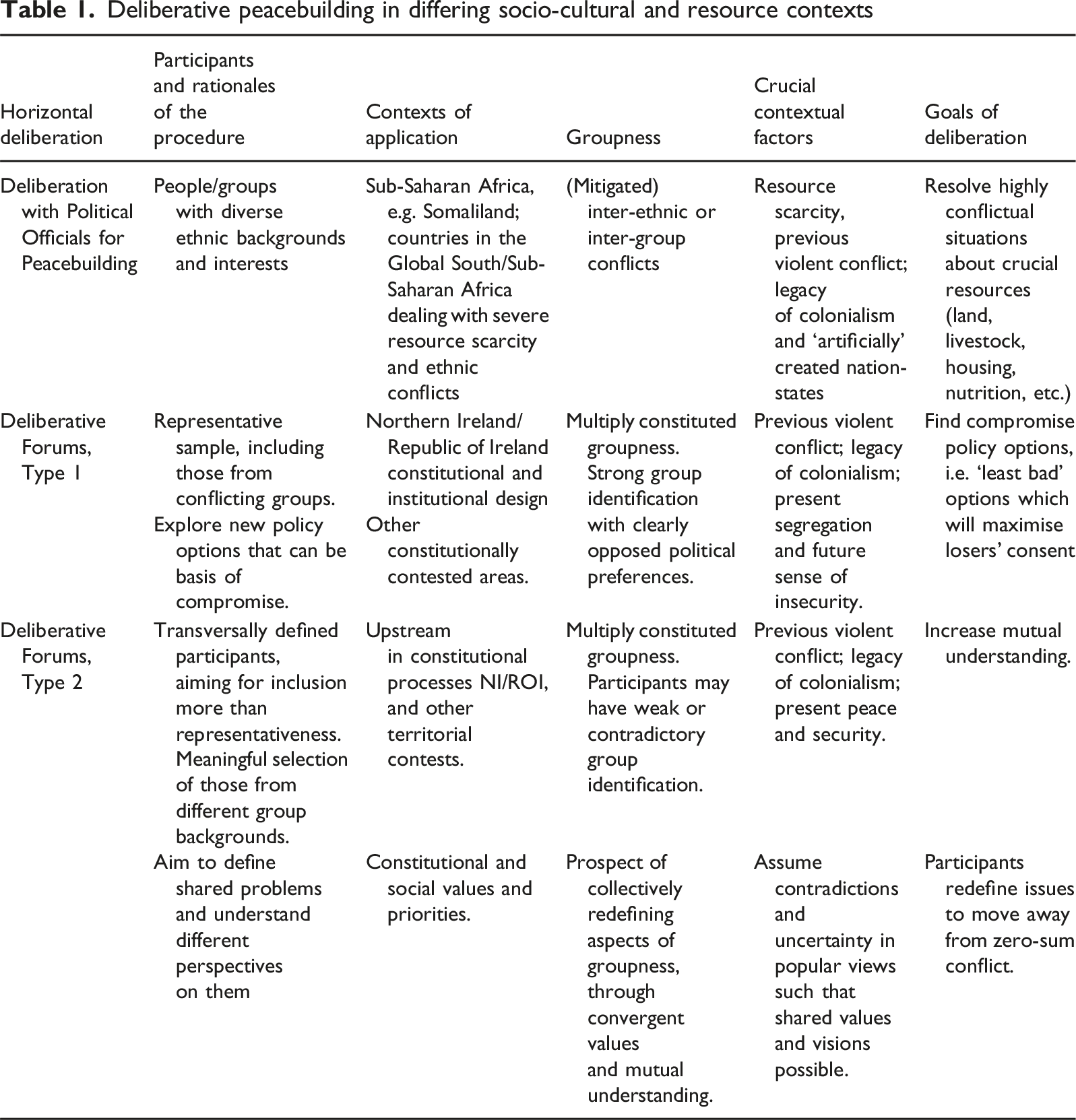
Our discussion in this article has focused on foundational issues – the need for horizontal approaches to peacebuilding and within this the value of deliberation. To conclude, we point out the relevance of our discussion for the topics discussed in this special issue. The contemporary ‘climate emergency’ has had a huge impact on conflicts worldwide. We have shown that it is important in peacebuilding attempts, including in eco-environmental models, to give recognition to the differential experience of different groups. This allows us to build the cultural dimension of group division into analysis of environmental problems. At present, contemporary eco-environmental peacebuilding processes tend to focus all too strongly on the nexus between environmental crises and conflicts, leaving out the ways people actually deal with associated resource crises and the meanings they confer upon them. In addition, current eco-environmental peacebuilding models adopt a top-down approach that fails to acknowledge the needs, suffering, and preferences of the people at the grassroots most severely affected. This threatens not just the legitimacy but also the effectiveness of the peacebuilding model.
Finding an alternative is most certainly difficult. If a horizontal model is necessary, it is seldom sufficient. Governments all over the globe are confronted with the need to combine grassroots-driven initiatives to tackle environmentally exacerbated conflicts with the need to tackle the climate crisis also on a global level, with cooperation from the most powerful states and actors. How to combine the horizontal, as discussed in this article, and the vertical is a major problem of our time.
Footnotes

Funding
The authors received no financial support for the research, authorship, and/or publication of this article.
Declaration of Conflicting Interests
The authors declared no potential conflicts of interest with respect to the research, authorship, and/or publication of this article.
Data Availability Statement
Data sharing is not applicable to this article as the data sets generated in the Irish study are still kept confidential for ethical reasons.