




Abstract
Visa regimes were key global mechanisms of the COVID-19 pandemic governance. Many nationals, both from the Global South and North, were subject to the several visa regulations during the pandemic. Whilst nationals of the Global North could regain their visa-free travel rights in the further phases, the others are still entrapped in the visa regimes, just like the pre-pandemic period. Considering visa’s global importance for border regulations in the (post-) pandemic period, what has changed for mobility rights of the visa applicants? This study examines changes in mobility rights for visa applicants during and after the pandemic, focusing on Schengen visa regime from March 2020 to June 2023. Our argument is twofold: first, the EU temporarily but substantially changed visa policies in the name securing the public health and free movement in(to) the Schengen area. However, these policies for securing mobility also created administrative gray zones that include new travel restrictions, confusions as well as strategic spaces for accessing to the mobility rights. Second, ongoing visa issuance practices and application process problems since the pandemic reveal a regression in the mobility rights lasting in the (post-)pandemic period. Hence, this article offers a more nuanced account of mobility rights by shedding light on the Schengen visa regime which will continue to play substantial roles in the EU’s border management system in the post-pandemic period.
Introduction
From waiting lines in supermarkets and social distancing in the streets to health screenings at gyms and airports, borders were hardened everywhere in the world during the COVID-19 pandemic (Aradau & Tazzioli, 2021). Interestingly, borders became “everything” of the solutions for contemporary issues, ranging from governing the pandemic to stopping irregularized migration (Paasi et al., 2022, p. 3). Although border policies showed significant variations (Piccoli et al., 2023), travel restrictions topped the global agenda in 2020 (UN Tourism, 2021).
COVID-19 pandemic policies for mobile subjects and their effects in the (post-) pandemic period remain an important research topic due to their implications for the evolution of border surveillance regimes (Koinova et al., 2023). Accordingly, several critical studies have analyzed the policies, practices, and consequences of the COVID-19 pandemic (Fassin, 2020; Shindo et al., 2023). These studies have revealed uneven governance strategies and their effects on different nationals, residents, and refugees during and after the pandemic in terms of shifting governance rationales (Tazzioli & Stierl, 2021), tools of governance (Alemanno & Bialasiewicz, 2021; Häkli, 2021), and differentiated governance of subjects (Aradau & Tazzioli, 2021). Thus, they have illustrated how accesses to the mobility and public health rights were politically articulated with each other during the pandemic.
Against this backdrop, it is safe to argue that visa regimes were key mechanisms of the COVID-19 pandemic governance. In fact, for many nationals of the Global South countries, visa regimes were already restricting their mobility rights (Mau et al., 2015; van Houtum, 2010). In sharp contrast, many nationals of the Global North countries could enjoy high number of visa-free travel opportunities before the pandemic. However, a preliminary analysis of Piccoli et al. (2023) reveals that visa-free travel opportunities for some Global North countries, like Germany, also decreased substantially in the early months of the pandemic in 2020. Hence, bordering the spread of the SARS-CoV-2 virus through passport and visa regimes became a genuinely global phenomenon during the pandemic. Nevertheless, while some passport holders could “recoupled” their mobility rights and enjoy visa-free travel, especially after the post-vaccination period (Shindo et al., 2023, p. 6), many others continue to face visa regimes in the (post-)pandemic period. Then, if their visa-free travel rights were not coupled, it is important to address whether the COVID-19 period represented a change for the mobility rights of these visa subjects. Indeed, considering the centrality of visa regimes in the (post-)COVID-19 world, it is crucial to explore not only whether individuals can visit countries with or without visa but also introduced visa policies, permeability of the visas’ paper borders, and complexities of the visa application procedures.
From these vantage points, we focus on the Schengen visa regime as a key international border strategy to understand the changes in mobility rights in terms of policies, practices, and experiences. Our argument is twofold. First, the EU’s COVID-19 policies, introduced in the name of public health and securing the free movement of persons in the Schengen area, created administrative gray zones for visa applicants between 2020 and 2022. While these administrative gray zones affected access to mobility rights by creating additional restrictions and confusions (Vijay & Fletcher, 2021), Schengen visa applicants and Schengen states could negotiate mobility rights with the EU bodies as well. We identify these contestations in relation to two policies: changing visa applicant categories and temporarily introduced public health mechanisms. Second, we highlight visa issuance practices and visa application process problems as complementary aspects of Schengen visa policies during the COVID-19 pandemic. We argue that the fluctuating visa application volume, high visa rejection rates, and ongoing visa application process problems indicate a decline in the mobility rights of Schengen visa applicants compared to the pre-pandemic period. Thus, these two arguments offer a more nuanced account of the changes in mobility rights and contribute to critical discussions on the (post-)COVID-19 world.
Visas, Borders and Mobility Rights
Modern states govern who can enter and exit their borders through passports and visas by possessing “monopoly over legitimate means of movement” (Torpey, 2018, p.2). Typically, while passports define border subjects as citizens, visa systems define non-citizens as residents, tourists, businesspeople, or so-called irregularized or undocumented subjects in cross-border settings. In this frame, visas are border mechanisms that selectively mobilize and immobilize travelers (Bigo & Guild, 2005). What is noteworthy in the case of visas is that visa applicants often experience these “paper borders” (van Houtum & Bueno Lacy, 2020, p. 709) or “walls” (Özdemir & Ayata, 2018, p. 183) in their home country rather than at the actual legal border lines through consular processes. Accordingly, visa regimes are remote border control mechanisms of modern states (Zolberg, 2003).
In his study on the EU’s external border regime in the context of visas, van Houtum (2010) argues that borders contain three interlinked processes: “bordering” as a process of making a given land an exclusive territory; “ordering” as a process of purification of this bordered space and “othering” as a systematic differentiation process between subject categories like natives/foreigners. In this framework, states use visa regimes to draw borders between populations as either visa-requiring or non-visa-requiring. Based on this categorization, states operationalize selective border control practices over some, but not all foreigners through visas, based on their political, economic, and social boundaries. In other words, visas materialize states’ external borders by classifying and governing who can be included and excluded through “bordering, ordering, and othering” (van Houtum, 2010; van Houtum & van Naerssen, 2002). Thus, passports and visas have a substantial impact on international affairs, including visa diplomacy (Stringer, 2004), economic dynamics, such as trade and tourism (Song et al., 2012), as well as on the everyday lives of travelers as partners, migrants, or researchers (Dixit, 2021; Souiah, 2019; Turner, 2020). In other words, visas amalgamate what we call the international, political, and social.
Broadly, visa systems operate at the international and individual levels (Salter, 2006). At the international level, visa regimes divide nationalities into different categories, including visa-free nationalities, short-term visa-requiring nationalities, airport transit visa-requiring nationalities, and travelers eligible for e-visas. From bilateral relations and economic interests to the perceived security risks, multiple factors play role in this categorization (Finotelli & Sciortino, 2013). After this nationality-based visa categorization, visa-required passport-holders must police themselves through documentation processes at the individual level (Salter, 2006). While sharing a travel itinerary is enough for some passport holders, this documentation process can be quite intrusive, necessitating the collection of biographical data about applicants’ past (e.g., their previous credit records), present (e.g., family ties in their home country or vaccination “passports”/certificates) and future (e.g., binding job contracts). By operating at the international and individual levels, visas materialize territorial and social boundaries.
Therefore, passport holders are not uniformly subject to this confession process inherent in visa regimes (Salter, 2006) because contemporary passport regime hierarchically categorizes subjects and treats them unequally (Harpaz, 2021). Thus, visa regimes, especially those in the Global North (like Schengen visa regime) can mirror global inequalities by selectively distributing mobility rights across nations and individuals (Dixit, 2021; Mau, 2010; Mau et al., 2015; van Houtum & van Uden, 2022). Mau et al. (2015) portray this division between the Global North and the Global South with regard to visa-free travel as the “global mobility divide,” specifically referring to the exclusion of the Global South from the free mobility regime through visas. In this regard, being an underprivileged passport-holder means being subject to the intersection of citizenship-based inequalities (e.g., power of passports) with social dynamics (e.g., possessing the required amount of money in a bank account, marital status, or job security) in the home country. While fortunate individuals in terms of citizenship, class, and social status can visit many Global North countries without many mobility hurdles, the mobility of some passport holders or illegalized migrants can be structurally pushed back via visa issuance practices, including rejections (Scheel, 2019). Thus, the structural inequalities of global-citizenship regimes and social boundaries intersect in contemporary mobility regimes (Altan-Olcay & Balta, 2020; Harpaz, 2021; Mau et al., 2015; Scheel, 2019).
This unequal mobility rights landscape is especially the case in the Schengen visa regime, which often privileges nationals of Global North countries and imposes visa requirements on many Global South countries, primarily Africa and Asia. Hence, many critical approaches to the Schengen visa have revealed the discriminatory effects of European paper-made walls (Hobolth, 2014). For example, van Houtum (2010) highlights that the Schengen visa regime constitutes a sort of “apartheid” by classifying some states as “positive,” that is, those whose nationals can freely enter the Schengen Area, and some as “negative,” that is, those whose residents need visas for entry. These exclusionary practices of Schengen’s paper borders constitute a potentially deadly and vicious cycle in which illegalized migrants are forced to choose risky routes toward Europe because of limited access to mobility rights through visas (van Houtum & Bueno Lacy, 2020). Accordingly, the Schengen visa constitutes a less visible border, dividing the globe into two categories: people who are included and excluded in the Schengen area (Bigo & Guild, 2005).
In addition to the border control and structural inequalities, travel documents are also integral to the public health mechanisms. Historical evidence show that travel documents can be used in epidemiological crises such as plague and cholera (Salter, 2003). For example, Frowd (2014) argues the critical role of visas while discussing the mobility restrictions of people living with AIDS in the USA between 1987 and 2010. In short, documents play a “vital” role in modern international politics by materializing public health policy projections. Overtly or covertly, the use of passports and visas can become related to the health governance practices of states.
Importantly, McQuade and Neocleous (2020) argued that the COVID-19 pandemic represents a historical continuation of medical policing through surveillance and public health, which has always been related to the reproduction and protection of the so-called public order. In analyzing relationships among power, mobility rights inequalities, and public health governance in the context of the COVID-19 pandemic, scholars have addressed contemporary transformation of the state (Sahin, 2023); elite-level policy strategies (Oztig, 2022; Zahariadis et al., 2020); formations of surveillance tools such as vaccine certificates (Alemanno & Bialasiewicz, 2021; Häkli, 2021); confinement structures such as citizenship, gender, and borders (Shindo et al., 2023); political rationalities of control such as hygienic-sanitary bordering; securitization through humanitarianism; and riskification of migrant categories (Aradau & Tazzioli, 2021; Koinova et al., 2023; Tazzioli & Stierl, 2021).
Equally important, Altan–Olcay and Balta revealed the relationship between unequal access to public health and mobility control techniques (Shindo et al., 2023). Koinova et al. (2023) discussed how risk discourse reinforced the already-existing securitization of migration. A number of studies revealed the intricate relations between humanitarianism and securitization in relation to the public health measurements (Aradau & Tazzioli, 2021; Tazzioli & Stierl, 2021). Moreover, Piccoli et al. (2023) indicate that these uneven effects can be observed also for the nationals of Global North, depending on the comparison criteria. In their preliminary analysis, they argue that “international travel restrictions had a greater effect on passport-holders from the Global North because their pre-pandemic mobility rights were far more extensive than those of passport-holders from the Global South” (Piccoli et al., 2023, p. 514). Considering that nationals of Global North countries usually enjoy more visa-free travel (Mau et al., 2015), the COVID-19 pandemic was also a substantial change for many of these nationals with powerful and privileged passports, that is, passports enabling a high number of visa-free travel opportunities. In other words, the COVID-19 pandemic had multiple consequences also including “equalizing” effects, though almost at the bottom (see Figure 1). Hence, these studies address policies over bodies, urban spaces, and territories, and shedding light on the unevenly affected individuals due to COVID-19 pandemic regulations. The decline in visa-free travel for various countries between March and May 2020. Source: Piccoli et al. (2023, p. 515).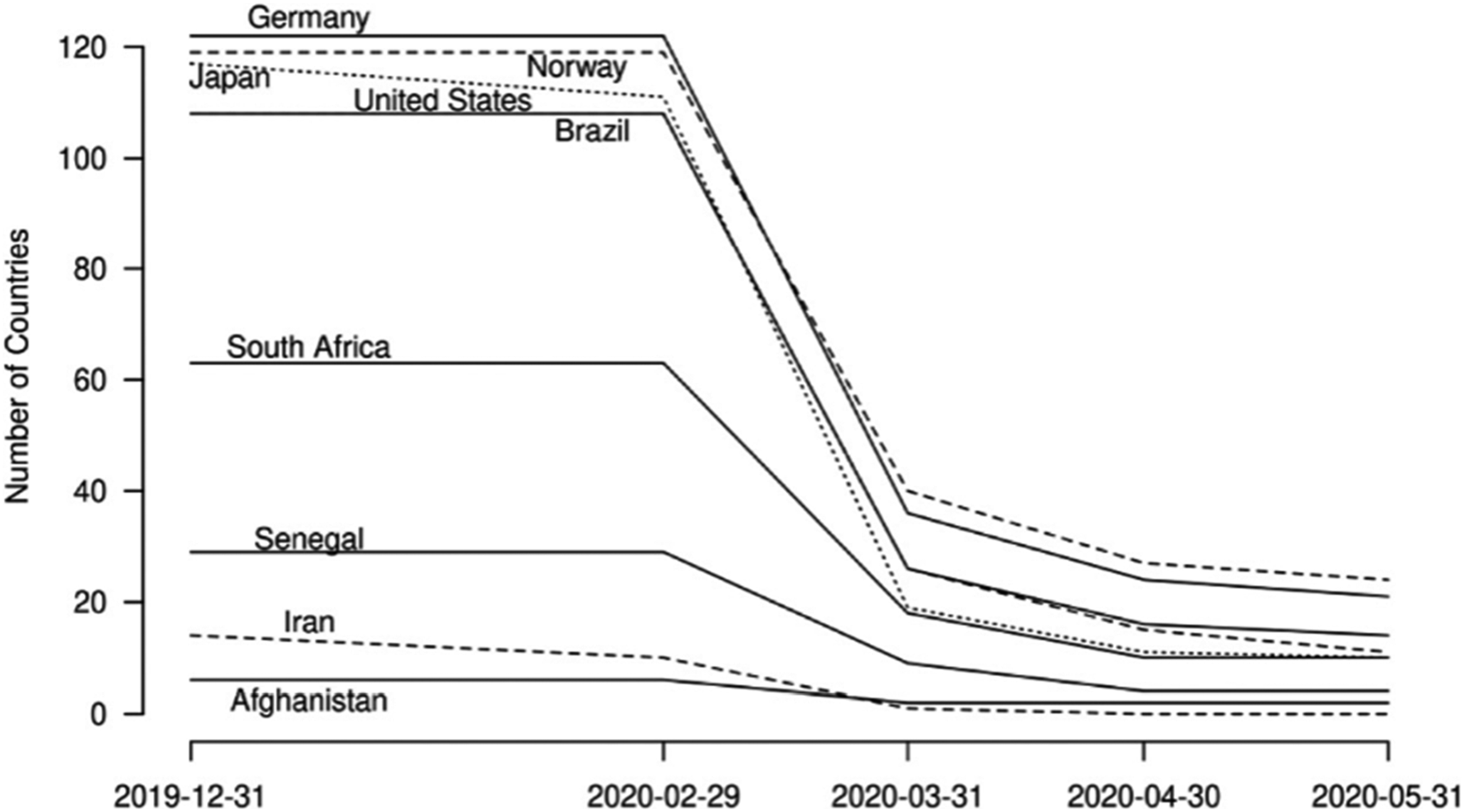
Drawing on a more comprehensive mobility rights conception, we aim to contribute to these critical discussions. Typically, mobility rights are assessed with reference to the number of visa-free travel opportunities of passport holders in the context of short-term mobilities. Despite the importance and popularity of visa-free travel as a quantifiable indication of mobility rights, this binary conceptualization of the term may overlook practical obstacles to accessing to the mobility rights, caused by variations across visa policies, practices, and experiences. Access to the mobility rights is a continuum rather than a binary variable of the number of visa-free travel opportunities (Mau, 2010). Relying on this continuum-based framework, our definition of mobility rights encompasses not only the number of visa-free travel opportunities, but also visa policies, issuance practices, and application processes that shape access to the mobility opportunities. Accordingly, our mobility rights notion includes visa-free travel rights opportunities of passport holder, what kind of visa policies that the traveler face, to what extent borders are permeable for the applicants, and how smooth one can arrange visa application procedures.
Materials and Method
We examine Schengen visa policies, practices, and experiences between March 2020 and June 2023. The COVID-19 pandemic regulations were officially in effect between March 2020 and August 2022, with significant practical variations taking place in the EU member states. To cover the ongoing changes after the pandemic, we extend our research scope till June 2023 with the available open-access data.
The Schengen visa facilitates international mobility rights into the Schengen area for up to 90 days in 180 day-period. Accordingly, we excluded long-term mobility and unregularized migration to the Schengen area when assessing access to mobility rights. We consider the Schengen visa system an important entry point for a dynamic understanding of mobility rights analysis during the COVID-19 pandemic because of its unequal structure, vital position, and sui generis modus operandi within the global mobility regime. First, the Schengen visa regime relies on a very selective structure that often disincentivizes mobility from the Global South with reference to the so-called risk factors, such as irregularized migration and the lower class (Bigo & Guild, 2005; van Houtum, 2010). As Figure 2 indicates with reference to countries in maroon and red colors that are subject to the Schengen visa system, the system predominantly targets Global South countries (van Houtum, 2010), with the notable exception of some Latin American countries. Moreover, as the securitization of migration gained momentum with the so-called migrant crisis in 2015–2016, policing rationalities such as surveillance and risk have been increasingly integrated into the EU’s border management for visa applicants (Hansen & Pettersson, 2021). Articulation of the exclusionary dynamics of the Schengen visa regime with security logic in the post-2015 period provides an insightful background for its unequal structure during the pandemic. Schengen visa policy map (2024). Source: European Commission (2024).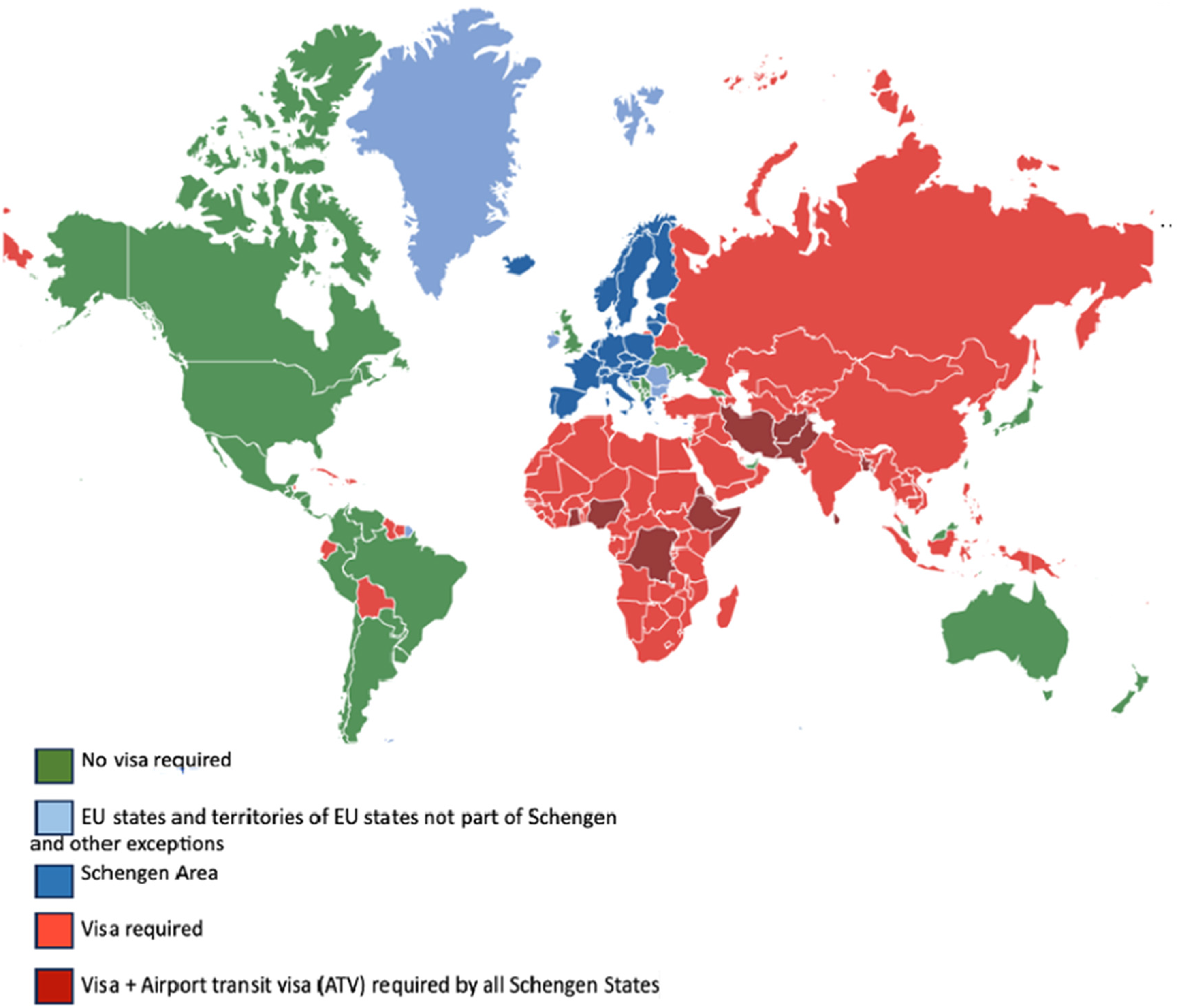
In addition to this unequal structure, the Schengen area has been the most popular region for international mobility compared to other regional destinations (Statista.com, 2023), making it an important hub of international mobility. Accordingly, in line with this position in the global mobility regime, the Schengen visa system had the capacity to process nearly 17 million visa applications before the pandemic began. Millions of visa applicants including businesspeople, researchers, and partners worldwide were severely affected by the EU’s COVID-19 pandemic regulations, and there were less than 3.5 million Schengen visa applications in 2020. Furthermore, there was a substantial correlation between international travel density and COVID-19 case in the Schengen area in 2020 (Oztig & Askin, 2020). These critical travel and case densities also paved the way for the introduction of several mobility policies for the regulation of Schengen system during the pandemic. Thus, the Schengen visa regime has broader implications for the global mobility regime in terms of the changes in mobility rights since the COVID-19 pandemic.
Finally, the Schengen visa regime provides insights for analyzing changes in mobility rights during and after the COVID-19 pandemic because of its sui generis modus operandi. While Schengen states make visa application decisions, the EU provides operational means and guidelines for a harmonized visa system, and visa application companies, such as VFS Global, offer technical and administrative services to Schengen consulates (Infantino, 2017, 2019). This mixture constitutes a sui generis modus operandi for the Schengen visa regime and paves the way for contestations during the COVID-19 pandemic regulations in terms of mobility rights. These contestations are relevant to identify gray zone administrative fields that give agencies for visa actors (i.e., the EU bodies, Schengen states, and visa applicants) even in a global crisis moment with implications on mobility rights. In short, Schengen’s uneven structure, vital position for international mobility, and sui generis modus operandi enabled us to investigate how the visa mechanism was used during the COVID-19 pandemic and its effects on the mobility rights.
Data sources of this research include the official publications of three EU bodies (i.e., the EU Commission, Council, and European Medicines Agency (EMA)), and Schengen visa statistics between 2014–2022. We complement these sources with the findings of secondary and gray literature to highlight policy contestations. Also, we benefit from anecdotal evidence of visa policy and application process problems in the post-pandemic period. We analyze the data with Merlingen’s (2011) methodological considerations on the networked governance analysis. We follow documentary and descriptive statistical analyses for these visa policies, practices, and experiences. In this framework, we initially analyzed the documents of the EU between March 2020 and June 2023 on pandemic regulations with reference to the COVID-19 timelines of the Council and Commision. 1 In this period, we identified two key policy issues affecting the mobility rights of visa applicants: changes in visa applicant categories and temporary public health mechanisms during the COVID-19 pandemic. We analyzed the data on these two policies in terms of their problem identification and policy justifications. Whereas the former reveals how the pandemic is contextualized and problematized to empower the Commission and Council to take action (e.g., introducing new travel policies during the pandemic), the latter reveals how policy actions were justified or challenged (e.g., questioning new traveler categories with legal and normative references) (Merlingen, 2011). However, these data source mostly provide the EU bodies’ activities and thus, delimit a thorough identification of policy implementation variations across Schengen states and their effects. To alleviate this limitation in relation to the policy variations, we note policy contestations and interactions among the EU bodies, Schengen states, and visa applicants, albeit not exhaustively, with secondary and gray literature. In addition to these two policies, we traced the lasting effects of the COVID-19 pandemic regulations by descriptively analyzing official Schengen visa statistics between 2014 and 2022 and anecdotal evidence of visa delays. The statistics show a change in visa application numbers and rejection rates at the global level as well as which Schengen countries continue to reject more visa applicants than others. Finally, anecdotal sources highlight two visa application process problems in the (post-)pandemic period: securing appointment slots and prolonging decision-making processes. By relying on these data sources, we aim to provide a more comprehensive account of mobility rights, including not only visa-free travel opportunities but also visa policies, issuance practices, and experiences of visa applicants.
Schengen Visa Policies During the Pandemic: Free Movement, Gray Zones and Contestations
The Schengen visa regime was a vital border policy area for the EU’s pandemic governance. The EU bodies, including the Commission, Council, and their advisory institutions: the European Medicines Agency (EMA) and European Centre for Disease Prevention and Control (ECDC) often offer legally non-binding regulations, recommendations, and advice for Schengen states. Hence, the EU aimed to govern international mobility in the Schengen area through the Schengen visa regime from the onset of the pandemic in March 2020 to August 2022. On the one hand, these soft border and visa policies projected additional mobility permission categories, albeit temporarily, for Schengen visa applicants during this period in the name of public health. On the other hand, the EU bodies and Schengen states also facilitated international mobility for some to secure free movement, even in the most restricted periods, by contesting these mobility barriers. Hence, the EU’s Schengen visa regime constituted a strategic administrative field during the pandemic. These contestations created gray zones in which EU bodies, Schengen states, and visa applicants could strategize the Schengen visa regime during the COVID-19 pandemic. These gray zones could extend and narrow the mobility rights of visa applicants. In this section, we illustrate the changed visa application categories and the introduction of public health policies for travelers as two contested policy examples during the EU’s pandemic governance.
The EU’s pandemic regulations for international mobility were officially in effect from the beginning of the COVID-19 pandemic in March 2020 to the lifting all measures affecting free movement in the Schengen area by August 2022, although with substantial practice variations in member states (European Council, 2023a). The EU’s first border regulation during the pandemic was a strict restriction for international mobility. Accordingly, the Commission reclassified visa application categories into non-essential and essential travelers (European Commission, 2020). Whereas the former visa type covered tourists, businesspeople, and cultural and scientific visits, the latter, whose mobility was prioritized, included workers in critical sectors such as health, food, and transportation, and were considered essential travelers whose mobility should be ensured in March 2020. Thus, the EU tried to facilitate the mobility of its citizens, their families, and long-term residents of the EU, UK, Norway, Iceland, Switzerland, and Liechtenstein. Moreover, essential workers such as health professionals, care workers, seasonal workers, scientists and medical industry workers, border personnel, engineers and workers in the energy and communication sectors, truck drivers, pilots, maritime workers, and staff of public organizations with critical tasks were also exempt from restrictions. In short, essential travelers corresponded to either their legal status or socioeconomic functions, while the rest were categorized as non-essential.
This reclassification of visa applicants during spring 2020 was justified by public health concerns amid the unpredictable atmosphere of the pandemic. However, this reclassification policy created a gray zone for some like unmarried partners of residents of the Schengen area. This situation became particularly problematic after the relaxation of tourism mobilities in the summer of 2020 (Schengenvisainfo.com, 2020). While some non-essential mobilities such as tourism were eased to alleviate the problems of the tourism industry in the member states, and family members of EU citizens and residents could apply for visas, unmarried partners were in administrative ambiguity due to their informal situation.
This in betweenness of unmarried partners sparked a transnational digital campaign called LoveIsNotTourism. 2 Loosely organized on digital platforms like Facebook and Twitter, binational couples requested exemptions from authorities for their mobility rights by raising awareness about their situation with protests, interviews, posts, hashtags. Later, some members of the European Parliaments and EU authorities took up this campaign and explicitly justified the mobility of unmarried partners as essential, concerning the EU Movement Directive (Directive 2004/38 EC), which considers “the partner with whom the Union citizen has a durable relationship, duly attested” also as a family member. Within the limits of the directive, the EU bodies called for broadening the definition of family member in Schengen states in line with the directive and refine their regulations by explicitly mentioning the eligibility of unmarried partners (Schengenvisainfo.com, 2020). Thus, some Schengen states, such as Denmark, the Netherlands, and Germany, decided to frame unmarried partners as essential travelers in the summer of 2020. Despite these improvements, the mobility rights of unmarried partners were not automatically relaxed due to the prolonged translation of this policy into practice and policy variations across intimacy-proving files (i.e., conditions and documents showing sustainable relationships) among Schengen states. For example, while Belgium had considered partner mobility as essential if partners are in relationship more than a year, physically seeing each other two times for at least twenty days, the Netherlands had considered longer than 3-months relationship as a minimum length of a durable intimacy. At the end of the day, reclassification of visa categories was a contested policy field during the pandemic.
In addition to reclassifying visa categories, the EU introduced and coordinated public health policies to assess outside countries’ risk levels during the pandemic. Accordingly, the EU tried to surveil the COVID-19 situation of foreign states every two weeks from June 2020 onwards, at the country level, in cooperation with the ECDC (European Council, 2023a). This surveillance mechanism considered the incidence (e.g., the number of COVID-19 cases per person in the country) and the country’s pandemic-related techno-political factors (i.e., testing, surveillance, contact tracing, containment, treatment, and reporting) as part of risk categorization, called the traffic light system. Nevertheless, some countries, such as France, adopted a national risk categorization system that also confused travelers in terms of whether they should follow the EU regulations or the French system (Benton et al., 2021; Blanford et al., 2022).
According to the EU’s risk categorization, visa applicants from some countries were also exempted from additional travel restrictions. During this period, the ECDC regularly reviewed the list of non-EU countries whose nationals were exempted from additional travel restrictions (European Council, 2023a). However, since the EU bodies’ lists exemption lists were not legally binding and rather were recommendations, there also emerged gray zones for visa applicants. For example, some Schengen states could transgress these lists and allow the residents of certain unlisted countries to enter their territories. While these additional exemptions by Schengen states potentially increased the mobility rights by strategizing these lists, they also caused administrative limbo and discordance across Schengen states concerning Schengen visa policies in 2020 and 2021.
Another gray zone effect of EU policies was the epidemiological risk categorization in the post-vaccination period. Especially until the use of vaccines in the EU in December 2020, country-level public health assessments became a critical mechanism for controlling mobility. Accordingly, travelers, including visa applicants, were subject to various regulations based on the risk categories of individuals’ populations or departure places, rather than their specific personal health situation. Later, the widespread use of PCR tests enabled states to determine whether individuals are infected with SARS-CoV-2. In addition, the use and authorization of COVID-19 vaccines accompanied this case-by-case diagnostic process since the early months of 2021. Despite ongoing challenges such as variants of the virus, the overall epidemiological situation has dramatically improved owing to the invention of COVID-19 vaccines and rapid access to COVID-19 PCR tests, especially from the mid-2021. Against this backdrop, instead of population- and departure-place-based risk categorizations, access to effective vaccines and test mechanisms recoupled with the access to the mobility rights (Shindo et al., 2023). Playing an advisory role, the EMA authorized some vaccines, such as Biontech/Pfizer, from December 2020 onwards (European Medicines Agency, 2020). Accordingly, individuals vaccinated with EMA-approved vaccines gradually enjoyed rapid travel to the Schengen area. However, the global scarcity of EMA-approved vaccines in 2021 led to the intersection of public health and mobility rights inequalities in the Global South, in relation to the Schengen visa regime. For example, Covishield, a non-EMA-approved vaccine, made up the overwhelming majority of vaccination numbers in Africa and was one of the main options for several Asian and Latin American countries by 2021 (Vijay & Fletcher, 2021). The division between EMA-approved and non-EMA-approved vaccines combined with unequal access to the vaccines in 2021 resulted in the continuation of quarantines and cast suspicion on specific traveler categories who did not prefer or could not access EMA-approved vaccines at that time (Veraldi & Kochenov, 2021). At the same time, more than ten EU member states recognized India’s Covishield vaccine, even if the EMA did not approve this vaccine in 2021, which resulted in “cacophony” in the Schengen area (Vijay & Fletcher, 2021). Similar to the transgressing EU safe country list recommendations based on sovereignty rights, a Schengen state had the opportunity to allow the entry of foreigners not vaccinated with EMA-approved vaccines in 2020 and 2021, as the EMA played only an advisory role. Hence, these gray zones also expanded and caused an uncoordinated facilitation of mobility rights in the Schengen visa regime.
Finally, certification practices complemented these public health measurements between July 2021 and August 2022, yet also brought additional ambiguities to the Schengen visa regime (Alemanno & Bialasiewicz, 2021; Häkli, 2021; Veraldi & Kochenov, 2021). As access to vaccines and tests became widespread, EU bodies operationalized digital COVID-19 certificates on July 1, 2021, to secure the circulation of safe travel. The EU’s Digital COVID-19 vaccination certificates allowed Schengen states to track individuals’ vaccination statuses until its deactivation in August 2022 and expiration in June 2023 in the member states (European Council, 2023a). After the technical harmonization of the certificate database with 51 visa-requiring non-EU countries, visa applicants could make themselves legible to EU authorities regarding their vaccination status. Since then, having such certificates with EMA-approved vaccines has allowed passengers to bypass quarantine measures until August 2022 (European Council, 2023a). The Commission also introduced COVID-19 test and recovery certificates under its digital green certificates system to alleviate potential problems for those that do not have the COVID-19 vaccine certificates (European Commission, 2021). However, as Häkli (2021) pointed out, having no such certificate likely to create additional suspicions over individuals without vaccine certificates in the border zones, even though these vaccine certificates were not obligatory means of travel.
As of August 2022, all member states have lifted these pandemic regulations for travelers including visa applicants (except for visa applicants from China, for whom restrictions were not lifted until February 2023) to ensure free movement (European Council, 2023a). Nevertheless, as we discuss the Schengen states did not always translate these EU-level “recommendations” or “advise” into practice even from the onset of the pandemic. Rather, contestations and negotiations among EU authorities, member states, and Schengen visa applicants had often shaped actual policy implementations. As a result of these gray zones, traveler categories were blurred, with strategic spaces and (in)humane consequences for some visa applicants, such as unmarried binational couples or people with non-EMA-approved vaccines.
Persistent Effects of the Pandemic? Visa Applications, Rejections and Delays
The EU bodies advised lifting all travel regulations on the basis of the pandemic in December 2022 (European Council, 2023a). Furthermore, many border control practices had already been suspended in many member states since mid-2021 and were completely removed by August 2022. Then, what are the immediate, and if exists, lasting consequences of the EU’s COVID-19 pandemic policies on mobility rights? In this section, we complement our discussion on visa policies and their consequences by focusing on visa practices and processes. We examine the fluctuating application volumes, increasing rejection rates, and application process problems to discuss changes in the mobility rights of visa applicants. Here, we argue that the problematic structure of the Schengen visa regime that predates the COVID-19 pandemic had worsened during the pandemic and afterward.
The first and most observable impact of the COVID-19 pandemic and related regulations was a substantial decrease in the number of Schengen visa applications in 2020. Bans on non-essential travel, such as tourism and business visits, required epidemiological criteria from Schengen visa applicants and slowdowns in the operations of visa application companies and embassies due to lockdowns
3
negatively affected the volume of Schengen visa applications, especially in 2020 and 2021.
4
Compared to nearly 17 million who had applied for visas since 2019, the total number of applicants were less than 3.5 million in 2020 (see Chart 1). Relaxing visa policies after vaccine deployment led to the gradual removal of visa bans in 2021 and this correlated with a limited increase in visa applications with over 8.5 million applicants in 2021. Contrary to the optimistic expectations for the post-pandemic period, application numbers decreased again in 2022 mostly because of the EU’s countermeasures against China’s changing COVID-19 pandemic policy, which included restrictive Schengen visa policies against visa applicants from China and geopolitical tensions with Russia and Belarus.
5
In summary, the developments during and after the COVID-19 pandemic have significantly affected the volume of Schengen visa applications since 2020. Global Schengen visa application numbers (2014–2022). Source: European Commission (2024).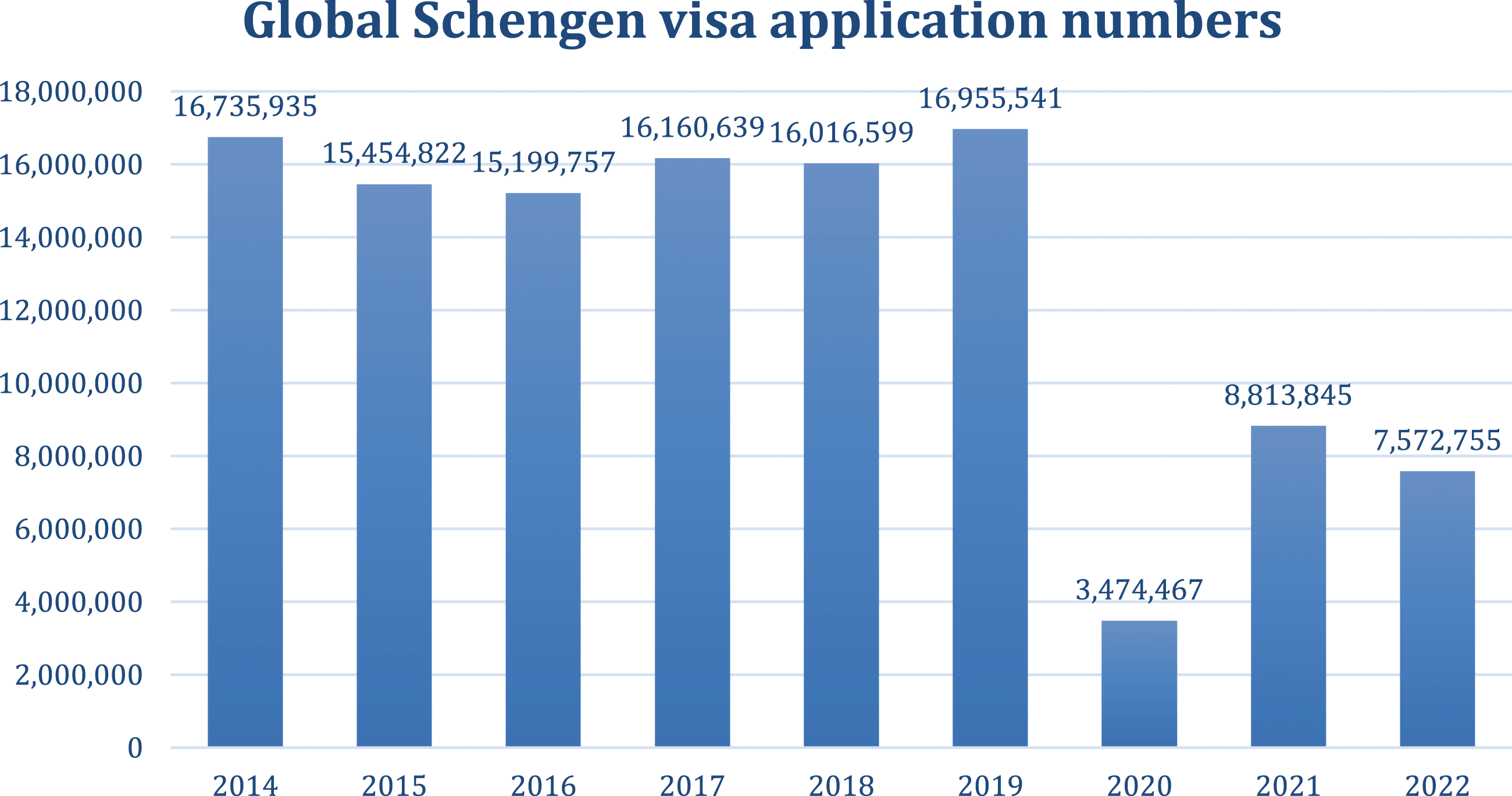
In addition to the fluctuating volume of Schengen visa applications, the dramatic increase in Schengen visa rejection rates reveals the worldwide and ongoing effects of the pandemic. Schengen visa rejection rates were rising even before the COVID-19 pandemic (see Chart 2). Although the visa rejection rate was 5% in 2014, it nearly doubled between 2014 and 2019. Nevertheless, these rates remained below ten percent before the pandemic. Global Schengen visa rejection rates (2014–2022). Source: European Commission (2024).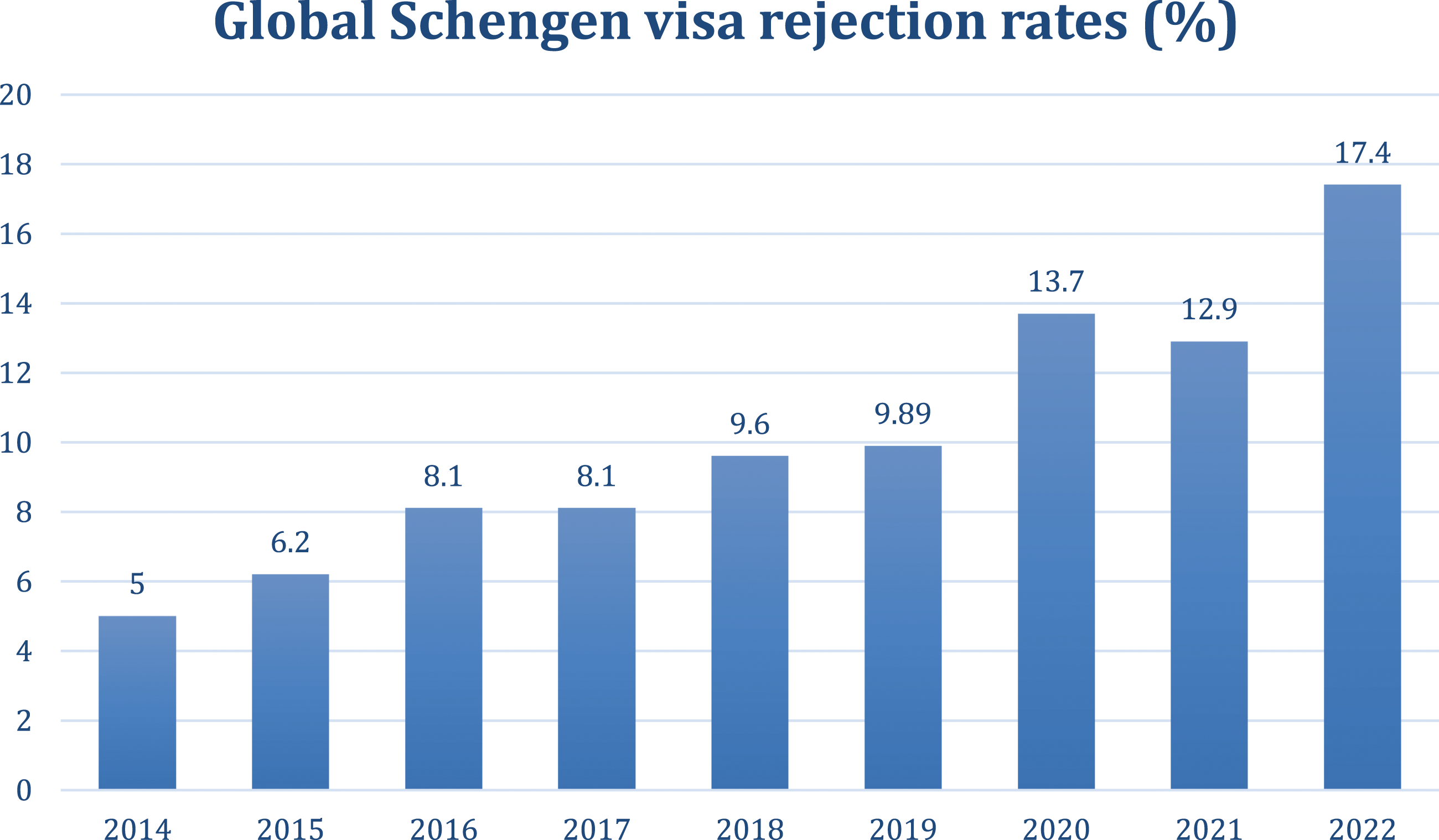
In line with strict visa policies, Schengen visa rejection rates reached 13.7% in 2020 during the pandemic, and this upward trend persisted after the pandemic, despite a 0.8% decrease in rejection rates in 2021. During the substantial relaxations of the COVID-19 pandemic period in 2022, the rejection rates increased dramatically from 2022 to 17.4%. While the COVID-19 pandemic has had a considerable negative impact on worldwide visa rejection rates, this trend continues even after the removal of pandemic regulations in 2022. This persistence of high Schengen visa rejection rates compared to pre-pandemic levels indicates regression of mobility rights as well.
Regarding rejections rates, the available data also show that Belgium, France, Malta, Spain, and Sweden had systematically higher visa rejection rates between 2019 and 2022 compared to other Schengen countries at the Schengen state level (European Council, 2023b). By consistently raising the rejection rate bars, these countries decrease overall permeability of the Schengen’s paper borders. Furthermore, these countries’ high visa rejection rates indicate that a decrease in mobility rights since the COVID-19 pandemic has been a significant practice in both Northern and Southern European countries, 6 similar to the pre-pandemic era (Landini & Sciortino, 2023).
Beyond these statistics, which only show the Schengen visa applicants who applied for a visa despite the existing mobility barriers and risks of being rejected, the regression of mobility rights can also be observed in the everyday experiences of visa applicants during the application processes. Two problems faced by Schengen visa applicants are especially noteworthy in the post-pandemic period: difficulties securing visa application appointments and extended processing times for obtaining a Schengen visa (European Commission, 2023). Because both the timing of visa application appointments and decisions regarding receiving a visa can affect travel plans, we consider that these factors are important for mobility rights. The EU officials acknowledge and justify visa delays due to “backlog from pandemic,” which is caused by the compounding factor of staff shortages and technical problems in Schengen consular operations after the pandemic in several countries Summer 2023 (Anadolu Ajansi, 2023; Netherlandsandyou.nl, 2023). These delays, which can last more than two months, negatively affect mobility rights during the post-pandemic period. As a result, while some visa applicants do not apply, others have to cancel their travel plans because of delays in the post-pandemic period in several countries including major hubs of Schengen visa applicants like Türkiye and India (Netherlandsandyou.nl, 2023; Schengenvisainfo.com, 2022). Moreover, these visa delays complicate already-existing financial barriers to get a visa which could officially take up to more than EUR 120. As the Commission’ State of Schengen Report (European Commission, 2023), reveals that “In some cases, applicants are paying up to EUR 500 to agencies or individuals just to secure an appointment” (p. 5). Accordingly, visa delays also negatively affect access to mobility rights through direct (i.e., missing planned travel) and indirect consequences (paying additional fees to grant an appointment).
Conclusion
By analyzing the evolution of the Schengen visa regime as the EU’s vital policy field during and after the pandemic, this study examined the change in mobility rights for Schengen visa applicants between 2020 and 2023. In this framework, we initially highlighted the EU’s two pandemic policies that created administrative gray zones for Schengen visa applicants: reclassification of Schengen visa applicant categories as essential and non-essential travelers, and the temporary introduction of public health policies like epidemiological risk categorizations, approval of SARS-CoV-2 virus vaccines, and the EU’s Digital COVID-19. The EU introduced these policies to border the flow of virus and to ensure free movement in the Schengen area. In fact, these policies provide more sophisticated health screening mechanisms and enable more flexible border regulations in the further phases of the pandemic for free movement. However, they sometimes caused additional administrative and legal limbos for visa applicants with important implications for mobility rights as well.
In relation to these temporary policies, we identified three developments in the Schengen visa regime that have been affecting visa applicants’ mobility rights during the (post-)pandemic period. These developments are the fluctuating application volumes owing to pandemic-related regulations, high visa rejection rates compared to the pre-pandemic period, and visa application process problems (i.e., limited access to appointment slots and long waiting times for visa applications due to limited consular operations). First, we discussed the visa application volume which did not return to the pre-pandemic level, despite travel relaxations since mid-2021. As a result of changes in Schengen visa policies during and after the COVID-19 pandemic, the global visa application volume has fluctuated severely. The consistent increase in Schengen visa application volume before the COVID-19 pandemic was historically low in 2020 and 2021. Despite the improvements since mid-2021, these numbers were still low in 2022 compared to those in the pre-pandemic period. These fluctuations in application volume indicate a decrease in attempts to use mobility rights through the Schengen visa. We also observed a proportional decrease in access to mobility rights in relation to Schengen visa issuance practices. Global Schengen visa rejection rates indicate that more people are likely to be excluded from mobility rights through Schengen visa rejection than during the pre-pandemic period. Moreover, a dramatic increase in rejection rates in 2022 shows that this trend has continued despite mobility relaxation in the post-pandemic period. Finally, we identified two visa application process problems that are affecting access to mobility rights. These problems include finding suitable appointment slots for planned travel and prolonged waiting times for visa decisions due to the backlog of the COVID-19 pandemic and limited consular services. As a result, visa applicants complain about limited available appointment slots, and long waiting times which can cause cancellation of planned travels, even if the visa is approved at the end.
By approaching mobility rights as a continuum rather than a binary variable of visa-free travel numbers, we incorporate Schengen visa policies, practices, and processes into the analysis. Hence, we highlighted the vital role of the Schengen visa regime in the EU pandemic governance in shaping access to mobility rights. Moreover, we discussed some of the repercussions of the COVID-19 pandemic period regulations in the post-pandemic period. Hence, we revealed the complex dynamics of the changes in the mobility rights of Schengen visa applicants.
Yet, this analysis of the Schengen visa system has limitations on the systematic analysis of the policy implementation variations across the Schengen states and ethnographic analysis of the lived experiences of visa applicants. Further studies can examine the international and domestic causes and effects of implementation variations across Schengen states during the pandemic and their significance for harmonizing the Schengen system in the post-pandemic period. Moreover, they can expand the scope of the analysis by examining the COVID-19 policies of Global South countries regarding the nationals of Global North countries and shed light on whether these policies were reciprocal. Finally, ethnographic research on visa applicants’ experiences can be very insightful in exploring how subjects can negotiate and resist border controls even in such unprecedented times. Hence, further studies can add depth into the analysis on the evolution of the Schengen visa regime in the (post-)pandemic period from alternative vantage points.
Footnotes
Acknowledgments
We would like to express our sincere gratitude to Assoc. Prof. Virginie Mamadouh and Dr. Yusuf Avci for providing invaluable insights and constructive feedback on the early versions of this article. Our thanks also extend to Assoc. Prof. Lacin Idil Oztig and Dr Umut Can Adisonmez, along with the team at Alternatives, for their continuous support. We are grateful to the diligent reviewers whose contributions have significantly improved the quality of the article. Finally, our appreciation goes to Editage ( ) and Sage Language Services for their assistance with English language editing.
Declaration of Conflicting Interests
The author(s) declared no potential conflicts of interest with respect to the research, authorship, and/or publication of this article.
Funding
The author(s) received no financial support for the research, authorship, and/or publication of this article.