




Abstract
This paper contributes to broader efforts to de-center and historicize IR theory by bringing into question dominant narratives about developing country behavior at the International Whaling Commission (IWC). This literature either neglects, or actively erases any possibility of developing country agency; different blindspots work to the same effect, whereby developing country behavior is assumed rather than investigated, and behavioral change, such as a decision to join the IWC, vote a certain way, or abide by the whaling moratorium, is driven mostly by exogenous factors—threats, bribes, and persuasion. If a developing country choosing a pro-whaling stance is evidence of vote-buying, and an anti-whaling stance is evidence of coercion or socialization, then great power agency is assumed to exist and matter without being demonstrated—and the possibility of agency is denied to most of the world. I use the case of Brazil, the last country to give up whaling in the American continent, to de-center and historicize important whaling-related decisions made from the 1950s–1990s. Brazil voted against the commercial whaling moratorium in 1982 but has since given up whaling and become a leader in whale conservation. The empirical analysis not only finds scant support for the dominant explanations, but it also challenges them on several grounds—and thus underscores the need for theoretical lenses that allow for developing countries’ agencies to be acknowledged. More than contributing to inclusive scholarship, taking alternative perspectives seriously is imperative for more just conservation practice, and more legitimate global governance.
Keywords
Intro
For the past several years, a “decolonizing mood” has permeated the IR academic community (Smith & Tickner, 2020, p. 1). Long criticized for its Western-centrism and lack of diversity, a pluralization project has gained traction with the Global IR project (Acharya, 2014). Global IR fosters a “pluralistic universalism,”—a place for marginalized actors, however one might define marginalization, to work towards more inclusive and diverse IR theory (Acharya, 2014, p. 649).
Global IR emphasizes diversity as a given condition and a core concept, rather than “a ‘critique’ from the outside” (Wiener, 2018, p. 18). It is not calling from “the margins” (Steans, 2003), “the periphery” (Tickner, 2013) or “from below” (Blaney & Inayatullah, 2008), but rather re-envisions the whole discipline as “truly” global and diverse. It rejects the universalism-relativism dichotomy, asserting “the opposite of homogenizing universalism is not relativism, but pluralism. Pluralistic universalism views IR as a global discipline with multiple foundations” (Acharya & Buzan, 2019); but in an important move, Global IR also rejects the type of “integrative pluralism” suggested by Dunne et al. (2013), the “theoretical peace” or “dialogue of the deaf” (Hurrell, 2016; Steans, 2003), where silos respectfully co-exist but do not interact.
De-centering and historicizing are essential tasks for pluralization; as many before them, Acharya and Buzan (2019, p. 308) demonstrate how some of the most sedimented IR narratives are “self-serving, ahistorical and brazenly racist” European oversimplifications of world history. For instance, the Cold War is termed “the long peace,” despite colonial wars erupting in much of the so-called Third World (Acharya & Buzan, 2019). Colonialism indeed has been largely ignored in theory-building (Acharya, 2014; Kayaoglu, 2010); Cuba was deemed irrelevant to the Cuban Missile Crisis, even as an oral history project attempted to reverse such invisibility (Laffey & Weldes, 2008). Indeed, much critical IR research reveals how dominant IR narratives about the “real,” “universal,” and “ahistorical,” are partial, situated perspectives (Blaney & Inayatullah, 2008; Epstein, 2017b) with limited applicability to most of the world (Neuman, 1998; Smith & Tickner, 2020). Critical IR scholars have challenged the utility and generalizability of core concepts and assumptions in the discipline, such as order (Smith, 2020), peace and conflict (Meyer, 2008; Tickner, 2020), state and sovereignty (Behera, 2020; Inayatullah & Blaney, 1995), security (Bilgin, 2020), foreign policy (Calkivik, 2020), international norms (Epstein, 2017a), regionalism (Deciancio, 2016), “world” history (Acharya & Buzan, 2019; Phillips, 2016), among others (Neuman, 1998; Tickner, 2003b; Walker, 1993).
In the words of Sajed (2012, p. 143), one of the main goals of such research has been “to bring a sense of historicity and contingency to a field that asserted its ahistorical truths and policed them with a fierce stubbornness.” This paper historicizes and de-centers the politics of whaling, a thematic field within IR in which the dominant narratives afford little agency to developing countries. I use the term ‘developing countries’ as a broad, imperfect term, to describe a condition of marginality in IR theory and practice, akin to the Global South, the Third World, the periphery, etc. Although such terms are often recognized as “problematic” but “useful” “analytical categories” (e.g., Acharya, 2014; Smith & Tickner, 2020), whaling politics are particularly useful in showing how such categories are relational and contextual. While the majority of analyses of whaling politics highlights a binary division along East-West 1 (Epstein, 2008; Kato, 2015; Kolmaš, 2021b), of a “cultural gulf” (Glass & Englund, 1991), of cultural imperialism (Freeman, 2001; Kalland, 1993a, 1994), and food hegemony (Barsh, 2001), this paper reorients the analytical categories to North-South, whereby Japan, the US, Norway, Iceland, the UK, etc., are on the same side of the binary—thus allowing more visibility to developing countries.
IR theory portrays developing countries in the history and politics of whaling as resigned respondents to threats, bribes, or as passive norm-takers. I challenge those assumptions by focusing on the case of one developing country, Brazil. Brazil was the last country in the American continent to give up whaling, after voting against the whaling moratorium in 1982—but is now a prominent anti-whaling member, and a leader in whale conservation. The analysis shows significant more local/national agency in whaling-related decision-making than the literature has commonly afforded to countries like Brazil. Beyond an impoverished IR theory, such neglect may conceal important lessons for conservation practice.
I proceed as follows: First, I review the IR literature on the politics of whaling, demonstrating how traditional IR assumptions about developing countries’ behavior at the International Whaling Commission (IWC) are uncritical, ahistorical, and often unsubstantiated accounts—that have nonetheless become self-evident truths in the field. I show how epistemological blindspots make it impossible to find developing country agency; their perspectives are assumed rather than analyzed, and their behavior is attributed to exogenous factors—namely bribes, coercion, and persuasion. This one-sided perspective assumes “great power” agency exists and matters, while the possibility of agency is denied to the majority of the world. Second, I describe the methodology and data. I use the methods of de-centering, stories, and contrapuntal reading (Bilgin, 2016; Said, 1994; Smith & Tickner, 2020) to historicize the complexities and overlapping events that led to important whaling decisions in Brazil. Data sources include publications, policy documents, interviews, and news articles, read and analyzed in their original Portuguese, and translated here. The empirical section then re-constructs five important whaling developments in Brazil: (1) The establishment of a “Japanese” whaling business, (2) Brazil’s membership and participation at the IWC, (3) Brazil’s vote against the IWC whaling moratorium, (4) Brazil’s compliance with the moratorium, and (5) Brazil’s “fast consolidation” as an anti-whaling country. I end by summarizing the case’s main challenges to IR’s dominant understanding of whaling politics, and the wider implications of scholarship’s complicity in perpetuating hierarchical relations among nations.
IR Theory and the Politics of Whaling
Whaling politics has been a fertile ground for IR research, 2 particularly regime theory. Signed in 1946 by 15 whaling nations, the International Convention for the Regulation of Whaling created the International Whaling Commission (IWC), in order “to provide for the proper conservation of whale stocks and thus make possible the orderly development of the whaling industry” (ICRW, 1946). Currently with 88 members, the IWC has provided almost eight decades of empirical material to IR scholars.
Rationalists have long been drawn to whaling politics, which provides a classic example of international (non)cooperation and bargaining among self-interested rational actors in a common-pool resources, tragedy of the common’s scenario—and as such, is a case for regime effectiveness “lessons” (Andresen, 1993, 1998, 2002; DeSombre, 2001; Friedheim, 2001; Hurd, 2012; Lieberman et al., 2012; M'Gonigle, 1980; Mandel, 1980; Mazzanti, 2001; Mitchell, 1998; Sigvaldsson, 1996). Rationalists have also used the IWC to study the relationship between foreign aid and voting patterns in international organizations (Dippel, 2015; Miller & Dolšak, 2007; Strand & Tuman, 2012). As the first global success story for environmental NGOs (Epstein, 2008), the politics of whaling literature expanded agency theorizing in IR beyond the nation-state (Andresen, 1989; Heazle, 2006; Mandel, 1980; Skodvin & Andresen, 2003), and the rise and spread of the anti-whaling norm has been studied from several perspectives, advancing our understanding of international norms dynamics (Bailey, 2008; Deitelhoff & Zimmermann, 2020; Epstein, 2006; Hirata, 2004; Nadelmann, 1990; Peez & Zimmermann, 2022; Sakaguchi, 2013; Stoett, 1997, 2005; Tatar, 2021).
Explanations for Developing Country Behavior at the IWC.
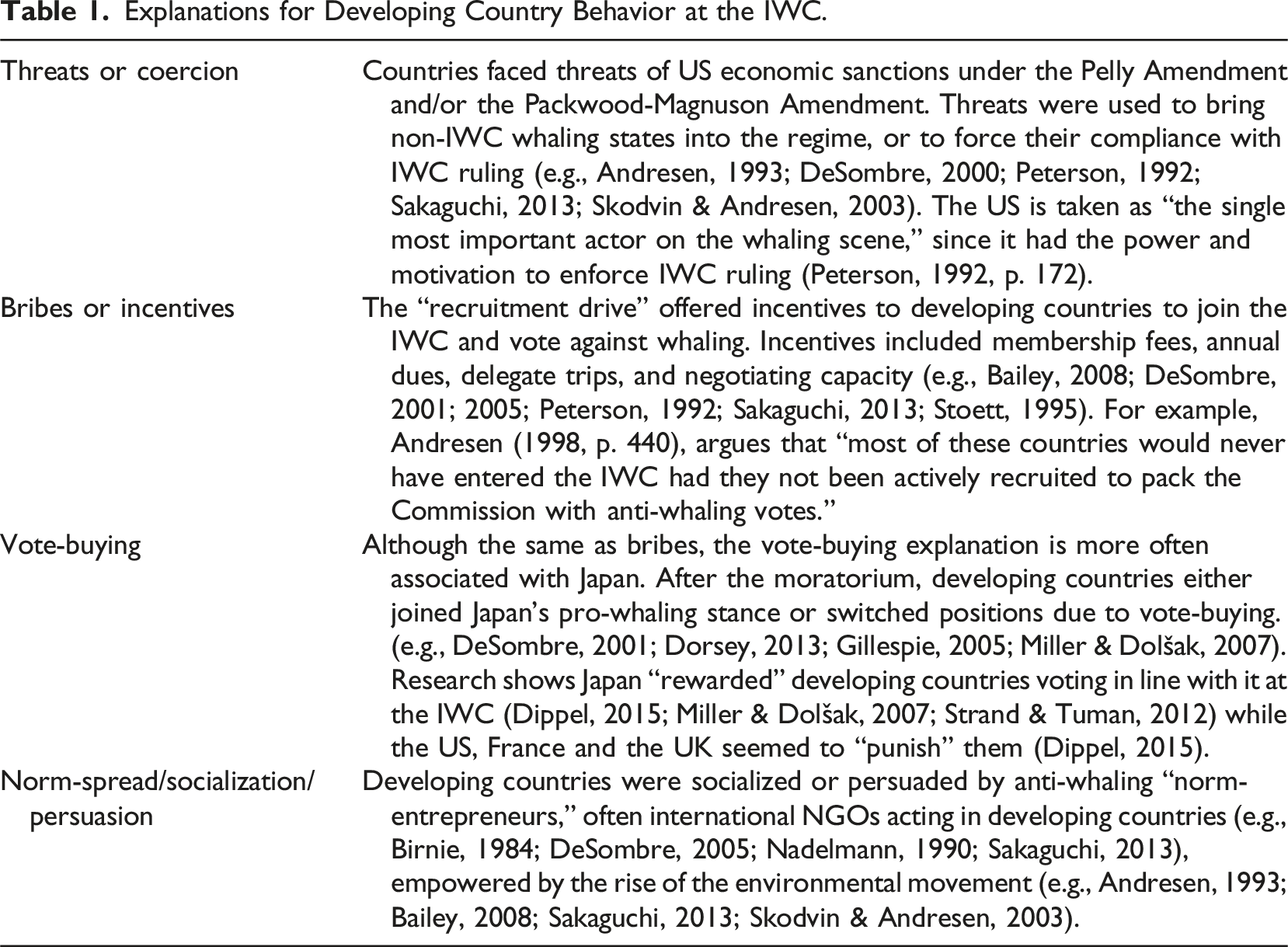
What these explanations share is the depiction of developing countries as little more than pawns in the game of the powerful, where bribes, threats, and vote-buying are part of great power politics, and/or as the passive blank canvases of norm socialization (Epstein, 2017c).
DeSombre (2001, pp. 192, 185) argues that all the bullying and bribing that transformed the IWC regime may have meant “winning the battle while losing the war,” since it may “not represent the real views of interested parties.” While I agree that IR scholars need to question the “effectiveness” of bribing and bullying beyond their short-term outcome, I argue IR scholarship is blind to what the “real views” of developing countries in the politics of whaling are. That the history of whaling is inseparable from colonial and imperial expansion (D’Ambrosio, 2014; Howkins, 2017) is never mentioned; The fact that many of the developing countries joining the IWC in the 80s were newly independent states is only relevant insofar as they were vulnerable to bribes and manipulation. And while developing countries’ perspectives are neglected, a book like activist David Day’s (1987) the Whale War is an ubiquitous source. Most of the claims throughout Day’s book lack evidence or sources but are often cited in the literature, if in less derogatory terms 6 (e.g., DeSombre, 2001, 2005; Peterson, 1992; Stoett, 1993, 1997).
More than an impoverished theory, this epistemic violence hinders our ability to find better solutions to the world’s problems (Smith & Tickner, 2020; Spivak, 1988). And while we might not know the “real views” of non-whaling developed countries like Switzerland either, Switzerland’s capacity to make sovereign decisions is never questioned, even as it abstained during the moratorium vote. As former Antigua and Barbuda Ministry of Agriculture Joanne Massiah put it, “it’s simply a matter of rank hypocrisy” (Bousquet, 2006); she elaborates: “We are accused of selling our votes and prostituting our sovereignty. But as sovereign states, we take great offence to this. No one questions the land-locked European states who have no oceans for whaling or whale-watching, but which have joined the IWC.”
The IWC case thus highlight how “dominant modes of IR analysis participate in the production of hierarchical international relations,” whereby “hierarchy is not produced by the actions of states alone but also in scholarly and popular analyses of world politics” (Chowdhry & Nair, 2002; Laffey & Weldes, 2008, p. 558; Tickner, 2003b). By uncritically accepting and reproducing claims such as those made in Day (1987) as self-evident, scholars have let unsubstantiated arguments acquire a taken-for-granted explanatory power that continues to define who matters in the IWC regime; such domination is an effect of power, a reflection of how some actors’ accounts of events have been taken seriously and made into generalizable theory, while others have been ignored or marginalized as unimportant (Doty, 1996; Laffey & Weldes, 2008; Smith & Tickner, 2020); Of how gatekeeping practices deem some partial perspectives as contributing to IR theory and others are demoted to the realm of foreign policy analysis or area studies (Abu-Bakare, 2022; Hagen & Ranawana, 2023; Umar, 2023).
Crucially, I am not arguing that threats, bribes, or persuasion never happened in the IWC. But a Global IR framing leads me to question the prevalence of these explanations, that they were the only or even the most important factors shaping developing countries’ whaling positions. If a developing country choosing a pro-whaling stance is evidence of vote-buying, and an anti-whaling stance is evidence of threats, then great power agency is assumed to exist and matter without being demonstrated, and the possibility of agency is denied to most of the world. Beyond theoretical or ethical imperatives, uncovering alternative perspectives can foster more equitable global conservation governance.
Methods and Data
While recognizing the importance of going “beyond critique” (Hurrell, 2016), theory-building is not the goal of this paper, not least because so little has been written about developing countries’ perspectives at the IWC. Rather, I follow Smith and Tickner (2020) in that “decentering” and “counterpoint” through “stories” are methods to render visible dominated perspectives and challenge the primacy of dominant IR narratives. De-centering, in this case, means to take the gaze away from dominant Euro-American IR accounts of developing countries in the politics of whaling, and to ground it in the Brazilian experience instead. More than taking different starting points, de-centering requires giving voice to Brazilian actors and scholars. This is facilitated through the use of stories, which, as opposed to “scholarly prose,” “allow us to lower our guard, avoid trying to fit things into accepted categories” (Smith & Tickner, 2020, p. 4). Stories do not imply untrue or unsubstantiated, but rather are meant to emphasize a freeform commitment to de-centering dominant narratives without immediately reducing these alternative narratives back into universal theorizing. As such, stories enable findings of multiple “beginnings” (Bilgin, 2016, p. 141), or indeed “multiple valuable positions” on the same issue (Innayatullah, 2013, 195), thus “opening the space for the creative and transgressive power of diversity and difference” (Smith & Tickner, 2020, p. 4).
Similarly, counterpoint, or contrapuntal reading, which draws on the work of Edward Said (1994), is a method in postcolonial IR (e.g., Bilgin, 2022; Chowdhry, 2007; Hindawi, 2021), and has recently made inroads in Global IR (Bilgin, 2016). The method exposes “overlapping territories” and “intertwined histories” of dominant and dominated, past and present (Said, 1994, p. 61). It seeks to extend “our reading of the texts to include what was once forcibly excluded” (Said, 1994, p. 67), to render visible the “multiple layers” of “existing stories” (Bilgin, 2016, p. 128). To Chowdhry (2007, p. 305), contrapuntal reading is a plea for historicizing “texts, institutions and practices (…), for paying attention to the hierarchies and the power-knowledge nexus embedded in them, and for recuperating a ‘noncoercive and non-dominating knowledge.’” Historicizing dominant narratives thus helps denaturalize them by “revealing their connections to existing power relations” (Deciancio & Tussie, 2022, p. 241). It is an exercise in exposing self-evident truths that dominant narratives have “monopolized and naturalized” (Smith & Tickner, 2020, p. 10). Such critical readings serve to show “that things are not as self-evident as one believed” (Foucault, 1988, p. 155).
Bilgin (2022, p. 779) notes that texts needed to decenter dominant narratives are often absent from “known outlets,” as understood in academia. Furthermore, they may not be available in English (Smith & Tickner, 2020); 7 Many developing countries lack organized or accessible archives, and indeed many of the sources I use are not available in English, 8 nor in physical or digital archives. Nonetheless, alternative narratives do exist, and I triangulated a wealth of sources (Appendix) to re-construct Brazil’s positions on whaling politics. With the aid of NVIVO software, I analyzed and coded these data for whaling-related contexts, actors, decisions, rationales, policy-changes, and events that were then layered over a timeline. The coding scheme was approached deductively and inductively (Kuckartz, 2014), and the process was iterative as sources analyzed often snowballed into other relevant sources (Waitt, 2005). The interpretive approach relies on meaning (not count), and thus the validation test is the point of theoretical saturation—when the addition of new text does not change the author’s interpretation of the issues (Epstein, 2008; Milliken, 1999).
Five key moments emerged from the analysis, although overlaps, contradictions, and coexistences complicate any notion of a single Brazilian position on whaling—and challenge any overly simplistic explanation, especially those premised on exogenous factors. Rather, the five key moments were identified because they represent a consolidation or change in the “story” of Brazil’s position and directly challenge dominant narratives. The five moments are: (1) The establishment of a “Japanese” whaling business, (2) Brazil’s membership and participation at the IWC, (3) Brazil’s vote against the IWC whaling moratorium, (4) Brazil’s compliance with the moratorium, and (5) Brazil’s “fast consolidation” as an anti-whaling country.
Each section, numbered #1 through #5, starts with a shaded box that summarizes the dominant narratives’ explanation of that moment. Although Brazil is rarely mentioned explicitly in the politics of whaling literature, the examples I find follow the assumptions about developing countries, broadly. I quote Day (1987), whenever possible, to further illustrate the troubling ground upon which the dominant narratives stand. I then reconstruct the Brazilian perspective through the stories emerging from the data, historicizing the complexities and the contexts in which those decisions were made. I end each section by summarizing the direct challenges to dominant explanations the evidence poses.
Empirical Analysis
#1—The Establishment of a “Japanese” Whaling Business in Brazil
IR scholars view Japanese whaling in Brazil as a colonial enterprise in which Brazil had little agency. For example, Stoett (1993, p. 290) cites Brazil and other developing countries to describe a “Japanese whaling empire;” he claims “Japanese companies have been accused of establishing, through the export of capital and expertise, pirate ‘whaling colonies’.” Elsewhere, Stoett (1997) offered Brazil as an example of Japanese vote-buying, which is then cited by Epstein (2008, p. 43) as evidence of “Japanese whaling global expansion.”
9
Whenever references are offered, the claim of “Japanese whaling colony” comes from Day (1987, p. 39), or Palazzo (1999), a Brazilian environmentalist and former IWC delegate, who is taken out of context.
10
This narrative implies and/or assumes that whaling began in Brazil with the Japanese and that Brazil had little control/interest in it.
Indigenous communities in Brazil opportunistically used stranded whales long before Europeans arrived (Toledo, 2009). Active whaling began in 1602, under Portuguese colonial rule (Hart & Edmundson, 2017; Toledo, 2009). It was opened up to private companies in the late 1700s, following North American and British whaling expansion towards the South Atlantic (Toledo, 2009). After independence (1822), whaling continued in six states (Hart & Edmundson, 2017), but when the IWC began debating commercial whaling moratoria in the 1970s, only one whaling station remained, in Lucena, state of Paraíba, in the Northeast. Whaling in Lucena dates back to 1911, when the private firm Companhia de Pesca Norte do Brasil 11 (COPESBRA) expanded its fishing business to Paraíba (Hart & Edmundson, 2017); operations continued until whaling was outlawed in the 1980s.
From the beginning, COPESBRA was run by businessmen of European descent (Dutch, British, Portuguese), with European input, technology, and expertise, especially from Norway. Historically focused on humpback whales for oil (Toledo, 2009), after World War II, COPESBRA began catching other whale species, selling whale meat to locals, and exporting baleen to France for corsets and shirt collars (Hart & Edmundson, 2017). The business was greatly impacted by the 1929 economic crash and World War II, and by the 1950s, it was facing financial instability (Hart & Edmundson, 2017).
The Great Depression and World War II had put into sharp relief the need to diversify the Brazilian economy, which still followed the colonial model of agricultural production for foreign consumption at the detriment of the local population, and a heavy reliance on imports for industrialized goods. The postwar period marked Brazilian elites’ “disillusionment” with the US, and we see in the 1950s the first consistent breaks in the long-standing foreign policy tradition of “automatic alignment” with the US (Bandeira, 1999; Ricupero, 2017). In 1956, President Juscelino Kubitschek (1956–1961), or JK, was elected on the promise to achieve five decades of development in five years. His “Targets’ Plan” implemented policies to accelerate development through import substitutions and heavy industrialization (Franca, 2019; Joaquim, 2008). The focus was on opening the economy to foreign capital while maintaining state oversight. JK saw in the post-war recovery of Europe and Japan new potential trading partners that could reduce reliance on US markets (Ricupero, 2017).
Fishing was one of the Plans’ targeted sectors. The previous Brazilian Fishing Code (1938) prohibited foreign ships (and national ships staffed by foreigners) from operating in Brazilian waters. Under new policy, foreign fishing companies could operate their boats in Brazil on a contractual, case-by-case basis. The idea was to integrate “advanced technology and modern equipment into the national fleet in order to increase fishing expertise and boost food production” (Hart & Edmundson, 2017, p. 102). In this climate of official encouragement, the Japanese multinational Nippon Reizo became a whaling partner, in 1958; COPESBRA remained a Brazilian registered company, with 60% Brazilian capital and 40% Japanese (Hart & Edmundson, 2017). Nippon Reizo was authorized to bring Japanese whaling ships to Brazil and required to have a two-thirds Brazilian crew within two years. It should use the “most modern” techniques, as “the useless death of the whales” was not permitted (Hart & Edmundson, 2017, p. 104).
The Japanese investment modernized Brazilian whaling, bringing newer ships and skilled workers to train the Brazilian workforce—and investments and technology that propelled local businesses. Catches more than doubled from 1958 to 1959, and processing efficiency improved; while Euro-American whaling practices tended to focus on oil extraction (Tønnessen & Johnsen, 1982), the Japanese techniques only wasted the blood.
Nationally, JK’s developmentalist policies had mixed results (Franca, 2019; Ricupero, 2017); but the Brazil-Japan whaling partnership was financially successful and had high local support (Duarte Filho & Aguiar, 2014). JK’s policies represent a shift not just in Brazil, but Latin America’s thinking about development (Tickner, 2003a, 2008), and similar whaling partnerships occurred at least in Chile and Peru (Quiroz, 2014).
Thus, dismissing the business as a “Japanese whaling colony” not only ignores Brazil’s agency in actively seeking the partnership and maintaining the business as part of a Brazilian led development plan, but it also erases all Western responsibility in establishing the business as a colonial enterprise, and later driving much of the demand. And while whaling eventually ended, the business model did not; following the whaling ban, COPESBRA focused on activities elsewhere, most notably shrimp trawling in the state of Pará (Hart & Edmundson, 2017). It also invested in fruit processing in Pernambuco, a business that still exists today, as “Niagro-Nichirei do Brasil Agrícola Ltda.,” whose mission is to “supply healthy fruit products all over the world.” It processes acerola-fruit in Brazil to export to Japan, Europe, and North America (Niagro, 2024).
#2—Brazil’s Membership and Participation at the International Whaling Commission
The IR literature assumes Brazil is disinterested in the IWC, its membership and participation an outcome of Japanese bribes or Pelly Amendment coercion. Day (1987, p. 39) claims that in 1974 “Japan rigged the voting by recruiting Brazil as an IWC nation,” to vote against a whaling moratorium being proposed that year. According to him, the “Japanese-owned and managed” whaling station in Brazil had served as a flag of convenience for Japan to illegally hunt endangered whales, but now “Brazil’s whaling commissioner served very nicely as a Japanese puppet when it came to moratorium ruling.” Alternatively, Dorsey (2013, p. 33) attributes Brazil’s membership to the US “effort to coerce nonmember states, like Brazil, to bring their operations under the IWC umbrella.” Indeed, most authors claim that nations whaling outside the regime joined thanks to US coercion, since they had “little incentive to join” and would “otherwise have chosen to free ride” (DeSombre, 2001, p. 192). Thus, if a whaling developing country joined, it was US coercion; but if they joined and voted pro-whaling, Japan bribed them.
Although Brazil was one of the 15 original signatories to the 1946 whaling convention, it withdrew participation from the IWC in 1965, following the military coup in 1964 (1964–1985). When the military government rejoined the IWC by Legislative Decree no 77 in 1973, it provided the following rationale for the 1965 departure: First, the lack of interest on the part of Brazilian technical bodies in the work of the Commission, at a time when our modest whaling fleet did not see its work hampered by the gradual destruction of certain species that the large fleets of some countries had been carrying out; and second, the limited success achieved by the Commission in its conservationist work (M. G. Barbosa, 1973, p. 5663).
Written by then Minister of Foreign Relations Mário Gibson Barbosa, the decree’s “Motives Explanation” argued that rejoining the IWC was in Brazil’s “economic and national interest.” It denounces the 1972 UN Conference on the Human Environment (UNCHE) for inspiring global anti-whaling sentiments, whereby “countries such as Japan and the USSR, owners of the largest whaling fleets (…) and countries such as Brazil, owner of a tiny fleet, were the target of indiscriminate attacks.” The targeting of Brazil is described as unfair, but the proposal to study a potential moratorium 12 is described as “reasonably moderate.”
Catches in the Southern Hemisphere, 1900–1985.
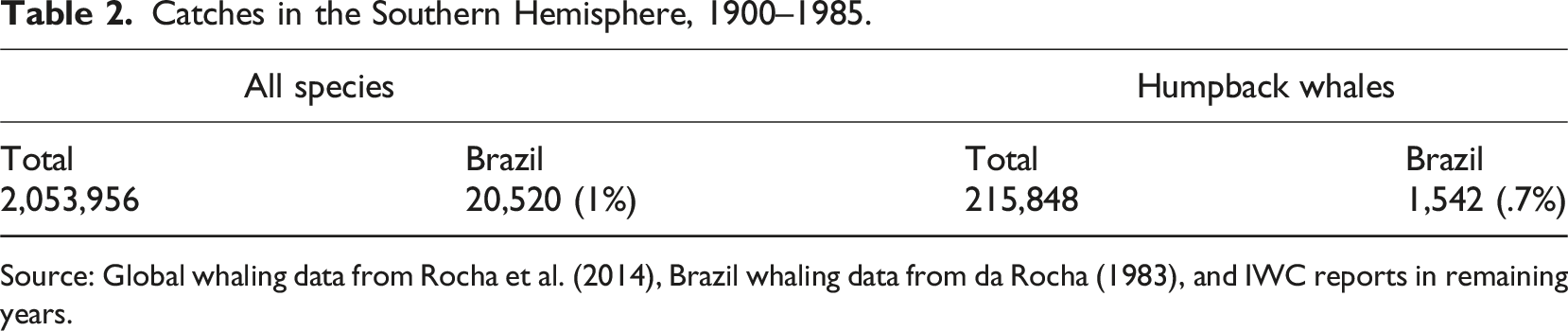
Source: Global whaling data from Rocha et al. (2014), Brazil whaling data from da Rocha (1983), and IWC reports in remaining years.
Barbosa concludes that, although a blanket moratorium could harm Brazil, “stricter conservation measures” were in the national interest. Thus, the IWC’s lack of success in conservation was given as one of two main reasons Brazil left the IWC in 1965, while an opportunity to act in favor of conservation was a reason to rejoin in 1973. Indeed, in one of Brazil’s first interventions at the IWC, it stated that it did not “agree with the exploitation of a natural resource without maintenance of that resource,” and that “it is necessary to give the commission the means to make it a true international forum for all matters concerned with conservation and exploitation of whales” (IWC, 1976, p. 19).
As such, Brazil reacted to UNCHE’s call for a whaling moratorium as it did to the conference more broadly—it perceived UNCHE as ignoring the historical role of the North in causing environmental problems and attempting to resolve them by limiting growth in the South (Castro, 2015). In being grouped indiscriminately with large industrial whaling countries, Brazil perceived a “big power hypocrisy” that often triggers developing countries to act (Acharya, 2018, p. 54). The budding environmental movement, however, also provided an opportunity to get the IWC to do what it had thus far failed to accomplish, and what Brazil could not accomplish unilaterally—namely to limit Japan and USSR’s indiscriminate catches. The literature has assumed that the US coerced nations into the IWC so they could be better controlled, and that international NGOs pushed conservation ideals. But all the evidence points to Brazil joining the IWC because it believed it could help control nations that had historically abused their power. The budding environmental movement was a trigger, but because it was a rising force that could help constrain the great powers through the IWC. Whale conservation ideals were already present in Brazilian government and society.
Far from a “Japanese puppet,” IWC’s verbatim records show a country that was confrontational with Japan, especially on Area II 15 quota disputes. In 1976, Brazil raises in plenary that Area II countries could not reach a quota agreement, so it proposes that “in the event of member countries being unable to agree on the allocation of quotas between them, a panel of commissioners should be asked to assist in resolving this difficulty” (IWC, 1976, p. 61). Rather than surrendering to another country’s will, it was using the institution to leverage power over negotiations it had always viewed as unbalanced.
#3—Brazil’s Vote Against the Whaling Moratorium
The politics of whaling literature assumes Brazil’s vote against the moratorium in 1982 was bought with Japanese foreign aid. Day (1987, p. 33) asserts that Brazil “served very nicely as a Japanese puppet when it came to moratorium.” Without providing a date, title, or author, he claims that an article on the newspaper Folha de São Paulo reported a Japanese offer of US$400 million in agricultural support, in exchange for a vote against the moratorium. DeSombre (2001) quotes Day to suggest Brazil, (also Chile
16
and Peru) voted against the moratorium because of Japanese foreign aid.
Brazil and six other countries voted against the IWC commercial whaling moratorium in 1982. Despite its whaling industry, it was not a straightforward decision, as anti-whaling sentiment existed within government and society. Senator Nelson Carneiro introduced the first senate bill (PLS 248/1976) to ban whaling in Brazil in 1976, but it would take almost a decade before a ban passed (see #4).
In 1973, Brazilian environmentalist Admiral Ibsen Gusmão Câmara became the first secretary of the newly created Inter-ministerial Commission for Sea Resources 17 (CIRM). CIRM is a navy-coordinated body integrated with various ministries, responsible for drafting recommendations related to ocean resources. Câmara, previously a covert anti-whaling campaigner, used his position within the military government to oppose whaling more directly (Sá de Corrêa & Brito, 2006).
In 1976, under Câmara’s leadership, CIRM held an extraordinary session to determine Brazil’s position at the IWC that year, in light of “the US proposal” for a full moratorium and “the Australian proposal” for the adoption of the New Management Procedure (NMP). 18 SUDEPE argued against the US proposal, which “lacked a technical and scientific basis,” and supported the NMP, which was considered a scientific yet sustainable approach to whaling (SUDEPE, 1982, p. 10). CIRM then made several recommendations in line with the Australian proposal through publishing Act no 4/76, including that Brazil should continue to “participate at the IWC, making efforts to improve the mechanisms for the preservation and rational exploitation of species,” and “continue to endorse (…) measures leading to a moratorium on the catches of demonstrably declining stocks” (CIRM, 1976).
Less than a year later, however, another meeting was requested, and the various ministries in attendance were divided (CCMA, 1977, SUDEPE, 1982); The final vote was four in favor of whaling and five against (SUDEPE, 1982). CIRM then changed its recommendation, affirming that “whaling in Brazil must cease” (CIRM, 1977). Whaling was to be phased out over two or three years, while other economic activities should be implemented to replace it. Additionally, CIRM noted, “these measures, adopted internally, should not be carried out in such a way as to allow other whaling countries to share quotas currently assigned to Brazil” (CIRM, 1977).
While the first CIRM recommendation had considered “the conservation, economic, social and international aspects” of whaling, the new recommendation concluded that “policy on the subject should be guided by the conservationist principles” (CIRM, 1977). Following CIRM’s updated recommendation, on July 24, 1979, through official order no 017/79, SUDEPE was to forbid whaling starting on January 1st, 1981, highlighting Brazilian law restricts the use of its natural resources to species not threatened by extinction. Notably, it argued that “national conscience repeals the killing of whales, regardless of its economic and social benefits” (SUDEPE, 1979). The order also noted the Northeast’s dependence on whaling, and emphasized the need to find and implement economic alternatives during the two “grace years” (SUDEPE, 1979). Later that year, however, a SUDEPE working group report suggested delaying the ban until 1988, arguing more time was needed to find alternatives (Correio Braziliense, 1979). The report also noted the health of minke whale populations, suggesting that a ban in Brazil would merely transfer its quota to other management Area II countries, Japan and the USSR (Correio Braziliense, 1979). These two points—the need for economic alternatives and for all countries to stop simultaneously, were reiterated in newspapers and in Brazil’s position at the IWC the following year: The position of my country, I repeat, is definitely to work toward the ceasing of whale killing but within a reasonable period of time which gives the possibility to make a full adaptation of the people dedicated to this activity to a new form of activity if possible, and also with the provision that this is done by all members altogether. It would make no sense whatsoever to abstain while others would continue. It’s a matter of almost a postulate for us that, if we decide to do it, it has to be a general game, not a game in which one does it, one doesn’t do it (IWC, 1980, p. 72).
In December 1980, SUDEPE issued a new order, no 030/80, officially allowing whaling to continue, just before the ban was to take effect (SUDEPE, 1980). The Ministry of Agriculture explained that revoking the order was “a decision that was above all social,” and that alternatives for the local population were needed before whaling could be suspended (quoted in Hart & Edmundson, 2017, p. 145). Brazil indeed abstained from voting on a blanket moratorium in 1981 (IWC, 1981), and SUDEPE, 1982 clarified that Brazil’s position was to encourage development of moratorium proposals at IWC’s technical committee, but that a favorable vote in plenary depended on other countries’ positions. Brazil’s official position was also that if moratorium proposals failed, the delegation was to secure a minke quota—reinforcing its unwillingness to stop unless everyone did. SUDEPE would later decide how much of the quota to authorize, according to “the degree of development of alternative fishing programs” (SUDEPE, 1982, p. 12).
With the suspension of order 017/79, the whaling debate intensified, and anti-whaling protests were widely reported. As it looked inevitable that a moratorium would eventually pass, politicians, labor unions and cooperatives asked the Food and Agricultural Organization (FAO) to intervene at the IWC on Brazil’s behalf. The document argued that “for a hungry population, who survives thanks to meals provided by whale meat, and for workers who dedicate their lives to the activity, philosophical or sentimental reasons for the interruption of whaling were not enough to justify the starvation and unemployment that they would suffer” (O Norte, 1981b). The FAO, a body with food security as its ostensible mission, came out in support of whaling in Brazil (O Norte, 1981a).
What becomes clear in this period, is that to Brazilian authorities the concern was the nation’s socio-economic needs, specifically in the Northeast region. Both pro- and anti-whaling advocates demanded attention to socio-economic problems, and even pro-whaling supporters did not defend whaling per se, but rather the right to sustainably use a resource that provided jobs and food security. Crucially, renouncing whaling while Japan and the USSR continued was perceived as tremendously unfair and untenable.
In 1982, in voting against the moratorium, Brazil did not passionately defend science-based sustainable whaling, as did Norway, Iceland, South Korea, and Japan. Brazil fell back on the principle of non-intervention, simply stating that it aligned with other Latin American countries’ statements, “in order that it is our strong belief that the provisions of this commission must be applied taking into account the rights of the coastal States to all the resources within their economic exclusive zones” (IWC, 1982, p. 83). As such, it was once again seeking to protect itself from potential foreign intervention by reinforcing the rule of international law—as did most of Latin America, regardless of how they voted.
Nothing in the data suggests Brazil’s vote was “bought” by Japan. The article in the Folha de São Paulo cited by Day (1987, p. 107) is not about whaling; it is a full-page report on the Japanese Prime Minister visit to Brazil. It focuses on Japan-Brazil economic relations, particularly Japanese investments in Brazil (primarily in the steel and agricultural sectors). The whaling reference is brief and immediately dismissed: Japan hopes to get Brazil’s understanding at the international level, regarding its position on whaling. In that regard, the Brazilian Minister asserted there is no change in the position already defined by the federal government, which is to accept whaling, as long as it is within acceptable standards set by the scientific community” (Folha de São Paulo, 1982, 16).
News reports through the years do quote environmental activists denouncing Japanese lobbying congress; But as I show in more detail next, all the actors involved were politically active, and lobbying congress was but one of their many strategies.
#4—Brazil’s Compliance with the Moratorium
Sakaguchi (2013) argues
19
Brazil complied with the moratorium due to a combination of US threats and international NGO persuasion, effectively socializing the anti-whaling norm in the country. He further argues that the lack of national, cultural, and economic importance of whaling, which, he claims, was a “de facto Japanese operation,” made it so Brazil “did not show a strong sense of resentment when they were threatened with sanctions” (Sakaguchi, 2013, p. 201).
Under President Geisel (1974–1979), Brazil’s military dictatorship (in place from 1964 to 1985) had begun a process of political opening called “distensão”—a plan to strategically restore civilian democratic rule (Salomão, 2019). President Figueiredo (1979–1985) deepened the commitment to democratic opening, granting political amnesty and allowing the return of those previously persecuted, imprisoned, or exiled for political crimes 20 (Salomão, 2019). He also reformed political party laws, enabling a multi-party system that thrived with the return of many formerly exiled activists and politicians (Salomão, 2019). It is in this period of distensão, especially from the mid-70s onwards, that various grassroots movements emerged, including socio-environmentalists (Alves, 2016). After order 017/79 was revoked in 1980, and especially after the moratorium vote in 1982, the whaling debate came to the forefront of public discourse in Brazil, and newspaper articles show a nation engaged and divided.
The moratorium passed in 1982, to take effect in 1986, and be reviewed by 1990. Initially seen as a temporary ban, whaling countries had four years to make implementation plans. While a formal objection to the moratorium was never truly considered, the meaning of compliance was debated: Should Brazil establish a temporary, or a permanent ban? Was it fair to ban whaling if Japan and the USSR continued? 21 Was scientific whaling an option? Actors voiced different opinions, but what was shared the most was a socio-economic concern for the affected communities—and so Brazil’s ability to comply with the moratorium seemed to be, at least on a moral level, tied to finding an alternative activity.
Since at least the early 1980s, many alternatives to whaling were suggested, by both sides, to help boost whaling-dependent local economies—such as developing shark, tuna, and shrimp fisheries, establishing jojoba plantations, and creating and/or improving local artisanal fisheries cooperatives. In 1980, in response to order no 017/79, SUDEPE proposed a collaboration among the Ministry of Agriculture, the Navy, and the State of Paraíba to support the development of alternatives, but noted that, “in reality, the possibilities offered by the state of Paraíba in terms of fishing development are few and not very advantageous, when compared to whaling” (SUDEPE, 1982, p. 12). In 1981, SUDEPE, in partnership with the department of Coordination of International Agricultural Affairs 22 allocated, as a loan, Cr$27,500,000.00 23 to support the implementation of a fishing cooperative. After several hurdles, the project was abandoned.
COPESBRA in turn argued there were no feasible alternatives to whaling. In a 1983 letter to the Paraíba Secretary of Industry and Commerce, COPESBRA reported they had studied the proposed alternatives carefully, “always focusing on a level of employment, revenue and profitability compatible with the company’s structure,” but found them all to be unrealistic and/or non-profitable (Toledo, 2009, p. 139).
Brazil also sought international support. In 1985, the IWC recognized a Brazilian–Philippine effort to create a working group to evaluate the socio-economic impacts of the moratorium, “particularly for those countries which have adhered to and been affected by it (IWC, 1985, p. 18). Brazilian newspapers reported the group was crucial, since “the IWC can help funnel resources from international institutions like the World Bank, IBRD 24 , etc., to lessen the social problems caused by the halt on whaling” (O Correio, 1985). The working group itself noted in 1986 that “it would be desirable to identify possible sources of international cooperation available to contracting governments implementing the zero-catch limit” (IWC, 1986, p. 16). Brazil became the groups’ convenor, and countries took small organizing steps in the late 80s (IWC, 1986, 1987, 1988). Few countries submitted complete reports (Brazil notably did not), and by 1989, Japan introduced small-type coastal-whaling into the group, arguing that “the moratorium affected the spiritual, psychological, physical and cultural well-being of people who depend upon whaling” (IWC, 1990, p. 20); From then on, the pro-whaling bloc dominated the group’s discussions, 25 which became a forum to argue for continued whaling, not for addressing socio-economic concerns in a post-whaling context.
Two years away from the moratorium going into effect, it was still unclear how the country would comply. Then, in 1984, Gastone Righi introduced House Bill 4.014 (PL 4014/84), proposing to halt whaling in Brazil for 5 years, starting in 1986. That Righi drafted the bill hints at all the changes happening in Brazil in the 1980s, and their repercussions on whaling. Righi was among the first in congress to be deposed and arrested after the passing of the infamous 1966 decree “Institutional Act no 5 (AI-5), which intensified political purges and made the president’s power even more arbitrary and concentrated” (Kinzo, 2001, p. 21). The AI-5 was revoked in 1978, but it was not until 1982 that new elections were held and Righi was re-elected. He soon became a leader in the House of Representatives (Prieto, 2019), and pushed for free and fair presidential elections in 1985. Popular elections did not happen, and Tancredo Neves was elected president through a so-called negotiated transition. However, the slow process of distensão had reached its peak, and various sectors of society took to the streets demanding a transition to democracy, a movement called Diretas Já (Oliveira & Marinho, 2012). Tancredo Neves died the night before taking office, and his Vice-President, José Sarney, became the first civilian president in 20 years.
It was in this climate of social unrest, hope, and political activism, that the future of whaling was debated. Brazilian pop culture icon Roberto Carlos, “The King,” releases in 1981 his song As Baleias (“the whales”), denouncing the activity. Brazilians, awakened by the Diretas Já and politically free for the first time in two decades, were active. There was a yearning to be part of the international community, to break away from the military dictatorship’s policies, to re-define what it meant to be Brazilian. News articles describe the importance of “honoring international commitments” (O Norte, 1985e), and not being “demoralized in the international context” by evading such commitments (O Norte, 1985b). Alexandre Araújo, an activist representing a Pernambucan NGO was quoted saying that whaling was not the real issue, but a matter of “ecological conscience,” that needed to be cultivated in Brazil, at all levels of society (O Norte, 1985c). Saving the whales had become part of state-building, a symbol for the nation’s aspirations.
It is also in this context that some reference to external pressure is made. Activists on both sides claimed legitimacy through selective use of norms and ideas. Anti-whaling activists were particular skillful in, on the one hand, denouncing Japanese lobbying as outrageous meddling, and on the other hand, treating the threats of sanctions as a given, and as Brazil’s responsibility to not get sanctioned—by abiding to international rule (e.g., O Correio, 1982; Estadão, 1985; O Norte, 1985c); The US never certified Brazil, and there is no evidence of direct threats; Thus, it was domestic activists who most used the threats of US threats. But they would also draw from the emerging anti-whaling norm itself, the precautionary principle, the importance of maintaining a good international image, etc. Pro-whaling actors and state officials did the same; they drew from the sustainable development norm, underscored the FAO’s support for whaling in Brazil, and invoked scientific authority more generally, arguing the industry had always followed rigorous scientific standards set by IWC scientists (e.g., O Momento, 1981; O Norte, 1981a; Correio da Paraíba, 1985).
As it became clearer the moratorium would go into effect this time, COPESBRA applied for a special permit to catch 470 minke whales in the name of “research.” In the same climate of activism, the scientific community was fast to denounce scientific whaling as fraud. Scientists from the Paraíba State University (UFPB) and the Northeast Fisheries Research and Extension Center, 26 denied COPESBRA’s claims that they were conducting research on whale parts provided by the company, and added that, if they were, lethal means would be unnecessary (O Norte, 1985a; Veja, 1985); The latter further highlighted that their research existed to monitor the catch and was thus unnecessary without an industry (Veja, 1985). CNPq, 27 Brazil’s National Scientific Agency, came out publicly against scientific whaling, and the public was encouraged to pressure the Ministry of Agriculture by sending letters (C. Barbosa, 1985). The special permit request was ultimately denied by Brazilian authorities.
By 1985, Righi’s bill had made it to the senate (as PLC 124/85), but still faced fierce opposition. Paula Frassinete, president of the local NGO APAN, 28 who had led the fight against whaling in Paraíba, summarized what the approval of the bill meant to civil society, in an interview to O Norte (1985d). The journalist wrote: “to her, if this happens [the defeat of the bill], the government would be going back to retrograde times of imperialism and authoritarianism, which she does not believe will happen, due to the fact that now Brazil is a nation based on popular will and norms of the New Republic.” The bill would be fought over many months to come; but President Sarney, seeking a political legitimacy he thus far lacked (Salomão, 2019), took executive action, and signed Decree no 92.150 to halt whaling for 5 years, starting in 1986. He did so on December 20th, 1985, surrounded by children, while releasing a book with all the letters they sent, begging him to sign the decree (O Momento, 1985). Five days later, COBESBRA declared it could not keep its doors open, and would begin dismantling the company (Hart & Edmundson, 2017).
The narrative of US threats as decisive had been taken for granted so many times by 2013, that it is the foundational assumption of Sakaguchi’s piece—he examines who resented the threats, not whether they happened. There is little evidence for that in the Brazil data, however. Actors on both sides of the whaling debate clearly understood there were external pressures constraining Brazil’s autonomy to make decisions but also that those pressures existed on both sides and could be mobilized to legitimize their preferred course of action. Far from being determinant of behavior, there is little evidence that Japanese influence or US threats were singularly decisive one way or another. Sakaguchi (2013) is correct in affirming that whaling was not culturally or economically significant to Brazil, as a nation. In all the data analyzed, not once did any actor claim a right to whaling based on culture, even though whaling had occurred since the 1600s. And although local actors viewed the whaling industry as indispensable, in a country of continental scale like Brazil, whaling’s contribution to the national economy was indeed negligible. However, dominant assumptions about the relevance of material factors in decision-making lead Sakaguchi to assume that Brazil did not resent threats due to whaling’s economic irrelevance. The lack of evidence of threats aside, it is noteworthy that he uses comparative historical catches to argue that whaling was not important to Brazil—when it was precisely that history of unequal exploitation that became a powerful pro-whaling argument at the time. From that view, Global North’s greed decimated shared resources, and now denied Brazil access to a resource it believed it had managed responsibly.
Sakaguchi’s pressure and persuasion model also overstates foreign influence in norm adoption and moratorium compliance. According to the evidence, international NGOs were all but absent from these processes, and Pelly Amendment threats were little more than background noise. However, his focus on resentment may prove valuable; it is possible that in such a sensitive political context, indeed a defining moment for Brazilian democracy, excessive outside influence could have led to a phenomenal backlash—especially if coming in the form of threats. In Brazil, the localization of the anti-whaling norm was infused with socio-economic concerns for the local population and with familiar narratives of historical injustices in exploitation of the poor by the wealthy. The leading anti-whaling advocates did not simply express concern for the whales but also advocated for better jobs and more support to the affected local community. Elsewhere, the Orientalist connotation of the anti-whaling norm, which has dehumanized all whalers as savage, primitive others (Epstein, 2008; Kolmaš, 2021b), has led to the rise of an “anti-anti-whaling” sentiment (Blok, 2008; Epstein, 2008). Aggravated by some international NGO’s extreme tactics, this sentiment has led to broader whaling support—even among younger groups, who were otherwise on a trend to care less about whaling than older generations (Bowett & Hay, 2009; Kolmaš, 2021a).
#5—Brazil’s “Fast Consolidation” as an Anti-Whaling Country
Brazil’s “fast consolidation” as an “anti-whaling country” (such as the many whale conservation laws passed in the late 80s and 90s and its increasingly more prominent role at IWC negotiations) is seen as the final stage of norm socialization. Sakaguchi (2013, p. 201) claims this happened “because anti-whaling NGOs were campaigning in, and succeeded in mobilizing” civil society. He highlights how a change to democracy in 1985 opened up to the establishment of international NGOs, and that such campaign “was so effective that by 1987 the Brazilian government prohibited whaling permanently through federal law” (Sakaguchi, 2013, p. 202).
The data clearly show that the anti-whaling fight in Brazil was led by Brazilians, across multiple levels of society. In their seminal work on environmental activism in Brazil, one of the major lessons Hochstetler and Keck (2007, p. x), drew is that “images of environmental activists in civil society pressuring state institutions for changes in policies and behavior” had to be substituted by an understanding that activism occurred as much inside the state as outside of it. Although analyzing distinct issues (Amazon Forest and pollution in São Paulo) in roughly the same time-period, similar findings in the whaling case complicate any notion of purity in anti-whaling advocacy in Brazil. Scientists, politicians, activists, artists, academics, student unions were all active, and some of the most important actors occupied several roles, at once being a scientist-activist-politician; Brazilian NGOs 29 were particularly important and many had emerged in the 70s with a characteristically socio-environmentalist focus—critical of environmental degradation but also of capitalist models of development with no social project (Alves, 2016; Inoue & Franchini, 2020). APAN, a local NGO located a quick boat ride from the whaling station, featured prominently locally and nationally. Paula Frassinete, APAN’s co-founder and president, fought for a wide variety of social and environmental issues over the years, serving also as biology professor and congresswoman - and was always a leading voice in the anti-whaling fight. Anti-whaling sentiment also existed within government since at least the early 70s; Admiral Gusmão Câmara (see #3) was one of the most prominent names in the fight against whaling in Brazil. He had a life-long career in the navy, and always used his position within government to push for conservation—his role at CIRM (which he helped create), where he openly pushed for anti-whaling policy in the 70s, was one of many such instances (Sá de Corrêa & Brito, 2006). Paulo Nogueira Neto was another prominent source of authoritative information when it came to anti-whaling advocacy. A reputable Brazilian ecologist with great social concern, he “was invited by the military government to participate in the formulation of an environmental policy for Brazil,” and took leading positions within government from 1973 to 1985 (Imperatriz-Fonseca et al., 2019, p. 365); He later gained international recognition, winning multiple awards, and being one of two Latin Americans to form part of the Brundtland Commission (WCED, 1987).
The first senate bill to ban whaling was proposed in 1976—only five years after the US outlawed whaling and three years before Australia. Although it took another decade before a ban took effect, it seems quite clear there was no “drastic” shift in Brazil’s position on whales. Conservation had always been key, and a socio-economic concern was always the holdup.
Socio-environmental activism was further boosted by the democratic opening, and saving the whales became part of democratic ideals; it became a symbol for saving the country. The signing of Decree no 92.185 and all the political changes empowered civil society, which was still suspicious of COPESBRA. There was momentum and they wanted a permanent ban, not a temporary halt. Pro- and anti-whaling groups lobbied congress, and despite fierce opposition by some North and Northeast senators, there was a growing anti-whaling sentiment across all levels of society. A major advertising agency in São Paulo provided free marketing advice and private companies sponsored a nation-wide anti-whaling campaign “on television, radio, posters and billboards” (Hart & Edmundson, 2017, pp. 150–151). A petition with more than 60 thousand signatures, and intense lobbying convinced senate leaders to vote on Righi’s bill, approved on December 16, 1987. President Sarney signed the bill two days later, making it law no 7.643. The law ended whaling and the intentional harassment of any cetacean 30 in Brazilian jurisdiction.
The momentum did not end there. The newly created (1985) Ministry of Environment 31 gained a regulatory branch in 1989, IBAMA, 32 the same year the Humpback Whale Project was established. The 2000s saw the sanctioning of the Right Whale Environmental Protection Area, and the enactment of 29 cetacean protection policies and laws (Lodi & Borobia, 2013). In 2008, all Brazilian waters were declared a sanctuary for whales and dolphins (Decree no 6.698).
The general assumption in the whaling politics literature that international NGOs were responsible for “converting” so many developing countries to the anti-whaling side is not supported by the evidence, especially in the form of straightforward causal links between regime change—arrival of international NGOs
33
—successful campaign—Brazil’s adoption of the anti-whaling norm. Greenpeace, who originally launched the Save the Whales campaign, did not open a Brazilian office until 1992. According to their websites, other international NGOs also had no local offices until after Brazil banned whaling: the World Wildlife Fund (WWF) in 1996, Conservation International (CI) in 1990, the Nature Conservancy (TNC) in 1988. While it is true transnational networks were beginning to form,
34
nothing in the data suggests international NGOs played a major role in Brazil’s compliance with the moratorium, or in the internalization of the anti-whaling norm. The global Save the Whales campaign undeniably served as an inspiration, but became relevant only insofar as Brazilian actors themselves adopted—and adapted—it to the national context. Or, in the words of an interviewee who has been deeply involved in whale conservation in Brazil for the past 40 years: I think there was a whole evolution of society in our [Latin American] countries, which was very endogenous. There was whaling, there was the depredation of whale populations, and there was a reaction from society. And it was not a reaction imposed from outside, our societies absorbed the call for urgency to end whaling, and through their own institutions mobilized their governments and caused these policies to change in their countries.
Conclusion
The politics of whaling literature in IR scholarship was built on questionable assumptions about the causal effects of great powers and international NGOs on developing country behavior. Without examining how, why, and if those actors came to matter, the literature ignored other sources and types of agency that may have played a larger role in the development of whaling policies and whale conservation in developing countries, as shown in the case of Brazil. Alternatively, the analysis grounded on Brazil challenges those assumptions on several grounds.
First, the “effectiveness” of threats, coercion, and even the very existence of vote-buying is not supported by the evidence. Although the US never certified Brazil under the Pelly Amendment, it is true that pressure existed on both sides. But what the data show is that, although being acutely aware of Brazil’s marginal condition, actors played the constraints in their favor, rather than letting the constraints define their actions. Similarly, international NGOs were all but missing from the Brazilian context; they served as inspiration to local actors, not as the sole norm protagonists. These insights buttress a recurrent theme in much IR research done from/on the Global South, that is to challenge the IR maximum that the international system is anarchic, posing instead it is hierarchic (Calkivik, 2020; Chagas-Bastos, 2022; Escudé, 1998; Neuman, 1998)—and that IR scholarship is complicit in the reproduction of such hierarchies (Laffey & Weldes, 2008; Smith & Tickner, 2020). If most of the world is constantly under pressure from greater powers, and dominant IR frames take evidence of that pressure as determinant of behavior, then marginal actors remain invisible. Despite practical and theoretical challenges, critical scholarship, now united under the Global IR umbrella, shows that “the South has had a voice, that the ‘subaltern could indeed speak’ and act, even if IR theories ignore them” (Acharya & Buzan, 2019, p. 309); rather, the issue is often “do the dominant listen?” (Hurrell, 2016, p. 15).
Second, the temporal framing that makes the US and Europe the reason whales were saved is challenged. In line with an increasingly vocal scholarship denouncing IR’s ahistorical truths, dominant IR narratives on whaling politics conveniently place “the West” at a moral high ground, while failing to address any historical responsibility in the decimation of whales. That facilitated the construction of the plight of whales as a global problem, in which even the poorest countries of the world not only had to pitch in to a solution but were construed as uncooperative and as hindering the effectiveness of the institution when they did not agree with the measures being imposed. Rather, the very design of the IWC, the resistance to impose national quotas, and the plunder of global whale stocks can be traced to very few States (Epstein, 2008; Tønnessen & Johnsen, 1982). That history was front and center in the Brazilian perspective, and a key rationale for decision-making. Shifting the temporal framing of the plight of whales thus renders visible a familiar history of overexploitation by the Global North, to the detriment of the Global South. IR’s persistent inability to capture the histories of colonialism and imperialism as driving forces for decision-making in the Global South makes it complicit with the silencing of diverse forms of agency that rely on principles other than ‘pragmatic’ power calculations (Acharya, 2018; Calkivik, 2020).
Third, the spatial framing of IR’s account of whaling politics was also challenged. Long understood as a West versus East, cultural conflict, the case of Brazil puts into sharp relief the need for conceptual tools that transcend geopolitical binaries. The high ideological alignment with the West and the high salience of socio-economic development, underscores the “ambiguous” place occupied by Latin America between “the West” and “the rest” (Fawcett, 2012; Sá Guimarães, 2020), and brings a critical North-South dimension to the politics of whaling and the Global IR debate—illustrating how there are multiple ways to de-center IR, and not every view “beyond the West” is necessarily “non-Western” (Kristensen, 2020). Importantly, it suggests IWC’s “cultural wars” may not be as clear-cut. While most global environmental regimes see a clear North-South divide (Betsill et al., 2014), thus making the Global South visible by default, the politics of whaling understood as a cultural clash between some of the wealthiest countries in the world has served to erase developing countries’ perspectives on both sides. And since how we understand problems is directly linked to the solutions we prescribe (Jasanoff & Martello, 2004), epistemological blindspots hinder not just the possibility of a diverse discipline, but our ability to solve the world’s problems.
Finally, epistemological blindspots cut across the theory/practice divide (Epstein, 2017c), and in failing to recognize developing country agency in research, scholarship has been complicit in silencing marginalized voices in practice. Asymmetries imposed by “selective recognition, contempt, and prejudice intrinsic towards those in the South” (Chagas-Bastos, 2022, p. 214) are the source and motivation of much developing country agency (Acharya, 2018), and IR scholarship must continue to advance theoretical lenses that render these processes visible. There is much ground for optimism; if not yet on the politics of whaling literature, certainly in the broader move towards Global IR.
Footnotes
Acknowledgments
I would like to thank all my Brazilian colleagues, who kindly shared with me their knowledge, experience, and a wealth of information not available anywhere else. Special thanks to Romilson da Costa Santos, who grew up by the whaling station and has worked to preserve its history; I’ll be forever grateful to the many days he spent showing me around and making history come to life; Special thanks also to Paula Frassinete, who shared with me her life’s journey and her invaluable collection of 30+ years of whaling news clips. I would also like to thank Lisa Campbell, Peter Jacques, and the anonymous reviewers whose comments greatly improved this manuscript.
Declaration of Conflicting Interests
The author(s) declared no potential conflicts of interest with respect to the research, authorship, and/or publication of this article.
Funding
The author(s) disclosed receipt of the following financial support for the research, authorship, and/or publication of this article: Fieldwork for this research was made possible by a grant from the Duke Brazil Initiative, the Duke Center for Latin American and Caribbean Studies, and the Duke Office of Global Affairs. The Duke Center for Interdisciplinary and International Studies kindly covered the open access publication fee.

Notes
Appendix
Data Sources
Publications on Brazil’s whaling history, notably Hart and Edmundson (2017) book, Toledo (2009) and Duarte Filho (2012) unpublished theses, and articles by Duarte Filho and Aguiar (2011, 2012, 2013, 2014).
International policy documents, including all IWC verbatim negotiation records from 1973–1991, IWC annual/technical reports and other documents when relevant.
Brazilian domestic policy documents, including draft bills, laws, policy recommendations, governmental agencies’ reports, etc.
200+ newspaper articles (1960–1992), from online archives and private collections. Many are from local Brazilian papers that no longer exist.
The data was triangulated with informal interviews and personal communications, including with Brazilian scholars, politicians, IWC delegates, and local NGO leaders. These collaborators not only helped validate the findings, but also shared much of the historical documents not available elsewhere.