




Abstract
Critical approaches to IR have often been criticized for lacking methodological rigour. Especially, authors informed by the works of Michel Foucault have faced challenges to justify their methodology, given that Foucault did not provide scholars with a methodological blueprint. This article argues that Carol Bacchi’s ‘What’s the problem represented to be?’ (WPR) approach provides a robust critical methodology for policy analysis. WPR is a method that facilitates the critical examination of public policies to analyse ‘how the “problem” is represented within them and to subject this problem representation to critical scrutiny’ (Bacchi, 2012b). This way of questioning differs from other forms of policy analysis in that it shifts the focus of analysis from policy as a ‘problem-solving’ exercise towards seeing policy as an act which is constructive of ‘problems’. Policies are therefore not analysed from a problem-solving perspective, but from a problem-questioning perspective. By making the ‘problem’ itself the focus of analysis, it becomes possible to uncover the political, epistemological and historical contexts which are constitutive of the problem representation. I demonstrate the value of this approach by subjecting the Cure Violence Global NGO to a WPR analysis.
Introduction
Critical approaches to IR are increasingly engaged with questions concerning method and methodology (Ackerly, Stern and True 2006; Salter, 2013; Shepherd 2013; Stump and Dixit 2013; Aradau & Huysmans, 2014; Lactatus, Schade and Yao 2015; Alejandro 2021). This ‘constitutes a decisive turn in a field once skeptical about issues of methods and methodology as a whole’ (Balzaq 2014, 377). A key driver behind these engagements with the more ‘technical’ aspects underlying critical research has been the assertion that critical approaches lack methodological rigour (Aradau & Huysmans, 2014; Leander, 2016). Such assertions are not in all instances unfounded because ‘[a]s a reflexive field, engaging with security practices and mainstream academic accounts of these practices, critical security studies have placed more emphasis on being critical of the established paradigms and practices and less emphasis on clarity and method’ (Salter, 2013, 1). However, critique is necessarily ‘incomplete, messy, partial, complicated, and failed, both in everyday/mundane and in macro-theoretical terms’ (Sjoberg, 2019, 77). Authors informed by poststructuralist approaches, specifically, have faced challenges to justify their methodologies, given that the ‘intellectual giants’ that anchor their work did not provide scholars with a methodological blueprint (Carta, 2019) as ‘post-structuralism does not translate neatly into research methods’ (Edkins, 2007, 93). Such charges have particularly forcefully been voiced in relation to Poststructuralist approaches to Discourse Analysis (PDA), such as those inspired by the works of Foucault, Derrida, Laclau and Mouffe (Herschinger, 2016; Lewis, 2017). Compared to other methods PDA has no clearly regulated procedure for the selection of sources, and, lacking a methodological blueprint, has been criticized for the subjective interpretation of data and issues concerning replicability and generalizability (Malmvig, 2006; Tatum 2018; Aydın-Düzgit and Rumelili 2019).
Despite the critique levelled against PDA, IR has over the last two decades seen a wide array of works inspired by this specific research methodology. Scholars have drawn on PDA to investigate the relationship between foreign policy and identity (Hansen, 2000), crisis (Nabers, 2015), the politics of justice (Shapiro, 2011), vernacular security (Jarvis & Lister, 2013), UN peacebuilding discourses (Shepherd, 2015), women in conflict (Åhäll, 2018), NGO’s (Holzscheiter, 2005), imperialism (Manchanda 2018), genocide (Meiches, 2019), resilience (Bourbeau, 2018) and many others. However, although PDA has become a widely accepted and used research method in IR, above outlined forms of criticism remain strong forcing scholars utilizing PDA to more vigorously justify their research methodology. In the quest of doing so, IR scholars have ventured into other disciplines to look ‘beyond the theoretical and methodological horizons of IR’ as these ‘could contribute to a stronger anchoring of discourse in the IR curriculum and … convince skeptics that the concept and analysis of discourse is not synonymous with obscure and woolly ways of conducting social science research’ (Holzschreiter 2014, 159–160).
This article argues that Carol Bacchi’s ‘What’s the problem represented to be?’ (WPR) approach, provides a robust PDA based methodology for policy analysis that, due to its inclusion of multiple theoretical and multidisciplinary perspectives in line with epistemological pluralism as well as a rejection of ‘closure’, avoids the fallacy of methods and methodology to police borders that ‘serve to normalize, exclude and dominate’ (Malmvig, 2006, 23). This policy analytical methodology, which Bacchi has been developing since the 1990s (1999), has its theoretical foundations in poststructualism, feminism, social constructionism and Foucault’s notion of governmentality. It provides researchers with a way of studying policy that opens up a method of investigation into aspects seldomly addressed in other approaches. Such as ‘how every proposal necessarily offers a representation of the problem to be addressed, how these representations contain presuppositions and assumptions which often go unanalysed, how these representations shape an issue in ways which limit possibilities for change’ (Chan, 2018, 24). WPR ‘also offers a framework for examining gaps and silences in policy debate by asking what remains unproblematised in certain representations’ (Chan, 2018, 24). Its practical application is enabled via an analytical strategy constructed around a series of six questions, which guide the analysis of particular policy problematisations (Bacchi, 2012b). Bacchi’s ‘model allows us to consider how issues become problematised, and it aims to understand the relations of power involved in the discursive framing of problems and their resulting solutions’ (Carson & Edwards, 2011, 65). Its goal is thus ‘to interrogate the discursive practices that underpin these representations, and to uncover the assumptions and silences that these practices (re)produce. In doing this, WPR aims to challenge the presentation of policies as rational responses to objective problems by demonstrating that they are instead the contingent products of prevailing policy/political discourses, and can therefore be thought “otherwise”’ (Clarke, 2019, 190). As such, WPR can be a powerful tool for IR to not only question the process of policy formulation but also to question the very notion that policies are ‘problem-solving’ endeavours as WPR exposes how policies are implicated in the construction of problems. Though the insights generated through the WPR approach have been demonstrated in various disciplines, such as public health (e.g. Marshall, 2012; Pringle, 2019; Riemann, 2019), critical social policy studies (Norocel, 2016; Pantazis, 2016; Peter and Polgar 2020) and been influential in various others (Payne, 2014; Pereira, 2014; O’Brien, 2016; Archibald, 2020), it has as of yet found only limited entrance into the field of IR. Here, its application has mainly been limited to Feminist Foreign Policy Analysis (FFPA) (Thomson, 2020; Parisi, 2020; Lee Koo 2020). Furthermore, although these studies utilize WPR, they do not systematically outline the approach or offer guidance for its application in IR. Though it is difficult to determine why WPR has so far not found greater appreciation in IR, one reason might be a lack of awareness. The recently held international symposium on Bacchi’s WPR approach at the University of Karlstadt evidences this. Proclaimed as ‘the largest gathering of WPR scholars to date’ (ISCPS, 2022, 5) only one contribution to this event came from a scholar located in the field of International Relations.
To increase awareness for WPR, this article provides an in-depth outline of the approach and demonstrate its potency for IR beyond FFPA by subjecting the NGO ‘Cure Violence Global’ (CVG) to a WPR analysis. CVG is a globally operating violence prevention project that has been founded by former World Health Organization (WHO) epidemiologist Gary Slutkin (M.D.). It assumes that violence can be controlled and contained via epidemiological methods and strategies applied to infectious disease control. In this CVG mirrors a broader international trend, as public-health-based approaches to violent crime prevention are increasingly endorsed by governmental agencies around the globe (Mitton, 2019; Riemann, 2019; Riemann and Rossi 2021). What makes CVG unique is its guiding proposition, which not only metaphorically links violence to a disease, but stipulates that violence ‘is a contagious disease’ (Slutkin, 2012, 111 emphases added). To date, CVG has been implemented in over 100 communities across 16 states, including countries in Africa, Latin America, the Middle East and Europe, with programs having been financed by international organizations such as USAID, The World Bank and the Inter-American Development Bank (IDB). NGO Advisor ranked CVG on the 9th place of the Top 500 NGOs list, and number one among those organizations working to reduce violence (NGO Advisor, 2021). US president Joe Biden’s acknowledgement that ‘gun violence is a public-health epidemic’ and his subsequent pledge to invest $5 Billion into ‘evidence-based’ community violence prevention programs (NBCnews, 14.04.2021), as well as the UNICEF’s endorsement of the CVG approach (2021) is likely to increase its standing further.
This article proceeds as follows. First, I provide a systematic outline of the WPR approach. Second, I introduce the CVG initiative and its ‘public health approach to lethal violence’ (Ransford, Kane and Slutkin, 2014, 233) and subject CVG to a WPR analysis, exposing the particular social reality that CVG constructs and the effects its violence as disease narrative produces. The concluding section points out the strength of the WPR approach and its specific value for IR.
The WPR Method
A key concern of IR scholarship has been the investigation of policies, policy making, and its effects in both domestic and international settings (Thakur & Weiss, 2009; Thomson, 2020; Carta & Narminio, 2021). Initially focused on exploring the effectiveness of policies as ‘problem-solving’ exercises, the interpretive turn in IR has raised awareness to the ways in which discourse constructs and produces ‘problems’ thereby calling into question the very ‘problem-solving’ assumption underpinning much of the literature (Cox, 1981). Interpretivist IR scholars have shown this in relation to security (Campbell 1992; Hansen, 2000), foreign policy (Doty, 1993) and various other concerns of IR (Mitzen, 2006; Agius, 2013; Shepherd, 2015). Although important insights have been generated by this form of analysis, scholars employing interpretative lenses faced challenges with regards to the research methodology applied in their research. Questions have been raised in relation to replicability, research design and the perceived lack of clear methodological procedures (Gleditsch & Janz, 2016; Kurowska and Bliesemann de Guevarra 2020). This has specifically been the case for Foucauldian inspired forms of PDA. In what follows I outline Bacchi’s WPR approach, arguing that it ameliorates many of the criticism directed against PDA as it provides IR scholars with a robust, versatile and replicable PDA methodology for policy analysis and the constitution of policy ‘problems’.
To understand the WPR approach, it is helpful to draw attention to the four theoretical traditions it is built upon: social construction theory, poststructuralism, feminist body theory and governmentality studies (Bacchi & Eveline, 2010, 117). Social constructionism emphasizes the extent to which our understandings of the world are the product of social forces, as such highlighting that ‘knowledge’ is a social construction. Poststructuralism adds to this understanding of ‘knowledge’ by raising awareness to how knowledges exercise power and how power is involved in producing specific forms of knowledge (Foucault, 1980). This has also specific effects on subject positions and the production of specific subjectivities, which poststructuralist treat as emergent rather than fixed. ‘This means that who we are and who we assume ourselves to be are, at least in part, reflections of the discourse and social practices, including policy practices, in which we are embedded’ (Bacchi & Eveline, 2010, 118). As ‘subjectivity is always embodied’ (Beasley & Bacchi, 2000, 344), WPR is also attentive to how the framing of problems and policies have real effects on lived/living bodies (Bacchi & Eveline, 2010, 119). In this, WPR’s is influenced by feminist body theory, which moves the body beyond ‘a dumb and passive container’ (Kirby, 1997, 148) and instead locates it at the ‘centre stage in the analysis of social cultural life as a political site par excellence’ (Beasley & Bacchi, 2000, 345). Here, Bacchi’s earlier work through which the WPR approach was developed was concerned with women’s bodies and the relationship between ‘women, policy and politics’ (Bacchi, 1999). As such, questions of gender have been conceptually central to WPR. Specifically, Bacchi draws attention not just to how policies effect people’s lives, for example, in relation to the inequalities these produce between genders, but also to how policies itself have the potential for being gendering as the way policies are represented contribute to constituting, reproducing and reinforcing ‘specific categories of social being’ (Bacchi & Eveline, 2010, 112), including those of ‘women’ and ‘men’. WPR thus not only focusses on the inequalities policies can generate, but also highlights the constitutive effects of policies in being gendering, heteronorming, racializing, third-worldizing, classing and disabling (Bacchi, 2017). Yet beyond its applicability for ‘women’s issues’ (Bacchi, 2009) and Bacchi arguing that they ‘would not characterize WPR as “feminist” in any clear and obvious sense’ (Bacchi, 2019), WPR shares with other feminist approaches a ‘focus on privilege, positionality, experience, rationality, objectivity, knowledge hierarchies, complexity of relationships, contextualization, antifoundationalism, and other theoretically and politically essential concepts’ (Archibald, 2020, 14). Bacchi makes this normative stance clear, arguing that WPR ‘presumes that some problem representations benefit the members of some groups at the expense of others. It also takes the side of those who are harmed. The goal is to intervene to challenge problem representations that have these deleterious effects, and to suggest that issues could be thought about in ways that might avoid at least some of these effects’ (Bacchi, 2009, 44). Last, though WPR takes the ‘policies’ through which we are governed as the entry point for analysis, its understanding of government or governance relies on how these are framed in governmentality studies. That means WPR takes a broad ‘understanding of government to include the full array of institutions, agencies and “knowledges”, including but also beyond the state, that shape and regulate human behaviours’ (Bacchi & Eveline, 2010, 119).
WPR aims to analyse how ‘problems’ are represented and to analyse what specific meaning is given to a ‘problem’ within a specific policy or document (Bacchi & Eveline, 2010). In this it goes against more traditional conceptions regarding policy making which seem to suggest that policies are responses to already existing problems waiting to be solved. WPR challenges this perspective and instead directs attention to how policies are constructive of ‘problems’. It is thus a methodological tool designed to scrutinize ‘presumed causality in the policy process’ (Pringle, 2019, 2), stipulating that policy should not be views as a response to ‘real’ and ‘objective’ problems, but ‘as a discourse in which both problems and solutions are created’ (Bacchi, 2000, 48). Bacchi thus treats policy ‘not only as a tool of governance, but also as a social text providing fruitful grounds for interpretation’ as ‘policy analysis cannot set out to interpret or critique social problems of any kind, without first challenging how policy defines the problem itself to begin with’ (Pringle, 2019, 2). As such, WPR is designed to facilitate the ‘critical interrogation of policies and programs’ by ‘focussing on the social and value-laden ways in which problems are initially defined’ (Archibald, 2020). To do this, WPR takes as its analytical starting point the discursive practice of ‘problem representation’. Such an analytical approach differs from other forms of policy analysis in that it ‘shifts the focus of analysis from policy as a “problem-solving” exercise, a technical, neutral and responsive process, to a mode of thinking that sees policy as an act which is constructive of “problems”’ (Marshall, 2012, 53). Thus, policies are examined not from a problem-solving perspective, but from a problem-questioning perspective. By making the ‘problem’ itself the focus of analysis, it becomes possible to uncover the political, epistemological and historical contexts which are constitutive of the problem representation. Such a form of interrogation is aimed at creating space ‘for reflecting more broadly on how we are governed’ rather than helping ‘policy analysts to offer useful advice’ as the act of problem representation and policymaking needs ‘to be challenged rather than simply accepted’ (Bacchi, 2009). WPR thus shows how we are governed through ‘problematisations’. But WPR goes further than that because it also sharpens our vision by exposing how specific problem representations emerge and how these shape solutions and subjectivities (Bacchi, 2012b). WPR therefore not only allows an interrogation of how policies produce problems, but also reveals how subjects are produced through these policy solutions and the implications for the subjectivities who are the targets of the policies shaped by these assumptions (Bacchi, 2012b). As such, WPR allows to contest and debate the construction of ‘problems’ within policies and to question how policy issues are constituted as particular kinds of ‘problems’ as well as the ‘lived effects’ these produce.
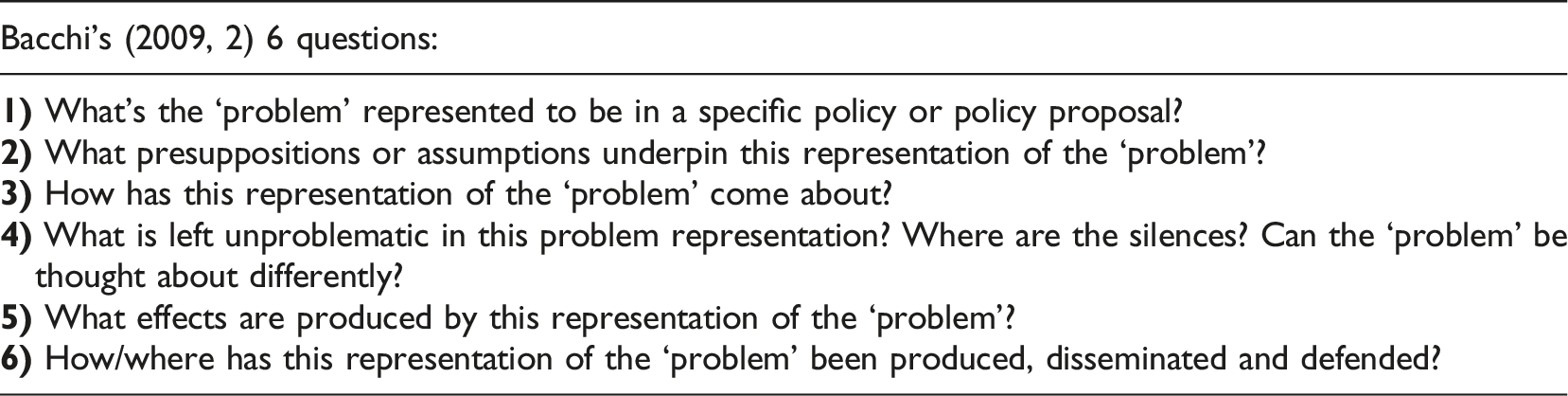
Question 1 asks the researcher to identify and assess what the policy proposes and to ‘“read off” the implied “problem” from this proposal’ (Bacchi, 2009, 48). For Bacchi, this step is the very crux of the method, since ‘what one proposes to do about something reveals what one thinks is problematic (needs to change)’ (Bacchi, 2012a, 21). This first question ‘sets the researcher up to move beyond face value assessments of social problems in order to unearth deeper ideational logics at play in the discourse at hand’ (Pringle, 2019, 5). For example, how is the problem of nuclear deterrence posed, what solutions are envisioned and what are the implied problems emerging from this, such as questions of identity, gender and hierarchy. Q1 is therefore aimed at diving deep into the problem representation and to identify both thought and unthought assumptions guiding this representation. An IR example for this form of reasoning is Janson and Eduards’ analysis of the United Nation’s Women, Peace and Security agenda (2016). Their investigation shows that although ‘the two main strategies the resolutions proscribe to address women’s vulnerabilities – representation/participation and the criminalization of rape’ which makes the resolution appear to identify threats to women and peace is a problem, ‘what is actually at stake is the importance of men and war’ (2016, 591).
Question 2 engages with the presuppositions or assumptions that underlie the problem representation? ‘This question involves a form of Foucauldian archaeology, identifying underlying conceptual logics and political rationalities in specific policies’ and to ‘[i]dentify key concepts, binaries, and categories’ informing the representation of this specific ‘problem’. ‘Conceptual logics’, here, refers ‘to the meanings that must be in place for a particular problem representation to cohere or to make sense’ (Carson & Edwards, 2011, 76). It thus links problematizations directly to the societies/knowledge systems that constitute them. Referring directly to Foucault’s Madness and Civilization, Bacchi encourages a Foucauldian inspired approach that is aimed at identifying ‘cultural precursors to social phenomena, without relying on linear or causal historical argument’ (Pringle, 2019, 6). Question 2 might be explained via the example of Neal’s analysis of the problem of ‘the exception’ that sketches out the ‘discursive formation of exceptionalism’ and its ‘terrain of contradictions, oppositions, correlations, additions, recurrences, remanences, accumulations and complementarities’ (2006, 45).
Question 3 exposes the historicity of the problem representation. Q3 can thus be seen as involving a form of Foucauldian genealogy that unpacks the implied problem(s) by focussing ‘on the practices and processes that led to the dominance of this problem representation (or of these problem representations)’ (Bacchi, 2009, 48). It is aimed at highlighting the political and cultural conditions ‘that allow a particular problem representation to take shape and to assume dominance’ (Bacchi, 2009, 48). It is thus focused on challenging presumed linearities of problem definitions with the intention to unearth the power relations at play within the policy making process as well as the actors, knowledges and events that have shaped a given discourse or particular problematization. Riemann’s (2021) analysis of the seemingly universal figure problem of the mercenary can serve as an example for such a genealogical approach, as his analysis shows that the mercenary problematique is not ‘as old as war itself’ but dependent on notions of modern subjectivity and Westphalian statehood.
Question 4 turns to the silences embedded within the problem representation. What does the representation omit? What voices are marginalized or excluded? What knowledges are relegated or ignored? The aim here, however, is not solely to identify these silences, but also to engage with how ‘the “problem” [can] be thought about differently?’ (Bacchi, 2009, 48). Here Bacchi encourages the research towards the ‘careful scrutiny of possible gaps or limitations in this representation of the “problem,” accompanied by inventive imagining of potential alternatives’ (Bacchi, 2012a, 23). Drawing again on Foucault, Q4 is aimed at identifying the combination of specific practices and relations that construct a problem in a particular time and place. This form of questioning thus lends itself to a comparative approach that could analyse differences in problem representation across historical periods and cross-culturally. Embedded in Q4 is furthermore an imperative to revisit the political nature of discourses, as ‘[a]ttending to the silences in a particular mode of problematization refocuses attention on how and why some subjects are problematized while others are not’ (Pringle, 2019, 8). In IR Hansen’s engagement with the absence of gender within the securitization framework can serve as a guiding example for bringing silences within a specific discourse to the fore. (2000)
Question 5 turns to the effects of the problem representation. Bacchi highlights three forms of effects; discursive effects (how the representation limits what can be said about an issue), subjectification effects (the way in which subjects and subjectifications are constituted) and lived effects (the effects on life and death) (Bacchi, 2009). To aid the researcher in this regard, she proposes a set of sub-questions: ‘What is likely to change with this representation of the “problem”? What is likely to stay the same? Who is likely to benefit from this representation of the “problem”? Who is likely to be harmed? How does the attribution of responsibility for the “problem” affect those so targeted and the perceptions of the rest of the community about who is to “blame”?’ (Bacchi, 2009, 48). Q5 thus pays attention to the material and lived effects that discourse, policy or governance produce. Ali and Whitham’s analysis of Islamophobia is an IR based example for this analytical aspect of a WPR analysis. Their investigation into the relationship between capitalism and Islamophobia ‘shows how constructions of Muslim populations as the “undeserving poor” are central to the intersectional racialized and gendered disentitlements of austerity’ (Ali & Whitham, 2021, 190).
Last, question 6 is aimed at exposing what factors contributed to the production of the problem, through which avenues it has been disseminated and how and by whom it has been defended. The aim is to explore how the problem representation has become accepted as ‘truth’. Q6, however, can also push beyond the construction and solidification of ‘truths’ and can engage with how the problem representation can be questioned, disrupted and replaced by, for example, considering ‘past and current challenges to this representation’ and ‘[c]onsider the discursive resources available for re-problematisation’ (Bacchi, 2009, 48). Q6 thus works in tandem with Q3 as it designed to ‘destabilize taken-for-granted truths’ and envision alternatives. As such it can be viewed as a tool for resistance. In this, Bacchi takes inspiration from Foucault, who, in his analysis of the importance of the medical definition of homosexuality for the gay movement shows how the oppressive discourse of medicalization served as a point of departure for resistant political intervention. An example from within the field of IR is Spike Peterson’s engagement with the intimate, which not only provides a genealogical analysis of the state-making process and its racial logics, but also shows how ‘normalisations of inequality deflect critical inquiry, and intentional, explicitly racist attitudes and practices are variously decried or simply denied’ and ‘promulgated by elites to naturalize the making of inequalities that burden the majority’ (Spike Peterson, 2020, 192).
This six-question framework is consciously deployed, as the questions ‘are strategically ordered so as toupset the naturalization of a social problem, thereby opening up room for critical intervention’ (Pringle, 2019, 5). Despite this, WPR is not prescriptive. Bacchi suggests that ‘specific questions can be applied where the analysis occasions their use’ (Bacchi, 2015, 133). As such, to interrogate problematizations, ‘[n]ot every question needs to be asked every time’ in a WPR analysis and therefore ‘it is possible to draw selectively upon the forms of questioning and analysis’ the approach offers (Bacchi & Goodwin, 2016, 24). In this WPR also highlights the ‘need for a sensitivity to context’ as ‘[w]hat works in one place at one time may not work elsewhere’ (Bacchi, 1999, 90). As such, WPR is cautious of the prescriptive and restrictive nature of a methodology, and therefore, the six questions are not a strict proposal but rather a tool for critical enquiry that is not ‘closed’ but ‘open ended’.
In conclusion, Bacchi’s framework offers a way to operationalize a structuralist approach to discourse analysis by focusing on problematisations. WPR unpacks policy problems by asking what the problem is represented to be, what assumptions and silences are necessary to this representation, and what effects it has on subjectivities. It is a framework that pushes ‘the researcher to theorize across contemporary practices,and historical precursors’ (Pringle, 2019, 4), to ‘identify and deconstruct both said and unsaid discourses by uncovering and critiquing issues of power, privilege, subjugation and hegemonic discourses which they may contain’ (Pereira, 2014, 395), but also ‘reveals how problematisations are central to the practice of government—to governing’ (Bacchi, 2009, ix-xiii). In the following, section I turn to an exemplary application of the WPR methodology by applying it to the specific case of the NGO CVG.
Applying WPR: CVG, Neoliberalism and the Medicalization of Violence
Long before the COVID 19 outbreak have scholars raised awareness to the increasing medicalization of society (Weinstock, 1997; Conrad & Schneider, 1980). IR has not been untouched by this (Elbe, 2011; Howell, 2011; Worsnop, 2019; Wenham & Farias, 2019). In this, section I turn to an aspect that so far has escaped the attention of IR: the increasing medicalization of violence (Mitton, 2019; Riemann, 2019). This trend is evidenced by the World Health Organization making violence ‘a public health priority’ and centering its global strategy for violence prevention around the public health model; the World Bank pronouncing the public health approach the most effective form of violence intervention; and UNICEF declaring the public health model to violence prevention a high-priority strategy (Krug et al., 2002; The World Bank, 2016; Modvar & Úbeda, 2017). As such it is not surprising that governmental agencies around the globe are increasingly endorsing the public health model and investing in public health approaches to violence prevention (Delgado, 2021). This section critically interrogates this move by analysing the most prominent public-health-based approach to violence prevention: the Cure Violence model.
Cure Violence, which launched in 2000 in the Chicago area, is specifically aimed at reducing gun crime. Due to its success in decreasing gun violence, its approach was rapidly copied and introduced within other North American cities such as New York, New Orleans and Baltimore, before branching out globally with projects in Iraq, Jamaica, the UK and many others (CVG.org). CV changed its outlook in 2019, embracing more clearly its aspiration to go beyond the United States. In the process CV became Cure Violence Global (CVG).
What makes CVG a unique program is its assumption that violence not only ‘behaves like a contagious problem’ (CVG.org) but that violence, in the words of founder and program director Slutkin, ‘is a contagious disease’ (2012, 94). Slutkin (2011) explains: In my presentations I often show several graphs side by side. One shows a cholera outbreak in Somalia, where I worked for three years trying to curb this terrible epidemic as it devastated refugee camps. Beside it, another graph shows a curve of a better-known tragedy – the 1994 mass killings in Rwanda, which claimed nearly 800,000 lives. A third graph shows killings in US cities, which appear like outbreaks of tuberculosis in Europe centuries ago. Side by side, they demonstrate how violence behaves like outbreaks of disease. (para. 6)
Violence thus mimics other diseases such as Cholera and Ebola. Again, in the words of Slutkin: ‘It has been said for a long time that violence begets violence, but it is just as tuberculosis begets tuberculosis, or flu begets flu, that violence begets violence’ (2012, 104). As ‘violence behaves like a contagious problem’ that ‘is transmitted through exposure, acquired through contagious brain mechanisms and social processes’ it ‘can be effectively treated and prevented using health methods’ (CVG.org).
In its approach to cure violence, CVG’s models its method on a standard approach for reversing epidemics that follow a three-phase system: identification, interruption and change (CVG.org). The first step pinpoints zones of contagion. These ‘zones’ are spaces in which a high level of violent acts occurred over time. Through the data acquired during the identification process it becomes possible to generate an epidemiological map, which makes it possible for CVG to localize high-risk subjects. The data by which CVG identifies such high-risk subjects is based on an indeterminate list of ‘risk factors specific to a community’ (CVG.org). However, CVG requires that ‘[p]articipants recruited to receive the treatment’ (Butts et al., l 2015, 40) meet at least four of seven criteria for being at highest risk: carries or has ready access to a weapon; has a key role in a gang; has a poor criminal history; is involved in high-risk street activity such as dealing in illegal drugs; is a recent victim of a shooting (in the past 90 days); being between 16 and 25 years of age; and finally, being recently released from prison or a juvenile facility for a criminal offense against a person. (Ransford et al., 2014, 237)
The identification process is followed by an interruption phase. This phase forms the core of the CVG approach, and it is aimed at interrupting the transmission of person-to-person violence. To successfully stop ‘transmission’ CVG makes use ‘Violence Interrupters’ (VIs). VIs are ‘culturally appropriate workers who live in the community, are known to high-risk people, and have possibly even been gang members or spent time in prison, but have made a change in their lives and turned away from crime’ (CVG.org). Their experience with violence enables these workers to identify ‘at-risk’ subjects, as VIs had previously been ‘at-risk’ subjects themselves. This knowledge puts VIs in the position to appropriately deal with ‘at-risk’ subjects and to prevent the development of violent behaviour. Furthermore, due to their past encounters with violence and their connections with the community, VIs are perceived as credible messengers and therefore can built connections with high-risk and gang-involved individuals allowing them to develop knowledge about upcoming violent acts of retaliation. Butts et al. (2015) describe this process as follows: When one person is injured or shot, the victim's friends and known associates are likely to seek revenge. The VI’s from Cure Violence sites seek out those associates and try to ‘talk them down,’ or persuade them that there are other ways to negotiate the conflict without engaging in more violence that could risk their liberty and even their own lives. (41)
The last phase of CVG’s anti-violence strategy is aimed at changing the norms within a community that accept and encourage violence. Here, so-called Outreach Workers (OWs) take on a specific role. OWs, much like VIs, need to be perceived as credible messengers. In difference to VIs, who monitor threats and intervene directly, OWs us ‘their relationships with program participants to help connect high-risk individuals to positive opportunities and resources in the community, including employment, housing, recreational activities and education’ (Butts, et al., 2015, 41). CVG furthermore expands on the individually focused works of VIs and OWs by developing community centred approaches aimed at changing the normative acceptance and culture of violence. The efforts that this phase includes are special events such as rallies, marches, community barbeques where anti-violence messages are propagated, and community workshops and summits where high risk individuals are convened to discuss the use of violence. Additionally, a public education campaign, which has been shown to effectively change other behaviors such as smoking, is deployed to change group and community norms related to violence. (Ransford, Johnson, Decker, Payne and Slutkin 2016, 3)
The underpinning idea behind this last stage is that of a ‘positive epidemic’ (Frazier, 2010, 2), as the ‘spread of information and skills makes possible group immunity, where a population becomes resistant to a disease because its (new) norms support behaviours that protect them from infection’ (Slutkin, Ransford & Decker 2022, 47). Hence, once the new anti-violence norm has become accepted by a critical mass of individuals, these can than ‘infect’ the community at large with the new anti-violence norm leading to group immunity.
Interrogating CVG Critically: A WPR Analysis
This section will subject the CVG initiative to a WPR analysis with a focus on four of Bacchi’s questions; the representation of the ‘problem’ (Q1), the assumptions underpinning this representation (Q2), what is left unproblematic or silent in this representation (Q4) and what effects this representation of the problem produces (Q5). The data for this analysis has been drawn from the official CVG website, which was analysed between 1 July and 31 July 2020, a period in which CVG celebrated its 20th anniversary.
Beginning with the proposal of a specific program, policy or initiative (Q1), CVG proposes that violence is a disease as its founder Gary Slutkin makes unmistakably clear; ‘[t]hat violence is an epidemic is not a metaphor; it is a scientific fact’ (2011, para. 7). Hence, following the logic of WPR, if an epidemiological approach based on medical, scientific knowledge is the proposal, violence is clearly framed as a public health problem. The use of medical metaphors and analogies to understand violence has a long history and has been observed widely among biological, psychological and sociological approaches to violence (Praeg, 2007). Yet, this is qualitatively different from treating violence as a disease. Public health-based approaches do not use the medical language as a heuristic devise to understand violence, they actually are based on the idea that violence is a medical issue. Medicine becomes, in other words, the episteme through which violence must be understood. Implied in this problem representation is the assumption that other ‘non-medical’ solutions to violence, such as sociological ones, are problematic. As Slutkin indeed makes clear, alternative approaches to violence ‘do not correctly understand the problem scientifically’, leading ‘to ineffective and even counterproductive treatments and control strategies’ (Slutkin, 2012, 95).
What are thus the assumptions and presuppositions that underpin the CVG initiative (Q 2)? Three key issues stand out. First, CVG presupposes the superiority of a quantitative, evidence-based epidemiology over other approaches to prevent violence. It argues that prior assessments of violence have failed because they were based ‘on moralistic or sociological diagnosis’ and not ‘on proven scientific findings’ (Riemann, 2019, 5). Following CVG, modern science however allows us to move away from analysing violence through incorrect, sociological or moral lenses, thereby preventing us from making the wrong diagnosis. Secondly, in this the CVG narrative displays a teleological outlook that is typical of modern society. (Conrad & Schneider, 1980) It argues that previous assessments of violence failed because ‘we did not know—did not yet know—what was really happening’ (Slutkin, 2012, 94–95). Much like medieval people, who stigmatized those infected with the plague or leprosy as ‘bad’ people, our culture today holds similar views about people who commit acts of violence (Slutkin, 2012). However, medieval superstitions were overcome by scientific discoveries, and CVG argues that science can help us overcome our false understanding of violence. CVG thus proposes a progressive narrative in which medical progress is seen as promising a solution to overcoming the problem of violence that plagued humanity since its beginnings. Thirdly, CVG is firmly anchored in methodological individualism with its focus on identifying ‘high-risk’ individuals and stipulating individual pathology. As such CVG is part of the wider shift of focus in epidemiological studies, away from methodological holism to methodological individualism (Yadavendu, 2005). This has important implications for the presuppositions that guide CVG. By placing almost exclusive emphasis on notions of transmissibility determinants of risk that go beyond the individual are relegated to vague intermediate factors. The following is indicative: As is the case in most contagious processes, not all persons exposed express the clinical condition of violent behavior, as there are factors that influence uptake—in particular, proximity, dose, and age. Other factors, such as poverty, poor education, and family structure, should be understood as modulating factors. …These processes, whereby persons exposed to violence are at heightened risk for perpetration of violence, are thought to be responsible for contagions of child abuse, intimate partner violence, street violence, suicide, mass shootings, riots, and terrorism. These types of violence should be understood as syndromes of the same disease process that differ by context. (Slutkin, Ransford & Zvetina 2018, 49)
As a result, violence becomes disentangled from socio-economic inequalities and explained by reference to individual pathology alone. Indeed, as Rojas Durazo has argued, transposing a disease model ‘sets out to deflect attention away from social injustices, while highlighting individual pathology’ (Rojas Durazo, 2016, 181). By placing the ideological marker of disease on the problem of violence, CVG replaces political solutions with medical diagnosis and treatment models.
This leads us over to the silences in CVG’s violence as disease narrative (Q4). CVG’s reliance on an epidemiological approach to violence conceals structural, political and sociological factors that might underpin said violence in the name of a value-free science. The conceptualization of violence as a disease ‘acquired through contagious brain mechanisms’ (CVG.org), thus makes violence a purely biological condition. In this way, CVG constructs ‘regimes of truth’ (Foucault, 1980) that delegitimize alternative, non-medical regimes while shifting the terms of debate from contingent sociological factors to the seemingly timeless forces of nature and biology. Through this shift, CVG’s violence as disease narrative displaces the conceptualization of violence as a social problem thereby obscuring any form of structural factors that might create the social conditions for violence. Here, Powers analysis of the medicalization of social control comes to mind: The medicalization of social control is visible when ‘system’ problems of order and deviance in a culture begin to be addressed in term of the medical model of disease and thereby bypass other discourses such as those of aesthetics and ethics. Human problems are not seen as social issues for discussion and critique but ‘problems’ to be solved in terms of diagnosis and treatment model. (2001, 21)
Hence, as the narrative of CVG understands violence in terms of a disease that can be cured via a diagnosis and treatment model, social, political and economic forms of violence are disguised. What is more, by turning violence into an object of natural science, CVG explicitly excludes any sociologic analysis and therefore engages in an epistemic violence (Spivak, 1988) that devalues sociological analysis by constructing epidemiological framework as superior. By treating violence as an epidemic, violence becomes reduced to biological concerns alone, silencing in turn the structural factors that might underlie said violence.
Moving on to the effects of CVG’s problem representation (Q5)? CVG constructs violence as a disease that can be cured via the statistic-based techniques of modern epidemiology. In doing so, the CVG narrative not only reduces perpetrators of violence to a statistical biomass that can be quantitatively assessed but furthermore turns zones ‘contaminated’ by violence into ‘governable spaces’ (Rose, 1999, 31). Within these spaces, at-risk individuals are reduced to objects of knowledge that can be governed via techniques of behaviour change. These techniques, as Legget (2014) has pointed out, are a tool of neoliberal governmentality to direct human behaviour in a paternal fashion. CVG does so via the ‘medical gaze’ of OW’s and VI’s, which exposes at-risk individuals to the constant surveillance, regulation and normalizing judgement of CVG experts with the aim of restoring at-risk individual’s capacity to serve as productive citizens that become ‘contributors to their local economies’ (CVG.org). CVG therefore facilitates a public-health-based social policy that leaves questions of inequality as a cause of violence relatively untouched, because the focus of intervention is on the individual rather than the structure, while promoting neoliberal paternalism as a necessity to improve people’s lives. CVG’s approach has thus a strong paternalist bent despite its insistence on responsibilisation and self-care. This is however not in opposition to neoliberal modes of governing, as Milton Friedman (Friedman & Friedman, 1980), one of the key proponents of neoliberalism, made clear: ‘Freedom is a tenable objective only for responsible individuals … We cannot categorically reject paternalism for those whom we consider as not responsible’ (32–33). And here, biology provides the scientific justification for CVG’s construction of irresponsible subjects. Although CVG does not go so far as to invoke a violence microbe, it refers to biological mechanisms (mirror neurons, hormonal reward systems, dysregulation in the limbic system and prefrontal cortex) which are accountable for the infection (Slutkin, 2012, 19, 107). In CVG’s violence as disease narrative, violent offenders are therefore not acting subjects, but biologically driven bearers of a mental deformation and therefore ‘irresponsible’ subjects in need of paternal care. To identify ‘irresponsible’, or in CVG’s language, ‘at-risk’ individuals, statistical data provides CVG with the necessary scientific facts. In this, CVG confirms Lupton’s (1995) observation that ‘risk’ is a moral technology used as a means of identifying specific targets for health care intervention. What is more, the construction of epidemiological ‘facts’ produces the ‘normal’ subject, which falls within the normal distribution of health determinants and the ‘at-risk’ subject that falls outside this distribution (Petersen & Lupton, 1996). The epidemiologist’s activity of ‘naming, mapping [and] grouping’, hence, is not an innocent act (Nguyen, 2010, 133). Although the use of statistical analysis to identify at-risk populations is treated as being purely descriptive, these groups are not ‘naturally’ existing groups but created through the very process of their epidemiological identification (Nguyen, 2010). Epidemiological research is therefore not merely a neutral, descriptive act, but ‘a productive process that has the potential to create social identities and realities’ (Führer & Eichner, 2015, 1). The epidemiological approach used by CVG offers a compelling example of this productive process. Through its public health approach, CVG defines the boundaries between the ‘normal’ and the ‘pathological’, thereby producing new identities of risky bodies and subjectivities in which the categories of identity and difference are derived from assumptions concerning biological infection or immunity resistance. CVG’s founder is unmistakably clear that the marker for violence, like it is with any contagious disease, lies within the body itself: ‘An infectious disease begins with exposure to the infection by a susceptible person. Susceptibility refers to the level (or lack) of resistance to infection for an individual; this could be due to the immune system’ (Slutkin, 2012, 101). And here, the visual language of the CVG website stipulates that the colour of susceptibility and lack of biological/mental resistance is the non-White. Indeed, as Ransford et al. mention in a recent article: ‘Although being part of a minority population is not a criterion, the majority of the CV clients are in fact either Hispanic or African American’ (2014, 237). Hence, by classifying already marginalized groups as bodily unfit, white master-narratives reveal themselves. This is further enhanced within the CVG narrative. White men are not only represented as subjects greatly immune to violence (characterized by their visual absence from depictions of perpetrators or victims on the website), but also framed as those ‘gods in white’ solely able to cure violence. The pictures on the CVG website evidence this, as the men ‘in charge’, whether scientist, doctor or priest, are predominantly white, while People of Color are overwhelmingly represented as victims, potential perpetrators, high-risk individuals, OWs, or VIs. Most individuals portrayed on pictures on the CVG websites depicting peoples are ‘non-white’ (232), while only 3 are white. This depiction creates the visual representation of violence being a ‘non-white’ problem. Through this representation CVG produces two distinct sets of identities. First, white subjects in charge and able to find a solution to violence, and second, non-white subjects framed as violent perpetrators or passive victims. By drawing the line between the ‘normal’ and the ‘pathological’ on the basis of characteristics of ‘race’, already marginalized people who happen to live in zones ‘contaminated’ by violence are re-stigmatized. Hence, although Slutkin wants to free the perpetrators of violent acts from ‘moral’ stigma, his project reinforces just that. What we thus find hidden behind CVG’s supposedly value-free scientific language is a racialized discourse. This is no surprise given that epidemiology, as a scientific discipline, has historically ‘been White, male, upper class, and exclusionary to persons with identities falling outside that narrow scope’ making its history burdened with ‘legacies of racism, misogyny, and Eurocentrism that are part of the histories of science and medicine’ (Allan and Lewis 2020, 3–4).
Furthermore, liking violence to a contagious disease allows not only to stigmatize those that are ‘infected’, but also calls for a violent suppression of those potentially infected by it as the contagion narrative portrays individuals living within the contaminated zones as potentially dangerous and diseased. This racially inflected contagion narrative of violence is nothing new; on the contrary, its roots date back to, at least, colonial times. Donna Haraway has, for example, argued that ‘In the face of the disease genocides accompanying European “penetration” of the globe, the “colored” body of the colonized was constructed as the dark source of infection, pollution, disorder, and so on, that threatened to overwhelm white manhood (cities, civilization the family, the white personal body)’ (1991, 223). CVG’s virus paradigm therefore allows the emergence of an infection paranoia that implies that not only the virus, but also those infected must be suppressed (Weinstock, 1997, 83). Due to this colonial narrative CVG might be read in relation to a broader consideration of the violent implications that accompany globalization. In Empire, Hardt and Negri have argued that; ‘The age of globalization is the age of universal contagion’ (2000, 136). It is a time ‘in which increased contact with the Other has rekindled anxieties concerning the spreading of disease and corruption since permeable boundaries of the nation-state can no longer function as a colonial hygiene shield’ (Sampson, 2012, 2). Hence, with the hygiene shield gone, contagion can only be avoided by vaccination. And here ‘culturally appropriate intervention workers’ (CVG.org) are used to protect the white body politic. These ‘culturally appropriate intervention workers … who have made a change in their life’s’ (CVG.org), however, can only become transmitters of the cure, but are never cured, nor become the cure themselves. They are reduced to an epidemiological defense shield. Hidden within the scientific language of CVG is therefore a racist colonial settler logic. A logic in which ‘the white West affirms its humanity by denying the full humanity of the non-whites who most viscerally embody the threat of viral contagion’ (Dougherty, 2001, 5). Therefore, violence becomes classified as residing only within the uncivilized former ‘colonial’ subjects. The contagious effects of violence are thereby inscribed within those very colonial subjects which now ‘colonize’ the spaces of the former colonizer, bringing the violence prevalent in their ‘uncivilized’ spaces with them. Through such an understanding, violence can then temporally and spatially be moved to the colonies itself. CVG’s violence as disease narrative is thus engaged in a purifying violence that externalizes pure, or direct, physical violence by making it a disease that comes from the ‘outside’.
Conclusion
This article argued that Bacchi’s WPR method can be a welcome tool for critical scholars within the field of IR and its wider sub-fields to analyse discourses and meaning-making practices within policy making. It does so because; first, the six-question framework provides a clear and robust methodological framework that breaks the analysis of policies into a manageable step-by-step process. WPR can thus challenge criticism directed against PDA’s perceived lack of methodological rigour. Additionally, and even more important, by being organized around six questions, WPR provides researchers with a guided approach to PDA, which can be especially useful for students and junior scholars, as finding methodological guidelines in the works of thinkers like Foucault is a challenging task and in this way the barriers for entrance to their thought can be lowered. Second, though robust, WPR is a versatile and dynamic analytical framework that embraces multiple theoretical and multidisciplinary perspectives. It thus is open to epistemological pluralism, allowing scholars from various theoretical backgrounds to make use of the six-question framework as a guide for their analysis. Third, WPR breaks with the ‘silences that persist and continue to reinforce established categorizations and assumptions’ (O’Hagan, 2020, 14) by refocussing the attention of policy analysis to marginalized people and perspectives. In this way WPR becomes a ‘critical practice of thinking otherwise’ (O’Hagan, 2020, 16) that opens up the space for policy analysis to go beyond interpretation and instead envision ways of resistance or to propose alternatives to the status quo.
I evidenced WPRs potency by applying the method to the case of CVG. My analyse showed that beneath CVGs philanthropic innocence and anti-violence message, CVG produces a multitude of violent practices and effects. First, by making violence the object of natural science, CVG engages in an epistemic violence that devalues and silences sociological, political and economic explanations of violence. Second, by endorsing a public health solution to violence prevention, CVG replaces political solutions with medical diagnosis and treatment models. In doing so, violence becomes separated from structural factors and explained by individual pathology alone. Third, CVG’s epidemiological approach violently draws boundaries between the ‘normal’ and the ‘pathological’ according to markers of race. This produces new identities based on the value-free scientific language of biological infection or immunity resistance. Lastly, CVG’s contagion narrative portrays individuals living within the contaminated zones as potentially dangerous and diseased and as such calls for their violent suppression. Hence, in its quest to find a remedy for the dreaded disease of violence, CVG is not immune to practicing violence itself.
Footnotes
Acknowledgments
I would like to thank Kasia Kaczmarska, Hannes Hansen-Magnusson, Norma Rossi, Ingvild Bode, Jana Fey and the anonymous journal referees whose comments improved this paper.
Declaration of Conflicting Interests
The author(s) declared no potential conflicts of interest with respect to the research, authorship, and/or publication of this article.
Funding
The author(s) received no financial support for the research, authorship, and/or publication of this article.
