




Abstract
What feelings foster peace? This question is rarely asked in International Relations. This article, therefore, sets out to analyse the way people involved in peace processes speak about feeling by using one particular set of metaphors and allegories, namely, such tropes that refer to family in any way. The article presumes that family metaphors are particularly well suited to speak about difficult feelings since they are inherently ambiguous: on one hand, families are a universal experience, which means that their use speaks to a wide and general public; on the other hand, families are a personal and subjective experience, so that metaphors and allegories can be left unspecified, for each listener to be filled with their own ideas. By looking at speeches by Nobel Peace Prize laureates, the article explores how this ambiguity is used when talking about peace. It finds that family metaphors can build bridges and imagined connectivity; but they can also be used to deny a shared relation between two parties. The article concludes that family metaphors and allegories are capable of not only breaking up conflict lines but also of cementing them in an elusive and subtle way.
Language is fossil poetry
A voice from the dark called out,
‘The poets must give us
imagination of peace, to oust the intense, familiar
imagination of disaster. Peace, not only
the absence of war’.
What feelings foster peace? This question is rarely asked and even less often answered. Especially in the academic discipline of International Relations (IR), the question of the emotional world of peace has been little regarded, at least in comparison to the many works that offer detailed analysis of the economic, institutional, legal or social conditions of peacemaking efforts. The recently published Oxford Handbook of Peacebuilding, Statebuilding and Peace Formation (Richmond and Visoka, 2021), for instance, contains in its 659 pages only a half-page about ‘feeling peace’ (Wallis, 2021). Even in the Handbook’s chapter on the psychology of peace feelings or emotions are only mentioned in their pathological dysfunction as trauma or their politically rationalised institutionalisation in the form of truth and reconciliation acts (Christie, 2021: 222-223). The question of what feelings and emotions will successfully generate peace is still largely separated from the question of the political, economic or legal conditions under which post-conflict reconstruction can be effective (see as exception, for instance, Jeffery, 2020).
This reflects a more general struggle within IR to integrate emotions and feelings into their political analysis despite the importance that feelings like anger, aggression or fear, on one hand, or trust, care, solidarity or loyalty, on the other hand, carry in vernacular political discourse and how these feelings are implicit in many IR theories (Crawford, 2000; Hutchinson and Bleiker, 2014; Mercer, 2014). The difficulties to analytically think emotions and feelings of peace involve a range of complex epistemological and methodological problems, of which the salient one is the observer’s incapacity to directly observe emotional reactions or the role of feelings in situation perceptions and decision-making (Crawford, 2000).
However, even if IR scholars cannot directly observe emotions at work (see for a longer discussion Jeffery, 2014), nor gauge their genuineness, it is possible to analyse the use of emotional language and feelings in political narratives (see, for instance, Charteris-Black, 2011; Cienki and Yanow, 2013 also Koschut, 2020). In the present case, it is possible to analyse how people talk about the feeling of conflict and peace, and to interpret these narratives so as to understand what imaginaries of conflict and peace are mobilised and what kind of political or social visions emerge from these.
This is the purpose of this article. It seeks to analyse the use of one particular category of speech, namely, symbolic stories of family and kinship. Such symbolic stories can be told either in the form of metaphors where the a family image is used as an invocation of something else (e.g. ‘brotherhood’ to invoke solidarity); or as allegories, that is, as stories about families, one’s own or others, to convey a deeper meaning about politics, or, in this case, peace. The article argues that there is no universal way in which family allegories and metaphors are used, despite their universality. Departing from the presumption that the use of metaphors and allegories has not only cognitive effects on the audience but also impacts behavioural reactions to the speaker and situation (Hendricks and Boroditsky, 2016), the article is interested in exploring the speakers’ imaginary of their and others’ capability to make and maintain peace. The presumption is that by describing through family metaphors or allegories what peace should feel like, speakers not only sketch an idea of the feelings of peace but also of who should be the agents of these feelings.
There would not be violent conflict if these feelings were indisputably, consensually and commonly shared; the question is, therefore, how family metaphors and allegories are used to overcome difference in the imagination of peace and how they support an identification of the audience with a commonly shared peace. In the words of Lynne Cameron, the question is how family allegories and metaphors contribute to the creation of emotional connectivity that is the basis of ending and overcoming violent conflict (Cameron, 2016: 427; also Cameron, 2012).
The article proceeds in two steps: it first sets out the conceptual framework about the ways symbolic images and stories allow not only gauging emotions and feelings but also examining what kind of emotions and feelings are evoked. It then analyses the corpus of speeches by laureates of the Nobel Peace Prize in the light of exploring who is using such rhetorical figures of speech, in which context and to what effect. This corpus of text has been chosen as the purpose of these speeches is functionally and by their very ‘raison d’être’ to develop visions and imaginaries of peace. They are therefore ideal to explore how the use of family tropes contributes to this painting of a vision, and what the vision looks like once the hidden and underlying meaning of peace is teased out of the metaphorical and allegoric speech. The analysis will show that even though family allegories and metaphors are always used to appeal to feelings of security and protection from harm, they are not always used to create a vision of peace that bridges conflicts and unites conflicting parties.
Metaphors and allegories in political speech and their analysis
Symbolic speech, that is, metaphor and allegory, is used in storytelling to convey meanings that are difficult to communicate through literal semantics because either words do not exist or the words that do exist are considered inadequate by the author. Metaphor and allegory are therefore common to talk about phenomena that are not easily talked about. Feelings are such a phenomenon insofar as there is only a limited and often inadequate vocabulary for complex and potentially undefinable emotional reactions to human ‘being-in-the-world’ as Heidegger attempted to describe the enormity of impressions that call upon human cognition, consciousness and emotions (Bontekoe, 1987; Forgács, 2022). Metaphors and allegories are often very close and hard to distinguish as allegories can be understood as extended metaphors where it is not only one or two words that stand in for a differed meaning but an entire story. To tease out the meaning that is intended between the lines but unspoken, it is necessary to interpret these metaphors and allegories. Hermeneutics offer a range of caveats on how to do so because metaphors and allegories have commonly several functions in a text and their meaning is conditioned by a range of contextual factors.
Aristotle in his essay on metaphors distinguished between poetic and rhetoric metaphors, those that are used to illustrate and sublimate a poetic narrative, and those that are devised to clarify a concept and make it more persuasive (Charteris-Black, 2011). This distinction can be applied to allegories, too, and it has been widely discussed and received in (Western) linguistics as a distinction between symbolic speech figures that are used as rhetorical speech acts that intend to persuade an audience of the well-foundedness of a particular course of action; and metaphors and allegories that are performative acts by which new or alternative ‘worlds’ are created where words do not mean necessarily what they say at all but convey a different meaning (Forgács, 2022). This dichotomy has been early on adopted in political thought (Musolff, 2016) and academic IR and led to the development of specific political languages which presented themselves as ‘value-free’ or ‘rational’.
Yet, a number of critical advances in IR like post-colonial (see, for instance, Bhabha, 1990) or feminist approaches (see Åhäll, 2018; Hutchings et al., 2008; Wibben, 2010) have deconstructed this dichotomy. The criticism of the rational-emotional divide in the use of metaphors, allegories, narratives and non-academic language in the analysis and writing about the international is articulated around two propositions: first, critics argue that the concept of a rational language relies just as much on imaginary meanings as poetic language does (e.g. Milliken, 1999); that insisting on one type of semantics and grammar being more valid than another excludes voices and insights; and that this is a matter of social power rather than of epistemology (Barber, 2006; Ravecca and Dauphinee, 2018; Ravecca, 2016). Second and related to this first point, critics point out that ‘people’, that is, non-academically trained participants in political processes as well as the audience of political discourses, often use symbolic speech in both ways simultaneously, strategically and to draw out new and different worlds (e.g. Eberle, 2019; Enloe, 2011; Mayer, 2014). As Charteris-Black says ‘politicians use metaphor to tell the right story’ (Charteris-Black, 2011: 28) and consequently, analysing politics also always implies looking at and reflecting upon narrative, linguistic and poetic choices (Inayatullah, 2013; Suganami, 2008; Thakur, 2021).
Metaphors are particularly important in political storytelling because they allow talking about what is not commonly spoken about or what is extremely difficult to speak about, like, for instance, the feelings one should have when entering or aspiring to a period of peace after war. Feelings associated with violent conflict or peace are typically complex and marred by their ‘unspeakability’ as the emotions mobilised by events or situations of violence and peace are multi-fold (e.g. simultaneous feelings of anger, sadness, euphoria, shame, etc.), potentially conflicting (e.g. agents feeling both, horror over bloodshed and euphoria of fighting) and generally overwhelming and ‘deafening’ in their intensity (for a similar discussion on violent experiences, see Nagar, 2016). When speaking in situations of a conflict that is still ongoing (even if not violently) or that has just ended, speaking about peace also implies talking about highly sensitive issues like justice, reconciliation, empathy or forgiveness (Cameron, 2016; Jeffery, 2020). Speakers wish to mobilise feelings in the audience of solidarity and sympathy with their plight but in the contexts of speaking about peace, they cannot do so by othering or externalising the party with which they were in conflict. They have to connect with their audience in positive terms and symbolic speech allows creating what Lynne Cameron calls ‘imaginative connecting’ (Cameron, 2016: 427). In this article, the presumption is that family allegories and metaphors are used strategically and deliberately, but that the feelings for or about peace that are expressed in these speak in imaginary and poetic terms of a new world of peace that is to be.
Symbolic speech figures fulfil several functions in texts and their meaning results from both, their situatedness in larger contexts of the text itself, and their place in the text within. Family metaphors and allegories are particularly versatile as they refer, on one hand, to socially constructed and dominant narratives about status and expectations related to typical imaginaries of family roles (the protecting husband and father, the caring and loving mother, the dutiful daughter, the heir-son, etc.). On the other hand, they never convey the same idea of family since the cultural, social and individual experience of families are so diverse that those symbolic evocations of family are open signifiers that need to be filled with subjective and individual meaning by the recipient. That there are these two levels of meaning allow for the ambiguous reception of family metaphors and allegories which is, in turn, a necessary condition to engage conflicting parties in exercises of bridging and empathy by calling on both, the commonly human and the particular subjective. When attempting to understand what role family metaphors play in speeches about the aspirations how peace should (or will) feel, then this ambiguity needs careful consideration.
When analysing the use of symbolic speech that references ‘family’, either as a metaphor or as an allegory (a story with a meaning beyond the literal), it is therefore necessary to hermeneutically interpret these tropes, and to do so with respect to the speaker as well as the context of the speech. On a the level of the concrete context, the latter is the same for all speakers, namely the celebration of some form of ‘peace’ with the specific audience of the Nobel Prize ceremony; on the level of content, the speeches’ also refer to similar situations namely the intention or even success of significantly contributing to the end of a situation of collective violence. However, as it will be discussed further below, the specific situations of conflict and of peacemaking do differ and, hence, the speakers’ use of symbolic imaginaries of peace differs.
These differences in conflict are only one of the many that distinguish the speakers, however. As will be discussed further below, speakers hail from different genders, and geographic and social backgrounds, and these differences enormously affect the meaning given to the metaphors and allegories. Taking these differences into account while hermeneutically interpreting the symbolic speech acts of the Nobel Peace Prize speeches will show that similar speech figures can mean very different things.
‘Our moral duty to stand as mothers . . .’ Symbolic speech of family in Nobel Peace Prize laureate speeches
The corpus
The corpus of text analysed comprises 133 speeches delivered by Nobel Peace Prize laureates from 1901 to 2020; 16 by women and 88 by men. The Prize has been awarded 102 times to individuals and organisations: 90 men, 25 organisations and only 18 women. Only five women (28%) have received the award alone; the others have shared it with one or several other women (four times), with another man (four times) or an organisation (once). This is compared with 45 (50%) men who have received the award alone. Of the 18 awards to women, 7 have been given in the past 20 years, whereas only 9 have been given in the 99 years before. The huge inequality in gender distribution of awards is matched by an impressive inequality in the world regions from which the laureates hail as Figure 1 shows. Given the very restricted circle of nominators (members of national parliaments, other (mainly European) international institutions, former laureates) the Norwegian Nobel Committee has not been very inclined to support female, working class or colonial nominees.
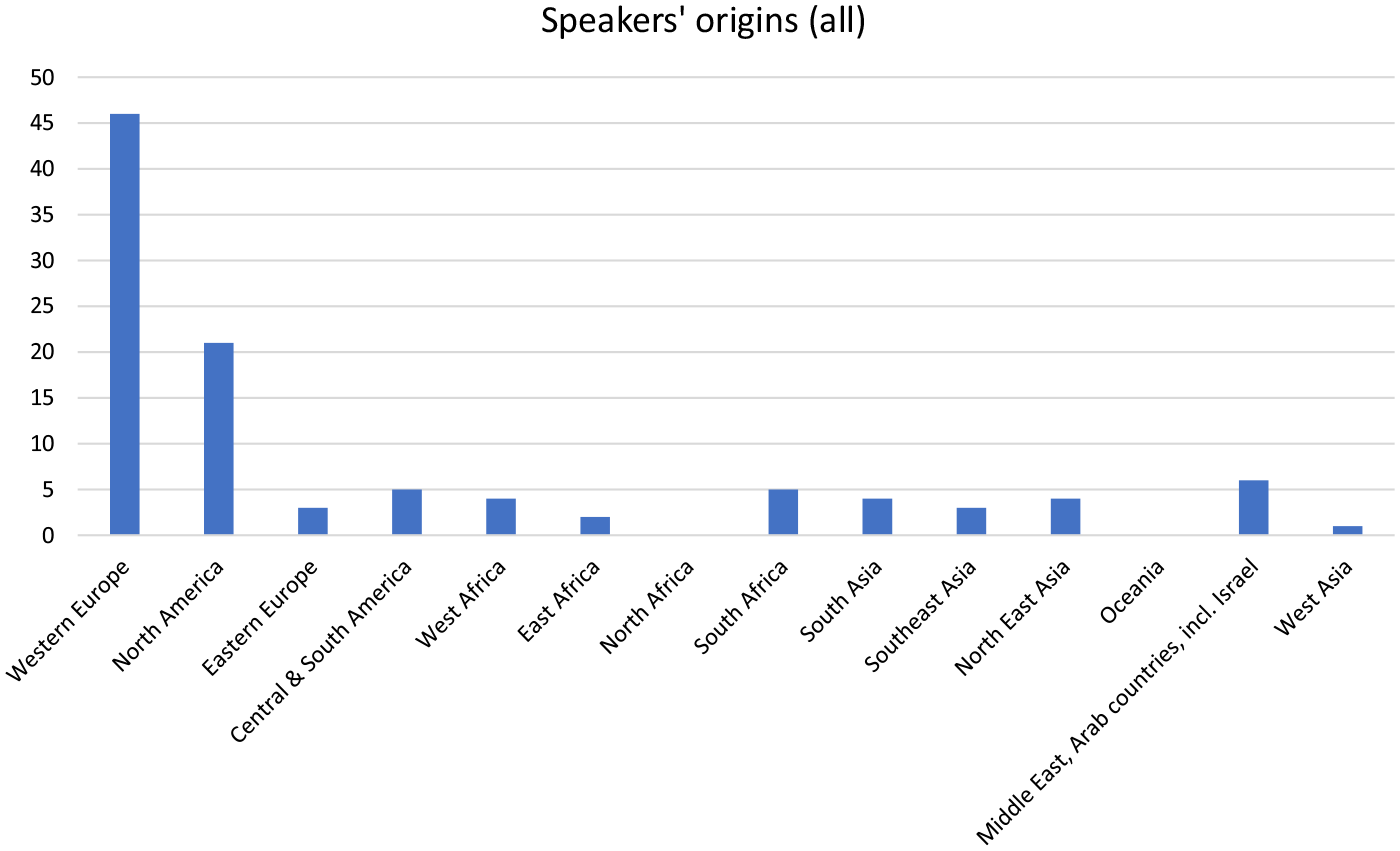
Geographic origin of Nobel Laureates who gave a speech.
The selectivity of the award largely explains the Eurocentric notion of ‘peace’ that the award symbolises. Particularly in the first half of the 20th century, the award was given for ‘peace work’ that centred around state war between European powers and there in particular to personalities who were seen as having contributed to the European and American peace movement, to international law (e.g. the Hague or Geneva Conventions) and the creation of (Eurocentric) international organisations like the League of Nations. This focus on international law and cooperation changes after World War II even if the Eurocentrism of the laureate selection and award motivations does not. During the Cold War, efforts for disarmament become a major theme in the reasons for awarding the Prize but also human and civil-political rights which become most important in the post–Cold War period (see Figure 2).
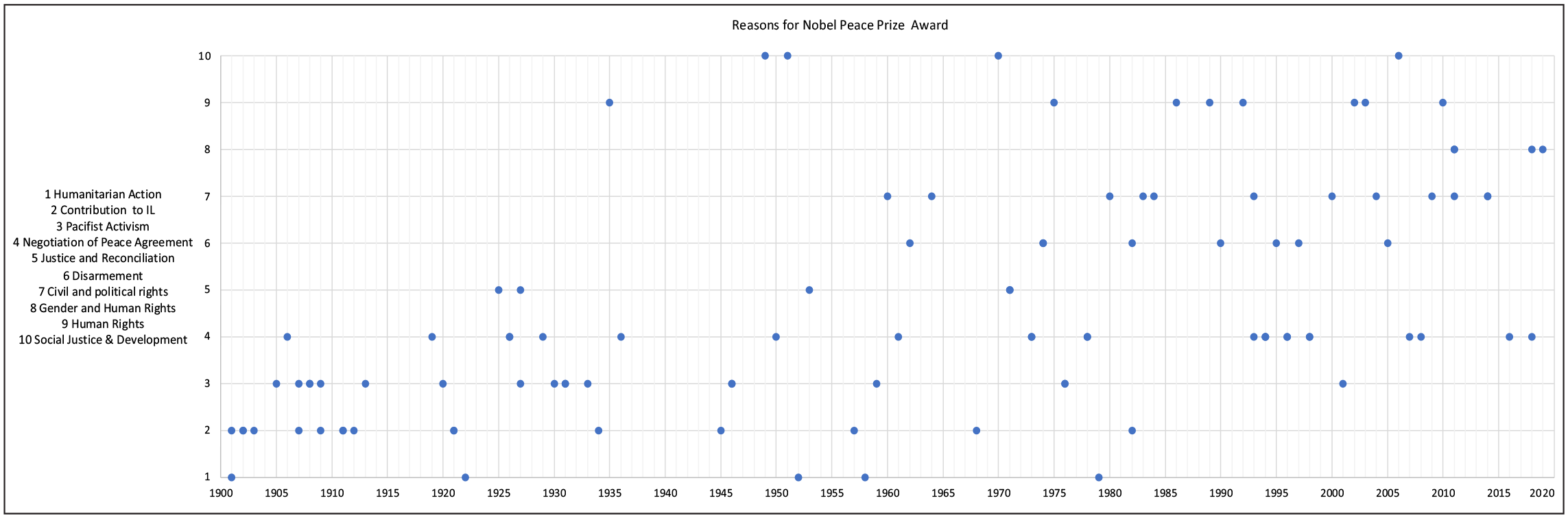
Reasons for the award of the Nobel Peace Prize over time, 1901–2020.
The understanding of peace as a state of law that ends or prevents military or armed confrontation is still alive in the tradition to award the Prize to peace negotiators. This means, however, that many of the recipients are not pacifists but politicians who have been personally involved in decisions over the use of violence.
As it happens, of the 52 speeches that used family metaphors, the majority are by such laureates as Figure 3 shows.
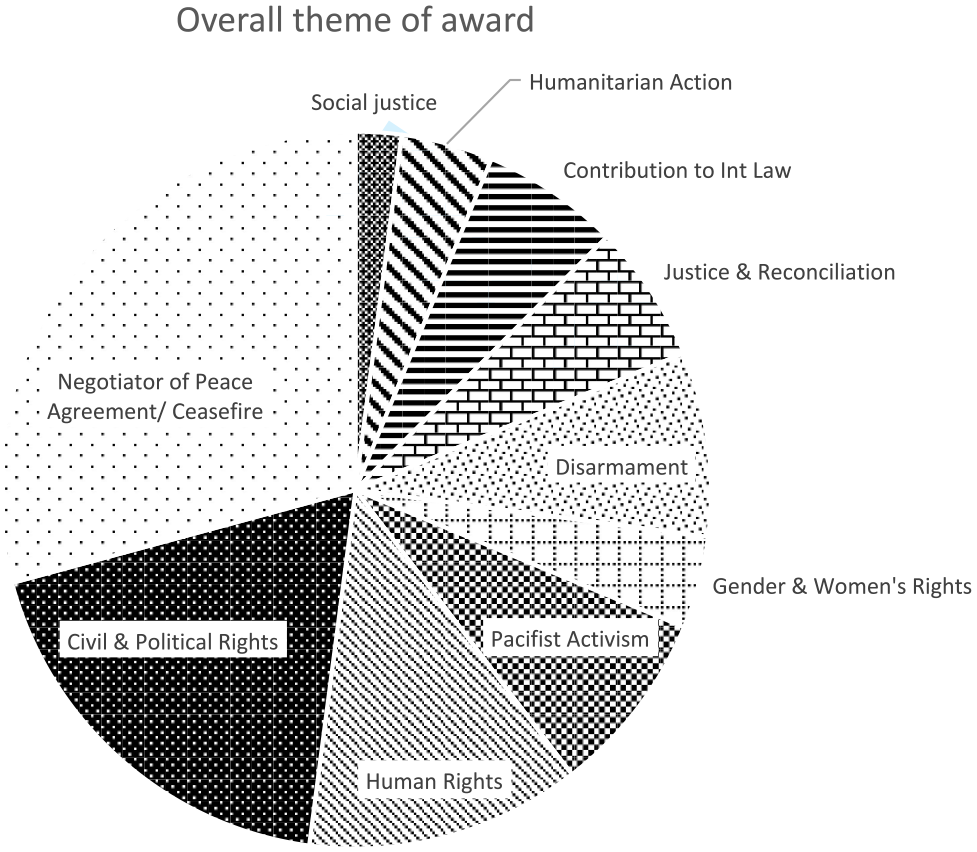
Reasons for the award of Nobel Peace Prize to those who used family metaphors in their speeches.
The use of family metaphors and allegories: common humanity, ‘our’ family, and the (im)possibility of bridging antagonisms
Out of the 133 speeches of the corpus, 52 referred to family and family roles as figurative metaphors and allegories; the other speeches made no reference to family or family roles at all. Such symbolic speech was identified in two ways. First, the text search function was used to search for terms like ‘family’, ‘father’, ‘mother’, ‘brother’, ‘children’ and so on. Second, all 133 speeches were additionally hand-coded to identify non-explicit family references in expressions like ‘future generations’, ‘our ancestors’ and so on and to differentiate how the metaphors were used. Family metaphors and allegories are used in these selected speeches in various ways: as literal metaphors (e.g. ‘brotherly love’), as allegoric stories, as analogies, simile, or as other figures of speech. These were all coded as ‘family metaphors’; including the allegorical stories speakers told of their own families because it is clear from the context (speaking as an authority on peace) that the family rhetoric is used to offer mental representations of peace and not to give true-fact genealogical accounts. The rhetoric function of these family references was in all cases to invoke an imaginary of social relations, interactions, values and possibilities that are not explicitly denoted. This was observed for all 52 speeches that made use of family metaphors or allegories. In the following discussion the article will reference, however, individual speeches that expressed these meanings particularly strongly. By zooming into these speeches and their usage within the rhetoric context of the speech, and set in relation to the conflict and the speaker’s personality, it will become clear that beyond these common references to family meanings, every speaker creates their very own imaginary of peace with the language of family.
As Figure 3 shows, most of the speakers who used family references had been awarded the Nobel Peace Prize for their efforts to end armed conflict but only for about half of them, the war had been a personal experience. Yet, within the context of the Nobel Peace Prize award ceremony, the speakers used family metaphors often in the introduction to situate themselves in a conflict or peace environment and to establish their authority. The reason they saw themselves as having been awarded the price was their responsibility as mother, father, or child who has known the violence, loss and grief of conflict but also the happiness and serenity of peace. Wangaari Matthai, for instance, concludes her speech with these idyllic images of a childhood in Kenya’s nature: As I conclude I reflect on my childhood experience when I would visit a stream next to our home to fetch water for my mother. I would drink water straight from the stream. Playing among the arrowroot leaves I tried in vain to pick up the strands of frogs’ eggs, believing they were beads. But every time I put my little fingers under them they would break. Later, I saw thousands of tadpoles: black, energetic and wriggling through the clear water against the background of the brown earth. This is the world I inherited from my parents. Today, over 50 years later, the stream has dried up, women walk long distances for water, which is not always clean, and children will never know what they have lost. The challenge is to restore the home of the tadpoles and give back to our children a world of beauty and wonder. (Maathai, 2004)
Family allegories like this give the speaker the legitimacy to talk about war/peace because it is an experience in their own family: ‘I lost my mother, six of my brothers and my brothers’ children’, Nadia Murad explains (Murad, 2018).
‘As a child born in Belgium just after the war, I heard the stories first-hand. My grandmother spoke about the Great War. In 1940, my father, then seventeen, had to dig his own grave. He got away; otherwise I would not be here today’, gives the general tenor of the EU’s reception speech by Herman van Rumpoy (2008).
Rigoberta Menchu connects her personal and her family’s story with the longer story of the colonisation of America: I consider this Prize, not as a reward to me personally, but rather as one of the greatest conquests in the struggle for peace, for Human Rights and for the rights of the indigenous people, who, for 500 years, have been split, fragmented, as well as the victims of genocides, repression and discrimination . . . As you know, I am myself a survivor of a massacred family. (Menchu, 1992)
By calling on their ancestors and placing themselves in a generational timeline the speakers articulate their work as part of a longer process and connect past and future: ‘May justice prevail. This would allow the Congolese people to weep for their loved-ones, to mourn their dead, to forgive their torturers, to overcome their suffering and finally to project themselves into a serene future’ (Mukwege, 2018). The mentioning of children in particular points to the future: ‘Above all, we owe it to the children of the world to stop the conflicts and to create new horizons for them. They deserve peace and decent opportunities in life’ (de Klerk, 1994). Family allegories also legitimise the speaker as advocate of the dead who cannot speak anymore as Setskuko Thurlow’s speech on behalf of the victims of the nuclear attack on Hiroshima shows: Whenever I remember Hiroshima, the first image that comes to mind is of my four-year-old nephew, Eiji – his little body transformed into an unrecognizable melted chunk of flesh. He kept begging for water in a faint voice until his death released him from agony. (Thurlow, 2017)
Finally, they show the speaker’s (stereotypical) role as carer (woman) or protector (man). This is commonly emphasised in the introduction where the tone is set for a common-sensical appeal to peace that will follow: As the first African woman to receive this prize, I accept it on behalf of the people of Kenya and Africa, and indeed the world. I am especially mindful of women and the girl child. I hope it will encourage them to raise their voices and take more space for leadership. I know the honour also gives a deep sense of pride to our men, both old and young. As a mother, I appreciate the inspiration this brings to the youth and urge them to use it to pursue their dreams. (Maathai, 2004)
Motherly feelings and the universal quest for peace
Betty Williams’ speech in honour of the Nobel Peace Prize she received in 1976 for her peace efforts in the Northern Irish Troubles (together with Mairead Corrigan) is a clear case of making universal appeals to peace on the grounds of articulating an idea of motherhood that cuts across political divisions (Williams, 1976). She starts her speech with the story of Anne Maguire, a young mother who had been killed and all of her children, aged 6 weeks to 9 years, by a car that had spun out of control after the driver, a member of the Irish Republican Army, had been shot dead by the British Army. This incident had led to the Peace People’s Movement and Peace marches held all over Northern Ireland between August and November 1975, organised by Corrigan (Anne Maguire’s sister) and Williams. On the background of this foundational story, Williams speaks about the peace movement she started as motherly duty and work of love. She contrasts ‘motherly’ traits – love, compassion, intuition, being involved with life and ‘new life’, that is, children – with the war of men: So we are honored, in the name of all women, that women have been honored especially for their part in leading a nonviolent movement for a just and peaceful society. Compassion is more important than intellect, in calling forth the love that the work of peace needs, and intuition can often be a far more power searchlight than cold reason. We have to think, and think hard, but if we do not have compassion before we even start thinking, the we are quite likely to start fighting over theories. The whole world is divided ideologically, and theologically, right and left, and men are prepared to fight over their ideological differences. Yet the whole human family can be united by compassion. . . . Because of the role of women over so many centuries in so many different cultures, they have been excluded from what have been called public affairs; for that very reason they have concentrated much more on things close to home. . .they have kept far more in touch with the true realities . . . the realities of giving birth and love. The moment has perhaps come in human history when, for very survival, those realities must be given pride of place over the vainglorious adventures that lead to war.
Betty Williams uses the mothering trope to convey the universal feelings of sadness, despair and grieve that the killings of the Troubles cause in all people of Northern Ireland. All women can give birth, all mothers have held infants in their womb and hands, and, hence, all women know how precious it is to give life. It is implied that all men who respect women and mothers for this capacity of theirs to give and nurture life, will also respect their outrage and grief in the face of the Trouble’s violence.
Desmond Tutu (1984) uses similarly a story of mothers’ caring and loss to convey feelings of outrage, anguish and sorrow over the brutality of South Africa’s apartheid regime: We visited some of the trouble-spots on the Witwatersrand. I went with others to the East Rand. We visited the home of an old lady. She told us that she looked after her grandson and the children of neighbors while their parents were at work. One day the police chased some pupils who had been boycotting classes, but they disappeared between the township houses. The police drove down the old lady’s street. She was sitting at the back of the house in her kitchen, whilst her charges were playing in the front of the house in the yard. Her daughter rushed into the house, calling out to her to come quickly. The old lady dashed out of the kitchen into the living room. Her grandson had fallen just inside the door, dead. He had been shot in the back by the police. He was 6 years old. A few weeks later, a white mother, trying to register her black servant for work, drove through a black township. Black rioters stoned her car and killed her baby of a few months old, the first white casualty of the current unrest in South Africa. Such deaths are two too many. These are part of the high cost of apartheid.
In the violence of the Troubles or Apartheid, both Betty Williams and Desmond Tutu would have many stories to tell about death and pain. However, both choose to talk about the killing of children and infants. Children and infants are symbols of innocence and of the future, and therefore, discourses about their killing express an image of pure victimhood. Their death is not only a devastation for their kin but also a disaster for the society in which they were killed. Without children or with children who only know violence, a society has no future. The detail of both stories seeks to convey this double loss to the audience; that of the helpless victims and that of the society’s becoming. 1
In his speech Tutu doubles down with further anecdotes on the multiple ways Apartheid is destroying families, killing children, imprisoning fathers and widowing mothers. With these stories he paints a picture of despair and desolation which he contrasts with the promises of South Africa’s nature, economy and lands. The audience should feel exasperated by the many injustices he tells of, and feel hope at the prospect that the end of Apartheid would also spell the end of these injustices. The figures of speech he uses to paint this picture are intricate mixtures of family, religious and nature metaphors, especially through the invocation of the salvation after the apocalypse in the Revelation of St. John.
I come from a beautiful land, richly endowed by God with wonderful natural resources, wide expanses, rolling mountains, singing birds, bright shining stars out of blue skies, with radiant sunshine, golden sunshine. There is enough of the good things that come from God’s bounty, there is enough for everyone, but apartheid has confirmed some in their selfishness, causing them to grasp greedily a disproportionate share, the lion’s share, because of their power . . . In pursuance of apartheid’s ideological racist dream, over 3.000.000 of God’s children have been uprooted from their homes, which have been demolished, whilst they have then been dumped in the bantustan homeland resettlement camps . . . God calls us to be fellow workers with Him, so that we can extend His Kingdom of Shalom, of justice, of goodness, of compassion, of caring, of sharing, of laughter, joy and reconciliation, so that the kingdoms of this world will become the Kingdom of our God and of His Christ, and He shall reign forever and ever. Amen. Then there will be a fulfillment of the wonderful vision in the Revelation of St. John the Divine (Rev. 6:9ff):
2
9. After this I beheld, and lo, a great multitude, which no man could number, of all nations and kindreds and people and tongues, stood before the throne and before the Lamb, clothed with white robes, and palms in their hands, 10. And cried with a loud voice saying, ‘Salvation to our God, who sitteth upon the throne, and unto the Lamb’. 11. And all the angels stood round about the throne, and about the elders and the four beasts, and fell before the throne on their faces, and worshipped God 12. saying, ‘Amen; Blessing and glory and wisdom and thanksgiving and honor and power and might, be unto our God forever and ever. Amen’
Bishop Tutu hence invokes peace as a state where human beings are thrown back to their universally shared position as ‘God’s children’ who will find peace in their final submission to his fatherly authority. Peace as a state of awe, wonder and deep spiritual belief in front of one overwhelming, non-earthly father.
The claim to universality of these peace feelings serves an additional function in the speeches of Williams and Tutu, namely to confer legitimacy to them who are not in positions of power to change the circumstances of the violence they are decrying. Because the emotions, that we associate with parents who grieve their killed children, are universal (sadness, grief, despair, pain), anyone who shares these feelings can speak. In Williams’ speech, this authorisation to speak about ending violence is even further stressed through the statement that she herself is a mother. Other laureates similarly mention that they speak as mothers or fathers or as victims in their own right who have universally experienced the pain of war.
Father, sons and ‘our’ peace
However, in the context of powerful personalities who have commanded much of this violence, this reference to own experiences of violence becomes a strange utterance of a potential threat. The speeches of the Nobel Prize Laureates of 1994, Yasser Arafat, Shimon Peres and Yitzhak Rabin, are rife with these highly ambiguous family metaphors and allegories that could be interpreted to speak more of war than of peace. In noticeable distinction to the women-child metaphors used by Tutu or Williams, these three use a particularly high number of ‘son’ references.
Tutu and Williams (and others who used motherly tropes) avoid talking about the perpetrators of violence, the young men, even in symbolic forms. The IRA fighter in the car who was shot dead by the British army is simply a ‘dead man’ but not the son of some mother or the brother of some sister. In Tutu’s story we do not learn why the husbands of the women waiting in front of the prison were jailed. By focusing on the (innocent) victims of violence and claiming universality to the feelings of loss and pain which contrast with the partial and partisan feelings of politics and by blending out the ‘problem’ of ‘sons’, they circumvent the question why there is violence in the first place.
Arafat, Peres and Rabin, all three, however, pursue a masculine strategy of talking about peace which invokes the fighters and, hence, becomes a highly ambivalent imaginary of peace as Table 1 with excerpts of their speeches show. Instead of appealing to a common humanity like Williams does by evoking children, the speech of sons, of forefathers and metaphorical fathers expresses a claim of exclusive lineage: ‘my heritage’ against ‘theirs’. In addition, all three mix their son references with value-laden speech figures that reference religious tropes and allude to the land. The speeches, hence, reproduce the divisions of the Palestinian–Israeli conflict in which both sides refer to history and religion to justify their exclusive claims. The peace they advocate is the peace for their land, their children and their families; not for all.
Family references in the speeches of Yassir Arafat, Shimon Peres and Yitzhak Rabin.
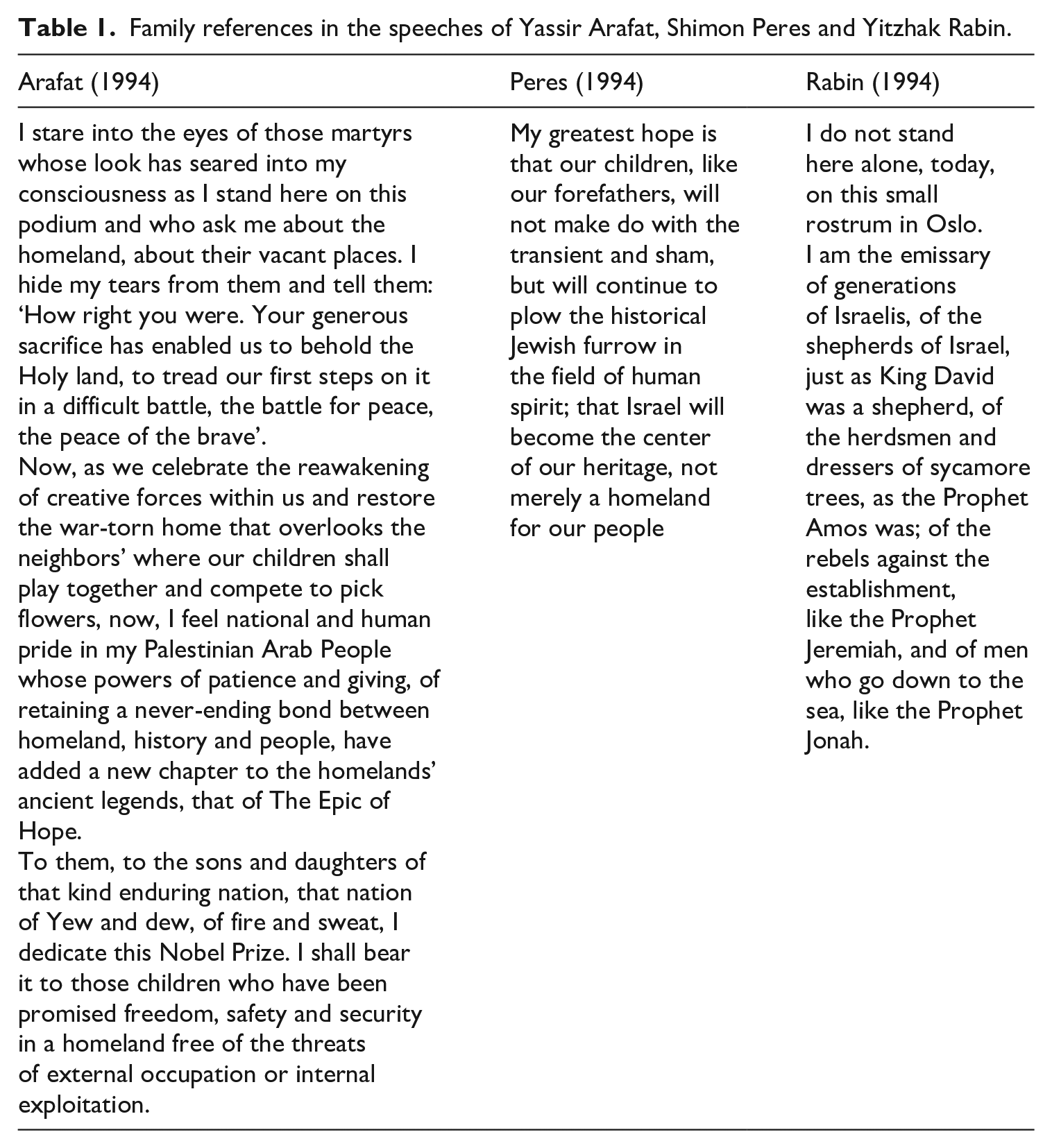
All three speak of peace as an infant that needs to be nourished but it is for each of them an infant of their family not the universal infant that Williams or Tutu have been alluding to. Rabin moves the furthest into this direction when admitting that birth is a lottery but instead of modelling this into a claim about universal humanity he uses this birth metaphor to legitimate fatherly protection: ‘From the moment he (the infant) comes, close-fisted, into the world, his fate lies in the hand of his nation’s leaders’.
By talking of children’s, sons’ and daughters’ death Arafat’s, Peres’ and Rabin’s speeches seek to infuse emotions of anguish and pain just like Williams’ and Tutu’s speeches do, yet, they also wish to evoke feelings of pride, nationalism, loyalty and exclusive communion by mixing the family references with nationalist, religious and heroic images. The use of children’s metaphors and the corresponding references to leadership and decision-making seeks to instil furthermore feelings of trust that the destiny of children and families, of innocent victims and of helpless infants are in good fatherly hands. Rabin especially evokes the masculine image of a pained father who does not want to but has to send off his son to battle to defend the home, and who therefore has to do this in a responsible, thoughtful, weighed and wise manner. Even if the damages of war are great in terms of human, cultural and economic costs, they are necessary. For all three, non-violence is not a road to peace but a sign of defeat and loss. And while peace is indeed the state in which children can go to school without sorrows or pick flowers, it is only so because men have, in the past, fought and are, in the future, ready to fight for it. The motherly peace of home is, in the world of the Middle East, a political illusion.
Family symbolism as call for reconciliation
The key missing piece in the speeches of Arafat, Rabin and Peres is any positive reference to the each other across the Palestinian–Israel divide, or any declaration that peace in the Middle East would need to be built together. This lack of acknowledgement is a far cry from those speeches that seek to urge reconciliation and justice as means to peace. Some of these use family metaphors too. The speeches of Ellen Johson Sirleaf, Leymah Roberta Gbowie and Tawakkol Karman, joint Peace Prize of 2011, provide good examples of this use of family metaphors.
In all three speeches, the laureates use family metaphors and allegories to evoke the (female) emotion work that ending war and peace requires. All three introduce family metaphors early on in their speeches, notably by calling each other ‘sisters’ and ranking themselves in a ‘lineage’ of women who have received the Peace Prize before them. They also use the sister metaphor to speak for women more generally, hence, invoking the solidarity of children among each other. In the gendered world of family relations, the sister metaphor has other connotations than the brother metaphor Yitzhak Rabin, Shimon Peres and Yassir Arafat are using. While both sibling metaphors speak of solidarity of the young one against an older generation, and against an outside world that imposes their expectations on the speaker and their audience, the brother metaphor implies much more freedom than the sister metaphor (see Pratt, 1994). In our patriarchal societies, young men can do anything they like, hence, invoking brotherhood is more a call to action, to explore the big, wide world and to take it in, as, for instance, in Beethoven’s Ode to Joy ( ‘All people become brothers in their heavenly march to joy’), the calls to revolution like Bakunin’s anarchist-communist ‘Program of International Brotherhood’, or the call for ‘fraternité’ in the French state motto inherited from the Revolution.
Invoking sisterly solidarity, however, is more often a specific appeal to women having first to fight for and gain the right to walk out into the world. Sisters do not naturally have a place of their own in the outside world like the heirs, successor and name keepers of sons do. They also do not have a natural community other than a family defined for them by men. Sisters who grow up to become adult women are (stereotypically and, most often actually) expected to marry outside the family, move away and take on the name of their husband’s families. Calling upon sisterhood is therefore also a call to preserve this moment in one’s life in which you and your sibling are not yet the other of a man. In the feminist movement in particular the discourse of sisterhood designates a space where women are free from social expectations of subordination, and where women are united in their struggle against patriarchy above and beyond any other substantial differences of class or race that might exist between them (hooks, 1986; Gunkel et al., 2012; Klein and Hawthorne, 1997; Lugones and Rosezelle, 1995; Peroni and Rodak, 2020).
By reclaiming this space of womanly solidarity in their speeches, Karman, Gwobie and Johnson Sirleaf set the tone of their speeches by associating ‘peace’ with this sisterly space of solidarity and war and violence with the patriarchal, masculine outside world. Contrary to radical feminists, however, their call for sisterhood does not exclude the use of other, more traditional metaphors in the way Betty Williams (see above) does. Leymah Roberta Gbowie, for instance, foregrounds motherly care in the same way as Williams did, and just like her situates the care for children as the key trigger for founding the peace movement she is representing. In contra-distinction to Williams, however, she explicitly associates the violence towards children with the violence against women, and imputes both to ‘young drugged men’: Women had become the ‘toy of war’ for over-drugged young militias. Sexual abuse and exploitation spared no woman; we were raped and abused regardless of our age, religious or social status. A common scene daily was a mother watching her young one being forcibly recruited or her daughter being taken away as the wife of another drug-emboldened fighter. We used our pain, broken bodies and scarred emotions to confront the injustices and terror of our nation. We were aware that the end of the war will only come through non-violence, as we had all seen that the use of violence was taking us and our beloved country deeper into the abyss of pain, death, and destruction. . . when confronting warlords we [the women of her movement] did so because we felt it was our moral duty to stand as mothers and gird our waist, to fight the demons of war in order to protect the lives of our children, their land and their future.
Whereas in Williams’ discourse the ‘front line’ of violence goes in-between families, the violence of war rips through families in Gbowie’s speech. Karman uses a similar imagery in her speech on Yemen’s youth and democracy movement. While this reflects not only the different nature of the conflicts out of which these female led peace movements were born, it also reflects a different understanding of family and women’s roles in these. All three laureate’s emphasis on sisterhood, indeed, inverses the gendering of the public-private divide. Men, or more accurately war faring men violently invade family spaces and destroy the ‘inside’ of families, while it is the women who go out into the streets, take responsibility and political office (Johnson Sirleaf) to bring peace to the community.
Different to Arafat, Rabin and Peres, the articulation of the public, political space as the space of sisterly solidarity is more inclusive than the articulation of the political space as that of the national family. Figuratively, Karman, Gwobie and Johnson Sirleaf suggest that they can be a sister to everyone; Arafat’s, Rabin’s and Perez’s use of family metaphors, however, emphasises that they can be leaders to their own families, only.
Karman, Gwobie and Johnson Sirleaf also use the metaphor of daughters to garner legitimacy for their position as Nobel Peace Laureates. All three situate themselves in a lineage of women having received the award as heroines of peace. But they also use stories of daughterhood as indicator for their personal evolution into political leaders: as daughters they are fulfilling destinies that ancestors had designed for them. The metaphor of daughter allows walking a thin line between claiming responsibility for their political actions as the right thing to do for ‘dutiful’ daughters who are serving their ancestors wills; and of shedding the same responsibility by keeping the head low and downplaying their agency. Great care is taken to include men into their speeches about their peace work. Hence, the discourse of sisterhood now and again slips to become a discourse of ‘fraternity’. No one wants to smash the patriarchy; they just want to guide them out of their wrong ways.
Conclusion
Family metaphors and allegories are an important way of speaking about peace because they are, at once, universally rooted in socio-cultural imaginaries, and open to be individually filled by the audience in their concrete meanings. Family tropes allow Nobel Peace laureates to speak of their own feelings about the award and their imagined feeling of peace in the community, without having to get into the nitty-gritty and eventually conflictual detail of the peace itself. The metaphors are part of the story they are telling the audience about the peace they imagine for themselves, their communities and their (former) enemies. While the metaphors are used by all to convey feelings of safety, belonging and protection, they are not used so necessarily in an inclusive way. Especially by linking family allegories and metaphors to other tropes of (indivisible) land, authority and the state, Arafat, Rabin and Peres devise an exclusionary vision of peace where it is only the own family (nation) that is imagined to enjoy peace, not the other. Their use of family figures of speech is not meant to build conflict-crossing community between Palestinians and Israelis but to cement their respectively exclusive claims of peace for them.
The ontological and symbolic role of family metaphors and allegories varies in gendered ways. In the gendered usage, that is, speaking ‘as fathers’ or ‘as mothers’, the ambiguity of family metaphors is dissolved. In the larger picture of Israeli and Palestinian military and conflict politics, the fatherly discourses of all three build on hierarchical, patriarchal and exclusive politics of difference. The three speakers walk a very thin line between postulating an overarching relation between the two antagonistic groups, the peace accords, while refuting any intimate connection between the two.
However, the ‘motherly’ or ‘sisterly’ discourses of Williams, Tutu, Sirleaf, Karman and Gwobie (and others like Maathai) advance concepts of inclusiveness, openness and equality. They shift the family bond of their allegories as to expressing a desire to translate the hostile and antagonistic relations between two sides of a conflict into a unifying force of inter-dependent and intimate connection. The imaginary of feeling peace is conceived to be shared beyond the past hostilities and continuing conflicts, and peacemaking is claimed to be inspired by this commonly shared imaginary of peace. The use of family symbolism in speech allows safeguarding an individual, subjective space where everyone in the audience can feel free to imagine their own peace, while presenting the political, public side of peace as one that is humanely and socially shared. The difference in the rhetoric effect of family metaphors and allegories in these two usages show that their meaning does not reside in the universality of the social fact of families alone, nor can it be reduced to the (often stereotypical) associations with literal family relations or positions. Rather, the discursive context of their use and the politics of the discourse itself interact with their meaning on the socially constructed and individual levels, and push family symbolism into either direction.
Peace, in this perspective, feels like the ease with which the speaker and the audience can close the gap between their experiences of war and conflict, and the proposed vision of what will come after the fighting has ended. Peace will feel as reconciliation once motherly care and love is embraced as a principle of interaction between the (formerly) hostile parties. However, patriarchal antagonism will continue as long as families are defined as the patriarch’s own. As Arafat’s, Peres’ and Rabin’s speeches show, the ambiguity of family metaphors can very well be used to devise a common future without implying reconciliation between parties or bridging conflicts. Consequently, the politics of peace that are sketched through family metaphors and allegories can differ greatly between community-building visions predicated on equality, recognition and reconciliation; and ‘fenced’ vision predicated on separation, distance and (authoritarian) mediation of relations. Given that 28 years after Arafat’s, Peres’ and Rabin’s speeches, there is still no resemblance of even a peace as sketched by these three (as contrary to the situation in Northern Ireland, for instance), the imaginary of family symbolism seem to replicate a stable pattern of commonly shared feelings for peace but sadly such that reproduce distinction, antagonism and with that feelings of insecurity, fear and, ultimately, unending conflict.
Footnotes
Funding
The author(s) received no financial support for the research, authorship and/or publication of this article.
