




Abstract
There is an ongoing debate in the research literature on whether the neoliberal economic rationalities permeating public administration, policy, and governance across much of the world provide the means necessary for promoting sustainable development. Parallel to this debate, it has been suggested that resilience thinking, a notion with growing policy importance, could either reproduce the neoliberal mainstream or challenge it at its core, depending on the modes of resilience thinking emerging from practice. Taking the position that new economic rationalities are needed, this study examines how transformative modes of resilience thinking that emerge from practice create tensions that can support a transformation toward the economic rationalities of the so-called doughnut economics, an alternative economic model that outlines a vision and a path toward ecological and social sustainability.
Introduction
We live in contradictory times. On the one hand, the expansion of modern development trajectories during the post–World War era has produced extraordinary progress concerning some aspects of human well-being, such as increased life expectancy and reduction of extreme income poverty (Raworth, 2017; United Nations, n.d.). On the other hand, these trajectories, and the economic rationalities underpinning them, are associated with socioecological changes posing severe threats to human well-being (see Raworth, 2017), such as the increased overuse of Earth’s biophysical capacity (Steffen et al., 2015), rising economic inequalities (Hardoon et al., 2016; Piketty, 2014), and environmental injustices (Agyeman et al., 2003; Anguelovski et al., 2016; Di Chiro, 2018). Reflecting this contradiction, the mainstream economic rationalities underpinning governance processes and modern development trajectories across the world are subject to dispute, especially in the neoliberal guise dominating politics and policy over the past three to four decades. On the one hand, the proponents of the neoliberal mainstream argue that the neoliberal rationalities provide the means necessary for sustainable development. On the other hand, advocates of alternative positions in political economy argue that other economic rationalities, with different theoretical underpinnings, are needed—economic rationalities making environmental sustainability and more equal opportunities for social well-being the core priorities of development, not gross domestic product (GDP) growth (see Bell, 2015; Hornborg, 2015; Raworth, 2017). Building on the latter argument, this article focuses on “resilience thinking”—a term here used to describe the twin concepts of climate resilience and climate change adaptation—and its potential and limitations disrupting neoliberal economic rationalities and promoting alternative economic rationalities, more specifically those of the so-called doughnut economics (Raworth, 2017).
Resilience thinking has emerged in both research and policy, providing particular ways of approaching anthropogenic environmental changes and their social–ecological impacts (Adger et al., 2009; Folke, 2006; Olsson, 2018; United Nations, 2019). Some of its critics argue that resilience thinking reflects and reproduces neoliberal rationalities (e.g., Gillard, 2016; Joseph, 2013; Watts, 2015). Others show how resilience (Adger et al., 2009; Harris et al., 2018) and the associated notion of climate change adaptation (Olsson, 2018; Pelling, 2011) are political and negotiable and have identified different modes or styles of resilience thinking. Some modes preserve the neoliberal rationalities and the development trajectories they support. Others are in tension with these rationalities and have the potential to catalyze disruption and transformation. Adger et al. (2009) go so far as to suggest that resilience thinking could function as an alternative paradigm to the current growth-centered paradigm. Hence, from the normative position of this article, there are reasons to further investigate how transformative resilience thinking can disrupt neoliberal economic rationalities and create momentum for rationalities through which ecological sustainability and social well-being are prioritized before GDP growth, as in doughnut economics.
In this article, I use the phronetic social science approach (Flyvbjerg, 2001) to examine transformative modes of resilience thinking emerging from narratives of climate adaptation practice and how they relate to the theoretical assumptions of both mainstream neoliberal economics and the alternative economic rationalities of doughnut economics. My focus on economic rationalities is due to their central influence on modern societies’ development trajectories. As Raworth (2017, p. 5) puts it: “[e]conomics is the mother tongue of public policy, the language of public life and the mindset that shapes society.” In several countries, including Sweden, the influence of neoliberal economic rationalities is, for instance, conveyed through the salience of market mechanisms in the organization of public administration, captured with the umbrella term “new public management” (NPM; Peters & Pierre, 2018; Pollitt & Bouckaert, 2017); the dominance of neoliberal rationalities in urban and regional development discourse, emphasizing the “need” of promoting growth through spatial competition between cities and regions, for example, by prioritizing the development of places attracting innovative and well-educated people (Aronsson, 2013; Granberg & Nyberg, 2018; Öjehag-Pettersson, 2015); and through the “market environmentalists’” solutions to environmental degradation (Bell, 2015; Lockie, 2013). Since neoliberal economic rationalities are central to the way politics and societies are shaped, the exploration of tensions that could disrupt them and create momentum for alternative economic rationalities is of key importance from the normative position of this article.
In specific terms, the empirical focus of this article is on resilience thinking emerging from narratives of actors involved in climate change adaptation at the level of local governments in Sweden, 1 including public officials as well as actors from civil society and the business sector involved in the governance of adaptation. There are two methodological rationales for this empirical focus. First, the Swedish case constitutes a paradigmatic case (Flyvbjerg, 2006) in the sense that tensions between resilience thinking and neoliberal economic rationalities emerging in the narratives there “[…] highlight more general characteristics of the societies” (Flyvbjerg, 2006, p. 232) in which such rationalities coexist. That is, the tensions emerging in the Swedish contexts plausibly have family resemblances (see Goertz, 2006) with tensions that emerge in other governance contexts. Climate change adaptation and resilience are manifested in public policy at several governance levels, especially at the local level, in many parts of the world (see Olsson, 2018; Schlosberg et al., 2017; United Nations, 2019), 2 implying that resilience thinking to a large extent transpires in governance contexts permeated by neoliberal rationalities. This includes the contexts of urban and regional growth policies (e.g., Book et al., 2010; Granberg & Glover, 2014; Herrschel, 2013; Hu, 2015; Monfaredzadeh & Berardi, 2014), NPM (Peters & Pierre, 2018; Pollitt & Bouckaert, 2017), and market environmentalism (Bell, 2015; Lockie, 2013). Thus, this study provides important insights into the discussions of the transformative prospect of resilience thinking. These insights could stimulate reflection and transformative action on how neoliberal rationalities can be challenged and the rationalities of doughnut economics promoted, both in Sweden and in other countries in which resilience thinking is promoted alongside neoliberal ideas. In addition to other Nordic and European countries, this includes countries in other parts of the world, such as Australia (see Granberg & Glover, 2014).
Second, the focus on the local governance level, including actors in public administration and the private sector, provides insights into a substantially important arena for the governance of climate adaptation. To start with, the complexity of a socioenvironmental issue like adaptation means that public administration and its public officials play key roles in shaping adaptation politics and policies. In contrast to the notion of public officials as neutral actors, they are thus understood as political agents partaking in the framing and formulation of policy, the political agenda setting, and the knowledge production on which the policies are based. In essence, they are central to the formation of “sustainable development” trajectories (Hysing & Olsson, 2017), which includes resilience thinking. Moreover, the level of local governance is an important arena for adaptation, both in Sweden and beyond, since many adaptation measures are shaped and implemented at this level, making it a hub for adaptation practice. Local governments in Sweden and other countries such as Germany and the United States also participate in various governance networks involving governmental and nongovernmental actors (Bulkeley et al., 2014; Hughes, 2015; Olsson, 2018). 3 Interestingly, the latter type of actor has been shown to represent transformative modes of resilience thinking (see Schlosberg et al., 2017) that produce tensions with neoliberal rationalities. In short, the level of local governance is central to the politics and policies of climate adaptation and could potentially include a plurality of understandings of resilience thinking, including modes that are transformative.
Against this backdrop, the purpose of this article is to contribute to the broader discussion concerning the transformative potential of resilience thinking. More specifically, narratives of practice are examined to identify potential modes of resilience thinking in tension with neoliberal economic rationalities by reflecting doughnut economic rationalities. Considering these findings, the transformative potential of resilience thinking is then further elaborated.
The remaining part of this article is structured as follows. First, the central theoretical underpinnings of doughnut economics, neoliberal economics, and resilience thinking are outlined, and the transformative potential of resilience thinking is discussed. Second, the methodological approach and methods are presented. Third, the results of the empirical analysis are reported. Finally, the implications of the findings are discussed followed by an elaboration of the difficulties and possibilities of fulfilling the transformative potential of resilience thinking.
Resilience Thinking and Economic Rationalities in Theory
The neoliberal economic rationalities currently underpinning most governance settings and development trajectories across the world have been subject to critique, both in political economy research arguing for alternative economic theories (e.g., Hornborg, 2015; Raworth, 2017) and in resilience research arguing for transformative modes of resilience thinking (e.g., Adger et al., 2009; Harris et al., 2018; Olsson, 2018; Pelling, 2011; Schlosberg, 2012). These bodies of research address the concerns of growing economic inequalities, environmental degradation, and environmental injustices and argue that these parsimoniously treated concerns need to become the top priorities of development—an emphasis shared with research specifying alternative conceptualizations of sustainable development, such as “just sustainabilities” (Agyeman et al., 2003). As part of this change of priorities, these bodies of research stress that the primacy of GDP growth cannot continue, especially not among already affluent countries and populations, since it produces unsustainable pressures on the Earth system and thus undermines the conditions for human well-being. Hence, these bodies of research argue for a new set of priorities, changing the course and meaning of development (e.g., Agyeman et al., 2003; Hornborg, 2015; Pelling, 2011; Raworth, 2017).
Related to the above, there are, as mentioned, different modes of resilience thinking, some of which tend to reproduce neoliberal rationalities and others that pose a challenge to them. Consequently, as underlined by Harris et al. (2018), resilience thinking comprises many possible and competing meanings and, therefore, is in that sense political. In each context, the meaning and practical use of resilience and adaptation are shaped through specific processes. In this study, resilience and adaptation are thus conceptualized as things in the making, not as specific and clearly defined outcomes or traits (see Moser et al., 2019). Depending on the processes through which the meaning of resilience and adaptation are shaped, resilience thinking can therefore challenge or reproduce neoliberal rationalities (Harris et al., 2018; Moser et al., 2019). Examples of the latter mode of resilience thinking include apolitical, managerial conceptualizations of resilience and climate change adaptation, excluding reflection and problematization of underlying values and norms (e.g., Gillard et al., 2016; Ison et al., 2014; Westling et al., 2014); conceptualizations neglecting aspects of differentiated power in terms of knowledge (e.g., Klenk & Meehan, 2015) and injustices (e.g. Schlosberg et al., 2017), including processes producing various injustices (Bulkeley et al., 2014); and resilience thinking reproducing specific neoliberal rationalities (e.g., Joseph, 2013; Watts, 2015). However, the multiple meanings of resilience and adaptation imply that some modes of resilience thinking can be transformative and, accordingly, contribute to unsettle neoliberal rationalities and promote alternatives addressing and problematizing processes producing inequities, ecological degradation, environmental injustices, and so on (Adger et al., 2009; Harris et al., 2018; Olsson, 2018; Pelling, 2011; Schlosberg et al., 2017). Hence, resilience thinking could become a force for preservation or transformation of neoliberal economic rationalities, depending on how it emerges through the processes of context-specific practices.
The specific modes of resilience thinking emerging in a context, and consequently their relation to neoliberal rationalities, are to a large extent premised on the knowledge, values, and norms shaping how the central features of resilience come to matter in that context. I conceptualize these in terms of two overarching features. The first feature is the emphasis on social–ecological connections in complex and dynamic nonlinear systems. This feature includes a focus on system structures and processes maintaining a specific system state, but also processes weakening a given system state and pushing it toward thresholds or tipping points that, if crossed, push the system into a new and often irreversible state. The processes influencing a system are assumed to operate at multiple spatial scales (e.g., local, regional, national, global) and time scales (Adger et al., 2009; Folke, 2006; Gallopín, 2006). This overarching feature creates possibilities for several variations, producing different modes of resilience thinking. These include variations in the scope of socioecological connections in focus and, related to this, the selection of processes assumed to reinforce and undermine a system state, how these processes should be prioritized and responded to, which system states “need” to be made resilient, and so on. Such variation is associated with differences in the underlying knowledge(s), values, and norms. Moreover, the variations relate to and overlap with the second overarching feature of resilience: adaptive capacity. This feature entails the capacity needed to facilitate adaptation (Adger et al., 2009) and is conceptually comprised of the four Rs: robustness, redundancy, rapidity, and resourcefulness (Norris et al., 2008). Selecting and prioritizing things to make robust and redundant, choosing things in “need” of rapid response measures, and using specific methods and resources to mobilize such changes (resourcefulness) will reflect specific knowledge(s) and their theoretical assumptions, norms, and values, including economic theoretical knowledge. This brings me to the issue of how these resilience features relate to the rationalities of doughnut economics and neoliberal economics, especially to ways in which resilience could produce tensions with the latter.
In brief, doughnut economics is based on seven rationalities or theoretical assumptions, distinguishing it from mainstream neoliberal economics. 4 To start with, the primary goal of development is not the pursuit of perpetual GDP growth, as in neoliberal economics, but thriving in balance. The latter entails securing a social foundation providing good development chances for all humans, represented by the doughnut’s inner ring. This social foundation is based on human rights and its aspects are all included in the United Nations’ sustainable development goals, including food, health, education, income and work, peace and justice, political voice, social equity, gender equality, housing, networks, and energy. Moreover, thriving in balance encompasses development under the ecological ceiling of Earth’s biophysical capacity—the outer ring of the doughnut—as specified in the planetary boundaries framework (see Raworth, 2017; Steffen et al., 2015). Second, to promote development within the doughnut, the economy needs to be distributive by design and, third, regenerative by design. That is, to move above the inner ring, a doughnut economy is distributive by design. By contrast, the assumption of neoliberal economics is that market mechanisms will produce both continuous economic growth and, eventually, a distribution of the economic resources that will benefit everyone. Furthermore, the economy is regenerative by design to support development that stays under the ecological ceiling. By contrast, the neoliberal economic assumption is that growth, through competitive and free markets, will eventually result in environmentally friendly development by providing the incentives and means for developing and investing in green innovations. Fourth, staying under the ecological ceiling entails a growth agnostic assumption, in contrast to the presumed necessity of growth in neoliberal economics. Also, promoting transformation entails a conceptualization of the economy as dependent on a supportive Earth system and connected to more aspects of society than the market, including the state, the commons, and households. That is, the fifth assumption of doughnut economics is that the economy needs to be reconceptualized as socioecologically embedded, in contrast to the self-contained market system of neoliberal economics. This also relates to the sixth and seventh assumptions: Economic analyses should be based on dynamic and complex systems thinking, not mechanical equilibrium, and on an understanding of human behavior as motivated by socially shaped values in contrast to the a priori assumption that humans are driven exclusively by self-interest, as in the homo economicus of neoliberal economics (Raworth, 2017).
As implied by the outlined assumptions of doughnut economics and neoliberal economics, the resilience features mirror some assumptions of doughnut economics while being in tension with neoliberal economics. For starters, doughnut economics and resilience share the emphasis on socioecological connections and dynamic systems thinking, including the associated emphasis on tipping points beyond which systems move into new and potentially irreversible states. The resilience-grounded planetary boundaries framework, emphasizing the importance of human development staying within the planetary boundaries (one of which is climate change) and creating a safe operating space away from dangerous and irreversible biophysical tipping points pushing the Earth system out of the relatively stable state of the Holocene epoch (Steffen et al., 2015), is directly incorporated in doughnut economics. The planetary boundaries framework thus forms part of the argument for thriving in balance, promoting a regenerative economy by design, and growth agnosticism (Raworth, 2017). Depending on how the resilience features emerge through practice, they could produce significant tensions with the theoretical assumptions of neoliberal economic rationalities, such as the self-contained market system, mechanical equilibrium, and even the primacy of GDP growth.
To conclude, this outline of resilience thinking and economic rationalities points to clear overlaps between the overarching features of resilience and the rationalities of doughnut economics—rationalities in tension with neoliberal economics. Thus, resilience thinking has the potential to create tensions with neoliberal economics and support rationalities forming part of doughnut economics. However, this will largely depend on the knowledge, and associated values and norms, contributing to the formation of resilience thinking in practice.
Method
This study is based on the phronetic social science approach (Flyvbjerg, 2001; Flyvbjerg et al., 2012b), which is a methodological approach putting values and power relations at the center of attention. Moreover, the aspiration is to promote a more desirable development by furthering interests, values, and perspectives marginalized by dominant power formations, for example, by challenging neoliberal rationalities and by promoting doughnut rationalities. The proponents of the phronetic approach argue for social science studies stimulating value-rational reflection, deliberation, and action in society while also providing insights into how power relations supporting undesirable trajectories can be disrupted. The latter focus is explicitly connected to the aspiration to support societal change since, as Flyvbjerg (2004) puts it, “[r]ationality without power spells irrelevance” (p. 292). More specifically, power is understood in the Foucauldian sense as productive power/knowledge, decentralized, and omnipresent. Consequently, the primary questions of power in focus are “how” questions, such as how power/knowledge is exercised to maintain a specific formation of power; how this formation constitutes subjects, value hierarchies, and objects; and how it can be challenged (Flyvbjerg, 2001, 2004; Foucault, 1982; Olsson, 2018).
My analysis and discussion draw on the four phronetic questions provided by Flyvbjerg (2001), which are focused on demonstrating the trajectory of the phenomenon under study, the mechanisms of power maintaining it and its winners and losers, whether the normative position specified by the researcher calls for change and, if so, how change can be incited. Translated to my study, I examine whether transformative modes of resilience emerge from the narratives, producing a trajectory toward doughnut rationalities in conflict with the trajectory of neoliberal rationalities. Moreover, the question of how the neoliberal trajectory is challenged is answered through an elaboration of the so-called tension points. Hence, tension points are used to inquire into conflicting mechanisms of power between, on the one hand, transformative modes of resilience thinking reflecting doughnut rationalities and, on the other, neoliberal rationalities. These two aspects of the phronetic approach are explicated in the empirical analysis. The question of winners and losers, whether change is called for in terms of a need for resilience thinking creating additional tension points, and how change can come about from such tension points are elaborated in the concluding discussion.
This brings me to the concept of “tension points,” which is the key analytical unit used to develop the conceptual themes presented in the empirical analysis section. Tension points are power relations particularly sensitive to disruptive problematizations since they, from the normative position of the researcher, reveal contestable knowledge, dubious practices, and potential conflicts (Flyvbjerg, 2012; Flyvbjerg et al., 2012a). Hence, they create possibilities for change by making, as Foucault (1987) puts it, “[…] the acts, gestures, discourses that up until then had seemed to go without saying […] problematic, difficult, dangerous” (p. 113). As analytical units, tension points thus enable me to conceptualize themes revealing frictions with the potential to unsettle a specific formation of power and ignite change.
The tension points presented in the analysis, moreover, provide a basis for my reconstructive aspiration, developed in the concluding discussion—an aspiration forming part of the phronetic approach. That is, the phronetic approach is committed to reconstruct alternatives that are “better” in the sense that they are “[…] more inclusive of values and groups that are legitimate and pertinent to the issue at hand, but that may have been marginalized by other more powerful values and groups” (Flyvbjerg et al., 2012a, p. 286). Specifically, tension points between transformative resilience thinking and neoliberal economic rationalities provide a basis for elaborating on how transformative modes of resilience thinking can support transformation toward doughnut economics. Hence, they provide insights enriching phronetic reflection, deliberation, and action on alternative pathways to sustainable futures. Note, the aspiration is not to point to the “only way” forward but to produce phronetic research contributing to societies’ “[…] practical rationality in elucidating where we are, where we want to go, and what is desirable according to diverse sets of values and interests” (Flyvbjerg, 2001, p. 167).
Narrative analysis is the method used for the qualitative analysis. This method suits the focus on context-dependent knowledge in phronetic research (Flyvbjerg, 2001; Flyvbjerg et al., 2012a; Landman, 2012). Narrative analysis includes a broad church of analytical strategies, which converge in their focus on analyzing accounts of people’s direct or indirect experiences, often of events, and their evaluations of these experiences. The analytical strategies range from thick descriptions of a single person’s narrative to thematic categorizations of many short narratives told by several people. The latter includes different types of discourse analysis (Landman, 2012). This study positions itself on the discourse analytical end of this spectrum. I have identified and categorized transformative resilience thinking, emerging from the narratives, reflecting doughnut economic rationalities, and producing tension points with neoliberal economic rationalities. When conceptualizing the tension points with the latter rationalities, I have either used contrasting neoliberal rationalities conceptualized from the narratives of the participants or compared the articulations of the participants with the neoliberal rationalities presented above. That is, I highlight narratives representing a discourse in conflict with that produced through neoliberal rationalities and conceptualize such discursive conflicts as tension points.
The conceptualization of tension points has, furthermore, been carried out through an abductive coding process, meaning that I have searched for codes articulating discursive content in line with the concepts of transformative modes of resilience thinking and doughnut economics, as described in the previous section, in tension with neoliberal rationalities. The theoretical concepts of resilience thinking, doughnut economics, and neoliberal rationalities thus provide the interpretive frame that I utilize to recontextualize the narratives of the focus group participants (Danermark et al., 2003), by conceptualizing them as tension points. In other words, a code like “[…] nobody makes individual gains from recycling. It is not cheaper for you. It is a real pain […]. However, people still do it because they know that it’s the right thing to do” (Focus Group in Oceanfront City, 2018, p. 10), is interpreted as an articulation that reflects the doughnut-economic assumption that humans are motivated by socially shaped values. This assumption is in stark contrast to the neoliberal a priori assumption that human behavior is driven by self-interest and is an example of a tension point.
Moreover, when conceptualizing the codes into tension points, I classified groups of codes having a family resemblance (Goertz, 2006) regarding how they produce friction with neoliberal rationalities. This conceptualization process was ongoing and dynamic, with me moving back and forth between the interpretive frame and the empirical codes, so as to make plausible interpretations and conceptualizations of the data (Danermark et al., 2003). Furthermore, to assist the conceptualization process, I used Goertz’s (2006) three-level conceptual structure, with a basic level (tension points as the primary concept), a secondary level (conceptualizations of different types of tension points), and an indicator level (the empirical codes from the material exemplifying a specific type of tension point; see Online Appendix 2). In the analysis, I used illustrative quotes exemplifying each tension point.
As argued in the Introduction section, the tension points are relevant for discussions on the transformative potential of resilience thinking, particularly in the contexts of governance, since they are both paradigmatic and operate in a central arena for resilience thinking. Hence, although it would be problematic to claim that the particular articulations, or codes, exemplifying a specific tension point are somehow empirically representative in terms of frequency, and thus “typical” of a larger population (see Flyvbjerg, 2006; Landman, 2012), they nevertheless have general analytical relevance since they are likely to have a family resemblance with narratives producing similar tension points in other governance contexts, both within and outside of Sweden. Accordingly, they can provide valuable insights for phronetic reflection, discussion, and action far beyond the Swedish contexts examined here.
The empirical data used for the narrative analysis were retrieved from focus groups. The argument is that focus groups are particularly useful for capturing articulations of tension points since they promote interactions between the respondents and encourage discussions in which the participants share and deliberate on their experiences and understandings of a phenomenon (see Breen, 2006; Kitzinger & Barbour, 1999), such as resilience thinking. Hence, although pressures to conform to the group could hold back articulations of different viewpoints, focus groups could spur discussions between people with opposing views and interests (Kitzinger & Barbour, 1999). In addition to the tension points emerging from a specific participant’s narrative, focus groups can thus capture tension points emerging from the interaction between participants.
As mentioned, the focus of my analysis section is to abductively recontextualize practitioners’ narratives of climate resilience to examine whether there are those that articulate trajectories of resilience thinking in conflict with neoliberal rationalities and, if so, conceptualize the tension points they produce. To enable this type of recontextualization, the focus groups were designed with the objective of providing broad accounts of the experiences and understandings of current climate adaptation practices. To nourish the focus group discussions and encourage the participants to share and discuss different aspects of their experiences and understandings of climate resilience and adaptation, five overarching themes were addressed that relate to different aspects of resilience thinking. 5 In addition, questions and subquestions were connected to each theme to support the focus group discussions when needed (see Online Appendix 3).
In total, three focus group interviews were conducted. Each focus group included actors involved in adaptation practice at the local governance level in Sweden, more specifically in three municipalities. 6 Each focus group had between three and four participants plus the moderators, and each lasted about 1½–2 hr. Initially, more participants were supposed to partake in the focus groups, but for various reasons a few dropped out. Nevertheless, the final composition was sufficient for the purpose of this study (see Kitzinger & Barbour, 1999).
Two strategies were used to select the participants of the focus groups. First, in each municipality, a public official with a coordinating role for adaptation-related issues was instructed to invite people partaking in adaptation at the local level and, if applicable based on the first criteria, these should preferably come from several sectors and organizations. The strategy to let a municipal public official at each municipality select participants in this way is motivated by our interest in actors somehow involved in adaptation at the local governance arena. However, since this strategy is associated with risks of screening (Kitzinger & Barbour, 1999), we also used a second strategy. Namely, the research team, of which I am a part, invited additional actors from the business and voluntary sectors somehow engaged in adaptation practices at the local arena but not necessarily in collaboration with the municipal coordinator or anyone else in the municipal public administration.
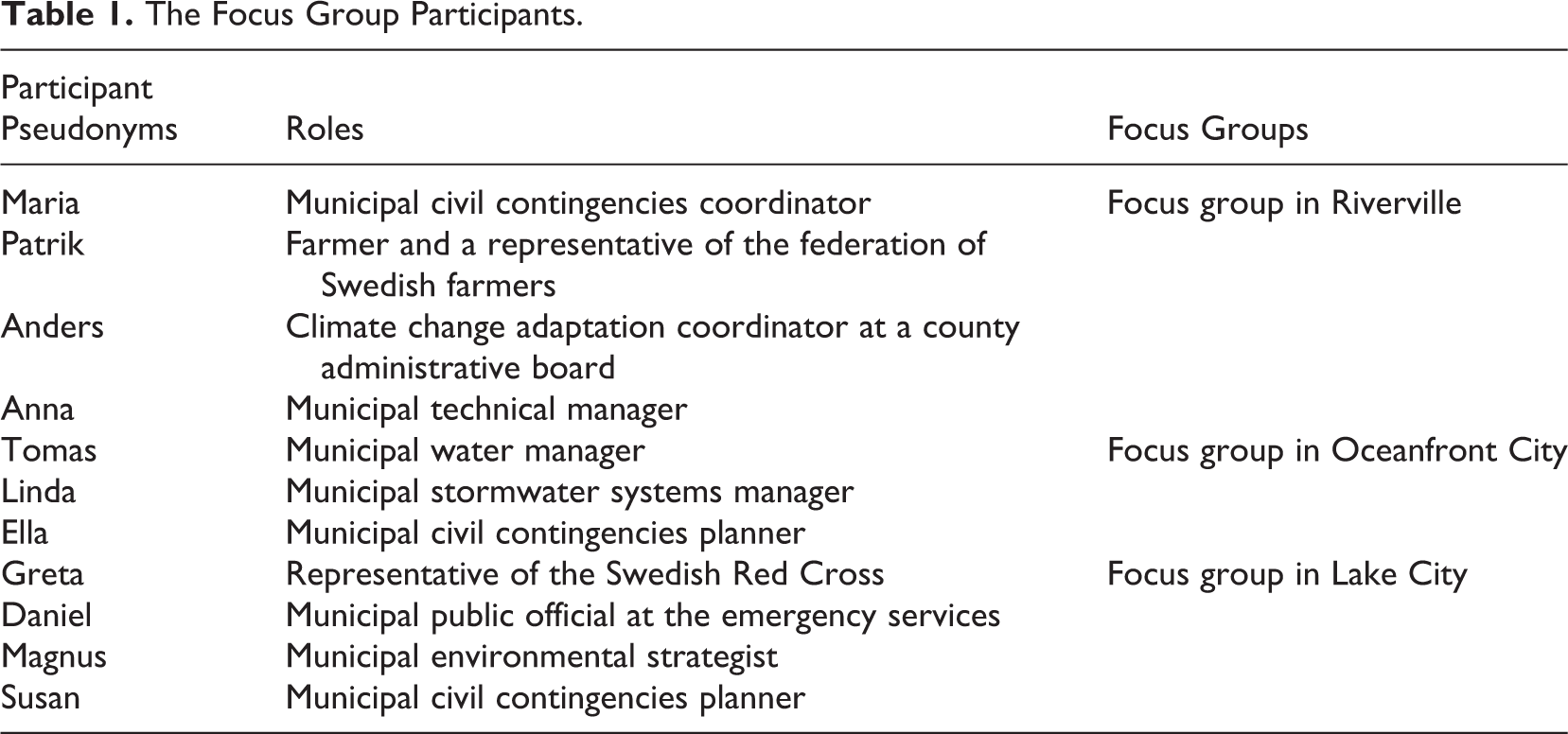
The focus group participants included public officials from different municipal sectors—including those with a focus on disaster risk reduction and crisis management as well as sectors working with more long-term climate change adaptation planning—and participants from a nonprofit nongovernmental organization and the business sector. Each focus group had a different composition (see Table 1). 7
The Focus Group Participants.
Resilience Thinking and Economic Rationalities in Practice
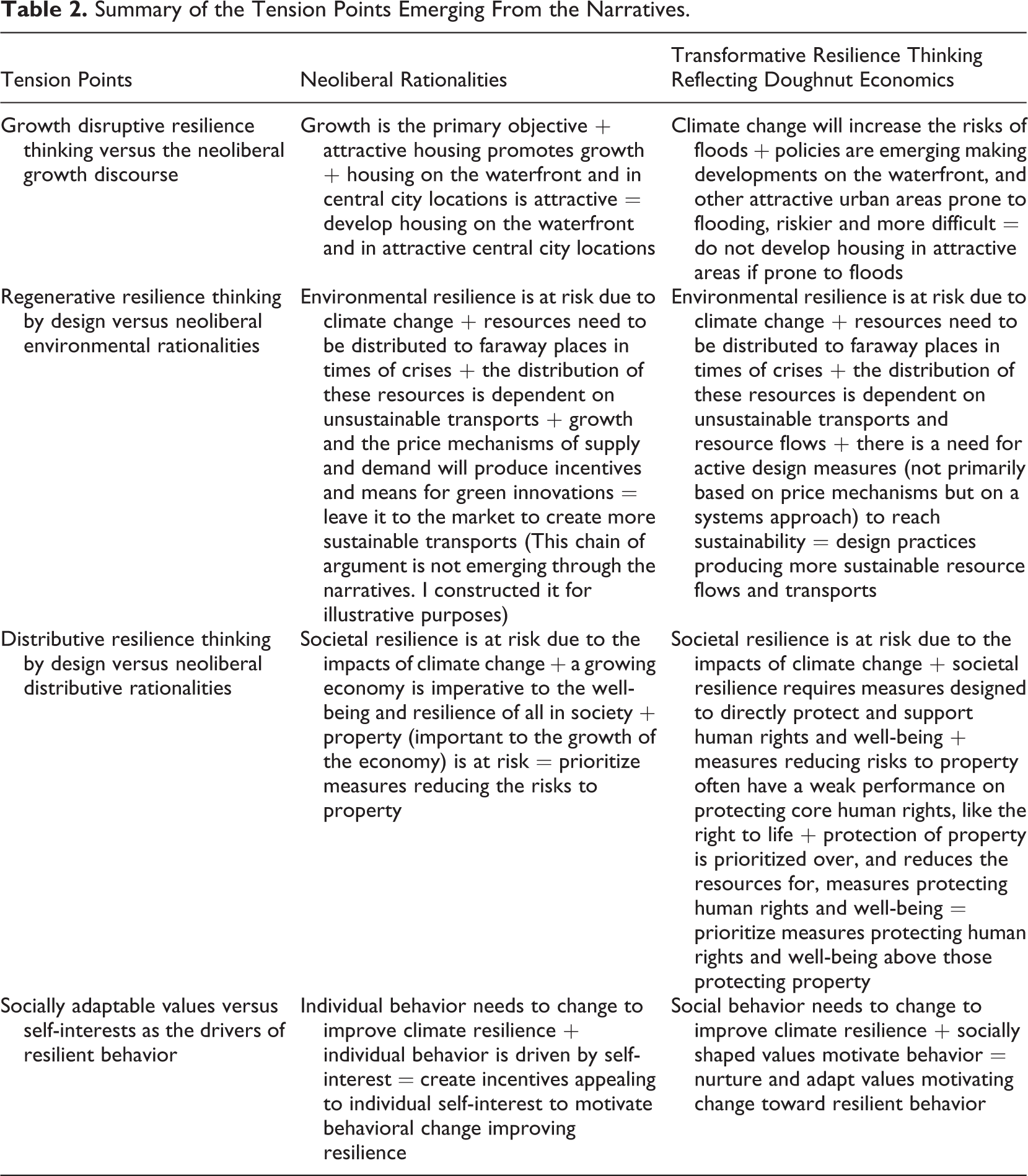
I have conceptualized four tension points emerging from the narratives of the focus group participants. The first tension point is between growth disruptive resilience thinking and neoliberal growth rationalities. The second is between regenerative resilience thinking by design and neoliberal environmental rationalities. The third is between distributive resilience thinking by design and neoliberal distributive rationalities. The fourth is between two competing assumptions of what motivates change toward resilient behavior: socially adaptable values or self-interests. In what follows, each tension point is presented under its own heading.
Growth Disruptive Resilience Thinking Versus the Neoliberal Growth Discourse
One of the tension points emerging in the narratives is between resilience thinking and the neoliberal growth discourse—a tension in which growth emerges as the primary concern but where a specific feature of the neoliberal growth discourse is challenged. To start with, the primacy of growth was made particularly clear in Oceanfront City but was also implied in Lake City and Riverville. This value hierarchy was articulated in narratives describing efforts to promote attractive developments, as indicated by Linda, a stormwater manager in Oceanfront City, who uttered: “[…] social sustainability and climate are on the agenda. We don’t need to scream. […] However, the top priority is always to build more” (Focus Group in Oceanfront City, 2018, p. 55). Here, the primacy of growth over climate resilience is articulated in relation to developments in central areas of Oceanfront City. As such, it is an expression of the emphasis of the neoliberal growth discourse on the “need” to enhance urban attractiveness to promote competitiveness (see Introduction section). Hence, it points to GDP growth as the core priority—recall that population growth forms part of GDP growth (see Piketty, 2014).
Nevertheless, although growth emerged as the primary objective in relation to climate resilience, a type of tension point transpired through which resilience thinking defies core aspects of the notion of promoting urban attractiveness. More specifically, this type of tension emerged through an account of a new local public policy and an account of a change in an insurance company’s policy. The former was articulated when Tomas, a water manager in Oceanfront City, described a new local policy requiring all new plan descriptions to include a specification of how many additional cubic meters of stormwater each new development generates. As a result of this policy, he emphasized that politicians in Oceanfront City cannot, as previously done, ignore increased flood risks created from new developments. In his words: [t]hen it becomes a bit harder for a politician […] [b]ecause up until now the political level could claim: “no, but we didn’t…” They didn’t know. […] But after this [new policy] they have it in black and white, that this plan will worsen the flooding problems in [Oceanfront City] […]. (Focus Group in Oceanfront City, 2018, p. 12)
Concerning the tension emanating from the insurance policy change, Tomas stressed that a Swedish insurance company (Länsförsäkringar) had recently declared that they would not insure houses to be developed in an area on the ocean waterfront in another municipality in the same county as Oceanfront City. In his words, the reason was that “Länsförsäkringar had stated: ‘we will not insure new houses in this new area in […] [that] municipality since the county administrative board says that the plan should not be implemented’” (Focus Group in Oceanfront City, 2018, p. 8). Adding to this, Linda also stressed that the insurance company’s statement and its implications for future developments were monitored by the Oceanfront City (Focus Group in Oceanfront City, 2018), indicating that this tension could come to disrupt plans to develop housing in areas prone to flooding on the oceanfront.
To conclude, the neoliberal rationality of promoting attractive developments for stimulating growth currently emerges as more prioritized than climate resilience. However, a tension point with resilience thinking transpires since many of the attractive locations are increasingly flood-prone in a changing climate. There are, moreover, indications suggesting that this tension point is becoming more significant, particularly due to policy changes emphasizing resilience objectives. The conflicting mechanisms of power transpiring from this tension point are summarized in terms of two conflicting chains of argument (see Table 2).
Summary of the Tension Points Emerging From the Narratives.
Regenerative Resilience Thinking by Design Versus Neoliberal Environmental Rationalities
This section illustrates a tension point with neoliberal environmental rationalities articulated in a narrative of resilience thinking underscoring the importance of promoting a regenerative economy by design. This tension point also relates to the doughnut-economic stress on promoting an embedded economy and utilizing complex systems thinking. One focus group participant articulated a mode of resilience thinking underlining the importance of practices promoting a regenerative economy—practices also reflecting the notions of an embedded economy and complex systems analysis. Consequently, this narrative implies a tension point with the neoliberal assumption that continued growth, supported by market mechanisms, will eventually result in ecological sustainability.
The tension point emerged through a narrative told by Greta, the head of operations for the Swedish Red Cross in Lake City. Her narrative connected the work with climate-adapted humanitarian aid to the aspiration of promoting a circular economy, counteracting the drivers of anthropogenic climate change and other forms of environmental degradation. More specifically, and in her words, “[…] my main focus is second-hand [clothing], [and] knowledge on how we can change our behavior. Consumer behavior […]” (Focus Group in Lake City, 2018, p. 15). She went on to describe how the Swedish Red Cross had moved away from the practice of flying secondhand clothing from Sweden to places in need of humanitarian aid because of its unsustainable implications. However, she also emphasized how the lack of demand for such clothing in Sweden, in combination with an insufficient infrastructure for reusing clothing material in poor condition, meant that the Swedish Red Cross was currently selling secondhand clothing to a company in Germany. This company, in turn, found buyers for the clothing in relatively good condition, while shredding the remaining clothing into stuffing sold to companies producing furniture. She stressed that this enables the Swedish Red Cross to convert the secondhand clothing into money, which subsequently can be distributed to places in need without using unsustainable transports, while also contributing to more sustainable resource flows through promoting circular economy practices. Hence, it is an example of how humanitarian aid and crisis management can be linked to regenerative systems thinking in practice—systems thinking that reshapes practices by reducing the anthropogenic drivers of climate change while also building capacity for managing crises, including those associated with climate change. This initiative to redesign unsustainable practices can be contrasted to an alternative scenario (not described by Greta) in which the reliance is on the neoliberal assumptions that growth and the price mechanisms of free markets will suffice to create incentives and means for sustainable transports.
Moreover, this narrative exemplifies a dissatisfaction with and problematization of the linear economic rationalities of the self-contained market and a call for a more circular economic infrastructure, in this case in Sweden. As Greta put it: “[…] why are there no such facilities in Sweden? […] Why do we have to transport them [the clothing] to Germany” (Focus Group in Lake City, 2018, p. 17). Statements such as these make the linear economic practices linked to the notion of the self-contained market problematic and contested, opening for actions to challenge them and demand more regenerative practices by design.
To conclude, when interpreted through the lens of doughnut economics, Greta’s narrative produces a tension point with the neoliberal notion that market mechanisms and growth will eventually produce ecological resilience and sustainability, as well as with the notion of the self-contained market. The tension point is generated through her emphasis on creating practices for a regenerative and embedded economy in ways reflecting complex systems thinking (see Table 2 for the contrasts between the chains of argument reflecting neoliberal and doughnut rationalities). This type of tension point could, in combination with the Swedish Red Cross’s capacity to inspire others to follow by example, come to incite transformation toward rationalities that form part of doughnut economics.
Distributive Resilience Thinking by Design Versus Neoliberal Distributive Rationalities
Another tension point emerges through narratives in friction with the neoliberal reliance on market-oriented growth to eventually produce well-being across all population strata. Specifically, this tension point is articulated in narratives questioning the prioritizing of measures primarily protecting property—and by extension the local economy—above measures directly focusing on securing human rights and well-being. These latter measures reflect the doughnut-economic notion of a distributive economy by design. This tension point emerged in a narrative told by Ella, a civil contingencies planner in Oceanfront City. Problematizing the primary focus on flood risks in Oceanfront City’s work with climate adaptation, Ella highlighted the high costs of flood risk-preventive measures in relation to their relatively low influence on the improvement of human rights and well-being. She stressed that the risk of dying from floods in Sweden is very low and that floods primarily cause economic damage and risks. Basing her risk analyses on what she called a “feminist security policy approach,” Ella stressed the importance of reflecting on how the reduction of risks and vulnerabilities are prioritized and whether these priorities are justifiable in relation to the priorities of other risks and welfare needs. As she put it: “[…] you can make active choices and accept a vulnerability; you know about it and you need to live with it […]. Heatwaves or teacher salaries, nursing salaries may be more prioritized” (Focus Group in Oceanfront City, 2018, p. 22). Later in the focus group discussion, she continued: Hence, when Tomas [the water manager] only talks about cloud bursts, I stand next to him and say, “but remember that heat waves result in more fatalities.” We should not get hung up on what the politicians think, i.e. that cloudbursts are the only thing. (Focus Group in Oceanfront City, 2018, p. 29)
To conclude, Ella’s narrative, when interpreted through the lens of doughnut economics and neoliberal economics, produces a tension point with the neoliberal notion of primarily promoting market-oriented growth, assumed to eventually benefit well-being across the population. That is, she problematized the priority of protecting property and, by extension, the local economy by emphasizing the need of designing measures directly protecting and supporting human rights and well-being (see Table 2 for the conflicting chains of argument).
Socially Adaptable Values Versus Self-Interests as the Drivers of Resilient Behavior
The mobilization of rapid responses to challenges associated with climate change is emphasized in resilience thinking. This implies that the motivation of “desirable” human responses is a core issue. In neoliberal economics, the motivation of desirable behavior is premised on the a priori assumption of the self-interested and utility maximizing homo economicus. By contrast, doughnut economics conceptualize human behavior as motivated by socially shaped values. Some social contexts may, for example, primarily nurture values of self-enhancement, while other social contexts to a large extent foster values of self-transcendence. The latter includes values that motivate actions toward that which is perceived to be the common good. The point is that behavior is conceived as motivated by dynamic values that are collectively shaped through social processes, in contrast to the homo economicus assumption that behavior is motivated by presocial self-interests (see Raworth, 2017). In this section, I provide the examples of narratives reflecting assumptions of homo economicus and of resilience thinking reflecting the notion of behavior as being motivated by socially shaped and adaptable values—two conflicting assumptions producing a tension point.
A narrative exemplifying the a priori assumption of the self-interested individual was articulated by Anders, a climate change adaptation coordinator at a county administrative board. He described how he appeals to the self-interest of actors by illustrating positive synergies between energy efficiency, economic profit, and climate resilience measures to motivate them to implement the latter. In his words: […] often we try to argue that […] this is something that’s good for you, but maybe you haven’t really identified it yourself […]. […] if you implement these measures your activities will be more resilient against different types of risks. […] your undertakings can [also] become more profitable in the long-term if you save energy, as an example regarding climate change adaptation. (Focus Group in Riverville, 2018, p. 81)
To conclude, this section illustrated a narrative describing resilient behavior as motivated by socially shaped and adaptable values. This narrative produces a tension point with the assumption that behavior is motivated by self-interest. If this type of narrative would gain widespread support in public administration and governance networks, the tension point it produces could arguably incite a serious challenge to the notion of the self-interested subject of homo economicus. Moreover, it could promote the assumption that human behavior is motivated by socially shaped and adaptable values, as in doughnut economics.
Concluding Discussion
In this article, I used the phronetic approach to conceptualize tension points between transformative modes of resilience thinking and neoliberal rationalities that become accentuated through my abductive interpretation of focus group narratives. Specifically, four tension points are identified: (a) growth disruptive resilience thinking versus the neoliberal growth discourse, (b) regenerative resilience thinking by design versus neoliberal environmental rationalities, (c) distributive resilience thinking by design versus neoliberal distributive rationalities, and (d) the assumption that resilient behavior is motivated by socially shaped and adaptable values versus the notion that it is motivated by presocial self-interests. I have argued that these tension points have disruptive potential that could eventually support a movement toward doughnut-economic rationalities. That is, they produce counter-narratives reflecting doughnut economic rationalities while contesting the neoliberal notions of (i) promoting growth by developing attractive housing, (ii) using market mechanisms and growth as the basis of reaching ecological sustainability, (iii) promoting economic resilience as the means of increasing societal resilience and well-being, and (iv) mobilizing behavioral change based on the assumptions of homo economicus. It can also be argued that some of these tension points challenge motivations reproducing the primacy of growth—what Raworth (2017) describes as factors creating a “growth addiction”—particularly by contesting the assumptions that growth is a necessary condition for reaching ecological sustainability and for attaining societal resilience and human well-being.
Nevertheless, the potential of the tension points to challenge the core of the neoliberal rationalities, specifically the primacy and addiction to growth, is not fully convincing. It has been argued that there are several strong factors reproducing the growth addiction, such as the widespread societal appeals of consumerism and the many apprehensions and allures supporting the current primacy of neoliberal growth policies. Most of these factors are not contested by the tension points described above. It has, for instance, been claimed that the primacy of growth is reproduced by the economic and military competition between states—a competition associated with the fear of losing power and security as well as with the desire for status and recognition. Examples of other factors described as sustaining the growth addiction are fears that the lack of growth will result in unemployment and reduced tax revenues (see Raworth, 2017) and, related to this, insufficient tax revenues for the perceived necessities of national welfare systems (Gough & Meadowcroft, 2011). 8
To further disrupt the primacy of growth and open up for development trajectories based on growth agnosticism and the idea of thriving in balance, there is arguably a need for additional modes of resilience thinking producing tension points with the primacy of growth as such, including the factors reproducing the addiction to growth. Arguably, these modes of resilience thinking are particularly important in affluent countries—such as Sweden, the United States, and Australia—since some of the world’s largest ecological footprints of consumption per capita are made in those countries (Global Footprint Network, 2018; Jorgenson & Givens, 2013). Although it is unclear what these modes of resilience thinking would look like in practice, they could arguably come about from narratives and practices contesting the factors motivating the addiction to the primacy of growth.
From a local governance perspective, one tension point making the primacy of growth problematic and contestable might, for instance, be generated from resilience thinking, highlighting the links between the growth policies governing the municipalities, the municipalities’ ecological footprint of consumption per capita (see Fauré et al., 2016; Hult & Larsson, 2016), and the unsustainable anthropogenic pressures on the Earth system (Steffen et al., 2015). Directly underlining the disproportionately large and unsustainable impacts that the trajectories of these growth policies and associated consumption levels have on the Earth system would describe them as environmentally problematic and dangerous. That is, by describing the primacy of growth as a threat to human security (see O’Brien et al., 2010), this description would provide a counter-narrative to that which depicts growth as the basis for security and well-being. Moreover, a focus on these links opens up the possibility of bringing the arguments and evidence of various environmental and social injustices to the fore (e.g., Agyeman et al., 2003; Anguelovski et al., 2016; Bulkeley et al., 2014; Di Chiro, 2018; Schlosberg, 2019; Schlosberg et al., 2017), encouraging the problematization and contestation of the primacy of growth based on arguments for justice as well. This mode of resilience thinking thus creates tension points with factors that reproduce the growth addiction and arguably has potential to support a transformation toward doughnut economics. This potential would likely be even greater if mobilized together with the tension points of other transformative modes of resilience thinking, including but not limited to those described in this study.
The counter-narratives produced by this type of resilience thinking would, however, also be challenged by factors reproducing growth addiction, such as those spurring military and economic competition between states. This does, for instance, mean that in a scenario in which the rise of China results in a continued escalation of economic and military rivalry with the United States and other great powers, the counternarratives challenging the growth addiction could easily fade into nothing or become limited to rare and isolated instances, particularly if they are not strategically and broadly mobilized. Hence, to stand a chance against these strong factors, the mobilization of widespread support for transformative modes of resilience thinking is arguably of key importance. In a scenario in which these modes of resilience thinking gain broad support among various governance actors and the public, the disruptive effects of the tension points could become extensive and potentially pose a significant challenge to neoliberal rationalities. That is, it could open for widespread phronetic discussions and actions problematizing neoliberal rationalities based on their deficiencies in promoting well-being and security, not the least from intra- and intergenerational perspectives. In such a scenario, these modes of resilience thinking could support a transformation toward the rationalities of doughnut economics, including the goal of thriving in balance—a transformation that, in particular, would be likely to benefit the interests of future generations and those currently suffering from the marginalization of ecological sustainability and justice-related issues. Although such a scenario might come across as unrealistic and naive, a strategic use of the tension points of transformative modes of resilience thinking, including but not limited to those presented in this study, may nevertheless support a movement toward it.
Supplemental Material
Supplemental Material, Appendix_1,_list_of_quotes_in_Swedish_original - The Transformative Potential of Resilience Thinking: How It Could Transform Unsustainable Economic Rationalities
Supplemental Material, Appendix_1,_list_of_quotes_in_Swedish_original for The Transformative Potential of Resilience Thinking: How It Could Transform Unsustainable Economic Rationalities by David Olsson in Alternatives: Global, Local, Political
Supplemental Material
Supplemental Material, Appendix_2_on_conceptual_structuring_and_process_conceptualizing_the_themes - The Transformative Potential of Resilience Thinking: How It Could Transform Unsustainable Economic Rationalities
Supplemental Material, Appendix_2_on_conceptual_structuring_and_process_conceptualizing_the_themes for The Transformative Potential of Resilience Thinking: How It Could Transform Unsustainable Economic Rationalities by David Olsson in Alternatives: Global, Local, Political
Supplemental Material
Supplemental Material, Appendix_3 - The Transformative Potential of Resilience Thinking: How It Could Transform Unsustainable Economic Rationalities
Supplemental Material, Appendix_3 for The Transformative Potential of Resilience Thinking: How It Could Transform Unsustainable Economic Rationalities by David Olsson in Alternatives: Global, Local, Political
Footnotes
Declaration of Conflicting Interests
The author(s) declared no potential conflicts of interest with respect to the research, authorship, and/or publication of this article.
Funding
The author(s) disclosed receipt of the following financial support for the research and/or authorship of this article: This work was supported by myndigheten för samhällsskydd och beredskap (Societal Resilience in Sweden, award number 217-34).

Supplemental Material
The supplemental material for this article is available online.
Notes
Author Biography
References
Supplementary Material
Please find the following supplemental material available below.
For Open Access articles published under a Creative Commons License, all supplemental material carries the same license as the article it is associated with.
For non-Open Access articles published, all supplemental material carries a non-exclusive license, and permission requests for re-use of supplemental material or any part of supplemental material shall be sent directly to the copyright owner as specified in the copyright notice associated with the article.
