



Abstract
The use of self-ligating brackets is becoming increasingly popular in modern orthodontic practice. However, one of the major downsides of self-ligating brackets is the lack of rotational control, which is typically achieved using rotation wedges in conventional brackets but is not possible with self-ligating brackets. The paper highlights two techniques for achieving rotational control with self-ligating brackets. The first technique involves using a flowable composite to create a wedge effect within the bracket, while the second method utilizes a Chewie to correct rotation. The paper describes effective and time-saving techniques for achieving rotational control with self-ligating brackets, which can make them more appealing to orthodontists.
Introduction
Rotation control is one of the most difficult tooth movements to achieve in self-ligating brackets. 1 For conventional twin brackets, the use of rotational wedges, rotation springs, and figure-of-eight ligation ties is possible, which need to be tied to the wings of the bracket. 2 However, such rotational auxiliaries cannot be used in self-ligating brackets due to the locking door. Thus, in this article, the authors have described two techniques for rotation correction in self-ligating brackets.
Method 1: Composite Wedge Technique
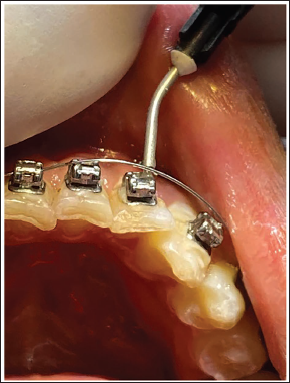
In this method, the authors have used flowable composite to fill the slot on the side that needs lingual rotation.
Steps:
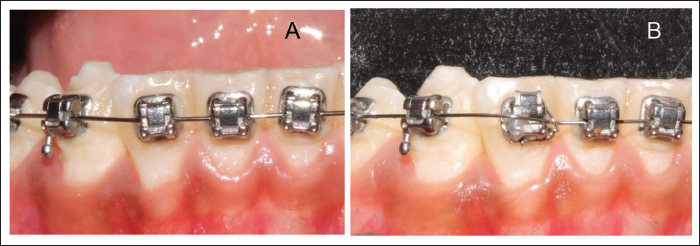
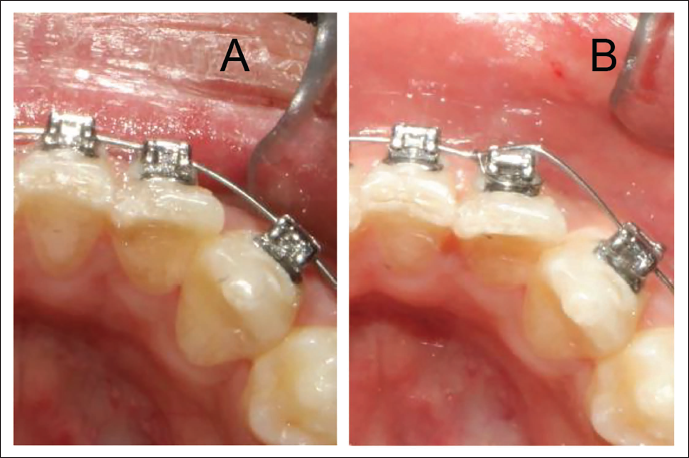
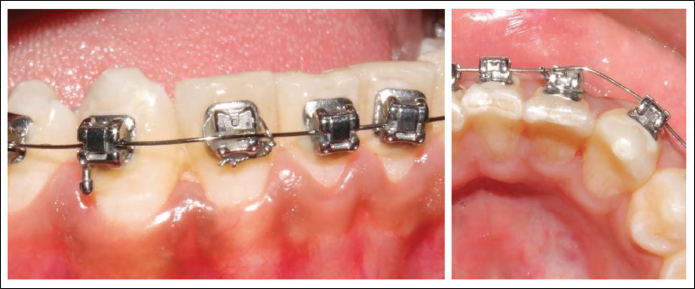
Before placing the archwire, place a small drop of flowable composite in the slot of the bracket (Figure 1) on the side that needs lingual rotation, that is, in our case, distal (Figure 2a). Cure the composite with a curing light. Place the archwire. Pass the small ligature wire under the main archwire on the composite side and ligate it over the archwire on the other side that needs buccal rotation, that is, in our case, the mesial side (Figure 2b). The occlusal view, as shown in Figure 3, shows the deflection in the archwire. Figure 4 shows rotation correction achieved. The limitation of this technique is that the removal of composite from the slot after rotation correction may be difficult in certain cases, and caution should be exercised not to impinge on the locking door while removing the composite.
Place the Drop of Flowable Composite on One Side.
(A) Conventional Self-ligation. (B) Composite Wedge Technique.
(A) Conventional Self-ligation Occlusal View. (B) Composite Wedge Technique Occlusal View.
Rotation Correction.
Method 2: Ligature Wire Wedge
In this method, the authors have used ligature wire, which every orthodontist is very familiar with.
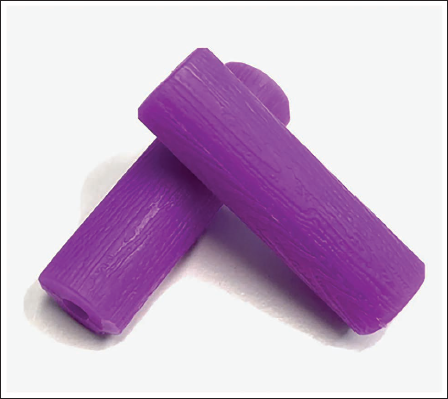
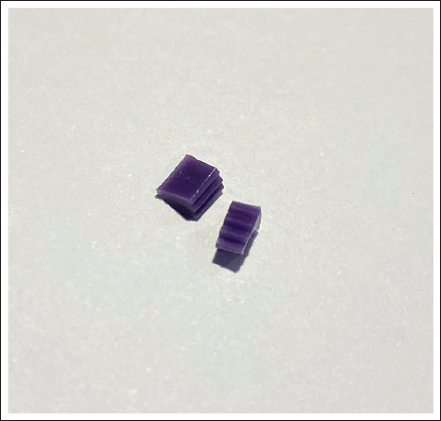
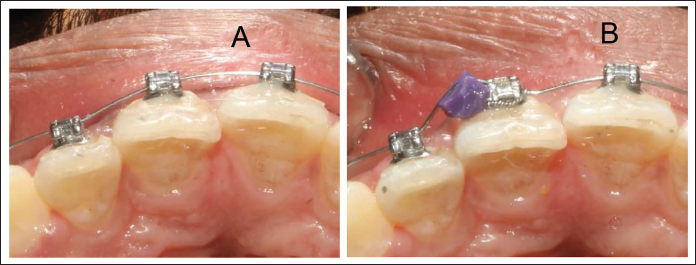
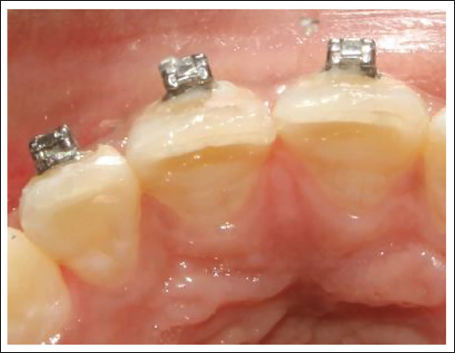
Steps: Take a chewie (aligner seater) (Figure 5) and cut it into a small rectangular piece, roughly the size of a bracket, as shown in Figure 6. Take a ligature wire and pass it vertically through the piece of chewie. Before placing the archwire, place the ligature wire with the wedge on the side that is buccally rotated, that is, in our example, the distal side (Figure 7a), and tie it to the bracket. Place the archwire above the chewie wedge and ligate it over the archwire on the side that is rotated lingually, such that the archwire is seated inside the slot, as in our case, the mesial side (Figure 7b). Figure 8 shows the rotation correction achieved. The limitation of this technique is the color of the chewie; had it been transparent or white, it could be used in the aesthetic region without any patient objection.
Chewie.
Chewie Cut into Rectangular Pieces.
(A) Conventional Self-ligation Occlusal View. (B) Ligature Wire Wedge Occlusal View.
Rotation Correction.
Conclusion
With the increasing use of self-ligating brackets, addressing the problem of rotational control is required. Both techniques mentioned here are effective in rotation correction within the period of 4-6 weeks. The clinician can decide on the technique that suits the case best and use the technique they are comfortable with.
Footnotes
Declaration of Conflicting Interests
The authors declared no potential conflicts of interest with respect to the research, authorship, and/or publication of this article.
Ethical Approval
Not applicable.
Funding
The authors received no financial support for the research, authorship, and/or publication of this article.
Informed Consent
Not applicable.
