



Abstract
Tooth fracture at the cervical margin is frequently seen, and orthodontic extrusion of the same can be carried out to achieve a “ferrule effect” for successful restoration.
Various techniques incorporating conventional removable and fixed orthodontics have been employed to facilitate orthodontic extrusion of the fractured tooth. The clear aligner can be used to facilitate the extrusion of a fractured tooth using the “bootstrap” arrangement. Bootstrap mechanics involve placing bonded buttons at the gingival margins on the facial, lingual, or both surfaces of a tooth that is lagging.
In this pearl, an innovative and economical prerestorative orthodontic method, based on the biomechanical principles of the “bootstrap” arrangement used in aligners, is developed for the successful extrusion of a fractured tooth using a clear retainer and orthodontic elastics. The amount of extrusion of the fractured tooth was 2.5 mm and was achieved in a time frame of 3 weeks.
The appliance is patient-friendly and cost-effective. Moreover, the appliance omitted the use of fixed orthodontic treatment mechanics.
Introduction
Orthodontic tooth movement can be used to facilitate or enhance endodontic or restorative care. The most common scenario described is that of a tooth with a crown compromised by tooth structure loss due to fracture, caries, resorption, or tooth surface loss. Under these circumstances, in the presence of adequate root length and attached gingiva, the root may be extruded using controlled orthodontic forces. 1
The final aim of extrusion is to expose a sufficient amount of circumferential healthy tooth tissue and to obtain the “ferrule effect,” which will strongly decrease the rate of vertical fractures.
Traditional orthodontic methods have been used for the extrusion of a fractured tooth, such as the use of magnets, removable orthodontic appliances with springs, and fixed labial and lingual orthodontic appliances. 2
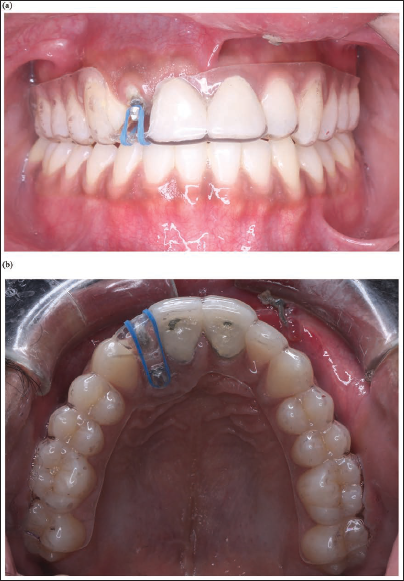
The clear retainer/aligner can be used to facilitate the extrusion of a fractured tooth using the “bootstrap” arrangement. Bootstrap mechanics involve placing bonded buttons at the gingival margins on the facial, lingual, or both surfaces of a tooth that is lagging. 3 An orthodontic elastic is then stretched across the occlusal surface of the seated clear aligner to attach to the buttons and/or notches cut into the tray on opposite sides. 4
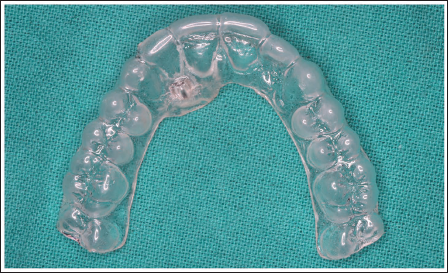
The following pearl describes an innovative and aesthetically pleasing prerestorative orthodontic technique using a removable retainer fabricated with a thermoplastic sheet. The clear retainer was modified to apply extrusive force on the fractured tooth using elastics based on the biomechanical principles of the “bootstrap” arrangement used in clear aligners.
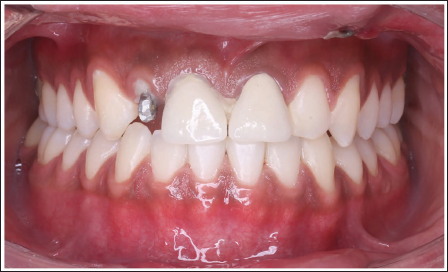
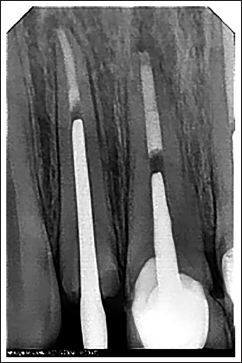
An adult male patient aged 21 years was reported with the chief complaint of a fractured tooth. On clinical examination, the upper right lateral incisor was fractured at the gingival level with no clinical crown. As the patient denied extraction of the respective tooth, orthodontic extrusion of the tooth was planned. The endodontic treatment was completed, and a custom-made post was cemented (Figures 1 and 2). A notch was made on the custom-made metal post in order to provide an attachment to facilitate the extrusion of the tooth.
Intraoral Frontal View of Fractured Upper Right Lateral Incisor with Cemented Post.
RVG Depicting Cemented Metal Post.
As the patient was aesthetically concerned, extrusion was planned using a removable appliance fabricated using a thermoplastic sheet.
Steps:
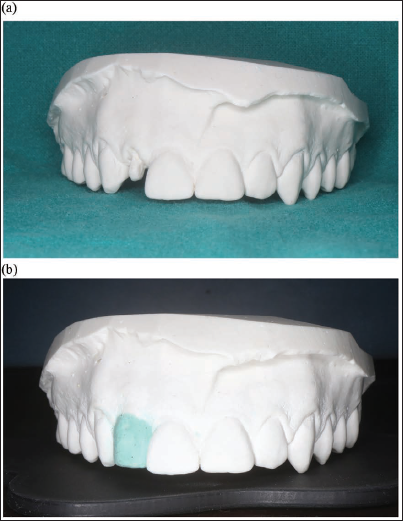
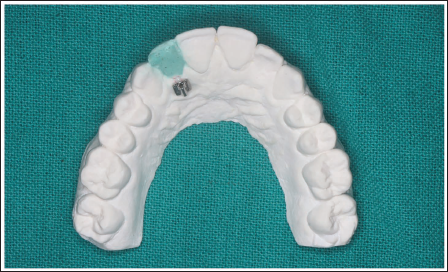
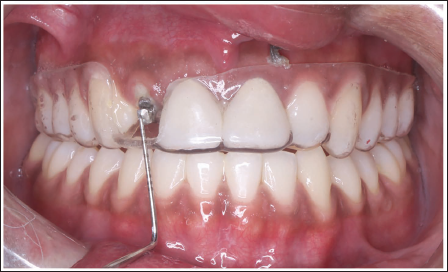
The upper arch impression was recorded using alginate, and the space of the missing upper right lateral incisor on the cast was filled using dental stone (Figures 3a and 3b). In order to provide an attachment for the elastic, a Begg’s bracket was placed in the rugae area (Figure 4). The thermoformed sheet with 1.5 mm × 1.25 mm dimensions was fabricated and trimmed (Figure 5). The labial part of the removable retainer was trimmed in order to facilitate the easy extrusion of the lateral incisor during force application through the orthodontic elastic. William’s graduated periodontal probe was used to check the distance between the apex of the cemented post and the trimmed margin of the clear retainer (Figure 6). The removable appliance was placed, and bootstrap elastic delivering 3 oz of force per day was applied from Begg’s bracket (incorporated within the appliance) to the notch fabricated on the custom-made post (Figures 7a and 7b).
5
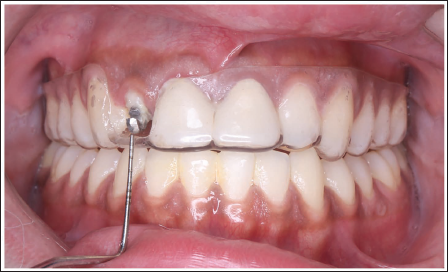
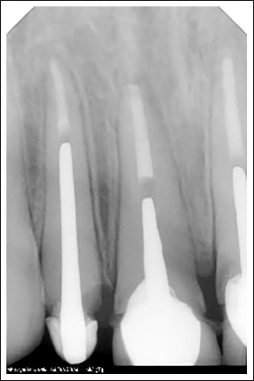
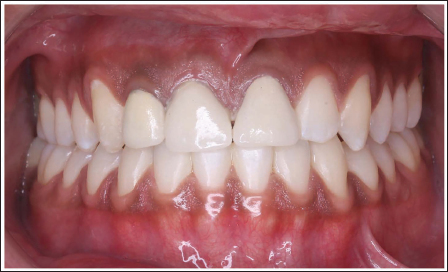
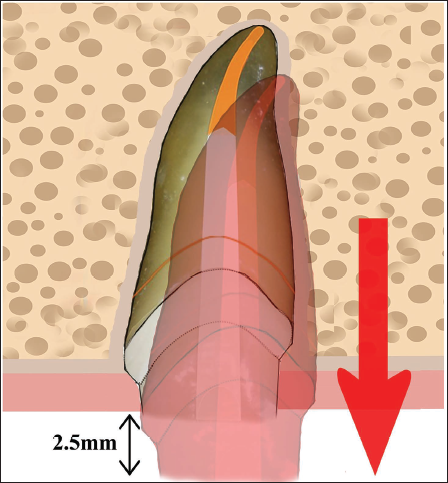
Extrusion of 2.5 mm was achieved in 3 weeks, which was confirmed with the use of graduated probe (Figures 8 and 9). The “ferrule effect” was created, which facilitated successful restoration with a prosthetic crown (Figures 10 and 11).
(a) Maxillary Cast with Post of Upper Right Lateral Incisor; (b)Maxillary Cast with the Upper Lateral Carved with Green Dental Stone.
Maxillary Cast with Begg’s Bracket Placed in Rugae Area.
Maxillary Thermoformed Sheet Fabricated and Trimmed with Embedded Begg’s Bracket.
Intra-oral Frontal View with Trimmed Labial Part of Clear Retainer and William’s Graduated Probe.
(a) Intra-oral Frontal View of the Clear Retainer with Bootstrap Elastic Engaged to the Post; (b) Intra-oral Maxillary Occlusal View of the Clear Retainer with Bootstrap Elastic Engaged to the Begg’s Bracket.
Intra-oral Frontal View after Extrusion of Upper Right Lateral Incisor.
Post Extrusion RVG.
Intra-oral Frontal View with Prosthetic Crown in Upper Right Lateral Incisor.
Diagrammatic Representation of the Extrusion through Bootstrap Mechanics.
Conclusion
In this pearl, an innovative and economical prerestorative orthodontic method, based on biomechanical principles of the “bootstrap” arrangement used in aligners, is developed for the successful extrusion of a fractured tooth using a clear retainer and orthodontic elastics. The amount of extrusion of the respective fractured tooth was 2.5 mm and was achieved in a time frame of 3 weeks.
The appliance is highly esthetic, convenient to use, and cost-effective. Moreover, the appliance omits the requirement for fixed orthodontic treatment mechanics. This case is a successful demonstration of achieving predictable tooth movement using just biomechanical principles without the need for extensive treatment planning.
Footnotes
Declaration of Competing Interests
The authors declared no potential conflicts of interest with respect to the research, authorship, and/or publication of this article.
Ethical Approval
It is not applicable, as it is a clinical innovation.
Funding
The authors received no financial support for the research, authorship, and/or publication of this article.
Informed Consent
A written and signed informed consent has been obtained from the patient.
