




Abstract
Objective
The aim of this study is to determine the factors that are effective in seeking orthodontic treatment of Turkish adult individuals and to evaluate the effects of demographic characteristics such as gender, age, marital status, and educational status of the participants on these factors comparatively.
Methods
A questionnaire-based study was applied to participants who want to receive orthodontic treatment. In the first part, the participants were asked about demographic information such as gender, age, marital status, occupation, and educational status. A total of 542 people (330 female and 212 male) were included in our study. The age of participants included in the study ranged between 18 and 45. Questions about oral hygiene, regular dental check-ups and the factors that affect in seeking orthodontic treatment were asked in the second part of the questionnaire.
Results
Young adults and females were found to have a higher rate of seeking orthodontic treatment. When the participants were asked what led them to orthodontic treatment, 72.1% of the participants stated that they thought it as a necessity such that they should receive orthodontic treatment. Material selection in orthodontic treatment shows statistical significance according to demographic characteristics (p < 0.05). While 48% of the participants in the 18ȓ24 age group preferred metal orthodontic brackets, 37.9% of the participants in the 25–45 age group preferred clear aligner. Moreover, 40.4% of the married participants preferred clear aligner, while 45.1% of the single participants preferred metal orthodontic brackets.
Conclusion
The factors in seeking orthodontic treatment of individuals vary according to demographic characteristics and social environment of individuals.
Introduction
Malocclusion is defined as a significant deviation from the normal or ideal occlusion. 1 Malocclusions are a multifactorial disorder of undetermined etiology.2, 3 Besides such factors as chewing, speaking, swallowing, temporomandibular joint disorders, the etiological factors include trauma and periodontal diseases, dental caries, and prematurely lost deciduous teeth. It is important for clinicians to understand the physical, social, functional, and psychological effects of malocclusions on the quality of life because these malocclusions can inform us about their impact on people’s lives and show why individuals seeking orthodontic treatment.4, 5
Adult orthodontic treatment procedures differ according to adolescents and children.6, 7 Although a patient treatment in the period of growth and development can only be performed with the help of orthodontic intervention, adult patients require physicians of various specialties. 8 The major difference of adult orthodontic treatment is that this interdisciplinary interaction is often necessary. 9
Orthodontists generally identify fully grown individuals as adults. Adults seeking orthodontic treatment are often described in two ways. The first group includes individuals, who are mostly in their twenties and are often aged younger than 35 years, and they wish to get orthodontic treatment in their youth but have not been treated for economic or other reasons. The aim of these individuals is to improve their quality of life and they have more demands from orthodontists. The second group includes people between the age of 40 and 50. Patients in this group have complex dental problems and require orthodontic treatment as part of a larger treatment plan. The aim of their treatment is to protect their oral health and to reach a wide range of periodontal and restorative goals.10, 11
Technological innovations take a very important place in orthodontic practice. Progress in material and technological developments offers a variety of treatment options to both orthodontists and patients. 12 Because of the diversity resulting from these developments, it is difficult to generalize orthodontic treatment, as well as the materials and appliances used. Presently, the most up-to-date techniques and treatment options include metal bracket, esthetic bracket, lingual technique, and clear aligner appliances.
Adult patients seek orthodontic treatment basically according to the esthetic reasons.13, 14 Due to high esthetic expectations adult patients choose less visible or invisible orthodontic treatment options. 15 As a result, while traditional labial appliances (buccal) remain as the dominant option, lingual and clear aligner appliances, which are more esthetic factor of treatments, have started to be in demand. 16
Materials and Methods
In this study, there was prepared a questionnaire as a data collection tool consisting of 18 questions aimed to evaluate the factors which are effective for Turkish adults in orthodontic treatment. The first five questions of the questionnaire include such demographic characteristics as gender, age, marital status, occupation, and educational status. In the second part of the questionnaire, which consists of 13 questions, there were represented questions about oral hygiene, regular dental check-ups, and the factors that affect orthodontic treatment seeking. This study was carried out in Ordu University Faculty of Dentistry Orthodontics Department, Ordu. This study was approved by the Clinical Research Ethics Committee of Ordu University (2022/68). In the questionnaire forms, the participants were asked to confirm that they participated in the research voluntarily.
The total sample size required for this study to detect a moderate effect with 95% power and 0.50 impact size was 500 people using the G*Power (version 3.1.9.2; Axel Buchner, Universität Düsseldorf, Düsseldorf, Germany) program. A total number of participants in the survey was 542 people. Frequency analysis of the obtained data and prepared frequency distribution tables was performed. Interactions between demographic variables and research questions were examined Pearson chi-square test. In chi-square tests, Pearson chi-square value (χ 2 ) was calculated if the expected frequencies were ≥5, and Fisher’s exact test value was calculated if the expected frequencies were <5. Statistical significance level was accepted as 5%. All calculations were made with the IBM SPSS (version 26, IBM SPSS Statistics, Armonk, USA) statistical program.
Results
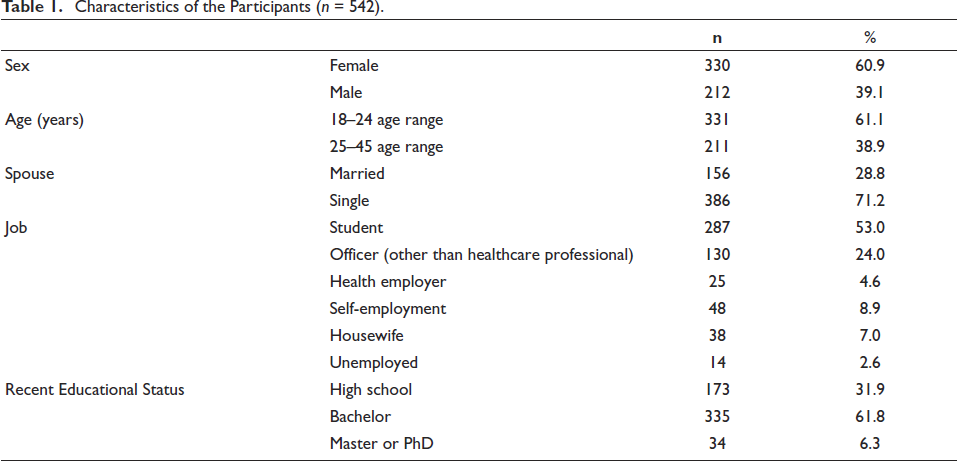
About 60.9% were female and 39.1% were male. 61.1% of the participants are in the 18–24 age range, 38.9% are in the 25–45 age range. 28.8% of the participants are married and 71.2% are single. 53% of the participants are students, and 24% are officer (other than healthcare professional), 7% are housewives, and 2.6% are unemployed. Considering the educational status of the individuals participating in the study, 31.9% of them were high school graduates, 61.8% were bachelor graduates, and 6.3% were master or PhD graduates. Demographic characteristics of the participants are shown in Table 1.
Characteristics of the Participants (n = 542).
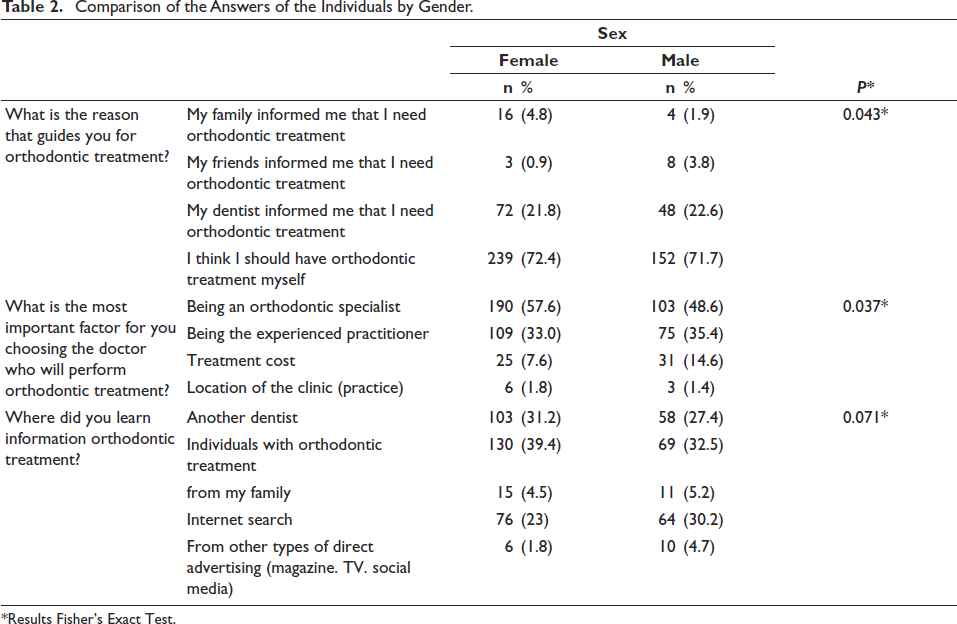
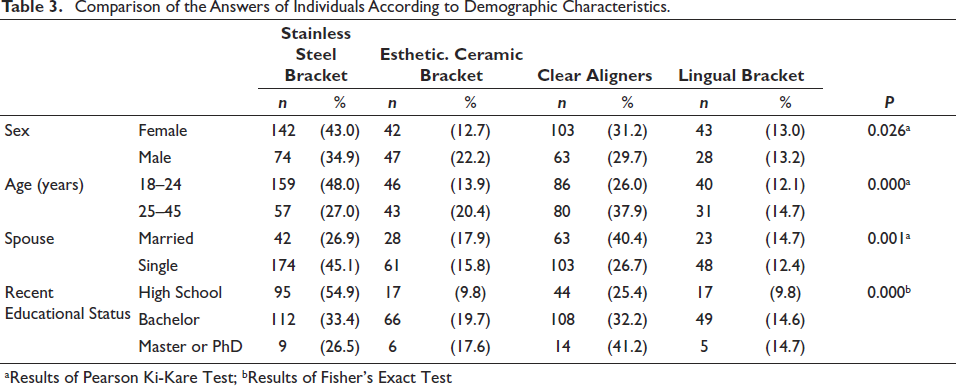
There was a statistically significant difference between the gender and answers given by the participants to the questions of “What is the reason that guides you for orthodontic treatment” and “what is the most important factor for you choosing the doctor who will perform orthodontic treatment” (p < 0.05) (Table 2). There was a statistically significant difference between answers given by the participants to the question “Which material do you prefer for orthodontic treatment” and demographic characteristics (p < 0.05) (Table 3).
Comparison of the Answers of the Individuals by Gender.
Comparison of the Answers of Individuals According to Demographic Characteristics.
For the question “What is the most important factor for you in choosing a physician who will perform orthodontic treatment” 54.1% (n = 293) of respondents answered that being orthodontic specialist, 33.9% (n = 184) being the experienced practitioner, 10.3% (n = 56) answered that cost of treatment, and 1.7% (n = 9) said that the location of the clinic (practice) where orthodontic treatment will be performed.
Discussion
Technology progress has allowed to develop appliances that are esthetically acceptable and more comfortable for the patient, which remain active for a long time and cause less pain. For these reasons, the interest of adults in orthodontic treatment is increasing every year.
There have been many studies comparing gender and desire for orthodontic treatment.17–19 Lee’s study that based on the willingness to receive orthodontic treatment shows that according to gender female were more willing to receive orthodontic treatment. 20 According to gender, female patients’ goals and expectations in orthodontic treatment were higher than men. While 60.9% of the 542 participants in our study were female, 39.1% were male. In our study, the desire for orthodontic treatment is more common among young adults and singles. Our study is similar to other studies in terms of the high rate of females seeking orthodontic treatment.
The study conducted by Oh et al. showed that 66.7% of the participants make decisions concerning orthodontic treatment on their own. 21 Hamdan in his study investigated the relationship between the perceived need for treatment by the individual, the parent, and the clinician versus actual need for orthodontic treatment; it is seen that 43% of individuals apply to the clinic for orthodontic treatment due to their own decisions. 22 In our study, for the question “What is the reason that guides you for orthodontic treatment?” 72.1% of the participants answered that they think by themselves that they should have orthodontic treatment.
Oh et al.’s study 21 attributes motivating factors for orthodontic treatment to providing psychological and esthetic confidence. This is similar to the results of previous studies, which showed that the main goal of orthodontic treatment is to improve esthetics and appearance as well as straightening teeth. Our study aimed to evaluate the motivating factors of individuals by the question “What is the factor that motivates you for orthodontic treatment.” Response rates were characterized at most 38% of feeling better and 36.2% being able to laugh better. These responses are similar to studies showing the psychosocial aspect of orthodontic treatment.
In a study considering the choice of appliance type for orthodontic treatment, younger participants and those who live in areas with smaller populations were significantly more likely to choose metal brackets than others. Older participants and those who live in medium-size population areas were significantly more likely to choose esthetic bracket or clear aligner. 11 In our study, answering about the type of orthodontic treatment appliance, 39.9% of the participants stated that they preferred metal bracket, 30.6% clear aligner, 16.4% esthetic bracket, and 13.1% lingual bracket. According to gender, 43% of female and 34.9% of men wish to have metal brackets. While 48% of the participants in the 18–24 age range chose metal brackets, 37.9% of the participants in the 25–45 age range chose the clear aligner. 40.4% of the married participants choose the clear aligner and 45.1% of the single participants choose the metal orthodontic bracket. In our study, there was a statistically significant difference between this question concerning appliance type selection and gender, age, and marital status (p < 0.05).
Conclusions
Esthetics is the foreground source of motivation in orthodontic treatment. Among individuals the psychosocial effect of orthodontic treatment is more dominant, and this effect guides people to seek orthodontic treatment. Improvement of chewing, speaking, and oral health remains secondary source of motivation among individuals. It is recommended that dentists inform people more about the importance of orthodontic treatment’s esthetic effects, as well as the effects considered as the secondary source. Moreover, since patients who wish to get orthodontic treatment have lack of treatment knowledge and material choices, orthodontists are recommended to perform orthodontic treatment by considering the patient’s expectations and preferences in addition to their own preferences while choosing treatment and material.
Ethical Approval
Ethical approval from Scientific Review Boards (IRBs) was obtained by the Clinical Research Ethics Committee of Ordu University (2022/68).
Footnotes
Declaration of Conflicting Interests
The authors declared no potential conflicts of interest with respect to the research, authorship, and/or publication of this article.
Funding
The authors received no financial support for the research, authorship, and/or publication of this article.
