




Abstract
The NiTi open coil spring is commonly accustomed to creating spaces for crowded teeth. It is difficult to anticipate the length of the open coil spring desired to open up the exact quantity of space; sometimes, the length of the open spring falls short of opening up the space required. In such a case, the base arch wire must be taken out and replaced with an expanded open coil spring, which is both difficult and time-consuming. There are various reactivation methods available, such as split tubings, cutting a C-shaped tube to the desired length, adding extra length to the spring, creating C-rings, and using composite beads. Hence, we have designed a very simple yet effective chairside method to reactivate NiTi open coil spring with the removal of base arch wire.
Introduction
The NiTi open coil spring is commonly accustomed to creating spaces for crowded teeth. It is difficult to anticipate the length of the open coil spring desired to open up the exact quantity of space; sometimes, the length of the open spring falls short of opening up the space required 1 . In such a case, the base arch wire must be taken out and replaced with an expanded open coil spring, which is both difficult and time-consuming. 2 There are various reactivation methods available, such as split tubings, cutting a C-shaped tube to the desired length, 3 adding extra length to the spring, 4 creating C-rings, 5 and using composite beads.6, 7
We innovated a simple yet effective chairside method to reactivate the open coil spring without removing the arch wire.
Method of Fabrication
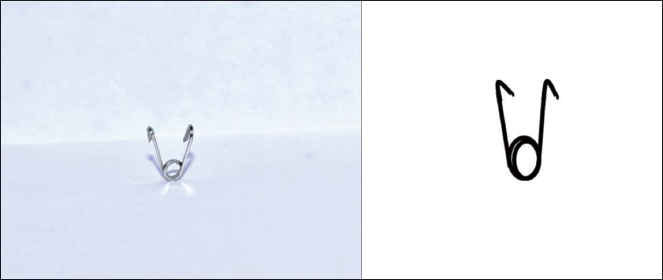
Use a Heavy bird beak plier to bend the stainless-steel wire in V shape with an incorporated helix (Figure 1).
Expose the arch wire with tucker.
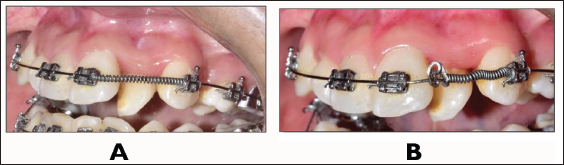
Place “V” spring over the arch wire and crimp it (Figure 2).
V Spring with Line Diagram.
(a) Spring Requires Reactivation. (b) V Spring is Placed to Activate NiTi Open Coil Spring.
Versatility
On the rectangular base arch wire, a spring made of round wire can be used and vice versa.
It can be made with 0.018 0r 0.020 inch round stainless-steel wire or 0.016 × 0.022 inch or 0.017 × 0.025-inch rectangular stainless-steel wire.
Advantages
Does not necessitate the removal of arch wires, resulting in less chairside time.
Prevents the reciprocal force.
Addition of a helix aids in further activation.
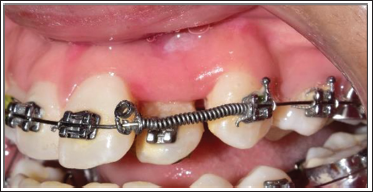
Once the space opens (Figure 3), spring can be placed anywhere by moving along the base arch wire.
Additional Space is Obtained Using V Spring.
Discussion
The versatility of V spring gives wider range of activation without removal of ligation of adjacent bracket. Clinical experience with this spring has shown that no further activation is required after a single reactivation.
Footnotes
Declaration of Conflicting Interests
The authors declared no potential conflicts of interest with respect to the research, authorship and/or publication of this article.
Funding
The authors received no financial support for the research, authorship and/or publication of this article.
