




Abstract
Fixed orthodontic treatment is predominantly governed by the use of nickel-titanium (NiTi) wires for alignment and leveling due to its shape memory properties.
Engaging NiTi wires in the misaligned dentition for initial alignment and leveling is an inconvenient procedure and requires the use of wire tucker for engaging in the slot of the bracket. Similarly, cinching NiTi wire at the ends of the tube is a tedious process and requires the use of a wire cincher. Intraoral placement of an open coil spring sometimes becomes tricky due to its springiness, thus making its ligation time-consuming and may also require assistance or else might cause injury.
Moreover, since the introduction of the novel severe acute respiratory syndrome coronavirus 2 (SARS-CoV-2) and its spread throughout the world, dentists, in general, are at higher risk of contracting the disease for their close contact with saliva. The need for sterilization is of utmost importance and thus an instrument that serves the purpose of three instruments is a major boon for the practitioner in terms of user-friendliness and maintaining its sterility.
A multipurpose bracket holder is thus presented, which can be used easily as a NiTi bender, archwire tucker, and an open-coil spring placer.
Introduction
During orthodontic treatment, it is occasionally very tricky to engage nickel-titanium (NiTi) wires into the bracket slot of irregular, crowded, and rotated teeth; this problem was overcome with the advent of ligature tucker. 1 A bracket holder has been thus modified which can also be used as an arch wire tucker.
Open coil springs in orthodontic tooth movement are regularly used to make space between teeth. During its placement, the spring wields constant force toward both the ends, making its ligation time-consuming and may also require assistance or else might cause injury. 2 To deal with this problem, a modified bracket holder design is presented for better safety and convenience during the ligation of open coil spring intraorally. A similar design was reported with a groove at the central section of its front surface as a means for adjusting the bracket positioned between the members of the holder. 3
NiTi wires are extensively used within orthodontics for leveling and alignment as they possess properties like superelasticity and shape memory effect with brilliant mechanical and corrosion properties, and biocompatibility. Cinching of NiTi wire is one of the challenges faced by orthodontists, due to its shape memory property; also, heating of NiTi wires is troublesome and time-consuming. 4
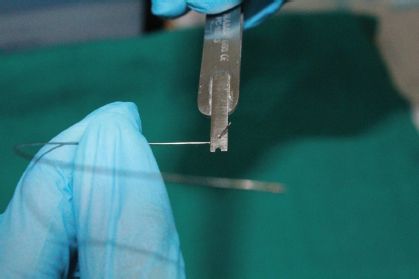
A fast, easy, and effective technique to cinch NiTi wires is presented where a sharp bend is given such that NiTi wires lose their property of shape memory. This is similar to the method used by NiTi cinching pliers.
Moreover, since the introduction of the novel SARS-CoV-2 and its spread throughout the world, dentists, in general, are at higher risk of contracting the disease for their close contact with saliva. The need for sterilization is of utmost importance and thus an instrument that serves the purpose of three instruments is a major boon for the practitioner in terms of user-friendliness and maintaining its sterility.
Thus, a bracket holder has been improved which can be used as an archwire tucker, NiTi bender, and open-coil spring placer.
Appliance Design and Fabrication
Open-coil spring placer
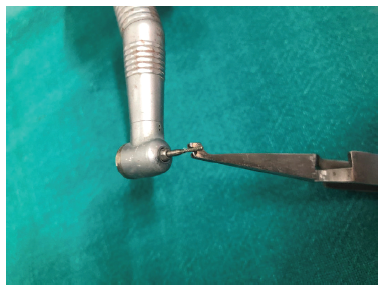
On the bracket holder side (Figure 1A), place the straight bur at 90° and cut it to 2 mm depth.
Tucker
Straight Bur of 2 mm Diameter Used to Make a Slot on Bracket Holding Side with Airrotor.
Bracket Holding Side with Slot Used to Compress Open Coil Spring for Easy Ligation.
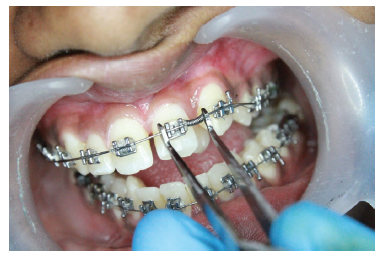
On the bracket adjusting end, a small U-shaped cut is made in the plate using straight fissured bur and airrotor (Figure 2A).
NiTi bender
Make a Small U-shaped Cut in the Front Side of the Plate Using an Airrotor and Flat Fissured Bur.
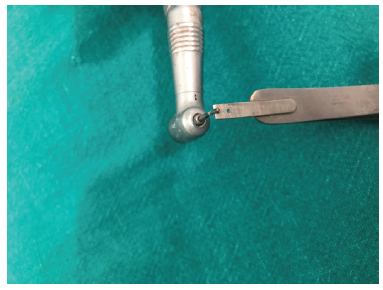
Front Side of the Plate with U-shaped Cut Used as a Tucker.
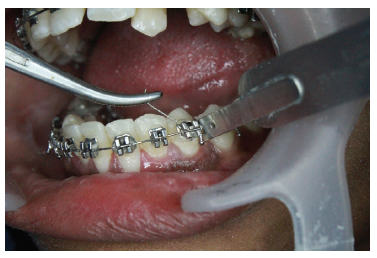
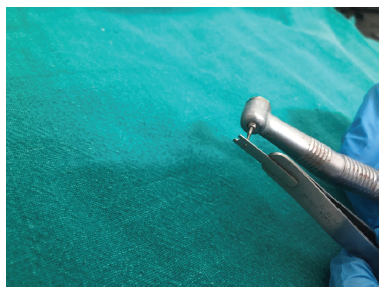
Using straight fissured bur and an airrotor, make a hole of 2 mm diameter on the steel plate (Figure 3A).
Make a Small 2 mm Hole on the Plate with a Straight Fissure Bur and Airrotor.
After the Wire Is Passed Through the Hole, It Is Rotated Upward to Make a Bend on the NiTi Wire.
Clinical Application
This modified archwire tucker can be effortlessly used in both posterior as well as anterior segments (Figures 2A and B).
Excess wire distal to the molar tube can be sharp bent gingival or inward (Figures 3A and B).
During ligation, compress the open coil spring with the modified bracket holder and engage the archwire easily in the bracket slot (Figures 1A and B). It can be used in both round and rectangular wire.
Advantages
Saves valuable clinical time.
Serves as three instruments, thus decreasing the inventory.
Easy to construct; no special armamentarium needed for fabrication.
Economical.
Footnotes
Declaration of Conflicting Interests
The authors declared no potential conflicts of interest with respect to the research, authorship, and/or publication of this article.
Funding
The authors received no financial support for the research, authorship, and/or publication of this article.
Statement of Informed Consent and Ethical Approval
Necessary ethical clearances and informed consent was received and obtained respectively before initiating the study from all participants.