




Abstract
The process of attaching brackets to the tooth surface has evolved from brackets being welded to bands to attaching them using light cure composite resin materials. Similarly, the curing lights have advanced from bulky Quartz-Tungsten-Halogen lights to light-emitting diode (LED) curing units. The LED curing units available now have advanced features like high intensity light, reduced curing time, and are very expensive and rely upon prior charging of the unit. The present article describes a curing light which is powered by an external power source like, laptop, smartphone, and power bank and is very compact compared to the present curing lights and is also less expensive.
Introduction
Orthodontic treatment involves brackets which are attached to the teeth surfaces to apply orthodontic force; this has been the tradition till the arrival of aligners into the armamentarium of an orthodontist. In the early 1980s, visible light-cured restorative materials were introduced which became increasingly popular for bonding orthodontic brackets, lingual retainers, and bands as they allowed unlimited work time. The catalyst used for these adhesives was camphorquinone, which cured in the visible light range (440-480 nm) with a Quartz-Tungsten-Halogen (QTH) light, making them safe for exposed eyes and skin. 1
The light sources for polymerization of composite resins available are QTH, Plasma Arc Curing, Argon laser, and light-emitting diode (LED). The light intensity of curing devices is defined by the International Organization for Standardization as the International Organization for Standardization (ISO) 4049 standard, which recommends an intensity of 300 mW/cm2 with a wavelength bandwidth of 400 to 515 nm on the tip of the light curing device. 2 The present curing lights available in the market have intensity of more than 1,000 mW/cm2 and have a curing time of less than 20 s. These curing lights are less cumbersome when compared to the original halogen curing lights but are still bulky to carry. The present day curing lights have supercapacitors which reduce the charging time of the curing light and are very expensive.
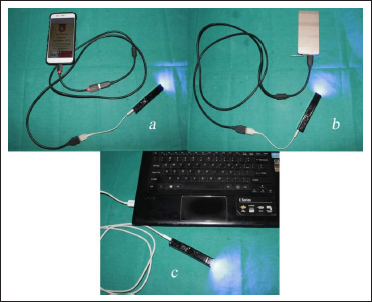
This article describes and evaluates an innovative light-curing unit that is less cumbersome, less expensive when compared to the present day curing lights, and uses laptop, smartphone, and power banks as power source (Figure 1).
SmartLite Unit Attached to Different Power Sources Namely (A) Smartphone, (B) Power Bank, and (C) Laptop.
Materials and Methods
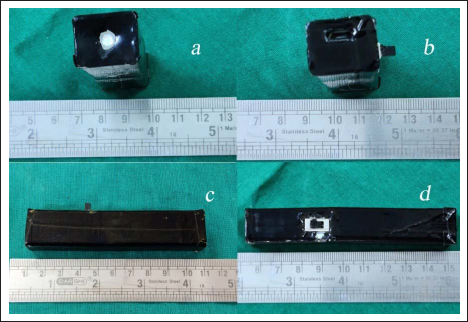
SmartLite is a prototype light-curing unit housed in a rectangular 3D printed casing of 10 cm in length and 3 cm in width (Figure 2). The unit itself consists of LED bulb which emits blue light at an intensity of 525 mW/cm2, 440 to 480 nm wavelength at the top of the casing (Figure 2A). At the base, there is a micro USB port used to attach the power sources (Figure 2B). On one side of the casing, there is an on/off switch (Figure 2C, D).
Dimensions of the SmartLite Unit.
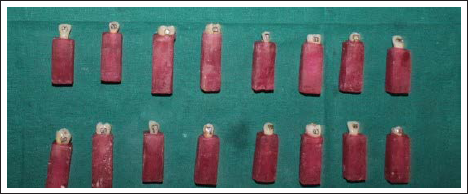
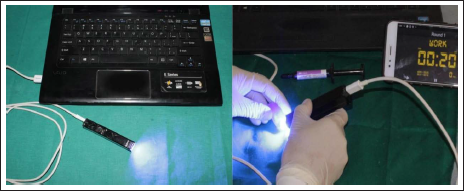
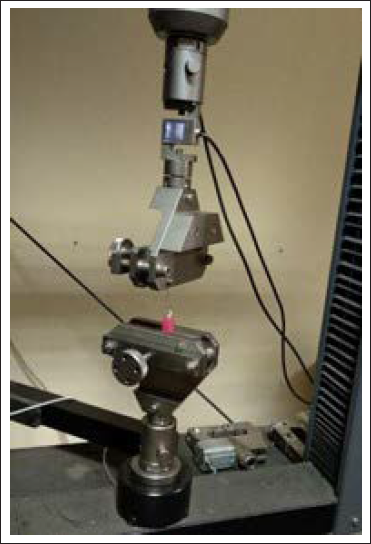
The SmartLite prototype light-curing unit was tested on crowns of recently extracted 16 random human anterior and posterior teeth (Figure 3). All teeth were mounted in acrylic for testing. Preadjusted 0.022″ metal brackets were bonded to all teeth using TransbondXT primer and adhesive. SmartLite unit was used to prime and cure the bracket for 20 s per teeth respectively. The power source used was laptop (Figure 4). After curing, the sample was assessed for shear bond strength using a universal testing machine at a crosshead speed of 1 mm per min, with a load of 1 kN (Figure 5).
Sample Mounted to Be Cured Using SmartLite Unit.
SmartLite Attached to Laptop Being Used for Curing the Sample.
Shear Bond Strength of Light-Cured Brackets Measured on Universal Testing Machine.
Results
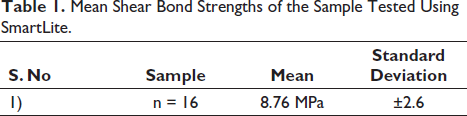
The mean shear bond strength of the brackets cured with the SmartLite unit was 8.76 mPA (±2.6) (Table 1).
Mean Shear Bond Strengths of the Sample Tested Using SmartLite.
Discussion
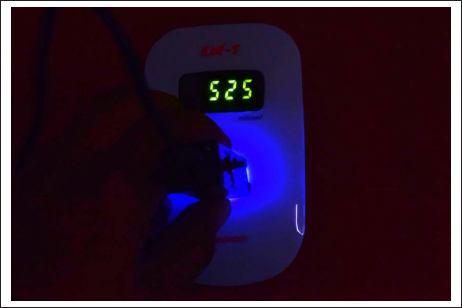
The curing units have undergone various modifications to overcome the disadvantages of the QTH light source LED that are used in curing units. SmartLite unit consists of LED bulb which emits blue light at an intensity of 525 mW/cm2, 440 to 480 nm wavelength (Figure 6). The LED used here is in accordance with ISO 4049 which states that the intensity of a curing unit for dental resins should be 300 mW/cm2 with a wavelength bandwidth of 400 to 515 nm.
LED Unit with an Intensity of 525 mW/cm2, 440 to 480 nm Wavelength.
On testing the mean shear bond strength of the brackets bonded with SmartLite was 8.76 mPA (±2.6). This was in accordance with the study done by Reynolds in 1975 and states that minimum bond strength of 6 to 8 MPa is adequate for most clinical orthodontic needs. The curing lights available in market have intensity of more than 1,000 mW/cm2, have a curing time of less than 20 s but require prior charging with electricity. Smartphones and power banks have become an inseparable part of a clinician’s armamentarium. SmartLite is powered by such external power sources like laptop, smartphone, or power bank which are carried by clinicians. SmartLite acts as a good curing light for bonding in case of failure of prior charging of the LED unit or in rural areas where there is problem of electricity. Lack of a battery source in the light unit also makes it easy to carry in the pocket and very compact. Though the advanced LED curing lights reduce the orthodontic bonding time, they are still expensive when compared to SmartLite.
Conclusions
SmartLite is a compact, portable, and less-expensive prototype of a curing light which can use smartphones, power banks, and laptops as a power source. The teeth cured with this light unit have mean shear bond strength of 8 MPa which makes it ideal to be used in orthodontic bonding procedures.
Footnotes
Declaration of Conflicting Interests
The authors declared no potential conflicts of interest with respect to the research, authorship, and/or publication of this article.
Funding
The authors received no financial support for the research, authorship, and/or publication of this article.
Statement of Informed Consent and Ethical Approval
Necessary ethical clearances and informed consent was received and obtained respectively before initiating the study from all participants.
