




Abstract
Aim:
To evaluate the demineralization resistance and the shear bond strength of enamel surfaces after erbium, chromium: yttrium–scandium–gallium-garnet (Er,Cr:YSGG) laser etching (2 W/15 Hz, 2 W/25 Hz) and to compare them with conventional acid etching for orthodontic bonding.
Materials and Methods:
A total of 60 extracted human premolars with intact enamel surface were used for this study. Demineralization Resistance was estimated using ion-coupled plasma atomic emission spectrometer (ICP-AES). Shear bond strength was evaluated using Universal Testing Machine—Instron.
Results:
Statistically significant difference (P < .001) was found in the concentration of dissolved calcium (Ca) and phosphorus (P), with the highest mean Ca and P in the acid-etched group, followed by 2 W/15 Hz laser-etched group and least with 2 W/25 Hz laser-etched group. Maximum bond strength was found in the acid-etched group (12.06 MPa), followed by the 2 W/25 Hz laser-etched group (9.01 MPa) and 2 W/15 Hz laser-etched group (8.39 MPa). The differences were statistically significant.
Conclusions:
Laser conditioning of enamel surface revealed significant demineralization resistance with a minimal dissolution of Ca and P ions in the demineralizing solution. Moreover, optimum bond strength was obtained similar to that of acid etching; hence, Er,Cr:YSGG laser conditioning of enamel surface is preferred over the conventional phosphoric acid etching for orthodontic bonding.
Legends for Illustration
Ca: calcium
Er,Cr:YSGG: erbium, chromium:yttrium–scandium–gallium-garnet
Er:YAG: erbium:yttrium–aluminum-garnet
ICP-AES: ion-coupled plasma atomic emission spectrometer
P: phosphorus
Introduction
Direct bonding of brackets has revolutionized the clinical practice of orthodontics. The most common method of enamel preparation is phosphoric acid etching. However, acid etching removes the fluoride-rich surface layer of the enamel, thereby causing demineralization, which makes them more permeable and prone to acid attacks.1, 2 This has been suggested as one of the reasons for the high prevalence of white spot lesions after orthodontic treatment with fixed appliances.
Alternative conditioning methods have been tried with poly(acrylic acid) 3 or pre-treatment of the enamel surface with a sandblast of aluminum oxide, 4 but these methods failed to achieve adequate bond strength to resist intraoral forces.5, 6
Similarly different types of lasers such as CO2, erbium: yttrium–aluminum-garnet (Er:YAG), neodymium: yttrium–aluminum-garnet (Nd:YAG), and erbium, chromium: yttrium–scandium–gallium-garnet (Er,Cr:YSGG) have been used in orthodontics for enamel conditioning to bond brackets. However, the major disadvantage of these lasers was thermal damage, rendering these lasers unsuitable for hard tissue treatments. The innovation of Er:YAG laser and Er,Cr:YSGG laser permit ablation without any thermal side effects. 7
Er,Cr:YSGG (2790 nm) has a high absorption coefficient of water in enamel since laser wavelengths operate in the region of the major absorption peak for water (2790 nm) and are thus suitable for hard-tissue ablation treatments. 8 This has led researchers to explore its use in enamel conditioning.
Berk et al 9 compared laser-irradiated enamel surfaces with different power outputs (0.5 W, 0.75 W, 1 W, 1.5 W, and 2 W with a constant frequency of 20 Hz) with conventional phosphoric acid etching. He found that low-powered laser irradiations (0.5 W, 0.75 W, and 1 W) were not capable of etching enamel surface, but he suggested that a dosimetry of 1.5- and 2-W laser irradiation may be an alternative to conventional acid etching.
It has been perceived that the ideal dosimetry for enamel conditioning with laser are predominantly 1.5 W/20 Hz, 2 W/20 Hz.10-12 But up until now, no studies have been undertaken to evaluate the effect of frequency variations. Majority of the studies have focused on varying the power outputs, but frequency settings were kept constant at 20 Hz. When the frequency is increased, there is a possibility of increasing the number of contacts in the enamel, thereby increasing the surface area with decreased surface roughness.
In this context, the present study was conducted to evaluate the shear bond strength and demineralization resistance of enamel surface conditioned using Er,Cr:YSGG laser with a constant power output of 2 W but with variable frequencies of 15 Hz and 25 Hz, and then they were compared with conventional acid etching that was kept as a control.
Materials and Methods
The advantage of the Er,Cr:YSGG (BiolaseTM and WaterLase iPlusTM) laser used in this study is that the frequency settings are adjustable unlike the previous laser systems, where the frequency setting was fixed at 20 Hz.10-12 Laser irradiation was carried out in non-contact mode at a distance of 5 to 7 mm with the equipment set at the configuration of 60% air and 30% water.
Sample Description
Sixty sound human premolars, with intact enamel surface, extracted for orthodontic reasons, were selected for the study. The teeth were cleared of soft tissue debris and blood and immediately stored in distilled water. Thirty teeth were randomly allocated to test 2 different parameters, viz. demineralization resistance and shear bond strength.
Sample Preparation for Testing Demineralization Resistance
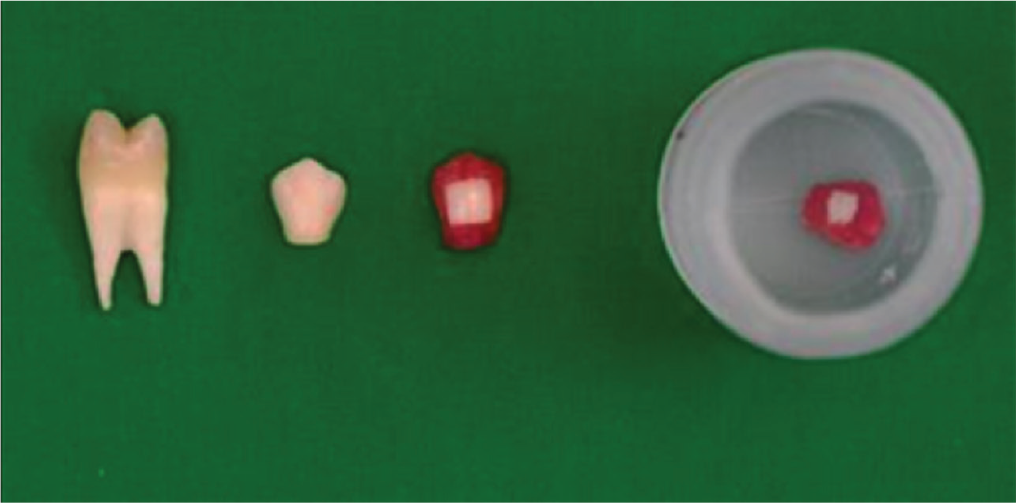
Color-Coded Acrylic Blocks
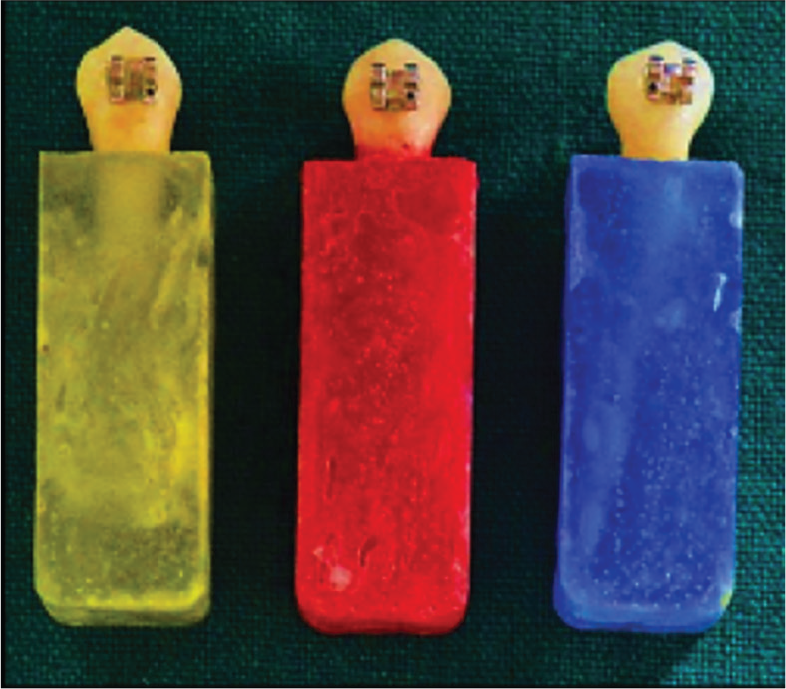
Evaluation of Demineralization Resistance
The crowns of 30 selected teeth were sectioned as presented in Figure 1. The complete enamel surface of the sectioned teeth was covered with nail varnish, except 5 mm × 5 mm window on the buccal surface and then assigned into 3 groups of 10 each.
Demineralization solution was prepared by diluting nitric acid to 5% solution. Each prepared tooth was put into a separate container, containing 15 mL of demineralization solution and stored at room temperature for 24 h. Then, the solution was diluted 100-fold, and the dissolved calcium (Ca) and phosphorus (P) concentrations were measured with an ion-coupled plasma atomic emission spectrometer (ICP-AES. Acquired values were then subjected to statistical analysis.
Evaluation of Shear Bond Strength
Thirty teeth were randomly allocated and embedded in color-coded acrylic blocks, which were divided into 3 groups of 10 teeth each for testing shear bond strength (Figure 2):
After enamel conditioning, pre-adjusted edge-wise metal premolar brackets (Gemini 3M) were bonded onto the tooth surface with Transbond XT (3M Unitek, Monrovia, CA), and the samples were stored in distilled water at room temperature for 24 h for maintaining the hydration level. The samples were then tested for shear bond strength using a universal testing machine (INSTRON no. 3382) at cross-head speed of 0.5 mm/min force passing parallel to the buccal surface and the obtained data were subjected to statistical analysis.
After de-bonding, the enamel surface was observed under stereomicroscope (10× magnification, Olympus, SZX9, Olympus Corporation, Shinjuku-Ku, Japan), and the amount of remaining adhesive was evaluated according adhesive remnant index (ARI) developed by Artun and Bergland. 13
Results
The data collected were statistically analyzed using SPSS version 19.0 (IBM, Armonk, NY, released 2010).
Results of normality tests—Kolmogorov–Smirnov and Shapiro–Wilks—showed that all the variables followed normal distribution. To compare mean values between the 3 groups, one-way ANOVA was used, followed by Tukey’s HSD post hoc tests for pair-wise comparison. (If P-value was < .05, then it was considered to be statistically significant).
Evaluation of Demineralization Resistance
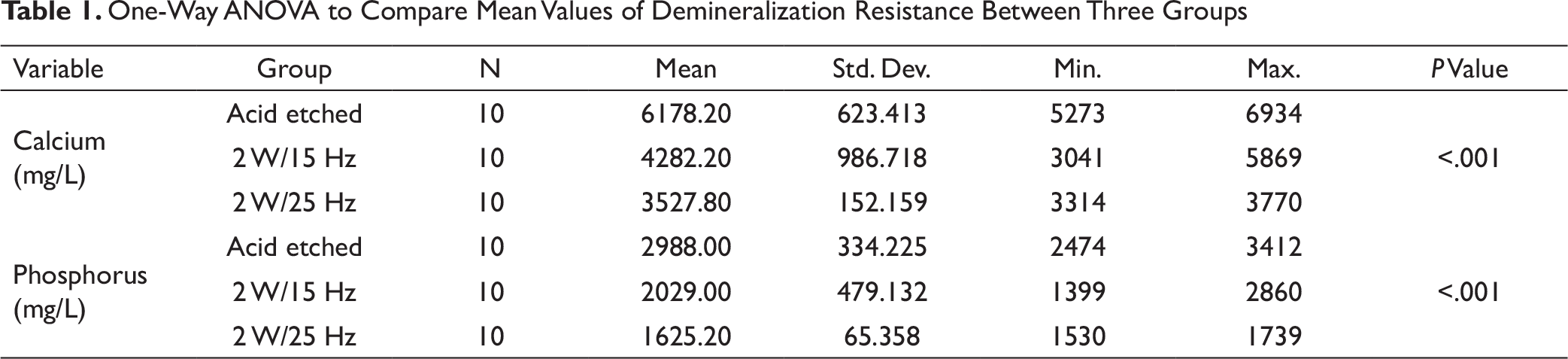
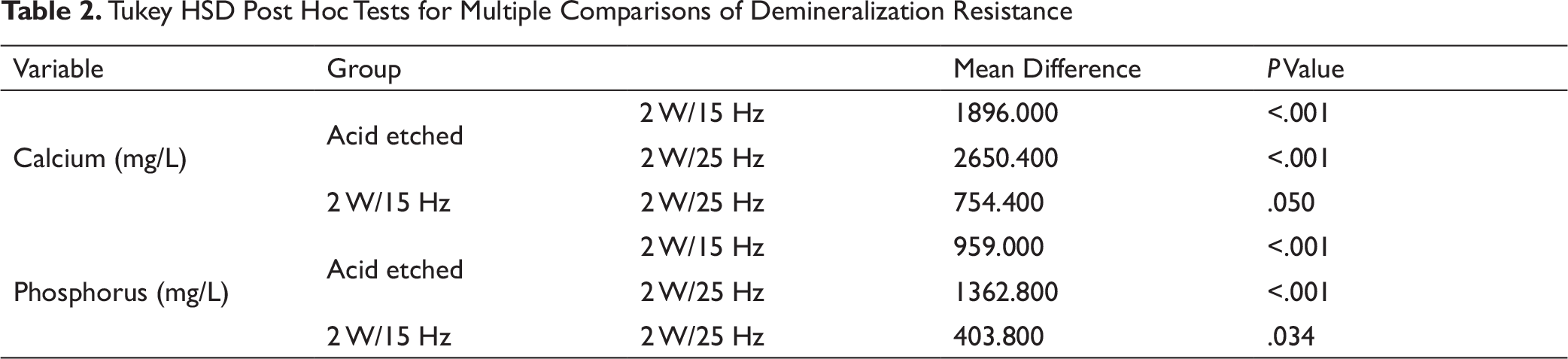
Highest dissolved mean Ca and P was found in the acid-etched group (Ca—6178.20 mg/L, P—2988 mg/L), followed by 2 W/15 Hz laser-etched group (Ca—4282.20 mg/L, P—2029 mg/L), and least with 2 W/25 Hz laser-etched group (Ca—3527.80 mg/L, P—1625 mg/L). The results were statistically significant (Table 1).
One-Way ANOVA to Compare Mean Values of Demineralization Resistance Between Three Groups
Tukey HSD Post Hoc Tests for Multiple Comparisons of Demineralization Resistance
One-Way ANOVA to Compare Mean Values of Shear Bond Strength Between Three Groups

Tukey HSD Post Hoc Tests for Multiple Comparisons of Shear Bond Strength

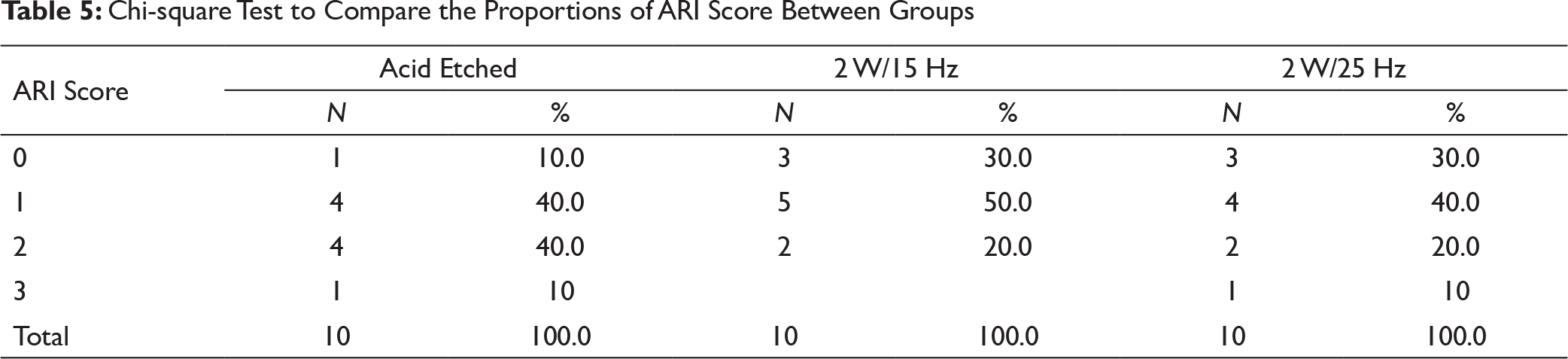
Chi-square Test to Compare the Proportions of ARI Score Between Groups
Assessment of Shear Bond Strength
One-way ANOVA was performed to compare the mean values among 3 groups. There were statistically significant difference (P < .001) in bond strength between the groups, and the highest bond strength was found in the acid-etched group (12.06 ± 1.75 MPa), followed by 2 W/25 Hz (9.01 ± 1.3 MPa) and then 2 W/15 Hz laser-etched group (8.39 ± 1.25 MPa). (Table 3)
Tukey HSD post hoc tests were performed for multiple pair-wise comparisons. There were statistically significant differences while comparing acid-etched group with 2 W/15 Hz and 2 W/25 Hz laser-etched group (P < .001). No statistically significant differences were found between the laser-etched groups (P > .05). (Table 4).
The ARI scores of the samples without saliva contamination are listed in Table 5. On acid-etched surfaces, 80% of the bond failure sites were within the adhesive. On 2 W/15 Hz laser-etched surfaces, 70% of the bond failure sites were within the adhesive. And on 2 W/25 Hz laser-etched surfaces, 60% of the bond failure sites were within the adhesive. However, the results were statistically not significant (P > .05).
Discussion
The demineralization resistance and the shear bond strength between acid-etched and laser-etched enamel surface was evaluated using ICP-AES and Universal Testing Machine, respectively.
On comparing the 3 groups, there was statistically significant difference in the concentration of dissolved Ca and P, with the highest dissolution in the acid-etched group, followed by 2 W/15 Hz laser-etched group, and least with 2 W/25 Hz laser-etched group (Table 1).
This findings are in agreement with the studies of Hossain et al 14 and Kim et al, 15 which revealed Er:YAG laser-treated enamels were more acid resistant due to improved crystalline structure and blocking effect of organic matrix when compared with acid-etched enamel.
The mechanisms underlying the demineralization resistance of laser can be due to:
Reduction in the carbonate content and modification of the organic matrix.
16
In lased enamel, the inter-prismatic and intra-prismatic spaces that act as ion diffusion channels during the demineralization process were blocked by the decomposed organic materials, making the enamel less vulnerable to mineral loss.15, 17-19 Formation of micro-spaces and micro-fissures in lased enamel. These spaces are believed to trap the Ca, P, and fluoride ions released from the tooth during the demineralization process.15, 20
When comparing the shear bond strength, highest bond strength was found in the acid-etched group, followed by the 2 W/25 Hz and 2 W/15 Hz laser-etched group. The differences were statistically significant.
Comparatively lower bond strength with the laser than acid-etched group may be due to non-homogenous laser application with hand-sweeping motion, leaving untouched areas on the surface. 2 W/25 Hz laser-etched group showed increased bond strength compared to 2 W/15 Hz, and this may be attributed to the fact that there is a possibility of increasing the number of contacts in the enamel as you increase the frequency of the laser.
Maijer and Smith 21 found a bond strength of 8 MPa to be adequate for orthodontic brackets; likewise, Reynolds 22 proposed adequate bond forces range from 6 to 8 MPa. So, in this study, the shear bond strength values obtained from laser conditioning of enamel were clinically adequate.
Similar to our results, Ozer et al, 23 Basaran et al, 10 and Lee et al 24 stated that laser etching yielded success rates as 37% phosphoric acid etching and did not find statistically significant differences in the laser- and acid-etched surfaces.
Nevertheless, the results of our study were in contrary to Usumez et al 12 who reported that enamel conditioning with Er,Cr:YSGG laser was not a suitable method for orthodontic bonding .This could be due to the low laser power settings used in their study (1 W/20 Hz) that was not sufficient to create favorable etching surface.
Hence, it can be inferred that laser may be preferred over acid etching, as laser etching, in spite of providing optimum bond strength, increases demineralization resistance, thereby preventing white spot lesions which are the most prevalent iatrogenic consequence of orthodontic therapy. 25
Although all experimental steps of this study were conducted in a judicious manner and strictly according to the protocol, in vitro studies had some limitations to simulate oral environment. However, the main advantage of in vitro testing of demineralization resistance was that it provided investigators with the capability of performing single-variable experiments under controlled conditions. Several factors may contribute bracket bonding failure in patients. These factors were difficult to reproduce in the laboratory, and this could be one of the limitations of this study.
Hence, future studies should perform clinical trials on larger sample sizes and evaluate the precise efficacy of laser systems in terms of enamel conditioning.
Conclusion
It is prudent to conclude that Er,Cr:YSGG laser conditioning of enamel surface can be preferred over the conventional phosphoric acid etching in orthodontic bonding. Among the 2-laser parameters, 2 W/25Hz can be favored over 2 W/15 Hz because 2 W/25 Hz laser-etched surface yielded increased bond strength and more demineralization resistance potential over 2 W/15 Hz.
Footnotes
Acknowledgment
I owe enormous debt of gratitude and sincerely express my thanks to Dr Premila Suganthan BDS, MSc (Laser Dentistry), Director, KP Institute of Laser Studies, for her expert advice and encouragement throughout our research and permitting us to utilize Er,Cr:YSGG laser equipment in her institute.
Declaration of Conflicting Interests
The authors declared no potential conflicts of interest with respect to the research, authorship, and/or publication of this article.
Funding
The authors received no financial support for the research, authorship, and/or publication of this article.
