




Abstract
Introduction
Self-ligating bracket systems are popular and seem to demonstrate lesser friction, allowing tooth movement without exerting unwanted forces on surrounding structures. This umbrella review aimed to compare self-ligating and conventional bracket systems for treatment efficiency.
Methods
An electronic search in 8 databases was performed for literature published between January 1, 1990, and October 1, 2021, with manual hand-searching of references of retrieved articles. Quality assessment was performed using the risk of bias in a systematic tool by 2 independent reviewers. Data were extracted using a prepiloted form (Joanna Briggs Institute) for evidence synthesis. Corrected covered area was calculated to quantify study overlaps across systematic reviews with or without meta-analysis.
Results
605 articles were retrieved, of which 16 were selected. Most included studies had a low risk of bias, except for 6 that showed an unclear risk of bias. Data analysis revealed a reduction in lower incisor proclination, bacterial accumulation, and oral malodor using self-ligating appliances.
Conclusions
Self-ligating systems reduce mandibular incisor proclination, bacterial accumulation, external apical root resorption, chairside time, and oral malodor. No other differences could be demonstrated in comparison with conventional appliance systems.
Introduction
Stolzenberg introduced self-ligating brackets more than 70 years ago as a method for faster ligation requiring less chairside time. 1 Since then, a wide range of designs have been introduced, offering low friction with secure bracket-to-archwire engagement.
The dissent between advocates of conventional and self-ligating brackets stems from the principles of friction, which is created as teeth slide along an archwire. Proponents of self-ligating systems claim to overcome friction by converting the oral environment into one where tooth movement and tissue adaptation occur under complete physiologic control. 2 Reduced friction and faster ligation could result in faster and more efficient orthodontic treatment. Self-ligating systems also claim fewer clinical visits, greater alignment efficiency, and better oral hygiene. 3 These wide-ranging advantages are the reason for inevitable comparison with the existing conventional systems. Current appliance systems, though rigorously tested, show methodological and design variations with a lack of treatment protocol standardization, making direct comparisons of appliance systems difficult.
In the hierarchy of evidence, systematic reviews with or without meta-analyses are considered top tier and are used for providing evidence-based care to patients. With an increase in evidence-based research, 2 main limitations occur: the inclusion of publication bias in systematic reviews and insufficient evidence to draw meaningful conclusions. A plethora of systematic reviews have compared different aspects of self-ligating and conventional systems, where results obtained are often divergent and not coherent. These limitations have been addressed to an extent in umbrella reviews that summarize and synthesize results and data from the existing evidence so that they can be analogized and ultimately provide an analysis of what is known, along with recommendations for clinical practice and future research.4, 5
Because of abundant systematic reviews published on self-ligation, there is a need to evaluate additional evidence to answer pertinent questions regarding the efficacy of this method. An umbrella review allows the findings of previous reviews relevant to a review question to be compared and contrasted. Hence, this umbrella review aims to present complex and multifaceted features of a wide area of evidence in a systematic and methodological way to help clinicians choose a system that benefits their practice. Recent studies evaluating treatment outcomes have been included in this umbrella review to form a framework to unify data and help make accurate and conscientious decisions.
Objectives
To assess systematic reviews, with or without meta-analyses, of self-ligation system effectiveness for:
The amount of evidence assessed (systematic reviews’ characteristics and characteristics of their included studies).
Risk of bias.
Primary Outcomes: Treatment efficiency with respect to upper and lower incisor inclination, alignment efficiency, space closure, external apical root resorption, transverse dimension changes, torque expression, frictional resistance, and anchorage.
Secondary Outcomes: Clinical effectiveness with respect to oral hygiene, orthodontic pain, treatment time, bracket failure rates, and chairside time.
Material and Methods
Study Registration
The study was registered on the prospective register of systematic reviews on November 9, 2020, with registration number CRD 42020206208. There was compliance with preferred reporting items for overviews of systematic reviews with the harms 2017 checklist, and no author had any conflict of interest (Appendix 1). 6
Sources of information
A literature search was conducted between January 1, 1990, and October 1, 2021, for systematic reviews and meta-analyses that investigated and compared treatment outcomes of self-ligating and conventional bracket systems with respect to alignment efficiency, space closure, transverse dimensional changes, assessment of external apical root resorption, and upper and lower incisor inclination. Clinical effectiveness was assessed by evaluating treatment time, chairside time, pain, and oral hygiene.
Databases searched included MEDLINE (via PubMed), SciELO, LILACS, Science direct, Embase, German National Library of Medicine, and major repositories of systematic reviews such as Cochrane Central Register of Controlled Trials (The Cochrane Library). References of included papers were manually verified for a comprehensive search for relevant studies, and grey literature was searched through the Open Grey database.
Search Strategy
The search was developed in the MEDLINE (PubMed) database based on the population, intervention, comparison, and outcome question: Are self-ligating brackets better than conventional brackets in clinical performance with respect to treatment time, alignment efficiency, space closure, root resorption, and oral hygiene? The search used keywords, MeSH terms and Boolean operators OR and. There was no restriction on language or publication dates. A similar strategy was adopted for other databases used. Only systematic reviews and meta-analyses were considered. (Appendix 2).
Study Selection and Eligibility Criteria
The studies were assessed based on predefined population, intervention, comparison, and outcome elements as:
Primary Outcomes: Treatment efficiency with respect to the assessment of external apical root resorption, alignment efficiency, transverse dimensional changes, space closure, pain, oral hygiene, frictional resistance, upper and lower incisor inclination, and torque expression. Secondary Outcomes: Clinical effectiveness, oral hygiene, pain, treatment time, periodontal health, bracket failure rates, and chairside time.
Type of Studies Included: Systematic reviews of randomized and nonrandomized studies, with or without meta-analyses
Review Selection Process
Publications were uploaded to Rayyan QCRI (Qatar Computing Research Institute) (
Assessment of Methodological Quality of the Reviews
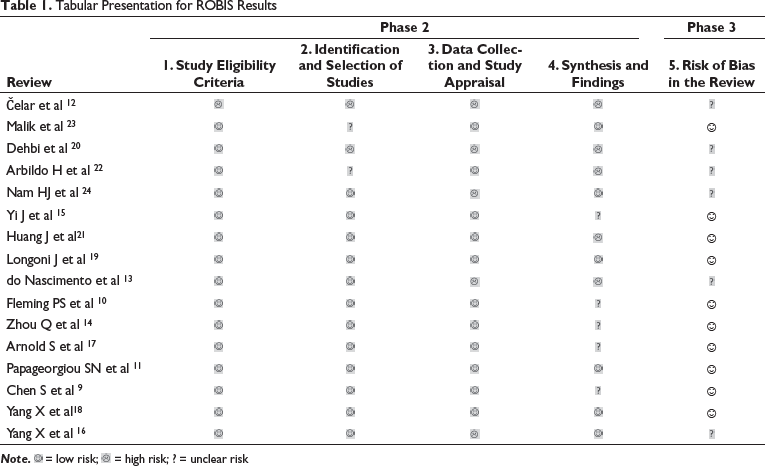
Methodological evaluation was performed using the risk of bias in systematic reviews (ROBIS) tool, which evaluates systematic reviews and meta-analyses. 8 Risk of bias was evaluated in 3 phases: (a) Assessing relevance, (b) identifying concerns with the review process, which is further broken down into 4 domains: Study eligibility criteria, identification and study selection, data collection, and study appraisal and synthesis and findings, and (c) judging the risk of bias. These were considered together for allocating a “low,” “high,” or “unclear” risk of bias score. Any discrepancies during the scoring process were resolved through discussion and consensus (Table 1).
Tabular Presentation for ROBIS Results
Data Extraction and Management
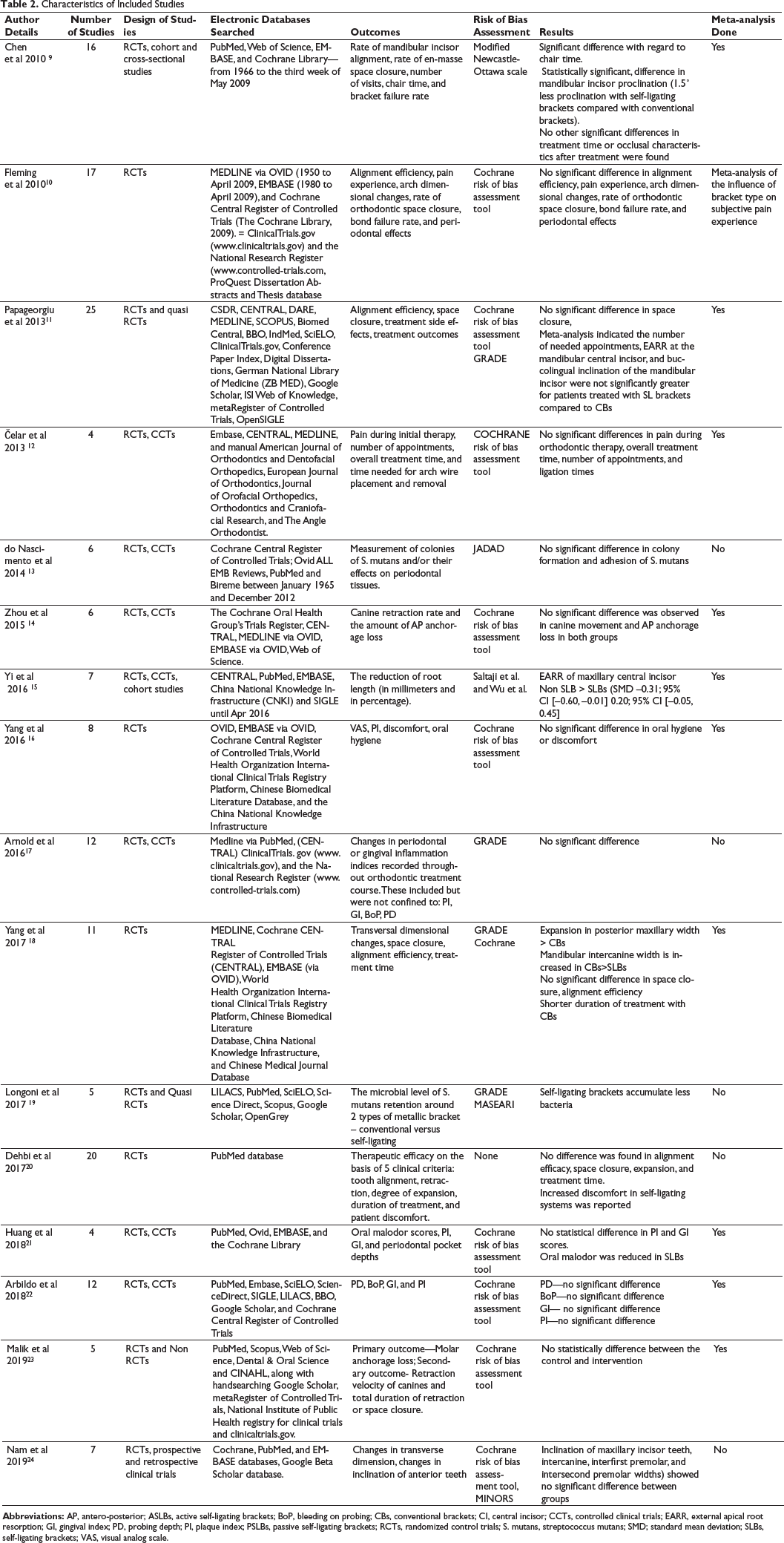
A standardized, prepiloted form developed by the Joanna Briggs Institute was used to extract data, assess study quality, and perform qualitative evidence synthesis. 4 2 independent reviewers (MM and SV) collected the data in structured tables. The information extracted was authors, year, review title, number of articles included, databases used, search strategy, data collected, quality, and risk analysis of bias (yes or no and which tool was used), type of analysis (qualitative or quantitative), and study results and conclusion. Any difference in opinion between the 2 reviewers was resolved by a third reviewer (PC). The summary of evidence and outcomes assessed in systematic reviews were summarized through data tables of included review characteristics (Table 2).
Characteristics of Included Studies
Analysis of Degree of Overlap in Studies
Citation matrices were generated to determine overlap in studies across systematic reviews. Corrected covered areas (CCAs) were calculated (CCA = 0–5, slight; 6–10, moderate; 11–15, high; and >15, very high overlap). CCA was found to be 0.6 (0.066% overlap) overall in all 17 included studies, which is considered low. An additional CCA for 3 studies was also undertaken as they evaluated similar parameters such as alignment efficiency, arch dimensional changes, bracket failure rates, and treatment time differences at the same time (Table 3).9, 10, 11 A CCA score of 0.14 (14% overlap) was obtained, indicating a low incidence of repetition of primary studies (Appendix 3).
CCA of the Reviews Reporting Similar Outcomes

Results
Description of Included Reviews
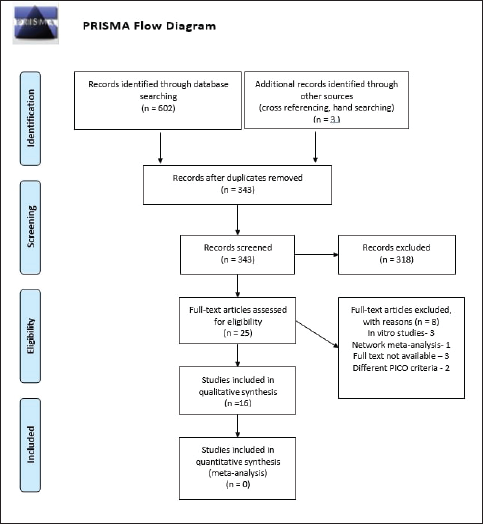
The initial search found 605 studies, and after the removal of duplicates, 343 were selected for review by 2 independent reviewers (MM and SV). Any conflict was resolved by a third reviewer (PC). Studies were scrutinized by applying inclusion criteria, and 25 systematic reviews were found eligible for full-text assessment (Figure 1). Following full text assessment, 16 articles were included,9-24 and 8 were excluded. Out of 17 studies, 12 performed a quantitative analysis,9, 10, 11, 12, 14, 15, 16, 18, 21, 22, 23 and 5 performed a qualitative analysis.13, 17, 19, 20, 24
Characteristics of the Reviews
Most studies included randomized control trials (RCTs) and Quasi RCTs along with controlled clinical trials. Only 4 studies focused solely on RCTs.10, 16, 18, 20 PubMed, Cochrane, Embase, and Google Scholar were the most frequently searched databases. Additional databases included LILACS, ProQuest, German National Library, China National Knowledge Infrastructure (CNKI), SIGLE, and OpenGrey. Only 1 study limited searches to PubMed, 20 with 2 limited to the English language,12, 23 and 1 limiting the time from January 2012 to January 2017. 22
Characteristics of Studies Included in the Review
The numbers of studies contained within systematic reviews were more or less uniform. Reviews by Chen et al., 9 Fleming et al., 10 and Papageorgiou et al. 11 included the highest number of studies. The rest included an average of 6 studies. Cochrane’s risk of bias tool was frequently used to assess primary studies. The Jadad scale was used by de Nascimento et al., 13 and the Modified Newcastle Ottawa scale was used by Chen et al. 9 A GRADE assessment and the Cochrane risk of bias tool were used in 2 studies.11, 18
Methodological Quality of the Reviews
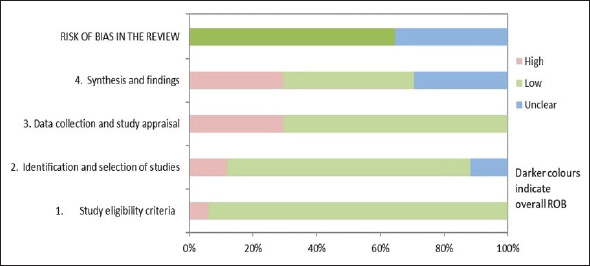
The risk of bias in 10 studies was low,9-11, 14, 15, 17-19, 21, 23 while it was unclear in 6.12, 13, 16, 20, 22, 24 The methodological quality of almost all studies was positive to signaling questions in domains 1 and 4 of phase 2 of ROBIS. However, Celar et al. and Malik et al. placed language restrictions on English and German,12, 23 and Arbildo et al. placed restrictions on the time. 22 4 studies did not mention any efforts made to reduce data collection errors and risk of bias assessment. In synthesis and findings, the main concerns were the absence of sensitivity analyses to make findings more robust. 16, 20, 23, 24
According to phase 3 of the ROBIS tool, most studies did not appropriately address all concerns identified during phase 2 in domains 1 to 4.
All studies did not emphasize results based on statistical significance, and studies included in the systematic reviews and meta-analyses were valid. Thus, we can conclude that most studies had a low overall risk of bias, with conclusions supported by evidence (Table 1; Figure 2).
Effects of Intervention
Tabular Presentation of Qualitative Findings
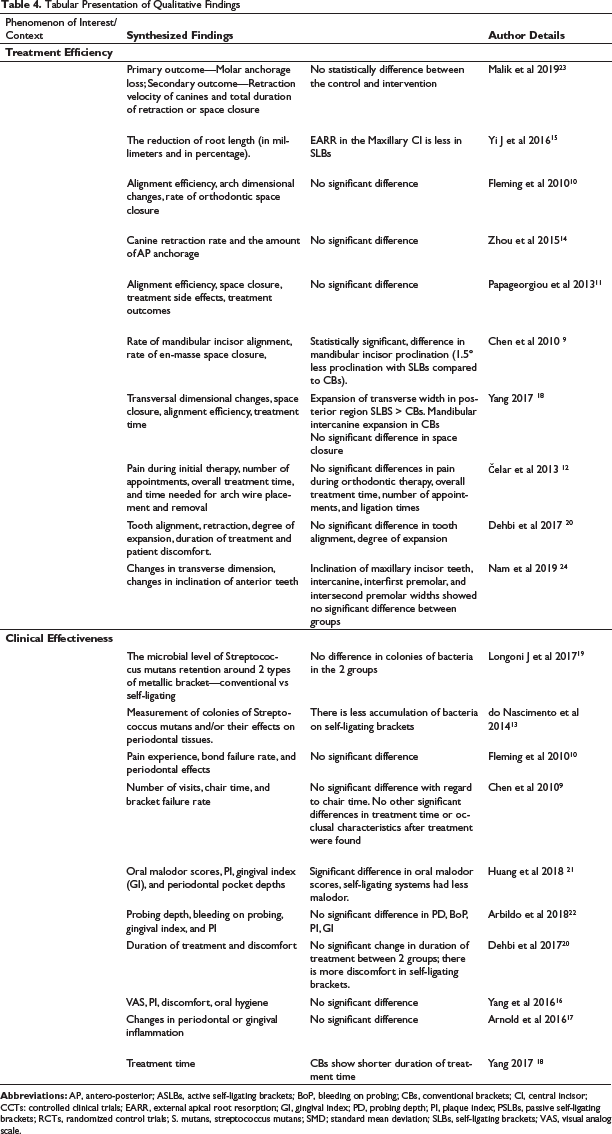
Treatment Efficiency (Table 4)
Data analysis from included studies revealed reduced lower incisor proclination by 1.46mm (95%CI [–2.79, –0.13]). 9 Yang et al. evaluated interfirst premolar and molar widths and concluded that self-ligating brackets showed increased transverse dimensions posteriorly, while conventional brackets showed increased mandibular intercanine width. 18 Only 1 study evaluated root resorption and determined that external apical root resorption in maxillary central incisors was less with self-ligating brackets than conventional bracket systems by 0.31 mm (CI [−0.60, 0.01]). 15 There were no significant changes in alignment efficiency, space closure, and anchorage loss. 10, 11, 14, 18
Clinical Effectiveness (Table 4)
Systematic reviews assessed the effect of self-ligation on periodontal tissues using different periodontal parameters such as plaque index, gingival index, and bleeding on probing. Longoni et al. found that self-ligating brackets accumulated less bacteria than conventional. 19 2 studies measured plaque index, gingival index, bleeding on probing, and periodontal pockets but found no significant differences between self-ligating and conventional brackets.17, 21 Huang et al. found that oral malodors were less with self-ligating brackets. 21 No statistical differences in chairside time were observed in the study conducted by Chen et al. 9
Yang et al. 18 reported a shorter treatment time when using conventional bracket systems. No significant differences were observed in other clinical parameters such as pain, discomfort, and overall treatment time.10, 23
Discussion
Orthodontists prefer to use appliances that help achieve treatment goals without prolonging treatment duration. Published studies also provide evidence that self-ligating brackets produced quicker results and required fewer office visits.25, 26, 27 During orthodontic treatment, periodontal health, and oral malodor are not mutually exclusive but rather codependent on each other for comprehensive and satisfactory treatment. It was, therefore, necessary to analyze data comparing periodontal health in self-ligating and conventional bracket systems.
The main objective of conducting an umbrella review of systematic reviews was to evaluate the methodological quality of systematic reviews on self-ligation and summarize diverse findings related to clinical efficiency and conclusions drawn from current literature. Included articles attempted to report differences between both systems with respect to treatment outcomes, side effects, and acceptability in patients to enable clinicians to make informed decisions on their use.
A citation matrix quantifies the number of times primary studies recur in each systematic review with the investigation of individual studies to derive the CCA mathematically. The value denotes the percentage of overlap of primary studies within the systematic review. 28 The CCA of included articles in this umbrella review was 0.6, which is low. A low CCA indicates less overlap of primary studies within each systematic review and meta-analysis, and data can be interpreted with precision. It is also essential to narrow down calculations to a specific parameter to identify overlapping primary studies. Thus, we also performed a CCA for 3 studies that evaluated concurrent outcomes such as alignment efficiency,9, 10, 11 arch dimensional changes, bracket failure rates, and treatment time differences (Table 3). A CCA score of 0.14 (14% overlap) was obtained, indicating an incidence of repetition of primary studies. Hence, primary studies in the included systematic reviews are not discordant, and the synthesis of results can be deemed accurate.
The ROBIS tool, used to assess systematic reviews, was designed to be as standardized as possible to assess the risk of bias and relevance to the research question. It was more suitable than AMSTAR 2 as it had more in-depth signaling questions to assess quality. 29 Major concerns in assessing the risk of bias included domains related to the selection of studies, data collection, and study appraisal. 2 reviewers completed the ROBIS assessment independently to avoid incorporating bias, and the third reviewer resolved any disagreement.
Most included articles conducted searches in at least 4 electronic databases, which was adequate except for Dehbi et al., who only searched PubMed. 20 Included articles compared treatment outcomes of passive self-ligating systems to conventional.
Comparison parameters were varied and comprehensive within the same study. Rate of alignment efficiency was evaluated by 5 studies,9, 10, 11, 18, 20 space closure was evaluated by 7 studies,9, 10, 11, 14, 18, 20, 23 pain and discomfort were reported by 3 studies9, 10, 20 and periodontal condition and oral hygiene were evaluated by 7 studies.10, 11, 13, 17, 19, 21, 22 Transverse arch dimensional changes were evaluated by 4 studies10, 17, 18, 24 and 1 study reported external apical resorption. 15
Methodological quality of all studies was positive to the following questions: The protocol provided a priori, had an adequate selection of studies by 2 independent reviewers, had a comprehensive search strategy, and provided characteristics of included studies. There was a lack of relevant systematic reviews and meta-analyses that compared the 2 systems based on factors like frictional resistance and torque expression, so it was not feasible to consider these parameters. Treatment outcomes such as molar anchorage, space closure, treatment time, number of visits, bracket failure rate, pain, and discomfort were found to be statistically insignificant in most studies except Dehbi et al., who reported more discomfort in self-ligating systems, which could be attributed to limiting their search strategy to a single database. 20
Although no significant differences were observed between self-ligating and conventional brackets in terms of pain, discomfort, oral hygiene, and overall treatment time, some aspects like pain, discomfort, and oral malodor could be relatively subjective. All systematic reviews and meta-analyses concluded that self-ligating systems demonstrated a reduction in external apical root resorption and lower incisor proclination. Less accumulation of bacterial colonies and oral malodor are additional advantages. However, many uncontrolled factors influence clinical orthodontic treatment. Substantial clinical heterogeneities, such as variations in time intervals and patient compliance, must be addressed.
Limitations
This umbrella review is one of the first that evaluated treatment outcomes and efficiency of self-ligating bracket systems. There are some inherent methodological restrictions with no clearly established guidelines on conducting such umbrella reviews, leading to overgeneralizing results. Umbrella review methodology relies on critical appraisal of every primary study in systematic reviews, which is an inherent limitation.
Future Research
Additional studies are needed to evaluate the differences between self-ligating and conventional orthodontic systems. Current evidence is insufficient to make definitive conclusions at this time. One disadvantage of all systematic reviews is the limited number of primary studies. Primary studies with larger sample size and uniform inclusion criteria will enable researchers to make definitive conclusions about the superiority of one system over the other.
Standardizing quantitative synthesis in an umbrella review will lead to a better understanding of results. Lastly, suitable methods need to be developed to address heterogeneity in various systematic reviews.
Conclusions
The methodological quality of systematic reviews conducted on self-ligating brackets was high as most studies followed similar protocols.
Self-ligating brackets had a limited advantage over conventional brackets in routine clinical conditions.
Self-ligating brackets reduced external apical root resorption in anterior maxillary teeth.
Self-ligating brackets demonstrated reduced amounts of lower incisor proclination.
Therapeutic efficiency in terms of maxillary incisor inclination, alignment efficiency, space closure, transverse dimensional changes, and anchorage showed no differences between self-ligating and conventional bracket systems.
Self-ligating and conventional bracket systems showed similar results in terms of bracket failure rate, pain, total treatment time, and periodontal effects.
Oral malodor and chairside time were the only clinical parameters that showed a reduction with self-ligating bracket systems.
Supplemental Material
Supplemental material for this article is available online.
Supplemental Material for An Umbrella Review of Systematic Reviews With or Without Meta-Analysis Assessing Treatment Outcomes and Efficiency of Self-Ligating Brackets by Meghna Mukhopadhyay, Shubhnita Verma, and Prasad Chitra, in Journal of Indian Orthodontic Society
Footnotes
Declaration of Conflicting Interests
The authors declared no potential conflicts of interest with respect to the research, authorship, and/or publication of this article.
Funding
The authors received no financial support for the research, authorship, and/or publication of this article.

Statement of Informed Consent and Ethical Approval
Necessary ethical clearances and informed consent was received and obtained respectively before initiating the study from all participants.
References
Supplementary Material
Please find the following supplemental material available below.
For Open Access articles published under a Creative Commons License, all supplemental material carries the same license as the article it is associated with.
For non-Open Access articles published, all supplemental material carries a non-exclusive license, and permission requests for re-use of supplemental material or any part of supplemental material shall be sent directly to the copyright owner as specified in the copyright notice associated with the article.
