




Abstract
Introduction
The aim of this study was to evaluate the validity of Ramanujan’s equation in measuring arch perimeter on untreated natural dentition models and their orthodontically corrected posttreatment models. The secondary objective was to apply the equation to predict the arch perimeter gained by the expansion of the molar teeth or proclination of the incisor teeth and compare it with the actual posttreatment arch perimeter changes.
Methods
32 maxillary and mandibular (16 pretreatment and 16 posttreatment each) fairly aligned diagnostic casts of orthodontically treated nonextraction patients with class I molar relationships were used. The arch perimeter was measured using 0.012 mm stainless steel wire and was compared with the calculated arch perimeter obtained using Ramanujan’s equation. Pearson correlations were used to determine the correlation between the measured and predicted values. Paired t-tests were used to assess changes in different variables in the pre- and posttreatment study casts of maxilla and mandible.
Results
Positive correlation of 0.06 (90% CI) between predicted and measured values was found. In maxillary (P = .04) study models, predicted arch perimeter by use of Ramanujan’s equation was more reliable than mandibular (P = .74) study models.
Conclusion
Ramanujan’s equation can be an important aid to calculate the arch perimeter change by the expansion of molar teeth and proclination of incisor teeth 0.06 (90% CI). It is helpful for more accurate nonextraction treatment planning before the start of orthodontic treatment. In maxillary (P = .04) study models, calculated arch perimeter using Ramanujan’s equation is even more reliable than mandibular study models (P = .74).
Introduction
There are many factors in orthodontic treatment that should be deciding whether to treat a malocclusion with or without extractions. One of these was space requirements.
There are various methods in orthodontics to treat arch length deficiency (ALD), such as expanding the dental arch, distalizing the posterior teeth, proclining the incisor teeth, reducing teeth interproximally, or extracting teeth. Between these methods proclining the incisor teeth and expanding the molar teeth are commonly used for gaining space in the dental arch in nonextraction orthodontic treatment, so accurate prediction of these changes is necessary.
Some investigators have attempted to predict the peripheral arch length changes related to arch width expansion. Adkins et al 1 concluded that there was a 4.7 mm of average increase in the arch perimeter for 6.5 mm of average molar expansion. 1
Currier JH, in 1969, conducted a study in relation to human dental arch form. He concluded that the human arch form resembled the geometrical form of an ellipse.2, 3
Ramanujan’s equation, 1914, was used to calculate the perimeter of an ellipse.
Chung and Wolfgramm 2 conducted a study in which they compared the measured value of a maxillary arch perimeter with the calculated value of maxillary arch perimeter by using Ramanujan’s equation and found that the ellipse was an accurate geometric model of the maxillary arch form. 2
Aghera et al 4 conducted a study in which they compared the measured value of maxillary and mandibular arch perimeter with the calculated value using Ramanujan’s formula. They found Ramanujan’s equation used to calculate the arch perimeter with a 1.5% chance of error in the maxillary dental arch and a 1.7% chance of error in the mandibular dental arch. It can also be used to predict change in the arch perimeter by molar expansion and incisor proclination. 4
“In the previous study, only pretreatment models were used to compute the accuracy of Ramanujan’s equation for calculating the arch perimeter.”
In this study, perimeter was calculated with the aim to quantitatively demonstrate the mathematical correlation of Ramanujan’s equation for the perimeter of an ellipse and the maxillary and mandibular arch perimeter in pre- and posttreatment study models.
The secondary objective of this study was to apply the equation to predict the arch perimeter increased by expansion of the molar teeth; or proclination of the incisor teeth.
Material and Methods
Institutional ethics committee (IEC) for research Manubhai Patel Dental College and Hospital and Ori, Vadodara, Reference no: MPDC_141/ORTHO-30/18. 16 orthodontically treated nonextraction patients study models were selected with 99% confidence and 90% power.
Inclusion Criteria
Fairly aligned arch prior to orthodontic treatment.
Patient should have from first molar to first molar permanent dentition.
Minor spacing is acceptable.
Exclusion Criteria
Severely crowded arch.
Cases treated by extraction.
Dental anomalies.
Cases treated by distalization
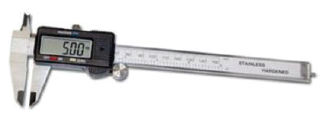
Linear measurements were obtained from the mid-buccal surfaces of the distobuccal cusps of the first molar teeth by used of vernier caliper (TOLEXO-electronic digital vernier caliper with LCD display screen) for the maxillary and mandibular arch (Figure 1).
Digital Vernier Caliper.
The perpendicular distance was measured from the line intersecting the distobuccal cusps of the first molar teeth and the facial surfaces of the central incisors for the maxillary and mandibular arch, respectively, using a vernier caliper and straightedge ruler.
Measurement of the arch perimeter was made directly on each dental cast from the distobuccal cusps of the first molar teeth with a 0.012 mm stainless steel wire that contacted the mid-buccal surface of each tooth for maxillary and mandibular arch.
Measurement of the Arch Perimeter Directly on Each Model.
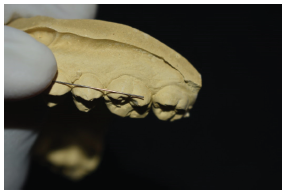
The 0.012 mm stainless steel wire was marked at the distobuccal cusps of the first molar teeth and then the wire was straightened. The marks made on the wire were measured with the caliper.
The measurements collected were used in Ramanujan’s equation (perimeter of an ellipse).
(a + b) {1 + (3h/(10 − √(4 − 3h))}
Where h = (a - b) 2/(a + b) 2
Aghera et al 4 found that based on Ramanujan’s equation in maxillary arch every 1 mm of molar expansion resulted in an increase of 0.73 mm in arch perimeter and every 1 mm of incisor proclination resulted in an increase of 1.67 mm in arch perimeter. In mandibular arch, every 1 mm of molar expansion resulted in an increase of 0.74 mm in arch perimeter and every 1 mm of incisor proclination resulted in an increase of 1.65 mm in arch perimeter. We applied these results in the prediction of posttreatment values in the present study which was our secondary objective. 4
Primary Objective
The value for “a” and “b” (Figure 3 and Figure 4). 2
Diagram of an Ellipse Fit on the Maxillary Dental Arch.
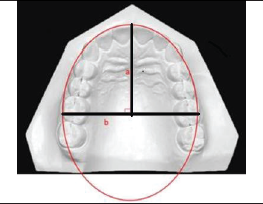
Diagram of an Ellipse Fit on the Mandibular Dental Arch.
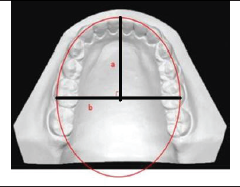
a = perpendicular distance measured from the line intersecting the distobuccal cusps of the first molar teeth and the facial surfaces of the central incisor teeth.
b = linear measurement from the mid-buccal surfaces of the distobuccal cusps of the first molar teeth divided in half.
The values were calculated with Ramanujan’s equation (perimeter of an ellipse), and then these values were compared with the values measured directly on each model from the distobuccal cusps of the first molars using a 0.012 mm stainless steel wire contacting the mid-buccal surfaces of teeth. This comparison was done on pre- and posttreatment models.
This kind of comparison of measured values and values obtained from Ramanujan’s equation will validate the application of the equation on both natural dentition and orthodontically treated dentition.
Secondary Objective
Measured a2 and b2 (a and b in posttreatment) were compared with a1 and b1 values (a and b in pretreatment). Based on the change in a and b, the change in arch perimeter were calculated as predicted perimeter posttreatment (Pp2).
a1 - 31.90 (Pretreatment a), b1 - 25.75 (Pretreatment b).
a2 - 33.42 (Posttreatment a), b2 - 25.07 (posttreatment b).
Hence:
A’ = 1.52 (a2 - a1), B’ = -0.68 (b2 - b1).
P1 = 2.52 (arch perimeter increased after 1.52 mm proclination obtained by replacing a for a2 = (a1 + A’) = (a1 + 1.52) and b for b1 in Ramanujan’s equation).
P2 =-1 (arch perimeter change after 0.68 mm constriction obtained by replacing b for b2 = (b1 - B’) = (b1 - 0.68) and a for a1 in Ramanujan’s equation).
Hence,
Pp2 = Pm1+/-(P1+/-P2) = 95.80 + (2.52 - 1) = 97.32.
The arch perimeter obtained by this calculation (Pp2) was compared to actual posttreatment perimeter (Pm2, measured perimeter posttreatment) and tested for any correlation between them.
This relation of Pp2 and Pm2 will tell us the effectiveness of Ramanujan’s equation in predicting arch perimeter changes before starting treatment. The closer the values Pp2 and Pm2 to each other, better the usefulness of Ramanujan’s equation in prediction of posttreatment arch perimeter with the specific amount of expansion or proclination that is planned.
All the clearly defined measurements (as mentioned previously) were carried out by a single well-trained researcher in order to minimize any information bias.
Statistical Tests
Pearson correlations were used to determine the correlation between the measured value of arch perimeter and calculated value of arch perimeter of study casts before and after orthodontic treatment.
Paired t-tests were used to assess changes in different variables in the pre- and posttreatment study casts of maxilla and mandible.
Results
Primary Objective
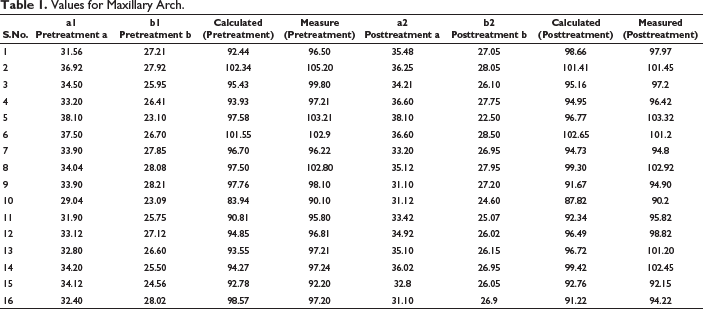
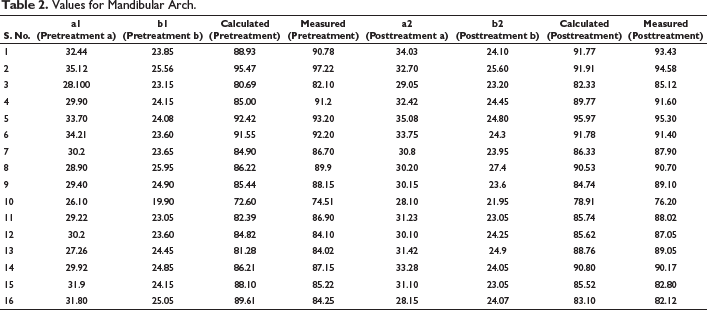
“The values were calculated with Ramanujan’s equation (perimeter of an ellipse), and then these values were compared with the values measured directly on each dental cast from the distobuccal cusps of the first molar teeth using a 0.012 mm stainless steel wire contacting the mid-buccal surfaces of teeth. This comparison was made on pre- and posttreatment models. This kind of comparison of measured values and values obtained from Ramanujan’s equation will validate the application of the equation on both natural dentition and orthodontically treated dentition.”
Values for Maxillary Arch.
Values for Mandibular Arch.
Paired t-Test for Maxilla and Mandible.

Correlations Between Calculated and Measured Value.

Secondary Objective
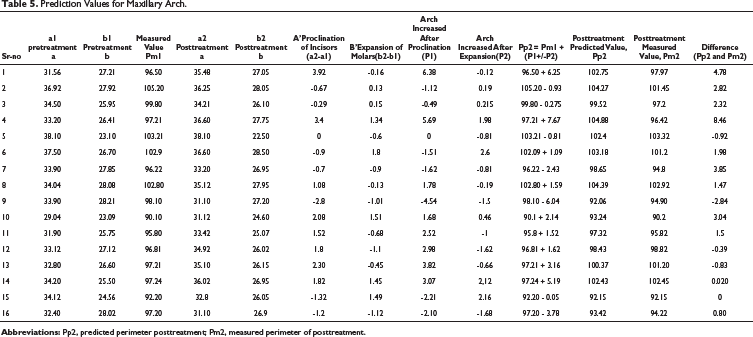
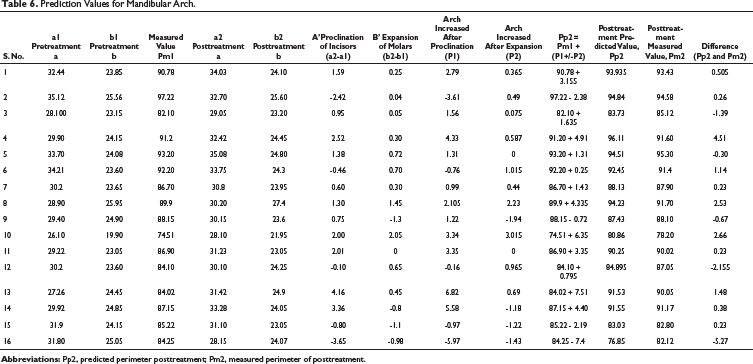
“The arch perimeter obtained by this calculation (Pp2) was compared to actual posttreatment perimeter (Pm2, measured perimeter posttreatment) and tested for any correlation between them.”
Prediction Values for Maxillary Arch.
Prediction Values for Mandibular Arch.
Paired t-Test for Predicted and Measured Values of Mandible.

Paired t-Test for Predicted and Measured Values of Maxilla.

Paired t-Test for all Predicted and Measured Values of Maxilla and Mandible.

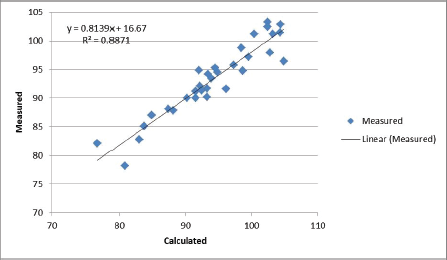
The measured perimeter of posttreatment (Pm2) was plotted against the predicted calculated perimeter (Pp2) graph with minimum value 70 on both axes as shown in Figure 5. The measured perimeter of posttreatment (Pm2) was plotted against the predicted calculated perimeter (Pp2) graph with minimum value 0 on both axes as shown in Figure 6. “Here, the graph in Figure 6 started at 0 value on both axes and that in Figure 5 started at 70 so all values are located between 75 and 105.”
The Measured Perimeter of Posttreatment (Pm2) was Plotted Against the Predicted Calculated Perimeter (Pp2), Graph with Minimum Value 70 on Both Axis.
The Measured Perimeter of Posttreatment (Pm2) was Plotted Against the Predicted Calculated Perimeter (Pp2), Graph with a Minimum Value 0 on Both Axis.
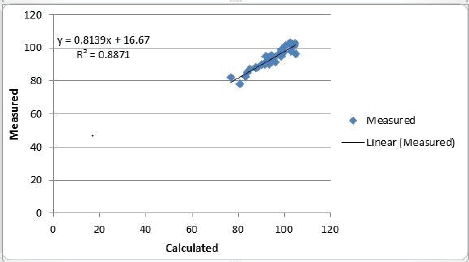
Here for the secondary objective, maxillary correlation is positive and mandibular correlation between the measured value and calculated value is negative, but the overall correlation is positive 0.06 (90% CI).
Discussion
In many orthodontic cases, expansion or proclination of anterior teeth is an effective method for gaining space in the dental arch in nonextraction treatment planning. In this study, we have used Ramanujan’s equation of an ellipse to calculate the arch perimeter of the maxillary as well as the mandibular arch in pre- and postorthodontic treatment. We have applied the equation to predict the arch perimeter that can be gained by an expansion of the molar teeth or proclination of the incisor teeth and compared it with posttreatment measured value.
Sabrina et al 5 conducted a study using the mathematical geometric model to calculate alteration in arch length by proclination of anterior and concluded that for every 1 mm of incisor proclination, there is a gain of 1.21 mm to 2.07 mm arch perimeter. However, this study was done on geometric models and not tested on physical study models. Steiner 6 concluded that every 1 mm of incisor proclination resulted in 2.07 mm of gain in arch perimeter. So proclination of incisors and expansion of molars are the key factors in nonextraction orthodontic treatment planning. Here also the values were obtained by extrapolating and mathematical computation.5, 6
Yolanda et al 7 conducted a study on Pont’s index in study models of patients who finished a nonextraction orthodontic treatment and concluded that a significant difference was found between Pont’s index norms and the measurements obtained from the models. But in this study, calculated value obtained after molar expansion and incisor proclination by use of Ramanujan’s equation correlates with the measurement obtained from the models by a statistically significant amount. 7
As demonstrated by Chung and Wolfgramm 2 , Ramanujan’s equation can be used to calculate the maxillary arch perimeter with a 1.2% of error. In this study, we found similar results. The study by Chung and Wolfgramm 2 only tested maxillary arch models by the equation and also did not test predictive accuracy of Ramanujan’s equation as we have tried in our study. 2
As demonstrated by Aghera et al 4 , Ramanujan’s equation can be used to calculate the arch perimeter with a 1.5% of error in maxillary dental arch and a 1.7% chance of error in the mandibular dental arch. They also found that in maxillary arch, every 1 mm of molar expansion resulted in an increase of 0.73 mm in arch perimeter, and every 1 mm of incisor proclination resulted in an increase of 1.67 mm in the arch perimeter. In the mandibular arch, every 1 mm of molar expansion resulted in an increase of 0.74 mm in arch perimeter, and every 1 mm of incisor proclination resulted in an increase of 1.65 mm in the arch perimeter. 4
As demonstrated by Aghera et al 4 , Ramanujan’s equation for an ellipse can be used to calculate the arch perimeter with a 1.5% error in maxillary dental arch and a 1.7% error in mandibular dental arch. We found similar results for maxillary (SD = 2.415, P = .25) and mandibular study models (SD = 2.465, P = .28). 4
According to rules while treating class I malocclusion cases when less than 4 mm of arch length discrepancy, always nonextraction treatment is indicated; with 5 mm to 9 mm of arch length discrepancy, extraction or nonextraction treatment is indicated depending on soft and hard tissue considerations; and for more than 9 mm of arch length discrepancy, always extraction treatment is indicated. 8 A popular trend to resolve an arch length discrepancy is to expand the dental arch and procline the incisor teeth. However, it must be well understood that the limitations of expansion like stability and incisor considerations. 9 Excessive transverse expansion cause fenestration of the roots through the alveolar process and sometimes also cause root resorption. 8
Ramanujan’s equation can be used to predict the arch perimeter gained by expansion of molars and proclination of anteriors. We have continued this study further to check the reliability of equation in posttreatment models.
Ramanujan’s equation was used to predict the arch perimeter gained by the expansion of molars and proclination of anterior. In this study, we found a correlation (P = .06 (90% CI)) which was positive between our predicted and the measured values in posttreatment.
So, Ramanujan’s equation can be an important aid to calculate arch perimeter for a particular expansion of molar teeth and proclination of incisor teeth (P = .06 (90% CI)).
Also, in this study, we found that in maxillary (P = .04) study models predicted arch perimeter by use of Ramanujan’s equation is even more reliable compared to mandibular study models (P = .74), which shows more crowding tendency. “Limitation of this study is mathematical equations are time-consuming or require mathematical software.”
Conclusion
Ramanujan’s equation can be an important aid to calculate arch perimeter by the expansion of molar teeth and proclination of incisor teeth (0.06 (90% CI)). It is helpful for nonextraction treatment planning before the start of orthodontic treatment. The maxillary (P = .04) study models predicted arch perimeter using Ramanujan’s equation is even more reliable than mandibular study models (P = .74). We need to further research various methods of prediction until we arrive at the gold standard. After evaluating several such methods, we may eventually be able to establish more accurate treatment plans.
Synopsis
(a + b) {1 + (3h/(10 − √(4 − 3h))}
where h = (a - b) 2/(a + b) 2
a = Perpendicular distance measured from the line intersecting the distobuccal cusps of the first molars and the facial surfaces of the central incisors.
b = linear measurement from the mid-buccal surfaces of the distobuccal cusps of the first molars divided in half.
Footnotes
Acknowledgments
Authors are thankful to Mr Sivam Nalin Patel and Dr Rahul Aghera for developing the software for calculating the arch perimeter using the Ramanujan’s equation. We are grateful to him for helping us in our study
Declaration of Conflicting Interests
The authors declared no potential conflicts of interest with respect to the research, authorship, and/or publication of this article.
Ethics Approval
Institutional ethics committee (IEC) for research Manubhai Patel Dental College and Hospital and Ori, Vadodara, Reference no: MPDC_141/ORTHO-30/18.
Funding
The authors received no financial support for the research, authorship, and/or publication of this article.
Informed Consent
Not applicable