




Abstract
Objective:
This study aimed to analyze the expression of torque between 2 passive self-ligating brackets by simulating different clinical situations using finite element analysis.
Material and Methods:
Two passive self-ligating brackets, that is, Damon Q (Ormco, Glendora, California) and Smart Clip (3M Unitek, Monrovia, California), were 3D modeled using micro-computed tomography. ANSYS V14.5 software was used for analysis. Archwire and bracket interactions were simulated to measure torque expression by changing wire alloys (stainless steel [SS] and titanium molybdenum [TMA]) and interbracket dimensions.
Results:
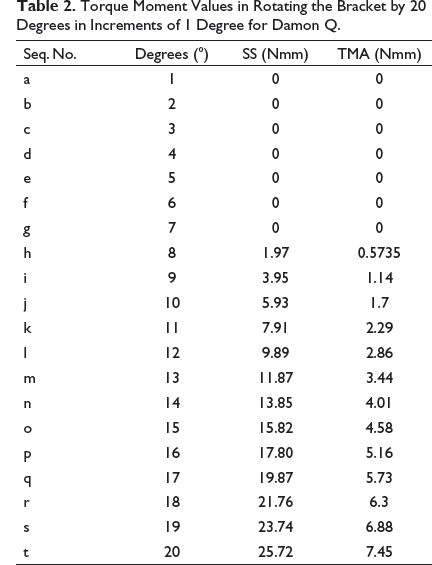
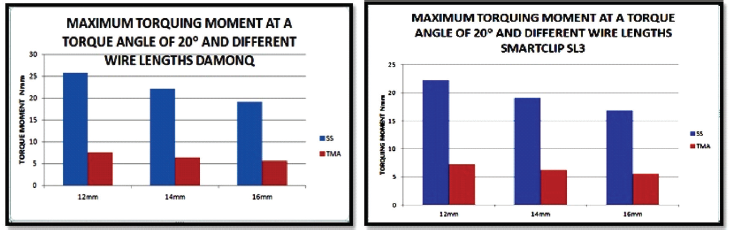
Damon Q brackets generated higher torque values compared to Smart Clip brackets with both SS and TMA wires. Damon Q brackets generated the highest torquing moment of 25.72 Nmm and 7.45 Nmm, while Smart Clip brackets generated 22.25 Nmm and 7.31 Nmm with 0.019 × 0.025″ SS and TMA wires, respectively, at an interbracket distance of 12 mm. Torquing moments decreased for Damon Q and Smart Clip brackets when wire length increased from 12 mm to 16 mm.
Conclusion:
Damon Q with 0.019 × 0.025″wires exhibited superior torquing characteristics as compared to Smart Clip brackets with similar archwires.
Introduction
Tooth movement and torque are the basic foundation of orthodontic-induced treatment. 1 Rauch defined torque as a moment generated by rectangular wire torsion in a bracket slot. 2 Correct maxillary anterior teeth labiolingual inclination is required for optimal orthodontic treatment outcomes, good smile esthetics, proper anterior guidance, and Class I anterior and posterior occlusion. Under-torqued maxillary incisors can result in arch length and space discrepancies. 3 The amount of torque expression depends upon the play between bracket slots and archwire, tooth morphology, archwire dimensions, ligation modes, stiffness of archwire alloys, bracket deformation, magnitude of wire torsion, and bracket design.4-6 Clinically, an additional factor that affects the torquing moment is interbracket distance which depends on both crown and bracket widths. 6 In 1987, Meyer and Nelson et al 7 mentioned that torquing moments also depended on vertical positioning of brackets on teeth wherein a 3 mm shift could result in a torque angle change up to 15 degrees. However, in 1997, Miethke et al found torque variation of 10 to 15 degrees with vertical discrepancy of 1 mm during placement of brackets. 8 Tooth morphology (tooth surface curvature and crown–root angle [CRA]) greatly affects torque moments. 9 Archambault et al mentioned that nickel-titanium (NiTi) alloys with low elastic modulus with less than half the stiffness of stainless steel (SS) show decreased torque expression as compared to SS. 10 Ideal occlusion requires maxillary incisors with correct inter-incisal angles and good contact. 11 Effective values for torque moments range between 10 Nmm and 20 Nmm, whereas the minimum value reported for torquing a maxillary central incisor was 5 Nmm.12, 13
An engineering computer simulation tool for stress–strain calculations in materials including living tissues is the finite element method (FEM). Solutions for complex biomechanical questions can be obtained by using FEM.14, 15 Unlike clinical experiments requiring patients or animals, FEM can be used to simulate treatment approaches and observe biomechanical responses. 16 Loading configuration, structure geometry, and material properties affect FEM reliability. The accuracy of FEM analysis may differ from the real-world scenario by up to 20%.3, 14, 17
Passive self-ligating brackets (SLBs) are gaining popularity due to easier and faster ligation, reduced friction, adequate torque expression, and reduced overall treatment time. The gate or fourth wall retains the wire in the slot enabling ligation and tooth movement. Passive ligation systems work with reduced friction; however, their torquing characteristics remain uncertain.18, 19
Evidence concerning torque expression of brackets and archwire interactions is less frequently reported due to complexity of the experimental configuration.
13
This study aimed to analyze torque expression in 2 widely used passive SLBs, that is, Damon Q and Smart Clip, using two archwire combinations (SS and TMA) with respect to interbracket distance. Such detailed information on torque of a selected bracket system is difficult to obtain by other experimental techniques because the interactions of archwires and bracket slots have to be very precise. The brackets were scanned and modeled using micro-computed tomography (micro-CT) for FEM analysis to obtain accurate results according to the selected parameters as follows:
The torque moments of 2 passive SLBs (Damon Q and Smart Clip) were measured by rotating the right upper central incisor by 20 degrees in increments of 1 degree along the bracket slot central axis. Changes in archwire alloys (SS, TMA) and interbracket distance on torque moments were analyzed.
Methodology
Damon Q (Ormco, Glendora, Calif) and Smart Clip (3M Unitek, Monrovia, California) passive SLBs were used in the study. The brackets were made of SS and of 0.022″ slot dimension. Bracket specimens were scanned and finite models of 4 brackets (maxillary left incisor to maxillary right canine) were generated. Initially, three-dimensional (3D) solid models of Damon Q and Smart Clip brackets were constructed using a micro-CT XRADIA 500 scanner for 45 min. Two different archwire alloys, that is, SS (GAC-USA) and TMA (GAC-USA), with dimensions of 0.019 × 0.025″ were also modeled and constructed. Micro-CT images were taken to improve anatomical accuracy and reproduce fine geometrical aspects.
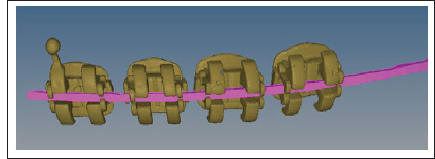
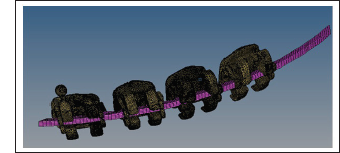
The volumetric data of 1000 slices each in digital imaging and communication in medicine (DICOM) format were imported to 3D slicer software for conversion into stereolithography (.STL) format 3D models. Figures 1A and 1B show the geometric models of Damon Q and Smart clip, respectively. FEM models were generated with the help of meshing using Hypermesh V11 software utilizing the 3D models (Figures 2A and 2B).
ANSYS V14.5 software was used to conduct the analysis. 3D tetrahedral elements were used for discretizing the complete assembly. A total of 44 289 elements were connected by 48 268 nodes for Smart Clip and 41 903 elements were connected by 46 289 nodes for Damon Q brackets.
Damon Q Brackets With 0.019 × 0.025″ Archwire.
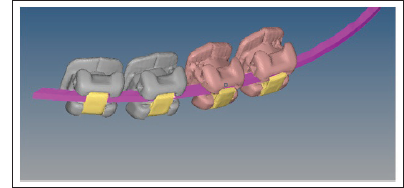
Smart Clip Brackets With 0.019 × 0.025″ Archwire.
Meshing of Damon Q Brackets.
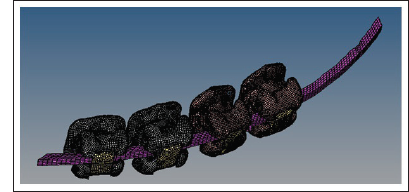
Meshing of Smart Clip Brackets.
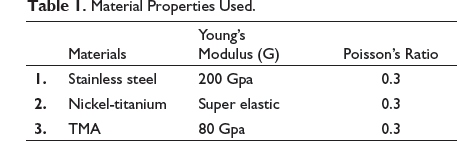
Material Property Assignment
Material Properties Used.
Boundary Conditions
Specific boundary conditions were applied in the finite element model. The wire was allowed to move freely in rotated bracket slots. Contact analysis based on the Coulomb friction model ensured this. On account of this, wire deformation did not occur till contact with the walls of the bracket slots ensured wire restriction. A coefficient of friction of 0.2 was used between the bracket and the wire. The study was limited to torque expression without involving teeth. The maxillary right central incisor bracket was rotated from neutral position to a total of 20 degrees in increments of a degree enabling measurement of simulated torque angle/moment values. The other brackets remained fixed without rotation. von Mises stress values for both bracket types were also calculated prior to analysis and values for the same were Smart Clip (Maximum stress Mpa at 120.25) and Damon Q (Maximum stress Mpa at 89.26).
Force Application
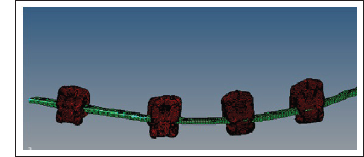
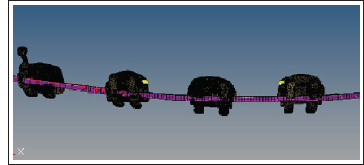
From maxillary left central bracket to right lateral bracket, a constant length was maintained for all 5 bracket⁄wire configurations at 12 mm for Damon Q (Figure 3) and Smart Clip brackets (Figure 4) to determine bracket width and mode of ligation effects. For assessing the effect of a variable increase in wire lengths, an increase in wire length from 12 mm to 16 mm between left upper central and right lateral bracket in increments of 2 mm in the model was done for both bracket types. Free wire length was increased from 12 mm to 14 mm and from 14 mm to 16 mm with similar wire dimensions of 0.019 × 0.025″. The maxillary right central incisor bracket was rotated from neutral position to a total of 20 degrees in increments of a degree enabling measurement of simulated torque angle/moment values. The other brackets remained fixed without rotation (Figure 5).
Damon Q Bracket⁄Wire Configurations at 12 mm.
Smart Clip Bracket⁄Wire Configurations at 12 mm.
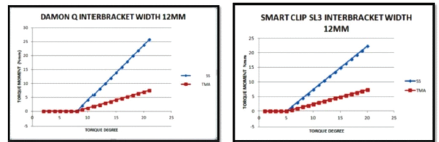
Torquing of Damon Q and Smart Clip Brackets at 20 Degrees in ANSYS V14.5.
Results
Simulations of torque moments were performed using ANSYS V 14.5 FE program on the 3D base models of 2 SLBs (Damon Q and Smart Clip) and wires (SS and TMA) prepared by scanning software. The torque moments at different engagement angles in the slot were analyzed using FEM software and the results are discussed as follows:
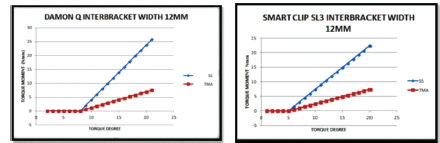
The interaction between Damon Q brackets and archwires at 12 mm is observed as a curve with 2 segments separated by a single bend. The plane represents the degree of play within the torqued bracket slot of the right upper central incisor. On increasing the angle of rotation from 0 degrees to 20 degrees, a sudden increase in the torquing moment is evident on contact of the torqued wire with the neighboring brackets slots at 8.5 degrees. The SS wire generated higher torquing moments of 25.72 Nmm with sharper increase when compared to TMA with a torquing moment of 7.45 Nmm at an interbracket distance of 12 mm in Damon Q brackets at 20 degrees of rotation.
Moments for Different Angles of Rotation of Damon Q and Smart Clip Bracket up to 20 Degrees at 12 mm.
Torque Moment Values in Rotating the Bracket by 20 Degrees in Increments of 1 Degree for Damon Q.
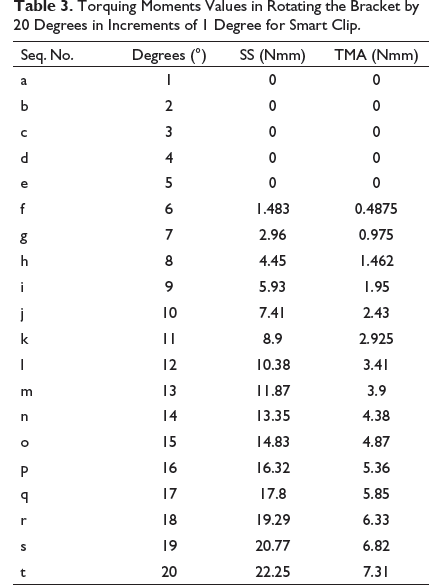
Torquing Moments Values in Rotating the Bracket by 20 Degrees in Increments of 1 Degree for Smart Clip.
In this study, the effect of interbracket distance on torquing moments was also evaluated at different wire lengths between the upper left central incisor and the right lateral incisor brackets by an increase of 2 mm in 2 steps from 14 mm to 16 mm.
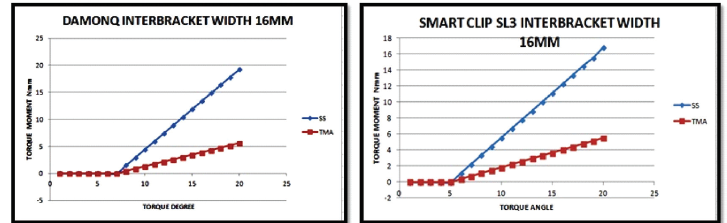
On measuring torquing moments of Damon Q brackets at different angles of rotation at 14 mm, a sudden increase in torque expression was observed after 8.5 degrees of bracket rotation. SS wire generated highest moments of 22.04 Nmm as compared to TMA wire of dimension 0.019 × 0.025″ at an interbracket distance of 14 mm at 20 degrees.
Moments for Different Angles of Rotation of Damon Q and Smart Clip Bracket up to 20 Degrees at 14 mm.
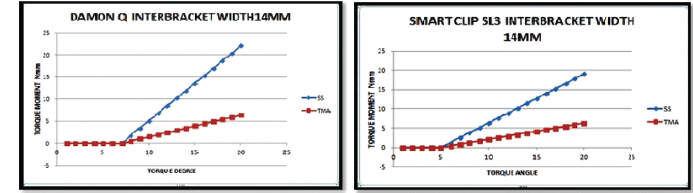
However, a sudden increase in torque expression was observed after 6 degrees of bracket rotation with Smart Clip brackets. On comparing the wires, the highest moment of 19.089 Nmm was observed with SS wire than TMA wire, which generated a torquing moment of only 6.26 Nmm.
Torquing moments at interbracket span of 16 mm with a gradual increase in bracket rotation from 0 degrees to 20 degrees showed a similar pattern of torque expression as with interbracket distance of 14 mm. The highest moment of 19.2 Nmm was generated in SS wire and 5.59 Nmm was observed for TMA wire of dimensions 0.019 × 0.025″ at an interbracket distance of 16 mm. Similarly, for Smart Clip brackets, the highest moment generated was 16.8 Nmm in SS wire and 5.58 Nmm for TMA wire.
Moments for Different Angles of Rotation of Damon Q and Smart Clip Bracket up to 20 Degrees at 16 mm.
In both Damon Q and Smart Clip, torque expression of 2 wire types, namely SS and TMA with 0.019 × 0.025″ dimension decreased as wire length increased. An increase of wire length from 12 mm to 14 mm and 16 mm caused decreased maximum torquing moment for Damon Q and Smart Clip by 14.3% and 25.34%, respectively. However, Damon Q brackets generated higher torque values compared to Smart clip brackets with both SS and TMA wires at 12 mm, 14 mm, and 16 mm. Also, SS produced a greater torquing moment compared to TMA at an interbracket distance of 12 mm,14 mm, and 16 mm.
Maximum Torquing Moments at 20 Degrees for Damon Q and Smart Clip Brackets.
Discussion
The primary aim was to analyze the torque expression between 2 SLBs by changing wire alloys (SS and TMA) and interbracket distances using finite element analysis (FEM).
A plethora of literature exists on expression of torque in the field of orthodontics. Current literature includes studies of in vitro type and theoretical models using measuring devices such as bracket/wire torquing devices, worm gear-driven apparatus, the orthodontic measurement and simulation system (OMSS), as well as studies of in vivo type which analyze torque indirectly by observing tooth inclination. Results of in vitro studies are difficult to interpret by a clinician as the prediction of torque expression may vary with different bracket–wire combinations. Also, mechanical models do not take into consideration the physiological response of the periodontal ligament and are prone to errors as the wire or bracket may distort, or fit may not be proper. In addition, OMSS experiments have been shown to record smaller torque values. 20 On the other hand, FEM has generated immense interest in orthodontics as it is easy to calculate stress and understand deformation of complex structures and tooth movements. It is a numerical technique which uses simulation to understand complex biomechanical scenarios. Thus, FEM overcomes the previously mentioned disadvantages and has been used in the present investigation to measure torque expression.3, 17
Torque is responsible for buccolingual angulation of teeth (crown and root length) which in turn affects smile and occlusion. Correct interincisal angle permits incisal guidance during mandibular protrusion and additionally influences anterior teeth alignment, arch perimeter, and smile esthetics. 11 Variations in torque can be due to manufacturing process (casting and milling), material properties (hardness, elastic modulus, archwire dimension and alloy), ligation methods, kind of brackets and bracket–wire combinations. Various manufacturing processes have not been included in this study as it would have made the investigation more complex and difficult to interpret. 13
Damon Q is a recent variant of a passive SLB which has a gate or slide (4th moving wall) that helps to convert the bracket slot into a tube. In contrast, Smart Clip’s passive self-ligating mechanism functions with the help of NiTi clips that can be opened or closed with elastic deformation. Torque expression in conventional, active, and passive SLBs using different bracket–archwire combinations has been previously evaluated. However, limited data are available on torque expression between 2 widely used passive SLBs, as mentioned above.
Clinically, effective torque moments between 5 Nmm and 20 Nmm have been recommended. In the present study, clinically effective torque was achieved by Damon Q at 10 degrees and by Smart Clip at 9 degrees. The initial torque expressed in Smart Clip is probably due to NiTi clips. At 20 degrees, higher torque moments were observed with Damon Q compared to Smart clip brackets. This result is in disagreement with a study conducted by Huang et al 17 where they found that Damon 3MX brackets showed increased torque play and low torquing moments with 18 × 25 SS wires as compared to Speed brackets. Similar results were observed by Morina et al, 6 Badawi et al, 18 and Sfondrini et al 21 This difference can be attributed to the use of OMSS which measures smaller torque values and also due to fatigue incorporated in NiTi clips. In contrast, Franco et al 22 identified higher torque expression with Damon 3MX brackets that expressed torque earlier to be clinically effective, which is similar to the results of this study.
Huang et al 17 also concluded that torquing moments were greatly affected by torsional stiffness of wires than the ligation type, when FEM was used. Changing the wire dimension from 18 × 25 to 19 × 25 with a change in the wire alloy from TMA to SS caused an increase of 600% in torque expression. This is similar to the present findings which show significant differences between SS and TMA wires. SS wires show larger torque expression compared to TMA. The findings match those of Ramegowda et al, 5 Singh et al, 23 Papageorgiou et al, 3 and Archamboult et al 10 Reduced modulus of elasticity in NiTi and TMA which exhibit much lesser stiffness compared to SS wire is ineffective in torque transmission within the bracket slot.
The final objective of the study was assessing torquing moments with increase in wire length. Difference in torque expression exists between single rotated brackets and wire combinations and multibrackets and wire combinations. Papageorgiou et al 24 found negligible influence of interbracket wire length on torque expression. This is in disagreement with results of the current study which show decreased torque moments with increase in wire length. However, currently, studies with context similarities are negligible making comparisons difficult.
In conclusion, Damon Q showed superior torque expression compared to Smart Clip though no significant difference was evident in clinically effective torque expression. Application of torque in SLBs for treatment mechanics should be considered carefully as there is potential alteration in load and moment expression. Finishing with TMA archwires in Damon Q is clinically effective with no unwanted side effects. Even though SS archwires cause a higher torque expression, high torquing moments could damage roots and/or cortical plates. However, findings of the study point to anticipated clinical behavior, with a possibility that the final observed behavior could differ as bone density and tooth morphology vary from person to person.
Conclusions
Among passive SLBs, Damon Q demonstrated maximum torque values as compared to Smart Clip.
0.019 × 0.025″ SS wires generated higher torquing moments as compared to 0.019 × 0.025″ TMA wires.
Increasing the interbracket distance decreased the amount of torque expression.
Footnotes
Declaration of Conflicting Interests
The authors declared no potential conflicts of interest with respect to the research, authorship, and/or publication of this article.
Funding
The authors received no financial support for the research, authorship, and/or publication of this article.
Statement of Informed Consent and Ethical Approval
Necessary ethical clearances and informed consent was received and obtained respectively before initiating the study from all participants.