




Abstract
Introduction:
The success of orthodontic therapy depends upon the knowledge and clinical skills of the orthodontist as well as awareness and sincerity of the patient. Due to long treatment duration, commitment and good rapport between both sides is essential. This retrospective study was undertaken to understand the factors affecting the reasons for discontinuation after commencement of treatment in a Government run hospital.
Materials and method:
A telephonic questionnaire survey was conducted on 153 patients who had discontinued treatment midway and their responses were analysed. The subjects were divided into 3 groups depending upon their school going years. The major focus areas were -1. Reasons for seeking orthodontic treatment 2. Reasons for pursuing treatment in this hospital and 3. Reasons for discontinuation of orthodontic treatment.
Results and conclusions:
Long waiting period before starting the treatment, failure to give subsequent appointments by the doctor, and having to leave the city were found to be the three most common causes for discontinuation. To reduce the attrition rate a three step strategy was devised to ensure an improved orthodontic outcome for the patients and to see more smiling faces bid adieu each year.
Keywords
Introduction
“Behind every smile there’s teeth,” said Confucius; what he perhaps forgot to add is “Behind every corrected beautiful smile, there’s an Orthodontist!”
Our dental institute has been catering to a mixed socioeconomic demography from all strata and classes of the society, located in the heart of a densely populated old city area, since 10years. The Department of Orthodontics with an experienced team and dedicated doctors sees a footfall of average 500 patients a year, catering to the needs of both the masses who cannot afford treatment costs at private clinics, as well as the classes who trust the acumen and experience of the doctors here. Despite this diversity and sincere efforts, the department does not see all of these 500 smiles leave us after completion of their treatment, for some discontinue the treatment in between leaving us perplexed and disappointed.
It is found that at an institutional level, there exists a huge discrepancy in the clinical daily workload between government and private dental colleges in India. The number of OPD patients daily visiting these hospitals differs as per the location, facilities, and the treatment charges offered by these institutes. The teaching syllabus for postgraduate students is standardized by the Dental Council of India, which states that the clinical requirement to be a minimum of 50 patients per doctor (postgraduate trainee) during their training program. Striking a balance between maintaining a high turnover OPD rate and maintaining not only the clinical records but also the follow-up and treatment of these patients becomes a challenging situation in major government-run institutes in which the number of patients per doctor is huge.
The percentage of failed appointments has been shown to be related to a number of socioeconomic factors. 1 These include age,2-4 sex,2-5 social class,2, 3 race,6, 7 dental state,8, 9 level of education,3, 4 large families, 6 distance traveled,3, 4, 10, 11 weather, 2 forgetfulness,2, 3, 6, 10, 12 time interval between making appointment and date of appointment, 3 degree of medical urgency, 13 illness, 14 availability of transport, 14 source of payment, 7 medical debts, 6 depression/psychiatric problems,2, 3, 6 and apprehension. 5
In an accidental finding, it was realized that a plausible number of patients dropped out after either their initial orthodontic consultations or after getting their treatment records made in the department. Keeping all the above factors in mind, it was thought worthwhile to conduct the present survey in the Department of Orthodontics and Dentofacial Orthopedics to determine the contributing factors which could have possibly led to the discontinuation of the orthodontic treatment. This retrospective study is an endeavor to understand the various reasons which could have possibly led the patients to discontinue an ongoing orthodontic treatment midway.
Materials and Methods
The presented study was conducted after approval from the Institutional Review Board of dental college and hospital. The orthodontic diagnostic records (Consisting of x-ray OPG, lateral cephalogram, photographs, impressions, and case history) of 1899 cases that were registered in the department during 2015 to 2018 were analyzed for selection. A total of 250 patients were included in the study who had either not reported back for treatment after initial consultations or those who failed to continue with the appointments after 3 months of starting with either fixed/removable orthodontic therapy.
A telephonic questionnaire (In vernacular language) survey was conducted in which 153 patients who had responded to the calls were interviewed for 8 to 10 min by a single principal operator. In case of minors (<18 years old) their parent/guardian was interviewed. Following this with due consultation, sustained efforts were made to allay their worries and appropriately address their concerns so as to encourage them to come back to the department for further discussion. A face-to-face discussion was held for them with the senior faculty,and those willing to restart the treatment were then allotted to their respective doctor (postgraduate trainee).
Patient Questionnaire Form
The English translation of the same is as follows:
Patient’s name:
Age:
Sex:
Orthodontic Registration Number:
When did you first visit the Department of Orthodontics and Dentofacial Orthopaedicsin this hospital? Why did you wish to undergo orthodontic treatment?
Malaligned teeth
Proclined teeth
Difficulty in chewing
Injury due to malaligned teeth
Proximity to your place of residence Treatment of a relative is either being done or was previously done in this hospital Heard by way of word of mouth
Yes/no
Why did you discontinue the ongoing orthodontic treatment?
Treatment cost is higher than expected
Distance to be traveled to reach the hospital is more
Hospital timings clash with school/tuition timings
Unwillingness to undergo extraction of tooth/teeth or pain experienced during the orthodontic treatment is unbearable
Social reasons
Long waiting period for starting of treatment
Subsequent appointment/s was/were not given by the doctor (postgraduate trainee)
Other reasons
Yes/no
Results
One hundred and fifty-threepatients (70 male and 83 female) patients were further divided into 3 different age groups:
Active school going years (11 to 15 years) Crucial school going years (16 to 20 years) Above 20 years of age
Discussion
Out of the total 1899 patients who had reported to the Department of Orthodontics and Dentofacial Orthopaedics during 2015 to 2018, 13% patients discontinued treatment due to various reasons. During the postgraduate training program, each trainee doctor is allotted more than 100 patients, thus providing them with ample opportunities to treat a diverse variety of patients using different treatment modalities. Despite this, a high patient dropout was observed in the department, which was a reason for concern and evaluation.
Reasons for Seeking Orthodontic Treatment
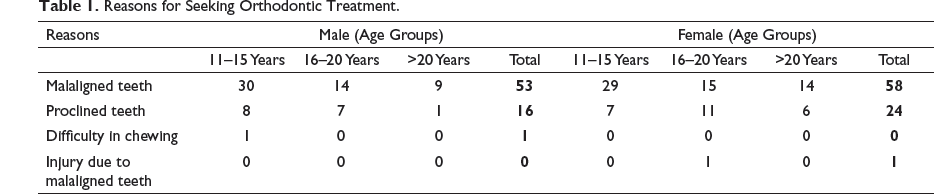
A desire to straighten teeth and to improve the smile were found to be the prime motivating factors for seeking orthodontic treatment. 15 In the present study, 72.5% patients wanted to undergo orthodontic treatment due to malaligned teeth. Out of 26.1% patients, 15.6% female patients and 10.4% male patients were found to be keen for treatment as they felt their proclined teeth gave them an unesthetic appearance which was also found to be the second most common reason for seeking orthodontic treatment (Table 1). In a study conducted by Mane et al, it was shown that nearly 17.4% out of 500 people faced problems during marriage proposals due to malaligned teeth. 16
Lewit and Virolainen also showed in a study consisting of 129 American high school children that those with the severest malocclusion had the greatest desire for treatment. However, no significant differences were found in desire for treatment between the moderate malocclusion and the good occlusion group 17 .
Reasons for Pursuing Orthodontic Treatment in This Hospital
Reasons for Seeking Orthodontic Treatment.
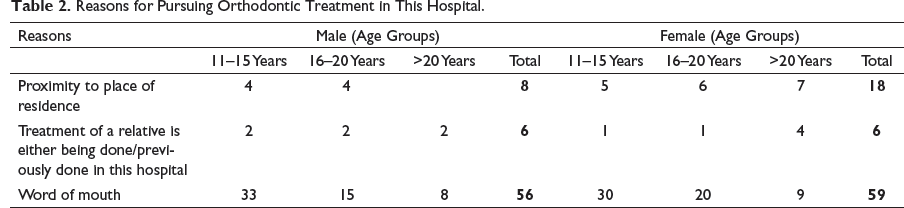
Reasons for Pursuing Orthodontic Treatment in This Hospital.
Reasons for Discontinuation of Orthodontic Treatment (Tables 3 and 4)
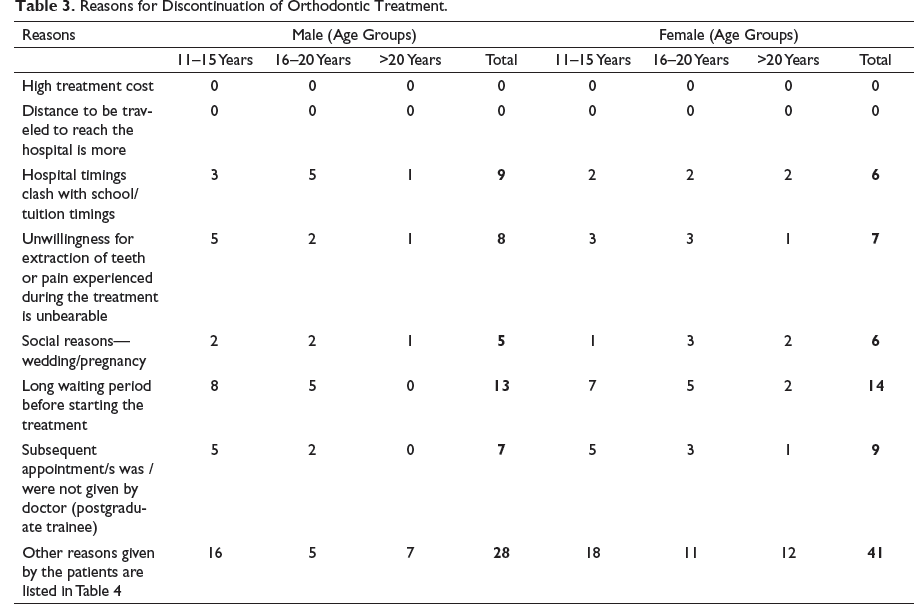
During the telephonic survey, no reasons were found to be associated with inability to pay the treatment costs, as the hospital treatment charges are kept minimal and affordable to the masses. Therefore, most of the patients from different socioeconomic classes are able to bear the treatment charges. The hospital also organizes many dental camps, so as to create awareness in children from rural and deprived areas, to motivate them to undergo required orthodontic therapy. Similarly, no discontinuation was associated with the distance traveled to the hospital, as the hospital is located in the city center in a densely populated area.
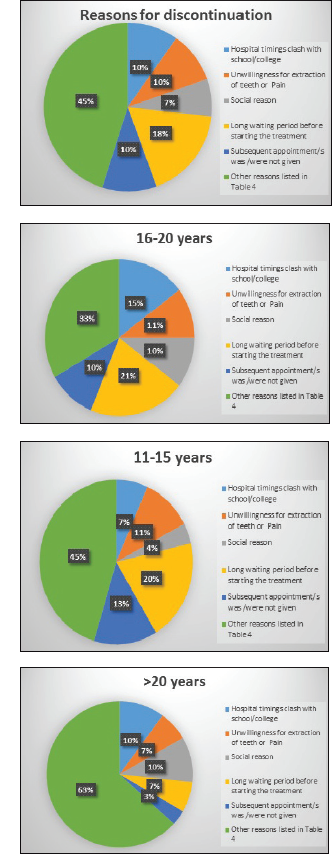
In the present survey, 9.8% patients found the hospital timing to be inconvenient to them and, hence, could not keep up with the monthly follow-up visits, as the timings clashed with their school/tuition or college timings. The proportion of patients who said that they were not willing for the extraction of teeth as the part of their orthodontic treatment plan was 9.8%. Various social reasons such as wedding, pregnancy, and parental pressure were reasons for discontinuation of 7.16% of patients (Figure 1). In a study by PN Mane et Al., it was also shown that 9.8% out of 500 people faced problems during marriage proposals due to braces. 16
It is observed that parents play an important role in initiation of orthodontic care and are the single most important factor in the motivation for treatment. 18 Lewit and Virolainen observed that parental wishes were important for dependent adolescents, but the more self-reliant adolescents were less influenced by parental or peer approval than by severity of the malocclusion. 17
In the present study, a significant 17.6% patients found that the waiting period for the treatment to be started was very long, and hence, they did not report back to the department. The proportion of patients who reported discontinuation of the treatment due to lack of motivation from the doctor (postgraduate trainee), as they failed to give subsequent appointments to them, was 10.45%.
Reasons for Discontinuation of Orthodontic Treatment.
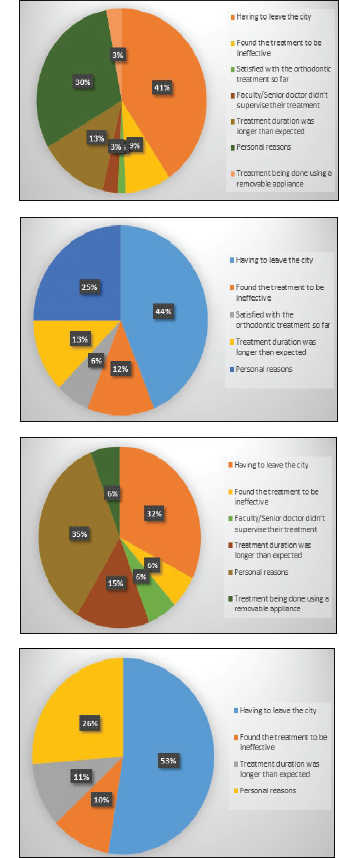
Other Reasons for Discontinuation of Orthodontic Treatment (Other Reasons Given by the Patients are Tabulated as Below).
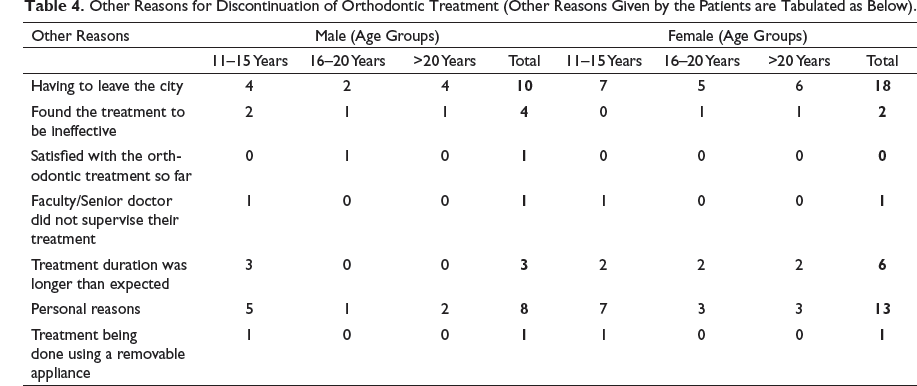
In accordance with the present study, Brattstrom, who telephonically interviewed 80 patients, had found lack of motivation to be the most common reason for discontinuation among the 46% of the total patients surveyed. He reported that 8% patients had a conflict with the dentist. One patient found the treatment to be inadequate in the initial stages and, hence, discontinued the treatment. Ten percent were unaware that the treatment was terminated prematurely, whereas a further 10% found the incomplete treatment to be adequate. Difficulty with the appliance wear (26%) was the second most common reason for discontinuation. 23 In his study, Murray had also showed that use of removable appliances was associated with failure to complete treatment. 24
Six percent of patients found the entire duration of treatment to be much longer than their expectation. This is in accordance with the study conducted by Patel in which he found that the patients were clearly dismayed at the length of the treatment time, suggesting that full discussion with a clear and realistic estimation of treatment time prior to the start of orthodontic treatment may help reduce the proportion of discontinued treatments. 25
In the present survey, discontinuation rate seemed to be higher among the kids in the active school going year (11 to 15 years), while it reduces with increase in age. In contrast to this, Haynes showed that 15- to 17-year-old patients in England and Wales had the highest discontinuation rates (39.8%) compared with 10- to 14-year-old patients (21.3%). 26 In his study, Patel found the discontinuation rate to be the highest in the 15 to 17 year age group (32%) with the over 18-year age group discontinuation rate reaching 28%. 25
Conclusion
Non-compliance and non-adherence have become a rising cause of concern for orthodontists in modern times because of which there has been an increase in the number of cases not responding to treatment, especially in a government hospital setting. The present retrospective study analyzed the reasons for this non-compliance wherein a majority (17.6%) discontinued treatment as they found the waiting period for their treatment to be started too long; 10.45% patients were not given appointments due to patient overload, while 18.3% patients had to leave the city due to personal reasons.
While the study was meant to find the causes for this non-compliance, it also aimed at providing solutions for the same. Hence, to resolve these issues, we have devised a
Adherence and compliance are pivotal in ensuring an improved orthodontic outcome for the patients, and we are committed to endeavor to strengthen these outcomes using these approaches and, each year, see more smiling faces bid us adieu, satisfied with their completed orthodontic treatment.
Reasons for Discontinuation of Orthodontic Treatment:Age Group Wise Distribution. (a) Reasons for discontinuation of orthodontic treatment in 11 to 15 years age group. (b) Reasons for discontinuation of orthodontic treatment in 16 to 20 years age group. (c) Reasons for discontinuation of orthodontic treatment in >20 years age group.
Other Reasons for Discontinuation of Orthodontic Treatment Given by the Patient: Age Group Wise Distribution. (a) Other reasons (45%) for discontinuation in 11 to 15 years age group. (b) Other reasons (33%) for discontinuation in 16 to 20 years age group. (c) Other reasons (63%) for discontinuation in >20 years age group.
Format Used by Data Operator.
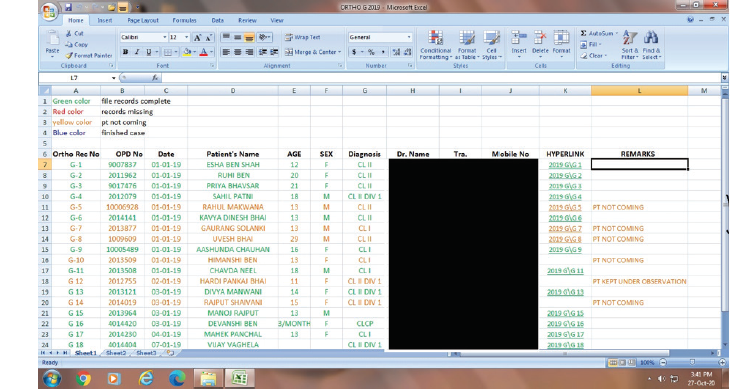
Hyperlink Access to Patient Records.

Color-Coded Format Used by Postgraduate Doctor (Trainee).
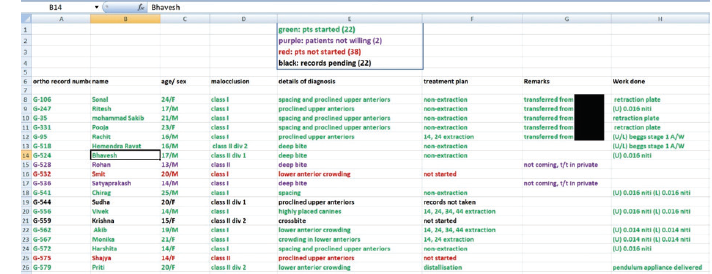
Footnotes
Statement of Informed Consent and Ethical Approval
Necessary ethical clearances and informed consent was received and obtained respectively before initiating the study from all participants.
Declaration of Conflicting Interests
Funding
The authors received no financial support for the research, authorship, and/or publication of this article.
