



Abstract
An emergent health crisis, coronavirus disease 2019 (COVID-19), has demanded strict disinfection and sterilization protocols to limit the spread. One such approach is the use of ultravioletC (UVC) radiation for surface decontamination in hospital settings. UVC is the most powerful of the UV wavelengths and, therefore, the most damaging. The radiation is used for sterilization of workplaces and objects, and although there is no current evidence, perhaps it may eradicate airborne coronavirus. Humans should not be subjected to this form of irradiation. This form of radiation comes with a health warning, and humans should not be in the vicinity when UVC sterilization is occurring. This case report deals with the unfortunate incidence of an operator affected by UVC radiation while working on a patient in an orthodontic clinic. The article will serve as a timely warning to clinicians that awareness of the safety protocols should be observed. Besides, we present some recommendations for the use of UVC depuration of dental operatories.
Introduction
The incomprehensible severe acute respiratory syndrome coronavirus (SARS-CoV-2) infection today has made the world demand strict implementation of newer protocols to limit the pandemic. With dentistry labeled as the most high-risk job, 1 various disinfection and sterilization protocols have been suggested by the health regulatory bodies to limit the potential cross-contamination in dental offices. One of the novel approaches that gained momentum in this aspect is ultraviolet (UV) irradiation disinfection techniques.2, 3
In this article, we report a case of potential accidental exposure to UVC that occurred to a clinician while at work. The detailed review of the literature and conferred recommendations for using UVC germicidal lamps in dental operatories have been discussed.
Case Report
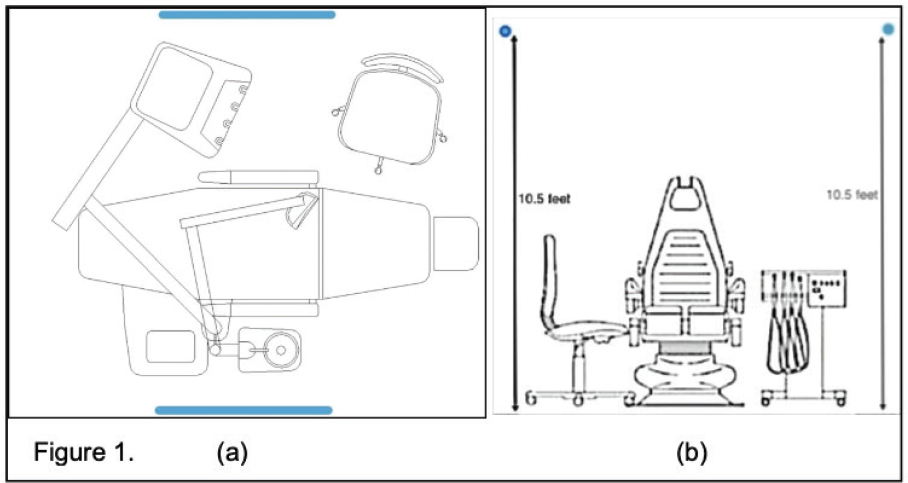
The incident occurredin an orthodontic clinic where the roof fitted UVC light was installed for sterilization purposes. Two UVC lights (JaschTM TLD T8 30W with voltage 240V, 50/60Hz) had been roof-fitted at a distance of approximately 10. 5 feet (3. 2m) from the operating chair (Figure 1). A female orthodontist provided emergency care involving a loose band associated with an Advance-Sync appliance for a patient. The UVC lights were accidentally on for about 45 min until the orthodontist prepared the armamentarium, seated the patient, and finished the procedure. During the treatment, the clinician was wearing a level-II coronavirus disease 2019 (COVID-19) personal protection armamentarium, which included a 65-g non-permissible surgical gown accidentally tied loose at the neck and back, a head-cap N-95 mask, and protective eyewear attached to dental loupes with lights. The patient was wearing full-sleeved clothes, a head cap, and a long drape tied high up on the neck. The rubber dam was placed throughout the procedure.
Position of UVC Lights Fromthe Dental Chair. (a) Top view, (b) Front view.
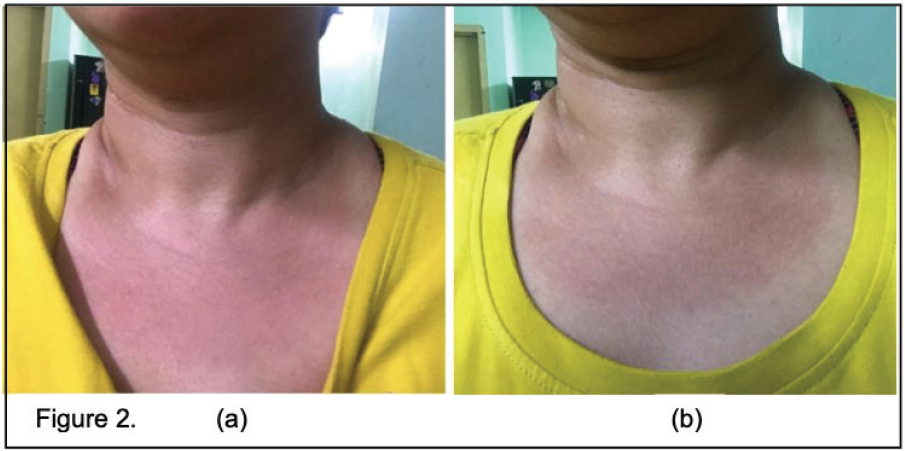
Half an hour after the procedure, the orthodontist developed irritation around the neck region, followed by redness and some amount of pain (Figure 2a). Immediate precautions advised by the dermatologist were to keep the affected area clean and sweat-free. If that affected area felt itchy,it was recommended not to scratch it; instead, calamine-based lotion was to be applied. Upon diagnosis, the dermatologist concluded it as asunburn due to direct exposure to UVC radiation. No other abnormality was detected in the surrounding structures. The treatment included topical application of Dermocalmlotion (Bis in Die [BID, twice a day]) and Cosvate cream (Hora Somni [HS, before bed]) and tablet Allegra 180 mg HS for 5 days (Figure 2b).
(a) Symptoms Noted After UVC Exposure. (b) Regression of Symptoms After Dermal Treatment.
Discussion
Ultraviolet radiation can be classified into UVA(315 to 400nm), UVB(280 to 315 nm), and UVC (200 to 280nm). 3 The shorter the wavelength, the more penetration capacity. Typically, at about 254 nm peak, UVC is used in many dental offices for complementary surface disinfection and air purification from the aerosols produced by high-speed handpieces or ultrasonic scaler. 4 The modus operandi primarily lies in the absorption of photons resulting in the formation of pyrimidine (thymine and cytosine) dimers, thereby causing the inactivation of deoxyribonucleic acid (DNA) and ribonucleic acid (RNA). 5
However, the penetrability of UV radiation also poses some after effects. While UVA radiation is the least hazardous and most associated with skin ageing, UVB is known to cause DNA damage and is a risk factor in developing sunburn, skin cancer, and cataracts. UVC is a “germicidal” radiation with the ability to penetrate deeper, killing bacteria and inactivating viruses. 6 There are various types of UVC germicidal lamps—cold cathode germicidal UV lamps, hot cathode germicidal UV lamps, slimline germicidal UV lamps, high output germicidal UV lamps, UV LEDs, and UV lamp shapes with lamp connectors. The latter two are the safest to be used with the utmost precautions.
This case report describes a vital observation of adverse effects produced by exposure to UV germicidal lamps. There are very few studies reporting accidental exposures to UVC at work in hospital settings. 7
The most critical UV radiation applications in the dental office are the destruction of airborne microorganisms and the inactivation of microorganisms present on surfaces. 2 While advantages include convenience of use and no requirement of chemicals, 8 UV only works in its light path and can be blocked by objects. 4 The use of this untouchable disinfection method has been proven to be an effective tool for disinfecting pathogens and is less susceptible to human errors arising from manual cleaning if handled well. On the contrary, UVC alone is ineffective and should be used along with manual cleaning of surfaces with a sodium hypochlorite solution.9, 10
The susceptibility of COVID-19 for UVC has not yet been specifically evaluated, and the dose required to inactivate Sars-CoV-2) is still a predicament (about 30mJ/cm 2 to 108mJ/cm 2 ). 11, 12 The efficacy of the lamps for pathogen inactivation depends upon the area of the dental office and power and positioning of the UVC lamp. Once absorbed by the obstructors, UV radiation is no longer active.
Importantly, overexposure to UVC radiation causes ocular and epidermal signs and symptoms. Typical skin reactions in a welder and acute sunburn produced by an electric insect-killing device with an irradiance of as much as 46 mW m-2 have been reported previously in the literature.13, 14 As for germicidal lamps, adverse effects include facial erythema, burning sensation, irritation, pain, keratoconjunctivitis, sunburn, conjunctival redness, blurry vision, photophobia, and irritation to the airway due to the generation of ozone from UVC lamps.7, 11 In our case, the dentist reported no ocular symptoms due to protective eye wear and face shield. Dermal symptoms to the uncovered skin surfaces appeared but were mild, maybe due to the increased distance of UV rooftop lights from the operator. More so, the objects near to the light source experience higher exposure than the objects further away; this explains the fact the patient did not experience any symptoms, as they were shadowed over by the sitting operator.
Recommendations for Ultraviolet-C Sterilization of Orthodontic Operatories
The positioning of germicidal lights is essential in order to provide direct exposure to the surfaces to be sanitized. Since the distance traveled by the radiation affects irradiance and penetrability, UVC tower lamps offer more effective sterilization than rooftop lights. The duration of sterilization should be set as recommended by the manufacturer but must be calculated as per the volume of operatory/surface area to depurate. Most importantly, operatories must be evacuated during the sterilization process, not just for effective decontamination but also to prevent UVC exposure and its iatrogenic effects.
Conclusions
We must learn to live in this COVID era and have to be precocious till effective mass-scale vaccination or herd immunization happens. There are no sufficient data to support the fact that UV lights can inactivate the SARS-CoV-2 virus; however, UVC exposure is an excellent means to reduce viral/bacterial load in an orthodontic office. However, one must ensure that the operatory is vacated for UVC decontamination.
Abbreviations
SARS-CoV-2: severe acute respiratory syndrome coronavirus
COVID-19: coronavirus disease 2019
UVC: ultraviolet C
UVA: ultraviolet A
UVB: ultraviolet B
DNA: deoxyribonucleic acid
RNA: Ribonucleic acid
BID: Bis in Die (twice a day)
HS: Hora Somni (before bed)
