




Abstract
Firm adaptation and locking of the thermoplastic aligners, retainers, and bleaching trays make it difficult during removal, making the patients often frustrated, leading to poor compliance. Generally, to remove these, patients tend to use their fingernails or some sharp hooks, which would cause distortion or a tear. Hence, a simple, user-friendly aligner removal tool was designed to overcome these issues.
Introduction
Thermoplastic aligners and retainers serve better esthetics in terms of alignment of teeth and retention of the achieved orthodontic corrections, respectively, with higher patient acceptance and a generally better quality of life. 1 The efficiency of aligners depends mostly on patient compliance during wearing, maintaining, and removing. Some patients learn to use them very quickly, while others face a great deal of effort, especially during removal from the teeth, discouraging them from cooperating with the treatment. Few patients use their nails or some sharp hooks like elastic placer unknowingly to remove the aligner, which might get torn or distorted. 2
An auxiliary like “aligner removal tool” is commercially available that help patients remove the aligner with ease. However, the use of such a device is less widespread as its plastic hook gets easily distorted and often pokes the gingiva during removal; its long handle does not fit in the aligner/retainer box. This present article describes a simple, user-friendly aligner removal tool to overcome this hurdle.
Fabrication
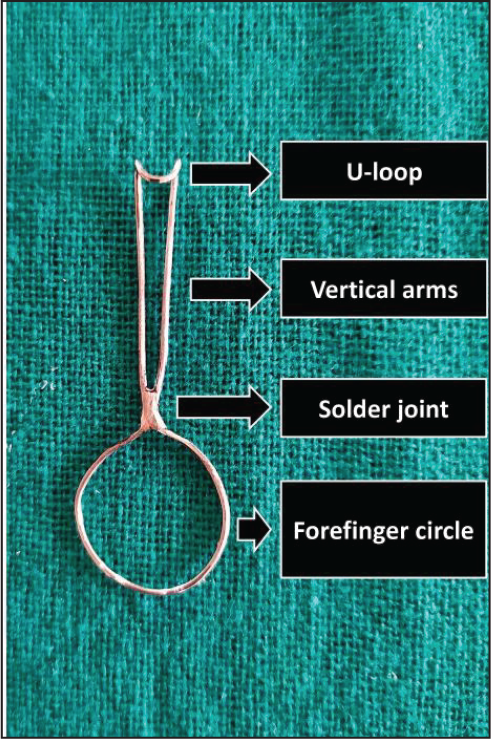
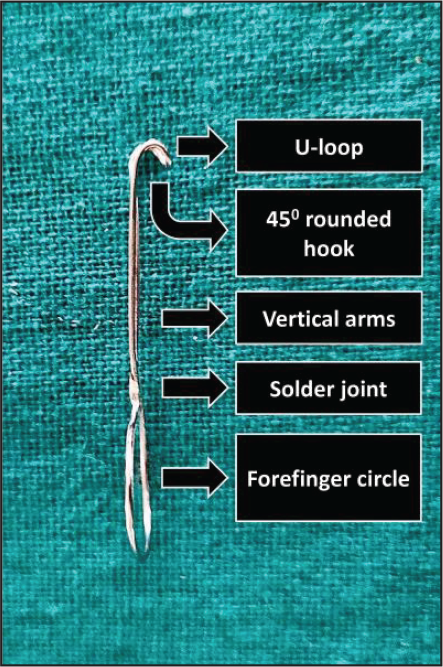
Take approximately 15 cm length of 22-gauge stainless steel wire and, at the center, make a U-loop of about 1 cm width. About 1 cm from the U-loop (behind), form a rounded angle of about 45 degrees of both the vertical arms. Converge the vertical arms to meet at their tips. Now, take around 10 cm length of the same gauge wire and bend it into a circle, such that the forefinger is easily inserted. Place the convergent tips of the U-loop and forefinger circle junction in the same plain, at a single point, and solder them (Figures 1 and 2).
Clinical Usage
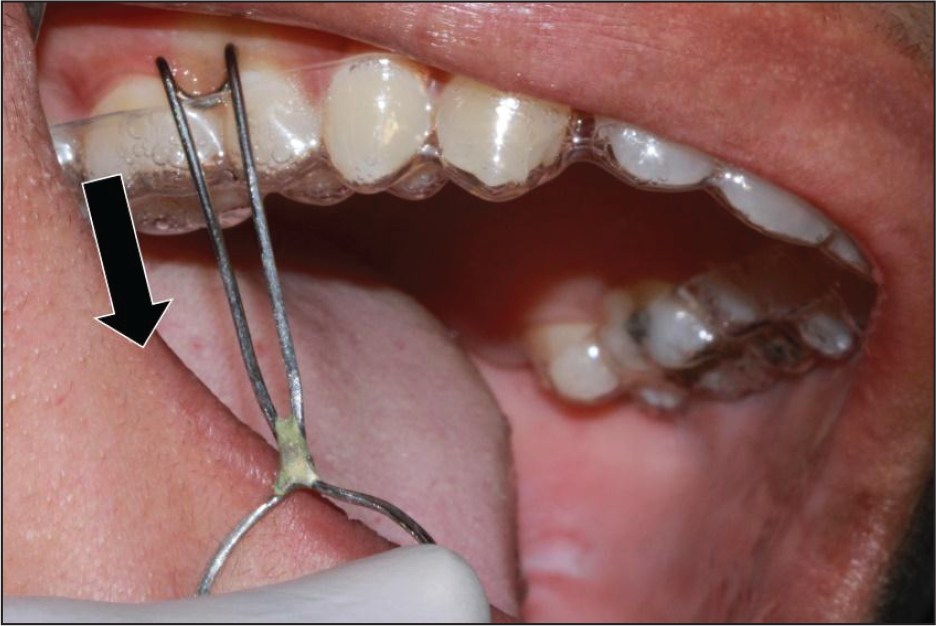
Hold the circle with forefinger in place and hook the broad U-loop between the teeth’s gingival area and aligner, at one side of the molar area (buccal). Slowly pull the tool toward the occlusal surface and repeat it on the other side of the arch (Figure 3). Continue the procedure until the aligner is completely removed from the teeth.
Discussion
Generally, to remove the aligners, patients place their fingertips or nails between the gingival margin of the aligner and buccal side of the teeth near the molars and pull it occlusally. 3 Patients continue this task until the aligner is completely removed from the teeth, which often frustrates them and leads to poor compliance. Usage of fingernails or any sharp object during removal of the aligners impinges the gingiva, distorts, or tears the thermoplastic material. Commercially, aligner removal tools made out of plastic are readily available; they tend to bend at the hook. Moreover, the large handle does not allow them to fit in the aligner storage box, making them to be carried separately.
The present described design of the aligner removal tool serves to be rigid but with a smooth rounded U-loop as a wide hook. The U-loop easily passes between the aligner margin without poking the soft tissue and damaging the aligner. The handle is convenient to hold with a forefinger, and the overall size of the tool is sufficient to fit in the aligner storage box. Apart from removing the aligners, patients can use this tool to remove thermoplastic retainers and bleaching trays with ease.
Conclusion
The stainless-steel aligner removal tool is simple to fabricate and instantly ready for use. It is intended to improve patient cooperation during the removal of the aligner impressively.
Statement of Informed Consent
Written informed consent was obtained from the subject for the use of photographs for publication.
Footnotes
Declaration of Conflicting Interests
Funding
The authors received no financial support for the research, authorship, and/or publication of this article.