




Abstract
With exceptional progress in the field of electronics, newer diagnostic modalities have become popular in medicine. Out of the several gadgets invented, smartphones are the handiest and celebrated innovations of the world. The usage of smartphones has had a colossal influence on individuals and society in all aspects of daily life such as the economy, education, and communication just to mention a few. It also has an extended spread to many sectors, including health care and dentistry with multifarious benefits. Today, several orthodontic applications are available as software on computers and smartphones. The applications can process diagnosis, provide a good doctor–patient interface, and also cater to patient needs. Concerning orthodontics, diagnosis is of high priority, with radiographic analysis being the most crucial step. At the moment, several applications are available on smartphones to perform cephalometric analysis using radiographs. Just with a few clicks, cephalometric analysis can be performed, and the results are displayed in a flash. Only a minor number of orthodontists are enlightened about the operation of smartphones for cephalometric analysis. To elicit awareness, a narrative review has been performed on the software for cephalometric analysis available on smartphones. This article reviews the reliance of smartphones for the assessment of cephalometric analysis.
Keywords
Novelty
Many articles have been published, regarding the usage of smartphones for cephalometric analysis, but no article until now has reviewed several applications and drawn their benefits. This study provides clinicians and students a variety of applications used for cephalometric analysis on smartphones. Considering that computerized cephalometric software amounts from ₹200,000 to ₹400,000, the smartphone cephalometric applications range from free of cost to a maximum of ₹7359.66, inclusive of in-app purchases. With this benefit of buying time, cost-friendly and accurate diagnostic potential of smartphone cephalometric analysis, the applications will be a viable option.
Introduction
The benefits and excellence of radiography as a diagnostic gift in orthodontics were first demonstrated by W.A. Price in 1900, 5 years after the discovery of X-rays. 1 The procedure of radiographic cephalometry was later derived from firm and deep-rooted anthropological craniometric studies and the adoption of the Broadbent–Bolton cephalometer invented in 1931. 1 The most standardized procedure of making a lateral cephalogram is by using the head positioning cephalometer (cephalostat). 1 The patient is positioned within the cephalostat, using adjustable bilateral ear rods—one in each auditory meatus—and with the Frankfurt plane parallel to the floor. 1 As a result, a series of lateral skull radiographs are obtained in a standardized manner, thus creating a reproducible beam/film/patient projection geometry. 1 This, in turn, allows a comparison of structures and also allows making precise measurements on the radiographs either directly or by superimposing the tracings. 1
Speaking of lateral cephalography, lateral cephalogram is one of the five essential diagnostic aids used in orthodontics. It is an indispensable tool. 2 It is used to diagnose, provide treatment plans, evaluate treatment results, study growth and development, monitor analysis, and is also used for research purposes.1-11,13-15 Traditionally, lateral cephalograms are traced manually on cellulose acetate overlays with the assistance of a millimeter ruler, a protractor, a 0.3-mm lead pencil, and a good quality viewBox.7,15 This procedure has remained the gold standard for untold years.2,6,9 Despite its pandemic use, the procedure is cumbersome and time-impeding, and the radiographs tend to deteriorate over a while and require room for storage. Errors with manual tracing occur due to superimposition of the structures present, making it difficult to identify landmarks, improper tracing, and calculations procedures; besides, errors also occur due to human fatigue.2-11,13-15
Advancements in the field of computerized radiography over the past decades have led digital radiographs to gain popularity. 12 With this invention, digital tracing has gradually replaced manual tracing methods. 3 The computerized cephalometric software has several advantages—it is user friendly, provides the benefit of time, requires only limited storage space, allows manipulation of image size and contrast adjustment of the radiograph, and radiation exposure is comparatively low and superimposition errors are avoided.2-11,13-15 The main disadvantage of the computerized cephalometric software is that it is expensive. 3 Because of this, many orthodontists did not consider investing in the computerized cephalometric software.
Details of the Applications Available on Smartphones.
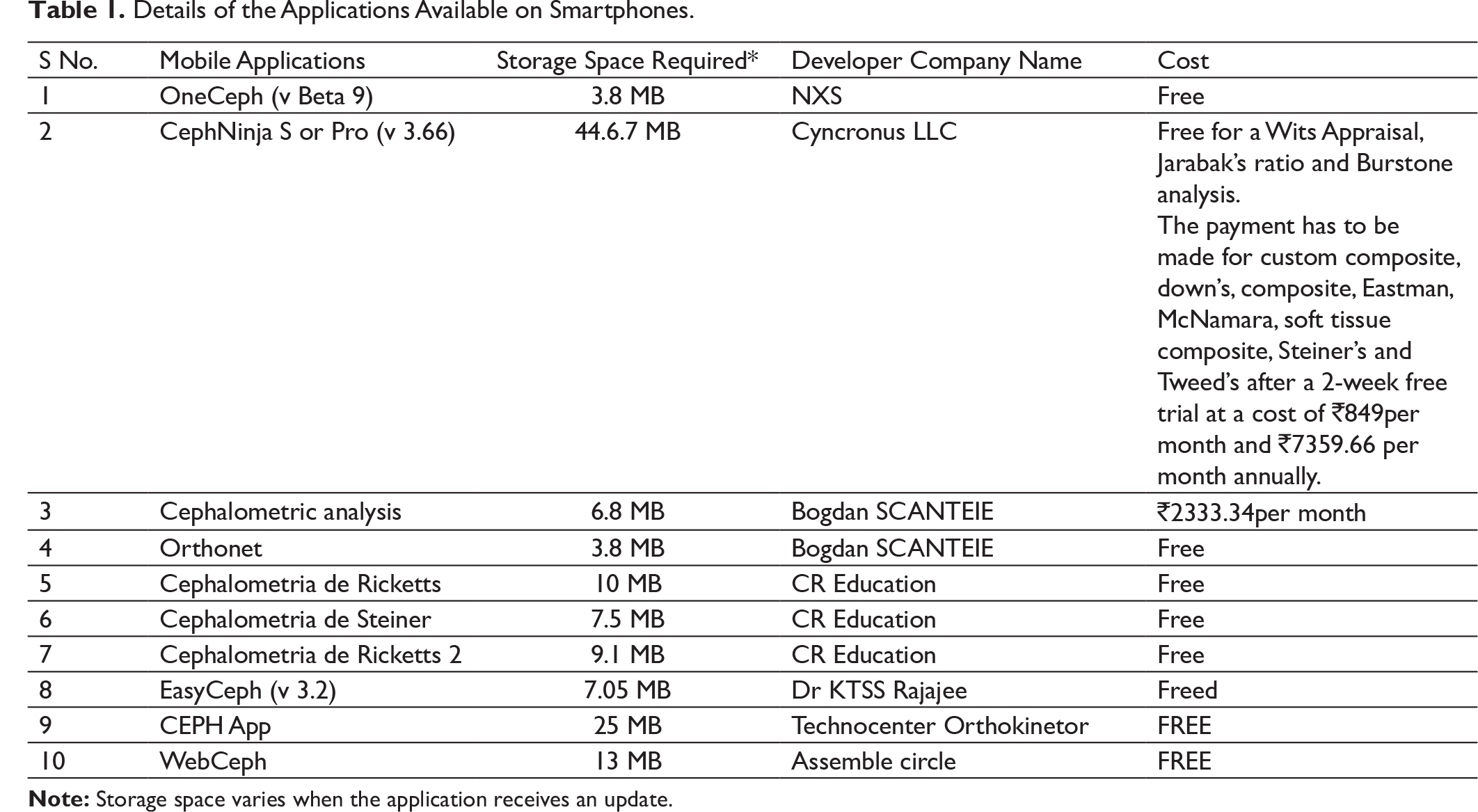
Rigorous research was performed by using keywords, and a total of 55 articles were obtained. Android and apple-based smartphones were also employed for this review. The keyword “cephalometric analysis” was typed into the “Google Play Store” or “App Store,” and a total of eight applications were found suitable for the review. Each application was downloaded and tested based on performance, cost, and ease of usage.
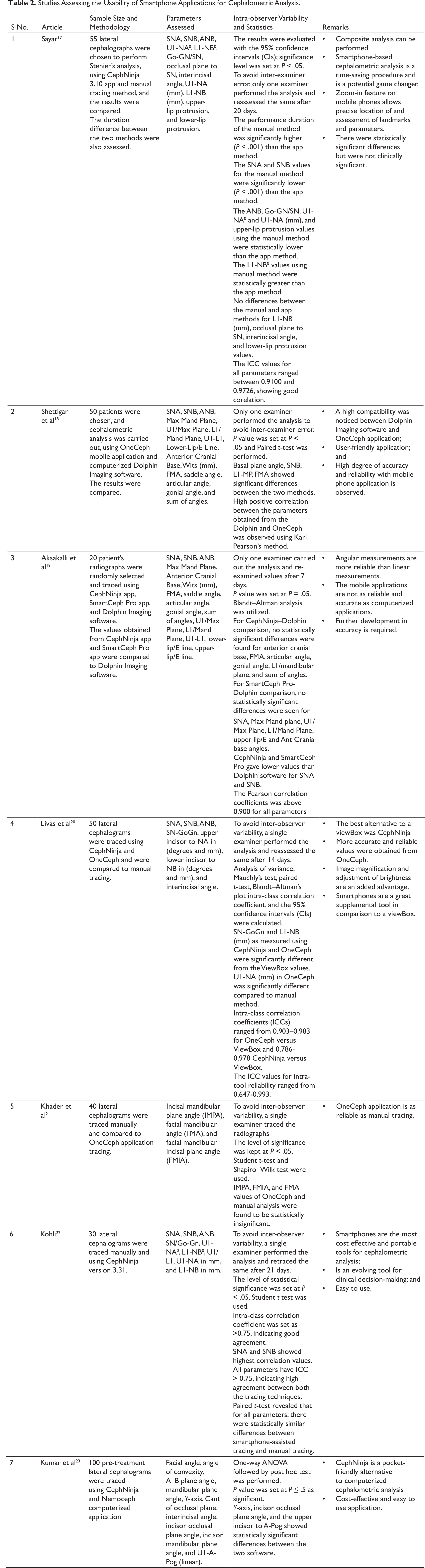
According to Pavan Kumar Mamillapalli et al., traditional cephalometric analysis is time protracting and technically demanding. So, he and his team developed an application called “OneCeph,” which provides a convenient interface with the most commonly used analyses. It is available for free and can be downloaded from Google Play Store. He said that the above-mentioned application simplifies a very complex and time-impeding task like cephalometric analysis. He also added that it provides structured reference and improves e-learning skills. 10 According to Shettigar et al. the application “One ceph” proved to be accurate in diagnosis when tested against Dolphin software. 18
According to Mayuresh Jagannath Baheti et al., the usage of smartphones has made life easy going. Both the patients and doctors are profited by this invention. 16
According to Gulsilay Sayar et al., smartphone cephalometric tracing is a fast process. They had employed “Ceph Ninja 3.10” for their study. A comparison of cephalometric analysis through Steiner’s method was made by manual tracing and by smartphone application analysis. The SNA, SNB, ANB, Go-Gn/SN, and U1-NA (in ˚ and mm) values were lower by manual tracing. Although statistically significant differences were seen, the values were clinically acceptable. They concluded that the zoom-in function helps magnify images and mark the landmarks appropriately. They also added that smartphone cephalometric analysis is a “game-changer.” 17
According to Aksakalli Hilal et al., for any application to be used, it should be safe, reliable, precise, and highly reproducible. In their study, they employed two smartphone applications “Smartceph Pro” and “CephNinja.” Cephalometric analysis was performed on the two above-mentioned applications, and the results were compared to Dolphin Imaging software—a computerized cephalometric analysis program. The results showed that Dolphin Imaging software and CephNinja had 7 measurements in common, while Dolphin and SmartCeph had 6 measurements in common. In both the smartphone applications, angular measurements had higher reliability than linear measurements. Errors in values were caused due to a lack of calibration or due to image distortion. Also, the three programs employed in the study were semi-automatic programs, which could result in a few errors. 19
Studies Assessing the Usability of Smartphone Applications for Cephalometric Analysis.
Conclusion
The results show good reliability of the smartphone cephalometric applications.
The analysis performed can be transferred via e-mail, WhatsApp, or even through Bluetooth in a matter of a few minutes.
Calibration of images before performing analysis is essential to avoid errors of magnification.
Smartphone cephalometric analysis using “OneCeph” is a time-saving procedure and can also perform composite analysis by adding the required parameters to favorites. It definitely has an upper hand for the time being, as it is free of cost and can perform unlimited cases, but it has the disadvantage of availability only on Android-based smartphones. It is the most user-friendly and accurate application, as it has a very methodological approach and also has numerous options for sharing the data.
Considering that computerized cephalometric software amounts from ₹2,00,000 to ₹4,00,000, the smartphone cephalometric applications range from free of cost to a maximum of a few thousands of rupees inclusive of in-app purchases.
CephNinja Pro is a revolutionary application, which can be downloaded only on Apple-based devices and allows not only cephalometric analysis to be performed but also provides photographic analysis and patient management features. It has a drawback of being a paid application, but the application will be launching a new artificial intelligence version, where landmarks will be marked automatically, making cephalometric analysis a cakewalk experience.
SmartCeph Pro is not reliable for Wits Appraisal.
OneCeph and CephNinja are undoubtedly the most commonly used smartphone applications
Mesh Terms
Smartphone, cephalometric analysis, orthodontics, android-based applications, Apple-based applications, free of cost, computerized cephalometric software, smartphone cephalometric software, and recent advances in cephalometric analysis.
