




Abstract

Conventional cephalometric analyses are based essentially on radiographic images of the osseous structure. As the draping soft tissues overlying these structures have a vital role in facial esthetics, many soft tissue cephalometric analyses have been introduced. However, all these analyses quantify the anterior-most limit of the projected profile. Prominence or hollowness of cheek contours is an indication of the underlying maxillary prognathism or retrognathism.1, 2 The midfacial skeletal and soft tissue discrepancies which are reflected over the contours of cheek are assessed clinically.
Cephalometric quantification of the cheek contours has been overlooked, as these are not clearly projected in lateral cephalograms. 3 Arnett’s soft tissue cephalometric analysis comprehensively explains the method to include these vital areas using clinical evaluation and via metallic markers for cephalometric evaluation. Their article describes placement of metallic markers over midfacial structures, but the entire projection of the cheek contours and the nasal base-lip contour does not get recorded by this method. 2 Photographs have the advantage of recording the cheek profile. However, the underlying skeletal structures cannot be correlated with the projected cheek profile without using special software.
Cheek profiles can be convex, flat, or concave. Proper esthetic restoration of the cheek profile would need quantification of both the soft and the hard tissue discrepancies. This article describes the use of barium sulphate paste over cheek contours and nasal base to enhance their images in lateral cephalograms. Barium sulphate is used in radiology and in cosmetics worldwide due to its safe and inert nature. Barium sulphate paste is regularly used in cephalometry as contrast media to study tongue size and position.
Method
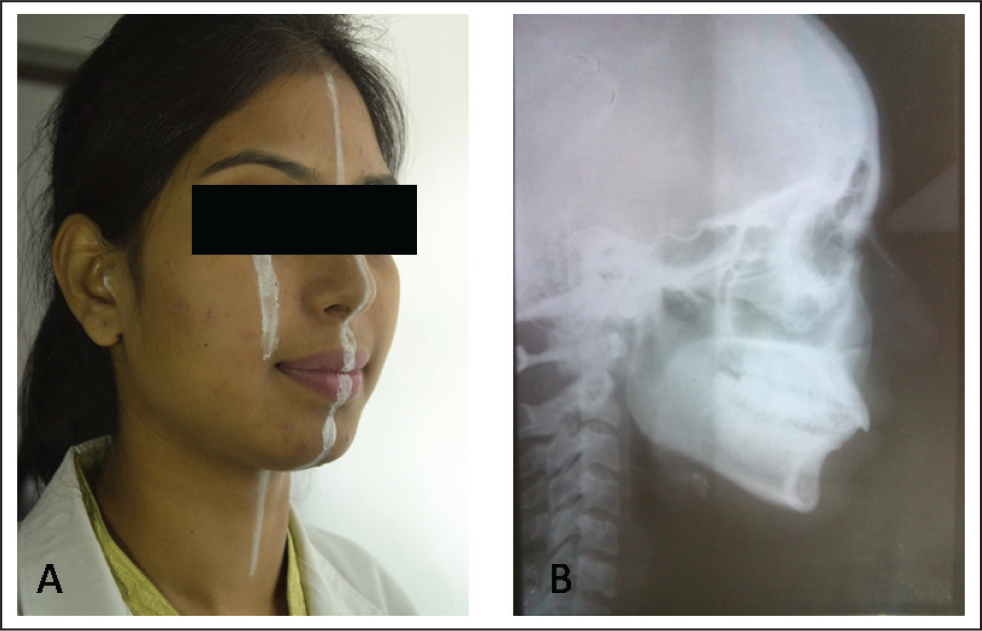
Barium sulphate powder is mixed with water to get a sufficiently thick paste of creamy consistency which does not flow and can be applied evenly over the cheek contours. Barium sulphate paste must be mixed freshly for each patient as evaporation of water would thicken the mix. This paste is applied over the facial midline and over the right cheek from just under the pupil of eye and up to the corner of mouth, as shown in Figures 1A and 2A. Care must be taken to avoid touching eyes by maintaining distance from the lower eyelid. The lateral cephalogram is obtained as per the standard method.
(A) Patient Preparation for Lateral Cephalogram (B) Lateral Cephalogram with Enhanced Cheek Contour (Note the Cheek Profile Fullness)
(A) Patient Preparation for Lateral Cephalogram (B) Lateral Cephalogram With Enhanced Cheek Contour (Note the Cheek Profile Flatness)
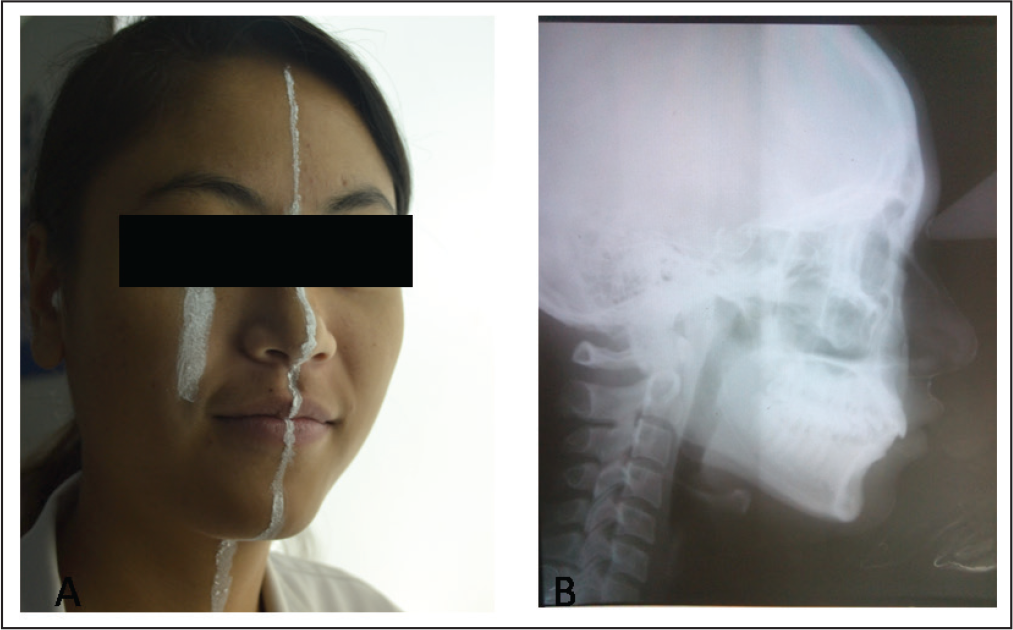
The enhanced image of the cheek profile on the procured lateral cephalograms (Figures 1B and 2B) is a useful diagnostic record. The relationship between the hard and soft tissues of the midface can be recorded and quantified on lateral cephalograms by this method, and can be used for planning cosmetic procedures to get a well-balanced face.4-6
Conclusion
Application of barium sulphate paste over soft tissue contours is an easy and economical method to improve the diagnostic value of the lateral cephalogram by enhancing soft tissue outline of cheek and nasal base-lip contour.
Statement of Informed Consent:
Written informed consent was obtained from the subject for the use of photographs for publication.
