



Abstract
Abstract
The AdvanSync2 Class II corrector is a modification of the original Herbst appliance with advantages of immediate placement in conjunction with fixed appliances. Though easy to place and activate, the molar bands have a possibility of dislodgement due to the vertical force component from the telescopic arms requiring immediate intervention from the orthodontist. An easy and reliable method to prevent molar band dislodgement is highlighted.
Introduction
The AdvanSync2 Class II corrector is the latest device for mandibular advancement in Class II malocclusions and has features similar to a miniature Herbst appliance. The main advantages of this appliance are attachments only on molars with improved esthetics and the ability to advance the mandible immediately without the need for extensive arch alignment and the use of heavy stainless steel stabilizing arch wires like in previous appliances.1, 2 Additionally, residual growth can be utilized to the optimum reducing the sagittal discrepancy rapidly with reduction in the overall treatment times and better patient motivation. 3
However, the appliance has some disadvantages like a strong vertical component of force being generated due to the piston attachments on upper and lower molars (Figure1). This could be beneficial in reducing lower incisor proclination 4 but leads to frequent loosening and dislodgement of the cemented crowns. Additionally, the hard temper of the metal used in the crowns prevents accurate contouring at the occlusal surfaces leading to gaps between the teeth and crowns, causing food entrapment, and causing risk of enamel demineralization. This is noticeable especially when there is a lack of accurate fit between the crowns and teeth due to a size mismatch since crowns are available only in 4 sizes which may not always give a good fit due to varying tooth anatomy. To overcome these inherent disadvantages, the following modifications may be carried out.
Bands Cemented with Glass Ionomer Cement
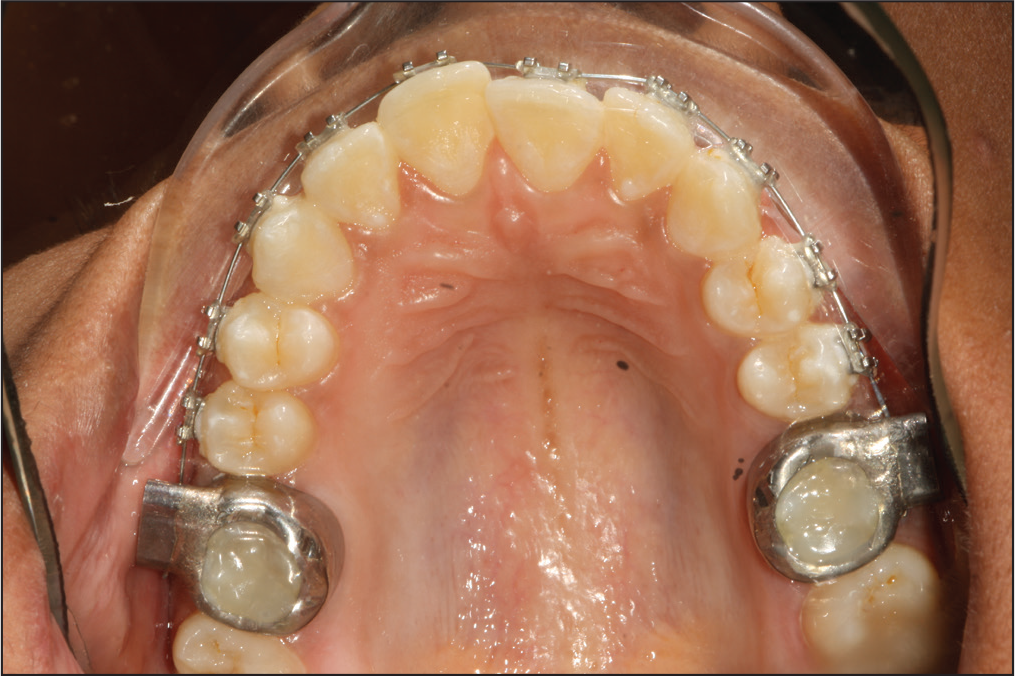
Procedure
Cement all 4 crowns with glass ionomer luting cement and carefully remove the excess from the occlusal surfaces using a sharp scaler.
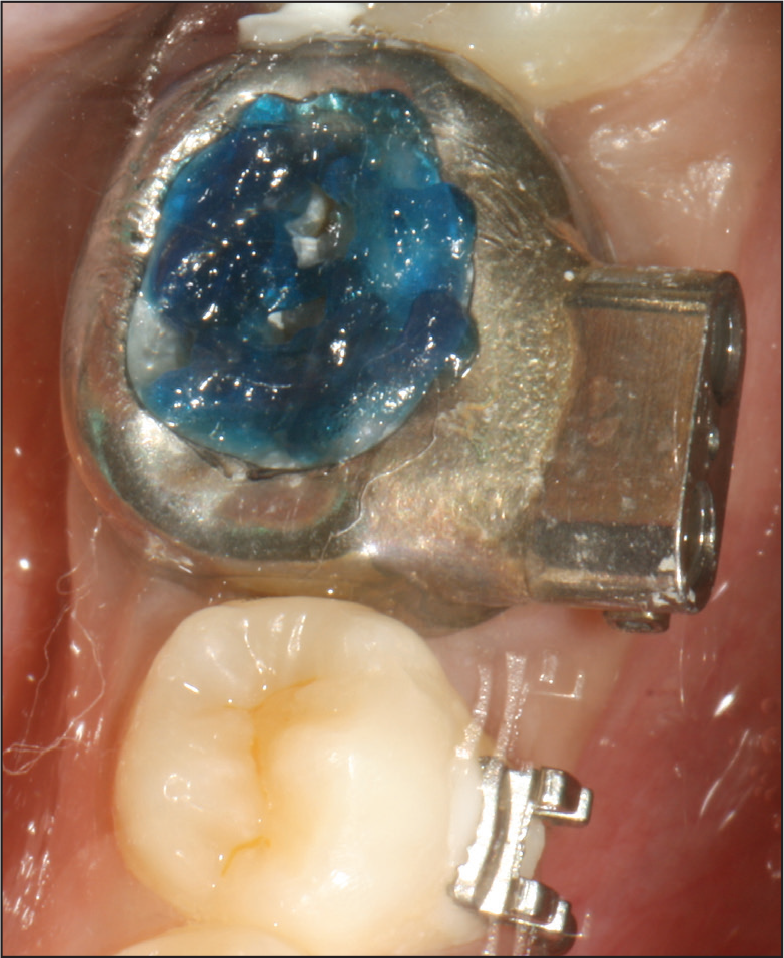
Isolate the molars, etch the complete occlusal surfaces with phosphoric acid for 5 seconds to minimize enamel damage, rinse with water, air dry, apply a thin film of bonding agent to the surfaces , and light cure each surface for 10 seconds (Figure 2). Additionally, a self-etching primer can be used in lieu of the total etch method which utilizes phosphoric acid to keep damage to enamel to the minimum.
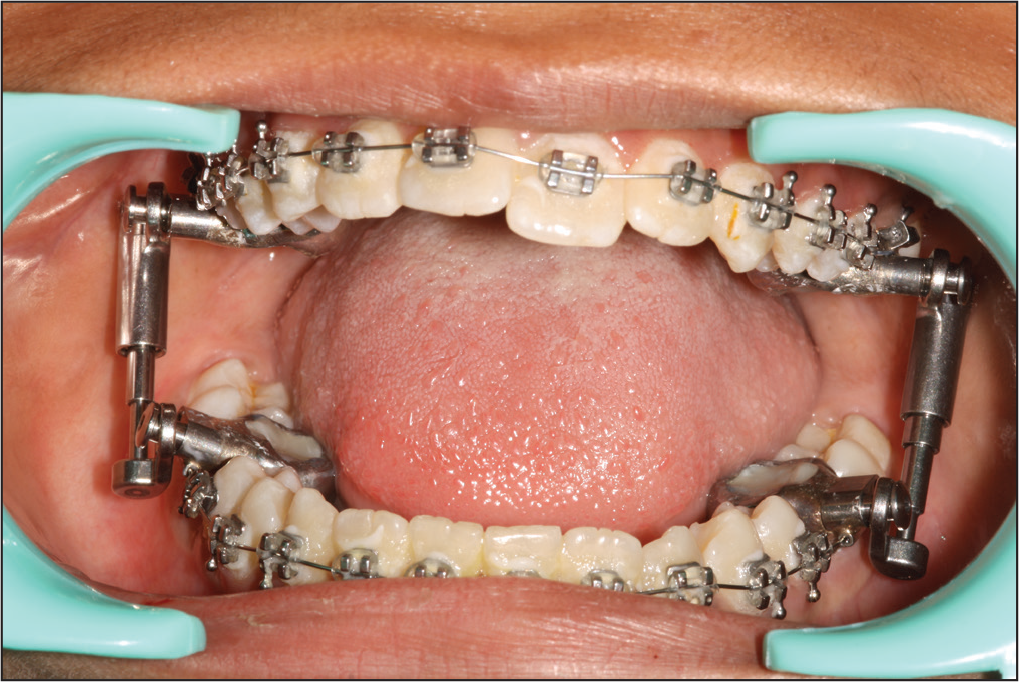
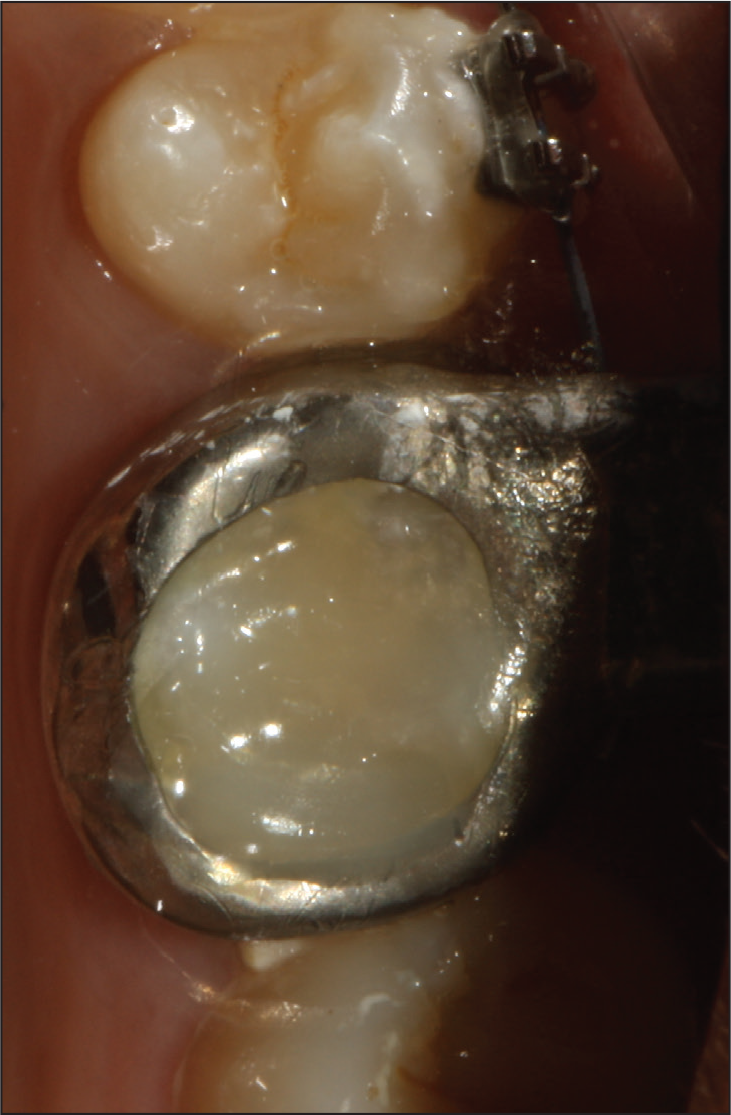
Flow a thin layer of flowable composite onto the occlusal surfaces allowing the material to completely seal all spaces between the crowns and teeth and light cure for 15 seconds (Figures 3 and 4).
The flowable composite prevents food entrapment, allows easy hygiene maintenance, and reinforces the attached crowns preventing dislodgement during use.
Since the composite is flowable with minimum filler particles, it can easily be removed from the tooth surfaces at the end of treatment using a fine air-rotor bur at low speed with copious irrigation. The occlusal surfaces can then be cleaned and polished to restore function as before. If done carefully, the procedure causes minimal enamel damage like in conventional bracket bonding which also uses acid etching to enable bonding of the composite to the tooth structure.
Flowable glass ionomer luting cement can also be used to block gaps between hard AdvanSync crowns and tooth structure. The inherent anti cariogenic properties of glass ionomer can be utilized to prevent enamel demineralization. However, as glass ionomers do not bond directly to tooth structure like composites, they may be slightly less effective in preventing crown dislodgement.
Acid Etching the Occlusal Surface
Reinforced Bands with Telescopic Arms Attached
Flowable Composite Reinforcement
Limitations
A comparative study of the failure rates of glass ionomers and flowable composites have not yet been done. Both materials are used for a short duration of time to primarily prevent inadvertent band loosening during treatment. In cases where the clinician feels the enamel quality is poor to begin with, a glass ionomer may be preferred. The extremely hard temper of the AdvanSync2 molar band results in small spaces between the band and teeth, allowing food entrapment and caries development during treatment. The glass ionomer cement and the flowable composite block all such gaps and provide rigidity to the band preventing dislodgement. At the end of treatment, glass ionomer cement can easily be removed using an ultrasound scaling tip. The flowable composite need not be removed completely, and the occlusal pits and fissures can continue to have a thin layer of composite on them acting like a pit and fissure sealant. Since the composite is flowable and does not have filler particles, it wears away with time and enamel damage is thus prevented
Footnotes
Declaration of Conflicting Interests
The author declared no potential conflicts of interest with respect to the research, authorship, and/or publication of this article.
Funding
The author received no financial support for the research, authorship, and/or publication of this article.
