




Abstract
Abstract
A number of methods are available for correcting an isolated supra-erupted molar. The most commonly used method involves using orthodontic miniscrew implants with supporting spring and elastics. This article describes a simple, non-invasive and versatile method of intrusion of the isolated supra-erupted molar. The method used provides additional benefits in not only being pain-free while providing continuous force but also being flexible enough to inculcate other design modifications to suit the patient’s need.
Introduction
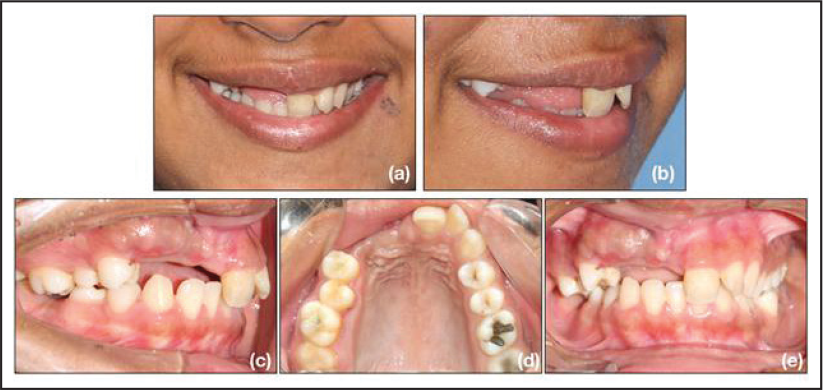
Encountering supra-erupted posterior teeth is common in adult orthodontics. The most common cause for the same is loss of opposing teeth, which requires prosthetic replacement (Figure 1a-e). However, a supra-erupted tooth presents itself with a variety of problems like anchorage control in the vertical dimension, placement of brackets, and occlusal clearance for tooth movement. Among the various treatment modalities present for the correction of supra-erupted tooth, enameloplasty and intentional root canal treatment followed by crown reduction will lead to loss of tooth structure. 1 A more conservative approach is to intrude the supra-erupted molar.
The most commonly used method to intrude the supra-erupted molar is using miniscrew implants.2, 3 Although it provides a minimally invasive treatment alternative and does not require patient compliance, it is still technique sensitive and lacks the versatility in the design to incorporate other features depending on the patient requirement. Treatment planning becomes particularly challenging when it also involves meeting the aesthetic requirement of the patient (Figure 1). This article presents a simple, non-invasive, and versatile method of fabrication of vacuum-formed appliance to perform molar intrusion.
Technique
Patient’s arch impression is made with alginate. After pouring with Type II gypsum stone, the cast is visually inspected for any severe undercuts, and if any, they are blocked out.
Additionally, acrylic teeth can be placed in edentulous areas of the cast according to the arch symmetry and stabilized with a thin layer of self-cure acrylic at the base to simulate the lost gingiva zenith.
A hard acrylic sheet (1 mm thick) is placed in the vacuum-forming orthodontic machine with the cast placed horizontally beneath the acrylic sheet.
After the fabrication of the appliance through the aforementioned method, the occlusal segment of the supra-erupted teeth is cut out using a scalpel blade (Bard Parker blade no. 11).
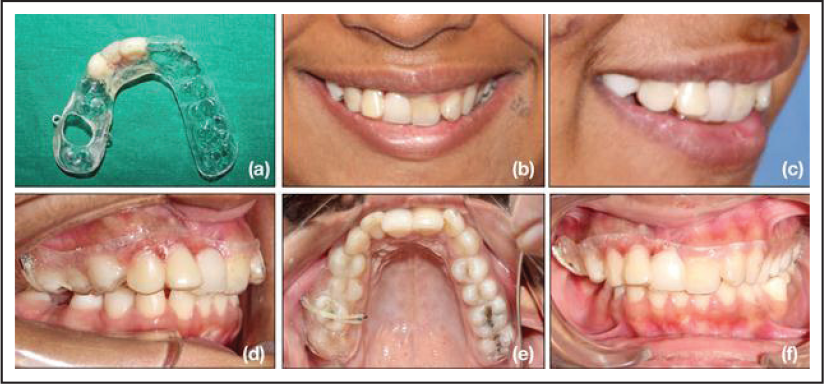
Stainless steel wires (0.16 × 0.22) or alternatively Begg’s bracket can be used to fabricate 2 hooks and place near the gingival end on the buccal and palatal side of the cut out segment of the acrylic sheet with the help of self-cure acrylic (Figure 2a).
Clinical Procedure
At the stage of carrying out molar intrusion, 1/8′′ 4.5 oz elastics are placed running from the buccal hook over to the palatal hook across the occlusal surface of the supra-erupted posterior teeth (Figure 2d-e). The vacuum-formed appliance on the other teeth provides the anchorage in the vertical dimension. The intrusive force generated by the elastic is transmitted to the supra-erupted teeth.
Patient Reporting With Missing Anterior Teeth 11, 12, and 13 and Supra-Erupted Right Maxillary First Molar (16): (a) Formal Smile View, (b) Oblique Smile View, (c) Right Lateral View With the Supra-Erupted Maxillary First Molar, (d) Occlusal View, and (e) Frontal View
(a) Vacuum-Formed Appliance Fabricated With Hooks Attached at the Buccal and Palate Side of the Cut Out Occlusal Segment of the Supra-Erupted Maxillary Right First Molar Along With the Replacement of the Missing Anterior Teeth With Acrylic Teeth, (b) Frontal Smile View With the Appliance, (c) Oblique Smile View With the Appliance, After 5 Months: (d), After Molar Intrusion With Elastics, (e) Occlusal View, and (f) Frontal View With the Appliance
Discussion
In orthodontics, aesthetic concern of the patients is an important factor during the course of planning the treatment. Presently, aligners and vacuum-formed appliances provide a suitable alternative to bring about minimal orthodontic tooth movement while providing high aesthetics.4, 5 This appliance is also versatile to inculcate other patient needs like incorporation of the missing teeth in the appliance to address the aesthetic concerns of the patient, particularly in the anterior region, till a permanent replacement can be placed.
Conclusion
Vacuum-formed appliance for intrusion of supra-erupted molar is advantageous as it is easy to fabricate and provides good stability and anchorage control in the vertical dimension. It also helps in immediate aesthetic rehabilitation before permanent replacement is provided.
Footnotes
Declaration of Conflicting Interests
The authors declared no potential conflicts of interest with respect to the research, authorship, and/or publication of this article.
Funding
The authors received no financial support for the research, authorship, and/or publication of this article.