




Abstract
Abstract
Force application through the hooks forms an integral part of sliding mechanics in orthodontics. Various methods used for intra/intermaxillary force application are expensive or require skill and time for fabrication. This article presents an innovative approach for welding hooks on the base archwire fabricated from the distal part of the archwire. It is a simple, sturdy, and inexpensive technique that does not require additional armamentarium and skill.
Introduction
Hooks are an integral part of orthodontics for intramaxillary/intermaxillary force application.1-3 Sliding mechanics 4 often require the placement of hooks mesial to canines for the retraction of anterior segment. Kobayashi hooks, soldered hooks, sturdy hooks, crimpable hooks, and pre-posted archwires are commonly used for application of elastics.
Major disadvantage of the available hooks is that prefabricated crimpable hooks are expensive, and fabrication of soldered hooks requires skill, experience, and time. The design of welded hook fabricated from the excess distal portion of the working archwire is as follows.
Fabrication
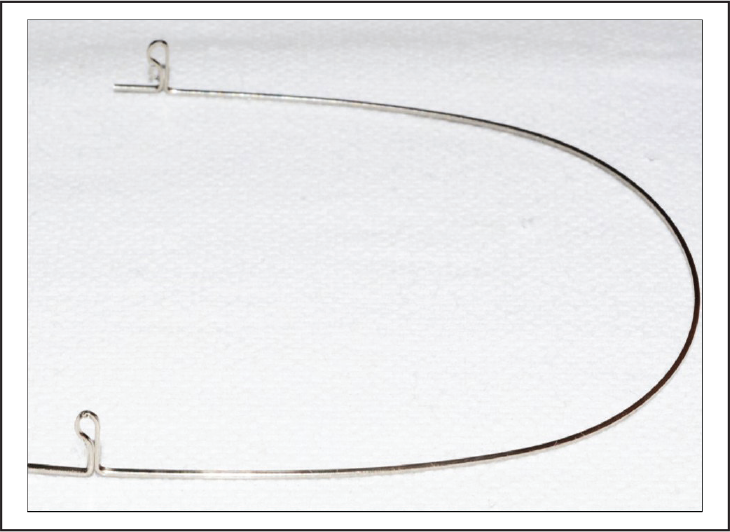
A bull loop of 2 mm diameter and 5 mm height is formed at the distal end of rectangular stainless wire, i.e., 0.021" 0.028" for (0.022" 0.028" slot) or 0.017" × 0.025" (0.018" × 0.025" slot) (Figure 1).
A 90∞ bend is made mesial and distal to bull loop so that the legs lie flat in the same horizontal plane to form a hook.
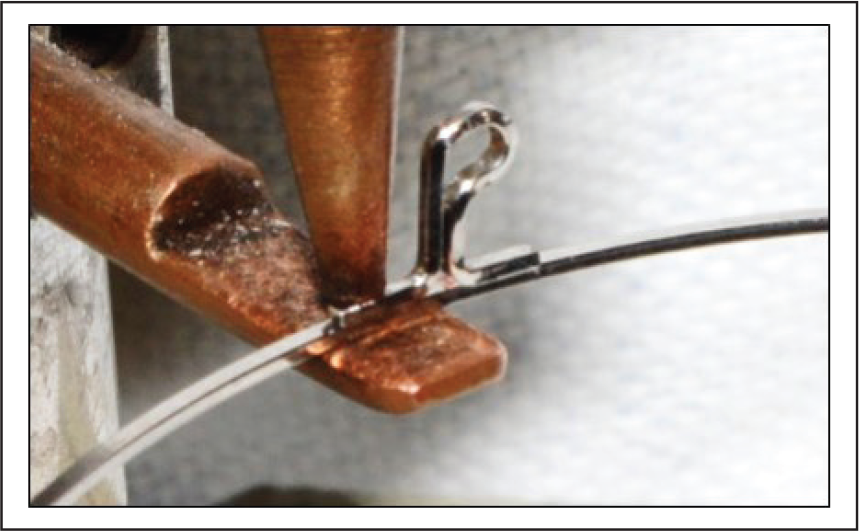
Hook is cut from the excess distal end of the archwire and welded over the working archwire between the lateral incisors and canine bilaterally (Figure 2). It is an alternate to soldered hook which has the same mesiodistal dimension as that of the welded hook. The extension should be less than the interbracket span so that it does not interfere with the engagement of the archwire.
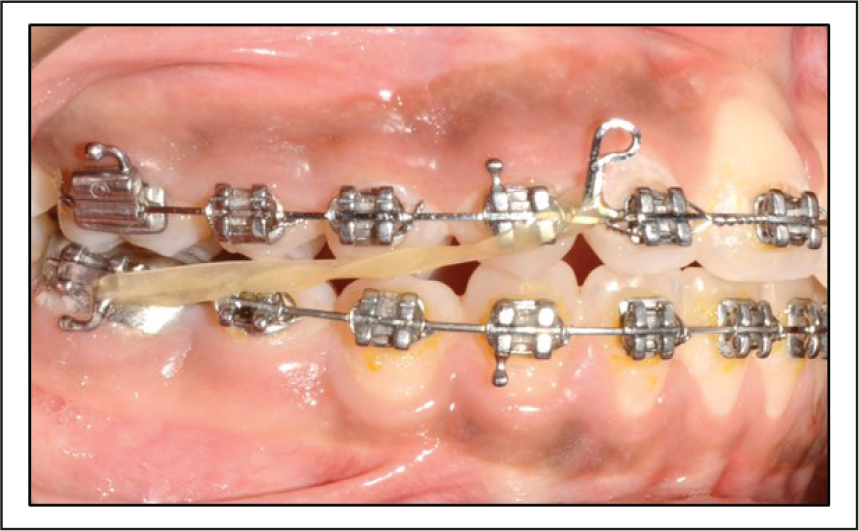
The hooks attached to archwire may be used for application of intramaxillary or intermaxillary elastics (Figure 3).
Advantage
Inexpensive, as no extra wire or solder needed for fabrication.
Adequate strength for clinical use.
Less chairside time is required.
Limitation
Needs precision for fabrication and welding, as higher welding current may anneal the base arch wire and make it non-functional.
Declaration of Conflicting Interests
The authors declared no potential conflicts of interest with respect to the research, authorship, and/or publication of this article.
Funding
The authors received no financial support for the research, authorship, and/or publication of this article.