



Abstract
Dismembered cats (Felis catus) have been found in North American schoolyards, parks, walkways, or lawns and sometimes result in local media attention. When a member of the public encounters these cats, they commonly report finding either the cranial or caudal half of a cat in a prominent location. Such findings cause public consternation and pose difficulties to investigators in identifying whether animal abuse has occurred and whether to concentrate resources on the investigation. This report describes necropsy results from 53 cats involved in such instances in the cities of Edmonton and St. Albert, Canada, from 2007 to 2016. We evaluated these results in relation to 2 hypotheses: that the dismembered cats were the result of human activity, or predation and scavenging by coyotes (Canis latrans). The main postmortem features were canine tooth wounds in the neck accompanied by tearing of the subcutaneous structures, skin avulsion, broken claws, and removal of internal organs with the colon and intestine attached to and trailing from the carcass. Based on the nature of the lesions, along with other circumstances of the deaths of the cats in this study, we concluded that these dismembered cat remains resulted from coyote predation on living cats and scavenging of the bodies of cats that died of other causes. We offer additional information to assist veterinarians, veterinary pathologists, and civic officials in identifying the probable cause of death for cat carcasses provided by members of the public.
Keywords
The remains of dismembered domestic cats are occasionally found in prominent urban locations in both Canada 3 (J. Pritchard, personal communication, 2017), and the United States 19 (M. Merck, personal communication, 2017). Such findings can alarm citizens and attract recurrent media attention. 4 Cat remains from these events are often brought to the attention of local veterinarians, who may have difficulty diagnosing the cause of death, and to animal control officers and/or police, who need to determine whether or not a crime occurred. In these situations, laymen often describe injuries to cats with phrases like “scalpel-like cuts” and “laser edges.” Once in the media, reports proliferate with ensuing speculation about possible human involvement in mutilating cats. 32 Civic authorities in these situations need to determine if the dismemberment is due to intentional human cruelty because such acts have been associated with escalating violence toward people in the forms of domestic violence or psychopathic behavior. 17 An alternative hypothesis is that dismembered cat carcasses result from predation or postmortem scavenging by urban-dwelling coyotes (Canis latrans). Coyote range has expanded over the past several decades 15 to include urban areas throughout North America. 31 Although coyotes are known predators of domestic cats, 13,16 they are also likely to scavenge animals that die of natural causes, accidental injury, or nonaccidental injury, including those buried by owners.
In the past decade, there have been several instances of cat dismemberment reported in the cities of Edmonton 18 and St. Albert, Alberta. 5 These occurrences first came to public attention in 2007 when television and print media carried reports of parts of cats being found in prominent locations in St. Albert. In response, a task force with representatives of the St. Albert Royal Canadian Mounted Police (RCMP), Edmonton City Police, Edmonton Animal Control officers, and the Alberta Society for the Prevention of Cruelty to Animals was formed to coordinate the response of authorities and to attempt to identify the individual(s) presumed to be responsible. Despite police investigation and the recovery and examination of parts of several cats, no offender was identified. In subsequent years, additional cats or parts of cats were found under similar circumstances and states of dismemberment, but again, despite the involvement of police and animal control officers, no culprit was identified.
When either entire carcasses or parts of bodies of cats were available to investigators, they were sent for postmortem examination. This article presents the results of those examinations over a 10-year period. We evaluated the observations in relation to the 2 hypotheses above: deliberate human activity or coyote predation and postmortem scavenging. Predation is defined as the preying of one animal on other live animals, whereas scavenging is to search for or consume carrion as food. 30 Many carnivores, including coyotes, use both predation and scavenging to obtain food from other animals. The findings of this study are intended to provide guidance to veterinarians in determining the cause of death and to police, bylaw officers, and humane society personnel to assess a possible criminal cause when presented with parts of a dismembered cat.
Materials and Methods
Study Area
Authorities submitted cat carcasses or their parts from the cities of Edmonton (latitude 53.63, longitude –113.32; 2017 population estimate 1 322 000) and St. Albert, a residential community adjacent to Edmonton’s northwest border (latitude 53.63, longitude –113.63, 2016 population 64 645). Land use in both urban areas included residential, industrial, and commercial development in addition to substantial areas of natural habitat within and bordering the cities. Both areas have large wooded river valleys that contain large areas of natural habitat supporting several wildlife species. These areas are dominated by aspen poplar (Populus tremuloides), balsam poplar (Populus balsamifera), and white spruce (Picea glauca) with understories that include several berry-producing shrubs. Both cities contain numerous grassy areas, both mowed and unmowed; natural parks with an interconnecting network of pathways; and off-leash dog parks.
Cats and coyotes are both prevalent in Edmonton and St. Albert. We estimate the coyote population in the city limits of Edmonton to be 500 to 1000 individuals (supported by B. Abercrombie, personal communication, 2018) and that in St. Albert to be about 50 to 100 (supported by M. Logan, personal communication, 2018). In Edmonton, reports to the city information line containing the word coyote increased from 148 in 2013 to 1446 in 2016. 11 No cases were submitted from the nearby bedroom communities of Sherwood Park, Leduc, or Spruce Grove, which are immediately east, south, and west of Edmonton, respectively.
Necropsies
The Edmonton City Police, the St. Albert RCMP, or City of Edmonton Animal Control and Bylaw officers submitted the cat carcasses described in this study to Animal Pathology Services (APS) Ltd. in Edmonton, Alberta, between January 2007 and December 2016. Necropsy reports were prepared for the investigating officers on cats or parts of cats thus received and formed part of the larger investigation file for each case. We excluded from further analysis 3 reports on cats that were submitted as the result of a criminal investigation in which a human perpetrator had been identified and had already been or was about to be charged with cruelty to animals. We then categorized the remaining case reports by findings from gross postmortem examination supplemented with information, when available, from police reports.
For each of the 53 events, date, cat breed, carcass condition, and injuries were recorded. We compared the temporal distribution of carcass recoveries against a null expectation of the mean number of reports over the 10 years of reporting and the 5 months in which they occurred annually using a chi-square test with the statistical package IBM SPSS Statistics for Windows, version 25 (SPSS, Inc., an IBM Company, Chicago, IL). When it was known or could be measured, we also recorded the location, sex, reproductive status (ie, intact vs spayed or neutered), and presence of identifying information. The first author performed a gross postmortem examination on each of the 53 whole or partial cat carcasses. Particular attention was paid to the nature of any traumatic wounds and penetrating injuries and to the characteristics of skin defects. When available, internal organs were assessed for gross evidence of preexisting disease processes. In most cases, various body parts and many internal organs were missing (Suppl. Fig. S1) or autolyzed, and it was not possible to collect a standard set of tissues for histopathologic examination. The liver was collected when available and frozen for potential toxicologic examination, but these samples were not processed.
We attempted to classify each animal by cause of death, with categories denoting probable predation, other trauma, or burial by humans. Any of these causes of death may have been followed by scavenging. We attempted to relate necropsy results to those in a study that distinguishes between motor vehicle accidents (MVAs) and nonaccidental injury (NAI), the latter being more likely to be associated with cruelty. 21 In collisions, rib fractures are rare but unilateral when they occur, and the trauma is less likely to involve the head and neck. Predator-like behavior may include lethal blows or bites to the head, especially on smaller farm species such as goat kids and lambs, 10 although scavengers of dead animals typically target posterior entry points where the skin is softer.
Results
Location and Case Characteristics
Among the 53 carcasses of cats, or parts thereof, that were submitted for postmortem examination between 2007 and 2016, 39 came from the city of Edmonton and 14 from the city of St. Albert. Police officers submitted 32 cats, civic animal control bylaw officers 14, and humane society officers 7. Police officers initially took 2 cats to veterinary clinics that subsequently forwarded the carcasses to APS. Dismembered cats were usually brought to the attention of authorities because entire cats or body parts were found in prominent locations such as walkways in natural areas, schoolyards, lawns, or front steps of private residences. Several complainants indicated they were motivated to contact police or humane societies because of the appearance of straight edges on some skin defects or the presence of trailing intestines, which they considered to be suggestive of malicious human activity.
There was a distinct temporal clustering of cases both by year and by month. No cases were seen in the years 2011, 2012, 2013, and 2015 and only 1 case in each of 2008 and 2009. Two large clusters of cases occurred in 2007 (34 cases) and 2010 (9 cases), with small clusters in each of 2014 (5 cases) and 2016 (3 cases) (Fig. 1). This pattern differs significantly from a null expectation based on the average number of cases per year (5.3 animals/year; test statistic = 185.0, df = 9, P < .0001). These events were also clustered seasonally, with all events occurring between June 17 and October 23 and almost 80% occurring in August (22 cases) and September (20 cases; Fig. 2). This pattern also differs significantly from a null expectation if cases were equally distributed across those 5 months (10.6 animals/month; test statistic = 35.4, df = 4, P < .001). The 2007 cluster was the largest and the most widely reported in local media, and all but 4 of those 34 events occurred in August and September. These occurrences began and ended abruptly for each cluster.
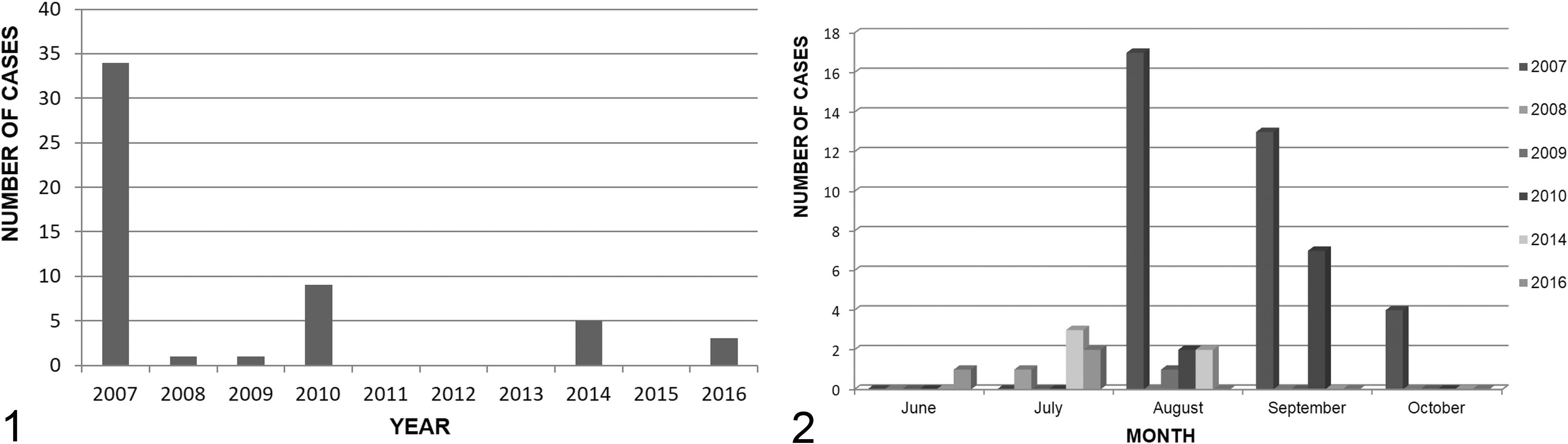
Temporal distribution of submissions of dismembered cat carcasses.
Necropsy Findings
Cats were categorized by breed as 23 Domestic Longhair, 26 Domestic Shorthair, and 4 Siamese or Siamese cross animals. Among 23 animals for which sex could be determined, 12 were neutered males, 5 were intact males, and 6 were females, 2 of which were spayed (Suppl. Fig S2). One of the 4 intact females was pregnant. One animal had a microchip, 1 had a collar with a name tag, and 4 had identification tattoos in the pinna. No attempt was made to determine the specific ages of any animals, but all were of adult size.
Most samples submitted for necropsy (37 animals, 70%) were incomplete bodies. Of the total submitted, there were 16 entire bodies, 14 cranial halves (defined as head, neck, forelimbs, and at least 3 ribs), 9 caudal ends (defined as pelvis and hindlimbs), and 14 portions (parts of cranial or caudal or both and/or internal organs) (Suppl. Fig S3). Commonly, the specimen was missing most internal organs (Fig. 3). When half a body was submitted, the vertebral column was almost always transected at or near either the thoracolumbar or the lumbosacral junctions. In all but 1 case, when either the cranial or the caudal portion of a cat was submitted, the other half could not be found by either the investigating officer or complainant. In 1 case, two halves of the same body were found and submitted at the same time. No complementary halves of 1 body were submitted at separate times, which we determined by comparing haircoat color of half bodies in relation to the locations of reports.
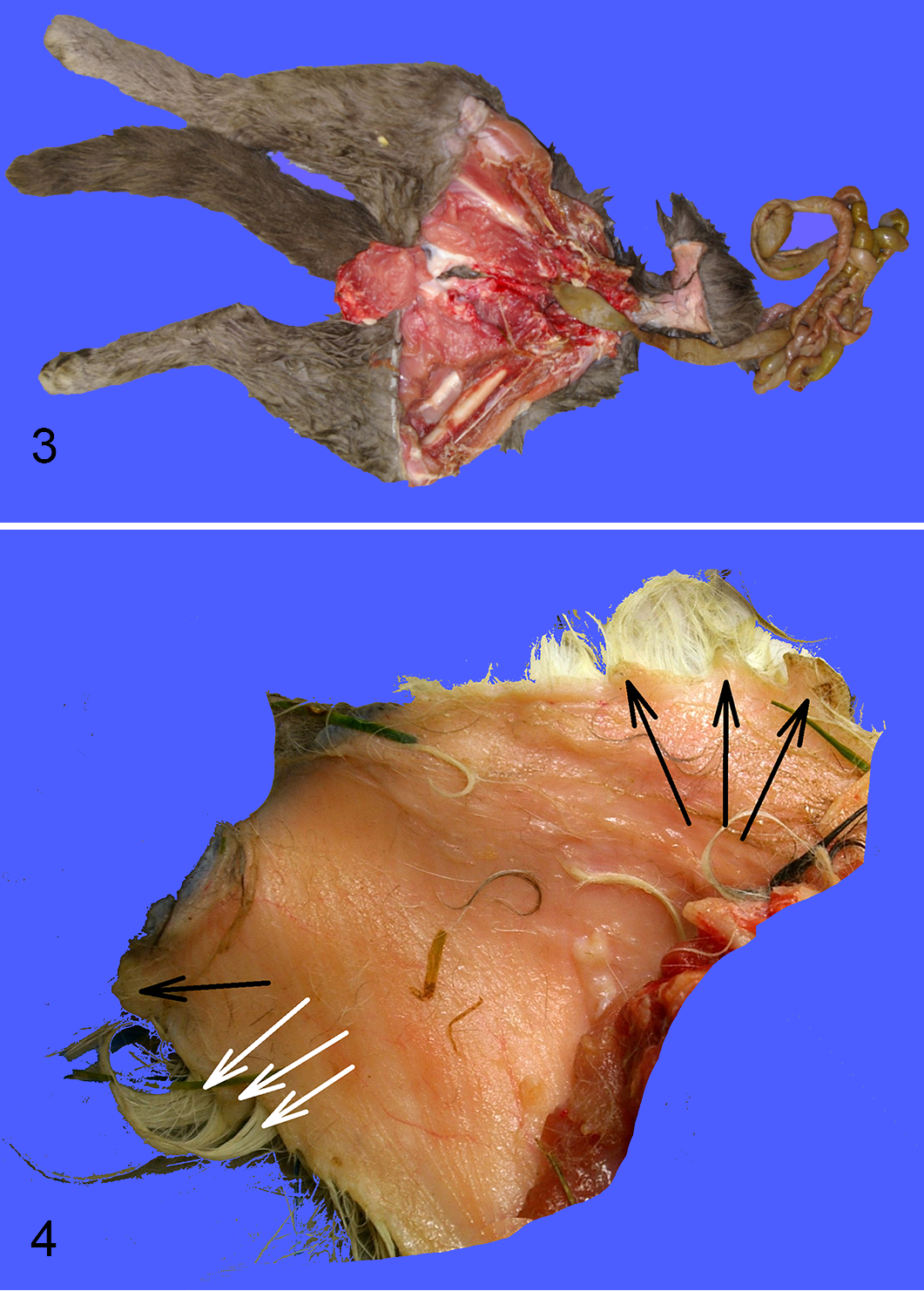
Cat, coyote predation or scavenging.
There were some features common to incomplete carcasses. The 2 most striking of these were the appearance of the intestines and colon and the edges of the skin defects. An intact length of intestine and/or colon was commonly present in partial carcasses, trailing from the carcass and entirely devoid of mesentery and mesenteric fat (Fig. 3). Each of the incomplete bodies also exhibited avulsion of the skin. Both types of defects appeared to have occurred postmortem, because there was no evidence of active bleeding along their edges or in immediately adjacent tissues. The edges of avulsed skin were irregular, often having a mammillated edge, and the edge of the epidermis and dermis was rounded. Short linear scratches in the epidermis were occasionally present, oriented approximately at right angles to the wound edges. Some animals exhibited both avulsion and areas so cleanly separated that they appeared to be caused by sharp-force incised injury. Such areas always constituted a minority (estimated at less than one-fourth) of the entire length of separated skin edges, and no animal with apparent incised skin margins lacked areas that were avulsed. Examination of the hair coat adjacent to even the most linear skin defects did not reveal any clusters of hairs that had been cleanly transected, a feature that would be expected if a sharp instrument had been used to make the wounds. Rather, a common feature was trailing of small tufts of intact hairs adhered together across the skin defect (Fig. 4). This finding is very suggestive of hairs being pulled into tufts as they slipped between the teeth of a predator/scavenger and held in that configuration by saliva.
We attempted to determine cause of death for all 53 animals, an assessment that was most accurate when either the entire carcass or the cranial half was available. In all such cases (n = 44, 83%), there was evidence of trauma that we divided into 2 categories: massive blunt trauma (8 cases, 15%) and wounds consistent with coyote predation (36 cases, 68%). The cause of blunt trauma was difficult to assess. The differences between MVA and NAI have been described, and the latter are more likely to be associated with cruelty. 21 In all 8 cases with blunt trauma, the cat had been either transected or scavenged after death. Four of these submissions were cranial halves with 7 ribs or fewer, 1 was a caudal half, 2 were intact carcasses, and 1 was a few pieces. One of the cranial halves had unilateral rib fractures consistent with the pattern described for MVA while none of the others (where ribs were available) had any rib fractures, also more consistent with MVA than NAI. Several had trauma to the head and neck, more typical of NAI than MVA, but also reported for coyote predation on smaller farm species such as goat kids and lambs. 10 The locations in which these specimens were found (eg, adjacent to roadways) was more consistent with MVA. Therefore, while equivocal, the probability lies with these cats dying due to MVA. One additional animal had trauma of uncertain origin, which might also have been due to MVA. This cat had a single blunt blow to the side of the head that was likely sufficient to either stun or kill it. Of the remaining 8 cases, the cause of death in 6 was undetermined as there was insufficient tissue to provide a diagnosis: 5 were skin and some bones with no additional tissue (Suppl. Fig. S4) and 1 was simply a very large tangled mat of cat hair. Two cases were believed to be burials of dead pets with each contained in decomposed cardboard boxes that were discovered in a ravine. Each box contained an entire cat skeleton and fur in a curled position but no additional tissue. One box also contained a cross (Suppl. Fig. S5). In summary, analysis of the necropsy reports revealed that all cases could be placed into 1 of 4 categories: coyote predation, death due to blunt trauma followed by scavenging, insufficient tissue for determination of a cause of death but with lesions consistent with coyote scavenging, and burial of pets without evidence of trauma (presumed to be natural causes).
In all of the cases we attributed to coyote predation, the skin of the head and neck was usually intact and often normal on external exam. However, dissection of the neck revealed that the underlying subcutaneous soft tissues and musculature were severely torn with irregular margins and hemorrhage and separation of the trachea, esophagus, and musculature from adjacent structures, consistent with bite wounds (Fig. 5). Puncture wounds caused by canine teeth were found in the skin over these areas of trauma (Fig. 6). Such puncture wounds occasionally occurred in pairs, but they were more commonly single. Single wounds would often have a pairing with a short linear abrasion of the skin. Skin penetrations were often easier to find from the internal (subcutaneous) side because they were typically obscured by hair on the external surface, and often there was little or no external blood. In addition to bite wounds to soft tissue structures of the neck, we found penetration and occasionally transection of the trachea and dislocation and fracture of the cervical vertebral column with trauma to and sometimes transection of the cervical spinal cord. Commonly, the trachea and esophagus were found intact but entirely separated from the ventral muscles of the neck by a large open space suggesting that canine teeth closed in the space immediately dorsal to these structures and ventral to the muscles of the cervical vertebral column. All trauma was accompanied by severe local hemorrhage. When the cat’s paws were available for examination, 23 had abraded and broken claws with separation or breaking of the keratin on the distal ends of the claws. Of these, 11 had fine gray hairs typical of the underhair of coyotes lodged between the layers of separated keratin (Fig. 7). Of the remaining 30 cases, 21 cats had normal claws, 4 were declawed, and 5 did not have claws available for examination (Fig. 8).
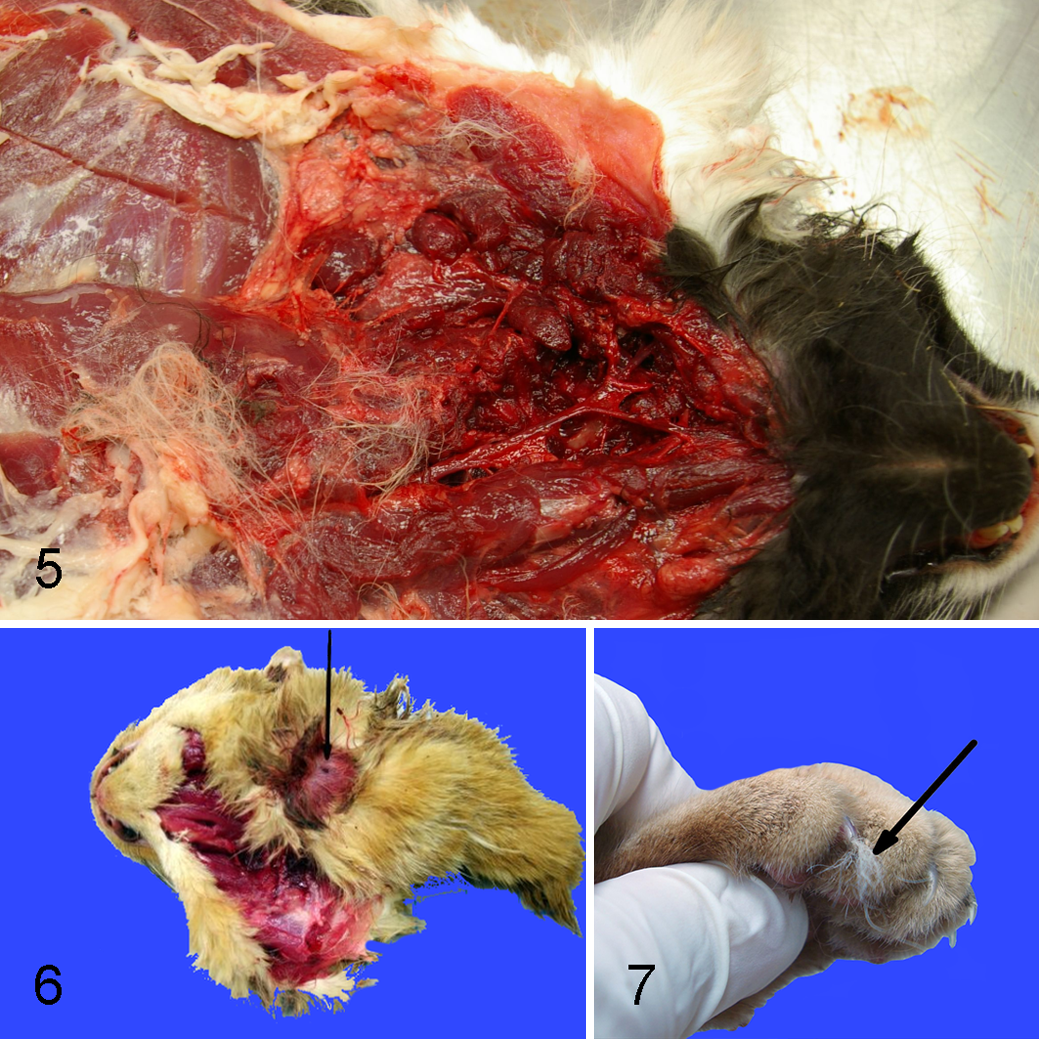
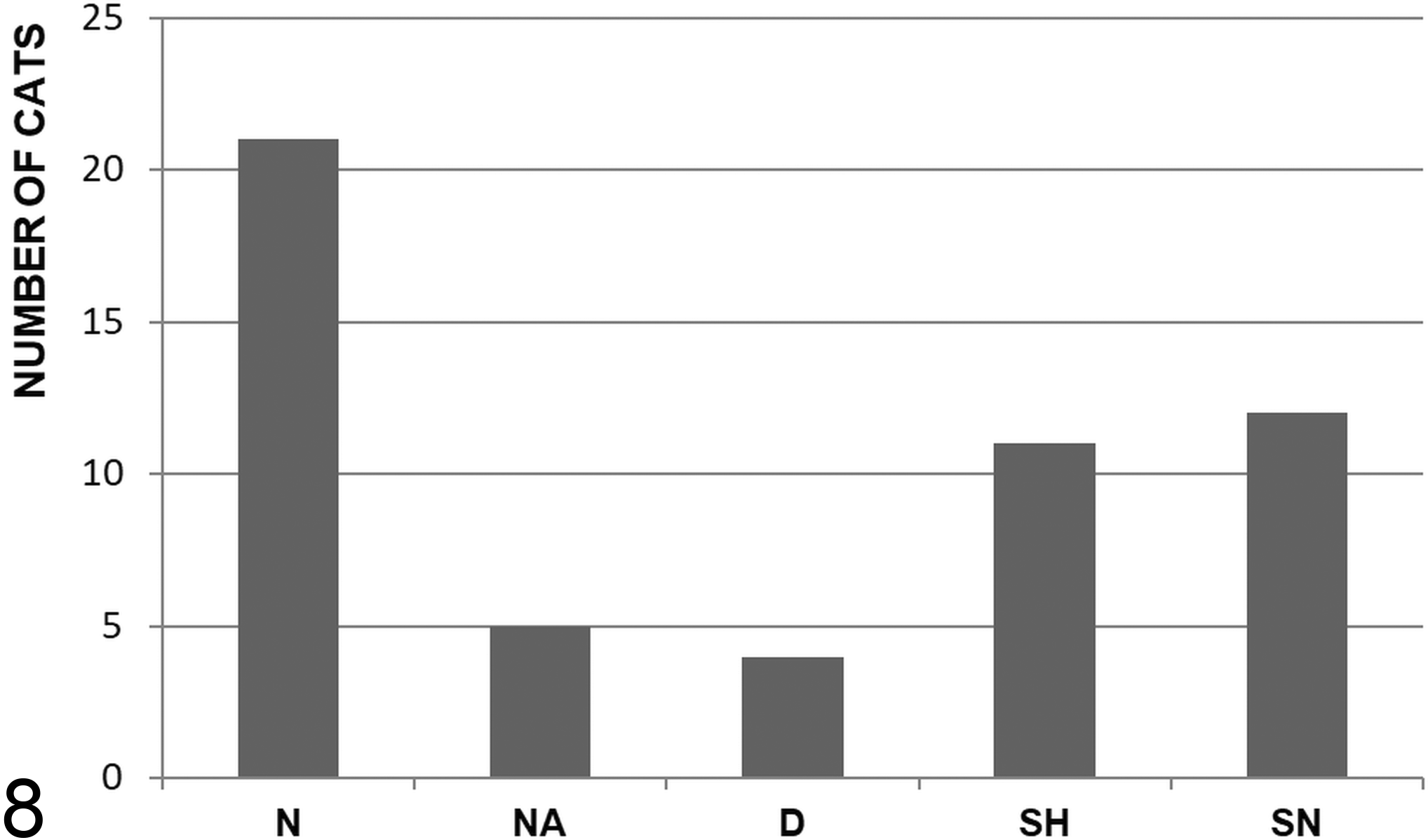
Claws of cats were often damaged and a number also had embedded gray hair, suggesting a fight with a coyote prior to death. D, cat was declawed; N, normal; NA, paws not available for examination; SH, claws split and hair entrapped; SN, claws split, no hair entrapped.
Scavenging of the internal organs was common, with 2 or more parenchymal organs (such as the lungs, liver, spleen, and kidneys) missing from most animals. Hearts were also commonly missing. Less often, the stomach, intestine, and colon were missing (Suppl. Fig. S1).
Discussion
Periodic media reports in Edmonton and other cities describe the discovery by citizens of mutilated cats and speculate that these carcasses could result from ritualistic or pathological behavior by humans. 23,29,34 These reports generally do not name an alternative hypothesis: that mutilated cats result from predation or scavenging by coyotes. Among 53 carcasses examined in this study, a majority (68%) could be directly attributed to coyote predation as a cause of death. An additional 15% appeared to be scavenged by coyotes after either being hit by a car or suffering some other trauma. The remaining 17% included pet burials and partial carcasses that had insufficient tissue remaining to determine cause of death. In no case was there any clear evidence of nonaccidental injury by humans. We think it unlikely that dogs were responsible for predation and scavenging because dogs typically exhibit more diverse locations of attack on the body, often by hamstringing their prey (crippling by traumatizing the extensor tendons of the tarsus), and typically kill but do not scavenge or consume prey. 1,2,8 Thus, we conclude that coyote predation and scavenging were responsible for most, if not all, of the cases of dismembered cat remains discovered in the Canadian cities of Edmonton and St. Albert.
Civic authorities have a duty to consider whether humans are responsible for mutilation of cats. Such activity might signal the actions of a sociopathic individual, illegal activity, or disturbing rituals, which is reason enough for the public to be encouraged to bring such cases to officials and request further investigation. These possibilities have fueled ongoing interest by both media and citizens when such events are reported. This study demonstrates the need for and benefit of systematic investigation and necropsy to generate the information required to come to an informed conclusion about seemingly disturbing events that might actually stem from coyote predation. Beyond the lack of evidence we found for such acts by humans, there is no documentation of ritualistic cat mutilation by cults in Alberta or any specific reason to think that cat mutilation is associated with cult rituals (Dr. S. Kent, personal communication, 2018). Animal sacrifice is not practiced as part of either Wicca or Satanism. Similarly, although the Afro-diasporic religions like Vodoun/Voodoo, Lucumi, and Santaria perform animal sacrifices, they use particular species, usually livestock, to honor particular goddesses and gods. There are no known groups practicing those religions in Edmonton. Furthermore, despite occasional periods of public concern, there are no articles in the scientific press on ritualistic animal abuse or killing. 24 Some people use animal bones in their private rituals, but most seem to gather them from the wild or purchase them from zoological specimen supply shops and do not use cat bones (S. Wagar, personal communication, 2018).
In contrast to the lack of evidence of ritualistic or sadistic cat mutilation, there is much circumstantial evidence to support predation by coyotes. Coyotes are well known to consume domestic cats in urban areas throughout North America. 16 Coyote scats collected in Edmonton had a 6% occurrence of cat hair, which comprised about 2% of the detected diet items. 25 If there are between 500 to 1000 coyotes in Edmonton (above), several dozen domestic cats might be consumed annually by coyotes to contribute to the annual average of 5 carcasses (or parts thereof) that were discovered by the public. Specialization on cats as prey by individual coyotes is quite plausible and may have produced the striking interannual variation in reported carcasses. Prey specialization has been reported for both coyotes 33 and cats 12 and may combine with seasonal opportunities to increase clusters of reports (below). In Edmonton, coyotes appear to vary consistently in their reliance on anthropogenic vs more natural habitat, 26 which sometimes correlates with dietary preferences and disease status, 27 and in their degree of nocturnal behavior, 28 which might further alter their overlap with cats.
Two other phenomena may have contributed to variation in the rate of carcass discoveries among years. First, the reporting might have been more clustered than was the occurrence of mutilated cats because initial media reports focused public attention 7 to increase rates of detection (ie, by searching for missing cats), reporting (when cat carcasses were found), and further media coverage. Via these effects, past media attention focused on cat mutilations 23,29,34 may have exaggerated biological pulses of activity to contribute to the sudden spike in reports in 2007. In addition to the cats reported herein from Alberta, dismembered cats have been examined by the British Columbia Veterinary Services laboratory in Abbotsford, British Columbia (S. Rafferty, personal communication, 2018); Prairie Diagnostic Services in Saskatoon, Saskatchewan (B. Wobeser, personal communication, 2018); and the Ontario Ministry of Agriculture, Food and Rural Affairs Laboratory in Guelph, Ontario (M. Spinato, personal communication, 2018). A second cause could be interannual variation in the availability of both natural and anthropogenic foods of coyotes. For example, in black bears (Ursus americanus), another generalist carnivore, reliance on human-associated food is consistently more prevalent in years of food scarcity. 22
Requests from the police for animal necropsies in Alberta increased in the past decade relative to the 3 decades prior to 2007 (P. N. Nation, personal observation, 2018). Rising awareness and reporting by the public could stem from concern for animals as well as greater recognition of the potential link between cruelty to animals and other forms of violence, such as spousal, elder, and child abuse. 6,19 Investigating clusters of suspicious animal deaths may be especially important if police are to identify individuals who are at risk for future sociopathic behavior. Rare examples of this phenomenon included Jeffrey Dahmer, who collected and mutilated dead animals before committing serial murders, 20 and Luka Magnotta, who killed kittens prior to killing and dismembering a person. 36
In addition to the pronounced clusters of cat mutilations among years, cases were also seasonally clustered between June and October, with 80% occurring in August and September. This timing corresponds with the usual period of dispersal for both coyotes and their rodent prey. 9 High availability of naive rodents and songbirds in late summer would support increased hunting activity by domestic cats, in turn increasing their vulnerability to coyotes. The fact that all cats examined were adults, not kittens, is consistent with hunting activity, as is the prevalence of male cats. In Edmonton, coyotes are active at both crepuscular periods and at night, 27 which may increase their opportunity to specialize on cats hunting rodents in late summer. Predation on cats by coyotes in late summer is also consistent with parents training their young of the year to hunt. Young coyotes that learn to hunt with easily captured domestic cats might later target them as prey.
Some additional explanation is warranted for the state of carcasses upon discovery. Often these were dismembered, including only half the animal and/or trailing intestines and colon. Each of these characteristics is potentially linked to the natural history of coyotes. The prevalence of half carcasses may have resulted from the shaking of cats after capture or tugging in opposite directions by 2 coyotes as part of play, teaching offspring to hunt, or cooperative hunting. A local trapper has directly observed 2 coyotes pulling a cat apart (B. Abercrombie, personal communication, 2017). Either shaking or play would also explain the separation of the vertebral column at its weakest points, the thoracolumbar and lumbosacral junctions, and the smooth edges of skin that were stretched while being avulsed. Shaking has been reported by other authors to explain the irregular edges that also are found on avulsed skin during scavenging by canids. 8 Necropsies also revealed that the mesenteric fat and parenchymal internal organs were often missing, which is consistent with their high caloric value to predators. 37 Removal of these components by coyotes would necessarily have contributed to the observation that the cat’s intestines were trailing from its body. The pattern of scavenging seen on cats is similar to that reported for outdoor feeding patterns of canids on human bodies and animal bodies used as proxies for humans: initial feeding begins with the soft tissues of the abdomen and chest prior to any feeding on the limbs or other structures. 10
The nature of cat predation by coyotes may also explain why cats were so often found in prominent locations. Presumably, each animal involved in a tug-of-war would gain the half of the cat that they held, potentially dropping it later if the coyote was disturbed by humans. Such disturbance might have been more likely near ravine paths and school yards where several animals were found. Deposition in other prominent locations may have resulted from a cat being chased by coyotes toward its home (eg, front yards and porches) or ambushed by coyotes at places where natural and residential habitat overlapped (eg, walkway or ravine paths). In addition, coyotes may have sought places near people to consume prey where they were secure from more dominant coyotes. 35 This speculation is supported by an anecdotal discovery of a coyote-killed jackrabbit (Lepus townsendii) on a neighbor’s porch (P. N. Nation, personal observation, 2018; Suppl. Figs. S6, S7).
Many of the specific strategies of urban coyotes may await description. Prior work on coyotes in Alberta demonstrated that urban coyotes have more diverse diets than rural animals and that urban animals vary in their use of residential habitat. 25 High use of residential habitat and anthropogenic food seems to correlate with both conflict behavior with humans and disease exposure for coyotes. 25,26 Deposition of partial cats, like other behaviors by urban-exploiting wildlife, is more likely to be observed by people in locations frequented by people, biasing reports to seemingly prominent locations.
Additional information could have been obtained from the necropsies in this and similar future investigations, but the associated costs may not be warranted. Additional investigations could have included radiographs to characterize injuries more thoroughly, histopathology to rule out disease, and DNA sequence analysis of hairs caught in cat claws to more definitively identify coyotes as predators rather than scavengers.
In summary, we conducted necropsies on 53 cat carcasses that were discovered by the public, usually dismembered, and often deposited in prominent locations. We used this information to evaluate 2 hypotheses: that the cats had been killed and mutilated by humans or that they resulted from predation or scavenging by coyotes. The evidence was overwhelmingly in support of predation and scavenging by coyotes. Public reporting of dismembered cats is likely to rise in future owing to the documented increases of both coyote 15 and feral cat populations in cities throughout North America. 14 Thus, we list here some information to assist police, animal control officers, veterinarians, and veterinary pathologists to more readily determine cause of death for future presentations of cat carcasses. Such investigations should begin by looking for evidence of bite wounds or blunt (eg, vehicle) trauma. Careful dissection of the head and neck is a requirement for assessing whether or not a predator kill has occurred. Coyote predation typically causes massive trauma to the soft tissues of the neck but little evidence of external trauma at the site of the fatal neck lesions. Canine tooth puncture marks in the skin are often more easily identified from the subcutaneous side. The claws of cats killed by coyotes may be split at the ends and may have tufts of fine gray (coyote) hair caught between frayed strands of keratin. Additional signs of coyote predation include tufting of intact hairs along the edges of wounds and pieces of intestine and colon trailing from the carcass that have been cleanly stripped of mesentery and fat. We suggest that only if none of these features are present would dismembered cats warrant further investigation as a potential criminal activity by humans.
Supplemental Material
Supplemental Material, DS1_VET_10.1177_0300985818809128 - A Forensic Pathology Investigation of Dismembered Domestic Cats: Coyotes or Cults?
Supplemental Material, DS1_VET_10.1177_0300985818809128 for A Forensic Pathology Investigation of Dismembered Domestic Cats: Coyotes or Cults? by P. Nick Nation and Colleen Cassady St. Clair in Veterinary Pathology
Footnotes
Acknowledgements
We thank Cst. A. Paradis, RCMP Detachment, St. Albert, Alberta, and Detectives B. Bowen and C. Bombier, Edmonton Police Service, Edmonton, Alberta, and their constables, as well as animal health technologists Laura Elliott and Nancy Perrin of Alberta Agriculture and Forestry. We appreciate use of observations of coyote-cat interactions by B. Abercrombie (Animal Damage Control). B. Abercrombie and Melissa Logan (City of St. Albert) supported our own estimates of coyote population sizes in Edmonton and St. Albert, respectively. S. Wagar, Wiccan Chaplain at the University of Alberta, and Dr. S. Kent, Department of Sociology, University of Alberta, provided information about cults, religious use of animals, and ritualistic sacrifice.
Declaration of Conflicting Interests
The author(s) declared no potential conflicts of interest with respect to the research, authorship, and/or publication of this article.
Funding
The author(s) received no financial support for the research, authorship, and/or publication of this article.
Supplemental material for this article is available online.
References
Supplementary Material
Please find the following supplemental material available below.
For Open Access articles published under a Creative Commons License, all supplemental material carries the same license as the article it is associated with.
For non-Open Access articles published, all supplemental material carries a non-exclusive license, and permission requests for re-use of supplemental material or any part of supplemental material shall be sent directly to the copyright owner as specified in the copyright notice associated with the article.
