




Abstract
When veterinary pathologists testify as expert witnesses in animal cruelty trials, they may find themselves in an intimidating and unfamiliar environment. The legal rules are clouded in mystery, the lawyers dwell on mundane details, and the witness’s words are extracted with precision by a verbal scalpel. An unprepared expert witness can feel ungrounded and stripped of confidence. The goal of this article is to lift the veil of mystery and give the veterinary pathologist the tools to be a knowledgeable and confident expert witness before and during testimony. This article discusses the types of expert witnesses, disclosure requirements and the importance of a good report, the legal basics of expert testimony, and how to be an effective expert witness. The article references Minnesota law; however, the laws are similar in most jurisdictions and based on the same constitutional requirements, and the concepts presented are applicable in nearly every courtroom.1
Keywords
Types of Expert Witnesses
Expert witnesses fall into 3 categories: fact expert, opinion expert, and consulting expert. 2 A veterinary expert is a fact witness if he or she has direct and firsthand knowledge of the individuals in the case or the incident. 3 For instance, if a veterinary expert was the first on the scene at a location of suspected animal cruelty, then he or she is a fact expert, because of direct observations of the scene of the crime.
An opinion expert is a veterinary expert who is qualified to offer an opinion based on education and experience. For example, a veterinary pathologist may offer an opinion about the cause of death of an animal based on laboratory results, reports, and opinions of other experts and postmortem examination.
A consulting expert is a veterinary expert hired by one of the litigants to aid in analyzing or evaluating a case. The consulting expert may or may not testify. Consulting experts are uncommon in criminal animal cruelty cases.
In animal cruelty cases, a veterinary pathologist often testifies as both the fact and opinion expert. In other words, the expert has firsthand knowledge based on personal examinations and observations but is able to offer an opinion based on education and experience. 4
Disclosure Requirements and the Importance of a Good Report
If a veterinary pathologist testifies for the state 5 in an animal cruelty trial, the state must provide the defense “a written summary of the subject matter of the expert’s testimony, along with any findings, opinions, or conclusions the expert will give, the basis for them, and the expert’s qualifications.” 6 The state must also provide the defense with reports of examinations, experiments, and scientific tests. 7 Likewise, if the defense hires an expert, they must disclose the same materials to the state. 8 The disclosure requirements gives each side time to study the opposing expert’s materials, prepare for cross-examination, and find weaknesses in the expert’s results.
If an expert’s findings, opinions, conclusions, results, or other materials are used as evidence in a criminal trial, that expert must testify. Simply submitting a report into evidence without testimony violates the defendant’s right to confrontation and has been repeatedly held impermissible by the United States Supreme Court and state courts. 9 In other words, if a veterinary pathologist provides any sort of expertise during an animal cruelty investigation, he or she can expect to be called to the witness stand if a case proceeds to trial. The rare exception is if a veterinary pathologist is hired as a consulting expert during case preparation simply to help the state prepare its case and is providing no testimony or evidence. 10
The disclosure requirement highlights the necessity for a good report. Whether a case goes to trial is based on a calculation of risk, especially by the defense. For instance, a defense attorney or his or her consulting expert will review a veterinary pathologist’s report from the state prior to determining whether to go to trial. If they find that the report is thorough, reasonable, and objective, they may conclude that trial is too risky and convince their client to plead guilty based on the strength of that report and the state’s expert. If they find that the report is biased, unprofessional, or lacking in detail or a discussion of alternative theories, they may find trial an acceptable risk given the numerous holes that can be exploited in that report. In other words, spending the time to write a clear, professional, objective, and thorough report will lessen the chance that a veterinary pathologist will have to spend a considerable amount of time testifying and preparing for court.
The Legal Basics of Expert Testimony
Rule 702 of the Minnesota Rules of Evidence is the gateway rule that permits expert testimony in certain circumstances (the rule is similar to the rule used in other jurisdictions). The rule states the following: If scientific, technical, or other specialized knowledge will assist the trier of fact
11
to understand the evidence or to determine a fact in issue, a witness qualified as an expert by knowledge, skill, experience, training, or education, may testify thereto in the form of an opinion or otherwise. The opinion must have foundational reliability. In addition, if the opinion or evidence involves novel scientific theory, the proponent must establish that the underlying scientific evidence is generally accepted in the relevant scientific community.
Compared with lay witnesses, expert witnesses have more flexibility in the courtroom. Lay witnesses are typically prohibited from offering opinions or may only offer opinions in limited circumstances. 15 Expert witnesses may offer an opinion on the ultimate issue to be decided by the trier of fact. 16 Lay witnesses are also typically prohibited from “lecturing” or offering broad explanations. 17 Expert witnesses also bring authority. Therefore, given the additional powers of an expert witness, a threshold must be met before they are allowed to testify.
The Threshold for Expert Testimony
Before a veterinary pathologist’s expert testimony is allowed in a trial, the judge must make 3 preliminary determinations: (1) Is the subject matter of the testimony outside the realm of common knowledge so that expert testimony can assist the trier of fact in reaching its decisions? (2) Does the expert, by way of education or experience, possess sufficient expertise or specialized knowledge so that opinions on this subject matter can assist the trier of fact? and (3) Is the foundation for the opinion sound so that the opinion can assist the trier of fact?
18
Assisting the trier of fact
Judges will allow veterinary expert testimony when it assists the trier of fact. 19 According to the Minnesota Supreme Court, “A reasonable test to be applied is whether the members of the jury, having the knowledge and general experience common to every member of the community would be aided in the consideration of the issues by the offered testimony.” 20 The court also noted, “We think … that such evidence should be received only where the subject matter is complicated or its operation difficult and embracing matters either in construction or operation not of common knowledge.” 21 In other words, if the testimony relates to matters of common knowledge, it will be of no use to a jury. 22
Expert testimony from a veterinary pathologist will typically meet this threshold, especially in animal cruelty cases. 23 Under Minnesota law, animal cruelty “means every act, omission, or neglect which causes or permits unnecessary or unjustifiable pain, suffering, or death.” 24 Veterinary pathologists have the medical training to describe to a jury how an act, omission, or neglect affected a particular animal or produced unjustifiable pain, suffering, or death. Such matters are outside the scope of common knowledge, especially considering that animals cannot verbally describe the act, omission or neglect, and its effect.
Furthermore, expert opinions are valuable in animal cruelty cases because penalties in Minnesota and other jurisdictions are based on level of harm. For instance, if the animal cruelty caused great bodily harm or death, the crime is a felony. 25 “‘Great bodily harm’ means bodily injury which creates a high probability of death, or which causes serious permanent disfigurement, or which causes a permanent or protracted loss or impairment of the function of any bodily member or organ, or other serious bodily harm to a service animal or a pet or companion animal.” 26 If the act caused substantial bodily harm, the crime is a gross misdemeanor. 27 “‘Substantial bodily harm’ means bodily injury which involves a temporary but substantial disfigurement, or which causes a temporary but substantial loss or impairment of the function of any bodily member or organ, or which causes a fracture of any bodily member to a service animal or a pet or companion animal.” 28 Expert veterinary testimony, especially from a veterinary pathologist, is necessary in determining the difference between a gross misdemeanor or felony based on level of harm and a cause of death.
Expert testimony in animal cruelty cases is also helpful with other aspects of proving the crime. For instance, the state has to prove that the act of cruelty was intentional. A veterinary expert may distinguish between intentional acts and accidental acts. 29 An expert may also link injuries to a weapon or suspect, or offer an opinion on how acts could have reasonably been prevented. 30
Qualifications of an expert
Before an attorney can obtain expert opinions from a veterinary pathologist, he or she must elicit evidence or statements from the expert to distinguish the expert from a lay witness. Although education, training, and knowledge are factors under Rule 702, courts have often viewed practical experience as the most important qualification. 31 The determination is whether the witness’s “knowledge of the matter in relation to which his opinion is sought is such that it will probably aid the trier of the question to determine the truth.” 32
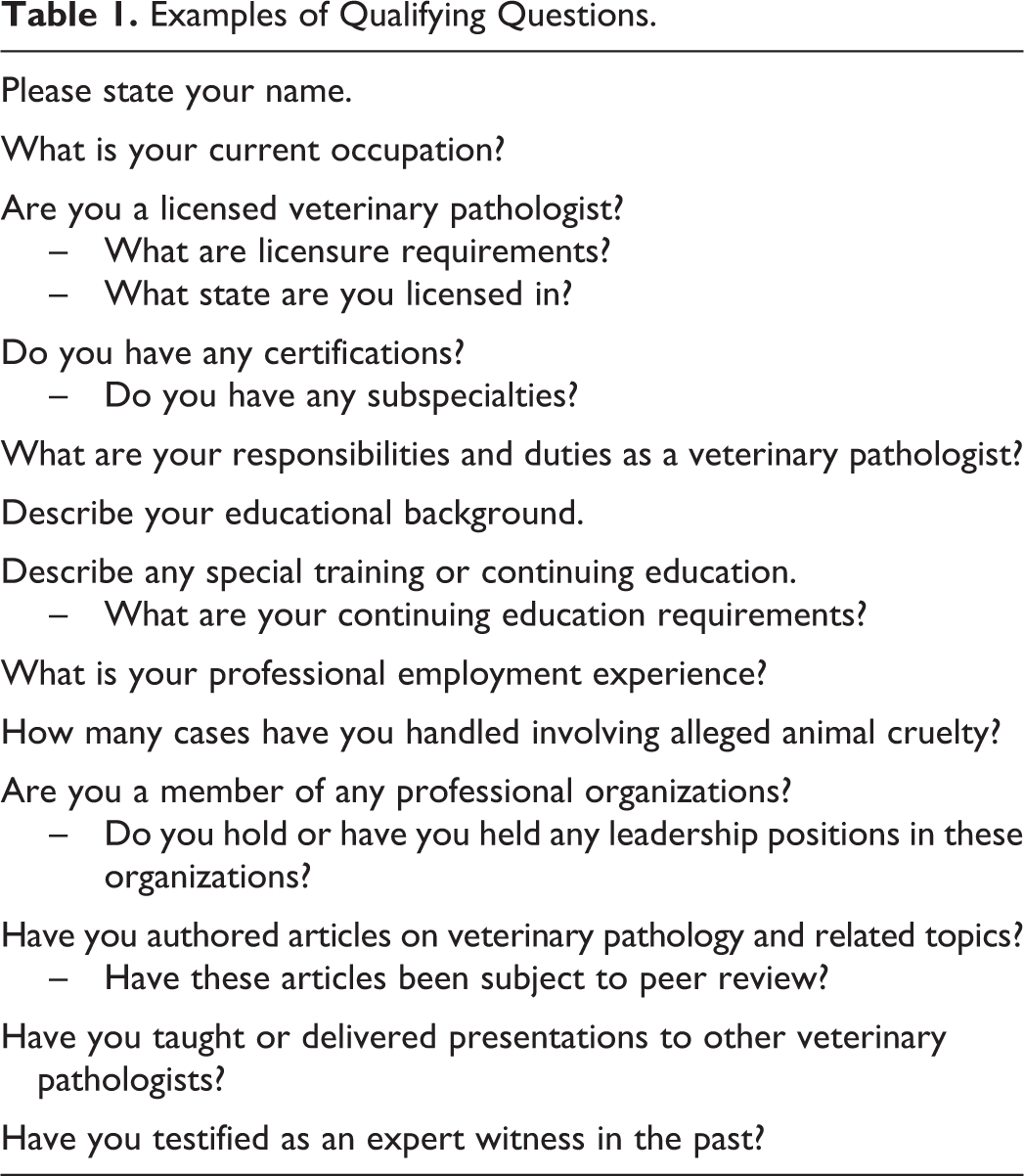
Sometimes, the lawyers are able to stipulate that a witness is qualified as an expert. In most cases, however, the proponent of the expert has to lay a foundation with testimony from the witness. In general, a veterinary pathologist called as an expert witness should be able to discuss his or her education, licensure requirements, occupation, past employment, duties and responsibilities, internships, number of similar cases, membership and leadership in professional organizations, professional lectures and presentations, professional publications, and awards and recognitions. Table 1 contains examples of qualifying questions. A good practice point is for a witness to explain the minimum qualifications in his or her field and then explain how he or she exceeds those qualifications. 33
Examples of Qualifying Questions.
Foundation for the expert opinion
The facts or data establishing an expert opinion must be sufficient for an adequate foundation. 34 This determination is subject to a 2-part test: “1. are these facts and data of a type relied upon by experts in this field when forming inferences or opinions on the subject; 2. is this reliance reasonable?” 35 These requirements provide “a check on the trustworthiness of the opinion and its foundation.” 36 Basically, the judge has to be satisfied that the facts or data the expert is using as the basis of his or her opinion are trustworthy and help guarantee the validity of the opinion. 37 An expert may rely on facts or data that are inadmissible in evidence, such as hearsay, “including conversations with other expert witnesses, professional literature, personal observations, or lectures.” 38
With regard to reliability of the opinion with medical experts, Minnesota courts are flexible and defer to the expertise of the expert. 39 The Minnesota Supreme Court has noted that “it is not necessary that medical opinion be capable of demonstration or that an expert speak with confidence excluding all doubt; it is enough that he state his opinion as true in his judgment.” 40
When the proponent establishes the basis for a veterinary pathologist as an expert, that expert should be able to explain the facts and data underlying the opinion and describe how it is customary to rely on those facts and data in the field. For example, a veterinary pathologist should be able to explain how he or she would typically diagnose a disease, how the diagnosis relies on the findings of other individuals such as laboratory technicians, and the reasonableness of relying on personal observations, education, experience, and scientific literature.
Novel Scientific Evidence
Scientific principles and tests evolve over time, and what was once accepted is often replaced by a new standard. A large amount of case law has developed over the concept of when “novel” scientific evidence moves from the realm of experimental to the acceptable. 41 To define the threshold into acceptance for novel scientific evidence, the court undertakes a different analysis for admissibility. The analysis is typically conducted at a separate hearing where the proponent has to establish that the novel scientific evidence is generally accepted in the relevant scientific community and that scientists deem it to be reliable. 42
The point at which a court undertakes the analysis is confusing to judges because it may involve an initial determination of whether the evidence is novel or whether the foundation should simply be scrutinized. 43 A good expert witness should be able to clarify the distinction. Otherwise, these hearings are expensive and time-consuming. 44 Hearings typically involve testimony from numerous experts because of the requirement to gauge acceptance in the “scientific community” and whether that community deems it reliable. Opinions often widely differ. As an example, a veterinary pathologist would have to be able to describe community-wide acceptance of the novel scientific evidence and help the proponent produce other witnesses that share that viewpoint. In addition, the veterinary pathologist will have to be prepared to discuss why and how the novel scientific evidence gained reliability and acceptance.
How to Be an Effective Expert Witness
Understanding Your Audience: The Jury
In jury trials, the trier of fact is the jury. An effective expert witness understands the science behind jury decision making and can tailor his or her communication style to the jury.
Prior to the start of trial, the parties undergo jury selection. In Minnesota, jurors are chosen from a list of registered voters and licensed drivers. 45 Jury selection is conducted via a process of elimination from the jury pool. For instance, each side is given a number of preemptory strikes, 46 and the court may strike an unlimited number of prospective jurors for cause. 47 Lawyers on each side have an idea of the type of juror they want and can guess the type of juror the other side wants. For instance, prosecutors will use preemptory strikes to remove jurors favorable to the defense, and the defense will use preemptory strikes to remove jurors favorable to the state. The panel left after the strikes often represents a typical cross section of the population.
Decades of social science and jury research “has shown that most people are affective, not cognitive, thinkers.” 48 “Most people are emotional, symbol oriented, selective perceivers of information who base their decisions largely on previously held attitudes about people and events.” 49 The typical person is also a deductive reasoner—using only a few premises to arrive at a decision and then accepting, rejecting, or distorting “other information to fit their already determined conclusions.” 50 In contrast, a scientific expert witness is a cognitive thinker—basing decisions on evaluation, synthesis, and analysis. Given a jury panel with a typical cross section of the population who will most like be affective thinkers, veterinary pathologists who are typically cognitive thinkers need to understand how to bridge that chasm between affective thinkers and cognitive thinkers.
A way to bridge that chasm is for veterinary pathologists to think of themselves as teachers. 51 Consider ways to take complicated testimony and make it simple and interesting for the students (the jurors). 52 A good exercise is for the expert witness to think back on his or her best teachers and what qualities made them good teachers. 53 Consider the ways in which those teachers made learning fun and understandable, and translate them into the testimony. 54 Veterinary pathologists should also employ different ways to get across the testimony, including visual aids. 55 Expert witnesses should delve into the natural enthusiasm and passion they have for their subjects. This is veterinary pathologists’ chance to discuss and share an area that they love and have spent years mastering. That enthusiasm will be noticed and appreciated by jurors, and it makes the expert likeable (likeability reaches the core of an affective thinker).
Additional complications include a juror’s preconceived notions about an expert. When a jury hears the term expert witness or veterinary pathologist, they may expect complicated and confusing testimony or a boring lecture. 56 They may also have questions about whether the expert is truly an expert, a belief that the expert is biased, or a notion that the expert is a condescending intellectual. 57 An expert can counter these expectations by using clear, nontechnical language; using visual aids; giving a thorough explanation of experience and education (eg, an expert should discuss what sets him or her apart from others in the field); demonstrating fairness and objectivity; and showing that he or she is a normal person who is there to help the jury with a decision. 58
General Tips on Being an Effective and Prepared Expert Witness
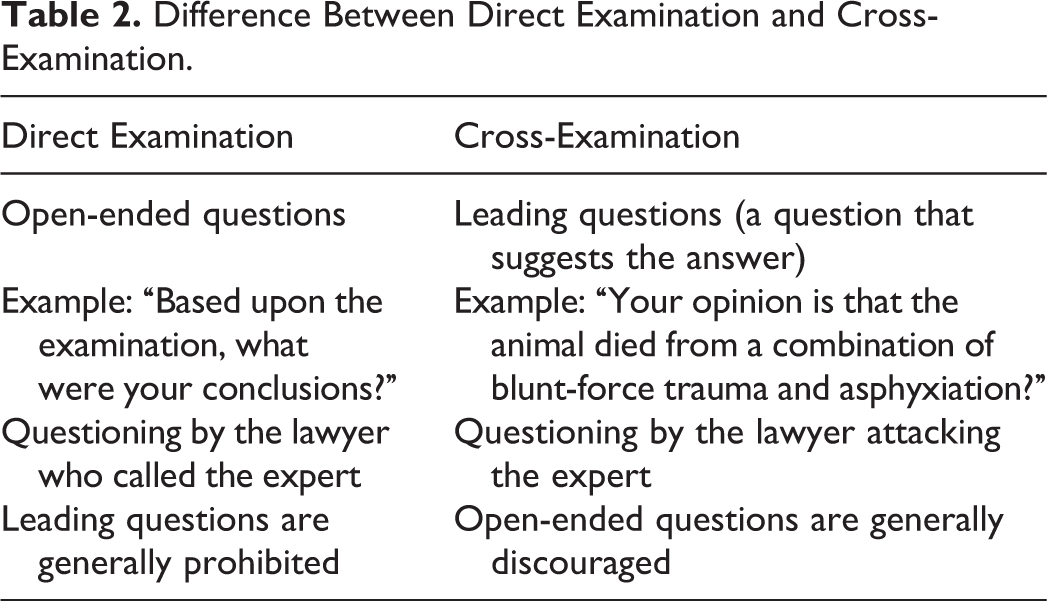
There are a number of ways a veterinary pathologist can be a prepared and an effective expert witness. First, the expert should always meet with the lawyer that chose him or her as the expert before giving any testimony. Of the tips discussed, this is the most important. This gives the expert a chance to explain to the lawyer his or her testimony, practice direct examination, and discuss the order of what will be covered and what exhibits will be introduced. Expert testimony is typically organized as follows: (1) introduction, (2) education and experience, (3) opinions, and (4) basis for the opinions. 59 Meeting with the lawyer ahead of time will also give the expert a chance to put together testimony in a meaningful way and prepare for cross-examination by the opposing party (Table 2 illustrates the difference between direct examination and cross-examination). A meeting prior to court also helps the lawyer and the expert to come to a “meeting of the minds” with the proposed testimony and the manner in which the testimony will be used.
Difference Between Direct Examination and Cross-Examination.
Second, a veterinary expert should visit the courtroom when it is empty to familiarize himself or herself with the layout of the witness stand, the location of the jury box, and the location of the attorneys. 60 An expert who knows the layout of the room beforehand can enter the courtroom with confidence.
Third, a veterinary expert should listen to the questions but speak to the jury. A veterinary pathologist should think about the testimony as a conversation with the jury. The expert should look at the jury when answering and be polite and friendly with responses to questions.
Fourth, prior to trial, a veterinary pathologist should provide the attorney with everything he or she has published, a résumé or curriculum vitae, and transcripts of any previous expert testimony in other trials, if available.
Fifth, the veterinary pathologist should bring all documents and notes related to the expert opinion in the case. It is permissible for an expert to refer to these documents and notes while testifying if the expert cannot recall something during his or her testimony (the best practice is to ask the attorney if it is permissible to refer to the notes before answering in order to refresh recollection).
Sixth, a veterinary expert should be confident in his or her testimony but should never make up an answer. It is permissible to admit when the expert does not know the answer to a question.
How to Handle Cross-Examination
An expert should prepare for cross-examination. The opposing attorney will typically attack an expert’s bias, the basis of the opinion, and the lack or reasonableness of alternative explanations. 61 Cross-examination from an opposing party is meant to destroy the credibility of the expert witness, reduce the expert’s likeability, or bolster the narrative of their case. For instance, a defense attorney in an animal cruelty case will often argue disease as a defense, not negligence of care; he or she may attempt to get the veterinary expert witness for the state to admit that disease could have been a factor in order to bolster his or her theory of the case.
The expert should ask the prosecutor beforehand about the anticipated defenses that will be raised by the opposing party so that he or she can prepare for cross-examination. The best way to prepare is to obtain a copy of the materials that the prosecutor obtained from the defense through the disclosure process. If the defense intends to question the expert using other scientific sources, those sources have to be disclosed, which gives the expert a chance to prepare. For example, a common technique is to attack the basis of the expert’s underlying opinion by using an alternative explanation found in a scientific treatise. Having a copy of this treatise beforehand will give the expert time to formulate a response and be prepared for questions concerning that treatise during cross-examination.
Another common cross-examination technique is for the attorney to “box in the expert” by gaining only “yes” or “no” answers without clarifying explanations. The expert should remember that the attorney offering the expert gets redirect (ie, additional open-ended questioning after cross-examination) and will allow an expert to clarify or expound on answers that were elicited during cross-examination.
Overall, the veterinary pathologist must maintain confidence in his or her expert opinion. If the pathologist is confident, then the trier of fact will be confident in relying on that opinion in making a decision; otherwise, the trier of fact may ignore the substance of the entire testimony. Many cross-examining attorneys will try to shake the expert’s confidence by getting the expert angry or flustered. An agitated witness appears confused, biased, or not forthcoming. This technique is also intended to make the witness defensive and argumentative, which reduces likeability. The best way to combat this technique is to remain calm and exceedingly polite; this will make the cross-examining lawyer look like a bully (which reduces the lawyer’s likeability).
Conclusion
The veterinary pathologist is often the most vital witness in an animal cruelty case. Understanding the basics of expert testimony and its requirements will give the veterinary pathologist a deeper understanding of legal procedures. Also, learning to connect with the jury and pretrial preparation will make the veterinary pathologist an indispensable expert witness.
Footnotes
Declaration of Conflicting Interests
The author(s) declared no potential conflicts of interest with respect to the research, authorship, and/or publication of this article.
Funding
The author(s) received no financial support for the research, authorship, and/or publication of this article.