




Abstract
The stomachs of 100 free-ranging black caimans (Melanosuchus niger Spix, 1825) from the Mamirauá Sustainable Development Reserve, Amazonas state, Brazil, were examined for parasitism and pathologic lesions. All animals were harvested for human consumption. Ascaridoid nematodes were found in 67 caimans and were identified as Brevimulticaecumsp. These parasites were associated with focally extensive, chronic gastric ulcers and formation of localized intramural granulomas containing nematodes. All caiman were in good nutritional condition, which suggests that effects of gastric nematodiasis on the crocodilian hosts were minimal at the time of slaughter.
The black caiman (Melanosuchus niger) is a New World crocodilian within the family Alligatoridae. 7 It is distributed throughout the Amazon region in Brazil, Colombia, Bolivia, Ecuador, Peru, and some regions of Guyana and French Guiana. 7 As the largest species of caiman, individuals can exceed 5 m in length. Large populations in some areas support legal harvest for hides and meat; however, overexploitation and habitat loss have resulted in declines in parts of their range.
Black caimans were harvested for human consumption as part of a pilot project for management of caimans in the Mamirauá Sustainable Development Reserve (MSDR), in the Brazilian Amazon. 1 Harvest of wild caimans offers a valuable opportunity to study enzootic disease and parasitism in free-ranging animals. The objective of this study was to examine the stomachs of black caimans captured within the MSDR and characterize parasites and pathological lesions.
All caimans were collected in December 2008 in São Raimundo do Jarauá, which is part of the Uarini municipality in the state of Amazonas. The area of harvest included 563 km2within the MSDR, which is bordered by the confluence of the Solimões and Japurá rivers and by the Paranã River of the Aranapu. 1 Authorization for this study was obtained from the Instituto Nacional do Meio Ambiente e dos Recursos Naturais Renováveis and the manager of the State Conservation Unit (No. 037/08).
The Government of the Amazonas State establishes the selection criteria for harvested caimans. 1 One hundred caimans were randomly selected during sanitary inspection of the viscera. Gross lesions were noted and preserved in 10% formalin for histological examination. Following fixation, tissues were processed into paraffin and sections were stained with hematoxylin and eosin using standard methods. Gastric nematodes were preserved in alcohol, formaldehyde and acetic acid solution and in 5% formaldehyde. Nematodes were later cleared in acetic acid and phenol for morphological study.
All caimans were male and measured 2.10 to 2.80 m in total length (mean, 2.45 m) and weighed between 26 to 86 kg (mean, 48 kg). Upon gross examination, nematodes were observed within gastric ulcers in 67 animals. The size and shape of the ulcers were variable, but most were oval and ranged from 2 mm to 2 cm in greatest dimension. Most ulcers were focally distributed, but the extent of mucosal area affected was estimated to be as great as 70% in some animals (Fig. 1). An additional 25 caimans had similar gastric ulcers without visualization of nematodes.
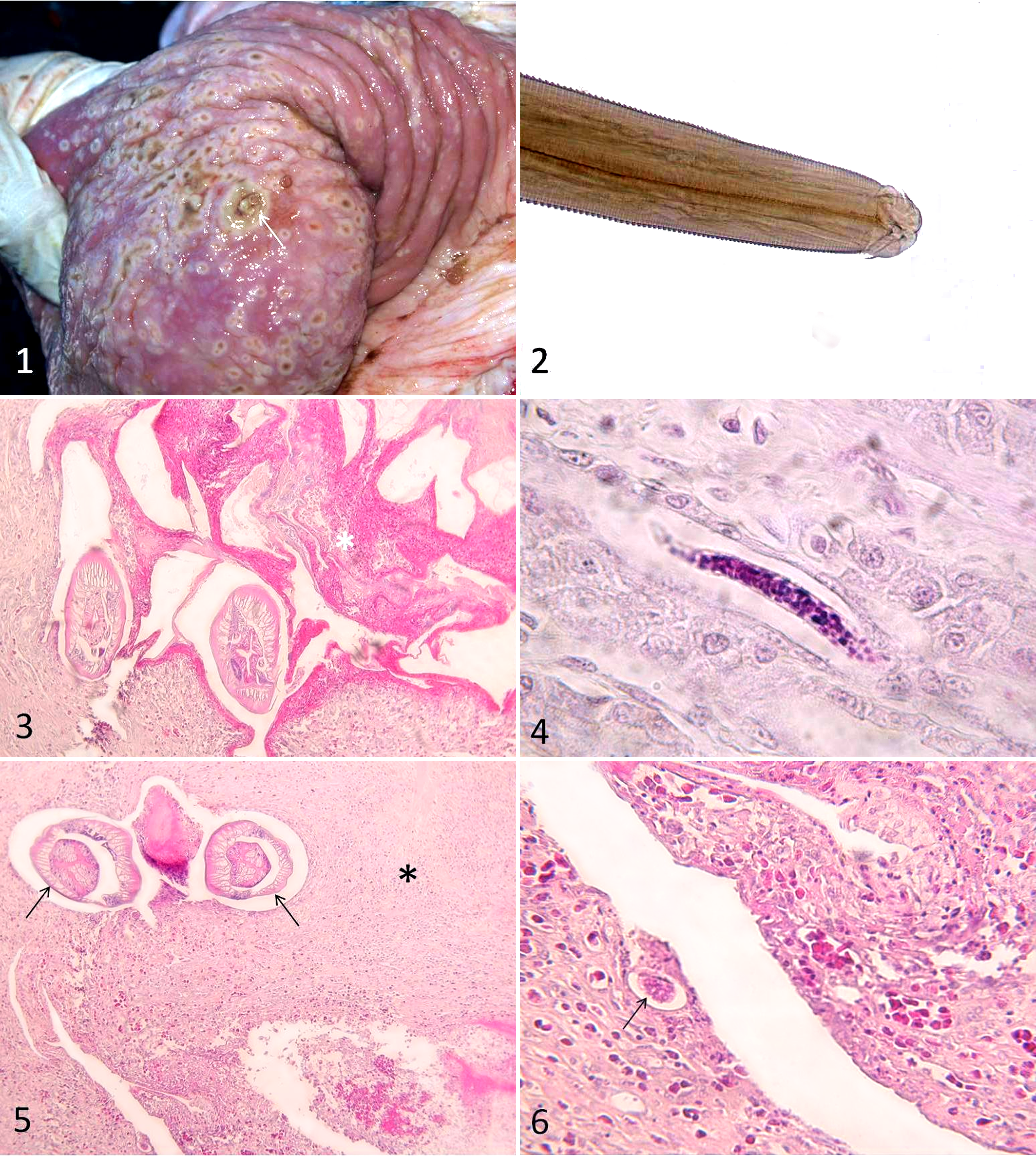
All of the nematodes collected from within the gastric granulomas and ulcers had morphologic features of the Brevimulticaecumgenus (Fig. 2), including voluminous lips, absent tooth rows, conspicuous interlips, an excretory pore at the nervous ring level, an esophagus ending in a ventricle with a short appendix, presence of an intestinal cecum, and a thin gubernaculum in males. 9
Histological examination of the gastric ulcers revealed chronic granuloma formation that expanded the submucosa and extended to the muscularis. Oblique and transverse sections of nematodes were present within the necrotic debris and granulocytic infiltrate that comprised with central regions of the granulomas (Fig. 3). Features of the nematodes included coelomyarian musculature and uninucleated enteric cells with a low brush border.
Small rhabditiform larvae were present within gastric crypts without associated inflammation (Fig. 4). Confident identification to species was not possible based on these specimens. Furthermore, the rhabditiform larvae were not specifically identified due to insufficient specimens. Further characterization of these parasites may benefit from genetic study.
In addition, parasite migration tracts were observed adjacent to adult nematodes and were bordered by necrotic debris and inflammation (Fig. 5). Nematode ova were embedded within the infiltrate and were associated with the nearby gastric mucosa (Fig. 6).
Great diversity of ascaridoid nematodes have been described in crocodilians. The genus Brevimulticaecum within the superfamily Ascaridoidea is one of the principal genera that infects reptiles, including crocodilians. Five species of Brevimulticaecum, B. baylisi, B. tenuicolle, B. stekhoveni, B. gibsoni, B. pintoi, are gastric parasites of crocodilians from North and South America. 5,10 Caiman scleropsand C. caiman yacare specimens captured in the States of São Paulo and Mato Grosso, respectively, are cited as definitive hosts of Brevimulticaecumspecies. 8 Additional descriptions of Brevimulticaecum species include C. c. crocodilus captured in Venezuela and Brazil, A. mississipiensiscaptured in the United States and M. nigercaptured in Brazil. 8 Species of Brevimulticaecumreported in black caimans include B. baylisi, B. stekhoveni, B. gibsoni. 2,3,8 The characterization of associated gastric lesions in the current study provides information on associated host injury and compliments these previous parasitological descriptions.
Mechanisms of host injury caused by ascaridoid nematodes include damage to mucosal surfaces and larval migration. 4 Infestations often are subclinical, and host effects and lesions primarily are observed in cases of severe infestation. 4 Despite the extent of mucosal injury observed in some caimans in the present study, all animals were in good nutritional condition and appeared to be clinically healthy. Similar observations were described in crocodiles in good nutritional condition that had large numbers (60 to 100) of Dujardinascaris mawsonae. 6
Gastric ulceration and granuloma formation associated with Brevimulticaecum species was a common finding in examined black caimans from the Brazilian Amazon. Parasites were associated with gastric ulceration in most caimans, and were the suspected cause of ulceration in additional animals. There did not appear to be any major effects on the caiman hosts at the time of slaughter based on nutritional condition; however, chronic effects or further host injury resulting from intense parasitism in some cases is possible.
Footnotes
Acknowledgments
We thank Jozélia Correia, Ramiro Dias Neto, Valdecio Pittch, Suellen Monger, Ana Carolina Pereira, the residents of the community of São Raimundo do Jarauá, Instituto Mamirauá, and Brian Stacy for helpful review of the manuscript.
Declaration of Conflicting Interests
The author(s) declared no potential conflicts of interest with respect to the research, authorship, and/or publication of this article.
Funding
This study was supported by pró-reitoria de pesquisa e desenvolvimento tecnológico, Universidade Federal Rural da Amazônia (No. 032010-028).