




Abstract
Purpose:
Professional quality of life (QoL) is crucial for healthcare workers as it affects performance at work and interaction with patients, but little is known about stressors influencing radiation oncology professionals. The present study aims to explore the professional QoL of radiation oncologists (ROs) and radiation therapists (RTTs) in an Italian radiotherapy department and to report data about the possible impact of personality factors, such as alexithymia and empathy.
Material and methods:
Participants filled out three validated questionnaires measuring the professional QoL, alexithymia, and empathy: (i) Professional Quality of Life Scale (ProQOL); (ii) Toronto Alexithymia Scale (TAS-20); (iii) Interpersonal Reactivity Index (IRI). Correlation, regression analyses and non-parametric tests were run.
Results:
A total of 48 professionals completed the survey (66.7% ROs, 33.3% RTTs). Considering the ProQOL dimensions, moderate levels of risk for burnout (BO) and secondary traumatic stress (STS) were found. BO was found to be predictive by TAS-20 total score (β=.37, p=.010), while STS resulted to be predictive by TAS-20 total score (β=.54, p <.001) and IRI Empathic Concern subscale (β=.45, p <.001). No significant differences were found between ROs and RTTs for all the considered variables, except for TAS-20 total score (p=.032), higher for RTTs.
Conclusions:
Results showed no evidence of high risk of burnout and no intrinsic differences regarding the professional QoL between ROs and RTTs. Findings suggest a significant role of alexithymia and empathy predicting professional QoL. These results underscore the importance of promoting a positive work environment and emotional competencies to prevent high stress levels.
Introduction
Professional quality of life (QoL) refers to the perception of work-related well-being, a crucial aspect for healthcare workers that may affect performance and patient care. In helping professionals, who may be exposed to vicarious distress, professional QoL has been described as a combination of positive and negative effects of caring, namely compassion satisfaction, secondary traumatic stress, and burnout. 1
Several studies have demonstrated the impact of long-term exposure to stressors on professional satisfaction and well-being, leading to distress, psychological disorders, and burnout.1–4 Burnout is a syndrome characterized by three dimensions: emotional exhaustion, depersonalization, and low personal accomplishment.5,6 This condition is frequent in helping professionals, and in particular those working in the oncology field seem to encounter more work-related stress than other health professionals. 7 Indeed, dealing with the communication of cancer diagnosis, cancer progression and deterioration, constantly facing life and death decisions and difficulties in treatment, being in contact with patients’ worsening physical condition or fatal illness and death are just some of the possible stressors that oncology professionals find themselves dealing with and that could increase their vulnerability. 8
In addition to vicarious distress, different factors may have an impact on professional well-being, both environmental and personal: number of working hours, increased clinical workload, changes in clinical practice, support of the institution as well as emotional intelligence, decision-making style and psychiatric morbidities, such as depression or anxiety, were found to have a potential influence on the quality of working life.9-11 Personality traits, such as alexithymia and empathy, may also play a role. Alexithymia refers to the difficulty in identifying, describing, and expressing emotions. It may influence professional interactions, both with patients 12 and colleagues, and has been shown to increase the risk of burnout with less professional gratification.13,14 Empathy is a multidimensional construct that reflects the ability to understand and share another’s emotions, important for caring interactions and with a positive impact on professional QoL. 12
Several studies have recognised a high prevalence of burnout in oncology physicians,7,15,16 but only a few focusing on radiation oncology.12,17–19 Furthermore, the role of personality traits on radiation therapists’ professional well-being has been investigated in European studies,12,17 but little is known about the Italian context. Being able to identify factors influencing professional QoL may be important to better understand working contexts and to set prevention and promotion interventions, therefore the present monocentric experience aims to explore professional QoL and to report data about the possible impact of personality factors in the largest Italian Radiotherapy Department.
Methods
Questionnaires
A total of three validated questionnaires, based on a 5-point Likert scale (1-to-5), were respectively considered to measure professional QoL, alexithymia, and empathy. Questionnaires were chosen in line with the framework used by Franco et al.12,13 in order to ensure consistency in methodology.
Firstly, the Professional Quality of Life Scale (ProQOL) questionnaire is the most commonly used measure of the positive and negative effects of working with people who have experienced extremely stressful events. 20 It consists of 30 items resulting in three scales: (i) Compassion Satisfaction (CS), which is about the pleasure derived from being able to work well; (ii) Burnout, which is associated with feelings of hopelessness and difficulty in dealing with work or doing job effectively; (iii) Secondary Traumatic Stress (STS), which is about work-related, secondary exposure to extremely or traumatically stressful events. Burnout and STS are the two elements of the Compassion Fatigue that represents the negative effect of caring. 20 Based on cut-off scores, participants are classified into low (score of 22 or less), medium (score between 23-41), and high (score of 42 or above) level for each scale. 20 The Cronbach’s alpha of the scales (α score range from 0.75 to 0.88) has shown good internal consistency and test-retest reliability. 20
Secondly, the Toronto Alexithymia Scale (TAS-20) questionnaire consists of 20 items resulting in a total score (TAS_Tot, range 20-to-100) and in three subscales to assess three factors of the alexithymia construct: difficulty identifying feelings, difficulty describing feelings, and externally oriented thinking. 21 Based on the total score, participants are classified as non-alexithymic (score of 51 or less), borderline (score between 52-61), and alexithymic (score of 61 or above). 21 The Cronbach’s alpha of the scale (α > 0.70) has shown good internal consistency and test-retest reliability.22,23
Lastly, the Interpersonal Reactivity Index (IRI) questionnaire is a multidimensional measure of empathy. It consists of 28 items divided into four subscales to assess: (i) perspective taking, which is the ability to adopt the perspectives of other people; (ii) emphatic concern, which is the tendency to respond to others with feelings of warmth, compassion; (iii) personal distress, that reflects the personal feelings of anxiety and discomfort in reaction to another’s negative experience; (iv) fantasy, that is the tendency to identify with characters in fictional situations. 24 The final score for each scale is in a range between 1 to 5. 25 The Cronbach’s alpha of the scales (α score range: in the English version from 0.70 to 0.78; in the Italian version from 0.63 to 0.74) has shown good internal consistency and test-retest reliability.25,26
Participants
The three above-mentioned questionnaires were administered via an online survey using Google forms platform on 15 October 2023. The survey was sent to all radiation oncologists (ROs) and radiation therapists (RTTs) of the European Institute of Oncology (IEO, IRCCS, Milan, Italy) Radiation Oncology department, for a total of 68 invited participants. Completion of the survey was anonymous, and all participants provided consent for data collection and publication.
Statistical analyses
Cronbach’s alpha was calculated for each subscale of the questionnaires in order to assess internal consistency and reliability. Shapiro-Wilk Test, descriptive statistics, and frequencies were calculated to assess variable’s distribution. Considering the 2:1 ratio of sample subgroups, the non-parametric median test was run for all the considered variables in order to assess possible differences between ROs and RTTs. Spearman coefficients were calculated to assess possible correlations between the compassion satisfaction scale and personality traits. First Pearson correlation coefficients and later hierarchical multiple regressions were calculated to assess the contribution of alexithymia and empathy explaining the compassion fatigue dimension (burnout and STS) of professional QoL: when significantly correlated with the outcome variables, the alexithymia total score and empathy subscales were included into the regression analyses. Two hierarchical multiple regressions were run with Stepwise method. The Variance Inflation Factor (VIF) and the tolerance factor were used to assess collinearity. Statistical analyses were run with IBM SPSS Statistics (Version 29).
Results
A total of 48/68 (71%) professionals, 32 ROs and 16 RTTs, filled out the survey from 15 October to 15 December 2023 and were considered for data analyses.
Consistency and reliability
Cronbach’s alpha coefficients resulted as acceptable or good for all ProQOL and IRI subscales (α score range from .68 to .88), except for Burnout (α =.63) and Fantasy (α=.61). TAS_Tot was found to have a good internal consistency (α= .88). All the variables resulted as having a normal distribution (p > 0.05 ), except for ProQOL Compassion Satisfaction (p = .044) and TAS Externally Oriented Thinking (p = - .039).
Descriptive assessment
Regarding the ProQOL questionnaire ( Figure 1 ), the majority of participants were found to be at low grade of risk for STS (56% of participants; 53% of ROs and 62% of RTTs) and moderate risk for burnout (71% of participants; 69% of ROs and 75% of RTTs). No participants were found in the high grade of risk for both scales. Furthermore, the majority of participants resulted in moderate (75% of participants; 69% of ROs and 88% of RTTs) or high (22% of participants; 28% of ROs and 12% of RTTs) level of CS. Overall, a total of nine participants (19% of ROs and 19% of RTTs) resulted as alexithymics according to the TAS_Tot, while 12 were classified as borderline (15.62% of ROs and 43.75% of RTTs), as reported in Figure 2 . Finally, regarding the four subscales of the IRI, the highest score was found in the empathic concern subscale (3.58 +/- 0.46) and the lowest in the personal distress subscale (2.51 +/- 0.55), a trend confirmed even by the subgroups scores ( Table 1). No significant differences were found between ROs and RTTs for all the considered variables, except for TAS_Tot (p=.032).
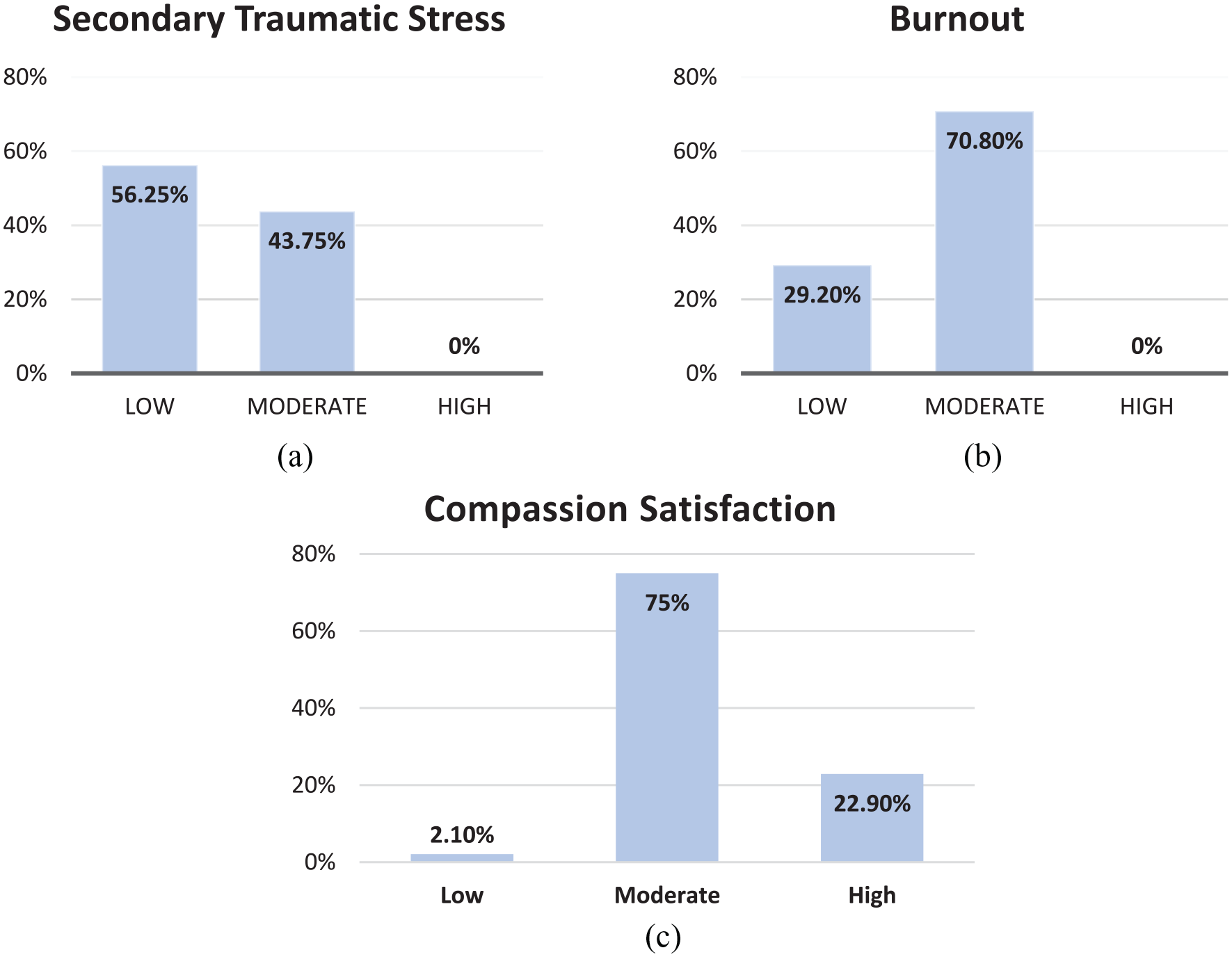
Distribution of participants according to the three ProQOL scores: Secondary Traumatic Stress (STS) (1a), Burnout (1b), and Compassion Satisfaction (1c).
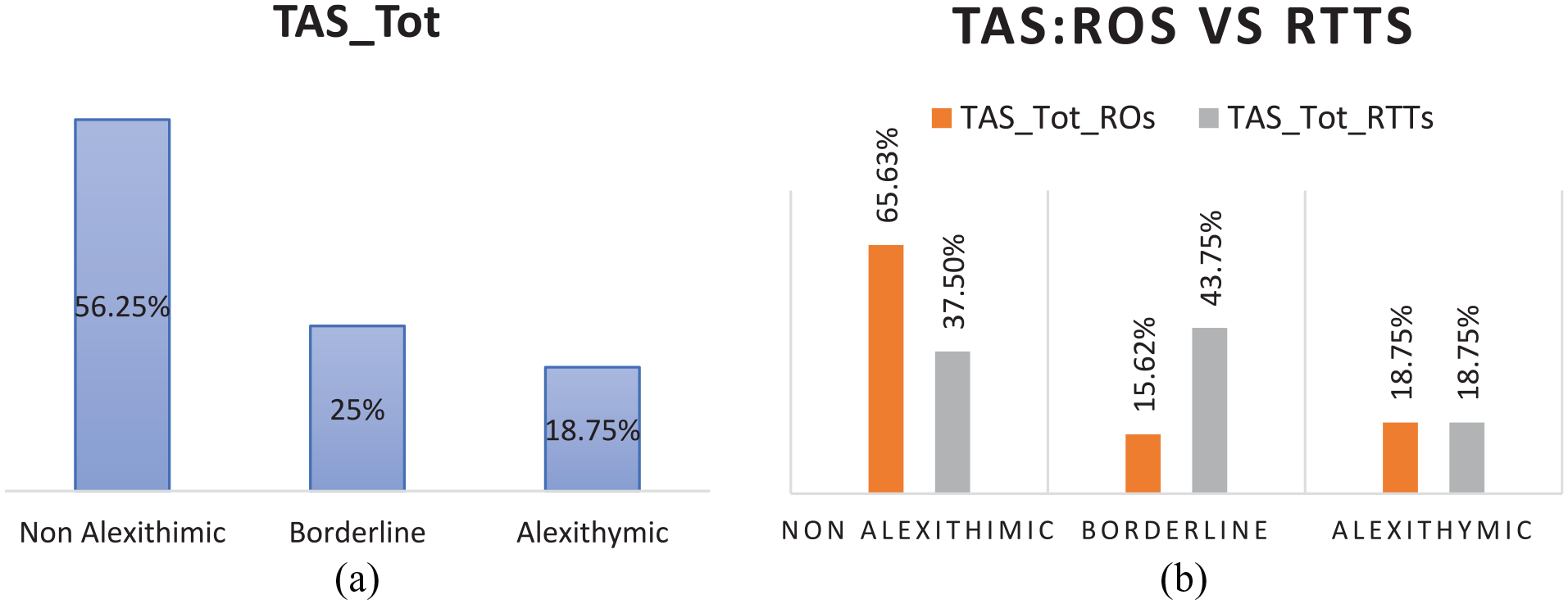
Percentage distributions of alexithymia related to the total sample (2a) and the two subgroups (2b).
Empathy subscales average scores and standard deviations related to the total sample and the two subgroups (ROs and RTTs).

Correlations and multivariate regressions
Compassion satisfaction resulted as negatively correlated with the TAS_Tot (ρ= -.299, p=.039) and positively correlated with Empathic Concern (ρ= .287, p=.048) and Perspective Tacking (ρ=.380, p=.008) subscales. Burnout was found to be positively correlated with TAS_Tot (r= .369, p=.010) and Personal Distress subscales (r= .321, p=.026), while a negative correlation was found with Perspective Taking (r= -.316, p=.029). However, the only TAS-Tot seems to have a predictive role in burnout, explaining the 12% of distribution (β=.37, p=.010). Finally, STS resulted as positively correlated with TAS_Tot and with all the IRI subscales (with the exception of perspective taking), with a predictive role in TAS_Tot (β=.54, p <.001) and Empathic Concern (β=.45, p <.001) that explained the 45% of the variance. Final models of the multivariate regressions are reported in Table 2.
Regression final models on ProQOL Burnout (BO) and Secondary Traumatic Stress (STS) Scales.

Discussion
This monocentric study investigated professional QoL in the largest Italian Radiotherapy Department focusing on the predictive role of personality traits, such as alexithymia and empathy.
Regarding the compassion fatigue dimension, no evidence of high risk was found in the considered sample. However, the results showed a moderate level of risk of burnout (a dimension of the compassion fatigue) in the majority of participants (70.8%), and a moderate level of risk of secondary traumatic stress (the second dimension of compassion fatigue) in 43.75% of participants. Moreover, results showed a moderate to high level of compassion satisfaction (respectively the 75% and the 23 % of participants). This finding could reflect the engagement grade with the work done: perceiving emotional and organizational support, positive relationships with colleagues, other than self-esteem and self-efficacy are just some of the factors that could promote a positive work-related state of mind of involvement and commitment to the tasks. This may result in higher professional satisfaction and reduced burnout,27,28 suggesting that the engagement could represent the motivational process through which environmental and personal factors (e.g., alexithymia and empathy as in our study) may impact on professional well-being.
Our findings confirm what was found in a recent study involving different oncology healthcare professionals from five general hospitals in China and showing the predominance of participants set in a low to moderate grade of risk for the compassion fatigue subscales and in a moderate to high level for compassion satisfaction. 7 On the other hand, findings from two similar studies and specific for radiotherapy professionals.12,17 suggested higher levels of burnout and secondary traumatic stress compared to our results, with, respectively, 25-30% and 23-24.1% of the sample at highest grade of risk for each scale.12,17 These discrepancies could be explained by differences in sample size (more than 300 participants vs 48 in the present study) and sample composition. Indeed, the present study considered two different occupational profiles of the Radiotherapy Department, RTTs, and ROs, unlike the homogeneous sample of the studies mentioned above [respectively composed by medical physicists (n = 17) and RTTs (n = 12)]. It can be hypothesized that job demands specific for professional profiles are not detected here, such as technical requirements or the needed interactions with patients, which may have an impact on the perceived stress and, as a consequence, on the observed overall rates.
Furthermore, the individual characteristics here investigated, alexithymia and empathy, had shown to have a significant role predicting the professional QoL and the analyses results were in line with the literature.12,15 Alexithymia is proven to have a negative impact on professional QoL, increasing risk of burnout and secondary traumatic stress, and with a negative correlation to compassion satisfaction. These results suggest that radiotherapy professionals who show greater difficulties in dealing with their own and other’s emotions are likely to be less satisfied with their work situation, experiencing higher distress. Furthermore, alexithymia may result in ineffective coping strategies and difficulties in relationships, additional factors that may impact on motivation and enhancing the risk of fatigue. Moreover, our results showed a significant higher prevalence of alexithymics in the RTTs subgroup suggesting that the relation among alexithymia, occupational profile and the professional fatigue may deserve a further in-depth analysis. Interestingly, Franco et al. 13 reported that the relationship between alexithymia and professional QoL can be moderated by the professional profile, highlighting that alexithymia’s impact on compassion fatigue varies according to professional roles. Specifically, their study found that profession moderated the relationship between alexithymia and STS, with ROs experiencing a more pronounced effect compared to medical physicists. ROs were found more prone to STS than RTTs, but in this case no interaction effect with alexithymia was found. In line with Franco et al., 13 our findings show no moderation effect of professional role (ROs vs RTTs) on the relation between alexithymia and STS, while a higher prevalence of alexithymia has been detected in RTTs. It can be hypothesized that other factors, such as sociodemographic differences between samples (e.g., gender prevalence of the subgroups) 13 may have an impact on the alexithymia rates. Nevertheless, both our study and the one by Franco et al. 13 highlight the critical importance of exploring the complex relation among professional role, alexithymia and work well-being. Future studies could further explore how these dynamics influence coping mechanisms and interventions targeted at specific professional roles.
Even empathy seems to have an important role. In particular, compassion satisfaction resulted in an increase in relation to higher levels of the ability to adopt the perspectives of other people (perspective taking) and the tendency to respond to others with feelings of warmth and compassion (empathic concern). Furthermore, empathic concern showed a predictive role, with a negative impact, on secondary traumatic stress. This result, in line with literature, 12 could be explained considering that the tendency to be involved in empathic relationships exposes one to other people’s emotions and distress, an aspect that may be modulated by effective coping strategies.
The implications of these data are definitely interesting for the healthcare industry: as alexithymia and empathy are individual traits involved in interpersonal relationships as well as in personal well-being, they may have a significant impact on patient care. Furthermore, several studies have shown a link between burnout and job turnover, absenteeism, poorer quality of care, increased medical errors, and lawsuits,29–32 outcomes that underline the impact of the professional QoL on the healthcare system. Although the outcomes of the present study did not suggest high risk of burnout in our population, moderate levels of distress deserve attention. To promote professional satisfaction and stress management, specialized training may be structured to enhance the positive effect of protective factors. Self-awareness and coping strategies, such as positive reframing and active coping, that were found to be positively associated with compassion satisfaction and negatively related to compassion fatigue,9,33,34 may mediate the impact of stressors and personality traits on the professional QoL, preventing an increase of fatigue.
The current study is not exempt from limitations. Firstly, the quite small sample size could have had an impact on variable distribution, as well as on the internal consistency of the scales. Moreover, only the 71% of the invited professional filled out the survey, data that could have affected the evaluation of QoL in the Radiation Oncology Department, underestimating the burnout rates and, consequently, overestimating work well-being. No sociodemographic information was collected in order to protect the anonymity of participants. As a consequence, we miss supplemental data that may be important to better understand the role of individual factors on professional QoL and a comparison between responders and non-responders. Furthermore, additional studies will be needed to identify specific environmental factors that may have contributed to burnout rates, here lower than in literature. Lastly, considering that RTTs may be employed in fields other than oncology, exploring stressors specific for the RTTs’ occupational profile in different healthcare areas may be helpful in explaining the relationship between the occupational profile and professional fatigue.
Despite these limitations, this study provided a first picture of the professional QoL in an Italian radiotherapy department, highlighting the impact of personality traits. No evidence of high risk of burnout were detected, however, the moderate level of risk of distress observed and the variety of factors involved in professional QoL emphasize the need of promoting emotional competencies and foster a positive work environment to mitigate the moderate risk of distress and prevent its escalation.
Footnotes
Acknowledgements
The European Institute of Oncology, Milan, Italy is partially supported by the Italian Ministry of Health with the Ricerca Corrente fund and 5x1000 fund. T.B. received a research fellowship from the Associazione Italiana per la Ricerca sul Cancro (AIRC) entitled “Radioablation ± hormonotherapy for prostate cancer oligorecurrences (RADIOSA trial): potential of imaging and biology” registered at Clinical Trials.gov NCT03940235, approved by the Ethics Committee of IEO and Centro Cardiologico Monzino (IEO-997), outside the current project. The funders had no role in the design of the study; in the collection, analyses, or interpretation of data; in the writing of the manuscript; or in the decision to publish the results.
Author contributions
Conceptualization: TB, MZ, GM, KM, GG; Methodology: TB, MZ, GM, GG, MGV, FM; Formal analysis: TB, MZ, GM, GG, MGV; Data Curation: TB, MZ, GG; Writing - Original Draft: TB, MZ; Writing - Review & Editing: All authors; Visualization: TB, MZ, MGV. Supervision: GP, BAJF.
Declaration of conflicting interest
The author(s) declared the following potential conflicts of interest with respect to the research, authorship, and/or publication of this article: The Division of Radiation Oncology of IEO received research funding from AIRC (Italian Association for Cancer Research), Fondazione IEO-CCM (Istituto Europeo di Oncologia-Centro Cardiologico Monzino), ACCURAY, IBA (Ion Beam applications), all outside the current project. BAJF received speakers’ fees from Bayer, Accuray, Astellas, Iba, Ipsen, Astra Zeneca, Tecnologie Avanzate, Recordati, Novartis; BAJF participated to Advisory Board of Accuray, Bayer, Seagen, all outside the current project. The remaining authors declare no conflicts of interest that are relevant to the content of this article.
Funding
The author(s) received no financial support for the research, authorship, and/or publication of this article.
Data availability
Data supporting the findings of this study are available from the corresponding author upon reasonable request.
