



Abstract
Objective
Previous research has shown that the role of neurotrophic receptor tyrosine kinase 2 (NTRK2) in breast cancer (BRCA) remains ambiguous. To help elucidate this, we conducted a retrospective study to investigate the relationship between NTRK2 protein expression and BRCA.
Methods
The prognostic significance of NTRK2 protein expression patterns was assessed by performing immunohistochemistry assays on 131 BRCA tissues and 56 adjacent normal tissues in a retrospective study. Furthermore, the sensitivity to chemotherapeutic drugs was quantified by “pRRophetic” and the sensitivity to immunotherapy was estimated using The Cancer Immunome Atlas website.
Results
NTRK2 protein was expressed at significantly higher levels in BRCA samples compared with normal tissues. The data indicated that NTRK2 expression is an independent risk factor for BRCA patient prognosis. Additionally, the high NTRK2 group exhibited increased sensitivity to certain chemotherapy drugs and achieved higher scores for immune checkpoint blockade therapy compared with the low NTRK2 group.
Conclusions
Our study demonstrated that higher NTRK2 protein expression is related to a less favorable prognosis in BRCA patients, as well as to enhanced sensitivity to specific chemotherapy and immunotherapy drugs.
Keywords
Introduction
Epidemiological data have suggested that breast cancer (BRCA) is the most commonly diagnosed female cancer. 1 With the rise in life expectancy and rapid development of diagnostic techniques, the BRCA incidence rate has been increasing annually. Recent studies employing high-throughput sequencing-based comparisons of tumor tissues and normal tissues have identified several genes that are preferentially expressed or frequently mutated in BRCA. These include BRCA1, BRCA2, ERBB2, ERα, and JAK2, which act as oncogenes in BRCA. 2 Multiphase tumorigenesis in BRCA involves the development, progression, and invasion of tumors. 3 Consequently, it is imperative to elucidate the underlying mechanisms and identify innovative reliable biomarkers to support effective therapeutic development for BRCA.
The neurotrophic receptor tyrosine kinase 2 (NTRK2) gene encodes the NTRK2 protein. 4 Also known as tropomyosin receptor kinase B (TRKB), this protein serves as a specific receptor for brain-derived neurotrophic factor (BDNF). Multiple studies have shown that NTRK2 is involved in the pathogenesis and progression of carcinoma. 5 Chromosomal translocation leads to NTRK2 fusions, resulting in activation of the NTRK2 signaling pathway, which has been implicated in promoting tumor progression and drug resistance development in carcinoma. 6 Some reports have suggested that NTRK2 expression levels are downregulated in BRCA and associated with a worse prognosis. 7 Conversely, other studies have indicated a positive association between NTRK2 expression levels and overall survival (OS) in BRCA patients. 8
Because of these controversial conclusions, the expression patterns and biological function of NTRK2 in BRCA remain ambiguous. Therefore, an in-depth investigation is required. In this study, we have validated the clinical and prognostic data of NTRK2 in BRCA using a BRCA tissue microarray. Furthermore, we have elucidated the role of NTRK2 for predicting the sensitivity of these tumors to chemotherapy and immunotherapy.
Materials and methods
Human BRCA tissue microarray
BRCA tissues and adjacent normal breast tissues (catalog numbers: HBreD131Su08 and HBreD077Su01) were received from Shanghai Outdo Biotech Co., Ltd. (Shanghai, China), which collaborated with Taizhou Hospital to establish a specimen library. The cancer tissues were obtained from BRCA patients who received surgery from January 2005 to September 2012. The deadline for follow-up was set at August 2016. NTRK2 protein (TRKB) was obtained from Affinity Biosciences (Jiangsu, China). This retrospective study complied with the Helsinki Declaration of 1975 as revised in 2013. We have de-identified all patient details. All patients provided written informed consent. The study was approved by the ethics committee of Taizhou Hospital of Zhejiang Province on 26 January 2010 and by the ethics committee of Wuhan No.1 Hospital (approval no. [2024]47).
Immunohistochemistry (IHC)
An anti-NTRK2 protein antibody (AF6461, Affinity Biosciences) diluted at 1:100 was used for IHC analysis. 9 The IHC results were independently evaluated by two pathologists who were blinded to clinical information. The NTRK2 protein expression score was determined by multiplying the staining intensity and percentage of positive cells. The intensity was quantified as “0” for no color particles, “1” for light brown particles, “2” for moderate brown particles, or “3” for dark brown particles. The scores were used to classify the samples as high (score > 180) or low (score ≤ 180) NTRK2 protein expression.
RNA-sequencing data
Data files, which included the expression matrix and clinical information of BRCA samples in TSV and JOSN formats, were first procured from The Cancer Genome Atlas (TCGA) database (https://portal.gdc.cancer.gov/) (downloaded in July 2022). This database included 1,057 BRCA tissues and 111 normal breast tissues. The data were then extracted and converted into TXT format.
Estimation of the sensitivity to chemotherapy and immunotherapy
The IC50 values of common chemotherapeutics were evaluated using the “pRRophetic” package in R software (www.r-project.org). The different responses to anti-programmed cell death protein 1 (PD1) and anti-cytotoxic T lymphocyte antigen 4 (CTLA4) treatments between the low- and high-NTRK2 expression groups were analyzed and visualized using The Cancer Immunome Atlas (TCIA) website (https://tcia.at/) via the “limma” and “ggpubr” packages in R (Table S1).
Statistical analysis
IHC scores and survival statistical analyses were performed using IBM SPSS 25.0 (IBM Corp., Armonk, NY, USA) and GraphPad Prism 8.0 (La Jolla, CA, USA). The differences between the low- and high-NTRK2 expression groups were assessed by chi-square tests. The Kaplan–Meier method was used to analyze prognosis, with log-rank tests used to assess statistical significance. The relationships between the clinical variables and BRCA patient prognosis were assessed by univariate analysis and multivariate Cox regression analysis. P-values < 0.05 were considered statistically significant: *P < 0.05, **P < 0.01, ***P < 0.001. TCGA database analyses and graphs were performed using R software (4.2.1). This retrospective study conforms to STROBE guidelines. 10
Results
BRCA tissues have higher NTRK2 expression levels
Overall, 131 BRCA tissues and 56 adjacent normal breast tissues were included in the tissue microarray. High NTRK2 protein expression was detected in the BRCA tissues compared with the adjacent normal tissues in the human BRCA tissue microarray (Figure 1(a)). Pearson chi-square analysis indicated that the NTRK2 protein expression levels were significantly higher in BRCA patients, with a frequency of 39% (51/131), compared with only 21% (12/56) in adjacent normal tissues (χ2 = 5.380, P = 0.02) (Figure 1(b)).

Neurotrophic receptor tyrosine kinase 2 (NTRK2) protein is expressed at higher levels in breast cancer (BRCA). (a) NTRK2 IHC staining images in adjacent normal tissues and BRCA tissues at 20× magnification and (b) higher NTRK2 protein expression levels were observed in BRCA tissues compared with adjacent normal tissues. *P < 0.05.
NTRK2 protein (TRKB) expression is positively correlated with BRCA patient clinicopathological characteristics
We further explored the correlations between the NTRK2 protein expression patterns and BRCA patient clinicopathological characteristics. As shown in Table 1, chi-square tests suggested strongly positive significant correlations between NTRK2 protein expression and BRCA patient clinicopathological characteristics, including vascular invasion (χ2 = 5.481, P = 0.019), lymph node metastasis (χ2 = 13.011, P = 0.001), TNM stage (χ2 = 11.42, P = 0.003), progesterone receptor (PR) status (χ2 = 4.756, P = 0.029), tumor recurrence and metastasis events (χ2 = 9.746, P = 0.002), and OS (χ2 = 23.537, P < 0.001).
Breast cancer patient clinicopathological characteristics after being grouped by neurotrophic receptor tyrosine kinase 2 (NTRK2) protein expression level.
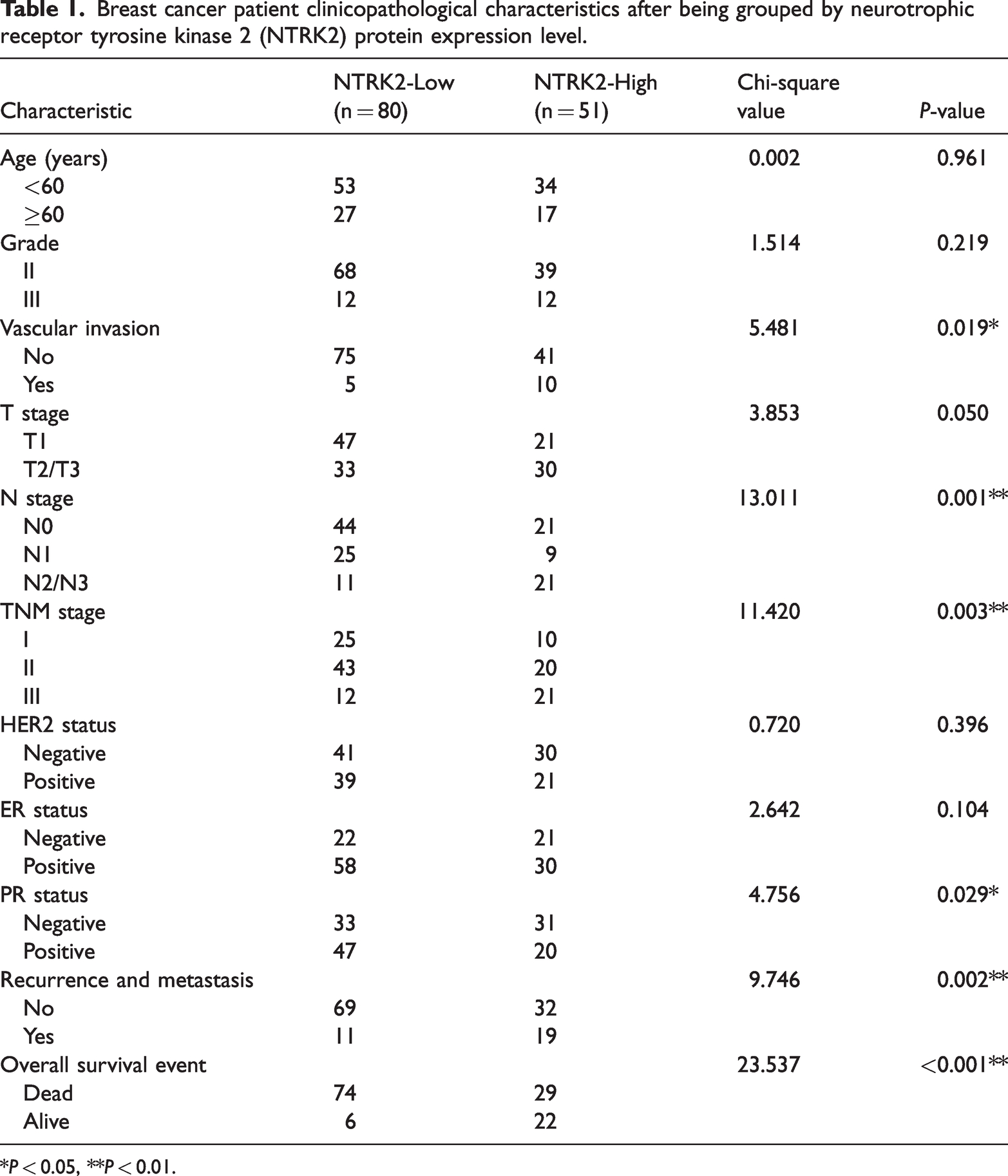
*P < 0.05, **P < 0.01.
NTRK2 protein expression is related to BRCA patient prognosis
We found that NTRK2 protein expression was related to the tumor recurrence, metastasis, and survival status of BRCA patients. We further analyzed the relationship between NTRK2 protein expression and BRCA patient prognosis. Among the 131 BRCA cases, 27 cases were HR-/HER2− (triple negative), 44 cases were HR+/HER2−, and 60 cases were HER2+. The survival analysis revealed that BRCA patients with higher NTRK2 protein expression levels experienced significantly reduced disease-free survival (DFS) (P = 0.0012) and OS (P < 0.001) than those with lower expression levels (Figure 2(a), (b)). HR+/HER2− BRCA patients with higher NTRK2 protein expression levels showed significantly reduced DFS (P = 0.011) and OS (P = 0.005) than those with lower expression levels (Figure 2(c), (d)). HER2+ BRCA patients with higher NTRK2 protein expression levels showed significantly lower OS (P < 0.001), but not DFS, than those with lower expression levels (Figure 2(e), (f)). Triple negative BRCA patients with higher NTRK2 protein expression levels did not display significant differences in DFS and OS compared with those with lower expression levels (Figure 2(g), (h)).

Neurotrophic receptor tyrosine kinase 2 (NTRK2) protein expression is related to poorer breast cancer (BRCA) patient disease-free survival (DFS) and overall survival (OS). (a) Kaplan–Meier curves showed that BRCA patients with high NTRK2 protein expression levels had shorter DFS than those with low expression levels (P = 0.001). (b) BRCA patients with high NTRK2 protein expression levels have shorter OS (P < 0.001). (c) High NTRK2 protein expression levels in HR+/HER2− BRCA patients were associated with shorter DFS (P = 0.011). (d) High NTRK2 protein expression levels in HR+/HER2− BRCA patients were associated with shorter OS (P = 0.005). (e) NTRK2 protein expression patterns did not demonstrate any statistically significant difference in DFS for HER2+ BRCA patients (P = 0.313). (f) High NTRK2 protein expression levels in HER2+ BRCA patients were associated with shorter OS (P < 0.001). (g) and (h) NTRK2 protein expression patterns did not demonstrate any statistically significant difference in DFS (P = 0.066) or OS (P = 0.061) in triple negative BRCA patients.
NTRK2 expression is an independent risk factor for BRCA patient prognosis
To determine if BRCA recurrence, metastasis, and cancer-related deaths were associated with NTRK2 protein expression, we explored the relationships between recurrence, metastasis, and clinicopathological characteristics of 131 BRCA cases through univariate and multivariate analyses. We found vascular invasion to be an independent predictor of poor DFS in BRCA patients (hazard ratio (HR) = 6.108, P < 0.001) (Table S2). In addition, both high NTRK2 protein expression (HR = 4.52, P = 0.002) and vascular invasion (HR = 3.33, P = 0.009) were independent predictors of poor OS in BRCA (Table 2).
Univariate and multivariate Cox regression analyses of breast cancer patient overall survival.
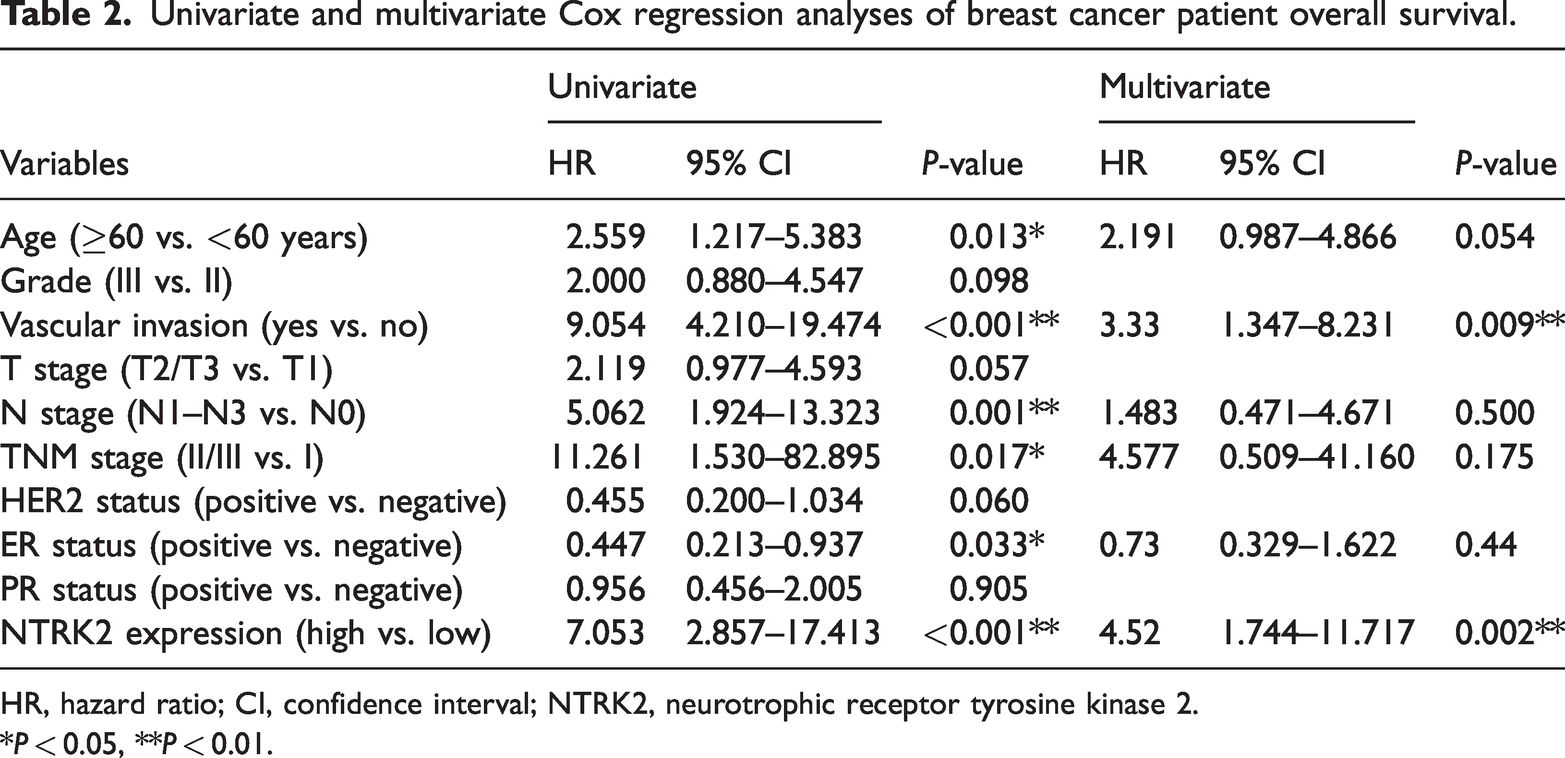
HR, hazard ratio; CI, confidence interval; NTRK2, neurotrophic receptor tyrosine kinase 2.
*P < 0.05, **P < 0.01.
NTRK2 expression is a predictive biomarker for the sensitivity to chemotherapy and immunotherapy
Because chemotherapy, targeted therapy, and immunotherapy have been demonstrated to be effective in BRCA patients, we evaluated the IC50 values of common drugs recommended for BRCA therapy. The low NTRK2 expression group was more sensitive to AKT inhibitor VIII, methotrexate, and gefitinib (P < 0.02), while the high NTRK2 expression group was more sensitive to bleomycin (50 µM), cytarabine, and (5Z)-7-Oxozeaenol (P < 0.03) (Figure 3(a)). Furthermore, the treatment scores of immune checkpoint proteins were examined. Our analysis demonstrated that the immunotherapy score was significantly elevated in the high NTRK2 expression group compared with the low NTRK2 expression group for all treatment categories examined. These included the no anti-CTLA4 or anti-PD1 treatment (P = 1.6 × 10⁻⁶; Figure 3(b)), combined anti-PD1 and anti-CTLA4 treatment (P = 0.0018; Figure 3(c)), anti-CTLA4 treatment alone (P = 0.00042; Figure 3(d)), and anti-PD1 treatment alone (P = 2 × 10⁻⁵; Figure 3(e)).
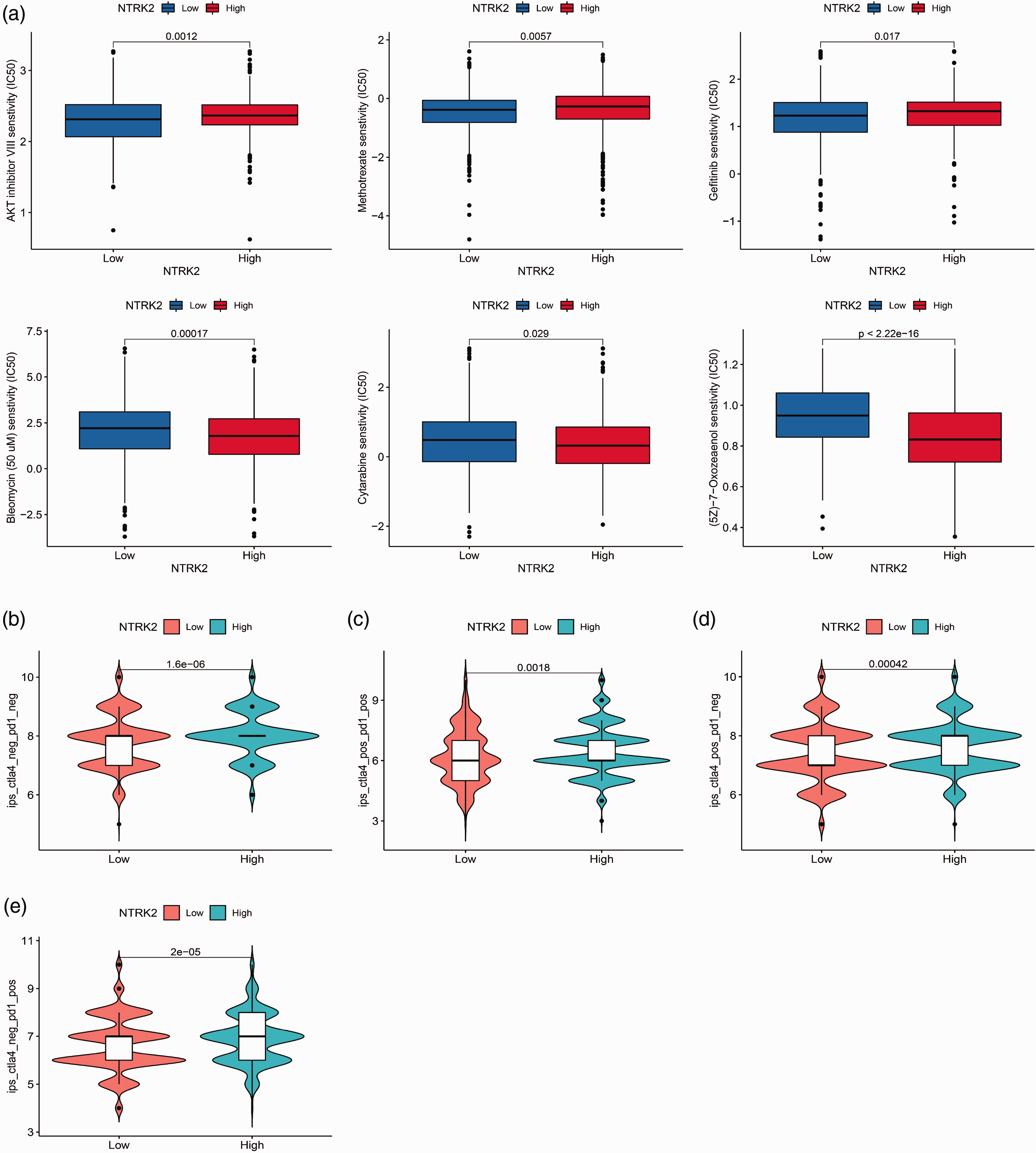
The predictive value of neurotrophic receptor tyrosine kinase 2 (NTRK2) expression was evaluated for various chemotherapy and immunotherapy drugs. (a) The IC50 values of chemotherapeutic drugs. (b–e) Violin plots showing the immunotherapy scores of the low and high NTRK2 expression groups (b) without anti-cytotoxic T lymphocyte antigen 4 (CTLA4) and anti-programmed cell death protein 1 (PD1) treatment, (c) combined anti-PD1 and anti-CTLA4 treatment, (d) anti-CTLA4 treatment alone, and (e) anti-PD1 treatment alone.
Discussion
Of all female malignant tumor types, BRCA has the highest morbidity rate worldwide. 11 Further research is needed to help develop new treatment methods for this disease. Novel mutations in tumor-related genes have been investigated in various cancers, including those in the genes encoding RET, FGFR1, FGFR2, FGFR3, NRG1, MET, ERBB2, PIK3CA, and AKT. Gene fusions caused by gene translocation contribute to NTRK overexpression. 12 Innovative drugs targeting insulin like growth factor receptor (IGFR), epidermal growth factor receptor (EGFR), and programmed cell death ligand-1 (PD-L1) have been gradually used to treat BRCA. Entrectinib (RDX-101, NMS-P626), a multikinase inhibitor, demonstrated efficacy in three clinical trials involving patients with NTRK2 gene fusions. Secretory breast carcinoma, one of the rarest types of BRCA that accounts for less than 1% of all cases, is reportedly related to NTRK2 gene fusion. 13 However, the role of NTRK2 in invasive BRCA remains inadequately understood and warrants further investigation.
NTRK2 is a member of the NTRK protein family. 14 NTRK2 overexpression has recently been reported in rat and human kidney epithelial cells acting as a potent anoikis suppressor through AKT activation. 15 Additionally, NTRK2 expression correlates with a malignant phenotype and poorer prognosis in colorectal cancer 16 and small cell lung cancer patients. 17 Abnormal NTRK2 expression or activation has been demonstrated to participate in the progression 18 and metastasis of many malignant tumors. 19 Furthermore, NTRK2 remains an attractive therapeutic target for anti-cancer therapies. However, the specific NTRK2-related signaling pathways that induce and maintain the cancerous and metastatic nature of the BRCA cells have not been thoroughly investigated. In this study, we demonstrated that NTRK2 protein is expressed at higher levels in BRCA tissues compared with adjacent normal tissues (Figure 1), as well as that NTRK2 is related to lymph node metastasis, TNM stage, tumor recurrence, distant metastasis, and OS in BRCA patients (Table 1). Notably, high NTRK2 protein expression levels correlated with poorer prognosis, which holds considerable implications for clinical translation (Figure 2).
Studies have shown that NTRK2 regulates the epithelial–mesenchymal transition through matrix metalloproteinase (MMP)2 and MMP9. 20 NTRK2 is involved in many signaling pathways, including the MAPK, AKT, and JAK/STAT3 pathways. NTRK2 can also downregulate the expression of p-AKT and p-ERK. 21 Two studies performed Kaplan–Meier survival analyses to investigate the connection between NTRK2 expression patterns and BRCA patient prognosis. Kim et al. showed that patients with higher NTRK2 expression levels exhibited worse survival outcomes than those with lower NTRK2 expression levels. 22 However, data from Wang et al. displayed the opposite result. 8 Our examination of NTRK2 protein levels using tissue microarray experiments indicated that NTRK2 overexpression was significantly related to poorer prognosis and was an independent risk factor of OS in BRCA (Table 2). BDNF-mediated activation of EGFR has been observed in lung cancer, suggesting that BDNF/NTRK2/EGFR crosstalk is a more common mechanism promoting brain metastasis. 23 BDNF can activate NTRK2 or EGFR in triple negative BRCA cells that positively express these receptors. 24
Immunotherapy-based approaches for BRCA have developed considerably, with many immune checkpoint inhibitors (ICIs) being applied in clinical trials and demonstrating encouraging results. 25 However, some patients still respond poorly to anti-immune treatment methods. Additionally, certain immunotherapy-related adverse events have been identified in clinical trials, which may limit their wide application. From the above results, we further discovered that high NTRK2 expression levels could help predict and increased likelihood of sensitivity to bleomycin, cytarabine, and (5Z)-7-Oxozeaenol. ICIs (anti-CTLA4 and anti-PD1 antibodies) also played an important role in targeting NTRK2 (Figure 3).
By analyzing NTRK2 protein expression patterns in 131 BRCA tissues, we found that NTRK2 expression was positively associated with vascular invasion, lymph node metastasis, TNM stage, and tumor recurrence and metastasis in BRCA. These correlations suggest that high NTRK2 expression is linked to a poorer prognosis. Our study implicated NTRK2 as a therapeutic target in BRCA. In our previous study, we analyzed the role of NTRK2 expression in HER2-positive BRCA using the same human BRCA tissue microarray (HBreD131Su08), which contained 60 HER2-positive BRCA cases. This work confirmed that NTRK2 is related to the brain metastasis of HER2-positive BRCA. 26 NTRK2 inhibitors are now emerging as potential therapeutic alternatives for the prevention or treatment of BRCA brain metastasis. 27
Our research still has some limitations, such as the lack of in vitro and in vivo experiments to explore the relationship between NTRK2 expression and immune cell infiltration in BRCA tumors. In subsequent studies, we plan to examine if NTRK2 affects the tumor immune microenvironment and immune cell infiltration in this disease.
Many signatures have been used to provide biological explanations of BRCA or drug-related mechanisms. Despite their great potential, few signatures have entered clinical practice, 28 as none have demonstrated a sensible biological interpretation or meaning with respect to disease etiology. 29 Our research data in this study were from a single center, which may limit the generalization of our results. Although we revealed that high NTRK2 protein expression may be an independent risk factor of BRCA patient OS, this has not been verified by strict testing framework 27 and no clinical trial has been performed. Drugs should also be screened for their sensitivity prior to follow-up clinical trials according to NTRK2 expression to further confirm its relevance in guiding clinical decisions for treating BRCA.
Conclusion
In this study, we demonstrated that NTRK2 expression is closely associated with BRCA patient clinicopathological characteristics and is an independent risk factor for OS in this disease. In addition, NTRK2 can potentially serve as a predictive biomarker for immunotherapy efficacy, as its expression levels correlated with the status of immune checkpoint proteins. Overall, these findings suggest that NTRK2 could serve as a therapeutic target for clinical intervention in BRCA.
Supplemental Material
sj-pdf-1-imr-10.1177_03000605241281322 - Supplemental material for High NTRK2 protein expression levels may be associated with poorer prognosis of breast cancer patients
Supplemental material, sj-pdf-1-imr-10.1177_03000605241281322 for High NTRK2 protein expression levels may be associated with poorer prognosis of breast cancer patients by Rui Zhang, Jianguo Zhao and Lu Zhao in Journal of International Medical Research
Supplemental Material
sj-pdf-2-imr-10.1177_03000605241281322 - Supplemental material for High NTRK2 protein expression levels may be associated with poorer prognosis of breast cancer patients
Supplemental material, sj-pdf-2-imr-10.1177_03000605241281322 for High NTRK2 protein expression levels may be associated with poorer prognosis of breast cancer patients by Rui Zhang, Jianguo Zhao and Lu Zhao in Journal of International Medical Research
Supplemental Material
sj-pdf-3-imr-10.1177_03000605241281322 - Supplemental material for High NTRK2 protein expression levels may be associated with poorer prognosis of breast cancer patients
Supplemental material, sj-pdf-3-imr-10.1177_03000605241281322 for High NTRK2 protein expression levels may be associated with poorer prognosis of breast cancer patients by Rui Zhang, Jianguo Zhao and Lu Zhao in Journal of International Medical Research
Supplemental Material
sj-pdf-4-imr-10.1177_03000605241281322 - Supplemental material for High NTRK2 protein expression levels may be associated with poorer prognosis of breast cancer patients
Supplemental material, sj-pdf-4-imr-10.1177_03000605241281322 for High NTRK2 protein expression levels may be associated with poorer prognosis of breast cancer patients by Rui Zhang, Jianguo Zhao and Lu Zhao in Journal of International Medical Research
Footnotes
Acknowledgements
We are thankful for the inimitable care and support of Yan Zhou over the years. In addition, we thank the reviewers who have provide suggestions for improving the manuscript.
Author contributions
All authors contributed to the study conception and design, material preparation, data collection, and data analysis. RZ wrote the first draft of the manuscript. All authors commented on previous versions of the manuscript and read and approved the final manuscript.
Declaration of conflicting interest
The authors declare that there is no conflict of interest.
Funding
This work was supported by the funding for scientific research project of Wuhan Municipal Health Commission (WX23A33), Hubei Province Science and Technology Plan project (2022BGE233), and Chen Xiao-Ping Foundation for the Development of Science and Technology of Hubei Province (CXPJJH12000005-07-62).

Supplementary materials
Supplementary Tables
Table S1. The R script of estimation of the sensitivity to chemotherapy and immunotherapy
Table S2. Univariate analysis and multivariate Cox regression analysis of disease-free survival in breast cancer patients
References
Supplementary Material
Please find the following supplemental material available below.
For Open Access articles published under a Creative Commons License, all supplemental material carries the same license as the article it is associated with.
For non-Open Access articles published, all supplemental material carries a non-exclusive license, and permission requests for re-use of supplemental material or any part of supplemental material shall be sent directly to the copyright owner as specified in the copyright notice associated with the article.
