



Abstract
Adverse drug reactions represent a major health burden because they cause notable patient morbidity and mortality. From this viewpoint, several strategies have been developed to prevent or reduce adverse drug reactions. One such strategy is the use of pharmacogenomics. Interindividual variability in drug response and adverse effects is mainly attributable to genetic variation in enzymes such as sulfotransferases and cytochrome P450s. The current narrative review discusses the relationship between the structure and activity of drugs. Specifically, the activity of drugs can be increased and/or their adverse effects can be reduced by altering specific positions in their structures.
Keywords
Introduction
Adverse drug reactions (ADRs) represent one of the 10 leading causes of morbidity and mortality in developed countries. 1 Most ADRs, which are associated with a variety of drugs and can affect every organ or system, are classified into type A, which is dose-dependent, or type B (idiosyncratic), which is dose-independent.2,3 Type A ADRs are generally more common than type B reactions. 4 ADRs have different characteristics depending on different factors such as race, sex, age, genotype, pathology, drug category, administration route, and drug–drug interactions. 1 Only 50% to 75% of patients react appropriately to drugs, whereas others experience a lack of efficacy or ADRs.5,6 Therefore; to minimize side effects, patients should follow instructions from their physicians with continuous observation of their condition by the physician, and pharmacogenomics should be considered. 7 Pharmacogenomics is the study of the effects of genes on drug response. 8 This field explains the interactions of genes and their functions with drugs. 9 A previous study mentioned that this term was invented by Friedrich Vogel in 1959. He noted the importance of genetic variants in clinical consequences. 10 The effects of genetic variants fall into two essential pathways: the candidate gene pathway and the genome-wide pathway. The candidate gene pathway is related to certain genes that are believed to interact with drug metabolism or its response, 11 whereas the genome-wide pathway encompasses diverse genetic variants such as single-nucleotide polymorphisms, insertions, or deletions.12,13 Some single-nucleotide polymorphisms identified in genome-wide research are associated with the mechanism of disease. 14 The current review highlights the role of pharmacogenomics in minimizing ADRs and explaining interindividual variability in drug responses. It gives a brief note on the effects of structural modifications on the efficacy and side effects of drugs.
ADRs and pharmacogenomics
The inclusion of pharmacogenomic testing in the follow-up of ADRs will lead to new clinical diagnoses of unexpected diseases and enhance the efficacy of drugs. 2 Approximately 20% to 30% of ADRs can be predicted by this testing. 15 It is useful for identifying genetic variants that encode certain cytochrome P450 enzymes (e.g., cytochrome P450 2C9 [CYP2C9], CYP3As, CYP2D6, CYP2C19). 15 These enzymes play critical roles in the metabolism and clearance of most drugs used in clinical settings. 16 For example, CYP2D6 participates in the metabolism of approximately 20% of drugs. 17 Polymorphisms in the alleles of CYP2A6 result in variations in nicotine metabolism between smokers. Low activity of this enzyme leads to the slow metabolism of nicotine, resulting in less severe withdrawal manifestations. 18 In addition, smokers carrying the DR2 A2 allele who used bupropion for smoking cessation experience better outcomes than their counterparts carrying the DR2 A1 allele.19,20 Tables 1 and 2 contain examples of drugs and their pharmacogenomic markers, structure modifications, and modified effects.
Pharmacogenomic markers and responses for select drugs.

CYP, cytochrome P450; PMs, poor metabolizers.
Effects of structural modification on select drugs and drug groups.
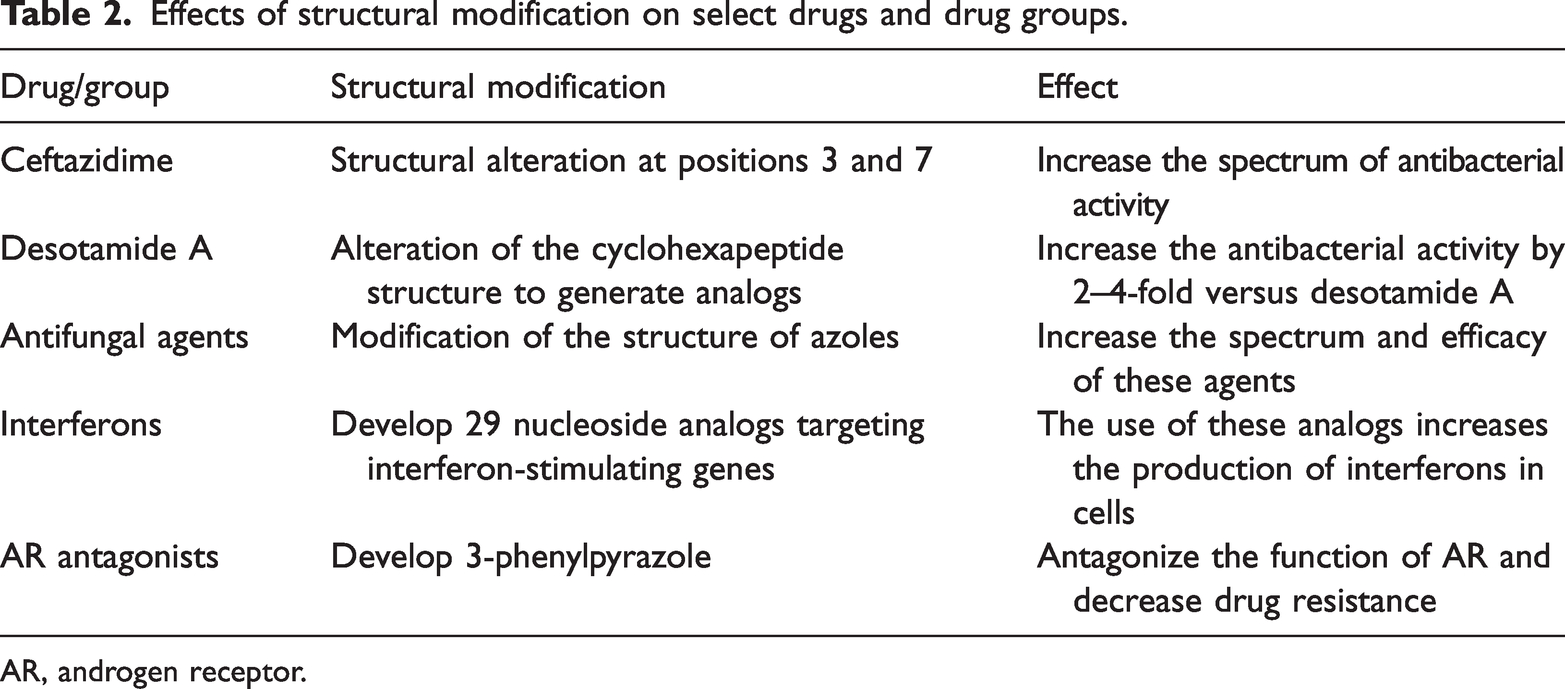
AR, androgen receptor.
Numerous clinical outcomes are attributable to diversity in pharmacogenomic modifications such as hydrolysis, oxidation, and acetylation. 21 For example, individuals with lower enzymatic activity will have higher concentrations of the drug in their circulation, making them more susceptible to drug-induced toxicity. Conversely, those with higher enzymatic activity will have lower concentrations of the drug. 17 Thus, it is clear that every metabolic track of a drug is affected by genetic variation. 22
It should be noted that genetic differences between individuals appear every 300 to 1000 nucleotides, and more than 14 million single-nucleotide polymorphisms exist throughout the human genome. 23 These variations have importance in the risk of developing diseases and responding to medications. 24 In addition, more than 100 drugs are known to be affected by pharmacogenomic variants. The product labels for these drugs have been updated by the US Food and Drug Administration (FDA), and an updated schedule of drug–gene relationships was newly issued with scientific evidence to organize treatment. 25 Thus, deep understanding of drug–gene interactions led to an increase in the number of drug labels containing pharmacogenomics information approved by the US FDA 26 and the European Medicines Agency, 27 with such information targeted mainly at healthcare providers. 20
Interindividual variation in drug response is attributable to epigenetic aberrations that affect genes responsible for drug distribution and targets. 29 These variations are mainly caused by genetic variation in enzymes. 30 For example, many studies revealed that Black patients with hypertension can have a reduced response to angiotensin-converting enzyme (ACE) inhibitors or angiotensin receptor blockers (ARBs) compared with White patients. Thus, these drugs should be used in combination with thiazide or calcium channel blockers instead opposed to their use as monotherapy. 31
Renin–angiotensin–aldosterone system (RAAS) inhibitors have been assumed to affect the incidence of COVID-19. 32 A trial of anti-ACE2 and anti-ACE1 antibodies found that viral replication was inhibited by anti-ACE2 antibodies. This proved that ACE2 is a functional receptor for COVID-19. 33 Thus, binding of the SARS-CoV-2 S protein to ACE2 permits viral entry and replication. 34 Many studies suggested that RAAS inhibitors increase the expression of ACE2. 35 Based on this information, patients who are using ACE inhibitors and ARBs could have a higher risk of COVID-19. 36 In addition, Najafi et al. reported that ACE inhibitors and ARBs expose patients with COVID-19 to a high risk of moderate-to-severe infections. 37 By contrast, RAAS inhibitors were found to reduce the risk of mortality and the need for ventilation in patients with COVID-19 and hypertension. 37 Moreover, Sentongo and colleagues reported that these drugs have a protective effect against COVID-19 in hypertensive patients. 38
Sulfotransferases (SULTs) stimulate sulfur conjugation, an extremely important phase II reaction in drug detoxification 39 for drugs such as acetaminophen 40 and NSAIDs such as dimethyl naproxen (a major metabolite of naproxen), which is specifically performed by SULT1A1.41,42 Conversely, SULTs can bioactivate carcinogens such as tobacco and procarcinogens such as 2-amino-α-carboline. 43 Although variability between individuals in the activity of SULTs is majorly attributed to epigenetic and environmental influences, genetic variation also plays a role 39 via non-synonymous single-nucleotide polymorphisms. 44 Such polymorphisms might be crucial for interindividual variability in drug response and toxicity or for increased disease risk. 45 For example, SULT1A1 polymorphism is associated with an increased risk of some cancers, such as breast cancer (especially in Asian patients), 46 gastric cancer, 47 tongue cancer in women, 48 and oral squamous cell carcinoma in Taiwanese patients with the H149Y haplotype. 49 CYP450s are critical in the stimulation of phase I drug metabolism 50 and detoxification as well as the elimination of common drugs. 51
CYP450 polymorphism can affect the efficacy and side effects of drugs. 52 For example, a study on Indian patients with systemic lupus erythematosus (SLE) who received cyclophosphamide found that patients with the variant allele CYP2C19*2 have a lower risk of ovarian toxicity. 53 By contrast, the risk is increased 5-fold by the presence of the CYP2C19*1/*1 genotype, as demonstrated in a study of Thai patients with SLE. 54 Codeine is converted to morphine via o-demethylation by CYP2D6, and this conversion is responsible for the activity of codeine. 55 Morphine levels differ between individuals according to the CYP2D6 genotype. High morphine levels have been found in individuals with more than two normal copies of CYP2D6, which explains morphine overdose symptoms in patients who received therapeutic doses of codeine. On the contrary, individuals with two inactive copies of this gene exhibited low morphine levels. 56 CYP2D6 is the major enzyme that metabolizes metoprolol, a β-blocker drug used to treat hypertension and other diseases. The risk of bradycardia varies between CYP2D6 poor metabolizers and CYP2D6 normal metabolizers. CYP2D6 poor metabolizers have a higher risk of bradycardia because of their higher levels of metoprolol. 57 Haloperidol is also metabolized by CYP2D6. A study by Brockmöller and colleagues reported that the risk of pseudoparkinsonism was higher in poor metabolizers. 58
Structure–activity relationships (SARs) have been used to discover and develop drugs and to correlate molecular information with biological activities and physiochemical properties. 59 To apply SARs, two steps must be followed. First, a description of the chemicals must be provided. Second, chemometric paths must be implemented to incorporate the link between structure and activity. 60 Accumulating information about SARs for a group of molecules will permit elucidation of the chemical space and expand chemical series to improve physiochemical and biological characteristics, such as optimizing potency, decreasing toxicity, and confirming full bioavailability. 61
Antimicrobial drugs
Many antibacterial drugs target ribosomal protein synthesis. One example is xenocoumacin 1, a natural product that binds to 16S ribosomal RNA. Because of the high homology between prokaryotic and eukaryotic ribosomes, SAR studies aimed to alter the selectivity between prokaryotic and eukaryotic ribosomes. Analogs selective for eukaryotic ribosomes have been developed, but inhibitors selective for prokaryotic ribosomes have not been obtained. 62 In light of the emergence of many Mycobacterium tuberculosis (MTB) strains that are resistant to antibiotics, new agents with greater efficacy against this microbe are desired. Girase and colleagues found that the addition of piperazine to antibiotic regimens provided efficacy against multidrug-resistant and extremely drug-resistant strains of MTB. 63
The structure of ceftazidime features two important positions, namely position 3, which contains a pyridine group, and position 7, which contains an aminothiazole ring and a propylcarboxy moiety. A study by Bergogne-Bérézin about the SARs of ceftazidime reported that structural alteration at these positions improved the affinity of the drug for the penicillin-binding proteins of gram-negative bacilli, increased its effects against beta-lactamases produced by certain bacteria, and expanded its spectrum of antibacterial activity to Pseudomonas and Acinetobacter. 64
Desotamide A is a cyclohexapeptide with antibacterial activities. Regarding the SARs of desotamide, Xu and colleagues developed 13 cyclopeptides including 10 analogs of desotamide A. In particular, desotamide A4 and desotamide A6 exhibited 2- to 4-fold antibacterial activity versus desotamide A, especially against gram-positive pathogens, and these analogs are being investigated as novel antibiotics. 65
Antifungal, antimalarial, and antiviral drugs
Fungi are important causes of infectious disease-related death. Pharmacologists have developed azole-based agents, which have proved effective against fungal infections and emerged as first-line treatments. Recently, fungal species with resistance to these drugs have appeared. Modifications of the structure of azoles could increase their spectrum and efficacy, and researchers are currently studying the SARs of azole-based agents. 66 The need for new antimalarial compounds is of great importance because of resistance to first-line artemisinin-based antimalarial drugs, the absence of active vaccines, and limited chemotherapeutic alternatives. 67
Interferons are proteins of the human innate immune defenses. Twenty-nine nucleoside analogs were investigated in a cell-based assay because of their capability to activate human interferon-stimulated genes, but only six of these analogs lacked cytotoxicity. These agents increase the production of interferons, which are an important target for antimicrobial therapy. 68
Other examples
Prostate cancer is mostly treated using androgen receptor (AR) antagonists, but the long-term use of these drugs can lead to resistance. Therefore, there is a need to assess new regimens. 3-phenylpyrazole was found to antagonize the function of AR, thereby alleviating drug resistance. 69 Free fatty acid receptor 2 is sensitive to short-chain fatty acids, and this receptor was identified as a specific target for many drugs. Researchers have focused on amide-substituted phenylbutanoic acid, a potent agent targeting free fatty acid receptor 2. In particular, Hansen and colleagues studied SARs with the goal to increase the efficacy of drugs targeting this receptor.70 Figure 1 shows different examples of SARs and their role in optimizing potency, decreasing toxicity, and improving bioavailability of drugs.

Structure–activity relationships. AR, androgen receptor; MTB, Mycobacterium tuberculosis.
Conclusion
The current review described different examples of how altering the structures of drugs can greatly affect their pharmacological activity and safety profiles. Interindividual variation in drug responses should be considered before prescribing different drugs. Further pharmacogenomics studies targeting metabolic enzymes and receptors are highly recommended to develop newer agents with better efficacy and safety.
Footnotes
Author contributions statement
RHT wrote this mini-review and finalized its editing. All co-authors contributed equally to data collection and editing and revision of the manuscript, and all authors agree to be accountable for all aspects of the work.
Data availability statement
The data based on the results of the current study are accessible from the corresponding author upon reasonable request.
Declaration of conflicting interests
All authors declare that they do not have anything to disclose regarding conflict of interest with respect to this manuscript.
Funding
This study was not funded by any specific grant from funding agencies in the public, commercial, or not-for-profit sectors.
