



Abstract
Objective
To compare the beliefs, attitudes and feelings about work of healthcare professionals (HCPs) and teachers living in the Canary Islands (Spain) during the COVID-19 pandemic.
Methods
The study had two parts. In Part 1, the Delphi technique was used to adapt a questionnaire. Part 2 was a cross-sectional, comparative study, performed from August 31st to October 25th, 2021 using the questionnaire online distributed to samples of HCPs and teachers. The questionnaire had three dimensions each separated into three sections (i.e., beliefs [coping ability, prevention and organisation]; attitudes [risks, commitments, and obligations]; feelings about work [burnout, support and work satisfaction]).
Results
In total 1423 questionnaires were available for analysis, 640 from teaching staff and 783 from HCPs. Significant differences were found in eight of the nine sections. HCPs had a more positive attitude towards work compared with teachers, but had more negative beliefs and feelings about work. In addition, by comparison with teachers, HCPs were more committed to their work, more predisposed to take risks and fulfill their obligations, even though our sample of teachers felt more supported and satisfied at work.
Conclusions
Our results show that the pandemic caused a greater negative impact on job satisfaction of HCPs compared with teachers because they felt less supported by their superiors, which had a greater impact on their psychological health.
Introduction
On March 11th, 2020, the World Health Organization (WHO) formally declared coronavirus disease 2019 (COVID-19) a global pandemic. 1 Three years later, and far from ending the health crisis, members of the WHO International Health Regulations Emergency Committee issued a report in January 2023 and stated that they still consider the ongoing COVID-19 pandemic to constitute a global public health emergency. 2
In Spain, the Government decreed a state of alarm to deal with the health emergency and confined the population to limit and reduce infection rates, a situation that was extended until June 21st, 2020. 3 Subsequently, the general population and employment sectors have adapted to this new reality, and learned to live with the virus and the hygienic-sanitary and safety measures imposed by health authorities. However, working for a long time under a situation of stress, risk, and uncertainty has had an impact on the physical, mental, and emotional health of exposed workers, as well as on their performance and attitudes to work. 4
As the pandemic evolved, the educational sector sought alternatives to guarantee the education of its students. During the confinement, in the 2019/20 academic year, teaching staff initially taught via information and communication technologies (ICTs) from their homes in an improvised way and later in person using necessary hygienic-sanitary measures and personal protective equipment (PPE).5,6 For teachers, continuing to teach from their own homes caused an imbalance between their work and family life, with women being the ones who, to a greater extent, perceived online working as having a negative impact on their lives. 7 Similarly, when teachers returned to face-to-face teaching, it was estimated that nearly half of them suffered with stress and anxiety, and approximately a third with depression. 8 In May 2020, before face-to-face classes commenced, we found that teachers in the Canary Islands (Spain) were willing to teach using this modality providing relevant safety measures were guaranteed in their workplace. 6 However, a majority expressed doubts about the availability of such means. In another study we found that those teachers who had a school nurse/health professional in their centres during the 2021/22 academic year, perceived that they had more PPE, and felt safer in their workplace had more positive attitudes towards work with fewer feelings of professional exhaustion compared with teachers who did not. 9
Healthcare professionals (HCPs) have also been reported to be greatly affected by the pandemic because of the nature of their work and lived experiences in their work environment. 10 However, one study from approximately a thousand HCPs, found that irrespective of the problems encountered during the pandemic, they demonstrated an enormous commitment to their profession, even when there was an additional risk of infecting themselves or their relatives. 11 Nevertheless, over time, and probably because of prolonged exposure to an exceptional situation of risk and uncertainty with complex working conditions, this commitment to society and patients has decreased as feelings of professional burnout and emotional exhaustion have increased.4,12 Several studies support the observation that the pandemic has had a negative impact on the healthcare community.13–17 Indeed, data from a Canadian study involving a sample of intensive care nurses showed that post-traumatic stress levels and intention to leave the profession had tripled after the third wave of COVID-19.18,19 Importantly, in a previous study, we found that almost a fifth of HCPs required some type of psychological help or psychiatric therapy during the pandemic. 20
To our knowledge, there are currently no published studies that have compared information about job satisfaction and attitudes to work between HCPs and teaching staff after five waves of the COVID-19 pandemic. Therefore, the objective of our study was to compare differences in beliefs, attitudes and feelings about work between HCPs and teachers who worked in the Canary Islands, Spain, during this period of the COVID-19 pandemic using a common measuring tool.
Methods
The study was in two parts.
Part I
The Delphi technique was used to update two instruments (i.e., one for HCPs, 11 the other for teaching staff, 6 ) we had previously used in 2020. The instruments were based on a questionnaire previously created and validated by researchers in the UK, 21 and investigated beliefs, attitudes and feelings about work. The first versions of the instruments were distributed to HCPs (n=17) and teachers (n=14), from different fields within their areas of knowledge. Two rounds of testing were required to achieve consensus on the final instruments and evaluate their internal validity.
In the final questionnaires, questions were separated into five block areas; these were: (1) beliefs of workers about the pandemic (items were scored as: yes; no; don't know); (2) attitudes concerning work performed (items scored as: probable; don't know; not probable; does not respond); (3) sociodemographic details; (4) work-related issues of the respondent (items scored as: agree; disagree); (5) feelings about work (items scored as: never; once a year; once a month; several times a month; once a week; several times a week; daily). To determine the reliability of the instruments, Cronbach's alpha coefficients were assessed. Values for the teaching staff survey (69 items) and HCPs survey (78 items) were 0.967 and 0.954, respectively. These results suggest a high degree of internal consistency for each questionnaire.
Part 2
Subsequently, a cross-sectional comparative study was undertaken and involved HCPs and teaching staff living in the Canary Islands, Spain during the fifth wave of COVID-19 pandemic. From the questionnaires developed in Part 1, we selected items that would be common to both populations to construct a questionnaire that was used online from August 31st to October 25th, 2021. The questionnaire was digitized in the “Google Form” format and was pre-tested by the members of the research team to identify and correct any comprehension errors.
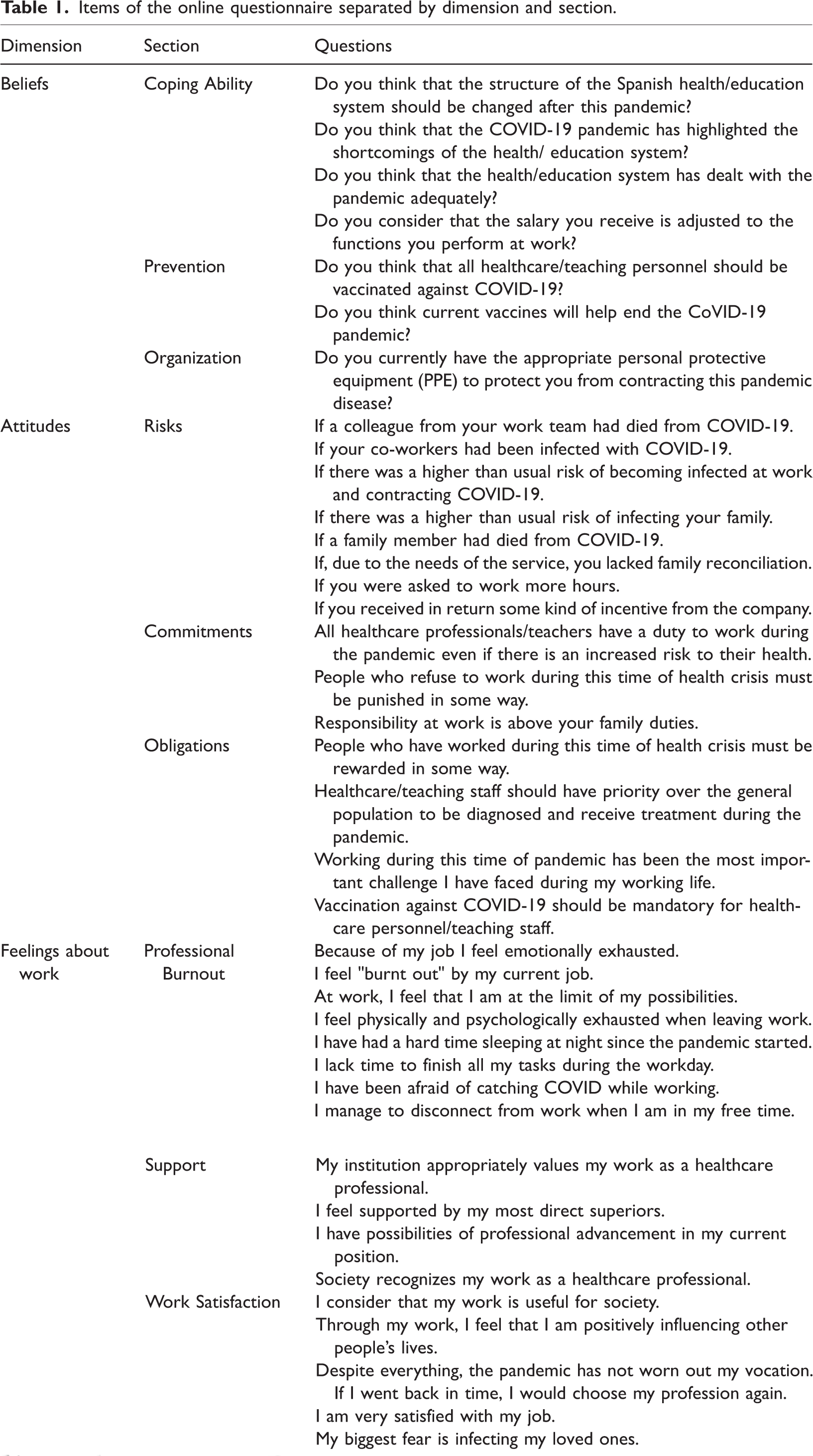
A brief explanation of the study was included in the first part of the questionnaire because it was a self-administered instrument. In the introduction, respondents were thanked for their participation, informed that all data would be anonymized and asked to provide written informed consent. Questions on demography were also included in the introduction. The main body of the questionnaire consisted of three dimensions (i.e., beliefs, attitudes and feelings about work) each separated into three sections (Table 1). For beliefs, the sections were, coping ability, prevention and organisation. For attitudes the sections were, risks, commitments, and obligations. For feelings about work, the sections were burnout, support and work satisfaction. The nine sections contained a total of 39 questions.
Items of the online questionnaire separated by dimension and section.
The target population for the education sector included teachers from public or private educational institutions; the group comprised of teachers from early-education and primary school to university professors. With regard to the target population for the healthcare sector, the HCP group consisted of doctors, resident doctors, nurses, resident nurses, physiotherapists, auxiliary nursing care technicians, emergency medical technicians, radiology technicians and laboratory technicians who had worked during the COVID-19 pandemic in public or private healthcare institutions. To be eligible for the study, participants (i.e., HCPs or teachers) had to have been active in their job during the pandemic period and provided written informed consent. Participants who responded inappropriately to a control question (i.e., designed to avoid automatic responses) were excluded from the study.
The study was approved by the Research Ethics Committee/Medication Research Ethics Committee of the Dr. Negrín University Hospital of Gran Canaria (CEI/CEIm HUGCDN) (CEIm HUGCDN Code: 2021-262-1 COVID-19) and complied with the ethical standards required by the Ethics Commission of the Universitat Jaume I (file number “CD/112/2021”). The reporting of this study conforms to STROBE guidelines. 22
Statistical analyses
Sample size calculations were based on data from two previous studies involving teaching staff or HCPs working in the Canary Islands in 2021.9,11,23 For HCPs, the sample size was based on 22,882 healthcare staff who were working in the specified period. In total, 585 HCPs were required for a confidence level of 95% with a sample error of 4%. For the educational sector, the sample size was based on a population of 35,714 teachers who were working in the specified period. In total, 590 teachers were required for a confidence level of 95% with a sample error of 4%.
Data were analyzed using SPSS software (version 25 for Windows®; IBM Corp., Armonk, NY, USA). A P-value < 0.05 was considered to indicate statistical significance. Descriptive statistics were used for analysis of demographic and employment data and response to questions on beliefs, attitudes, and feelings. Numerical data were tested for normality using the Kolmogorov–Smirnov test and then expressed as absolute and relative frequency. Categorical variables were analysed using Pearson's χ2 test or Fisher’s exact test. Data that were non-normally distributed were analyzed using Mann-Whitney’s U test.
Multivariable logistic regression models were used with dimension as an effect or dependent variable and HCP and teachers as explanatory variables for the response adjusted for sociodemographic and employment characteristics that had reached a statistically significant difference between the two groups. Data were presented as odds ratio (OR) with 95% CIs. The models used a backward stepwise strategy and starting with all variables in the model, the Wald test (at a significance level of P < 0.05) was used to confirm if each independent variable was significant or not.
Results
Demography
In total, 1485 completed questionnaires were received, of which 62 were excluded because of inclusion/exclusion criteria violations. Of the remaining 1423 questionnaires, 640 were provided by teaching staff and 783 were from HCPs.
The teachers were older than the HCPs (49 vs 43 years, P < 0.001), more worked in the public sector (95% vs 86%, P < 0.001) had permanent work contracts (68% vs 33%, P < 0.001) and a university degree (65% vs 46%, P < 0.001) (Table 2). However, there were no differences between groups in family situation or where they lived. There was a significant difference (P < 0.001) between groups in the time they had worked, with more teachers than HCPs working more than 20 years (46% vs 34%).
Demographic and employment information of the participants.

Data are expressed as, n (%) or median (interquartile range).
HCP, health care professional; ns, not statistically significant.
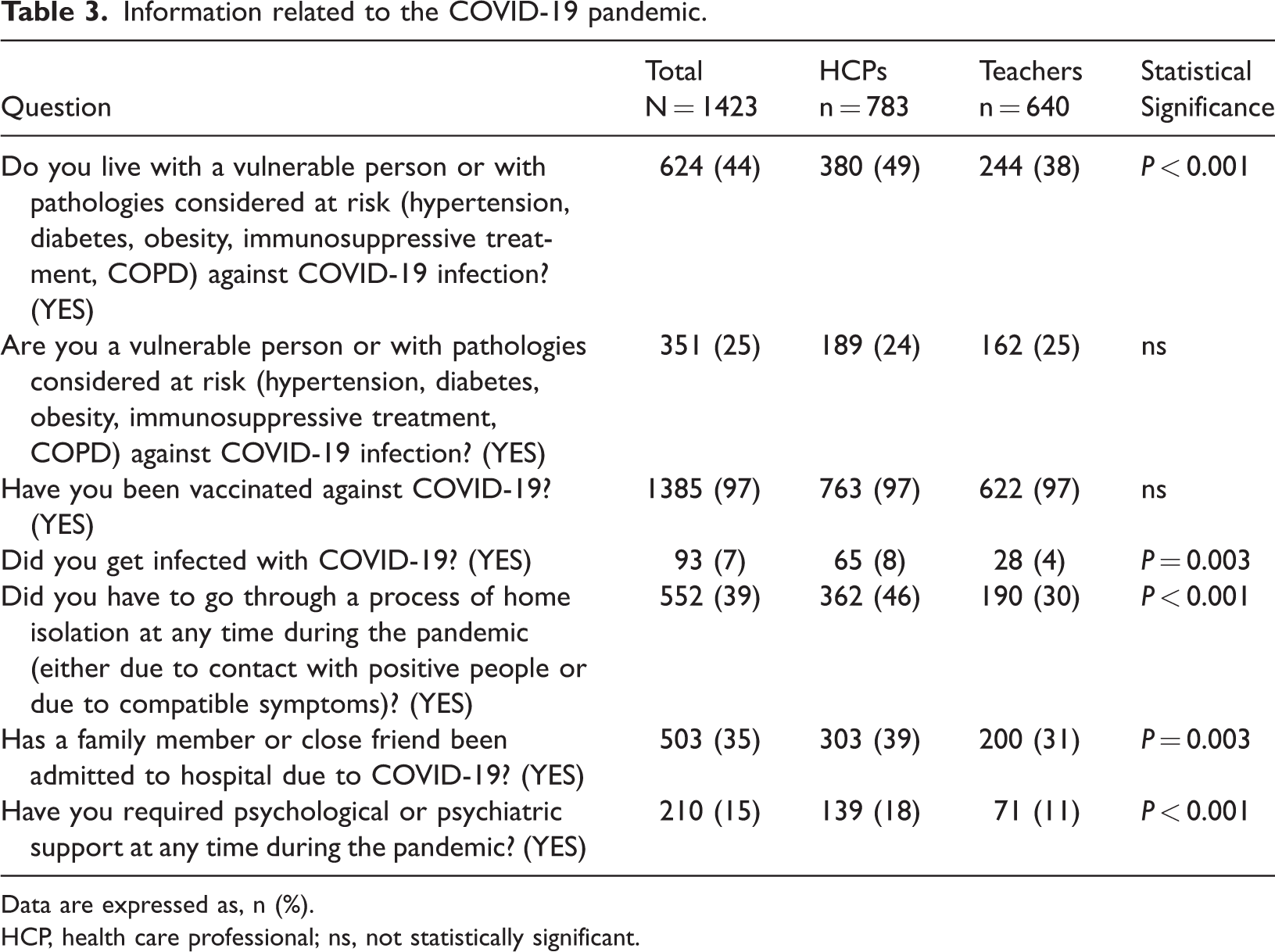
More HCPs than teachers lived with a vulnerable person (49% vs 38%, P < 0.001) and had more relatives or friends admitted to hospital because of COVID-19 (39% vs 31; P = 0.003) (Table 3). While the numbers were low, more HCPs than teachers contracted COVID-19 (8% vs 4%, P = 0.003) and underwent more home isolation processes (46% vs 30%, P < 0.001). In addition, the HCP group required more psychological or psychiatric support during the pandemic than the teacher group (18% vs 11%, P < 0.001).
Information related to the COVID-19 pandemic.
Data are expressed as, n (%).
HCP, health care professional; ns, not statistically significant.
Results from the questionnaire
With the exception of burnout, we found significant differences between HCPS and teachers in eight out of the nine sections of the questionnaire (Table 4).
Comparison of positive responses on Beliefs, Attitudes and Feelings about work.*

HCP, health care professional; ns, not statistically significant.
Percentages were calculated from available data.
Beliefs
Coping ability: More teachers were positive about their coping ability compared with HCPs (38% vs 13%, P < 0.001; OR, 0.23: 95% CI, 0.17–0.31; P < 0.001) (Table 4). An inspection of replies to individual questions showed that more teachers were satisfied with the salary they received compared with HCPs (44% vs 16%, P < 0.001; OR, 0.23: 95% CI, 0.18–0.30; P < 0.001) and considered that the system adequately coped with the pandemic (56% vs 29%, P < 0.001; OR,0.33: 95% CI, 0.26–0.41; P < 0.001) (Table 5).
Positive responses to individual questions on Beliefs, Attitudes and Feelings about work.*
HCP, health care professional; ns, not statistically significant.
Percentages were calculated from available data.
Prevention: Similarly, more teachers were positive about prevention compared with HCPs (78% vs 64%, P < 0.001; OR, 0.52: 95% CI, 0.39–0.69; P < 0.001) (Table 4). An inspection of replies to individual questions showed that a higher percentage of teachers considered that vaccines would help end the COVID-19 pandemic (79% vs 65%, P < 0.001; OR, 0.50: 95% CI, 0.38–0.67; P < 0.001) (Table 5).
Organization: By comparison to the previous two sections, more HCPs than teachers had a positive response to question about organization (92% vs 58%, P < 0.001; OR, 8.47: 95% CI, 6.22–11.55; P < 0.001) (Table 4). The specific question in this section referred to personal protective equipment (PPE) (Table 5).
Attitudes
Risk: For this section, more positive responses were obtained from HCPs than teachers (82% vs 43%, P < 0.001; OR, 4.60: 95% CI, 3.16–6.71; P < 0.001) (Table 4). An inspection of replies to individual questions showed that HCPs were more predisposed to continue working despite the fact that there was a greater risk of contagion (53% vs 29%, P < 0.001; OR, 2.81: 95% CI, 2.17–3.63; P < 0.001) or infecting relatives (34% vs 17%, P < 0.001; OR, 2.44: 95% CI, 1.82–3.26; P < 0.001) (Table 5). Moreover, this predisposition to work compared with responses from teachers continued even if co-workers had been infected by COVID-19 (86% vs 57%, P < 0.001; OR, 4.75: 95% CI, 3.56–6.35; P < 0.001) and even if a colleague from their work team (81% vs 59%, P < 0.001; OR, 2.98: 95% CI, 2.23–4.00; P < 0.001) or a relative (75% vs 59%, P < 0.001; OR, 2.08: 95% CI, 1.56–2.76; P < 0.001) would have died as a result of the pandemic (Table 5). Furthermore, HCPs responded more positively than teachers to being asked to work more hours if required (66% vs 35%, P < 0.001; OR, 3.71: 95% CI, 2.90–4.75; P < 0.001) or continue working if, due to the needs of the service (46% vs 29%, P < 0.001; OR, 2.16: 95% CI, 1.67–2.83; P < 0.001) or if they received some kind of incentive (83% vs 63%, P < 0.001; OR, 2.90: 95% CI, 2.19–3.84; P < 0.001). Commitments: More positive responses about commitments were obtained from HCPs compared with teachers (70% vs 50%, P < 0.001; OR, 2.35: 95% CI, 2.01–2.73; P < 0.001) (Table 4). An inspection of replies to individual questions showed that more HCPs than teachers regarded they had a duty to work during the pandemic (52% vs 33%, P < 0.001; OR, 2.22 95% CI, 1.79–2.76; P < 0.001) and felt that people who refused to work during the health crisis should be penalized I some way (22% vs 14%, P < 0.001; OR, 1.65 95% CI, 1.25–2.18; P < 0.001) (Table 5). Obligations: Similarly, more positive responses about obligations were obtained from HCPs compared with teachers (96% vs 85%, P < 0.001; OR, 3.96: 95% CI, 2.63–5.98; P < 0.001) (Table 4). An inspection of replies to individual questions showed that more HCPs than teachers indicated that working during the pandemic had been the most important challenge they had faced during their career (83% vs 77%, P = 0.003; OR, 1.48: 95% CI, 1.14–1.92; P = 0.003) and felt that people who had worked during the pandemic should be rewarded in some way (91% vs 66%, P < 0.001; OR, 5.19: 95% CI, 3.86–6.97; P < 0.001) (Table 5).
Feelings about work
Professional Burnout: Although there was no difference between groups in “burnt out” (71% vs 67%, for teachers and HCPs, respectively; Table 4) there were some significant differences in the responses to several individual questions in this section (Table 5). For example, more HCPs than teachers felt emotionally exhausted (75% vs 70%, P = 0.024; OR, 0.76: 95% CI, 0.60–0.97; P = 0.024) and showed more “burnt out” in their current job (61% vs 49%, P < 0.001; OR, 0.62: 95% CI, 0.51–0.77; P < 0.001) (Table 5). In addition, more HCPs than teachers had found it difficult to sleep at night since the start of the pandemic (54% vs 45%, P < 0.001; OR, 0.70: 95% CI, 0.57–0.86; P < 0.001) and felt more fear of getting infected while working (74% vs 61%, P < 0.001; OR, 0.56: 95% CI, 0.45–0.70; P < 0.001). Support: For this section, more positive responses were obtained from teachers than HCPs (43% vs 33%, P < 0.001; OR, 0.65: 95% CI, 0.53–0.81; P < 0.001) (Table 4). An inspection of replies to individual questions showed that more teachers than HCPs felt valued by their institution (55% vs 45%, P < 0.001; OR, 0.67: 95% CI, 0.54–0.82; P < 0.001) and felt more supported by their superiors (76% vs 61%, P < 0.001; OR, 0.51: 95% CI, 0.40–0.64; P < 0.001) (Table 5). By contrast, more HCPs than teachers considered that society recognized their work (51% vs 42%, P < 0.001; OR, 1.45: 95% CI, 1.17–1.78; P < 0.001). Work Satisfaction: More positive responses were obtained from teachers compared with HCPs (87% vs 76%, P < 0.001; OR, 0.48: 95% CI, 0.36–0.64; P < 0.001) (Table 4). By comparison with HCPs, teachers considered themselves more satisfied with their work (93% vs 76%, P < 0.001; OR, 0.49: 95% CI, 0.34–0.70; P < 0.001) and felt that through their work they were positively influencing others’ lives (97% vs 93%, P < 0.001; OR, 0.34: 95% CI, 0.20–0.59; P < 0.001) (Table 5). Moreover, more teachers than HCPs indicated that they would choose their profession again if they could go back in time (91% vs 86%, P = 0.002; OR, 0.59: 95% CI, 0.42–0.83; P = 0.002).
Discussion
Our survey, conducted in the Canary Islands, found that during the fifth wave of COVID-19 pandemic, HCPs had a more positive attitude towards work compared with teachers, but had more negative beliefs and feelings about work. In addition, by comparison with teachers, the HCPs in our survey were more committed to their work, more predisposed to take risks and fulfill their obligations, even though our sample of teachers felt more supported and satisfied at work. A study on burnout and well-being in HCPs, found that organizational support had an important protective effect in cushioning negative effects of work-related stressors, whereas social support was more linked with depression and anxiety. 24 These results are consistent with our research in that we found HCPs felt less supported by their institutions and direct superiors, and indicated that they were physically, psychologically, and emotionally exhausted by their work compared with teachers. Interestingly, previous investigators found that resilience was a significant negative predictor of emotional exhaustion and a positive predictor of personal fulfillment; their results encourage the implementation of resilience for both HCPs and teachers.25–27 Results from a previous study in HCPs during the pandemic, found age to be a protective factor against the need for psychological help, whereas having suffered from COVID, experiencing shortages of PPE and feeling emotionally exhausted were risk factors. 20 The same study found that HCPs had an obvious level of professional exhaustion as the repercussions of the pandemic continue.
Our findings concerning sleep problems, especially in HCPs, have been described elsewhere. 31 In that previous study, researchers found that almost two out of five HCPs suffered insomnia, and that these workers had higher levels of anxiety, depression, and sleep issues compared with the general population. We observed that HCPs, compared with teachers, not only had more problems falling asleep, but felt more fear of getting infected whilst working, and had a greater fear of infecting their relatives. Consistent with other findings, we observed that HCPs, by comparison with teachers, were the group of workers most affected by the COVID-19 pandemic, in terms of their attitudes and feelings.10,29
Despite both groups of workers having a similar employment regime (based on the Royal Legislative Decree 5/2015, dated 30th October 30,31) a large part of the educational sector has a stable employment contract, whereas most HCPs have temporary contracts. Greater job stability may have accounted for the fact that a significantly higher percentage of teachers compared with HCPs agreed that the system had dealt with the pandemic adequately. Indeed, HCPs were the group who most believed that COVID-19 pandemic had highlighted shortcomings of their system and considered that its structure should be changed. Given that the work environment, workload and working conditions are factors that influence the mental health and emotional well-being of workers, it is plausible that having precarious working conditions, worsened by the context of a health crisis, may have produced the perfect storm in the Spanish health system, and greatly affected the health of the HCPs.4,32–36 However, our sample of HCPs had a more positive work attitude than our teachers, as they were more committed to their work, more predisposed to assume risks and to fulfill their obligations. By contrast, our sample of teachers had a low predisposition to take risks at work, although having a school nurse in their centre increased this group’s ability to face the pandemic. 9
Unsurprisingly, a decrease in the level of commitment of HCPs can be expected after five waves of the COVID-19 pandemic, as the percentage of professionals who are willing to work in conditions of high risk of infection, willingness to work more hours, work in different health centres and take on additional tasks for which they have not been trained/educated, has also decreased.11,12,20 The loss of value among their attitudes is probably influenced by the experiences they have lived through, the professional burnout that working under high levels of stress for a long time entails, and the fact that working conditions remain the same or worse than before the start of the pandemic.27,36–38
Since the health crisis began, HCPs and teachers have been on the front-line of the fight against the coronavirus. Both groups have had to adapt quickly to new and stressful situations, work long hours in difficult conditions, and face constant risk of infection. We suggest that some proposed measures that may improve feelings and attitudes of the healthcare community could be:
Provide a safe and healthy work environment; ensure that HCPs have access to appropriate safety measures to minimize risk of infection; Provide an adequate salary for the training and skill level of HCPs and recognize risks implicit in health care; Provide the necessary workforce for the healthcare system and guarantee job stability; Provide emotional support to manage negative feelings among staff; Improve the relationship between healthcare personnel and institutions through effective communication. With regard to teaching staff, proposed measures to improve their work attitudes and feelings could be: Provide correct resources. Teachers must have access to necessary resources to carry out their work, including updated technological equipment and educational materials; Provide ongoing support and training to facilitate the teaching delivery process and ensure the best possible education for their students; Consider the establishment of the school nurse as part of the teaching staff.
Our study had some limitations. For example, it was performed in the outermost region of the Canary Islands, and so it is difficult to extrapolate our conclusions to other regions of Spain, or other countries, who were not impacted by the fifth wave of the pandemic to the same extent. Nevertheless, a strength of the present research was that it was the first to investigate how two disparate groups of workers performed during the context of a pandemic. In addition, our sample sizes were sufficient for us to draw reliable conclusions from these groups with a small sampling error. In conclusion, we found that HCPs were more affected by the COVID 19 pandemic in terms of attitudes and feelings, compared with teachers, and experienced a greater impact on their psychological health.
Footnotes
Declaration of conflicting interests
The authors declare that there are no conflicts of interest.
Funding
This study was partially funded through the nursing research promotion aid program of the Las Palmas Official College of Nursing (Colegio Oficial de Enfermería de Las Palmas, CELP) and the General Nursing Council (Consejo General de Enfermería, CGE).
