




Abstract
Objective
To evaluate the effect of the mode of delivery on neonatal oxidative stress and dynamic thiol–disulfide homeostasis.
Methods
Sixty women who were followed up in the Obstetrics and Gynecology clinic were included in this prospective study. Cord blood samples were obtained from women who underwent cesarean section (CS) and vaginal delivery (VD). Total oxidant status and total antioxidant status levels were measured by spectrophotometry. The dynamic thiol–disulfide balance was determined by colorimetry.
Results
The total antioxidant status and oxidative stress index levels were higher and total oxidant status levels were lower in the VD group compared with the CS group. Native and total thiol levels were higher while disulfide levels were lower in the VD compared with the CS delivery group, while disulfide levels were higher in the CS group.
Conclusion
These results indicate that disulfide formation leads to decreased antioxidant capacity in women undergoing CS. Monitoring of dynamic thiol–disulfide levels may thus provide clinicians with important information on the oxidative stress status in newborns.
Keywords
Introduction
In a normal healthy pregnancy, the developing tissues and organs of the fetus need adequate levels of nutrients and oxygen, leading to the formation of free radicals in both maternal and fetal tissues. 1 The initial stage of labor is associated with pain, fear, anxiety, and hypoxia, which induce the production of free radicals, 2 resulting in decreased antioxidant defense levels, disrupted oxidative balance, and oxidative stress (OS).3,4 A better understanding of the effects of the delivery mode on the health status of mothers and their infants is important to allow clinicians, women, and policy makers to make decisions. 5 In recent years, the rate of births with cesarean sections (CS) has increased worldwide. The oxidant–antioxidant balance is disrupted during cesarean delivery, leading towards oxidation. 6 Several studies have indicated that cesarean delivery is associated with lower stress levels than vaginal delivery (VD) in terms of lower blood cortisol.7,8 The antioxidant–oxidative balance in pregnancy is important in terms of understanding the physiological mechanisms of pregnancy-related diseases and determining the appropriate treatment methods.2,9 Free radicals are highly reactive molecules resulting from biochemical reactions and are an important component of cellular metabolism. 10 Oxidative and nitrosative stresses occur as a result of decreased antioxidant mechanisms following an abnormal increase in reactive oxygen species and reactive nitrogen species, 11 and this imbalance leads to OS and a corresponding decrease in antioxidant levels. This situation plays an important role in the pathogenesis of many diseases.12,13
Thiols, which contain a sulfhydryl group attached to the carbon atom in their structure, are an important part of the antioxidant system. During OS, thiols undergo oxidation reactions to form disulfide structures,4,14 which are then reduced back to thiol groups to achieve a thiol–disulfide balance. 11 Various studies have shown that the thiol–disulfide balance levels act as an indicator of increased free radical levels, and this balance can also be used as an indicator of OS due to an increase in free radicals.4,14–16 An abnormal thiol–disulfide balance is associated with the pathogenesis of many diseases.16–19 The aim of this study was to evaluate the effects of delivery mode on the neonatal thiol–disulfide balance and OS levels.
Methods
Patients
Pregnant women who were followed up in the Obstetrics and Gynecology clinic of Aksaray University Training and Research Hospital between February 2022 and April 2022 were included in this prospective study. Pregnant women with additional diseases, women in the risky pregnancy category (e.g., with preeclampsia or eclampsia), women with any intrauterine anomaly or fetal growth retardation, women with multiple pregnancies, and women who gave birth before the 37th gestational week were excluded from the study. The reporting of this study conforms to STROBE guidelines. 20 This study was approved by Aksaray University Local Ethics Committee (approval number: 09-SBKAEK, date: 13 January 2022). Written informed consent form was obtained from all the participants included in the study in accordance with the terms of the Declaration of Helsinki. All patient details were defined in our study.
Sample collection
Whole cord blood samples were collected into vacutainer tubes containing ethylenediaminetetraacetic acid at the beginning of labor from women in the VD and CS groups. The specimens were centrifuged at 1500 ×g for 10 minutes. The plasma samples were then separated into Eppendorf tubes and stored in a refrigerator at −20°C until assay.
Biochemical measurements
Total oxidant status (TOS) and total antioxidant status (TAS) measurements
TOS and TAS levels were measured spectrophotometrically based on the method developed by Erel. 21 The OS index (OSI) was calculated as OSI (arbitrary unit) = TOS (µmol H2O2 Eq/L)/TAS (µmol Trolox Eq/L) × 100.
Measurement of thiol–disulfide levels
Thiol/disulfide levels were determined by a fully automated spectrophotometric method. 22 Disulfide levels were determined by dividing the difference obtained by subtracting native thiols from total thiols by two.
Statistical analysis
Statistical analyses were carried out using SPSS 22 (IBM Corp., Armonk, NY, USA). The Shapiro–Wilk test was used to determine if the data showed a normal distribution. Categorical variables were compared by χ2 tests. Non-normally distributed data were compared by Mann–Whitney U tests, and continuous parametric variables were compared by Student’s t-tests. P < 0.05 was considered statistically significant.
Results
This prospective study enrolled 60 women, including 30 in the VD and 30 in the CS groups. Maternal age, gestational age, and infant birthweight and sex were similar in both groups (Table 1).
Demographic features of mothers and newborns

SD, standard deviation; VD, vaginal delivery; CS, cesarean section.
Student’s t-test; †χ2 test.
The biochemical parameters in the VD and CS groups are shown in Table 2. Neutrophils and white blood cells differed significantly between the groups, but there was no significant difference in any of the other biochemical parameters. Native and total thiol levels were significantly lower in the CS group compared with the VD group (P = 0.003; P = 0.001 respectively) (Table 3; Figures 1 and 2), while disulfide levels were higher in the CS group than in the VD group (P = 0.001) (Table 3; Figure 3). The reduced thiol ratio, oxidized thiol ratio, and thiol oxidation reduction ratio were higher in the VD group compared with the CS group (all P = 0.001) (Table 3). We also evaluated and compared TAS, TOS, and OSI levels, as indicators of OS status, between the groups. TAS levels were significantly lower and TOS levels were significantly higher in the VD group than in the CS group (both P = 0.001). The OSI was significantly higher in the VD group compared with the CS group (P = 0.001) (Table 3).
Biochemical parameters

ALT, alanine aminotransferase; AST, aspartate aminotransferase; WBC, white blood cells; VD, vaginal delivery; CS, cesarean section.
Mann–Whitney U-test.
Thiol–disulfide homeostasis parameters

VD, vaginal delivery; CS, cesarean section; TAS, total antioxidant status; TOS, total oxidant status; OSI, oxidative stress index.
Man-Whitney U test.
a[(-SH)/(-SH + -S-S-)] × 100, b[(-S-S-)/(-SH + -S-S-)] × 100, c[(-S-S-)/(-SH)] × 100, redox status of thiol–disulfide homeostasis.
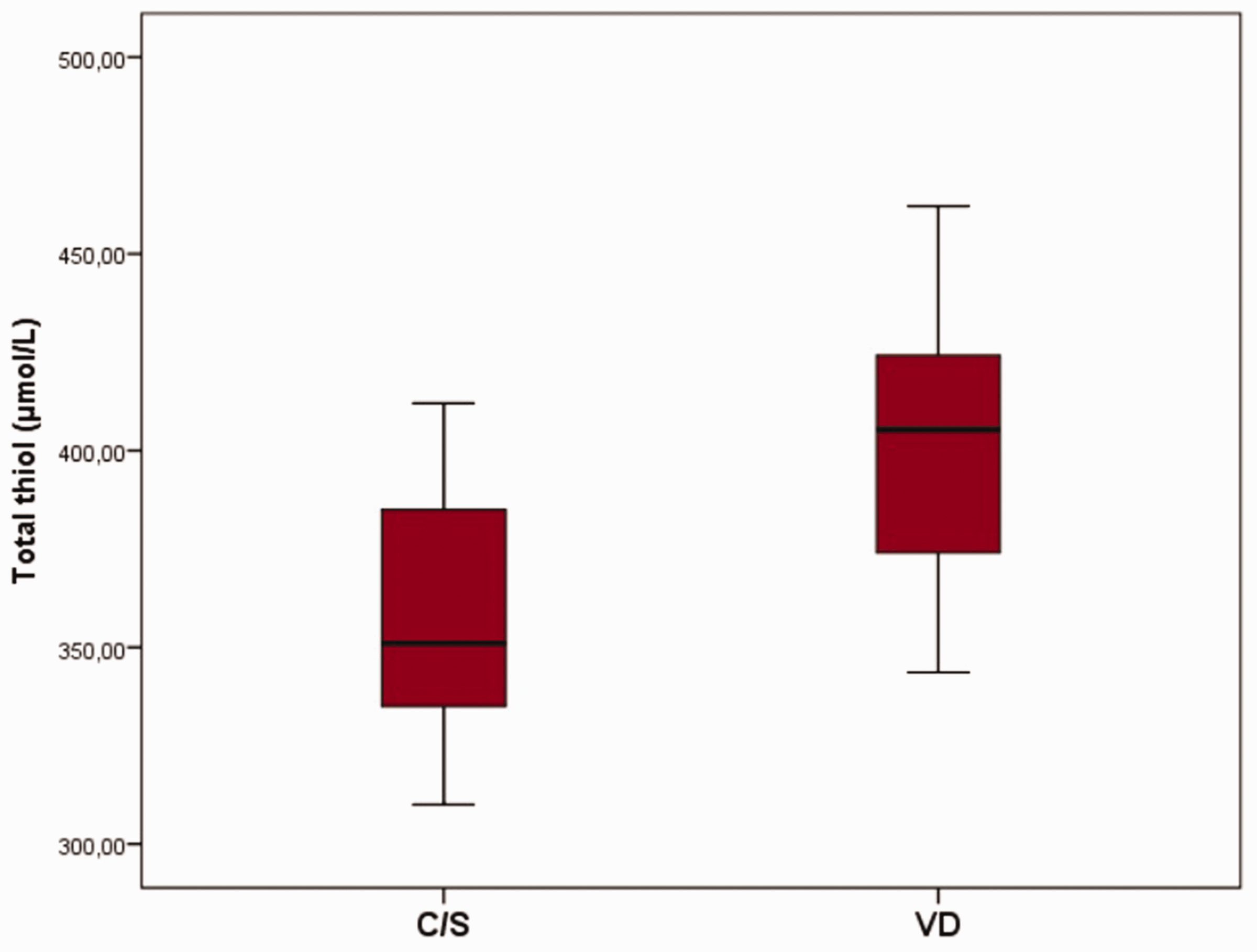
Total thiol levels in the cesarean section (CS) and vaginal delivery (VD) groups. Plasma total thiol levels were significantly lower in the CS group compared with the VD group (P = 0.001)

Native thiol levels in the cesarean section (CS) and vaginal delivery (VD) groups. Plasma native thiol levels were significantly lower in the CS group compared with the VD group (P = 0.003)

Disulfide levels in the cesarean section (CS) and vaginal delivery (VD) groups. Disulfide levels were significantly higher in the CS group compared with the VD group (P = 0.001)
Discussion
This prospective study showed that thiol levels in cord blood were significantly higher during VD compared with CS, while disulfide levels were significantly lower in the VD group. We also compared TAS, TOS, and OSI levels between the groups and showed that TOS and OSI were significantly higher but TAS levels were significantly lower in the VD group with respect to the CS group. We also revealed that the reduced thiol ratio, oxidized thiol ratio, and thiol oxidation reduction ratio differed significantly between the groups. Many factors increase OS levels during the transition of newborns from intrauterine to extrauterine life at birth. It has been reported that OS increases similar to during exercise as a result of the contractions of skeletal and uterine muscles during labor. 23 Newborns have low levels of plasma antioxidants and are thus highly sensitive to OS. 24 Tissue oxygen requirements increase during pregnancy, as a physiological state involving metabolic processes. This increased oxygen consumption leads to an increase in the production of free radicals, causing OS.12,25,26 Thiols are composed of sulfur and hydrogen atoms attached to a carbon atom, and play a significant role in the elimination of OS in cells. 27 When exposed to oxidation, thiols transform into disulfide structures, which is an indication of an early cellular response to OS. These disulfide structures are reduced back to thiol groups, leading to a dynamic thiol–disulfide equilibrium. Notably however, previous studies24,25 have revealed different results regarding the effect of the mode of delivery on OS in newborns.
Isik et al. 24 reported that native and total thiol levels were significantly higher in the VD group compared with the CS group, while disulfide levels were lower but did not differ significantly between the VD and CS groups. They concluded that the decrease in thiol levels and increase in disulfide levels in the CS group resulted from increased OS. In the current study, native and total thiol levels were significantly higher in the VD group with respect to the CS group, while disulfide levels were significantly lower. We hypothesized that CS increased OS and accordingly decreased thiol levels and increased disulfide levels. Vatansever et al. 28 showed that native and total thiol levels were significantly lower in women with early cord clamping compared with those with delayed cord clamping and lactating women, suggesting that a decrease in thiol levels might be an indicator of OS in newborns.
In the present study, TOS and OSI levels were lower while TAS levels were higher in the VD group compared with the CS group. Wilinska et al. 25 found that TAS and thiobarbiturate-reactive substance levels in newborn blood on the third day after birth were higher in the CS compared with the VD group, but hypothesized that there was no significant relationship between the intensity of OS and the mode of delivery. Adelenka et al. 29 showed that TAS levels were higher in the CS group than in the VD group, but malondialdehyde levels were higher in the VD group. They also concluded that there was no significant relationship between OS markers in neonates and the mode of delivery. In another study, Mutlu et al. 30 indicated that TOS and OSI levels were higher while TAS levels were lower in the VD group compared with the CS group, and suggested that there was an increased oxidative response during VD due to increased OS, or a decreased antioxidant response due to OS during elective CS or depletion of antioxidants from the environment. They also hypothesized that antioxidant defense mechanisms in neonates were profoundly modulated by the mode of delivery. In the current study, the reduced thiol ratio, oxidized thiol ratio, and thiol oxidation reduction ratio were higher in the VD group compared with the CS group. In contrast, Isik et al. 24 showed that the reduced thiol ratio and oxidized thiol ratio were similar between the groups.
This study was limited by its relatively small sample size, and further prospective studies with larger sample sizes are needed to confirm these results.
In conclusion, a decrease in cord plasma thiol levels and increase in disulfide levels indicate that OS is increased in newborns born following CS before labor initiation compared with infants born by VD. Dynamic thiol–disulfide levels might contribute to the monitoring of OS in newborns, and thiol–disulfide homeostasis might be a preferred indicator of OS. Measurement of dynamic thiol–disulfide levels may thus provide clinicians with important information on OS in newborns.
Footnotes
Acknowledgements
The authors thank all the participants for taking part in the study.
Author contributions
Conception and design of the research: HE, SOG. Acquisition of data: HE, SOG. Analysis and interpretation of data: HE, SOG Analysis: HE. Drafting the manuscript: HE. Revision of manuscript for important intellectual content: HE, SOG.
Data availability statement
The data that support the findings of this study are available on request from the corresponding author.
Declaration of conflict of interest
The authors declare that there is no conflict of interest.
Funding
This research was supported by Aksaray University Coordination Office of Scientific Research Projects (Project # 2022-021).
