



Abstract
Objective
To evaluate the perioperative administration of dexamethasone to prevent postoperative shivering.
Methods
We searched PubMed, Embase, Google Scholar, Web of Science, and Cochrane Library for relevant studies of the administration of dexamethasone to prevent postoperative shivering published through 31 May 2023. The primary outcome was the incidence of postoperative shivering. Secondary outcomes comprised the incidence of postoperative nausea, vomiting, and postoperative nausea and vomiting (PONV). RevMan 5.3 software was used for the data analysis.
Results
We included 12 randomized controlled trials (1276 participants). The results revealed a benefit favoring the perioperative administration of dexamethasone to prevent postoperative shivering (relative risk [RR]: 0.39; 95% confidence interval [CI]: 0.23–0.63), as well as the grade of shivering. The administration of dexamethasone also reduced the incidence of postoperative nausea (RR: 0.54; 95% CI: 0.39–0.73), postoperative vomiting (RR: 0.37; 95% CI: 0.20–0.65), and PONV (RR: 0.50; 95% CI: 0.26–0.95) compared with the control group.
Conclusion
This study indicated that perioperative administration of dexamethasone prevented postoperative shivering and decreased the incidence of other complications.
PROSPERO registration number: CRD42020164488.
Keywords
Introduction
Shivering is a common complication that appears postoperatively after anesthesia. Shivering is a protective mechanism that increases body temperature by rhythmic muscle contraction in the event of hypothermia. 1 Both general 2 and neuraxial 3 anesthesia may impair central and peripheral thermoregulatory control. As a consequence, poorly warmed patients usually become hypothermic intraoperatively. 4 Despite the frequency of shivering after anesthesia, this phenomenon should not be underestimated, as it has many negative psychological and pathophysiological implications. These implications comprise negative patient experience, high oxygen consumption and metabolic rate, and production of carbon dioxide and lactic acid, which may result in pulmonary and cardiac adverse events.5,6
For decades, various pharmacological and non-pharmacological measurements were applied to avoid the onset of postoperative shivering after anesthesia. Heating appears the most effective solution among non-pharmacological methods, 7 such as heating of the operating room, active cutaneous warming using mattresses heated with convection equipment or radiant appliances, and infusion fluid heaters. Commonly used perioperative opioids also impair thermoregulatory control. Nearly all opioids have thermoregulatory effects, which result from vasoconstriction and decreasing the shivering threshold. 8 A systematic review of pharmacological approaches to prevent postoperative shivering indicated that dexamethasone may have a beneficial effect in the prevention of postoperative shivering. 9 However, relevant evidence is insufficient. Several meta-analyses suggested that the incidence of postoperative shivering could be influenced by other drug options during anesthesia.10–12 However, no meta-analysis has assessed the effectiveness of the administration of dexamethasone to prevent postoperative shivering. We performed this meta-analysis to evaluate the administration of dexamethasone to prevent mainly postoperative shivering.
Materials and methods
Ethics
The Ethics Committee of Hangzhou TCM Hospital approved this study.
Inclusion and exclusion criteria
Three authors independently identified the eligibility of identified articles for in-depth examination using the following inclusion criteria: (1) article type: randomized controlled trial (RCT), without language limitation; (2) patients in the experimental group received dexamethasone perioperatively, while patients in the control group received a placebo or other controlled drugs; and (3) articles evaluating the effectiveness of dexamethasone to prevent perioperative shivering and other adverse events after anesthesia. The exclusion criteria were (1) article type: comments, case reports, crossover studies, letters, editorials, review articles, meta-analysis, and retrospective studies; (2) studies involving animal experiments; and (3) studies with missing data, or data that could not be extracted.
Search strategy
This meta-analysis was performed in accordance with the Preferred Reporting Items for Systematic Reviews and Meta-Analyses (PRISMA) 2020 guidelines 13 and the Assessing the Methodological Quality of Systematic Reviews (AMSTAR) tool.14,15 This study was registered in the International Prospective Register of Systematic Reviews (PROSPERO; registration number: CRD42020164488).
We searched PubMed, Embase, Google Scholar, Web of Science, and the Cochrane Library for relevant studies of the effectiveness of dexamethasone to prevent postoperative shivering published through 31 May 2023. The search terms comprised terms related to dexamethasone (i.e., “dexamethasone” OR “desoximetasone”) and terms related to shivering (i.e., “shivering” OR “shiver” OR “adverse reaction”). There were no restrictions on dates, sex, age, type of surgery, and anesthesia method. We then reviewed the full articles and applied our selection criteria. References from the retrieved papers were also reviewed to identify potential articles that were missed in our initial search. We also manually searched for additional studies using the reference lists of relevant systematic reviews and meta-analyses. Titles, abstracts, and the full text of potential articles were also screened after excluding duplicated studies. Pairs of independent reviewers screened the titles and abstracts of all citations using the prespecified inclusion and exclusion criteria. All instances of discordance regarding article eligibility were discussed between the pairs of investigators and the corresponding author to reach consensus.
Quality assessment
Three authors independently evaluated the quality of the included studies using the Jadad Scale. 16 The following items were evaluated: (1) whether the study followed the principle of randomization; (2) whether the participants and personnel were blinded; and (3) whether the study described detailed participant withdrawal or dropout. A Jadad score ≥4 reflected high quality. We also evaluated the risk of bias of the included studies using the Cochrane Risk of Bias Tool, 10 with the following criteria: (1) random sequence generation, (2) allocation concealment, (3) blinding of participants and personnel, (4) blinding of outcome assessment, (5) incomplete outcome, and (6) selective reporting. The judgment of each reviewer on each domain was categorized as “low risk”, “high risk”, or “unclear risk” of bias.
Data extraction
Data extraction was performed independently by two authors. The following information was extracted from each included study: the first author’s name, publication year, country, sample size of each group, types of surgery and anesthesia, details of the administration of dexamethasone, and outcomes of interest. If the included study had insufficient or missing data, we attempted to contact the authors by e-mail to obtain the raw data. Outcomes of interest were the incidence of shivering after anesthesia and the incidence of other adverse events, such as nausea and vomiting. Shivering was defined as involuntary, repetitive skeletal muscle movements, intraoperative heat loss, increased sympathetic tone, pain, and systemic release of pyrogens, all of which may result in perioperative shivering. 9
Statistical Analysis
Statistical analysis was performed using Review Manager version 5.3 statistical software (The Cochrane Collaboration, The Nordic Cochrane Centre, Copenhagen, Denmark). Dichotomous data were assessed using relative risks (RRs) and 95% confidence intervals (CIs). Heterogeneity was assessed by inspecting forest plots and the Q test, and the Higgins I2 statistic was used to quantify the results. A P-value for heterogeneity ≤0.10 was considered to indicate significant heterogeneity. 17 The Mantel–Haenszel randomized effects model was used to perform the meta-analysis; otherwise, the Mantel–Haenszel fixed effects model was used. P-values ≤0.05 were considered statistically significant. Sensitivity analysis was performed using the leave-one-out method when individual endpoints resulted in substantial heterogeneity.
Results
Literature Search
Using our search strategy, we identified 1741 potential articles during the initial search; 1710 articles were excluded after applying the exclusion criteria. The remaining 31 studies were assessed for eligibility, and 19 of these evaluated different outcomes of interest compared with the present study. Finally, 12 studies18–29 were included in this meta-analysis. Figure 1 is a flow diagram that describes the process of screening and selecting studies.

Flow chart showing the process of the identification and selection of articles for the meta-analysis.
Characteristics of the included studies
Descriptive data for the included studies in this systematic review and meta-analysis are shown in Table 1. The 12 studies were published between 1998 and 2021 and involved 1276 participants; 614 participants received dexamethasone in the experimental group, while 662 participants received a placebo in the control group. Of the 12 studies, 4 were performed in Egypt, 3 in Iran, 2 in Korea and the USA, and 1 in Pakistan.
Characteristic of the included studies.
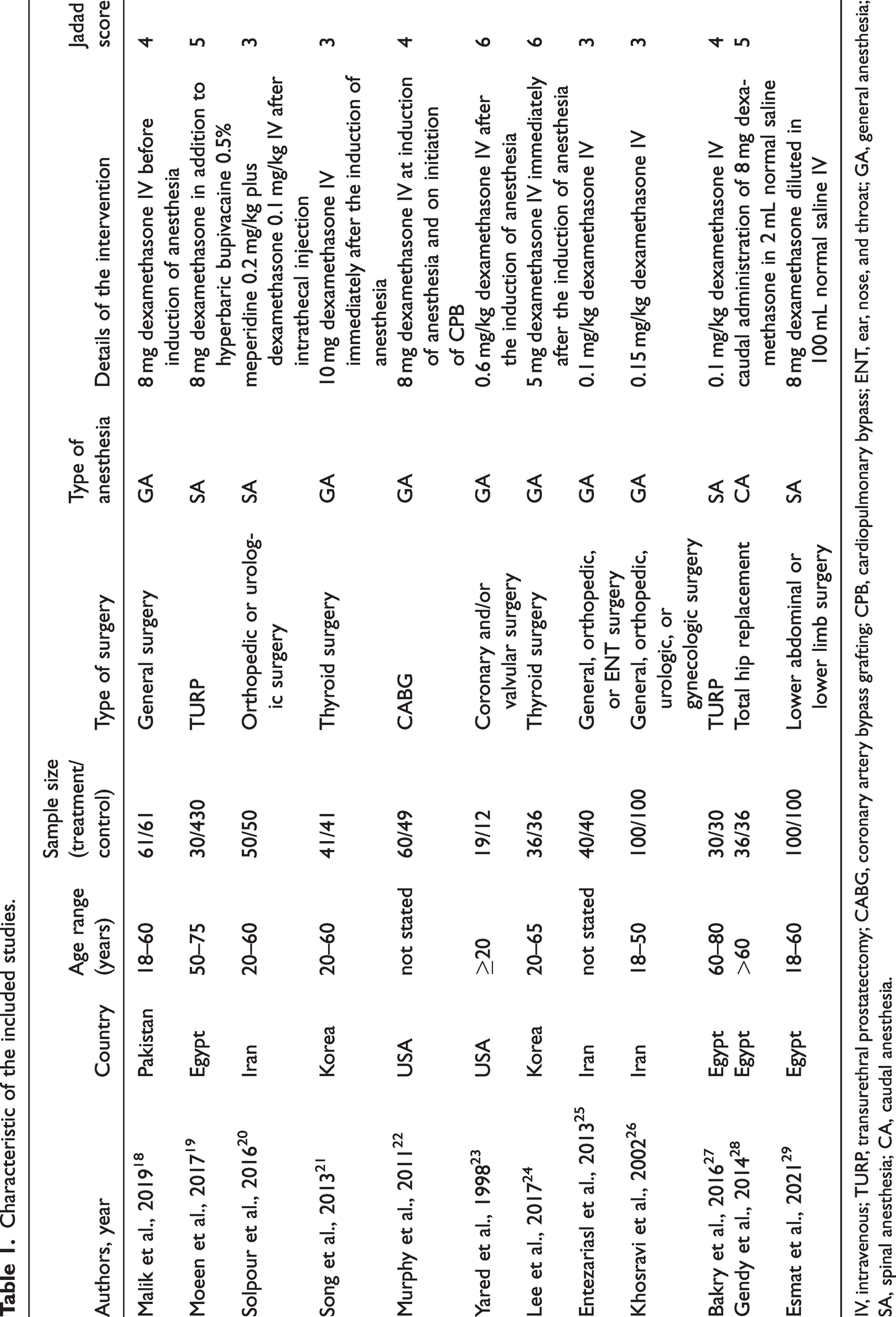
IV, intravenous; TURP, transurethral prostatectomy; CABG, coronary artery bypass grafting; CPB, cardiopulmonary bypass; ENT, ear, nose, and throat; GA, general anesthesia; SA, spinal anesthesia; CA, caudal anesthesia.
Quality assessment of the included studies
We use the Jadad score to assess the quality of the studies. Most of the included studies had a Jadad score of ≥4 points (Table 1), which reflected high quality. We also evaluated the risk of bias of the included studies using the Cochrane Risk of Bias Tool. 10 Most of the 12 RCTs described detailed information regarding random sequence generation, blinding of participants and personnel, blinding of outcome assessment, incomplete outcome data, and selective reporting. However, approximately half of the included studies did not provide detailed methods of allocation concealment (Figure 2).

Risk of bias summary. Green circles with a “+” sign indicate low risk; red circles with a “−” sign indicate high risk; and yellow circles with a “?” indicate unclear risk.
Heterogeneity and sensitivity analysis
For the primary outcome of the overall incidence of postoperative shivering, the I2 statistic was 77% for the meta-analysis of the 12 RCTs. This result indicates the presence of a relatively high degree of heterogeneity. Several characteristics of these studies may have contributed to the heterogeneity, including differences in the types of surgery and anesthesia, dosage of dexamethasone, and the time points of dexamethasone administration. We performed a sensitivity analysis using the leave-one-out method because only 12 studies were included in the meta-analysis; however, the heterogeneity among the studies changed only slightly after the sensitivity analysis. Notably, we found no heterogeneity in the meta-analysis of each grade of postoperative shivering.
Primary outcome
All 12 RCTs18–29 evaluated the overall incidence of postoperative shivering, and evidence of heterogeneity was present among the studies (P = 0.0002; I2 = 77%). A randomized effects model was used to analyze the outcome. The meta-analysis revealed that participants in the dexamethasone group had a lower incidence of postoperative shivering (RR: 0.39; 95% CI: 0.23–0.63; P < 0.00001) than that in the control group (Figure 3).

Forest plot of the effects of dexamethasone on the overall incidence of postoperative shivering.
We also performed a subgroup analysis of the grades of shivering. On the basis of the clinical manifestations, the intensity of shivering can be divided into five grades (0–4). 28 Table 2 shows the detailed information about each grade of shivering. There was no evidence of significant heterogeneity among the studies (I2 = 0%) in the subgroup analysis. A fixed-effects model was then adopted. The results suggested that the administration of dexamethasone effectively and significantly reduced the grade of postoperative shivering for grade 2 (RR: 0.48; 95% CI: 0.33–0.69; P < 0.0001), grade 3 (RR: 0.14; 95% CI: 0.06–0.37; P < 0.0001), and grade 4 (RR: 0.13; 95% CI: 0.04–0.38; P = 0.0002); however, the result was not significant for grade 1 (RR: 0.94; 95% CI: 0.60–1.48) (Figure 4).
Grades of shivering.


Forest plot of the effects of dexamethasone on the incidence of each degree of postoperative shivering. Grade 0, no shivering; Grade 1, peripheral vasoconstriction or piloerection but no visible shivering; Grade 2, muscular activity in only one muscle group; Grade 3, muscular activity in more than one muscle group but not generalized; Grade 4, shivering involving the whole body.
Secondary outcomes
Dexamethasone is widely used to prevent postoperative nausea and vomiting. 30 We analyzed the effect of the administration of dexamethasone on preventing postoperative nausea, postoperative vomiting, and PONV. Seven RCTs reported the incidence of postoperative nausea, and there was significant evidence of heterogeneity among the studies (P < 0.00001; I2 = 83%). A fixed-effects model was then used to perform the meta-analysis. However, the results provided no evidence indicating that dexamethasone could reduce the incidence of postoperative nausea (RR: 0.54; 95% CI: 0.39–0.73; P < 0.0001). Seven RCTs reported the incidence of postoperative vomiting, and there was no significant evidence of heterogeneity among the studies (I2 = 0%). A randomized effects model was used to analyze the outcome, which revealed that the incidences of postoperative vomiting and PONV in the dexamethasone group were significantly lower compared with the control group (RR: 0.37; 95% CI: 0.20–0.65, P = 0.0007 and RR: 0.50; 95% CI: 0.26–0.95, P = 0.03, respectively). Only three RCTs reported the incidence of PONV, and there was no significant evidence of heterogeneity among the studies (I2 = 0%). A randomized effects model was used for the meta-analysis, which revealed that the dexamethasone group had a significantly lower incidence of PONV (RR: 0.49; 95% CI: 0.38–0.63; P = 0.03) than that in the control group (Figure 5).

Forest plot of the effects of dexamethasone on preventing other adverse events after anesthesia. (a) Forest plot of the incidence of postoperative nausea. (b) Forest plot of the incidence of postoperative vomiting and (c) Forest plot of the incidence of postoperative nausea and vomiting (PONV).
Discussion
In this meta-analysis, we analyzed data for 12 RCTs involving 1276 participants. The results suggested that the administration of dexamethasone could effectively reduce the overall incidence of postoperative shivering. We also performed a subgroup analysis of each grade of shivering. The results were consistent with the initial results, indicating that the administration of dexamethasone decreased the incidence of each grade of shivering after anesthesia, particularly for grades 3 to 4. We also assessed the other prophylactic properties of the perioperative use of dexamethasone. However, the results showed no evidence indicating that the administration of dexamethasone is associated with a lower incidence of postoperative nausea, even though we observed lower incidences of postoperative vomiting and PONV in the dexamethasone group compared with the control group.
As a common complication after anesthesia, the overall incidence of shivering is as high as 55% after neuraxial anesthesia, according to a broad sample of 21 studies. 31 Nearly all opioids inhibit normal autonomic thermoregulation and increase susceptibility to postoperative shivering. 8 Shivering may increase oxygen consumption and the production of carbon dioxide as well as amplify the intensity of postoperative pain, 32 especially with high-grade shivering, which adversely affects postoperative rehabilitation. Under normal physiological conditions, shivering is a natural physiological response. However, after anesthesia, shivering is a stress response that leads to a series of adverse events. The etiology of postoperative shivering is not completely clear, but various mechanisms have been proposed. Perioperative hypothermia is one of the most probable causes for the development of postoperative shivering as a result of its stimulatory effects on the thermoregulatory center. 33 However, shivering, as a form of muscle hyperactivity, may be amplified even with normothermia, postoperatively. 34
Despite the implementation of heat preservation measures, the incidence of shivering after anesthesia remains high. During anesthesia, patients have loss of consciousness and lack behavioral thermoregulatory responses. Additionally, the mechanism of autonomic thermoregulation is inhibited by anesthetics, and the sweating threshold is increased slightly, which may significantly increase the threshold of shivering. 35 For these reasons, shivering occurs rarely during anesthesia; however, this differs dramatically after anesthesia. The mechanism of shivering after anesthesia is unclear. Central hypothermia is the main cause of shivering after anesthesia. 36 After anesthesia, there may be an imbalance between the recovery of thermoregulation and the response to core hypothermia, making it difficult to recover from hypothermia. Studies have suggested that receiving dexamethasone is associated with a higher body temperature compared with receiving normal saline.19,22 However, these studies did not discuss specific mechanisms underlying the phenomenon to explain why dexamethasone contributed to a lower incidence of postoperative shivering. The specific mechanisms require further studies to confirm. The release of cytokines caused by surgical trauma may also lead to postoperative shivering. 23 Dexamethasone has been used for many decades clinically for its anti-inflammatory, anti-allergic, and analgesic properties, 37 and for its prophylactic properties regarding adverse events, such as PONV. 30 Recently, a systematic review assessed pharmacological approaches to prevent postoperative shivering and indicated a beneficial effect of dexamethasone in reducing the incidence of postoperative shivering. 8 The results of our meta-analysis were similar to those in the systematic review, showing that the administration of dexamethasone could effectively reduce the incidence of postoperative shivering. Long-duration surgery and surgical trauma may increase the release of cytokines, such as tumor necrosis factor (TNF) and interleukin (IL)-6, resulting in a change in the body’s thermostatic set-point, leading to shivering. 38 Studies have reported that steroids beneficially alter the balance of pro- and anti-inflammatory cytokines in the blood.39,40 Via this mechanism, dexamethasone may inhibit shivering caused by the release of inflammatory factors, to a certain extent.
Guidelines advocate the use of dexamethasone to prevent postoperative shivering. 30 In the present meta-analysis, we also evaluated the association between dexamethasone and postoperative nausea and vomiting. The results were similar to those in a previous meta-analysis. 41 The results of our study indicated that patients who received dexamethasone had a lower incidence of postoperative vomiting and PONV. However, it appeared that the administration of dexamethasone had no effect on the incidence of postoperative nausea. When analyzing the incidence of postoperative nausea, we observed high heterogeneity among the included studies. However, a sensitivity analysis found no obvious sources of heterogeneity. Nausea is a vague feeling of impending vomiting. In other words, the feeling of nausea possesses some subjectivity. However, vomiting is defined as the forceful expulsion of gastric contents brought about by sustained contraction of abdominal muscles, and nausea often precedes vomiting. This is a clear and precise definition to record the incidence of vomiting and PONV. Dexamethasone may inhibit the synthesis and release of 5-hydroxytryptamine (5-HT) in the central or peripheral nervous system. 42 Additionally, the anti-inflammatory and antitoxin effects of dexamethasone may contribute to the maintenance of normal gastrointestinal motility, which may also be related to the prevention of nausea and vomiting after anesthesia.
There are several limitations in this meta-analysis. First, the included studies lacked standardization regarding dexamethasone infusion and timing, anesthetic regimens, patient selection, and follow-up periods. These issues may have partly increased the heterogeneity of the meta-analysis. Second, many studies had small sample sizes, and some studies had not calculated the power of the sample size. Furthermore, only three RCTs had registration identification numbers, which may reduce the validity of this study. Third, hypothermia is the main cause of shivering after anesthesia. However, almost none of the included studies recorded each patient’s body temperature after anesthesia. Finally, most studies did not investigate or report the occurrence of the adverse events associated with dexamethasone. Therefore, it is difficult to assess the safety of dexamethasone. High-quality, well-designed studies with large sample sizes are required to confirm the findings in the present study.
Conclusions
The findings in our study indicated that the administration of dexamethasone is associated with a lower incidence of postoperative shivering and also contributed to reducing the incidence of postoperative vomiting and PONV. However, further studies are needed to provide additional evidence, considering the limitations in this study.
Supplemental Material
sj-pdf-1-imr-10.1177_03000605231187805 - Supplemental material for Perioperative administration of dexamethasone to prevent postoperative shivering: a systematic review and meta-analysis of randomized controlled trials
Supplemental material, sj-pdf-1-imr-10.1177_03000605231187805 for Perioperative administration of dexamethasone to prevent postoperative shivering: a systematic review and meta-analysis of randomized controlled trials by Qiguo Tu, Rong Zhou, Zhengzuo Wan, Shan Chen, Qinqin Yang and Bin Que in Journal of International Medical Research
Footnotes
Author contributions
Q. Tu and R. Zhou collected the data and drafted the manuscript. Z. Wan, S. Chen, and Q. Yang performed the statistical analyses. B. Que contributed to the study conception. All authors read the manuscript and approved the final submission.
Data availability statement
Data supporting the findings of this study are available from the corresponding author, Bin Que (
Declaration of conflicting interests
The authors declare there is no conflict of interest.
Funding
The study was financially supported by grants from Zhejiang TCM Science and Technology Plan (No. 2022ZA105).

References
Supplementary Material
Please find the following supplemental material available below.
For Open Access articles published under a Creative Commons License, all supplemental material carries the same license as the article it is associated with.
For non-Open Access articles published, all supplemental material carries a non-exclusive license, and permission requests for re-use of supplemental material or any part of supplemental material shall be sent directly to the copyright owner as specified in the copyright notice associated with the article.
