



Abstract
Atherosclerotic cerebrovascular disease is one of the major causes of death in China, with associated serious risk of disability and burden on society and families. Therefore, the development of active and effective therapeutic drugs for this disease is of great significance. Proanthocyanidins are a class of naturally occurring active substances, rich in hydroxyl groups and from a wide range of sources. Studies have suggested that they have a strong potential for anti-atherosclerosis activity. In this paper, we review published evidence regarding anti-atherosclerotic effects of proanthocyanidins in different atherosclerotic research models.
Background
Carotid atherosclerosis is the most common and important type of arteriosclerosis. 1 Its pathological characteristics are thickening and hardening of the carotid artery wall, loss of elasticity, and reduction in the lumen of the wall. 2 Risk factors include diabetes, hyperlipidaemia, hypertension, obesity, smoking, autologous bioactive substances (e.g., serotonin, nitric oxide [NO], endothelin-1 [ET-1]) metabolic disorders, and chronic stress. 2
Procyanidins (PCs) are derived from proanthocyanidins (condensed tannins) and are a group of polymers formed from flavan-3-ols, epicatechin and catechin. 3 Depending on the degree of polymerisation, PCs may be classified as monomeric, oligomeric or polymeric. 3 Proanthocyanidins are widely found in fruits, leaves, seeds and skins of many plants, with grape seeds having a total content of up to 99%. 4 PCs are natural antioxidants; the antioxidant capacity of PC is 20 times that of vitamin E and 50 times greater than vitamin C.2,5 In food production, PCs are widely used to stabilize food colours and prevent rancidity. 2 They have also been reported to have anticancer, anti-infectious, anti-inflammatory, cardioprotective, antimicrobial, antiviral, antimutagenic, wounding healing, antihyperglycemic and anti-allergic properties. 2 Therefore, PCs have attracted attention not only from the food industry but also from public health organizations due to their potential health benefits. 4 In this paper, we review published literature regarding the potential anti-atherosclerotic effects of proanthocyanidins.
Molecular structure
Extensively found in dark-coloured vegetables and fruits, proanthocyanidins are named for their ability to produce anthocyanins when heated in an acidic medium. 6 The molecular structure of PCs is from a dimer to decamer formed by the condensation of different amounts of catechin or epicatechin, and the antioxidant capacity differs as the structure differs (Figure 1). 3 Generally, the antioxidant activity decreases as the degree of polymerization increases. 7 In addition, the antioxidant activity is also related to the number and position of hydroxyl groups, connection methods, and spatial configuration. 8

Chemical structure of proanthocyanidin unit.
Anti-atherosclerotic effects
Regulation of lipoprotein disorders
Abnormal lipid metabolism is an independent risk factor for carotid atherosclerosis. 2 Following oral administration of PCs to an experimental model of hyperlipidaemia in mice, researchers found that, compared with the control group, serum triglyceride, total cholesterol, and low-density lipoprotein cholesterol (LDL-C) levels were significantly reduced (Table 1). 9 The authors suggested that PCs could alleviate the lipid disorder, especially hypercholesteremia, and ameliorate atherosclerosis in mice fed a high fat diet, by regulating gene expression involved in hepatic lipid homeostasis. 9
Regulation of lipoproteins by proanthocyanidins.

TG, triglyceride; TC, total cholesterol; LDL-C, low-density lipoprotein cholesterol; PC, procyanidin.
Foam cells play a central role in the formation of carotid atherosclerosis as they form the atherosclerotic lipid core after phagocytosis of lipoproteins. 10 Processing and metabolism of cholesterol in the macrophage is one of the main steps in foam cell formation. In addition, foam cells can release inflammatory cytokines to accelerate the process of atherosclerosis. 10 A study in mononuclear THP-1 cells (human leukaemia monocytic cell line) found that proanthocyanidins inhibited excessive uptake of LDL-C by macrophages in the aortic endothelium and so inhibited foam cell formation. 11 The investigators found that the proanthocyanidins restrained macrophage foaming mainly by lowering the expression levels of cholesterol influx-related receptors CD36 and SR-A, and promoting the expression of cholesterol efflux-related receptor, ABCA1. In addition, it was found that proanthocyanidins significantly inhibited the expression of ACAT1, a key gene for intracellular cholesterol esterification. The investigators hypothesised that the proanthocyanidins suppressed the expression of ACAT1 via up-regulating the expression of miR-9, so lessening intracellular lipid accumulation and thereby inhibiting macrophage foam cell formation. This assumption was further verified by the fact that this process could be reversed by miR-9 inhibitors. 11
Autophagy-mediated cholesterol efflux from foam cells has been suggested as a possible solution for the treatment of atherosclerosis. 12 In an in vitro study, oxidized low-density lipoprotein induced foam cells demonstrated impaired autophagy flux via downregulated expressions of LC3BII/LC3BI, autophagy related gene-5, Class III phosphoinositide 3 kinase (Class III PI3K), Beclin1, ABCA1, and ABCG1 with concomitant increase in the expressions of protein 62, Class I phosphoinositide 3 kinase, Akt, and mammalian target of rapamycin. 12 However, these effects were significantly abolished by treatment with proanthocyanidins via activation of autophagy flux via Class III PI3K/Beclin1 and with upregulated expression of transporter proteins ABCA1 and ABCG1. The researchers found that the cholesterol efflux process in the foam cells was activated by lysosomal acid lipase and cathepsin D facilitated lipolysis of lipid droplets. They concluded that treatment with proanthocyanidins had stimulated the coordinated activation of autophagy and cholesterol efflux through Class III PI3K/Beclin1 pathway in foam cells, and hypothesised that this could be a promising therapeutic strategy against atherosclerosis. 12 Another study in a mouse macrophage cell line, showed that proanthocyanidins can also play a role in inhibiting macrophage foam cell formation through its metabolite 3-(4-Hydroxyphenyl), which affects the expression of ABCA1, SR-B1 and CD36 by regulating the nuclear factor (NF)-κB pathway and suppressing cellular oxidative stress and inflammatory responses. 13
Lower blood glucose and improve insulin resistance
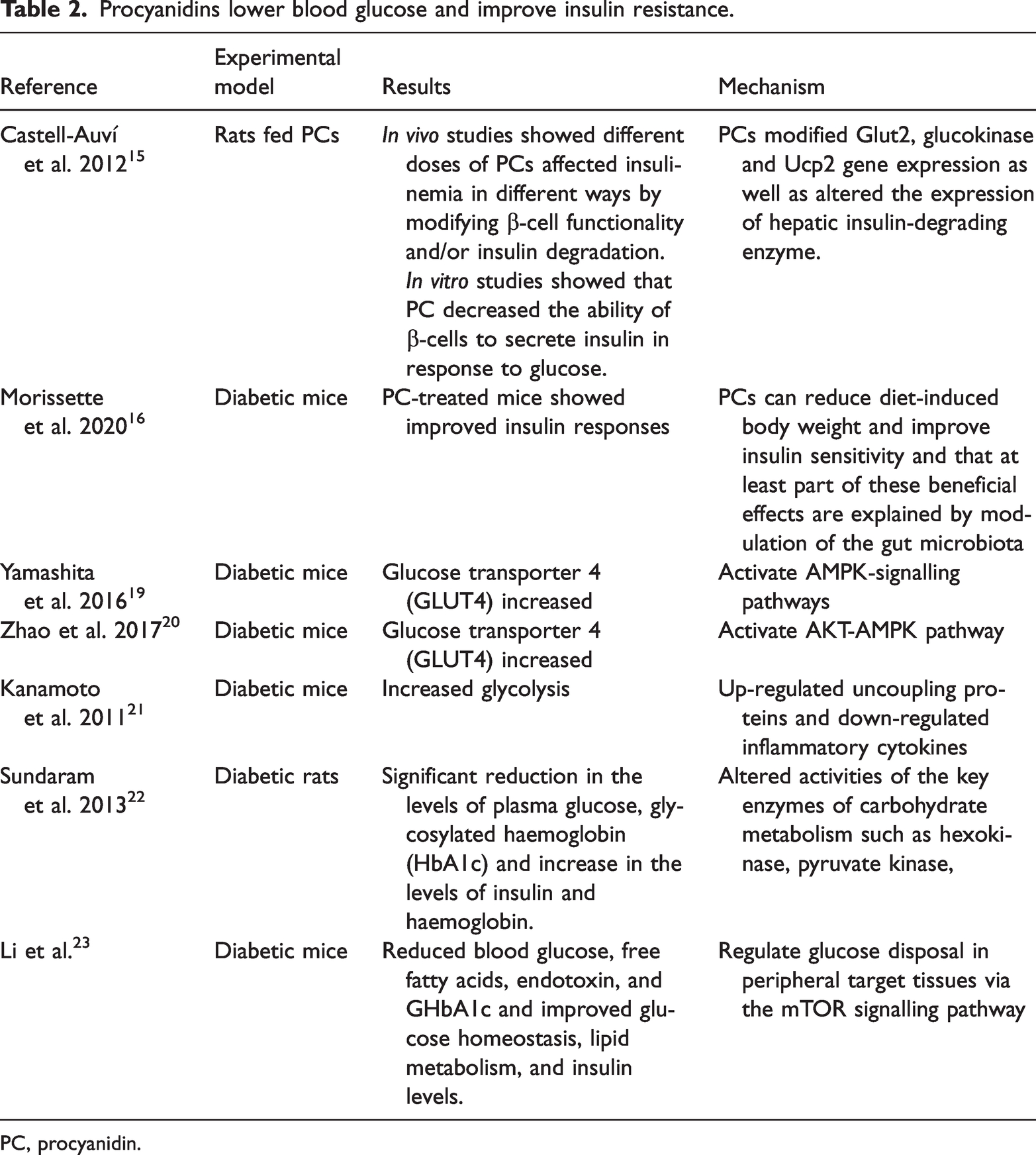
It is well established that diabetes can induce atherosclerosis, and so reducing blood glucose may prevent the progression of carotid atherosclerosis. One study showed that proanthocyanidins from Eugenia dysenterica fruits and leaves, act as a reversible non-competitive glucosidase inhibitor, which reduces the catalytic rate of α-glucosidase to the substrate, and so would have anti-diabetic potential. 14 Another group of investigators have shown that PCs can affect insulin synthesis, secretion, and gene expression by acting on islet β cells of experimental animals (Table 2). 15 In addition, PCs also altered the expression of hepatic insulin-degrading enzyme, thereby affecting insulin degradation. 15 These findings were confirmed by other researchers who also showed that PCs can improve insulin resistance in diabetic mice. 16 It is currently believed that oxidative stress caused by various pathological factors not only directly damages pancreatic islet cells, but also affects certain molecules in the insulin conduction pathway by activating multiple redox-sensitive signalling pathways, thereby leading to insulin resistance. 17
Procyanidins lower blood glucose and improve insulin resistance.
PC, procyanidin.
Glucose uses membrane-based glucose transporters (GLUTs) to enter cells. 18 GLUT4 is a major glucose transporter specifically in skeletal and cardiac muscles and adipose tissue and plays a pivotal role in glucose homeostasis by regulating cellular glucose uptake in these tissues. 19 AMP-activated protein kinase (AMPK) is a signalling pathway that regulates metabolic homeostasis. 19 Insulin- and AMPK-signalling pathways are the major regulators of GLUT4 translocation in muscle. Phosphorylation of AMPK and protein kinase B (AKT) promote the transfer of glucose transporters from the cytoplasm to the cell membrane, thereby facilitating glucose uptake. A study in diabetic mice showed that trimeric and tetrameric PCs activated both insulin- and AMPK signalling pathways and increased GLUT4 protein expression so preventing hyperglycaemia and ameliorating glucose tolerance. 19 These findings were confirmed by another study in diabetic mice that found PCs mitigate diabetic symptoms by stimulate glucose uptake in peripheral tissue via the activation of AKT and AMPK signalling pathways. 20
In a study in mice fed a high fat diet using black soybean seed coat extract as a source of PCs, researchers found that PCs increased glycolysis by up-regulating uncoupling proteins (UCPs) and down-regulating inflammatory cytokines. 21 Another study in diabetic rats found that the administration of PCs resulted in significant reductions in the levels of plasma glucose, glycosylated haemoglobin (HbA1c) and increases in levels of insulin and haemoglobin. 22 PCs altered activities of the key enzymes of carbohydrate metabolism such as hexokinase and pyruvate kinase. Another study found that dietary supplementation with PCs enhanced glucose homeostasis and attenuated mTOR signalling in a group of diabetic mice. 23 Overall, these animal studies suggest that PCs can promote the body's ability to take up and utilize glucose and maintain the stability of blood sugar.
Anti-inflammatory effects
Inflammation has a major role in all stages of atherosclerosis, and evidence suggests that the inflammatory response is a common link or pathway that links various atherosclerotic factors (Figure 2). 24

In an in vitro study, using mice macrophages, proanthocyanidins have been shown to have an anti-atherogenic effect by suppressing the up-regulation of NF-kB and cyclooxygenase-2 (COX-2). 25 In another in vitro study, using a rat model of pulmonary arterial hypertension, PCs ameliorated inflammation by the peroxisome proliferator- activated receptor gamma (PPAR-γ)/COX-2 pathway and inhibited the proliferation of pulmonary arterial smooth muscle cells, which leads to pulmonary vascular remodelling. 26 Other investigators found that a 40 μg/ml dose of proanthocyanidins significantly reduced inflammatory cytokine secretion by M1-type macrophages and enhanced this modulation by the addition of the JAK2 inhibitor AG490, as well as significantly upregulating protein expression of PPARγ, liver X receptor alpha (LXRα) and ATP-binding cassette transporter A1 and G1 (ABCA1/G1). 27 However, after the addition of the PPARγ blocker GW9662, the investigators found that the effect was inhibited. These results suggests that proanthocyanidins can reduce the inflammatory response and so inhibit atherosclerosis by inhibiting M1-type macrophage polarization through inhibition of the JAK2/STAT3 signalling pathway. 27 Following proanthocyanidin treatment in an atherosclerotic rat model, serum antioxidant enzymes (SOD and GSH-Px) were significantly increased, malondialdehyde (MDA) content was significantly decreased, and serum levels of tumour necrosis factor alpha (TNF-α), Interleukin (IL)-1β, IL-6, intercellular adhesion molecule 1 (ICAM-1) and vascular cell adhesion molecule 1 (VCAM-1) were also decreased and IL-10 levels increased. 28
Lower blood pressure
Both human and animal models have shown that hypertension is a major risk factor for the development of atherosclerosis. 29 Hypertension may accentuate the progression of atherosclerosis through mechanisms such as mechanical injury to endothelial cells of the arterial wall which induces LDL-C to invade the arterial wall and stimulates smooth muscle cell proliferation.2,29
Some researchers have proposed that PCs can reduce arterial pressure and protect blood vessels. 30 In a rat model of renal vascular hypertension, administration of proanthocyanidins regulated the sympathetic excitability and reduced blood pressure (BP) in hypertensive rats. It was suggested that the mechanism may be related to attenuating oxidative stress, ameliorating neurotransmitter imbalance, and decrease BP and sympathetic activity possibly through the nuclear factor E2-related factor 2 (Nrf2) pathway. 30 In another study, proanthocyanidins were found to inhibit the expression apoptosis signal-regulating kinase 1 (ASK1), NF-κB and its targeted gene – COX-2, in isoproterenol (Iso)-induced cardiac remodelling (CR) rat model. 31 The authors concluded that these findings suggest that administration of proanthocyanidins has the potential to attenuate Iso-induced CR by repressing oxidative stress and inhibiting the activation of the cellular signalling cascades involving the ASK1 and NF-κB pathways.
A dose dependent vasorelaxation effect of PC on normal rabbit aorta was found using PC perfusion of isolated aortic rings. The relaxant effect of PC was significantly reduced by removal of the endothelium and by treatment with the nitric oxide synthase inhibitor, L-NNA, or guanylyl cyclase inhibitor MB. 32 In another study, the effects of proanthocyanidins (250 mg/kg/d) on systolic BP and vascular remodelling were analysed by treating ouabain-induced hypertensive rats. 33 Systolic BP was significantly decreased and vascular remodelling was blocked. The ET-1 content was reduced while NO production was increased.
Lastly, in a study in humans, where subjects were randomized into three groups (placebo, 150 mg grape seed extract (GSE)/day, and 300 mg GSE/day) and treated for four weeks, systolic and diastolic BP decreased following treatment compared with placebo but there were no significant changes in serum lipids or blood glucose values. 34
Vascular endothelial protection
Endothelial dysfunction is now recognised as a key variable in the pathogenesis of atherosclerosis. 2 Various risk factors damage the arterial intima, which then undergoes an inflammatory-fibroproliferative reaction resulting in atherosclerosis. 2 Free radicals generated during metabolism and under the action of various risk factors can cause endometrial damage. Therefore, prevention of arterial endothelial injury is one of the key elements in the prevention and treatment of atherosclerosis. Experiments have identified lipopolysaccharide (LPS), a structural component of the outer membrane of gram-negative bacteria, as being involved in the pathogenesis of atherosclerosis,35,36 especially the lipid A moiety which is the toxic component of LPS.
A study using human umbilical vein endothelial cells (HUVECs), found that LPS caused the up-regulation of Caspase-3 expression by controlling the expression of mitochondrial apoptosis key proteins Bcl-2 and Bax, which in turn led to vascular endothelial cell apoptosis. Pre-treatment of the cells with PC markedly attenuated LPS-induced cytotoxicity and apoptosis. 37 The authors concluded that the potential molecular mechanism underlying the effects of PC was associated with the Bax/Bcl-2 and NF-κB signalling pathways. They suggested that PC may be useful as a novel therapeutic agent for infectious vascular diseases.
Inhibition of the proliferation of vascular smooth muscle cells
A precursor of arterial atherosclerotic damage is the accumulation of vascular smooth muscle cells in the intima. 2 Following the formation of the early fibrous cap, the local inflammatory environment can alter the expression of collagenase and inhibit the expression of proteolytic enzyme inhibitors, resulting in the weakening or even rupture of the fibrous cap, which in turn triggers thrombosis. Therefore, inhibiting the proliferation of vascular smooth muscle cells is an important means of preventing and treating atherosclerosis.38,39
Investigators found that PC from grape seeds had an inhibitory effect on the proliferation and migration of vascular smooth muscle cells induced by homocysteine. 40 They suggested that the mechanism may be achieved by blocking the reactive oxygen species-dependent NF-κB pathway. Another in vitro study found that PC from grape seeds suppressed advanced glycation end product (AGE) induced human aortic smooth muscle cell proliferation and migration and again suggested it was through the NF-κB pathway. 41
Antiplatelet aggregation
As inducers and promoters, platelets play a key role in the development of atherosclerosis. 42 The mechanism of action of antiplatelet drugs is to interfere with some of the steps leading to platelet aggregation. This may include: circulation of activated platelets; adhesion of activated platelets to the endothelium; activation of endothelial cells; secretion of cytokines by platelets; proliferation of vascular smooth muscle cells. 43
A study using a rat model of carotid artery thrombosis found that doses of PCs showed anti-thrombosis effects, and the mechanism closely correlated with inhibition of platelet activation and aggregation as well as protection of vasoendothelial cells. 44 Moreover, the highest does of PCs (400 mg/kg/d) surpassed the effect of aspirin. Another study in rats fed a high fat diet and supplemented with anthocyanin extract from black rice, thromboxane A2 (TXA2), TXA2/prostacyclin ratio, serum calmodulin, and soluble P-selectin were significantly decreased. PC supplementation also lowered serum triglyceride levels and raised hepatic CPT-1 mRNA expression. The authors suggested that dietary intake of PCs can reduce platelet hyperactivity, hypertriglyceridemia, and body weight gain, and facilitate in the maintenance of optimal platelet function in rats with dyslipidaemia. 45
Prospects and limitations
Research on the potential cardiovascular health benefits of proanthocyanidins has been going on for several years. 3 As natural antioxidants, they are recognized as one of the most effective ways to remove free radicals from the human body. 3 They have been shown to have preventive and health benefits in a variety of diseases, and are widely used in industries such as cosmetics, medicinal and healthcare. As reviewed above, there is evidence to show that proanthocyanidins have multiple anti-atherosclerotic effects such as: regulation of lipoprotein disorders; lowering blood glucose and improving insulin resistance; anti-inflammatory effects; lowering BP; vascular endothelial protection; inhibition of the proliferation of vascular smooth muscle cells; antiplatelet aggregation. However, most research has been conducted in animals or in vitro experiments. Therefore, further research on the function of proanthocyanidins is required from prospective, controlled clinical trials in large numbers of human subjects. Currently, the main methods of clinical therapy for atherosclerosis use conventional medicine, surgery and/or interventional lifestyle therapy. However, they are associated with high price, risk, and contraindications. Proanthocyanidins have the advantages of abundant sources, extensive pharmacological effects, low price, and few reported adverse reactions. Nevertheless, due to the complexity of carotid atherosclerosis, there is a need to elucidate the precise, potential mechanism of action of proanthocyanidins in this disease.
